You help make Hymnary.org possible. More than 10 million people from 200+ countries found hymns, liturgical resources and encouragement on Hymnary.org in 2025, including you. Every visit affirms the global impact of this ministry.

If Hymnary has been meaningful to you this year, would you take a moment today to help sustain it? A gift of any size—paired with a note of encouragement if you wish—directly supports the server costs, research work and curation that keep this resource freely available to the world.

Give securely online today, or mail a check to:
Hymnary.org
Calvin University
3201 Burton Street SE
Grand Rapids, MI 49546

Thank you for your partnership, and may the hope of Advent fill your heart.

Person Results

Tune Identifier:"^angelus_joseph$"
In:people

Planning worship? Check out our sister site, ZeteoSearch.org, for 20+ additional resources related to your search.
Showing 31 - 40 of 64Results Per Page: 102050

J. Grigg

1720 - 1768 Person Name: Rev. Joseph Grigg ( —1768) Author of "Not ashamed of Jesus" in Many Voices; or, Carmina Sanctorum, Evangelistic Edition with Tunes Grigg, Joseph, was born in 1728, according to the D. Sedgwick’s Manuscript," but this date seems to be some six or eight years too late. He was the son of poor parents and was brought up to mechanical pursuits. In 1743 he forsook his trade and became assistant minister to the Rev. Thomas Bures, of the Presbyterian Church, Silver Street, London. On the death of Mr. Bures in 1747, he retired from the ministry, and, marrying a lady of property, look up his residence at St. Albans. He died at Walthamstow, Essex, Oct. 29, 1768. As a hymnwriter Grigg is chiefly known by two of his hymns, "Behold a stranger at the door"; and "Jesus, and can it ever be?" His hymnwriting began, it is said, at ten years of age. His published works of various kinds number over 40. Those in which his hymns are found are:— (1) Miscellanies on Moral and Religious Subjects, &c, London, Elizabeth Harrison, 1756. (2) The Voice of Danger, the Voice of God. A Sermon Preached at St. Albans, and at Box-Lane, Chiefly with a View to the apprehended Invasion. By J. Grigg. London, J. Buckland, 1756. To this is appended his hymn, "Shake, Britain, like an aspen shake." (3) Four Hymns on Divine Subjects wherein the Patience and Love of Our Divine Saviour is displayed, London, 1765. (4) Hymns by the late Rev. Joseph Grigg, Stourbridge, 1806. (5) During 1765 and 1766 he also contributed 12 hymns to The Christians Magazine. In 1861 D. Sedgwick collected his hymns and poems, and published them with a memoir as: Hymns on Divine Subjects, * * * * London, 1861. This volume contains 40 "Hymns," and 17 "Serious Poems." In the “S. MSS." Sedgwick notes that in 1861 he omitted three hymns by Grigg, which were then unknown to him, viz.:—l) On "The National Fast," appended to a sermon preached at Northampton, Feb. 13, 1761, by W. Warburton, and published in London, 1761. (2) "A Harvest Hymn by the late Rev. Joseph Grigg," in 6 stanzas, in the Evangelical Magazine, July, 1822; and (3) On the Parable of Dives and Lazarus, dated "Feb. 15, 1767." -- John Julian, Dictionary of Hymnology (1907)

William Dalrymple Maclagan

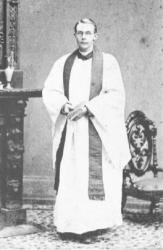
1826 - 1910 Person Name: William Dalrymple Maclagan, 1826 - 1910 Author of "Be still, my soul, for God is near" in Service Book and Hymnal of the Lutheran Church in America Maclagan, William Dalrymple , D.D., son of David Maclagan, M.D., was born in Edinburgh, June 18, 1826. In early life he entered the army, and served for some time in India. Retiring with the rank of lieutenant, he entered St. Peter's College, Cambridge, where he graduated B.A. 1856 and M.A. in 1860. Taking Holy Orders, he was curate of St. Saviour's, Paddington, 1856-58, and St. Stephen's, Marylebone, 1858-60. He then became Secretary to the London Diocesan Church Building Society, from 1860 to 1865; curate of Enfield, 1865-69; Rector of Newington, 1869-75; and Vicar of Kensington, 1875-78. He was also Hon. Chaplain to the Queen, and Prebendary of Reculverland in St. Paul's Cathedral, London. In 1878 he was consecrated Bishop of Lichfield. Bishop Maclagan's work has been mainly of a practical character, and his publications are few. The few hymns which he has written have been received with great favour, and create a desire for more of the same kind and quality. The following are in common use.:— 1. Again the trumpet sounds. Missions. Written about 1870. Appeared in the Hymns Ancient & Modern Hymns Ancient & Modern series of Hymns for Mission Services. 1871. 2. Be still, my soul, for God is near. Holy Communion. Part ii. is “O Body, broken for my sake." Written about 1873 for St. Mary's, Newington. In Thring's Collection, 1882. 3. Holy Spirit, Lord of love. Confirmation. Written about 1873, and published in Mrs. C. Brock's Children's Hymn Book, 1884. 4. It is finished, blessed Jesus [Saviour]. Good Friday. Written for Hymns Ancient & Modern, 1875. In several collections. 5. Lord, when Thy Kingdom comes, remember me. Good Friday. Written for the 1875 ed. of Hymns Ancient & Modern. Sometimes given in two parts: Pt. ii. Beginning, “Lord, when with dying lips my prayer is said." 6. The Saints of God their conflict past. All Saints. First published in Church Bells, 1870; and again in the Society for Promoting Christian Knowledge Church Hymns, 1871. 7. What thanks and praise to Thee we owe. St. Luke. Written for the 1875 edition of Hymns Ancient & Modern These hymns are of more than usual merit, being characterized by great simplicity, tenderness, and fervour. The special season or purpose is clearly indicated, and its lessons earnestly enforced. -- John Julian, Dictionary of Hymnology (1907) ============= Maclagan, Abp. W. D., pp. 709, i.; 1578, ii. At the present time all Abp. Maclagan's hymns are in common use, and most of his tunes likewise. With regard to the latter, it is exceptional to find so many tunes by the author of popular hymns sharing the same popularity in the principal hymnals. In Church Hymnal, 1903, and Hymns Ancient & Modern, 1904, combined, there are eight of his tunes, whilst the hymns are six in all. --John Julian, Dictionary of Hymnology, New Supplement (1907)

Iona Community

Person Name: The Iona Community (Scotland) Author of "O Christ, You Wept When Grief Was Raw" in Common Praise (1998) Iona Community, an ecumenical Christian group of men and women based on the small island of Iona off the coast of Scotland. The community began in 1938 when the Rev. George MacLeod of the Church of Scotland began a ministry among the unemployed poor who had been neglected by the church. He took a handful of men to the island to rebuild the ruins of a thousand-year-old abbey church. That rebuilding became a metaphor for the rebuilding of the common life, a return to the belief that daily activity is the stuff of godly service – work, and worship. The Community has since grown to include a group of members, associates, and friends all over the United Kingdom and many other countries. In addition to many conferences that attract people to Iona from around the world, the Community is known for its publishing of new songs and prayers for worship, both developed in community and gathered from around the world. For more information on the Iona Community, check their website: www.iona.org.uk. John Bell is probably the community’s most well-known member, having composed and arranged much of the community’s music. Sing! A New Creation

William Dressler

1826 - 1914 Person Name: Dessler Transaltor of "I Thirst, Thou Wounded Lamb of God" in Hymns of Consecration and Faith Prof. William Dressler was born in Nottingham, England and his father was at one time court flutiest to the King of Saxony. Mr. Dressler was graduated from the Cologne Conservatory of Music in 1847. Shortly after, he was first violinist of the Opera House in Wiesbaden and then became conductor. He came to this country in the early fifties as solo pianist and accompanist to Ole Bull. After traveling several seasons with concert companies Mr. Dressler settled in New York and devoted himself to teaching, playing in churches and composing. He was a former choirmaster and organist of the Fourth Avenue Presbyterina Church. He played in other churches, among them St. Charles Borromeo’s, St. Peter’s Roman Catholic in Brooklyn, and St. Peter’s iin Jersey City, where he remained for eighteen years . This long term in Catholic churches let him to compose much music for their services and many of his compositions have been used all over the world. Prof. Dressler was for many years musical editor for the old publishing house of William Hall & Son & J. L. Peters. He is survived by three children, all musicians. excerpts from New York Times Obituary, July 3, 1914

Benjamin Beddome

1717 - 1795 Person Name: Benjamin Beddome, 1717-1795 Author of "With Joy, Ye Saints, Direct Your Eyes" in The Cyber Hymnal Benjamin Beddome was born at Henley-in Arden, Warwickshire, January 23, 1717. His father was a Baptist minister. He studied at various places, and began preaching in 1740. He was pastor of a Baptist society at Bourton-on-the-Water, Gloucestershire, until his death in 1795. In 1770, he received the degree of M.A. from the Baptist College in Providence, Rhode Island. He published several discourses and hymns. "His hymns, to the number of 830, were published in 1818, with a recommendation from Robert Hall." Montgomery speaks of him as a "writer worthy of honour both for the quantity and the quality of his hymns." --Annotations of the Hymnal, Charles Hutchins, M.A. 1872. ========================= Beddome, Benjamin , M.A. This prolific hymnwriter was born at Henley-in-Arden, Warwickshire, Jan. 23, 1717, where his father, the Rev. John Beddome, was atthat time Baptist Minister. He was apprenticed to a surgeon in Bristol, but removing to London, he joined, in 1739, the Baptist church in Prescott St. At the call of this church he devoted himself to the work of the Christian ministry, and in 1740 began to preach at Bourton-on-the-Water, in Gloucestershire. Declining invitations to remove to London or elsewhere, he continued pastor at Bourton until his death, on Sep. 3, 1795, at the age of 78. Mr. Beddome was for many years one of the most respected Baptist ministers in the West of England. He was a man of some literary culture. In 1770 he received the degree of M.A. from Providence College, Rhode Island. He was the author of an Exposition of the Baptist Catechism, 1752, in great repute at the time, and reprinted by Dr. C. Evans in 1772. It was his practice to prepare a hymn every week to be sung after his Sunday morning sermon. Though not originally intended for publication, he allowed thirteen of these to appear in the Bristol Baptist Collection of Ash & Evans (1769), and thirty-six in Dr. Rippon's Baptist Selection (1787), whence a number of them found their way into the General Baptist Hymn Book of 1793 and other collections. In 1817, a posthumous collection of his hymns was published, containing 830 pieces, with an introduction by the Rev. Robert Hall, and entitled "Hymns adapted to Public Worship or Family Devotion, now first published from the Manuscripts of the late Rev. B. Beddome, M.A." Preface dated "Leicester, Nov. 10, 1817." Some of the early copies bear the same date on the title page. Copies bearing both the 1817 and 1818 dates are in the British Museum. The date usually given is 1818. Some hymns are also appended to his Sermons, seven volumes of which were published l805—1819; and over twenty are given in the Baptist Register of various dates. Beddome's hymns were commended by Montgomery as embodying one central idea, "always important, often striking, and sometimes ingeniously brought out." Robert Hall's opinion is just, when in his "Recommendatory Preface" to the Hymns, &c, he says, p. vii.:— "The man of taste will be gratified with the beauty and original turns of thought which many of them ex¬hibit, while the experimental Christian will often perceive the most secret movements of his soul strikingly delineated, and sentiments pourtrayed which will find their echo in every heart." With the exception of a few composed for Baptisms and other special occasions, their present use in Great Britain is limited, but in America somewhat extensive. One of the best is the Ordination Hymn, "Father of Mercies, bow Thine ear." Another favourite is “ My times of sorrow and of joy," composed, by a singular coincidence, to be sung on Sunday, Jan. 14, 1778, the day on which his son died, most unexpectedly, in Edinburgh. "Let party names no more," is very popular both in Great Brit, and America. "Faith, His a precious gift," "Witness, ye men and angels, now," and the hymn for Holy Baptism, "Buried beneath the yielding wave," are also found in many collections. Beddome's popularity is, however, now mainly in America. [Rev. W. R. Stevenson, M.A.] Beddome is thus seen to be in common use to the extent of about 100 hymns. In this respect he exceeds every other Baptist hymnwriter; Miss Steele ranking second. The authorities for Beddome's hymns are: (1) A Collection of Hymns adapted to Public Worship, Bristol, W. Pine, 1769, the Collection of Ash & Evans; (2) Dr. Rippon's Selections 1787, and later editions; (3) Sermons printed from the Manuscripts of the late Rev. Benjamin Beddome, M.A.,... with brief Memoir of the Author, Dunstable & Lond., 1805-1819; (4) Dr. Rippon's Baptist Register, 1795, &c.; (5) The Beddome Manuscripts, in the Baptist College, Bristol; (6) and Hymns adapted to Public Worship, or Family Devotion now first published, from Manuscripts of the late Rev. B. Beddome, A.M. With a Recommendatory Preface by the Rev. R. Hall, A.M. Lond., 1817. In his Preface, Mr. Hall gives this account of the Beddome Manuscript:— "The present Editor was entrusted several years ago with the MSS, both in prose and verse, with permission from the late Messrs. S. & B. Beddome, sons of the Author, to publish such parts of them as he might deem proper. He is also indebted to a descendant of the Rev. W. Christian, formerly pastor of the Baptist Church at Sheepshead, Leicestershire, for some of the Author's valuable hymns, which had been carefully preserved in the family. From both these sources, as well as others of less consequence, the present interesting volume has been derived." -- Excerpts from John Julian, Dictionary of Hymnology (1907) ======================= Beddome, Benjamin, pp. 121-124. Other hymns in common use:— 1. Great God, before Thy mercy-seat. (1817). Lent. 2. Great God, oppressed with grief and fear. (1787.) Reading H. Scripture. 3. How glorious is Thy word, 0 God. Holy Scripture. From "When Israel, &c," p. 124, i. 4. In God I ever will rejoice. Morning. From his Hymns, &c, 1817. 5. Jesus, my Lord, divinely fair. (1817.) Jesus the King of Saints. Begins with stanza ii. of “Listen, ye mortals, while I sing." 6. Rejoice, for Christ the Saviour reigns. Missions. Altered form of "Shout, for the blessed, &c," p. 123, ii. 7. Satan, the world, and sin. (1817.) In Temptation. 8. Thou, Lord of all above. (1817.) Lent. 9. Unto Thine altar, Lord. (1787.) Lent. 10. Ye saints of every rank, with joy. (1800.) Public Worship. The dates given above are, 1787 and 1800, Rippon's Selection; and 1817 Beddome's Hymns. --John Julian, Dictionary of Hymnology, Appendix, Part II

Phoebe Cary

1824 - 1871 Person Name: Phoebe Cary, 1824-1871 Author of "I ask not wealth, but power to take" in The Beacon Song and Service book Phoebe Cary, (1824-1871) was born and raised in Mount Healthy in Hamilton County, Ohio. Her family came from Lyme, New Hampshire to Ohio when her grandfather was given land in return for his service in the Continental Army. She was the younger sister of Alice Cary (1820-1871). She and Alice submitted poetry to religious periodicals. Phoebe remained in Ohio and continued to write many hymns, including, "One sweetly solemn thought." Mary Louise VanDyke =========================================== Cary, Phoebe, sister of Alice Cary, born near Cincinnati, Ohio, Sept. 4, 1824, and died within six months of the death of the same sister at Newport, July 31, 1871. Her works include Poems and Parodies, 1854; and Poems of Faith, Hope and Love, 1868. With Dr. Charles F. Deems she compiled Hymns for all Christians, 1869. Her hymns are:— 1. One sweetly solemn thought. Anticipation of Heaven. This piece was not intended for public use, nor is it a suitable metre for musical treatment, yet it has won universal acceptance and popularity. In some instances this has been attained by change of metre as in the Supplement to the Baptist Psalms & Hymns 1880, No. 1185. Johnson's Encyclopedia is in error in saying it was "written at the age of 17." The Congregational Quarterly for Oct., 1874, says, "it was written, she tells us, in the little back third story bedroom, one Sabbath morning in 1852, on her return from church." This statement shows that it was composed when she was 28, and not 17. The popularity of the hymn in Great Britain arose mainly through its use in the Evangelistic services of Messrs. Moody and Sankey. In the Protestant Episcopal Hymns for Church and Home, Phila., 1860, No. 383, it is given as "A sweetly solemn thought." The following additional pieces by this author are in the Lyra Sacra Americana, 1868:— 2. Go and sow beside all waters. Seed Sowing. 3. Great waves of plenty rolling up. Gratitude. 4. I had drunk, with lips unsated. Living Waters. [Rev. F. M. Bird, M.A.] --John Julian, Dictionary of Hymnology (1907)

Fred Pratt Green

1903 - 2000 Person Name: Frederick Pratt Green (1903-2000) Author of "O Christ, the healer, we have come" in Church Hymnary (4th ed.) The name of the Rev. F. Pratt Green is one of the best-known of the contemporary school of hymnwriters in the British Isles. His name and writings appear in practically every new hymnal and "hymn supplement" wherever English is spoken and sung. And now they are appearing in American hymnals, poetry magazines, and anthologies. Mr. Green was born in Liverpool, England, in 1903. Ordained in the British Methodist ministry, he has been pastor and district superintendent in Brighton and York, and now served in Norwich. There he continued to write new hymns "that fill the gap between the hymns of the first part of this century and the 'far-out' compositions that have crowded into some churches in the last decade or more." --Seven New Hymns of Hope , 1971. Used by permission.

Frank Mason North

1850 - 1935 Author of "Christ in the City" in The Pilgrim Hymnal North, Frank Mason, D.D., b. at New York, Dec. 3, 1850, graduated at Wesleyan University 1872, and entered the ministry of the Methodist Episcopal Church 1872. In 1892 he became Correspondence Secretary of the New York City Church Extension and Missionary Society, and is now (1905) editor of The Christian City. His hymns in common use include:— 1. Jesus, the calm that fills my breast. [Peace.] In The Plymouth Hymnal,1894; Sursum Corda, 1898; The Methodist Hymnal, 1905, &c. 2. When cross the crowded ways of life. [City Missions.] In The Methodist Hymnal, 1905. [Rev. L. F. Benson, D.D.] --John Julian, Dictionary of Hymnology, New Supplement (1907) ================= North, Frank Mason, D.D. (December 3, 1850--December 17, 1935). The Appendix Index reference, p.1607 in Julian, to Dr. North is to John Post Attwater who used "Frank North" as his nom de plume. In addition to the information included in the short biographical sketch at p.1677 it should be added that Dr. North continued his studies at Wesleyan University, advancing to the M.A. degree in 1875, later being honored by that institution's D.D., 1894, and L.L.D., 1918. He was a member of the New York East Conference of the Methodist Episcopal Church and served several pastorates in New York State and City as well as one at Middletown, Connecticut, 1887-1892. During the years 1892-1912, while Corresponding Secretary of the New York City Extension and Missionary Society and the editor of The Christian City, he was also Corresponding Secretary of the National City Evangelical Union of the Methodist Episcopal Church. From 1912 to 1924 he was the Secretary of the Board of Foreign Missions of his church and through these years he served as Chairman of its Executive Committee. He was also Secretary, Chairman of the Executive Committee, and President of the Federal Council of the Churches of Christ in America. It was largely through his efforts and influence that the Federal Council was organized. Trustee and member of governing boards of numerous institutions in the United States, China, and Japan, among the additional honors which came to him were Chevalier Legion of Honor and "Officer de l'Instruction Publique," France; Officer of the Royal Order of George I, Greece. He was one of the great Protestant leaders of his generation. The leading article in The Hymn, 30 April 1950, was an excellent appreciation of Dr. North and his work. Sources: Handbooks of various hymnals; Who Was Who I; Foote, Henry Wilder, Three Centuries of American Hymnody; Ninde, Edward S., Story of the American Hymn; Bailey, ALbert E., The Gospel in Hymns; Pratt, John Barnes, Present Day Hymns; correspondence. --Robert G. McCutchan, DNAH Archives

Charles William Everest

1814 - 1877 Person Name: Rev. Charles William Everest (1814-1877) Author of "Take up thy cross, the Saviour said" in Carmina Sanctorum Everest, Charles William, M.A., born at East Windsor, Connecticut, May 27, 1814, graduated at Trinity College, Hartford, 1838, and took Holy Orders in 1842. He was rector at Hamden, Connecticut, from 1842 to 1873, and also agent for the Society for the Increase of the Ministry. He died at Waterbury, Connecticut, Jan. 11, 1877 (See Poets of Connecticut, 1843). In 1833 he published Visions of Death, and Other Poems; from this work his popular hymn is taken:— Take up thy cross, the Saviour said. Following Jesus. The original text of this hymn differs very materially from that which is usually found in the hymn-books. The most widely known form of the text is that in Hymns Ancient & Modern, where it appeared in 1861. It was copied by the Compilers from another collection, but by whom the alterations were made is unknown. The nearest approach to the original is in Horder's Congregational Hymn Book, 1884. Original text in Biggs's English Hymnology, 1873, p. 24. [Rev. F. M. Bird, M.A.] -- John Julian, Dictionary of Hymnology (1907)

Henry Twells

1823 - 1900 Person Name: H. Twells (1823-1900) Author of "At evening, when the sun had set" in Hymns for Today's Church (2nd ed.) Twells, Henry, M.A., was born in 1823, and educated at St. Peter's College, Cambridge. B.A. 1848, M.A. 1851. Taking Holy Orders in 1849, he was successively Curate of Great Berkhamsted, 1849-51; Sub-Vicar of Stratford-on-Avon, 1851-54; Master of St. Andrew's House School, Mells, Somerset, 1854-56; and Head Master of Godolphin School, Hammersmith, 1856-70. In 1870 he was preferred to the Rectory of Baldock, Herts, and in 1871 to that of Waltham-on-the Wolds. He was Select Preacher at Cambridge in 1873-74, and became an Honorary Canon of Peterborough Cathedral in 1884. Canon Twells is best known by his beautiful evening hymn, "At even ere the sun was set." He also contributed the following hymns to the 1889 Supplemental Hymns to Hymns Ancient & Modern:— 1. Glorious is Thy Name, O Lord. The Name of God. 2. Know ye the Lord hath borne away? Ascension. 3. Not for our sins alone. Plea for Divine Mercy. 4. The voice of God's Creation found me. The Word of God a Light. -- John Julian, Dictionary of Hymnology (1907) ================== Twells, H., p. 1189, i. Canon Twells was born on March 13, 1823, at Ashted, Birmingham, and died at Bournemouth, Jan. 19, 1900. His Memoir, by W. Clavell Ingram, D.D., was published in 1901. His Hymns and other Stray Verses, appeared in 1901i. From it the following additional hymns have come into common use:— 1. Spirit of Truth and Might, 'Tis Thou alone can teach. [Our Words.] On "The Responsibility of Speech," p. 26. In the Sunday School Hymnary, 1905. 2. The day of Pentecost is fully come. [Whitsuntide.] Usually the second stanza is taken as the opening of this hymn. In this form it is given as "Awake, 0 Lord, as in the days of old," in Hymns Ancient & Modern, 1904, the Sunday School Hymnary, 1905, and other collections. --John Julian, Dictionary of Hymnology, New Supplement (1907)

Pages


Export as CSV
It looks like you are using an ad-blocker. Ad revenue helps keep us running. Please consider white-listing Hymnary.org or getting Hymnary Pro to eliminate ads entirely and help support Hymnary.org.