

 My Starred Hymns
 My FlexScores
 My Hymnals
 My Purchased Files
Planning worship?
Check out our sister site, ZeteoSearch.org,
for 20+ additional resources related to your search.
- |
User Links
Person Results
Richard Frederick Littledale
1833 - 1890 Person Name: Richard F. Littledale Author of "Eternal Shepherd, God most high" in Hymni Ecclesiae Richard Frederick Littledale (b. Dublin, 1833; d. London, 1890) entered Trinity College, Dublin, as a foundation scholar, graduated with a bachelors degree in classics, a Masters of Divinity in 1858, then a Bachelors and Doctorate in Civil Law at Oxford in 1862. From 1856 to 1857 he was the curate of St. Matthew in Thorpe Hamlet, Norfolk, and from 1857 to 1861 was the curate of St. Mary the Virgin, in Soho, London. For the remainder of his life he suffered from chronic illness and spent most of his time writing. He authored many books and pamphlets on Anglican liturgy, theology, and the church’s engagement with society, and completed his good friend John Mason Neale’s work on the psalms after Neale died in 1866.
Laura de Jong
================
Littledale, Richard Frederick, LL.D., D.C.L., son of John Richard Littledale, merchant, was born at Dublin on the 14th of Sept, 1833, and was educated at Bective House Seminary, and Trinity College, Dublin. His University course was distinguished. In 1852 he became a University Scholar; in 1854 he was first class in Classics and gold medallist; in 1856 he won the Berkeley gold medal (for Greek), and other honours. He graduated B.A., 1855, M.A., 1858, LL.D., 1862, and D.C.L. at Oxford, 1862. Taking Holy Orders in 1856, he was Curate of St. Matthew's, in Thorpe Hamlet, Norwich, from 1856 to 1857, and of St. Mary the Virgin, Soho, London, from 1857 to 1861. Through ill-health he retired from parochial work in 1861, and devoted himself to literature. Dr. Littledale's publications amount to about fifty in all, and embrace Theological, Historical, Liturgical, and Hymnological subjects chiefly. His prose works include:—
(1) Application of Colour to the Decoration of Churches, 1857; (2) Religious Communities of Women in the Early Church, 1862; (3) Catholic Ritual in the Church of England, 1861; (4) Continuation of Dr. Neale's Commentary on the Psalms, vols. ii., iii., iv., 1868-74; (5) Commentary on the Song of Songs, 1869; (6) The Petrine Claims, 1878-84; (7) Plain Reasons against joining the Church of Rome, 1880, &c.; (8) Short History of the Council of Trent; and several articles in the Encyclopaedia Britannica, 1882-88. His contributions to periodical literature have been also extensive and valuable.
Dr. Littledale's Liturgical, Devotional, and Hymnological works include:—
(1) Offices of the Holy Eastern Church, in the Original Greek, with translation into English, Notes, &c, 1863; (2) Carols for Christmas and Other Seasons, 1863; (3)The Priest's Prayer Book, with hymns, 1864, and with Brief Pontifical in 1870 and later editions; (4)The People's Hymnal, 1867 ; (5) The Children's Bread. A Communion Office for the Young, with hymns, 1868; (6) Primitive Liturgies and Translations, 1868-69; (7) Children at Calvary: being The Stations of the Cross in Metre for Singing, 1872; (8) the Christian Passover, 1873; (9) The Altar Manual, 1863-77. He was joint Editor of Nos. 3, 4, 8 and 9 with the Rev. J. E. Vaux; and of No. 6 with Dr. Neale.
In addition to a large number of hymns, original and translated, in the above works, Dr. Littledale has also directly contributed original and translated hymns to:—
(1) Lyra Eucharistica, 1863; (2) Lyra Messianica, 1864; (3) Lyra Mystica, 1865; (4) The Eucharistic Hymnal, 1877; (5) The Roman Breviary in English, by the Marquess of Bute, 1879; (6) The Altar Hymnal, 1884; (7) Supplement to Hymns Ancient & Modern, 1889; (8) to the Night Hours of the Church; (9) to the St. Margaret's Hymnal [East Grinstead], 1875; and (10) to the Church Times, The Guardian, &c, &c.
Dr. Littledale's Hymnological works in verse consist of translations of Danish, Swedish, Greek, Latin, Syriac, German, and Italian hymns, together with original Carols, Hymns, and Metrical Litanies. His original hymns remain to be noted. These include the following:—
i. In the Priest's Prayer Book, 1864 :—
1. Captain of Salvation. Christian Warfare.
2. Christ, on Whose Face the soldiers. Passiontide.
3. Christ, Who hast for sinners suffered. Passiontide.
4. God the Father, from on high. For the Sick.
5. Lord Jesu, by Thy passion. Passiontide.
6. Lord, Who in pain and weariness. Passiontide.
7. 0 Jesu, in Thy torture. Passiontide. In Meditations and Prayers on the Passion of Our Lord Jesus Christ, 1863.
8. 0 Lord, to Whom the spirits live. All Souls.
9. The clouds of sorrow rest upon mine eyes. For the Sorrowing.
ii. In the People's Hymnal, 1867:—
10. Christ, our song we lift to Thee. Blessed Virgin Mary.
11. Christ, our Sun, on us arose. Whitsuntide. In Carols for Christmas, &c, 3rd series, 1864.
12. Christ, the Lord, Whose mighty hand. Prayer for Peace.
13. Day is past and gone. Evening. In the Church Times, Feb. 17, 1866.
14. Eternal Shepherd, God most high. Vacancy of a See or Parish.
15. Eternal Wisdom, God most high. Common of Doctors.
16. God eternal, infinite. Septuagesima.
17. Hidden Saviour, great High Priest. Holy Communion.
18. I believe in God the Father. The Creed.
19. I worship Thee, Lord Jesu. Holy Communion. In the Church Times, May 10, 1865.
20. In Paradise reposing. Burial of a Child.
21. In songs of glad thanksgiving. General Thanksgiving.
22. Lord, Whose goodwill is ever sure. In time of Famine.
23. Now the sun is in the skies. Morning. In the Church Times, Jan. 27, 1866.
24. 0 God of mercy, God of love. For Rain.
25. 0 God, Who metest in Thine hand. For those at Sea.
26. 0 God, Whose Sole-Begotten left. Almsgiving.
27. 0 sing to the Lord, Whose bountiful hand. Thanksgiving for Rain.
28. Set upon Sion's wall. Ember Days.
29. The Cedar of Lebanon, Plant of renown. Christmas. First published in Sedding's Christmas Carols, 1863.
30. The fight is o'er, the crown is won. Burial of a Sister of Mercy.
31. The wintry time hath ended. Thanksgiving for Fair Weather.
32. We are marching through the desert. Processional.
33. When the day hath come at last. The Judgment.
In addition to these, a few of the more widely used of Dr. Littledale's original hymns, as "From hidden source arising," and others, are annotated under their respective first lines. In the People's Hymnal, 1867, Dr. Littledale adopted the following signatures:—
A. L. P., i.e., A London Priest.
B., i.e., An initial of a former address.
B. T., i.e., The initials of a former address.
D. L., i.e. Dr. Littledale.
F., i.e., Frederick.
F. R., i.e., Frederick Richard.
L., i.e., Littledale.
P. C. E., i.e., Priest of the Church of England.
P. P. Bk., i.e., Priest's Prayer Book.
Taken as a whole, Dr. Littledale's translations from the seven languages named above are characterised by general faithfulness to the originals, great simplicity of diction, good metre, smooth rhythm, and deep earnestness. His original compositions are usually on special subjects, for which, at th$ time they were written, there were few hymns, and are marked by the same excellent features of a good hymn as his translations. His main object throughout is to teach through Praise and Prayer.
--John Julian, Dictionary of Hymnology (1907)
======================
Littledale, Richard F., p. 679, ii. He died at Red Lion Square, London, Jan. 11, 1890.
--John Julian, Dictionary of Hymnology, Appendix, Part II (1907)
Richard Frederick Littledale
Catherine Winkworth
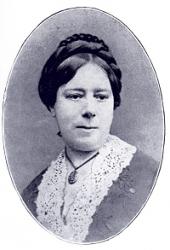
1827 - 1878 Translator of "Lord Jesus Christ, My Life, My Light" in The A.M.E. Zion Hymnal Catherine Winkworth (b. Holborn, London, England, 1827; d. Monnetier, Savoy, France, 1878) is well known for her English translations of German hymns; her translations were polished and yet remained close to the original. Educated initially by her mother, she lived with relatives in Dresden, Germany, in 1845, where she acquired her knowledge of German and interest in German hymnody. After residing near Manchester until 1862, she moved to Clifton, near Bristol. A pioneer in promoting women's rights, Winkworth put much of her energy into the encouragement of higher education for women. She translated a large number of German hymn texts from hymnals owned by a friend, Baron Bunsen. Though often altered, these translations continue to be used in many modern hymnals. Her work was published in two series of Lyra Germanica (1855, 1858) and in The Chorale Book for England (1863), which included the appropriate German tune with each text as provided by Sterndale Bennett and Otto Goldschmidt. Winkworth also translated biographies of German Christians who promoted ministries to the poor and sick and compiled a handbook of biographies of German hymn authors, Christian Singers of Germany (1869).
Bert Polman
========================
Winkworth, Catherine, daughter of Henry Winkworth, of Alderley Edge, Cheshire, was born in London, Sep. 13, 1829. Most of her early life was spent in the neighbourhood of Manchester. Subsequently she removed with the family to Clifton, near Bristol. She died suddenly of heart disease, at Monnetier, in Savoy, in July, 1878. Miss Winkworth published:—
Translations from the German of the Life of Pastor Fliedner, the Founder of the Sisterhood of Protestant Deaconesses at Kaiserworth, 1861; and of the Life of Amelia Sieveking, 1863.
Her sympathy with practical efforts for the benefit of women, and with a pure devotional life, as seen in these translations, received from her the most practical illustration possible in the deep and active interest which she took in educational work in connection with the Clifton Association for the Higher Education of Women, and kindred societies there and elsewhere. Our interest, however, is mainly centred in her hymnological work as embodied in her:—
(1) Lyra Germanica, 1st Ser., 1855. (2) Lyra Germanica, 2nd Ser., 1858. (3) The Chorale Book for England (containing translations from the German, together with music), 1863; and (4) her charming biographical work, the Christian Singers of Germany, 1869.
In a sympathetic article on Miss Winkworth in the Inquirer of July 20, 1878, Dr. Martineau says:—
"The translations contained in these volumes are invariably faithful, and for the most part both terse and delicate; and an admirable art is applied to the management of complex and difficult versification. They have not quite the fire of John Wesley's versions of Moravian hymns, or the wonderful fusion and reproduction of thought which may be found in Coleridge. But if less flowing they are more conscientious than either, and attain a result as poetical as severe exactitude admits, being only a little short of ‘native music'"
Dr. Percival, then Principal of Clifton College, also wrote concerning her (in the Bristol Times and Mirror), in July, 1878:—
"She was a person of remarkable intellectual and social gifts, and very unusual attainments; but what specially distinguished her was her combination of rare ability and great knowledge with a certain tender and sympathetic refinement which constitutes the special charm of the true womanly character."
Dr. Martineau (as above) says her religious life afforded "a happy example of the piety which the Church of England discipline may implant.....The fast hold she retained of her discipleship of Christ was no example of ‘feminine simplicity,' carrying on the childish mind into maturer years, but the clear allegiance of a firm mind, familiar with the pretensions of non-Christian schools, well able to test them, and undiverted by them from her first love."
Miss Winkworth, although not the earliest of modern translators from the German into English, is certainly the foremost in rank and popularity. Her translations are the most widely used of any from that language, and have had more to do with the modern revival of the English use of German hymns than the versions of any other writer.
-- John Julian, Dictionary of Hymnology (1907)
============================
See also in:
Hymn Writers of the Church
Catherine Winkworth
Charles Wesley
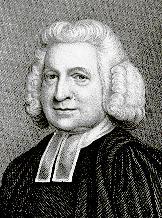
1707 - 1788 Author of "O Jesus, full of truth and grace" in The Wesleyan Methodist Hymnal Charles Wesley, M.A. was the great hymn-writer of the Wesley family, perhaps, taking quantity and quality into consideration, the great hymn-writer of all ages. Charles Wesley was the youngest son and 18th child of Samuel and Susanna Wesley, and was born at Epworth Rectory, Dec. 18, 1707. In 1716 he went to Westminster School, being provided with a home and board by his elder brother Samuel, then usher at the school, until 1721, when he was elected King's Scholar, and as such received his board and education free. In 1726 Charles Wesley was elected to a Westminster studentship at Christ Church, Oxford, where he took his degree in 1729, and became a college tutor. In the early part of the same year his religious impressions were much deepened, and he became one of the first band of "Oxford Methodists."
In 1735 he went with his brother John to Georgia, as secretary to General Oglethorpe, having before he set out received Deacon's and Priest's Orders on two successive Sundays. His stay in Georgia was very short; he returned to England in 1736, and in 1737 came under the influence of Count Zinzendorf and the Moravians, especially of that remarkable man who had so large a share in moulding John Wesley's career, Peter Bonier, and also of a Mr. Bray, a brazier in Little Britain. On Whitsunday, 1737, [sic. 1738] he "found rest to his soul," and in 1738 he became curate to his friend, Mr. Stonehouse, Vicar of Islington, but the opposition of the churchwardens was so great that the Vicar consented that he "should preach in his church no more." Henceforth his work was identified with that of his brother John, and he became an indefatigable itinerant and field preacher. On April 8, 1749, he married Miss Sarah Gwynne. His marriage, unlike that of his brother John, was a most happy one; his wife was accustomed to accompany him on his evangelistic journeys, which were as frequent as ever until the year 1756," when he ceased to itinerate, and mainly devoted himself to the care of the Societies in London and Bristol. Bristol was his headquarters until 1771, when he removed with his family to London, and, besides attending to the Societies, devoted himself much, as he had done in his youth, to the spiritual care of prisoners in Newgate. He had long been troubled about the relations of Methodism to the Church of England, and strongly disapproved of his brother John's "ordinations." Wesley-like, he expressed his disapproval in the most outspoken fashion, but, as in the case of Samuel at an earlier period, the differences between the brothers never led to a breach of friendship. He died in London, March 29, 1788, and was buried in Marylebone churchyard. His brother John was deeply grieved because he would not consent to be interred in the burial-ground of the City Road Chapel, where he had prepared a grave for himself, but Charles said, "I have lived, and I die, in the Communion of the Church of England, and I will be buried in the yard of my parish church." Eight clergymen of the Church of England bore his pall. He had a large family, four of whom survived him; three sons, who all became distinguished in the musical world, and one daughter, who inherited some of her father's poetical genius. The widow and orphans were treated with the greatest kindness and generosity by John Wesley.
As a hymn-writer Charles Wesley was unique. He is said to have written no less than 6500 hymns, and though, of course, in so vast a number some are of unequal merit, it is perfectly marvellous how many there are which rise to the highest degree of excellence. His feelings on every occasion of importance, whether private or public, found their best expression in a hymn. His own conversion, his own marriage, the earthquake panic, the rumours of an invasion from France, the defeat of Prince Charles Edward at Culloden, the Gordon riots, every Festival of the Christian Church, every doctrine of the Christian Faith, striking scenes in Scripture history, striking scenes which came within his own view, the deaths of friends as they passed away, one by one, before him, all furnished occasions for the exercise of his divine gift. Nor must we forget his hymns for little children, a branch of sacred poetry in which the mantle of Dr. Watts seems to have fallen upon him. It would be simply impossible within our space to enumerate even those of the hymns which have become really classical. The saying that a really good hymn is as rare an appearance as that of a comet is falsified by the work of Charles Wesley; for hymns, which are really good in every respect, flowed from his pen in quick succession, and death alone stopped the course of the perennial stream.
It has been the common practice, however for a hundred years or more to ascribe all translations from the German to John Wesley, as he only of the two brothers knew that language; and to assign to Charles Wesley all the original hymns except such as are traceable to John Wesley through his Journals and other works.
The list of 482 original hymns by John and Charles Wesley listed in this Dictionary of Hymnology have formed an important part of Methodist hymnody and show the enormous influence of the Wesleys on the English hymnody of the nineteenth century.
-- Excerpts from John Julian, Dictionary of Hymnology (1907)
==================
Charles Wesley, the son of Samuel Wesley, was born at Epworth, Dec. 18, 1707. He was educated at Westminster School and afterwards at Christ Church, Oxford, where he graduated M.A. In 1735, he took Orders and immediately proceeded with his brother John to Georgia, both being employed as missionaries of the S.P.G. He returned to England in 1736. For many years he engaged with his brother in preaching the Gospel. He died March 29, 1788. To Charles Wesley has been justly assigned the appellation of the "Bard of Methodism." His prominence in hymn writing may be judged from the fact that in the "Wesleyan Hymn Book," 623 of the 770 hymns were written by him; and he published more than thirty poetical works, written either by himself alone, or in conjunction with his brother. The number of his separate hymns is at least five thousand.
--Annotations of the Hymnal, Charles Hutchins, M.A., 1872.
Charles Wesley
George Rawson
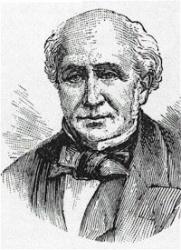
1807 - 1889 Author of "By Christ redeemed, in Christ restored" in The Smaller Hymnal Born: June 5, 1807, Leeds, England.
Died: March 25, 1889, Clifton, England.
Buried: Arno’s Vale Cemetery, Bristol, England.
Pseudonym: A Leeds Layman.
Rawson, George, was born June 5, 1807, at Leeds, in which town he practised for many years as a solicitor. In 1853 he assisted the Congregational ministers of Leeds in the compilation of Psalms, Hymns, and Passages of Scripture for Christian Worship, a volume commonly known as the Leeds Hymn-book. Mr. Rawson was a member of the Congregational body. In 1858 he also assisted Rev. Dr. Green and other Baptist ministers in the preparation of Psalms and Hymns for the use of the Baptist Denomination. A number of Mr. Rawson's own compositions first appeared in this and in the Leeds Hymn-book In 1876 he published his Hymns, Verses and Chants (Hodder and Stoughton, London), including his previously published hymns, and containing (exclusive of chants) 80 original pieces. In 1885 most of these, with several additional hymns, were published by the R. T. S. under the title Songs of Spiritual Thought. Mr. Rawson died March 25, 1889.
His hymns are distinguished by refinement of thought, and delicacy and propriety of language; and if they do not attain the first rank among the songs of the Christian Church, many are of great excellence. The most widely known are, "By Christ redeemed, in Christ restored;" "Come to our poor nature's night;" "Father in high heaven dwelling;" "In the dark and cloudy day;" and "Reaper, behold the fields are white." In the Leeds Hymn-book, 1853, and the Baptist Psalms & Hymns, 1858, there are also several recasts of and additions to the hymns of other writers. In addition to Mr. Rawson's hymns which are annotated under their respective first lines, the following are also in common use:-
i. From the Leeds Hymn-book, 1853.
1. Captain and Saviour of the host. Burial.
2. Give dust to dust: and here we leave. Burial.
3. God the Lord is King-—before him. Ps. xcix.
4. In the dark and cloudy day. Consolation.
5. Soul, thy week of toil is ended. Saturday Evening.
6. Though the night be very long. Resignation.
ii. From the Baptist Psalms & Hymns, 1858.
7. Beautiful, desired, and dear. Public Worship.
8. Blessed are they who have not seen. Faith.
9. Blessed is the faithful heart. Faithfulness.
10. Christ to heaven is gone before. Ascension.
11. God the Father, be Thou near. Evening.
12. He fell asleep in Christ the Lord. Burial.
13. Immersed beneath the closing wave. Holy Baptism.
14. Lord, we bless Thee, Who hast given. Holy Communion.
15. My Father God, with filial awe. Abiding in God.
16. Our eyes we lift up to the hills. The Lord the Pastor's Keeper.
17. Reaper, behold the fields are ripe [white] . Missions.
18. Rise, heart, thy Lord arose. Sunday.
19. Upon the holy mountains high. Security of the Church.
iii. From the Leeds Sunday School Hymn Book, 1858.
20. And will [How shall] the mighty God. The Holy Ghost.
21. Jesus, the Lord, our Righteousness. Jesus, the children's Friend.
22. O Thou Good Shepherd. The Good Shepherd.
iv. From Dr. Allon's Supplemental Hymns, 1868.
23. My Father, it is good for me. Trust.
24. Thou Who hast known the careworn breast. Evening.
25. Walking with Thee, my God. Walking with God.
v. From Mr. Rawson's Hymns, Verses, &c. 1876.
26. God is our Refuge; God our Strength. Ps. xlvi.
27. Lo, a voice from heaven hath said. Burial.
28. Lord, let me pray. I know not how. The Holy Spirit desired.
29. O pallid, gentle, grief-worn face. Easter Eve.
30. Out of the depths, the gulfs, the night. Ps. cxxx.
31. This, the old world's day of rest. Saturday Evening. [1854-7.]
32. Thou who Thyself didst sanctify. Ordination. [1854-7.]
33. Voices of the deep blue night. The Heavenly Call.
34. With gladness we worship. Public Worship.
Mr. Rawson is represented by about 50 hymns in the collections of the present day. It must be noted that in the Hymns, &c, 1876, and in the Songs, &c, 1885, the texts of the hymns have been revised, and in several instances been weakened thereby. [Rev.W. R. Stevenson, M.A.]
--John Julian, Dictionary of Hymnology (1907)
================
Rawson, George, p. 952, i. Additional hymns by this author in common use include:—
1. Come, Spirit of the Lord. From his “How shall the mighty God," in his Hymns, Verses, &c, 1876, No. 43.
2. Each trial hath a gentle voice. Patience and Hope. In the 1880 Supplement to the Baptist Psalms and Hymns. This is dated 1857. It is not in the author's Hymns, 1876.
3. Stand up before your God. All Saints. In the 1880 Baptist Psalms and Hymns this is dated 1865. It is not in Rawson's Hymns, 1876.
--John Julian, Dictionary of Hymnology, Appendix, Part II (1907)
George Rawson
Reginald Heber

1783 - 1826 Person Name: Reginald Heber, 1783-1826 Author of "O Thou, Who Gav'st Thy Servant Grace" in The Cyber Hymnal Reginald Heber was born in 1783 into a wealthy, educated family. He was a bright youth, translating a Latin classic into English verse by the time he was seven, entering Oxford at 17, and winning two awards for his poetry during his time there. After his graduation he became rector of his father's church in the village of Hodnet near Shrewsbury in the west of England where he remained for 16 years. He was appointed Bishop of Calcutta in 1823 and worked tirelessly for three years until the weather and travel took its toll on his health and he died of a stroke. Most of his 57 hymns, which include "Holy, Holy, Holy," are still in use today.
-- Greg Scheer, 1995
====================
Heber, Reginald, D.D. Born at Malpas, April 21, 1783, educated at Brasenose College, Oxford; Vicar of Hodnet, 1807; Bishop of Calcutta, 1823; died at Trichinopoly, India, April 3, 1826. The gift of versification shewed itself in Heber's childhood; and his Newdigate prize poem Palestine, which was read to Scott at breakfast in his rooms at Brazenose, Oxford, and owed one of its most striking passages to Scott's suggestion, is almost the only prize poem that has won a permanent place in poetical literature. His sixteen years at Hodnet, where he held a halfway position between a parson and a squire, were marked not only by his devoted care of his people, as a parish priest, but by literary work. He was the friend of Milman, Gifford, Southey, and others, in the world of letters, endeared to them by his candour, gentleness, "salient playfulness," as well as learning and culture. He was on the original staff of The Quarterly Review; Bampton Lecturer (1815); and Preacher at Lincoln's Inn (1822). His edition of Jeremy Taylor is still the classic edition. During this portion of his life he had often had a lurking fondness for India, had traced on the map Indian journeys, and had been tempted to wish himself Bishop of Calcutta. When he was forty years old the literary life was closed by his call to the Episcopate. No memory of Indian annals is holier than that of the three years of ceaseless travel, splendid administration, and saintly enthusiasm, of his tenure of the see of Calcutta. He ordained the first Christian native—Christian David. His first visitation ranged through Bengal, Bombay, and Ceylon; and at Delhi and Lucknow he was prostrated with fever. His second visitation took him through the scenes of Schwartz's labours in Madras Presidency to Trichinopoly, where on April 3,1826, he confirmed forty-two persons, and he was deeply moved by the impression of the struggling mission, so much so that “he showed no appearance of bodily exhaus¬tion." On his return from the service
”He retired into his own room, and according to his invariable custom, wrote on the back of the address on Confirmation 'Trichinopoly, April 3, 1826.' This was his last act, for immediately on taking off his clothes, he went into a large cold bath, where he had bathed the two preceding mornings, but which was now the destined agent of his removal to Paradise. Half an hour after, his servant, alarmed at his long absence, entered the room and found him a lifeless corpse." Life, &c, 1830, vol. ii. p. 437.
Heber's hymns were all written during the Hodnet period. Even the great missionary hymn, "From Greenland's icy mountains," notwithstanding the Indian allusions ("India's coral strand," "Ceylon's isle"), was written before he received the offer of Calcutta. The touching funeral hymn, "Thou art gone to the grave," was written on the loss of his first babe, which was a deep grief to him. Some of the hymns were published (1811-16) in the Christian Observer, the rest were not published till after his death. They formed part of a ms. collection made for Hodnet (but not published), which contained, besides a few hymns from older and special sources, contributions by Milman. The first idea of the collection appears in a letter in 1809 asking for a copy of the Olney Hymns, which he "admired very much." The plan was to compose hymns connected with the Epistles and Gospels, to be sung after the Nicene Creed. He was the first to publish sermons on the Sunday services (1822), and a writer in The Guardian has pointed out that these efforts of Heber were the germs of the now familiar practice, developed through the Christian Year (perhaps following Ken's Hymns on the Festivals), and by Augustus Hare, of welding together sermon, hymnal, and liturgy. Heber tried to obtain from Archbishop Manners Sutton and the Bishop of London (1820) authorization of his ms. collection of hymns by the Church, enlarging on the "powerful engine" which hymns were among Dissenters, and the irregular use of them in the church, which it was impossible to suppress, and better to regulate. The authorization was not granted. The lyric spirit of Scott and Byron passed into our hymns in Heber's verse; imparting a fuller rhythm to the older measures, as illustrated by "Oh, Saviour, is Thy promise fled," or the martial hymn, "The Son of God goes forth to war;" pressing into sacred service the freer rhythms of contemporary poetry (e.g. "Brightest and best of the sons of the morning"; "God that madest earth and heaven"); and aiming at consistent grace of literary expression.. Their beauties and faults spring from this modern spirit. They have not the scriptural strength of our best early hymns, nor the dogmatic force of the best Latin ones. They are too flowing and florid, and the conditions of hymn composition are not sufficiently understood. But as pure and graceful devotional poetry, always true and reverent, they are an unfailing pleasure. The finest of them is that majestic anthem, founded on the rhythm of the English Bible, "Holy, Holy, Holy, Lord God Almighty." The greatest evidence of Heber's popularity as a hymnwriter, and his refined taste as a compiler, is found in the fact that the total contents of his ms. collection which were given in his posthumous Hymns written and adapted to the Weekly Church Service of the Year. London, J. Murray, 1827; which included 57 hymns by Heber, 12 by Milman, and 29 by other writers, are in common in Great Britain and America at the present time. [Rev. H. Leigh Bennett, M.A.]
Of Bishop Heber's hymns, about one half are annotated under their respective first lines. Those given below were published in Heber's posthumous Hymns, &c, 1827. Some of them are in extensive use in Great Britain and America; but as they possess no special histories they are grouped together as from the Hymns, &c, 1827:—
1. Beneath our feet, and o'er our head. Burial.
2. Creator of the rolling flood. St. Peter's Day, or, Gospel for 6th Sunday after Trinity.
3. Lo, the lilies of the field. Teachings of Nature: or, Gospel for 15th Sunday after Trinity.
4. 0 God, by Whom the seed is given. Sexagesima.
6. 0 God, my sins are manifold. Forgiveness, or,
Gospel for 22nd S. after Trinity.
6. 0 hand of bounty, largely spread. Water into Wine, or, Gospel for 2nd S. after Epiphany.
7. 0 King of earth, and air, and sea. Feeding the Multitude; or, Gospel for 4th S. in Lent.
8. 0 more than merciful, Whose bounty gave. Good Friday.
9. 0 most merciful! 0 most bountiful. Introit Holy Communion.
10. 0 Thou, Whom neither time nor space. God unsearchable, or, Gospel for 5th Sunday in Lent.
11. 0 weep not o'er thy children's tomb. Innocents Day.
12. Room for the proud! Ye sons of clay. Dives and Lazarus, or, Gospel for 1st Sunday after Trinity.
13. Sit thou on my right hand, my Son, saith the Lord. Ascension.
14. Spirit of truth, on this thy day. Whit-Sunday.
15. The feeble pulse, the gasping breath. Burial, or, Gospel for 1st S. after Trinity.
16. The God of glory walks His round. Septuagesima, or, the Labourers in the Marketplace.
17. The sound of war in earth and air. Wrestling against Principalities and Powers, or, Epistle for 2lst Sunday after Trinity.
18. The world is grown old, her pleasures are past. Advent; or, Epistle for 4th Sunday in Advent.
19. There was joy in heaven. The Lost Sheep; or, Gospel for 3rd S. after Trinity.
20. Though sorrows rise and dangers roll. St. James's Day.
21. To conquer and to save, the Son of God. Christ the Conqueror.
22. Virgin-born, we bow before Thee. The Virgin Mary. Blessed amongst women, or, Gospel for 3rd S. in Lent.
23. Wake not, 0 mother, sounds of lamentation. Raising the Widow's Son, or, Gospel for 16th S. after Trinity.
24. When on her Maker's bosom. Holy Matrimony, or, Gospel for 2nd S. after Epiphany.
25. When through the torn sail the wild tempest is streaming. Stilling the Sea, or, Gospel for 4th Sunday after Epiphany.
26. Who yonder on the desert heath. The Good Samaritan, or, Gospel for 13th Sunday after Trinity.
This list is a good index of the subjects treated of in those of Heber's hymns which are given under their first lines, and shows that he used the Gospels far more than the Epistles in his work.
--John Julian, Dictionary of Hymnology (1907)
Reginald Heber
Hugh Stowell
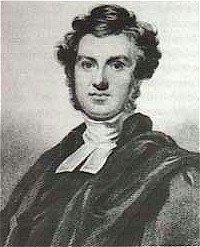
1799 - 1865 Person Name: Hugh Stowell, 1799-1865 Author of "From Every Stormy Wind that Blows" in Hymnal and Order of Service Stowell, Hugh, an able and popular minister of the Church of England, was born at Douglas, Isle of Man, December 3, 1799. He graduated at Oxford in 1822, and took holy orders the following year. He held various offices in his Church; became rector at Salford in 1831; was appointed honorary Canon of Chester Cathedral in 1845, and later Rural Dean of Eccles. He published several volumes. He also edited a book of hymns: A Selection of Psalms and Hymns Suited to the Services of the Church of England, 1831. To the several editions of this book most of his hymns were contributed. He died at Safford October 8, 1865.
From every stormy wind that blows 495
Lord of all power and might 206
Hymn Writers of the Church, 1915 by Charles Nutter
==================================
Stowell, Hugh, M.A., son of Hugh Stowell, Rector of Ballaugh, near Ramsey, was born at Douglas, Isle of Man, Dec. 3, 1799, and educated at St. Edmund Hull, Oxford, B.A. 1822; M.A. 1826. He was ordained in 1823, and held the curacy of Shepscombe, Gloucestershire; and then that of Holy Trinity, Huddersfield. Subsequently he was Curate in charge of St. Stephen's, Salford, and became rector of Christ Church, Salford, in 1831. In 1845 he was appointed Hon. Canon in Chester Cathedral; in 1851 Chaplain to the Bishop of Manchester; and Rural Dean of Eccles. He died at Salford, Oct. 8, 1865. His Memoir, by the Rev. J. B. Marsden, was published in 1868. Canon Stoweli was a popular and effective preacher. His publications included Tractarianism Tested, 1845; A Model for Men of Business, 1854 ; Pleasures of Religion and Other Poems, 1832; The Peaceful Valley, 1826 ; and a large number of single sermons, pamphlets, &c. His Selection of Psalms & Hymns was published as:—
A Selection of Psalms & Hymns Suited to the Services of the Church of England. By the Rev. H. Stowell, M.A., Manchester. Printed by Henry Smith, St. Ann's Square, 1831.
This Selection contained 233 hymns, in addition to versions of the Psalms. Of the hymns the following were by the compiler:—
1. Almighty Shepherd, Who didst give. (1828.) The Good Shepherd.
2. From every stormy wind that blows.
3. Gracious God, look down in kindness. Sunday School Anniversary.
4. Great God, we dare not bow the knee. Holy Communion.
5. Meek Lamb of God, on Thee. Lent.
6. To Thee, 0 God, we raise. Sunday School Anniversary.
7. Tune every heart, wake every tongue. Sunday School Anniversary.
8. When Jesus left the glorious sky. For an Infants’ School.
9. Yes, in the morning of our years. Sunday School Anniversary.
The 12th edition of this Selection published by Canon Stowell in 1864, was increased to 273 hymns, the additional hymns being in nearly every instance his own compositions. In addition to those already given we have:—
10. Again our yearly strain we raise. 1864.
11. Another year has glided past. (Before 1846.)
12. Another year with mercies strown. (Before 1846.)
13. Before Thy throne, 0 Lord, we bend. (Before 1846.)
14. By pressing dangers compassed round. 1843 (?).
15. Come, raise we all the blessed strain. 1862.
16. Hail, hallowed day of heavenly rest. 1844 (?).
17. Hark, how sweet those infant voices. 1841 (?).
18. How fruitless is the ploughman's toil. 1854.
19. How gently in night's silent hours. 1850.
20. Jesus is our Shepherd, Wiping, &c. 1849.
21. Jesus, Lord, Who hast ascended. 1853.
22. Jesus, Lord, we wait on Thee. 1863.
23. Jesus, our Saviour and our Lord. (Before 1846.)
24. Jesus, Prophet of Thy Church. 1861.
25. Lord, if our land be great and free. 1851.
26. Lord, in this dark and stormy day. 1848.
27. Lord, in Thy mercy hear our cry. 1855.
28. Meek Lamb of God, Who dost impart. 1859.
29. 0 God, the liquid sign of grace. 1856.
30. Sailing o'er life's changeful ocean. (Before 1846.)
31. Saviour, guide this little band. (Before 1846.)
32. The day of rest is passed away. (Before 1846.)
33. The morn of our lifetime is fast gliding by. (Before 1846.)
34. Though our lot be poor and lowly. 1847.
35. Thy cross, 0 Lord, the holy sign. 1840.
36. Wake, wake our yearly strain anew. 1852.
37. Wake, wake the joyful song. 1844.
38. We, a little simple throng. (Before 1846.)
39. We, little pilgrims of a day. 1845.
40. We love the holy house of prayer. 1857.
41. We will not weep as others do. 1842.
42. What is your life? It glances by. 1860.
43. What though our earthly lot be low. 1858.
These hymns were all written for the Anniversary Services of Christ Church Sunday Schools, Salford, and are included with others in a special Appendix in the 1877 ed. of the Selection as above.
Other hymns by Canon Stowell are:—
44. Children of old, Hosannah sang. Sunday Schools. 1830.
45. Lord of all power and might, Father of love, &c. Missions. Written for the Jubilee of the B. & F. Bible Society, March 7, 1853.
46. Shepherd of the ransomed sheep. The Good Shepherd.
47. Pilgrims in the narrow way. Sunday School Anniversary. This was his last hymn, and was written for the Christ Church Sunday School Anniversary, 1865.
Of Canon Stowell's hymns the most popular are Nos. 2, 3, 20 and 44. As a writer for children he was very successful. All the foregoing hymns are in the 15th ed. of his Selection edited by his son, Manchester, 1877; and in Hymns. By the late Rev. Canon Stowell, M.A. Manchester, 1868.
-- John Julian, Dictionary of Hymnology (1907)
Hugh Stowell
Thomas H. Gill
1819 - 1906 Author of "Thy happy ones a strain begin" in Pilgrim Songs (Number Two) Gill, Thomas Hornblower, was born at Bristol Road, Birmingham, Feb. 10th, 1819. His parents belonged to English Presbyterian families which, like many others, had become Unitarian in their doctrine. He was educated at King Edward's Grammar School under Dr. Jeune, afterwards Bishop of Peterborough. He left the school in 1838, and would have proceeded to the University of Oxford, but was prevented by his hereditary Unitarianism (long since given up), which forbade subscription to the Articles of the Church of England then necessary for entrance to the University. This constrained him to lead the life of an isolated student, in which he gave himself chiefly to historical and theological subjects. Hence his life has been singularly devoid of outward incident; and its interest gathers about his hymns, and the seasons of overmastering thought and feeling which gave them birth. The only events that can be chronicled are the publications of his books (see below).
It is in the singular combination of influences which has formed his character and determined his thinking that the real interest of his life consists. Here is to be found the true key to the understanding of his hymns. To his Puritan ancestry may be traced their deep religiousness; to his Unitarian training their ethical earnestness; and to his poetical temperament their freeness from conventionality. Delight in the divine songs of Watts was his earliest intellectual enjoyment; and in after years the contrast between their native force and fulness and their dwindled presentation in Unitarian hymnbooks began that estrangement from his hereditary faith which gradually became complete. These various influences mingled in his own hymns and have conspired to render him what Dr. Freeman Clarke calls him, "a more intellectual Charles Wesley." He belongs to the small company of really original hymnists. His hymns are marked by a remarkable absence of, and even opposition to, all antiquarian and sacerdotal ideas of Christianity, a keen discernment of the spirit rather than the mere letter of the Gospel; and profound thought on Scripture themes, so that some of his hymns are too subtle for use in the ordinary worship of the Church. Their style is characterized by a certain quaintness of expression reminding one of George Wither or John Mason, but modified by the influence of Watts's warmth of feeling. They have great sweetness of melody, purity of diction, and happy adaptation of metre and of style to the subject of each hymn. They are almost exclusively used by Nonconformists. Dale's English Hymnbook contains 39; the Baptist Hymnal, 19; Horder's Congregational Hymns, 11; Martineau's Hymns of Praise & Prayer, 11; and the Congregational Church Hymnal, 14. The following are Mr. Gill's published works:—
(1) The Fortunes of Faith, 1841; (2) The Anniversaries (Poems in commemoration of great Men and great Events), 1858; (3) The Papal Drama (an historical essay), 1866; (4) The Golden Chain of Praise Hymns by Thomas H. Gill, 1869; (5) Luther's Birthday (Hymns), 1883; (6) The Triumph of Christ (Memorials of Franklin Howard), 1883.
Mr. Gill's hymns number nearly 200. Of these, over 80 are in common use in Great Britain and America. The most widely used of these:— "Everlasting, changing never"; "O mean may seem this house of clay"; "O wherefore, Lord, doth Thy dear praise"; “Our God, our God, Thou shinest here"; "The glory of the spring, how sweet"; and "Thou biddest, Lord, Thy sons be bold"; are annotated under their respective first lines, the rest are noted below. [Rev. W. Garrett Horder]
The 75 hymns which follow are all annotated from the author's manuscript notes, kindly supplied for use in this work:—
1. Ah tremblers, fainting and forlorn. Eternal Youth. Written in 1868, and first published in his Golden Chain, &c, 1869, p. 149, in 9 stanzas of 4 lines. In 1873 Martineau gave stanzas iv.-ix. in his Hymns, &c, No. 256, as, "Young souls, so strong the race to run." These were repeated in the Baptist Hymnal, 1879, as No. 862.
2. Alas the outer emptiness. Consecration of the Heart. Contributed to G. Dawson's Psalms & Hymns, 1846, No. 121, in 7 stanzas of 4 lines. It was introduced to the American Unitarian collections through Hedge & Huntington's Hymns for the Church of Christ, 1853, No. 619.
3. Alas these pilgrims faint and worn. Whitsuntide. Written in 1853, and first published in his Anniversaries, 1858, p. 73, in 11 stanzas of 4 lines, then in G. Dawson's Psalms & Hymns, 1862, the Golden Chain, &c, 1869, p. 107, &c.
4. Alone with Thee, with Thee alone. Worship in Solitude. Written in 1856, and first published in his Golden Chain , &c, 1869, p. 26, in 8 stanzas of 4 lines.
5. And didst thou, Lord, our sorrows take? Passiontide. Written in 1849, and published in his Golden Chain, &c, 1869, p. 45, in 6 stanzas of 4 lines. It is in several English collections.
6. Behold the everlasting Son. Ascension. Written in 1862, and first printed in the Hagley Magazine, and then in G. Dawson's Psalms & Hymns, 1862, and the Golden Chain, 1869, p. 47, in 8 stanzas of 4 lines.
7. Break, newborn year, on glad eyes break. New Year. Written in 1855, and first published in his Golden Chain, &c, 1869, p. 144, in 6 stanzas of 4 lines. It is one of the most popular of the author's hymns, and is found in many collections.
8. Bright Presence! may my soul have part. Witness of the Spirit. Written in 1849, and first published in his Golden Chain, &c, 1869, p. 100, in 8 stanzas of 8 lines. It is repeated in The Songs of the Spirit, N. Y., 1871.
9. Bright Thy presence when it breaketh. Public Worship. Written in 1856, and first publised in his Golden Chain, &c, 1869, p. 27, in 6 stanzas of 6 lines. In the Baptist Hymnal, 1879, and in Dale's English Hymnbook it is in an abridged form.
10. Day divine! when sudden streaming. Whit-Sunday. Written on Whit-Sunday, 1850, and first published in G. Dawson's Psalms & Hymns, 1859, and again in the Golden Chain, &c, 1869, p. 97, in 3 stanzas of 8 lines. In some American collections, as the Dutch Reformed Hymns of the Church, 1869, it is given as "Day divine, when in the temple."
11. Dear Lord and Master mine. Resignation. Written in 1868, and first published in his Golden Chain, &c, 1869, p. 162, in 7 stanzas of 4 lines. It is in somewhat extensive use both in Great Britain and America.
12. Dear Lord, Thou art not sorry. Passiontide. Written in 1866, and first published in his Golden Chain, &c, 1869, p. 58, in 5 stanzas of 8 lines.
13. Dear Lord, Thy light Thou dost not hide . Christian Labours . No. 125 in the Golden Chain, &c, 1869, p. 178, in 8 stanzas of 4 lines on the text, "Let your light so shine before men," &c, and was written in 1855.
14. Do we only give Thee heed . Jesus the Gladdener of Life. Written in 1849, and first published in G. Dawson's Psalms & Hymns, 1853; and again in the Golden Chain, &c, No. 145, in 6 stanzas of 6 lines. In use in Great Britain and America.
15. Embrace your full Salvation. Heaven. Written in 1870, and first printed in The Congregationalist, 1873, in 9 stanzas of 8 lines. On including it in his English Hymnbook, 1874, Dr. Dale transposed some of the stanzas.
16. Farewell, delightful day. Sunday Evening . Written in 1867, and published in his Golden Chain, &c, 1869, No. 19, in 9 stanzas of 4 lines. In the Church Praise Book, N. Y., 1882, st. i., viii., ix., are given with the alteration of the opening line as, "Holy, delightful day." Dr. Hatfield, in his Church Hymnbook, N. Y., 1872, has the same opening, but he omits stanzas iv.-vi. of the original.
17. Father, glorious with all splendour. Holy Trinity. This hymn of great merit was written in 1860, and published in the Golden Chain, &c, in 1869, No. 4, in 7 stanzas of 8 lines. In some American collections, including Hymns & Songs of Praise, N. Y., 1874, No. 17, stanzas iv., vi., vii., are given as "Father, Thine elect who lovest."
18. Father, hast Thou not on me. Eternal Love . A Trinitarian hymn on eternal love, composed in 1867, and published in his Golden Chain, &c, 1869, No. 139, in 7 stanzas of 8 lines. In 1869, stanzas v.-vii. were given in the Supplement to the New Congregational Hymn Book, as "Mighty Quickener, Spirit blest."
19. Full many a smile, full many a song. Joy in God the Father. Written in 1854, and first published in his Golden Chain, &c, 1869, No. 8, in 9 stanzas of 4 lines. In Dale's English Hymn Book, 1874, No. 21, st. ii., which applied personally to the author alone, was omitted.
20. How can I, Lord, abide with Thee? Prayer. “Produced in 1856. Struck with the didactic character of Cowper's and Montgomery's hymns, ‘What various hindrances we meet,’ and ‘Prayer is the soul's sincere desire,’ I greatly wished to set forth the soul's view of prayer, simply, naturally, poetically, and achieved this hymn with much aspiration and satisfaction." Printed in the Golden Chain, &c, 1869, No. 119, in 8 stanzas of 4 lines, and headed "Pray without ceasing."
21. How, Lord, shall vows of ours be sweet? Public Worship. The author's earliest hymn. It was written in 1845, and first published in G. Dawson's Psalms & Hymns, 1846, No. 114, in 6 stanzas of 4 lines, and again in the Golden Chain, &c, 1869, No. 2. It is in several American hymnbooks.
22. Is earth too fair, is youth too bright? Consecration of Youth to God. Written in 1848, and first pub. in his Golden Chain, &c, 1869, No. 102, in 13 stanzas of 4 lines, and entitled "The Hymn of Youth."
23. Is not my spirit filled with Thine. God glorious in His works. "Written in the summer of 1846 among the hills and streams of Derbyshire," and first published in the Golden Chain, &c, 1869, No. 15, in 9 stanzas of 4 lines, and entitled "God glorious in His works."
24. Let bolder hearts the strife require. Prayer against Temptation. No. 218 in Martineau's Hymns of Praise and Prayer, 1873. It was written in 1851, and first published in the Golden Chain, &c, 1869, in 7 stanzas of 4 lines.
25. Lift thy song among the nations. National Hymn. Written in 1853, and first published in G. Dawson's Psalms & Hymns, 1853, in 4 stanzas of 8 lines. When repeated in the Golden Chain, &c, 1869, No. 62, an additional stanza (iii.) was given, and it was entitled "England's Hymn." It is a spirited hymn and worthy of greater circulation than it now has. The 1869 text is given in Dale's English Hymn Book, 1874, No. 1239.
26. Lord, am I precious in Thy sight. Grieve not the Holy Spirit. Composed in 1850, and first published in G. Dawson's Psalms & Hymns, 1853. In 1869 it was included in the Golden Chain , &c, No. 70, in 7 stanzas of 4 lines. It is in common in America. A cento is also in the Supplement to the New Congregational, 1869, No. 1095. It is composed of stanzas iii., v., vi. much altered, and not improved, and begins, "O Holy Spirit, dost thou mourn?"
27. Lord, comes this bidding strange to us ? Invitation to Rejoice. Written in 1849, and first published in his Golden Chain, &c, 1869, No. 144, in 11 stanzas of 4 lines.
28. Lord, dost Thou ne'er Thy servants bless? Free Grace. Written in 1855, on the words of Oliver Cromwell as used by him in a letter to his "beloved cousin Mrs. St. John," dated "Ely, 13th October, 1638. "Truly no poor creature hath more cause to put him self forth in the cause of his God than I. I have had plentiful wages beforehand; and I am sure I shall never earn the least mite." (Carlyle's Oliver Cromwell's Letters and Speeches, &c, Letter ii.) The hymn was first published in the Golden Chain, &c, 1869, in 9 stanzas of 4 lines.
29. Lord, from Thee, what grace and glory. National Hymn. This cento in Vince's Collection, 1870, No. 450, is from the poem, on St. George's Day, written in 1853, and published in the author'sAnniversaries, 1858, p. 47.
30. Lord, from these trembling souls of ours. Praise. Composed in 1859, and first published in his Golden Chain, &c, 1869, No. 3, in 10 stanzas of 4 lines.
31. Lord God, by Whom all change is wrought. God Eternal. Written in 1869, the keynote being the words of St. Augustine, "Immutabilis mutans omnia," and first printed in the Songs of the Spirit, N. Y., 1871. In 1874 it was included in Dale's English Hymn Book; and, in 4 stanzas, in the Baptist Hymnal, 1879.
32. Lord God of old, who wentest. Public Worship. Composed in 1868, and first published in his Golden Chain, &c, 1869, No. 30, in 5 stanzas of 8 lines.
33. Lord, if our dwelling place thou art Communion of Saints. Written in 1856, and first published in his Golden Chain, &c, 1869, No. 150, in 8 stanzas of 4 lines. The hymn, "Death has no bidding to divide," in Dale's English Hymn Book, 1874, begins with stanzas ii., and omits stanzas i., iv. of this hymn.
34. Lord, in this awful fight with sin. Victory through Christ. Written in 1857, and first published in his Golden Chain, &c., 1869, No. 128, in 7 stanzas of 8 lines.
35. Lord, in Thy people Thou dost dwell. Unity of Christ and His people. Written in 1864, and first published in his Golden Chain, &c, 1869, in 12 stanzas of 4 lines.
36. Lord, Thou hast been our dwelling place. National Hymn. "Begun among the Waldenses, 1864," and first published in his Golden Chain, &c, 1869, No. 59, in 8 stanzas of 7 lines, entitled, "The hymn of the Waldenses," and supplemented with the note, "This hymn as a whole belongs to the Waldenses only, among whom it was begun, but all the people of God have an interest in the first two and the last verses." Acting upon this suggestion of the author, these stanzas were given in the Supplement to the New Congregational, 1869, as No. 1025.
37. Lord, Thou wouldst have us like to Thee. Holiness desired. Written in 1846, and first published in G. Dawson's Psalms & Hymns, 1846, No. 120, in 8 stanzas of 4 lines. It is in several American collections.
38. Lord, Thy gracious voice hath spoken. Christ our Caesar. Written in 1849, and first published in G. Dawson's Psalms & Hymns, 1853; and again in the Golden Chain, &c, 1869, in 3 stanzas of 8 lines.
39. Lord, when I all things would possess. Humility. Written in 1850, and first published in his Golden Chain, &c, 1869, No. 111, in 8 stanzas of 4 lines. In Martineau's Hymns, &c, 1873, No. 304, stanzas ii., iv., vii. are omitted. This hymn is also in common use in America.
40. Lord, when we come at Thy dear call. The Holy Ghost, the Sanctifier. No. 72 in his Golden Chain, 1869, in 7 stanzas of 4 lines, was written in 1856, and is given in the Songs of the Spirit, N. Y., 1871.
41. May we not, Father, meetly mourn? Burial. No. 151 in his Golden Chain, &c, 1869, in 9 st. of 4 lines, was written in 1855.
42. Methought my soul had learned to love. Resignation. "Composed in 1852 and first printed in Golden Chain, 1869. It came from the very depths of my own heart, was inspired by a suppressed trouble which turned out one of the greatest blessings of my life." In the Golden Chain, &c, No. 114, it is given in 7 st. of 4 lines, and is headed, "Not my will but Thine be done."
43. My God, I do not flee from Thee. Joy. Written in 1849, and first published in his Golden Chain, &c., 1869, No. 10, in 7 stanzas of 4 lines. The New Congregational, 1369, No. 1119, begins with stanza ii., "Father, Redeemer, Quickener mine," and also omits stanza iv.
44. My God, my Majesty divine. Child of God. Written in 1845, and first published in G. Dawson's Psalms & Hymns, 1846, No. 116, in 8 stanzas of 4 lines, and again, after revision, in the Golden Chain, &c, 1869, No. 135. The original text is in common use in America.
45. Not, Lord, Thine ancient works alone. Public Worship. Written in 1874, and first printed in The Congregational, in 6 stanzas of 6 lines, and entitled, "The Living God." In Dale's English Hymn Book, 1874, st. iii. is omitted.
46. Not yet I love my Lord. Lent. Written in 1868, and first published in his Golden Chain, &c, 1869, No. 86, in 9 stanzas of 4 lines. It is in several collections, including Martineau's Hymns, &c, 1873, No. 199.
47. Not yet, ye people of His grace. Here and Hereafter. A hymn on the "The Vision Beatific," No. 165, in his Golden Chain, &c, 1869, in 11 stanzas of 4 lines. It was written in 1866, and is in American common use.
48. 0 height that doth all height excel. Written in 1853, and "was born of the words of Augustine in the outset of the Confessions, ‘Secretissime et Praesentissime,' and was the first of several hymns inspired by his wonderful antitheses about God." It was first published in G. Dawson's Psalms & Hymns, 1853, and again in the Golden Chain, &c, 1869, No. 13, in 9 stanzasof 4 lines. It is in English and American common use.
49. 0 Holy Ghost, Who down dost come. Whitsuntide. "Written at Malvern on Whitsunday, 1863; a day of singular spiritual enjoyment, and outward loveliness." It was first published in the Golden Chain, &c, 1869, No. 74, in 1 stanza of 4 lines, and headed, "A Breathing after the Holy Spirit," and is in several collections. In Martineau's Hymns, &c, 1873, No. 251, it begins with st. ii., "Spirit of Truth, Who makest bright," st. i. and vi. being omitted.
50. 0 not alone in saddest plight. Divine Guidance desired. Composed in 1856, and first published in his Golden Chain, &c, 1869, No. 120, in 9 stanzas of 4 lines.
51. 0 not to fill the mouth of fame. A Servant of Christ. "Composed in 1849, and printed first in a small collection of poems entitled, I think, “The Violet." In 1853 it was given in G. Dawson's Psalms & Hymns; and in 1869, in the Golden Chain, &c, No. 121, in 6 stanzas of 4 lines. Its use is mainly confined to America.
52. 0 not upon our waiting eyes. Divine Love. Written in 1849, and first published in his Golden Chain, &c, 1869, No. 29, in 5 stanzas of 4 lines.
53. 0 saints of old, not yours alone. Seeking God. Written in 1848, and first published in G. Dawson's Psalms & Hymns, 1853; and again, after revision, in the Golden Chain, &c, 1869, No. 126, in 10 stanzas of 4 lines. The American hymnbooks have usually the original text, but in Dale's English Hymn Book , 1875, and Holder's Congregational Hymn Book1884, the text is abridged from the Golden Chain.
54. 0 smitten soul that cares and conflicts wring. Heaven desired. Written in 1854, and first published in his Golden Chain, &c, 1869. No. 75, in 8 stanzas of 4 lines.
55. 0 Spirit, sweet and pure. Constant Presence of the Holy Spirit desired. Written in 1868, and given in his Golden Chain, &c, 1869, as No. 127, in 7 stanzas of 8 lines.
56. 0 time, ne'er resteth thy swift wing. Worth of Time. Written in 1855, and first published in his Golden Chain, &c, 1869, No. 98, in 9 stanzas of 4 lines.
57. 0 wherefore hath my spirit leave? Spiritual Changes. "Composed with great ardour and stir of soul in 1847, and first printed in the Golden Chain, 1869," No. 85, in 7 stanzas of 4 lines.
58. O'er fulness of grace, blest Britain rejoice. National Hymn. Composed in 1868, and first published in his Golden Chain, &c, 1869, No. 61, in 11 stanzas of 4 lines, and entitled, "The Thanksgiving Song of Protestant Britain”; to which was added the words of Milton: "Let us all go, every true Protestant Briton, throughout the three kingdoms, and render thanks to God the Father of Light, and to His Son, Jesus Christ our Lord."
59. Saviour, needs the world no longer! Christ All in All. "Written in 1847... it was inspired partly by my contemplation of Shelley's hapless, Christless life." It was first published in G. Dawson's Psalms & Hymns 1853, and again in the Golden Chain, &c, 1869, No. 35, in 7 stanzas of 6 lines, and headed, "Lord, to whom shall we go." Its use is limited, and far less than its merits deserve.
60. Saviour, Who from death didst take. The Resurrection of Christ, a cause of Confidence. Written in 1856, and first published in his Golden Chain, &c, 1869, No. 96, in 5 stanzas of 6 lines.
61. Sweet Spirit, would Thy breath divine. The Holy Ghost, the Purifier, desired. Written in 1856, and given as No. 71 in his Golden Chain, &c, 1869, in 10 stanzas of 4 lines.
62. The happy fields, the heavenly host. Heaven. Written in 1848, first published in G. Dawson's Psalms & Hymns, 1853, and again in the Golden Chain, &c, 1869, No. 157, in 10 stanzas of 4 lines.
63. Thy happy ones a strain begin. Joy in God. Written in 1846, and published in G. Dawson's Psalms & Hymns, 1846, No. 118, in 5 stanzas of 4 lines. In the Golden Chain, &c, 1869, No. 146, the text is slightly changed. The text in common use in Great Britain and America is from the original.
64. Too dearly, Lord, hast Thou redeemed. Lent. Written in 1855, and first published in his Golden Chain, &c, 1869, No. 97, in 9 stanzas of 4 lines.
65. Unto thy rest return. Lent. Written in 1866, and first published in his Golden Chain, &c, 1869, No. 92, in 6 stanzas of 8 lines.
66. We come unto our fathers'God. God our Abode. "The birthday of this hymn, November 22nd, 1868 (St. Cecilia's Day), was almost the most delightful day of my life. Its production employed the whole day and was a prolonged rapture.....It was produced while the Golden Chain was being printed, just in time to be a link therein, and was the latest, as ‘How, Lord, shall vows of ours be sweet?' was the earliest song included therein." In the Golden Chain, &c, 1869, it is No. 129, in 7 stanzas of 7 lines, and is entitled, "The People of God."
67. We triumph in the glorious grace. Citizens of Heaven. Written in 1855, and first published in his Anniversaries, 1858, and again in his Golden Chain, &c, 1869, No. 153, in 12 stanzas of 4 lines.
68. What sweetness on Thine earth doth dwell. Nature revealing God. [Summer.] Written in 1850, and first published in his Golden Chain, &c, 1869, in 8 stanzas of 4 lines.
69. When shall I, Lord, a journey take. Lent. Written in 1856, and first published in his Golden Chain, &c, 1869, No. 80, in 8 stanzas of 4 lines. It is in common use in Great Britain and America.
70. Whence this naming joy that maketh! The Prodigal's Return. "Written in 1853 just before the hymn beginning 'Thrice blessed soul, who still hath made,' with the text 'Son, thou art ever with me' (Golden Chain, No. 134), which is its completement; and first printed in the Golden Chain," 1869, No. 81, in 6 stanzas of 6 lines.
71. Would the Spirit more completely? The Gifts of the Spirit. Written in 1849, and first published in G. Dawson's Psalms & Hymns, 1853; and again in the Golden Chain, &c, 1869, No. 67. in 3 stanzas of 8 lines.
72. Ye children of the Father. Spiritual Worship. Written in 1867, and first published in his Golden Chain. &c, 1869, No. 23, in 6 stanzas of 8 lines.
73. Ye of the Father loved. Praise. Written in 1862, and first published in the Golden Chain, &c, 1869, No. 5, in 8 stanzas of 8 lines.
74. Ye people of the Lord, draw near. Holy Communion. Written in 1855, and first published in his Golden Chain, &c, 1869, No. 127, in 7 stanzas of 4 lines.
75. Ye souls, the Father's very own. Holy Diligence. Composed in 1867, and first published in his Golden Chain, &c, 1869, No. 142, in 9 stanzas of 4 lines.
These hymns are usually abridged in the hymnbooks, the length of most of them being against their use in their full form. Although they are gradually growing in popular esteem, the extent of their use is much more limited than their merits deserve.
-- John Julian, Dictionary of Hymnology (1907)
====================
Gill, T. H. , pp. 421-3. Additional hymns to those annotated are in common use:—(l) "O dreadful glory that doth make," a cento from No. 48, p. 423, ii.; (2) "O mystery of Love Divine " (The Love of Christ); (3) " Ye souls for whom the Saviour died" (Electing Love). These are all from his Golden Chain of Praise, 1869.
--John Julian, Dictionary of Hymnology, Appendix, Part II (1907)
========================
Gill, T. H. , pp. 421, i.; 1565, ii. &c. During the past ten years Mr. Gill's hymns have been widely used, especially in America, the result being that the following have to be added to the long lists already annotated as above:—
1. Ah! wherefore fall my tears so fast? [The World Overcome.] Published in his Golden Chain of Praise, 1869, p. 167. The hymn, "O Thou for Whom the strife was strong," in the American Hymns for Church and Home, 1895, is composed of sts. iii.-vii. of this hymn.
2. Dear Lord, Thou bringest back the morn. [Morning.] From his Golden Chain of Praise, 1869, p. 145.
3. I would not give the world my heart. This, in the Amer.Baptist Sursum Corda, 1898, No. 379, is a cento from "With sin I would not make abode," p. 1288, ii.
4. Not only when ascends the song. This in the Amer. Hymns of the Ages, 1904, No. 80, is a cento from “0 Saints of old, not yours alone," p. 423, i. 53.
5. Walk with the Lord! along the road. Composed of sts. v., vii.-ix., of "Ah ! tremblers, fainting and for¬lorn," p. 421, ii. 1. Included in the American Unitarian Hymns for Church and Home, 1895.
6. We would not dare their bliss to mourn. This in the Amer.Unit. Hymns for Church and Home, 1895 is composed of sts. v.-viii. of "May we not, Father, meetly mourn?" p. 422, ii. 41.
7. Wherefore faint and fearful ever. [ God is for us.] Published in the 2nd edition of his Golden Chain of Praise, 1894, No. xiii., in 7 stanzas of 6 lines, and dated 1880. In Hymns Ancient & Modern, 1904, in 5 stanzas. The cento "He Who suns and worlds upholdeth," is composed of stanzas ii., iii., and vii. of the original hymn. Mr. Gill died in 1906.
--John Julian, Dictionary of Hymnology, New Supplement (1907)
Thomas H. Gill
Cecil Frances Alexander
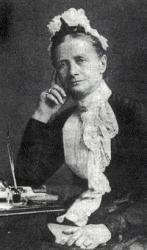
1818 - 1895 Author of "Beyond the holy city wall" in The Book of Common Praise As a small girl, Cecil Frances Humphries (b. Redcross, County Wicklow, Ireland, 1818; Londonderry, Ireland, 1895) wrote poetry in her school's journal. In 1850 she married Rev. William Alexander, who later became the Anglican primate (chief bishop) of Ireland. She showed her concern for disadvantaged people by traveling many miles each day to visit the sick and the poor, providing food, warm clothes, and medical supplies. She and her sister also founded a school for the deaf. Alexander was strongly influenced by the Oxford Movement and by John Keble's Christian Year. Her first book of poetry, Verses for Seasons, was a "Christian Year" for children. She wrote hymns based on the Apostles' Creed, baptism, the Lord's Supper, the Ten Commandments, and prayer, writing in simple language for children. Her more than four hundred hymn texts were published in Verses from the Holy Scripture (1846), Hymns for Little Children (1848), and Hymns Descriptive and Devotional ( 1858).
Bert Polman
==================
Alexander, Cecil Frances, née Humphreys, second daughter of the late Major John Humphreys, Miltown House, co. Tyrone, Ireland, b. 1823, and married in 1850 to the Rt. Rev. W. Alexander, D.D., Bishop of Derry and Raphoe. Mrs. Alexander's hymns and poems number nearly 400. They are mostly for children, and were published in her Verses for Holy Seasons, with Preface by Dr. Hook, 1846; Poems on Subjects in the Old Testament, pt. i. 1854, pt. ii. 1857; Narrative Hymns for Village Schools, 1853; Hymns for Little Children, 1848; Hymns Descriptive and Devotional, 1858; The Legend of the Golden Prayers 1859; Moral Songs, N.B.; The Lord of the Forest and his Vassals, an Allegory, &c.; or contributed to the Lyra Anglicana, the S.P.C.K. Psalms and Hymns, Hymns Ancient & Modern, and other collections. Some of the narrative hymns are rather heavy, and not a few of the descriptive are dull, but a large number remain which have won their way to the hearts of the young, and found a home there. Such hymns as "In Nazareth in olden time," "All things bright and beautiful," "Once in Royal David's city," "There is a green hill far away," "Jesus calls us o'er the tumult," "The roseate hues of early dawn," and others that might be named, are deservedly popular and are in most extensive use. Mrs. Alexander has also written hymns of a more elaborate character; but it is as a writer for children that she has excelled.
- John Julian, Dictionary of Hymnology (1907)
===============
Alexander, Cecil F., née Humphreys, p. 38, ii. Additional hymns to those already noted in this Dictionary are in common use:—
1. Christ has ascended up again. (1853.) Ascension.
2. His are the thousand sparkling rills. (1875.) Seven Words on the Cross (Fifth Word).
3. How good is the Almighty God. (1S48.) God, the Father.
4. In [a] the rich man's garden. (1853.) Easter Eve.
5. It was early in the morning. (1853.) Easter Day.
6. So be it, Lord; the prayers are prayed. (1848.) Trust in God.
7. Saw you never in the twilight? (1853.) Epiphany.
8. Still bright and blue doth Jordan flow. (1853.) Baptism of Our Lord.
9. The angels stand around Thy throne. (1848.) Submission to the Will of God.
10. The saints of God are holy men. (1848.) Communion of Saints.
11. There is one Way and only one. (1875.) SS. Philip and James.
12. Up in heaven, up in heaven. (1848.) Ascension.
13. We are little Christian children. (1848.) Holy Trinity.
14. We were washed in holy water. (1848.) Holy Baptism.
15. When of old the Jewish mothers. (1853.) Christ's Invitation to Children.
16. Within the Churchyard side by side. (1848.) Burial.
Of the above hymns those dated 1848 are from Mrs. Alexander's Hymns for Little Children; those dated 1853, from Narrative Hymns, and those dated 1875 from the 1875 edition of Hymns Ancient & Modern.
Several new hymns by Mrs. Alexander are included in the 1891 Draft Appendix to the Irish Church Hymnal.
--John Julian, Dictionary of Hymnology, Appendix, Part II (1907)
=============
Alexander, Cecil F. , p. 38, ii. Mrs. Alexander died at Londonderry, Oct. 12, 1895. A number of her later hymns are in her Poems, 1896, which were edited by Archbishop Alexander.
--John Julian, Dictionary of Hymnology, New Supplement (1907)
See also in:Hymn Writers of the Church
Cecil Frances Alexander
Johann Heermann
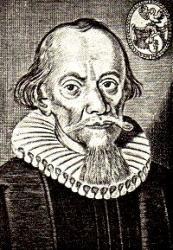
1585 - 1647 Author of "Ere yet the dawn hath filled the skies" in Book of Worship with Hymns and Tunes Johann Heermann's (b. Raudten, Silesia, Austria, 1585; d. Lissa, Posen [now Poland], 1647) own suffering and family tragedy led him to meditate on Christ's undeserved suffering. The only surviving child of a poor furrier and his wife, Heermann fulfilled his mother's vow at his birth that, if he lived, he would become a pastor. Initially a teacher, Heermann became a minister in the Lutheran Church in Koben in 1611 but had to stop preaching in 1634 due to a severe throat infection. He retired in 1638. Much of his ministry took place during the Thirty Years' War. At times he had to flee for his life and on several occasions lost all his possessions. Although Heermann wrote many of his hymns and poems during these devastating times, his personal faith and trust in God continued to be reflected in his lyrics. He is judged to be the finest hymn writer in the era between Martin Luther and Paul Gerhardt, one whose work marks a transition from the objective hymns of the Reformation to the more subjective hymns of the seventeenth century. His hymn texts were published in collections such as Devoti Musica Cordis, Hauss- und Hertz-Musica (1630, expanded in 1636, 1644), and Sontags- und Fest-evangelia (1636).
Bert Polman
===================
Heermann, Johann, son of Johannes Heermann, furrier at Baudten, near Wohlau, Silesia, was born at Baudten, Oct. 11, 1585. He was the fifth but only surviving child of his parents, and during a severe illness in his childhood his mother vowed that if he recovered she would educate him for the ministry, even though she had to beg the necessary money. He passed through the schools at Wohlau; at Fraustadt (where he lived in the house of Valerius Herberger, q. v., who took a great interest in him); the St. Elizabeth gymnasium at Breslau; and the gymnasium at Brieg. At Easter, 1609, he accompanied two young noblemen (sons of Baron Wenzel von Rothkirch), to whom he had been tutor at Brieg, to the University of Strassburg; but an affection of the eyes caused him to return to Baudten in 1610. At the recommendation of Baron Wenzel he was appointed diaconus of Koben, a small town on the Oder, not far from Baudten, and entered on his duties on Ascension Day, 1611, and on St. Martin's Day, 1611, was promoted to the pastorate there. After 1623 he suffered much from an affection of the throat, which compelled him to cease preaching in 1634, his place being supplied by assistants. In October, 1638, he retired to Lissa in Posen, and died there on Septuagesima Sunday (Feb. 17), 1647. (Koch, iii. 16-36; Allgemeine Deutsche Biographie, xi. 247-249, &c.)
Much of Heermann's manhood was spent amid the distressing scenes of the Thirty Years' War; and by his own ill health and his domestic trials he was trained to write his beautiful hymns of “Cross and Consolation." Between 1629 and 1634, Koben was plundered four times by the Lichtenstein dragoons and the rough hordes under Wallenstein sent into Silesia by the King of Austria in order to bring about the Counter-Reformation and restore the Roman Catholic faith and practice; while in 1616 the town was devastated by fire, and in 1631 by pestilence. In these troublous years Heermann several times lost all his moveables; once he had to keep away from Koben for seventeen weeks; twice he was nearly sabred; and once, while crossing the Oder in a frail boat loaded almost to sinking, he heard the bullets of the pursuing soldiers whistle just over his head. He bore all with courage and patience, and he and his were wonderfully preserved from death and dishonour. He was thus well grounded in the school of affliction, and in his House and Heart Music some of his finest hymns are in the section entitled "Songs of Tears. In the time of the persecution and distress of pious Christians."
As a hymnwriter Heermann ranks with the beat of his century, some indeed regarding him as second only to Gerhardt. He had begun writing Latin poems about 1605, and was crowned as a poet at Brieg on Oct. 8, 1608. He marks the transition from the objective standpoint of the hymnwriters of the Reformation period to the more subjective and experimental school that followed him. His hymns are distinguished by depth and tenderness of feeling; by firm faith and confidence in face of trial; by deep love to Christ, and humble submission to the will of God. Many of them became at once popular, passed into the hymnbooks, and still hold their place among the classics of German hymnody. They appeared principally in—
(1) Devoti Musica Cordis. Hauss-und Hertz-Musica &c. Leipzig and Breslau, 1630, with 49 hymns (2nd edition 1636, with 64; 3rd edition 1644, with 69). The first section is entitled "Hymns of Penitence and Consolation from the words of the Ancient Fathers of the Church." Seven of these, however, have no mention in their individual titles of the sources from which they are derived; and the remainder are mostly based not on Latin hymns, but on the prose meditations in Martin Moller's Meditationes sanctorum patrum, or on the mediaeval compilations known as the Meditationes and the Manuale of St. Augustine. (2) Sontags-und Fest-Evangelia. Leipzig and Breslau, 1636, being hymns on the Gospels for Sundays and festivals. (3) Poetische Erquickstunden, Nürnberg, 1656; and its Fernere Fortsetzung, also Nürnberg, 1656 [both in Wernigerode], are poems rather than hymns. The hymns of the Hauss-und Hertz-Musica, with a representative selection from Heermann's other poetical works, were edited by C. E. P. Wackernagel, prefaced by a long biographical and critical introduction, and published at Stuttgart, 1855.
Six of the most important of Heermann's hymns are annotated under their respective first lines. The other hymns by Heermann which have passed into English are :—
I. Hymns in English common use:--
i. 0 Jesu, du mein Bräutigam. Holy Communion. In his Devoti Musica Cordis, Breslau, 1630, p. 78, in 12 stanzas of 4 lines. Thence in Mützell, 1858, No. 34, in Wackernagel's ed. of his Geistliche Lieder, No. 22, and the Unverfälschter Liedersegen, 1851, No. 283. Seems to be founded on Meditation xi. in the mediaeval compilation known as St. Augustine's Manuale. Translated as:—
0 Jesu, Lord, who once for me, a good translation of stanzas i., ii., iv., v., viii., by A. T. Russell, as No. 158 in his Psalms & Hymns, 1851.
Other translations are: (l) 0 Jesu! Bridegroom of my Soul," by J. C. Jacobi, 1722, p. 44 (1732, p. 73). (2) "Dear Saviour, who for me hast borne," by Miss Dunn, 1857.
ii. Rett, 0 Herr Jesu, rett dein Ehr. In Time of Trouble. A prayer for deliverance and peace for the Church. In his Devoti Musica Cordis, 1630, p. 119, in 5 stanzas of 4 lines, among the "Songs of Tears." Thence in Mützell, 1858, No. 48, in Wackernagel’s ed., No. 36, and the Unverfälschter Liedersegen, 1851, No. 245. Translated as:—
Thine honour rescue, righteous Lord, in full, by Dr. M. Loy, in the Ohio Lutheran Hymnal, 1880.
iii. Treuer Wächter Israel. In Time of War. 1630, p. 115, in 13 stanzas of 7 lines, among the "Songs of Tears." In Mützell, 1858, No. 47; in Wackernagel's edition, No. 35, and the Unverfälschter Liedersegen, 1851, No. 594. Lauxmann, in Koch, viii. 549, says of it:—
"It is a powerful hymn filled with that prevailing prayer that takes heaven by force," and relates of st. vii.,11. v-7, "Eine Mauer um uns bau," that on Jan. 6, 1814, the Allied Forces were about to enter Schleswig. A poor widow with her daughter and grandson lived in a little house near the entrance of the town. The grandson was reading in his hymnbook those in time of war, and when he came to this said, “It would be a good thing, grandmother, if our Lord God would build a wall around us." Next day all through the town cries of distress were heard, but all was still before their door. On the following morning they had courage to open the door, and lo a snowdrift concealed them from the view of the enemy. On this incident Clemens Brentano composed a beautiful poem "Draus vor Schleswig."
It is translated as:—
Jesu! as a Saviour, aid. A good tr. of st; vii., viii., xiii., by A. T. Russell, as No. 138 in his Psalms & Hymns, 1851.
iv. Zionklagt mit Angst und Schmerzen. Church of Christ. First published in his Devoti Musica Cordis, 2nd ed., 1636 (1644, p. 196), in 6 stanzas of 8 lines, entitled, "From the beautiful golden saying of Isaiah, Chapter xlix." In Mützell, 1858, No. 101, in Wackernagel’s ed., No. 53, and the Unverfälschter Liedersegen, 1851, No. 256. Translated as:—
Sion bow'd with anguish weepeth A good translation of stanzas i., iii., v., by A. T. Russell, as No. 141 in his Psalms & Hymns, 1851.
Another translation is: "Zion mourns in fear and anguish," by Miss Winkworth, 1869, p. 198.
II. Hymns not in English common use:--
v. Ach Jesu! dessen Treu. Love to Christ. 1630, p. 144, in 33 stanzas. One of his finest hymns, full of deep love to Christ, but from its great length very little used in Germany. Translated as, "Ah! Jesus! Lord! whose faithfulness," by Miss Burlingham, in the British Herald, May, 1867, p. 72.
vi. Der Tod klopft bei mir an. For the Dying. 1656, p. 22, in 121. Translated as, "That Death is at my door," by Miss Winkworth, 1869, p. 201.
vii. Du weinest für Jerusalem. Christ weeping over Jerusalem. 1630, p. 81, in 6 stanzas, entitled, "On the Tears of Christ." Founded on St. Luke xix. 41-44, part of the Gospel for the 10 Sundays after Trinity. The translations are: (1) "With tears o'er lost Jerusalem," by Miss Cox, 1841, p. 159. (2) "Our Lord wept o'er Jerusalem," by Dr. H. Mills, 1845 (1856, p. 295). (3) "Thou weepest o'er Jerusalem," by Miss Winkworth, 1855,p. 70.
viii. Herr Jesu Christe mein getreuer Hirte. Holy Communion. 1630, p. 74, in 9 stanzas, founded on M. Moller's Meditationes sanctorum patrum, pt. i. c. 11, and pt. v. c. 2. The translations are: (1) "Dear Saviour, Thou my faithful Shepherd, come” by Miss Dunn, 1857, p. 111. (2) "Lord Jesus Christ, my faithful Shepherd, hear," by Miss Winkworth, 1858, p. 93, repeated in Lyra Eucharistica, 1863-64.
ix. Herr unser Gott, lass nicht zu Schanden werden. Christ's Church. 1630, p. 114, as one of the "Songs of Tears," in 5 stanzas. Translated as, "Ah! Lord our God, let them not be confounded," by Miss Winkworth, 1869, p. 197.
x. Hilf mir, mein Oott, hilf dass nach dir. Christian Conduct. 1630, p. 32, in 7 stanzas, entitled, "For a better life. From the words of Augustine." Founded on No. i. of the Meditationes current under the name of St. Augustine. This meditation is apparently by St. Anselm of Canterbury. Translated as, "Lord, raise in me a constant Flame," by J. C. Jacobi, 1725, p. 27 (1732, p. 105).
xi. Jesu, der du tausend Schmerzen. In Sickness. 1656, in the Fernere Fortsetzung, p. 79, in 12 lines, entitled, "In great bodily pain." Translated as, “Jesu, who didst stoop to prove," by Miss Winkworth, 1869, p. 200.
xii. Jesu Tilger meiner Sünden. Lent. 1656, in the Fernere Fortsetzung, p. 1, in 10 lines, entitled, "For Victory in Temptation." Translated as, "Jesu, Victor over sin," by Miss Winkworth, 1869, p. 201.
xiii. 0 Jesu, Jesu, Gottes Sohn. Love to Christ, 1630, p. 83, in 7 stanzas, entitled, “Of the Love, which a Christian heart bears to Christ, and will still bear." A beautiful expansion of his motto "Mihi omnia Jesus." The translations are: (1) "What causes me to mourn is this," a translation of stanza ii. by P. H. Molther, as No. 371, in the Moravian Hymn Book, 1789 (1886, No. 461). (2) "O Jesus, Jesus, Son of God," by Miss Burlingham, in the British Herald, Oct. 1865, p. 153, and in Reid's Praise Book, 1872.
xiv. Treuer Gott ich muss dir klagen. In Trouble. 1630, p. 103, in 12 stanzas, entitled, "Hymn of a sorrowful heart for increase of faith." Translated as, "Faithful God! I lay before Thee," by J. C. Jacobi, 1720, p. 9(1722, p. 70; 1732, p. 117), and as No. 538 in pt. i. of the Moravian Hymn Book, 1754.
xv. Wollt ihr euch nicht, o ihr frommen Christen. Second Advent. 1636, p. 210, in 9 stanzas, entitled, "On the day of the Holy Bishop Nicolaus. Gospel of Luke, 12 Chapter." Translated as: (l) "0 dear Christians, as 'tis needful, wou'd ye," as No. 153 in pt. i. of the Moravian Hymn Book, 1754. (2) “Help us, 0 Christ, to watch and pray," a tr. of st. ix. as st. iii. of No. 868 in the Moravian Hymn Book, 1789 (1849, No. 1221).
xvi. Wo soll ich fliehen hin. Lent. 1630, p. 20, in 11 stanzas, entitled, "A hymn of consolation in which a troubled heart lays all its sins in true faith upon Christ. From Tauler." Based on M. Moller's Meditationes, vol. i. pt. i., No. 10. Translated as, "0 whither shall I fly," as No. 447 in pt. i. of the Moravian Hymn Book, 1754. In 1886, No. 279, it begins with "0 Jesus, source of Grace" (stanza ii.). [Rev. James Mearns, M.A.]
--John Julian, Dictionary of Hymnology (1907)
Johann Heermann
Joseph Stennett
1663 - 1713 Author of "Another six days' work is done" in The Methodist Hymnal The author was a Baptist preacher in London, from 1690, to his death in 1713.
--Annotations of the Hymnal, Charles Hutchins, M.A. 1872.
=============================
Stennett, Joseph, the earliest English Baptist hymnwriter whose hymns are now in common use, was born at Abingdon, Berks, in 1663. He received a superior education at the Grammar School of Wallingford, and at the age of 22 removed to London, where for several years he engaged in tuition. In 1688 he married a daughter of George Guill, a French Protestant refugee, another of whose daughters was the wife of the celebrated Presbyterian minister, Dr. Daniel Williams, who became a generous friend to Stennett. In the following year he was called to preach by the Baptist Sabbatarian congregation then meeting in Devonshire Square, London, afterwards in Pinners' Hall; and in 1690 became its pastor, a position he retained to his death, July 4, 1713. Since the meetings of this congregation for worship were on the seventh day of the week, he was free to preach to other congregations on the Sunday, which he did very frequently, especially to the General Baptist Church in the Barbican. Such was Stennett's repute for piety, learning and practical wisdom that his advice was very much sought by his Christian friends, and by the "great Whig Lords” of that day he was occasionally consulted as to the feeling of the Dissenters concerning national affairs. His published works include:—
(1) Hymns in commemoration of the Sufferings of our Blessed Saviour Jesus Christ, compos'd for the Celebration of his Holy Supper, 1697; 2nd ed. 1703 (This is entitled in Stennett's Works, 1732, Hymns for the Lord's Supper). These were 37 in number, increased to 50 in the 3rd edition, 1709. (2) In 1700 he published a poetical Version of Solomon's Song of Songs, together with the XLVth Psalm. A second edition, corrected, appeared in 1709. (3) In 1712 he published twelve Hymns composed for the Celebration of the Holy Ordinance of Baptism; 2nd ed. 1722.
Stennett also translated Dacier's Plato and other works from the French, and published several sermons preached on days of National Thanksgiving and other public occasions. His Works were collected after his death and published in 1732, in 4 vols. They contain a Memoir, Sermons and Letters, the Hymns and Poems mentioned above, and a few other poetical pieces. A controversial work, An Answer to Mr. Russen's Book on Baptism, 1702, may be reckoned as a 5th vol. Of his hymns, that which, in the form of varying centos, is most widely known is, "Another six days' work is done". Others in common use include:—
1. Gracious Redeemer, how divine. Holy Communion. Appeared in his Hymns for the Lord's Supper, first edition, 1697. (Works, 1732, ii. p. 98.) Usually abbreviated.
2. Immortal praise be given. Holy Communion. Published in his Hymns for The Lord's Supper, first ed., 1697. (Works, 1732, ii. p. 97.) From this "We'll praise our risen Lord," is taken.
3. Jesus, O word divinely sweet. Redemption through Jesus. Published in Hymns for the Lord's Supper, 3rd ed. 1709, No. 47.
4. Lord, at Thy Table I behold. Holy Communion. This hymn is not in Stennett's Works. From it "With humble faith and trembling heart," is taken.
5. My blessed Saviour, is Thy love? Self-Consecration to God. Appeared in his Hymns for the Lord's Supper, 1697, No. 22. Usually abbreviated.
6. The great Redeemer we adore. Published in his Hymns for Baptism, 1712.
7. Whene'er one sinner turns to God. Holy Baptism. Published in his Hymns for Baptism, 1712, No. 12. From this "See how the willing converts trace" is taken. It begins with st. iii.
Several of his hymns additional to these are given in the older collections, but have passed out of use. We may add that the Joseph Stennett, the subject of this article, had a son, Joseph Stennett, D.D., who also became an eminent Baptist minister, and was the father of Samuel Stennett. [Rev.W. R. Stevenson, M.A.]
--Excerpts from John Julian, Dictionary of Hymnology (1907)
Joseph Stennett
Pages




