You help make Hymnary.org possible. More than 10 million people from 200+ countries found hymns, liturgical resources and encouragement on Hymnary.org in 2025, including you. Every visit affirms the global impact of this ministry.

If Hymnary has been meaningful to you this year, would you take a moment today to help sustain it? A gift of any size—paired with a note of encouragement if you wish—directly supports the server costs, research work and curation that keep this resource freely available to the world.

Give securely online today, or mail a check to:
Hymnary.org
Calvin University
3201 Burton Street SE
Grand Rapids, MI 49546

Thank you for your partnership, and may the hope of Advent fill your heart.

Person Results

Tune Identifier:"^vesper_hymn_bortnianski_stevenson$"
In:people

Planning worship? Check out our sister site, ZeteoSearch.org, for 20+ additional resources related to your search.
Showing 31 - 40 of 56Results Per Page: 102050

Carrie B. Adams

1859 - 1940 Author of "Heavenly Father, hear Thy children" in The Children's Hymnal and Service Book Adams, Carrie Belle (Wilson). (Oxford, Ohio, July 28, 1859-1940). Father, David Wilson, song writer, teacher of music. Married, 1880 to Allyn G. Adams, moved to Terre Haute, Indiana. Director and organist, First Congregational Church; Central Christian Church. Teacher (1887-1895), Indiana State Normal School. Wrote many anthems and cantatas, secular and religious, many published by Lorenz. --Keith C. Clark, DNAH Archives =================== Mrs. Carrie B. (Wilson) Adams was born in Oxford, Ohio, July 28, 1859. Her father, Mr. David Wilson, was author of a number of songs and books, also a singing teacher of note in his day, and her mother was quite musically inclined. Her experience with her father in elementary and advanced class work, in children's and harmony classes, her years of musical participation in solo work and in accompanying, in the organization and leadership, not only of choirs, but also of great choral organizations, her close touch with singers of elementary grade, as well as those of great skill and reputation, have given her a breadth of musical thought and practical power of adaptation that constantly enrich her work of composition. Miss Carrie B. Wilson became Mrs. Allyn G. Adams in 1880, and soon after located in Terre Haute, Ind., where her husband was a leading bass singer and interested in large commercial enterprises. Mrs. Adams soon became a leading figure in the musical life of that enterprising city, and has been actively identified with the Choral Club, Treble Clef Club, Rose Polytechnic Glee Club, First Congregational Church and Central Christian Church choirs, as director, chorister and organist. From 1887 to 1895 she occupied the chair of music in the Indiana State Normal School. Her first anthem was published in 1876. Among her best known publications are four anthem books — "Anthem Annual, Nos. 1 and 2," and " Royal Anthems, Nos. 1 and 2" ; "Music for Common Schools"; two sacred cantatas, "Redeemer and King " and "Easter Praise" ; an operetta for church and school use, "The National Flower"; a group of Shakespeare songs from "As You Like it," and a large number of anthems, male choruses, ladies' quartets and miscellaneous pieces in octavo form. http://archive.org/stream/biographyofgospe00hall/biographyofgospe00hall_djvu.txt

Derek Ferris

b. 1937 Harmonizer of "VESPER HYMN" in The Children's Hymnbook

John Eustace Giles

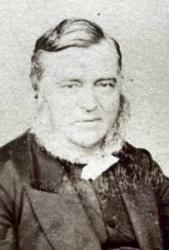
1805 - 1875 Person Name: John E. Giles Author of "Thou Hast Said, Exalted Jesus" in The Baptist Standard Hymnal Giles, John Eustace, was born at Dartmouth in 1805, and educated for the ministry at the Baptist College, Bristol. After preaching for a short time at Haverfordwest, he became, in 1830, pastor of the church in Salter's Hall, London. Leaving Baiter's Hall in 1836, he ministered successively at Leeds, Bristol, Sheffield, Bathmines (Dublin), and Clapham Common, London. He died at Clapham Common, June 24, 1875. His prose works include A Funeral Sermon on the Death of Robert Hall; Lectures on Socialism, &c. From childhood he composed hymns and poetical pieces. In 1834, at the request of the Baptist Missionary Committee, he composed a hymn in celebration of Negro emancipation, and Nos. 9,16, & 24 in their Jubilee Collection, 1842. The hymn by which he is best known is:— Hast Thou said, exalted Jesus? Holy Baptism (Adult). It is a composition of special merit, and in English Baptist congregations is probably oftener sung on Baptismal occasions than any other hymn. It was written "during a serious illness, in 1830, and in anticipation of having to baptize several persons at Salter's Hall, London, on his recovery." (Singers and Songs, 1869, p. 482.) It was printed in 1830 in 6 stanzas of 6 lines. In 1858 it was given in the Baptist Psalms & Hymns, No. 705, with the omission of st. ii. The full original text is in the Baptist Hymnal, 1879, No. 639. It is also in several other collections. [Rev. W. R. Stevenson, M.A.] -- John Julian, Dictionary of Hymnology (1907)

Ludwig van Beethoven

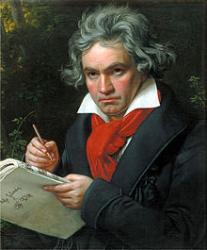
1770 - 1827 Person Name: Beethoven Composer of "[Childhood's days are passing o'er us]" in The Banner of Victory A giant in the history of music, Ludwig van Beethoven (b. Bonn, Germany, 1770; d. Vienna, Austria, 1827) progressed from early musical promise to worldwide, lasting fame. By the age of fourteen he was an accomplished viola and organ player, but he became famous primarily because of his compositions, including nine symphonies, eleven overtures, thirty piano sonatas, sixteen string quartets, the Mass in C, and the Missa Solemnis. He wrote no music for congregational use, but various arrangers adapted some of his musical themes as hymn tunes; the most famous of these is ODE TO JOY from the Ninth Symphony. Although it would appear that the great calamity of Beethoven's life was his loss of hearing, which turned to total deafness during the last decade of his life, he composed his greatest works during this period. Bert Polman

Thomas Tiplady

1882 - 1967 Author of "The Lambeth Vesper" in Hymns from Lambeth (Revised and Enlarged ed.) Tiplady, Thomas. Was Director of the Lambeth Mission in South London, which was maintained under the auspices of the Methodist Church. --The Hymn Society, DNAH Archives ============================== Thomas Tiplady is the Director of the Lambeth Mission in South London which is maintained under the auspices of the Methodist Church. There for thirty-seven years he has ministered among the poor of that section of the great British metropolis. It has been a ministry with many unique features among them a moving picture program at the "Ideal" which has become an institution in itself. Out of this work in London have come several volumes of hymns written originially for use in the services at the Mission. Several of these hymns are to be found in American hymnbooks. He is a member of the Hymn Society of America; and has had close relationship with the Society and its members. --Eleven Ecumenical Hymns, 1954. Used by permission.

Lucy Larcom

1824 - 1893 Author of "Drawing Nearer" in Song-Hymnal of Praise and Joy Larcom, Lucy, was born at Beverley Farm, Massachusetts, in 1826. Her Poems were published in 1864. Her hymn, "When for me the silent oar" [Death Anticipated), was published in 1868. She died in 1893. --John Julian, Dictionary of Hymnology, Appendix, Part II (1907) =============== Larcom, Lucy, p. 1576, ii. The extended use of this writer's hymns justifies a more detailed account of her life and work than is given on p. 1576. She was born in 1824, and worked from 1837-45 in the mills of Lawrence, Mass., then engaged in elementary teaching 1846-49, became a student at Monticello Female Seminary, Alton, Ill., 1849-52, and then entered upon advanced teaching in higher-class schools, and literary work. She edited with J. G. Whittier, Child Life in Poetry, 1871; Child Life in Prose, 1873; Songs of Three Centuries, 1875, &c. Her own works are Poems, 1869; Childhood Songs, 1875; Wild Roses of Cape Ann, 1881; Poetical Works, 1885; At the Beautiful Gate; And Other Songs of Faith, 1892. Her autobiography was published as A New England Girlhood. She died in 1893. In addition to "When for me the silent oar," of her hymns the following are in common use:— i. From her Poems, 1869. 1. Hand in hand with angels. Angelic companion¬ship. 2. If the world seems cold to you. 3. When for me the silent oar. Death ii. From her Wild Roses of Cape Ann, 1881. 4. In Christ I feel the heart of God. 5. O Spirit, "Whose name is the Saviour.” in. From her Poetical Works, 1885. 6. Breaks the joyful Easter dawn, master. 7. Heavenly Helper, Friend Divine. Christ the Friend. iv. From her At the Beautiful Gate, &c, 1892. 8. Draw Thou, my soul, O Christ. Looking to Jesus. 9. O God, Thy world is sweet with prayer. Prayer. 10. Open your hearts as a flower to the light. 11. King, happy bells of Easter time. Easter. The above notes are from the British Museum copies of Miss Larcom's works. --John Julian, Dictionary of Hymnology, New Supplement (1907)

Edith Lovell Thomas

1878 - 1970 Author of "On a Birthday" in A First Book in Hymns and Worship

Salīm Kassāb

1841 - 1907 Person Name: سليم كساب Author of "باسمك القدوس ندعو" in كتاب الترانيم الروحية للكنائس الإنجيلية Saleem Ibn Elias Kassab سليم بن إلياس كساب

Thomas M. Westrup

1837 - 1909 Person Name: T. M. Westrup Author of "Nuestro Dios nos compadezca" in El Himnario Evangelico Thomas Martin Westrup moved with his family from London to Mexico when he was fifteen years old. He translated hundreds of hymns and, along with his son, Enrique, published a three-volume hymnal Incienso Christiano. Dianne Shapiro from Celebremos su Gloria (Colombia/Illinois: Libros Alianza/Celebration), 1992

Josiah Conder

1789 - 1855 Person Name: Josiah Conder (1789-1855) Author of "Praise the God of all creation" in Hymns of the Ages Josiah Conder was born in London, in 1789. He became a publisher, and in 1814 became proprietor of "The Eclectic Review." Subsequently to 1824, he composed a series of descriptive works, called the "Modern Traveller," which appeared in thirty volumes. He also published several volumes of poems and hymns. He was the author of the first "Congregational Hymn Book" (1836). He died in 1855. --Annotations of the Hymnal, Charles Hutchins, M.A. 1872. ========================== Conder, Josiah, fourth son of Thomas Conder, engraver and bookseller, and grandson of the Rev. John Conder, D.D., first Theological Tutor of Homerton College, was born in Falcon Street (City); London, Sept. 17, 1789, and died Dec. 27, 1855. As author, editor and publisher he was widely known. For some years he was the proprietor and editor of the Eclectic Review, and also editor of the Patriot newspaper. His prose works were numerous, and include:— The Modern Traveller, 1830; Italy, 1831; Dictionary of Ancient and Modern Geography, 1834; Life of Bunyan, 1835; Protestant Nonconformity, 1818-19; The Law of the Sabbath, 1830; Epistle to the Hebrews (a translation), 1834; Literary History of the New Testament, 1845, Harmony of History with Prophecy, 1849, and others. His poetical works are:— (1) The Withered Oak,1805; this appeared in the Athenceum. (2) The Reverie, 1811. (3) Star in the East, 1824. (4) Sacred Poems, Domestic Poems, and Miscellaneous Poems, 1824. (5) The Choir and the Oratory; or, Praise and Prayer, 1837. Preface dated Nov. 8, 1836. (6) Hymns of Praise, Prayer, and Devout Meditation, 1856. This last work was in the press at the time of his death, and was revised and published by his son, the Rev. E. R. Conder, M.A. He also contributed many pieces to the magazines and to the Associated Minstrels, 1810, under the signature of " C." In 1838, selections from The Choir and Oratory were published with music by Edgar Sanderson, as Harmonia Sacra. A second volume was added in 1839. To Dr. Collyer’s (q.v.) Hymns, &c, he contributed 3 pieces signed "C"; and to Dr. Leifchild's Original Hymns, 1843, 8 hymns. As a hymn-book editor he was also well known. In 1836 he edited The Congregational Hymn Book: a Supplement to Dr. Watts’s Psalms and Hymns (2nd ed. 1844). To this collection he contributed fifty-six of his own hymns, some of which had previously appeared in The Star in the East, &c. He also published in 1851 a revised edition of Dr. Watts's Psalms and Hymns, and in the game year a special paper on Dr. Watte as The Poet of the Sanctuary, which was read before the Congregational Union at Southampton. The value of his work as Editor of the Congregational Hymn Book is seen in the fact that eight out of every ten of the hymns in that collection are still in use either in Great Britain or America. As a hymn writer Conder ranks with some of the best of the first half of the present century. His finest hymns are marked by much elevation of thought expressed in language combining both force and beauty. They generally excel in unity, and in some the gradual unfolding of the leading idea is masterly. The outcome of a deeply spiritual mind, they deal chiefly with the enduring elements of religion. Their variety in metre, in style, and in treatment saves them from the monotonous mannerism which mars the work of many hymn writers. Their theology, though decidedly Evangelical, is yet of a broad and liberal kind. Doubtless Conder's intercourse with many phases of theological thought as Editor of the Eclectic Review did much to produce this catholicity, which was strikingly shewn by his embodying many of the collects of the Book of Common Prayer, rendered into verse, in his Choir and Oratory. Of his versions of the Psalms the most popular are "How honoured, how dear" (84th), and "O be joyful in the Lord" (100th). His hymns in most extensive use are," Bread of heaven, on Thee I feed; " “Beyond, beyond that boundless sea;" "The Lord is King, lift up thy voice" (this last is one of his best); "Day by day the manna fell;" "How shall I follow him I serve;" "Heavenly Father, to whose eye" (all good specimens of his subdued and pathetic style); and "O shew me not my Saviour dying." This last is full of lyric feeling, and expresses the too often forgotten fact that the Church has a living though once crucified Lord. The popularity of Conder's hymns may be gathered from the fact that at the present time more of them are in common use in Great Britain and America than those of any other writer of the Congregational body, Watts and Doddridge alone excepted. [Rev. W. Garrett Horder] In addition to the hymns named above and others which are annotated under their respective first lines, the following, including two already named (4,16), are also in common use:— i. From Dr. Collyer's Hymns, &c, 1812. 1. When in the hours of lonely woe. Lent. ii. From The Star in the East, &c, 1824. 2. Be merciful, O God of grace. Ps. lxvii. 3. For ever will I bless the Lord. Ps. xxxiv. 4. How honoured, how dear. Ps. lxxxiv. 5. Now with angels round the throne. Doxology. 6. O Thou God, Who hearest prayer. Lent. Dated Sept. 1820. Usually abbreviated. iii. From The Congregational Hymn Book, 1836. 7. Blessed be God, He is not strict. Longsuffering of God. 8. Followers of Christ of every name. Communion of Saints. 9. Grant me, heavenly Lord, to feel. Zeal in Missions desired. 10. Grant, 0 Saviour, to our prayers. Collect 5th S. after Trinity. 11. Head of the Church, our risen Lord. Church Meetings. 12. Holy, holy, holy Lord, in the highest heaven, &c. Praise to the Father. 13. Jehovah's praise sublime. Praise. 14. Leave us not comfortless. Holy Communion. 15. Lord, for Thv Name's sake! such the plea. In National Danger. 16. O be joyful in the Lord. Ps. c. 17. 0 breathe upon this languid frame. Baptism of Holy Spirit desired. 18. 0 give thanks to Him Who made. Thanksgiving for Daily Mercies. 19. 0 God, Protector of the lowly. New Year. 20. 0 God, to whom the happy dead. Burial. 21. 0 God, Who didst an equal mate. Holy Matrimony. 22. 0 God, Who didst Thy will unfold. Holy Scriptures. 23. 0 God, Who dost Thy sovereign might. Prayer Meetings. 24. 0 how shall feeble flesh and blood. Salvation through Christ. 25. 0 how should those be clean who bear. Purity desired for God's Ministers. 26. 0 say not, think not in thy heart. Pressing Onward. 27. 0 Thou divine High Priest. Holy Communion. 28. 0 Thou Who givest all their food. Harvest. 29. 0 Thou Whose covenant is sure. Holy Baptism. 30. Praise on Thee, in Zion-gates. Sunday. 31. Praise the God of all creation. Doxology 32. See the ransomed millions stand. Praise to Christ. 33. The heavens declare His glory. Ps. xix. 34. Thou art the Everlasting Word. Praise to Christ. 35. Thy hands have made and fashioned me. Thanks for Daily Mercies. 36. To all Thy faithful people, Lord. For Pardon. 37. To His own world He came. Ascension. 38. To our God loud praises give. Ps. cxxxvi. 39. Upon a world of guilt and night. Purification of B.V.M. 40. Welcome, welcome, sinner, hear. Invitation to Christ. 41. Wheresoever two or three. Continued Presence of Christ desired. iv. From The Choir and the Oratory, 1837. 42. Baptised into our Saviour's death. Holy Baptism. 43. In the day of my [thy] distress. Ps. xx. 44. 0 comfort to the dreary. Christ the Comforter. v. From Leifchild's Original Hymns, 1843. 45. I am Thy workmanship, 0 Lord. God the Maker and Guardian. 46. 0 Lord, hadst Thou been here! But when. The Resurrection of Lazarus. 47. 'Tis not that I did choose Thee. Chosen of God. This is altered in the Church Praise Book, N. Y., 1882, to “Lord, 'tis not that I did choose Thee," thereby changing the metre from 7.6 to 8.5. vi. From Hymns of Praise, Prayer, &c, 1856. 48. Comrades of the heavenly calling. The Christian race. When to these 48 hymns those annotated under their respective first lines are added, Conder’s hymns in common use number about 60 in all. --John Julian, Dictionary of Hymnology (1907) =================== Conder, Josiah, p. 256, i. Other hymns are:— 1. O love beyond the reach of thought. The love of God. 2. O Thou, our Head, enthroned on high. Missions. 3. Son of David, throned in light. Divine Enlightenment desired. 4. Thou Lamb of God for sinners slain. Christ the Head of the Church. From "Substantial Truth, 0 Christ, Thou art." These hymns are all from his Hymns of Praise, &c, 1856. --John Julian, Dictionary of Hymnology, Appendix, Part II (1907)

Pages


Export as CSV
It looks like you are using an ad-blocker. Ad revenue helps keep us running. Please consider white-listing Hymnary.org or getting Hymnary Pro to eliminate ads entirely and help support Hymnary.org.