You help make Hymnary.org possible. More than 10 million people from 200+ countries found hymns, liturgical resources and encouragement on Hymnary.org in 2025, including you. Every visit affirms the global impact of this ministry.

If Hymnary has been meaningful to you this year, would you take a moment today to help sustain it? A gift of any size—paired with a note of encouragement if you wish—directly supports the server costs, research work and curation that keep this resource freely available to the world.

Give securely online today, or mail a check to:
Hymnary.org
Calvin University
3201 Burton Street SE
Grand Rapids, MI 49546

Thank you for your partnership, and may the hope of Advent fill your heart.

Browse People

Topics:scripture
In:people

Planning worship? Check out our sister site, ZeteoSearch.org, for 20+ additional resources related to your search.
Showing 331 - 340 of 953Results Per Page: 102050

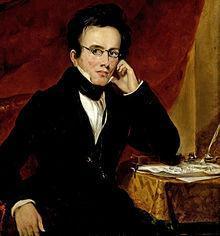
John Goss

1800 - 1880 Person Name: John Goss, 1800-1880 Topics: Canticles and Scripture Paraphrases Composer of "PRAISE, MY SOUL" in The Book of Praise John Goss (b. Fareham, Hampshire, England, 1800; d. London, England, 1880). As a boy Goss was a chorister at the Chapel Royal and later sang in the opera chorus of the Covent Garden Theater. He was a professor of music at the Royal Academy of Music (1827-1874) and organist of St. Paul Cathedral, London (1838-1872); in both positions he exerted significant influence on the reform of British cathedral music. Goss published Parochial Psalmody (1826) and Chants, Ancient and Modern (1841); he edited William Mercer's Church Psalter and Hymn Book (1854). With James Turle he published a two-volume collection of anthems and Anglican service music (1854). Bert Polman

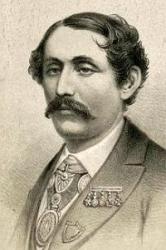
Louis M. Gottschalk

1829 - 1869 Topics: Holy Scriptures; Scriptures Composer of "MERCY" in Great Songs of the Church (Revised) Louis Moreau Gottschalk USA 1829-1869. Born in New Orleans, LA, to a Jewish father and Creole mother, he had six siblings and half-siblings. They lived in a small cottage in New Orleans. He later moved in with relatives (his grandmother and a nurse). He played the piano from an early age and was soon recognized as a prodigy by new Orleans bourgeois establishments. He made a performance debut at the new St. Charles Hotel in 1840. At 13 he left the U.S. And went to Europe with his father, as they realized he needed classical training to fulfill his musical ambitions. The Paris Conservatory rejected him without hearing him play on the grounds of his nationality. Chopin heard him play a concert there and remarked, “Give me your hand, my child, I predict that you will become the king of pianists. Franz Liszt and Charles Valentin Alkan also recognized his extreme talent. He became a composer and piano virtuoso, traveling far and wide performing, first back to the U.S., then Cuba, Puerto Rico, Central and South America. He was taken with music he heard in those places and composed his own. He returned to the States, resting in NJ, then went to New York City. There he mentored a young Venezuelan student, Carreno, and became concerned that she succeed. He was only able to give her a few lessons, yet she would remember him fondly and play his music the rest of her days. A year after meeting Gottschalk, she performed for President Lincoln and went on to become a renowned concern pianist, earning the nickname “Valkyrie of the Piano”. Gottschalk was also interested in art and made connections with notable figures of the New York art world. He traded one of his compositions to his art friend, Frederic Church, for one of Church's landscape paintings. By 1860 Gootschalk had established himself as the best known pianist in the New World. He supported the Union cause during the Civil War and returned to New Orleans only occasionally for concerts. He traveled some 95,000 miles and gave 1000 concerts by 1865. He was forced to leave the U.S. later that year as a result of a scandelous affair with a student at Oakland Female Seminary in Oakland, CA. He never came back to the U.S. He went to South America giving frequent concerts. At one, in Rio de Janeiro, Brazil, he collapsed from yellow fever as he played a concert. He died three weeks later, never recovering from the collapse, possibly from an overdose of quinine or an abdominal infection. He was buried in Brooklyn, NY. Though some of his works were destroyed or disappeared after his death, a number of them remain and have been recorded by various artists. John Perry

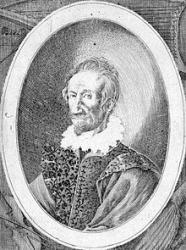
Claude Goudimel

1514 - 1572 Topics: liturgical Scripture Songs Harmonizer of "GENEVAN 42" in Voices United The music of Claude Goudimel (b. Besançon, France, c. 1505; d. Lyons, France, 1572) was first published in Paris, and by 1551 he was composing harmonizations for some Genevan psalm tunes-initially for use by both Roman Catholics and Protestants. He became a Calvinist in 1557 while living in the Huguenot community in Metz. When the complete Genevan Psalter with its unison melodies was published in 1562, Goudimel began to compose various polyphonic settings of all the Genevan tunes. He actually composed three complete harmonizations of the Genevan Psalter, usually with the tune in the tenor part: simple hymn-style settings (1564), slightly more complicated harmonizations (1565), and quite elaborate, motet-like settings (1565-1566). The various Goudimel settings became popular throughout Calvinist Europe, both for domestic singing and later for use as organ harmonizations in church. Goudimel was one of the victims of the St. Bartholomew's Day massacre of Huguenots, which oc­curred throughout France. Bert Polman

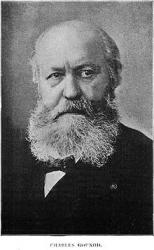
Charles F. Gounod

1818 - 1893 Person Name: Charles F. Gounod, 19th C. Topics: Responses, Musical to Scripture; Musical Responses to Scripture Composer of "LUX FLAT" in The Worshiping Church Charles F. Gounod (b. Paris, France, 1818; d. St. Cloud, France, 1893) was taught initially by his pianist mother. Later he studied at the Paris Conservatory, won the "Grand Prix de Rome" in 1839, and continued his musical training in Vienna, Berlin, and Leipzig. Though probably most famous for his opera Faust (1859) and other instrumental music (including his Meditation sur le Prelude de Bach, to which someone added the Ave Maria text for soprano solo), Gounod also composed church music-four Masses, three Requiems, and a Magnificat. His smaller works for church use were published as Chants Sacres. When he lived in England (1870-1875), Gounod became familiar with British cathedral music and served as conductor of what later became the Royal Choral Society. Bert Polman

John H. Gower

1855 - 1922 Topics: Scripture Composer of "MEDITATION" in The Sing! Hymnal

David Graham

b. 1948 Topics: Praise, Scripture an Other Short Spiritual Songs Author of "Ah, La,La,La" in Songs Rv David Alan Graham USA 1948-present. David Graham grew up in Southern California, he became a speaker, author, businessman, and high school pastor at a church in Southern CA, and then, 1984, a founding director of ‘Youth with a Mission’ (YWAM). He married Kathleen Susan (Kathy) Braham, and they had (at least) four children: Michelle, Kimberly, Jeffrey, and Michael. In 1980, while visiting his cousin with family in a wooded area of MT, he wrote his famous song (noted below) while resting against a Douglas fir tree and seeing beautiful scenery. In 1984 the family moved to Kalispell, MT, where he became Director of a branch of the ‘University of the Nations’, an organization that has sent 10,000+ staff members into the mission field. He held that position for 35 years. He then became assistant director to the North American Division of YWAM, a position he has held for about six years (as of this writing). He authored a book: “They Ride White Horses’, which discusses the value of life and coins the phrase: ‘The end of the search for significance’. The Grahams reside at Kalispell, MT. John Perry

Fred Kimball Graham

b. 1946 Topics: Service Music Prayer For Illumination / Scripture Response Composer of "EMMANUEL COLLEGE" in More Voices Fred Kimball Graham Assistant Professor of Church Music, Emmanuel College of Victoria University Mus.Bac.Ed., University of Toronto, M.M., Eastman School of Music, M.Phil., Drew University, 1985 Ph.D., Drew University, Fred Kimball Graham has been Assistant Professor of Church Music (part-time) since 2001, and Basic Degree Director at Emmanuel College since 2003. He arrived at the College after completing 14 exceptional years as Music and Liturgy Officer at the General Council offices of The United Church of Canada. During his tenure there, the denomination renewed its song resources through publication of Voices United (1996) and its prayer resources through publication of Celebrate God's Presence, both of which involved the worship office in intense ways. He completed the Bachelor of Music (Education) at the University of Toronto, and upon graduation in 1967 received the William Fairclough award, for studies in church music and conducting in Germany for three years. He taught choral and instrumental music in elementary and high schools in Ottawa, ON and Saint John, NB before taking up new duties as music director of the Anglican cathedral in Halifax, NS, as well as adjunct duties at the Atlantic School of Theology (church music, worship coordination) and Dalhousie University (professor of Organ Performance.) During this time he also completed a Master of Music in Organ Performance and Literature at the Eastman School of Music, Rochester, NY in 1981. He was accepted on a full-tuition scholarship in the Liturgical Studies program at Drew University, Madison, NJ in 1985, and completed the Master of Philosophy level in 1985, under the tutelage of the late Bard Thompson, Horton Davies, and Charles Rice. The thesis writing segment, supervised by Robin Leaver, involved researching Methodist hymnbooks of the 19th century in east-coast USA. The thesis is now published by Scarecrow Press as With One Heart and One voice: A Core Repertory of Hymn Tunes Published for the Use in the Methodist Episcopal Church USA 1808-1878. He has always maintained an active role in parish music ministry, serving since 1985 in several United Church congregations in the Toronto area for periods of six months to six years. As a travelling clinician in the areas of worship and music, Graham is well known from coast to coast in Canada's United Church communities. He contributed the hymn tune LIFE RESTORED to the Voices United collection, an arrangement to the Anglican Common Praise (1998), and two new tunes in 2006 to More Voices (supplement to Voices United) named NEW IDENTITY, and EMMANUEL COLLEGE. --almanac.logos.com/

Amy Grant

b. 1960 Topics: The Book of the Church : Holy Scripture Author of "Thy Word Is a Lamp" in The United Methodist Hymnal Amy Lee Grant PhD USA 1960-present Born at Augusta, GA, the youngest of four girls, her family moved to Nashville, TN, in 1967. She is the great granddaughter of Nashville philanthropist, A M Burton (founder of Life & Casualty Tower, WLAC Radio, and WLAC TV, and Lillie Burton). The Burtons attended the Nashville Ashwood Church of Christ, as did she. She wrote her first song: ‘Mountain Top’, at Harpeth School, Nashville, an all-girls school where she attended. In 1977 Grant was offered a recording contract before her 16th birthday after a recording studio owner heard her sing on a demo tape. That studio recorded her first 11 albums. She attended Furman U, Greenville, SC, and later Vanderbilt U, Nashville, TN. She held her first ticketed concert while attending Furman in 1978. In 1982 she married Gary Chapman. They had three children: Matthew Garrison, Gloria Mills (Millie), and Sarah Cannon. Chapman wrote the title track for her 2nd album, and they toured together in 1979. In 1980 she transferred to Vanderbilt U. She became a member of the Kappa Alpha Theta sorority. She made a few more albums before dropping out of college to pursue her recording career. In 1989 her album released was titled: ‘Never Alone’. Another album in 1982 was titled: ‘Age to Age’. In the mid-80s, she began touring and recording with Michael W Smith, and they developed a strong friendship, sometimes writing songs or contributing vocals to each other’s albums. Grant was also a back-up singer for Bill Gaither. She released her first Christmas album in 1983. NBC noticed and asked her to star in her own Christmas special. She developed a reputation as ‘Queen of Christian Pop. In 1984 her album: ‘Straight Ahead’ was released. She also saw success in 1985 as a contemporary pop singer, and released an album titled: ‘Unguarded’. In 1986 she performed secular music with a number of other artists, including, Peter Cetera, Randy Stonehill, and Art Garfunkel. Her album: ‘The Animals Christmas’ came out, and her first book came out that year titled: Amy Grant’s Heart to Heart Bible Stories’. In 1988 her album: ‘Lead Me On’, containing both Christian and secular music was voted the ‘greatest Contemporary Christian album of all time’. In 1991 she released her album: ‘Heart in Motion’, strictly contemporary pop music. Her famous track, ‘Baby, Baby’ was dedicated to her six-week-old daughter, Millie. To date, it has sold over 5 million copies. In 1992 she released her 2nd Christmas album: ‘Home for Christmas’. Another album followed in 1994: ‘House of Love’. In 1997 she released an album: ‘Behind the Eyes’. In 1999, she released her 3rd Christmas album: ‘A Christmas to Remember’. She and Gary Chapman also divorced that year. In 2000 she remarried to Vince Gill, and they have remained married to date. They have a daughter, Corina Grant from this marriage. In 2001 she won $125,000 on the TV show: ‘Who Wants to Be a Millionaire’. That year she also did an audio book titled: ‘The Creation’ (Bible stories for children). In 2002 Grant returned to Christian pop music and released an album of hymns: ‘Legacy.. Hymns and Faith’, a mix of bluegrass and pop music. This was her 25th anniversary in the music industry. Another album in 2003, ‘Simple Things’, was not as successful as earlier releases. In 2005 she released another album: ‘Rock of Ages.. Hymns and Faith’. That year she also hosted a NBC TV show titled ‘Three Wishes’. It featured a team of helpers making wishes come true for small-town residents. It was canceled after its first season due to high production costs. In 2006 she recorded a live CD/DVD titled: ‘Time Again’ at Fort Worth, TX, in Bass Performance Hall. In 2007 she released her book: “Pieces of My Life So Far’ (memories, song lyrics, poetry, and some pictures). In 2007, Grant left Word/Warner and contracted with EMI CMG, who released her regular studio albums as remastered versions. In 2008 she joined a writing team from Compassionart and recorded as a guest vocalist in London. That year she also re-released her 1988 album, ‘Lead Me On’. In 2009 she released an EP with two new songs and some old ones to benefit the Entertainment Industry Foundation’s (EIF) Women’s Cancer Research Fund. In 2010 she released an album titled: ‘Somewhere Down the Road’. In 2012 she received an honorary doctorate degree from Grand Canyon U, Phoenix, AZ, for music performance. That year Grant took part in a campaign called ’30 Songs / 30 Days’ to support the group ‘Half the Sky: Turning Oppression into Opportunity for Women Worldwide’. It was a multi-platform media project. That year she also was a guest narrator for Disney’s Candlelight Processional at Walt Disney World. She repeated as narrator in 2013 and 2015. In 2013 she released an album: ‘How Mercy Looks from Here’. In 2014 she released an album: ‘In motion: the Remixes’. That year she also had a new single in honor of Breast Cancer Awareness Month titled: ‘Welcome Yourself’. In 2015 she released a new compilation album: ‘Be still and Know’. In 2016 she released another album: ‘Tennessee Christmas’. It contained old and new music. She and her husband toured the U S and Canada with Christmas concerts, along with Michael W Smith and Jordan Smith. More similar concerts ensued in 2017. In 2020, Grant had an open-heart surgery to repair a congenital heart condition (PAPVR). In 2022 she sustained a concussion, cuts and bruises, requiring hospitalization, after falling from her bicycle while riding near Nashville’s Harpeth Hills Golf Course. Between 1983-2007 Grant received some 22 Dove Awards for music performance; six Grammies; and other awards, including: JCC Young Tennessean (1992); Pax Christi, St Johns U; Harmony, Nashville Symphony (1994); Sarah Cannon Humanitarian; Minnie Pearl Humanitarian; Voice of America; Golden Plate: Academy of Achievement (1996); Nashville Symphony: TN Performing Arts Center; Amy Grant Room for Music & Entertainment at Target House, St Jude’s Children Hospital (1999); Easter Seals Nashvillian of the Year (2001); Gospel Music Hall of Fame: GMA; Summit: Seminar in the Rockies (2003); Amy Grant Performance Platform: Nashville Schermerhorn Symphony Center; Hollywood Walk of fame (a star) (2006); Christian Music Hall of Fame (2007); Class of 1966 Friend of West Point (2008); Number 52 in the Top Female Artists of the Rock Era-1955-2015 (2015); Kennedy Center Honoree (2022). In 2023 she was again honored with a doctorate in Fine Arts degree from the University of Notre Dame, South Bend, IN. The family continues to live in the Nashville, TN, area. John Perry

David Grant

1833 - 1893 Topics: Scripture Songs; Scripture Songs Arranger of "[The Lord's my Shepherd]" in Hymns of Faith

Robert Grant

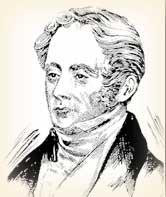
1779 - 1838 Person Name: Robert Grant, 1779-1838 Topics: Canticles and Scripture Paraphrases Paraphraser of "Oh worship the King" in The Book of Praise Robert Grant (b. Bengal, India, 1779; d. Dalpoorie, India, 1838) was influenced in writing this text by William Kethe’s paraphrase of Psalm 104 in the Anglo-Genevan Psalter (1561). Grant’s text was first published in Edward Bickersteth’s Christian Psalmody (1833) with several unauthorized alterations. In 1835 his original six-stanza text was published in Henry Elliott’s Psalm and Hymns (The original stanza 3 was omitted in Lift Up Your Hearts). Of Scottish ancestry, Grant was born in India, where his father was a director of the East India Company. He attended Magdalen College, Cambridge, and was called to the bar in 1807. He had a distinguished public career a Governor of Bombay and as a member of the British Parliament, where he sponsored a bill to remove civil restrictions on Jews. Grant was knighted in 1834. His hymn texts were published in the Christian Observer (1806-1815), in Elliot’s Psalms and Hymns (1835), and posthumously by his brother as Sacred Poems (1839). Bert Polman ======================== Grant, Sir Robert, second son of Mr. Charles Grant, sometime Member of Parliament for Inverness, and a Director of the East India Company, was born in 1785, and educated at Cambridge, where he graduated in 1806. Called to the English Bar in 1807, he became Member of Parliament for Inverness in 1826; a Privy Councillor in 1831; and Governor of Bombay, 1834. He died at Dapoorie, in Western India, July 9, 1838. As a hymnwriter of great merit he is well and favourably known. His hymns, "O worship the King"; "Saviour, when in dust to Thee"; and "When gathering clouds around I view," are widely used in all English-speaking countries. Some of those which are less known are marked by the same graceful versification and deep and tender feeling. The best of his hymns were contributed to the Christian Observer, 1806-1815, under the signature of "E—y, D. R."; and to Elliott's Psalms & Hymns, Brighton, 1835. In the Psalms & Hymns those which were taken from the Christian Observer were rewritten by the author. The year following his death his brother, Lord Glenelg, gathered 12 of his hymns and poems together, and published them as:— Sacred Poems. By the late Eight Hon. Sir Robert Grant. London, Saunders & Otley, Conduit Street, 1839. It was reprinted in 1844 and in 1868. This volume is accompanied by a short "Notice," dated "London, Juno 18, 1839." ===================== Grant, Sir R., p. 450, i. Other hymns are:— 1. From Olivet's sequester'd scats. Palm Sunday. 2. How deep the joy, Almighty Lord. Ps. lxxxiv. 3. Wherefore do the nations wage. Ps. ii. These are all from his posthumous sacred Poems, 1839. --John Julian, Dictionary of Hymnology, Appendix, Part II (1907)

Pages


Export as CSV
It looks like you are using an ad-blocker. Ad revenue helps keep us running. Please consider white-listing Hymnary.org or getting Hymnary Pro to eliminate ads entirely and help support Hymnary.org.