

 My Starred Hymns
 My FlexScores
 My Hymnals
 My Purchased Files
Planning worship?
Check out our sister site, ZeteoSearch.org,
for 20+ additional resources related to your search.
- |
User Links
Person Results
Charles H. Purday
1799 - 1885 Topics: Ordinary Time Week 26 Composer of "SANDON" in Hymns and Devotions for Daily Worship Charles H. Purday (1799-1885) A publisher, composer, lecturer, and writer, Purday had a special interest in church music. He published Crown Court Psalmody (1854), Church and Home Metrical Psalter and Hymnal (1860), which included SANDON, and, with Frances Havergal, Songs of Peace and Joy (1879). A precentor in the Scottish Church in Crown Court, London, Purday sang at the coronation of Queen Victoria. In the publishing field he is known as a strong proponent of better copyright laws to protect the works of authors and publishers.
Bert Polman
Charles H. Purday
Justin Heinrich Knecht
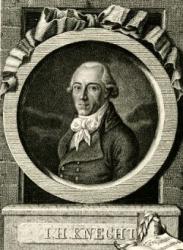
1752 - 1817 Person Name: Justin H. Krecht Topics: Year B, Ordinary Time after Pentecost, August 21-27; Year C, Ordinary Time after Pentecost, October 23-29 Composer of "ST. EDITH" in Psalms for All Seasons Justin Heinrich Knecht Germany 1752-1817. Born at Biberach Baden-Wurttemberg, Germany, he attended a Lutheran college in Esslingen am Neckar from 1768-1771. Having learned the organ, keyboard, violin and oratory, he became a Lutheran preceptor (professor of literature) and music director in Biberach. It was a free imperial city until 1803 and had a rich cultural life. He became organist of St. Martin’s Church in 1792, used by both Lutherans and Catholics, and was there for many years. He led an energetic, busy musical life, composing for both the theatre and church, organizing subscription concerts, teaching music theory, acoustics, aesthetics, composition, and instruments at the Gymnasium, affiliated to the Musikschule in 1806. He went to Stuttgart in 1806 in hopes of a post there as Kapellmeister, serving two years as Konzertmeister, but he was appointed Direktor Beim Orchester by the King of Wurttemberg in 1807. However, he returned to his former life in 1808 and remained there the rest of his life. He died at Biberach. He wrote 10 vocals, 11 opera and stage works, one symphony, 3 chamber music instrumentals, 7 organ works, 4 piano works, and 6 music theories. He was an author composer, editor, contributor, musician, compiler, and lyricist.
John Perry
Justin Heinrich Knecht
John Hullah
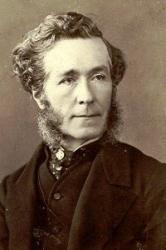
1812 - 1884 Person Name: John Pyke Hullah Topics: Ordinary Time Week 28 Composer of "BENTLEY" in Hymns and Devotions for Daily Worship Born: June 27, 1812, Worcester, England.
Died: February 21, 1884, London, England.
John Hullah
Benjamin Webb
1819 - 1885 Topics: Ordinary Time Week 12 Translator of "O Love, How Deep, How Broad, How High!" in Hymns and Devotions for Daily Worship Benjamin Webb (b. London, England, 1819; d. Marylebone, London, 1885) originally translated the text in eight stanzas, although six only appear in Lift Up Your Hearts. It was published in The Hymnal Noted (1852), produced by his friend John Mason Neale. Webb received his education at Trinity College, Cambridge, England, and became a priest in the Church of England in 1843. Among the parishes he served was St. Andrews, Wells Street, London, where he worked from 1862 to 1881. Webb's years there coincided with the service of the talented choir director and organist Joseph Barnby, and the church became known for its excellent music program. Webb edited The Ecclesiologist, a periodical of the Cambridge Ecclesiological Society (1842-1868). A composer of anthems, Webb also wrote hymns and hymn translations and served as one of the editors of The Hymnary (1872).
Bert Polman
==================
Webb, Benjamin, M.A., was born in London in 1820, and was educated in St. Paul's School; whence he passed to Trinity College, Cambridge, in 1838, B.A. 1842, M.A. 1845. Ordained by the Bishop [Monk] of Gloucester and Bristol he was Assistant Curate of Kemeston in Gloucestershire, 1843-44; of Christ Church, St. Pancras, 1847-49; and of Brasted, Kent, 1849-51; at which date he was presented to the P. C. of Sheen in Staffordshire, which he held until 1862, when he became Vicar of St. Andrews, Wells Street, London. In 1881 the Bishop [Jackson] of London collated him to the Prebend of Portpool in St. Paul's Cathedral. Mr. Webb was one of the Founders of the Cambridge Camden, afterwards the Ecclesiological Society; and the Editor of the Ecclesiologist from 1842 to 1868, as well as the General Editor of the Society's publications. His first appearance in print was as joint editor of Bishop Montague's Articles of Inquiry in 184; in 1843 he was joined with Mr. J. M. Neale in An Essay on Symbolism, and A Translation of Durandus; in 1847 he put forth his valuable work on Continental Ecclesiology; in 1848 he was joint editor with Dr. Mill of Frank’s Sermons, for the Anglo-Catholic Library, and with the Rev. J. Fuller-Russell of Hierurgia Anglicana. After the decease of his father-in-law (Dr. Mill), he edited Dr. Mill's Catechetical Lectures, 1856; a second edition of Dr. Mill's Christian Advocates Publications on the Mythical Interpretation of the Gospels, 1861; and of Dr. Mill's Sermons on our Lord's Temptation, 1873. He was also one of the editors of the Burntisland reprint of the Sarum Missal. One of his most valuable works is Instructions and Prayers for Candidates for Confirmation, of which the third edition was published in 1882. Mr. Webb was one of the original editors of the Hymnal Noted, and of the sub-Committee of the Ecclesiological Society, appointed to arrange the words and the music of that book; and was also the translator of some of the hymns. In conjunction with the Rev. Canon W. Cooke he was editor of the Hymnary, 1872, for which office his habitual reconstruction and composition of the words of the anthems used at St. Andrew's, Wells Street, as well as his connection with the Hymnal Noted, eminently qualified him. His original hymns contributed to the Hymnary, 1871 and 1872, were:--
1. Assessor to thy King. St. Bartholomew. In the Hymnary, 1872.
2. Behold He comes, thy King most holy. Advent. Originally written to be sung in St. Andrew's Church, Wells Street, as an anthem to the music of Schumann's Advent-lied, and afterwards published in the Hymnary, 1872.
3. Praise God, the Holy Trinity. Hymn of Faith. Originally written for use in St. Andrew's, Wells Street, and subsequently in the Hymnary, 1872.
4. Praise the Rock of our salvation. Dedication of a Church. Published in the Hymnary, 1872. Mr. Webb's authorised text is in the Westminster Abbey Hymn Book, 1883.
5. Ye angel hosts above. Universal Praise to God. In the Hymnary, 1872.
He died in London, Nov. 27, 1885. [Rev. William Cooke, M.A.]
-- John Julian, Dictionary of Hymnology (1907)
Benjamin Webb
Frederick W. Foster
1760 - 1835 Topics: Ordinary Time Week 29 Translator of "God Himself Is Present" in Hymns and Devotions for Daily Worship Foster, Frederick William, second son. of William Foster, was born at Bradford, Aug. 1, 1760, and educated at Fulneck, near Leeds, and at Barby in Prussian Saxony. Entering the Moravian Ministry he held several appointments until 1818, when he was consecrated a Bishop of the Moravian Church. He died at Ockbrook, near Derby, April 12, 1835. He compiled the Moravian Hymn Book of 1801, the Supplement of 1808, and the revised edition of 1826. His translations from the German, and his original hymns appeared in that collection. Two of his original hymns are in the Irish Church Hymnal, 1873; (1) "Lord, Who didst sanctify" 1808 (Holiness desired); and (2) "With thanks before the Lord appear," 1826 (Praise of the Saviour). [George Arthur Crawford, M. A.]
--John Julian, Dictionary of Hymnology, Appendix, Part II (1907)
Frederick W. Foster
Roberta Winston Martin
1907 - 1969 Person Name: Roberta Martin Topics: Ordinary Time Week 29 Adapter of "PRAISE GOD" in Hymns and Devotions for Daily Worship Roberta Martin (b 14 Feb. 1907, St. Francis, AR; d 13 Jan. 1969, Chicago, IL). A classically-trained pianist, Roberta Winston Martin directed the junior chorus at Chicago’s Ebenezer Baptist Church starting in 1932. She led the Youth Department of the National Convention of Gospel Choirs and Choruses in its early years. In 1933, Martin organized the Martin and Frye Quartette, a gospel ensemble later called the Roberta Martin Singers. The ensemble toured extensively from the outset and released dozens of recordings for Apollo and Savoy between 1947 and 1969. Martin’s classical flourishes on piano, distinct from Thomas Dorsey’s barrelhouse style, set new standards for gospel accompanists and inspired artists from James Cleveland to Richard Smallwood. She founded the Roberta Martin Studio of Music (1938), where she wrote, arranged, and published many of the most popular songs in the gospel music canon.
Robert Marovich, Hymns & Devotions for Daily Worship: African American Edition, ed. Chris Fenner (2025)
Roberta Winston Martin
Nikolaus Herman
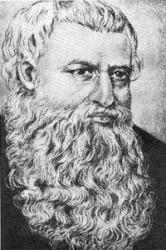
1500 - 1561 Person Name: Nikolaus Herman, 1480-1561 Topics: Year B, Ordinary Time after Pentecost, July 10-16 Adapter of "LOBT GOTT, IHR CHRISTEN" in Psalms for All Seasons Herman, Nicolaus, is always associated with Joachimsthal in Bohemia, just over the mountains from Saxony. The town was not of importance till the mines began to be extensively worked about 1516. Whether Herman was a native of this place is not known, but he was apparently there in 1518, and was certainly in office there in 1524. For many years he held the post of Master in the Latin School, and Cantor or Organist and Choirmaster in the church. Towards the end of his life he suffered greatly from gout, and had to resign even his post as Cantor a number of years before his death. He died at Joachimsthal, May 3, 1561. (Koch, i. 390-398; Allgemeine Deutsche Biographie, xii. 186-188, &c.)
He was a great friend and helper of J. Mathesius (q.v.) (who in 1532 became rector of the school, but in 1541 diaconus and in 1545 pastor of the church), and it was said that whenever Mathesius preached a specially good sermon Herman straightway embodied its leading ideas in a hymn. His hymns, however, were not primarily written for use in church, but were intended for the boys and girls in the schools, to supplant profane songs in the mouths of the young men and women, or for the daily life of the “housefathers and housemothers" in Joachimsthal, at home, and in their work in the mines. He is a poet of the people, homely, earnest, and picturesque in style; by his naiveté reminding us of Hans Sachs. He was an ardent lover of music and a very good organist. The chorales which he published with his hymns are apparently all of his own composition, and are among the best of the Reformation period.
Many of Herman's hymns soon passed into Church use in Germany, and a number are found in almost all books in present use. About 190 in all, they appeared principally in:—
(1) Die Sontags Evangelia uber des gantze Jar, in Gesenge verfasset, für die Kinder und christlichen Haussvetter, &c, Wittenberg, 1560 (dedication by Herman dated Trinity Sunday, 1559), with 101 hymns and 17 melodies. The best are those interspersed specially meant for children and not directly founded on the Gospel for the day. (2) Die Historien von der Sindfludt, Joseph, Mose, Helia, Elisa und der Susanna, sampt etlichen Historien aus den Evangelisten, &c., Wittenberg, 1562 (preface by Herman dated St. Bartholomew's Day, 1560), with 73 hymns and 20 melodies. In this case also the general hymns are the best. A selection of 60 (really 61) of his hymns, with a memoir by K. F. Ledderhose, was published at Halle, 1855.
One of Herman's hymns is noted under “Wenn mein Stündlein vorhanden ist." The others which have passed into English are:—
i. Bescher uns, Herr, das täglioh Brod. Grace before Meat. 1562, as above, and thence in Wackernagel, iii. p. 1228, in 6 stanzas of 4 lines; in Ledderhose, p. 70; and in the Berlin Geistliche Lieder, ed. 1863, No. 1133. Translated as:—
1. Thou art our Father and our God. This, by P. H. Molther, a translation of stanza vi., as No. 180 in the Moravian Hymn Book, 1789 (1849, No. 220, st. v.).
2. As children we are owned by Thee, a translation of stanza vi., as st. iii. of No. 191 in the Moravian Hymn Book, 1801 (1849, No. 220, stanza iii.).
ii. Die helle Sonn leucht jetzt herfür. Morning. 1560, as above, and thence in Wackernagel, iii. p. 1184, in 4 stanzas of 4 lines, in Ledderhose, p. 87; and in the Unverfälschter Liedersegen, 1851, No. 450. Translated as:—
The morning beam revives our eyes, a good and full translation by. A. T. Russell, as No. 71 in the Dalston Hospital Hymn Book 1848.
iii. Erschienen ist der herrliche Tag. Easter. 1560, as above, in 14 stanzas of 4 lines, entitled, "A new Spiritual Song of the Joyful Resurrection of our Saviour Jesus Christ; for the maidens of the girls' school in Joachimsthal”; and thence in Wackernagel, iii. p. 1175; in Ledderhose p. 23, and Unverfälschter Liedersegen, 1851, No. 134. It has reminiscences of the "Erstanden ist der heil'ge Christ". Translated as:—
The day hath dawn'd—-the day of days, a good translation by A. T. Russell of stanzas i., ii., xiii., xiv., as No. 113 in his Psalms & Hymns, 1851.
Another tr. is, "At length appears the glorious day," by Dr. G. Walker, 1860, p. 28.
iv. Hinunter ist der Sonnen Schein. Evening. 1560, as above, and thence in Wackernagel, iii. p. 1184, in 4 stanzas of 4 lines; in Ledderhose, p. 88; and in the Unverfälschter Liedersegen1851, No. 523. Some of the phrases may have been suggested by the "Christe qui lux es et dies" (q. v.). Translated as:—
1. Sunk is the sun's last beam of light, a full and good translation by Miss Cox in her Sacred Hymns from the German, 1841, p. 57. Included in Alford's Psalms & Hymns, 1844, and Tear of Praise, 1867; in Dale's English Hymn Book, 1875; in the Pennsylvania Lutheran Church Book, 1868, and others. It is also given considerably altered and beginning, "Sunk is the Sun! the daylight gone," in W. J. Blew's Church Hymn and Tune Book, 1851-55.
2. The happy sunshine all is gone, in full, by Miss Winkworth in her Lyra Germanica, 1st Ser., 1855, p. 225; repeated in her Chorale Book for England, 1863, and the Ohio Lutheran Hymnal, 1880.
Other translations are: (1) "Did I perhaps Thee somewhat grieve," a translation of stanza iii. in the Moravian Hymn Book, 1789, No. 756. In the 1801 and later eds. (1886, No. 1181, st. iii.), it begins, "Where'er I Thee this day did grieve." (2) "The sun’s fair sheen is past and gone," by H. J. Buckoll, 1842, p. 68. (3) "The sun hath run his daily race," by Lady E. Fortescue, 1843, p. 14.
v. Lobt Gott, ihr Christen alle gleich. Christmas. Written c. 1554, but first published 1560 as above, as the first of "Three Spiritual Christmas Songs of the new-born child Jesus, for the children in Joachimsthal." Thence in Wackernagel iii. p. 1169, in 8 stanzas of 4 lines; in Ledderhose, p. 1; and in the Unverfälschter Liedersegen, 1851, No. 47. It is one of the most popular German Christmas hymns. The melody set to it in 1560 is also by Herman; in 1554 to his "Kommt her ihr liebsten Schwesterlein" [in the Hymnal Companioncalled "St. George's (old)"]. Translated as :—
1. Let all together praise our God, a good translation of stanzas i., iii., vi., viii., by A. T. Russell, as No. 52 in his Psalms & Hymns, 1851. Repeated in Kennedy, 1863, adding a translation of st. ii., and beginning, "Let all creation praise our God."
2. Praise ye the Lord, ye Christians I yea, in full, by E. Cronenwett, as No. 31 in the Ohio Lutheran Hymnal 1880.
Other translations are: (1) "A wondrous change He with us makes," a tr. of stanza viii., ix. as No. 438 in pt. i. of the Moravian Hymn Book, 1754, repeated 1789-1826. (2) "Come, brethren, lets the song arise," by Dr. G. Walker, 1860, p. 26. (3) "Praise God, now Christians, all alike," by Miss Manington, 1864, p. 9. (4) "Praise God, upon His throne on high," in the Sunday Magazine, 1874, p. 384, signed "P. J." The hymn “Shepherds rejoice, lift up your eyes," given by J. C. Jacobi in his Psalmodia Germanica, 1722, p. 8, to Herman's melody (which was first published 1554) is, as stated in his Preface, taken from Bk. i. of Isaac Watts's Horse Lyricae
vi. So wahr ich leb, spricht Gott der Herr. Absolution. 1560, as above, in 11 stanzas of 4 lines, entitled "A hymn on the power of the keys and the virtue of holy absolution; for the children in Joachimsthal." Thence in Wackernagel, iii. p. 1183; in Ledderhose, p. 47; and the Unverfälschter Liedersegen, 1851, No. 429. It probably suggested the better known hymn, "So wahr ich lebe," q. v., by Johann Heermann. Translated as:—
Yea, as I live, Jehovah saith, I do not wish the sinner's death, in full, by Dr. M. Loy, as No. 245, in the Ohio Lutheran Hymnal, 1880. [Rev. James Mearns, M.A.]
--John Julian, Dictionary of Hymnology (1907)
Nikolaus Herman
William Boyd
1847 - 1928 Topics: Ordinary Time Week 16 Composer of "PENTECOST" in Hymns and Devotions for Daily Worship William Boyd Jamaica 1847-1928. Born at Montego Bay, he studied under Sabine-Baring Gould, and attended Worcester College,Oxford. He was ordained an Anglican priest in 1877, eventually becoming Vicar at All Saints Church, Norfolk Square, London.
John Perry
William Boyd
C. G. Gläser
1784 - 1829 Person Name: Carl G. Gläser, 1784-1829 Topics: Ordinary Time, Ninth Sunday C Composer of "AZMON" in Worship (4th ed.) Carl Gotthelf Gläser Germany 1781-1829. Born at Weissenfels, Burgenlandkreis, Sachsen-Anhalt, Germany, he received musical training from his father, after which he attended St. Thomas school in Leipzig. He became an author and composer. At Barmen he taught voice, piano, and violin. He also wrote and conducted chorale music. He died at Barmen.
John Perry
C. G. Gläser
Sydney Carter
1915 - 2004 Person Name: Sydney Carter, 1915-2004 Topics: 9th Sunday in Ordinary Time Year B Author of "I Danced in the Morning" in RitualSong
Sydney Carter
Pages




