

 My Starred Hymns
 My FlexScores
 My Hymnals
 My Purchased Files
Planning worship?
Check out our sister site, ZeteoSearch.org,
for 20+ additional resources related to your search.
- |
User Links
Person Results
W. A. Post
Composer of "[His love extends o'er all the earth]" in Adult Bible Class Hymnal No. 1
W. A. Post
Michael Haydn
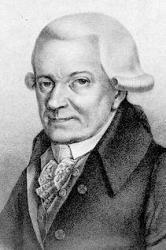
1737 - 1806 Person Name: Johann Michael Haydn, 1737-1808 Composer (attributed to) of "PILGRIM LINE" in One in Faith Johann Michael Haydn Austria 1737-1806. Born at Rohrau, Austria, the son of a wheelwright and town mayor (a very religious man who also played the harp and was a great influence on his sons' religious thinking), and the younger brother of Franz Joseph Haydn, he became a choirboy in his youth at the Cathedral of St. Stephen in Vienna, as did his brother, Joseph, an exceptional singer. For that reason boys both were taken into the church choir. Michael was a brighter student than Joseph, but was expelled from music school when his voice broke at age 17. The brothers remained close all their lives, and Joseph regarded Michael's religious works superior to his own. Michael played harpsichord, violin, and organ, earning a precarious living as a freelance musician in his early years. In 1757 he became kapellmeister to Archbishop, Sigismund of Grosswardein, in Hungary, and in 1762 concertmaster to Archbishop, Hieronymous of Salzburg, where he remained the rest of his life (over 40 years), also assuming the duties of organist at the Church of St. Peter in Salzburg, presided over by the Benedictines. He also taught violin at the court. He married the court singer, Maria Magdalena Lipp in 1768, daughter of the cathedral choir-master, who was a very pious women, and had such an affect on her husband, trending his inertia and slothfulness into wonderful activity. They had one daughter, Aloysia Josepha, in 1770, but she died within a year. He succeeded Wolfgang Amadeus Mozart, an intimate friend, as cathedral organist in 1781. He also taught music to Carl Maria von Weber. His musical reputation was not recognized fully until after World War II. He was a prolific composer of music, considered better than his well-known brother at composing religious works. He produced some 43 symphonies,12 concertos, 21 serenades, 6 quintets, 19 quartets, 10 trio sonatas, 4 due sonatas, 2 solo sonatas, 19 keyboard compositions, 3 ballets, 15 collections of minuets (English and German dances), 15 marches and miscellaneous secular music. He is best known for his religious works (well over 400 pieces), which include 47 antiphons, 5 cantatas, 65 canticles, 130 graduals, 16 hymns, 47 masses, 7 motets, 65 offertories, 7 oratorios, 19 Psalms settings, 2 requiems, and 42 other compositions. He also composed 253 secular vocals of various types. He did not like seeing his works in print, and kept most in manuscript form. He never compiled or cataloged his works, but others did it later, after his death. Lothar Perger catalogued his orchestral works in 1807 and Nikolaus Lang did a biographical sketch in 1808. In 1815 Anton Maria Klafsky cataloged his sacred music. More complete cataloging has been done in the 1980s and 1990s by Charles H Sherman and T Donley Thomas. Several of Michael Haydn's works influenced Mozart. Haydn died at Salzburg, Austria.
John Perry
Michael Haydn
Isaac Watts
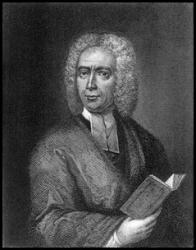
1674 - 1748 Author of "As long as life its term extends" Isaac Watts was the son of a schoolmaster, and was born in Southampton, July 17, 1674. He is said to have shown remarkable precocity in childhood, beginning the study of Latin, in his fourth year, and writing respectable verses at the age of seven. At the age of sixteen, he went to London to study in the Academy of the Rev. Thomas Rowe, an Independent minister. In 1698, he became assistant minister of the Independent Church, Berry St., London. In 1702, he became pastor. In 1712, he accepted an invitation to visit Sir Thomas Abney, at his residence of Abney Park, and at Sir Thomas' pressing request, made it his home for the remainder of his life. It was a residence most favourable for his health, and for the prosecution of his literary labours. He did not retire from ministerial duties, but preached as often as his delicate health would permit.
The number of Watts' publications is very large. His collected works, first published in 1720, embrace sermons, treatises, poems and hymns. His "Horae Lyricae" was published in December, 1705. His "Hymns" appeared in July, 1707. The first hymn he is said to have composed for religious worship, is "Behold the glories of the Lamb," written at the age of twenty. It is as a writer of psalms and hymns that he is everywhere known. Some of his hymns were written to be sung after his sermons, giving expression to the meaning of the text upon which he had preached. Montgomery calls Watts "the greatest name among hymn-writers," and the honour can hardly be disputed. His published hymns number more than eight hundred.
Watts died November 25, 1748, and was buried at Bunhill Fields. A monumental statue was erected in Southampton, his native place, and there is also a monument to his memory in the South Choir of Westminster Abbey. "Happy," says the great contemporary champion of Anglican orthodoxy, "will be that reader whose mind is disposed, by his verses or his prose, to imitate him in all but his non-conformity, to copy his benevolence to men, and his reverence to God." ("Memorials of Westminster Abbey," p. 325.)
--Annotations of the Hymnal, Charles Hutchins, M.A., 1872.
=================================
Watts, Isaac, D.D. The father of Dr. Watts was a respected Nonconformist, and at the birth of the child, and during its infancy, twice suffered imprisonment for his religious convictions. In his later years he kept a flourishing boarding school at Southampton. Isaac, the eldest of his nine children, was born in that town July 17, 1674. His taste for verse showed itself in early childhood. He was taught Greek, Latin, and Hebrew by Mr. Pinhorn, rector of All Saints, and headmaster of the Grammar School, in Southampton. The splendid promise of the boy induced a physician of the town and other friends to offer him an education at one of the Universities for eventual ordination in the Church of England: but this he refused; and entered a Nonconformist Academy at Stoke Newington in 1690, under the care of Mr. Thomas Rowe, the pastor of the Independent congregation at Girdlers' Hall. Of this congregation he became a member in 1693.
Leaving the Academy at the age of twenty, he spent two years at home; and it was then that the bulk of the Hymns and Spiritual Songs (published 1707-9) were written, and sung from manuscripts in the Southampton Chapel. The hymn "Behold the glories of the Lamb" is said to have been the first he composed, and written as an attempt to raise the standard of praise. In answer to requests, others succeeded. The hymn "There is a land of pure delight" is said to have been suggested by the view across Southampton Water. The next six years of Watts's life were again spent at Stoke Newington, in the post of tutor to the son of an eminent Puritan, Sir John Hartopp; and to the intense study of these years must be traced the accumulation of the theological and philosophical materials which he published subsequently, and also the life-long enfeeblement of his constitution.
Watts preached his first sermon when he was twenty-four years old. In the next three years he preached frequently; and in 1702 was ordained pastor of the eminent Independent congregation in Mark Lane, over which Caryl and Dr. John Owen had presided, and which numbered Mrs. Bendish, Cromwell's granddaughter, Charles Fleetwood, Charles Desborough, Sir John Hartopp, Lady Haversham, and other distinguished Independents among its members. In this year he removed to the house of Mr. Hollis in the Minories. His health began to fail in the following year, and Mr. Samuel Price was appointed as his assistant in the ministry. In 1712 a fever shattered his constitution, and Mr. Price was then appointed co-pastor of the congregation which had in the meantime removed to a new chapel in Bury Street. It was at this period that he became the guest of Sir Thomas Abney, under whose roof, and after his death (1722) that of his widow, he remained for the rest of his suffering life; residing for the longer portion of these thirty-six years principally at the beautiful country seat of Theobalds in Herts, and for the last thirteen years at Stoke Newington. His degree of D.D. was bestowed on him in 1728, unsolicited, by the University of Edinburgh. His infirmities increased on him up to the peaceful close of his sufferings, Nov. 25, 1748. He was buried in the Puritan restingplace at Bunhill Fields, but a monument was erected to him in Westminster Abbey.
His learning and piety, gentleness and largeness of heart have earned him the title of the Melanchthon of his day. Among his friends, churchmen like Bishop Gibson are ranked with Nonconformists such as Doddridge. His theological as well as philosophical fame was considerable. His Speculations on the Human Nature of the Logos, as a contribution to the great controversy on the Holy Trinity, brought on him a charge of Arian opinions. His work on The Improvement of the Mind, published in 1741, is eulogised by Johnson. His Logic was still a valued textbook at Oxford within living memory. The World to Come, published in 1745, was once a favourite devotional work, parts of it being translated into several languages. His Catechisms, Scripture History (1732), as well as The Divine and Moral Songs (1715), were the most popular text-books for religious education fifty years ago. The Hymns and Spiritual Songs were published in 1707-9, though written earlier. The Horae Lyricae, which contains hymns interspersed among the poems, appeared in 1706-9. Some hymns were also appended at the close of the several Sermons preached in London, published in 1721-24. The Psalms were published in 1719. The earliest life of Watts is that by his friend Dr. Gibbons. Johnson has included him in his Lives of the Poets; and Southey has echoed Johnson's warm eulogy. The most interesting modern life is Isaac Watts: his Life and Writings, by E. Paxton Hood. [Rev. H. Leigh Bennett, M.A.]
A large mass of Dr. Watts's hymns and paraphrases of the Psalms have no personal history beyond the date of their publication. These we have grouped together here and shall preface the list with the books from which they are taken.
(l) Horae Lyricae. Poems chiefly of the Lyric kind. In Three Books Sacred: i.To Devotion and Piety; ii. To Virtue, Honour, and Friendship; iii. To the Memory of the Dead. By I. Watts, 1706. Second edition, 1709. (2) Hymns and Spiritual Songs. In Three Books: i. Collected from the Scriptures; ii. Composed on Divine Subjects; iii. Prepared for the Lord's Supper. By I. Watts, 1707. This contained in Bk i. 78 hymns; Bk. ii. 110; Bk. iii. 22, and 12 doxologies. In the 2nd edition published in 1709, Bk. i. was increased to 150; Bk. ii. to 170; Bk. iii. to 25 and 15 doxologies. (3) Divine and Moral Songs for the Use of Children. By I. Watts, London, 1715. (4) The Psalms of David Imitated in the Language of the New Testament, And apply'd to the Christian State and Worship. By I. Watts. London: Printed by J. Clark, at the Bible and Crown in the Poultry, &c, 1719. (5) Sermons with hymns appended thereto, vol. i., 1721; ii., 1723; iii. 1727. In the 5th ed. of the Sermons the three volumes, in duodecimo, were reduced to two, in octavo. (6) Reliquiae Juveniles: Miscellaneous Thoughts in Prose and Verse, on Natural, Moral, and Divine Subjects; Written chiefly in Younger Years. By I. Watts, D.D., London, 1734. (7) Remnants of Time. London, 1736.
454 Hymns and Versions of the Psalms, in addition to the centos are all in common use at the present time.
--Excerpts from John Julian, Dictionary of Hymnology (1907)
==================================
Watts, I. , p. 1241, ii. Nearly 100 hymns, additional to those already annotated, are given in some minor hymn-books.
--John Julian, Dictionary of Hymnology, Appendix, Part II (1907)
=================
Watts, I. , p. 1236, i. At the time of the publication of this Dictionary in 1892, every copy of the 1707 edition of Watts's Hymns and Spiritual Songs was supposed to have perished, and all notes thereon were based upon references which were found in magazines and old collections of hymns and versions of the Psalms. Recently three copies have been recovered, and by a careful examination of one of these we have been able to give some of the results in the revision of pp. 1-1597, and the rest we now subjoin.
i. Hymns in the 1709 ed. of Hymns and Spiritual Songs which previously appeared in the 1707 edition of the same book, but are not so noted in the 1st ed. of this Dictionary:—
On pp. 1237, L-1239, ii., Nos. 18, 33, 42, 43, 47, 48, 60, 56, 58, 59, 63, 75, 82, 83, 84, 85, 93, 96, 99, 102, 104, 105, 113, 115, 116, 123, 124, 134, 137, 139, 146, 147, 148, 149, 162, 166, 174, 180, 181, 182, 188, 190, 192, 193, 194, 195, 197, 200, 202.
ii. Versions of the Psalms in his Psalms of David, 1719, which previously appeared in his Hymns and Spiritual Songs, 1707:—
On pp. 1239, U.-1241, i., Nos. 241, 288, 304, 313, 314, 317, 410, 441.
iii. Additional not noted in the revision:—
1. My soul, how lovely is the place; p. 1240, ii. 332. This version of Ps. lxiv. first appeared in the 1707 edition of Hymns & Spiritual Songs, as "Ye saints, how lovely is the place."
2. Shine, mighty God, on Britain shine; p. 1055, ii. In the 1707 edition of Hymns & Spiritual Songs, Bk. i., No. 35, and again in his Psalms of David, 1719.
3. Sing to the Lord with [cheerful] joyful voice, p. 1059, ii. This version of Ps. c. is No. 43 in the Hymns & Spiritual Songs, 1707, Bk. i., from which it passed into the Ps. of David, 1719.
A careful collation of the earliest editions of Watts's Horae Lyricae shows that Nos. 1, 7, 9, 10, 11, 12, 14, 16, p. 1237, i., are in the 1706 ed., and that the rest were added in 1709. Of the remaining hymns, Nos. 91 appeared in his Sermons, vol. ii., 1723, and No. 196 in Sermons, vol. i., 1721. No. 199 was added after Watts's death. It must be noted also that the original title of what is usually known as Divine and Moral Songs was Divine Songs only.
--John Julian, Dictionary of Hymnology, New Supplement (1907)
===========
See also in:
Hymn Writers of the Church
Isaac Watts
Samuel Stennett
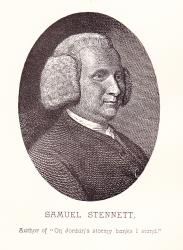
1727 - 1795 Author of "O'er all those wide extended plains" Samuel Stennett was born at Exeter, in 1727. His father was pastor of a Baptist congregation in that city; afterwards of the Baptist Chapel, Little Wild Street, London. In this latter pastorate the son succeeded the father in 1758. He died in 1795. Dr. Stennett was the author of several doctrinal works, and a few hymns.
--Annotations of the Hymnal, Charles Hutchins, M.A. 1872.
======================
Stennett, Samuel, D.D., grandson of Joseph Stennett, named above, and son of the Rev. Joseph Stennett, D.D., was born most pro;bably in 1727, at Exeter, where his father was at that time a Baptist minister. When quite young he removed to London, his father having become pastor of the Baptist Church in Little Wild Street, Lincoln's Inn Fields. In 1748, Samuel Stennett became assistant to his father in the ministry, and in 1758 succeeded him in the pastoral office at Little Wild Street. From that time until his death, on Aug. 24, 1795, he held a very prominent position among the Dissenting ministers of London. He was much respected by some of the statesmen of the time, and used his influence with them in support of the principles of religious freedom. The celebrated John Howard was a member of his congregation and an attached friend. In 1763, the University of Aberdeen conferred on him the degree of D.D. Dr. S. Stennett's prose publications consist of volumes of sermons, and pamphlets on Baptism and on Nonconformist Disabilities. He wrote one or two short poems, and contributed 38 hymns to the collection of his friend, Dr. Rippon (1787). His poetical genius was not of the highest order, and his best hymns have neither the originality nor the vigour of some of his grandfather's. The following, however, are pleasing in sentiment and expression, and are in common use more especially in Baptist congregations:—
1. And have I, Christ, no love for Thee? Love for Christ desired.
2. And will the offended God again? The Body the Temple of the Holy Ghost.
3. As on the Cross the Saviour hung. The Thief on the Cross.
4. Behold the leprous Jew. The healing of the Leper.
5. Come, every pious heart. Praise to Christ.
6. Father, at Thy call, I come. Lent.
7. Great God, amid the darksome night. God, a Sun.
8. Great God, what hosts of angels stand. Ministry of Angels.
9. Here at Thy Table, Lord, we meet. Holy Communion.
10. How charming is the place. Public Worship.
11. How shall the sons of men appear? Acceptance through Christ alone.
12. How soft the words my [the] Saviour speaks. Early Piety.
13. How various and how new. Divine Providence.
14. Not all the nobles of the earth. Christians as Sons of God.
15. On Jordan's stormy banks I stand. Heaven anticipated.
16. Prostrate, dear Jesus, at thy feet. Lent. Sometimes, "Dear Saviour, prostrate at Thy feet."
17. Should bounteous nature kindly pour. The greatest of these is Love. From this, "Had I the gift of tongues," st. iii., is taken.
18. Thy counsels of redeeming grace. Holy Scripture. From "Let avarice, from shore to shore."
19. Thy life 1 read, my dearest Lord. Death in Infancy. From this "'Tis Jesus speaks, I fold, says He."
20. 'Tis finished! so the Saviour cried. Good Friday.
21. To Christ, the Lord, let every tongue. Praise of Christ. From this,"Majestic sweetness sits enthroned," st. iii., is taken.
22. To God, my Saviour, and my King. Renewing Grace.
23. To God, the universal King. Praise to God.
24. What wisdom, majesty, and grace. The Gospel. Sometimes, “What majesty and grace."
25. Where two or three with sweet accord. Before the Sermon.
26. Why should a living man complain? Affliction. From this, "Lord, see what floods of sorrow rise," st. iii., is taken.
27. With tears of anguish I lament. Lent.
28. Yonder amazing sight I see. Good Friday.
All these hymns, with others by Stennett, were given in Rippon's Baptist Selection, 1787, a few having previously appeared in A Collection of Hymns for the use of Christians of all Denominations, London. Printed for the Booksellers, 1782; and No. 16, in the 1778 Supplement to the 3rd edition of the Bristol Baptist Selection of Ash and Evans. The whole of Stennett's poetical pieces and hymns were included in vol. ii. of his Works, together with a Memoir, by W. J. Jones. 4 vols., 1824. [Rev. W. R. Stevenson, M.A.]
--John Julian, Dictionary of Hymnology (1907)
Samuel Stennett
John S. B. Monsell
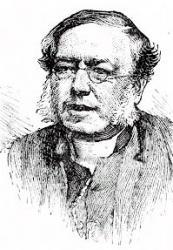
1811 - 1875 Person Name: John Samuel Bewley Monsell Composer of "MONSELL" in The Cyber Hymnal John Samuel Bewley Monsell (b. St. Colomb's, Londonderry, Ireland, 1811; d. Guilford, Surrey, England, 1875) was educated at Trinity College in Dublin and served as a chaplain and rector of several churches in Ireland after his ordination in 1835. Transferred to England in 1853, he became rector of Egham in Surrey and was rector of St. Nicholas Church in Guilford from 1870 until his death (caused by a construction accident at his church). A prolific poet, Monsell published his verse in eleven volumes. His three hundred hymns, many celebrating the seasons of the church year, were issued in collections such as Hymns and Miscellaneous Poems (1837), Spiritual Songs (1857), Hymns of Love and Praise (1863), and The Parish Hymnal (1873).
Bert Polman
===============================
Monsell, John Samuel Bewley, L.L.D., son of Thomas Bewley Monsell, Archdeacon of Londonderry, was born at St. Columb's, Londonderry, March 2,1811, and educated at Trinity College, Dublin (B.A. 1832, LL.D. 1856). Taking Holy Orders in 1834, "he was successively Chaplain to Bishop Mant, Chancellor of the diocese of Connor, Rector of Ramoan, Vicar of Egham, diocese Worcester, and Rector of St. Nicholas's, Guildford. He died in consequence of a fall from the roof of his church, which was in the course of rebuilding, April 9, 1875. His prose works include Our New Vicar, 1867; The Winton Church Catechist, &c. His poetical works are:—
(1) Hymns and Miscellaneous Poems, Dublin, W. Curry, Jun., & Co., 1837; (2) Parish Musings, or Devotional Poems, 1850; (3) Spiritual Songs for the Sundays and Holy Days throughout the Year. 1857 (People's Ed., 1875); (4) His Presence, not His Memory, 1855, 1858; (5) Hymns of Love and Praise for the Church's Year, 1863 (2nd ed. 1866); (6) The Passing Bell; Ode to The Nightingales, and Other Poems, 1867; (7) Litany Hymns, 1869; (8) The Parish Hymnal after the Order of The Book of Common Prayer, 1873; (9)Watches by the Cross, 1874; (10) Simon the Cyrenian; and Other Poems; (11) Nursery Carols.
In these works several hymns which appeared in the earlier books are repeated in the later, and thus at first sight his compositions seem to be more in number than they really are. The total amounts to nearly 300, and of these about one-fourth are in common use. The most popular of these are, "God is love; that anthem olden"; "God of that glorious gift of grace"; "Holy offerings, rich and rare"; “Lord of the living harvest"; "Mighty Father, Blessed Son"; and "Sing to the Lord a joyful song." In addition to those which are annotated under their respective first lines, the following are in common use:—
i. Appeared in his Hymns and Miscellaneous Poems, Dublin, 1837.
1. Birds have their quiet nests. Humility of Christ.
2. Dark and dim the day-light rose. Good Friday.
3. Friend of the friendless and the lone. Jesus, the Friend.
4. My God, what wondrous love was Thine. Whitsuntide.
5. O for a heart more fervent. Holiness desired.
6. O for the time when on the world. Missions.
7. The springtide hour brings leaf and flower. Spring.
8. This day the Lord is risen. Easter.
9. When cold our hearts and far from Thee. Teach us to Pray.
10. Why restless, why so weary? Providence.
11. Yes, I do feel, my God, that I am Thine. Assurance.
ii. Appeared in his Parish Musings, 1850.
12. In Thee, my [O] God, will we rejoice. Trust in God.
13. Lord, dependent on Thy promise. Holy Baptism.
14. Members of Christ, Children of God. Confirmation.
15. So teach me, Lord, to number. The Old and New Year.
16. Soon [soon] and for ever. Death anticipated.
17. The broken, contrite heart oppress'd. Promises of God.
18. Thou art near, yes, Lord, I feel it. Divine Support.
19. Would'st thou learn the depths of sin? Passiontide.
iii. Appeared in his Spiritual Songs, 1857.
20. A few bright leaders of her host. All Saints.
21. A happy, happy [merry, merry] Christmas. New Year's Day.
22. Blessed hope, that we the fallen [sinful]. Hope.
23. Heart in heart, and hand in hand. SS. Simon and Jude.
24. Jesus, my loving Lord! I know. Resignation.
25. Last Sunday of the work-day year. Sunday after Christmas Day.
26. Loved by God the Father. Holy Baptism.
27. Mercy, mercy, God the Father. Lent.
28. My head is low, my heart is sad. Confirmation. (Penitential.)
29. Oft doth the Christian's heart inquire. Christian Duty.
30. 0 God, most mighty, listen now. Charities. From "When languid frame or throbbing pulse."
31. 0 holy Sabbath day. Sunday.
32. 0 Lord, what records of Thy love. St. Barnabas. Sometimes, “Lord God, what records of Thy love."
33. 0 love, divine and golden. Holy Matrimony. From this, "Love divine and tender" is taken.
34. One lesson more the Church must learn. Waiting on God. From this, “One lesson Christ His own would teach" is taken.
35. Proudly in his [the] hall of judgment. Tuesday before Easter.
36. Sinful, sighing to be blest. Lent.
37. The Church of God, with equal care. St. James.
38. The journey done; The rest begun. Burial.
39. The simple trust that can confide. Trust.
40. Weary and sad, a wanderer from Thee. Lent.
iv. Appeared, in his Hymns of Love and Praise, 1863, and 2nd ed., 1866.
41. Bounteous blesser of the seedtime. Sexagesima. Seed Time.
42. Brightly hopeful for the future. God's mercy through life.
43. Christ is risen! Alleluia! Easter.
44. Come and deck the grave with flowers. Easter Eve.
45. Fight the good fight with all thy might. Fight of Faith.
46. Holy Spirit, long expected. Whitsuntide.
47. Hours and days and months and years. The Circumcision.
48. I have no comfort but Thy love. The Comfort of Love.
49. I knew Thee in the land of drought. A Song of Love.
60. I think of Thee, my God by night. Evening.
61. Jesu, gentle Sufferer, say. Good Friday.
52. Labouring and heavy-laden. Lent.
53. Light of the world, we hail Thee. Missions.
54. Lord, to whom except to Thee? Holy Communion.
55. My sins, my sins, my Saviour. Ash Wednesday.
56. O'er the distant mountains breaking. Second Advent.
57. Other Name than our dear Lord's. Jesus All and in All.
58. Pity on us, heavenly Father. Litany Hymn for Lent.
59. Praise the Lord, rejoice, ye Gentiles. Advent, or Missions.
60. Rest of the weary, joy of the sad. Jesus, the Saviour and Friend.
61. Shadow of a mighty Rock. Jesus, the Rock of Ages.
62. Sing, 0 heaven; 0 earth rejoice. Ascension.
63. Sweet is the gentle voice of spring. Seed Time.
64. Sweet is Thy mercy, Lord. Divine Mercy.
65. Teach me to do the thing that pleaseth Thee. Divine Teaching.
66. The good old times, how glorious. Advent.
67. The world may in its wealth delight. Rejoicing in the Lord. An altered form of "Let others in their wealth delight."
68. Though Thou slay me, I will trust. Faith.
69. To Christ the Lord! The Incarnate Word. Christmas.
70. When I had wandered from His fold. The Love of God.
v. Appeared in his Litany Hymns, 1869.
71. Lay the precious body, In the quiet grave. Burial.
72. My sins have taken such a hold on me. Litany of Repentance.
vi. Appeared in his Parish Hymnal, 1873.
73. I hunger and I thirst. Septuagesima.
Dr. Monsell’s hymns are as a whole bright, joyous, and musical; but they lack massiveness, concentration of thought, and strong emotion. A few only are of enduring excellence.
--John Julian, Dictionary of Hymnology 1907
=====================
Monsell, J, S. B., p. 762, ii. Additional hymns in common use include:—
1. Blessed Lord, Who, till the morning. Holy Scriptures. From his Spiritual Songs, 1857.
2. Christ incarnate in His poor. Christ in His Poor. From his Hymns of Love and Praise, 1863.
3. We ask for life, and mean thereby. Life and Work. From his Hymns of Love and Praise, 1863.
--John Julian, Dictionary of Hymnology, Appendix, Part II (1907)
====================
Monsell, J. S. B. Since the article on pp. 762-3 was written, copies of the original editions of Dr. Monsell's works have come into our hands, and from them we have to make the following corrections, the numbers following being those given to the first lines of the hymns on pp. 762-3:—
15. So teach me, &c. Hymns and Misc. Poems, 1837, p. 30.
17. The broken, &c. Hymns and Misc. Poems, 1837, p. 49.
18. Thou art near, &c. Hymns and Misc. Poems, 1837, p. 21.
19. Would'st thou, &c. Hymns and Misc. Poems, 1837, p. 14.
26. Loved by God, &c. Parish Hymnal, 1873, No. 181.
27. Mercy, mercy, &c. Prayers and Litanies, 1861,
p. 119.
28. My head is low, &c. Hymns of Love and Praise, 1866,
p. 125.
33. O Love divine, &c. Hymns of Love and Praise, p. 131.
38. The journey done, &c. Hymns of Love and Praise, p. 134.
40. Weary and sad, &c. Parish Hymnal, 1873, No. 209.
41-50. Hymns of Love and Praise, 1863.
51. See "Day of loss," &c, p. 282, i.
52. Labouring, &c. Prayers and Litanies, 1861, p. 116. 53-57. Hymns of Love and Praise, 1863.
58. Pity on us, &c. Prayers and Litanies, 1861, p. 125.
59. Praise the Lord, &c. Hymns of Love and Praise, 1863,
p. 13.
60. 61, 62, 64, 65. Prayers and Litanies, 1861.
63, 66-70. Hymns of Love and Praise, 1863.
72. My sins, &c. Hymns of Love and Praise, 1866, p. 34.
73. I hunger, &c. Hymns of Love and Praise, 1866, p. 128.
It will be seen from this list of additions and corrections that Dr. Monsell multiplied his works by giving much the same material under new titles, and that his Prayers and Litanies of 1861 were unknown to us when the original article was written. "We can sincerely add that few hymn writers are so perplexing to the annotator as Dr. Monsell. [Rev. James Mearns, M.A.]
--John Julian, Dictionary of Hymnology, New Supplement (1907)
John S. B. Monsell
William M. Runyan
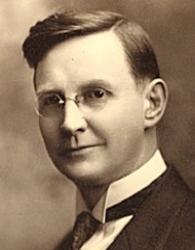
1870 - 1957 Person Name: W. M. R. Author of "Lord, I Am Coming" in Songs of the Great Salvation Showing early musical promise, William Marion Runyan (b. Marion, NY, 1870; d. Pittsburg, KS, 1957) was a substitute church organist by the age of twelve. He became a Methodist minister in 1891 and served several churches in Kansas but turned to evangelism in 1903; he worked for the Central Methodist Conference for the next twenty years. Following that service, Runyan became pastor at the Federated Church at John Brown University, Sulphur Springs, Arkansas. Editor of Christian Workers Magazine, he also served the Moody Bible Institute and was an editor for Hope Publishing Company until his retirement in 1948. Runyan wrote a number of hymn texts, gospel songs, and hymn tunes.
Bert Polman
William M. Runyan
C. W. Foss
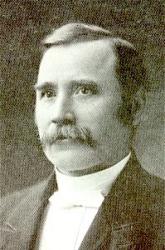
1855 - 1935 Person Name: Claude W. Foss Translator of "Thy Scepter, Jesus, Shall Extend" in The Hymnal and Order of Service Born: August 28, 1855, Geneva, Illinois.
Died: February 8, 1935, Rock Island, Illinois.
Son of Swedish immigrants, Foss attended the Red Wing College institute at Red Wing, Minnesota, then entered Augustana College at Rock Island, Illinois, in 1879. He graduated with his bachelor’s degree in June 1883. In 1884, he became professor of history and political science at Augustana College. In 1888 he became vice-president of the college, and served until 1900. On the death of Dr. T. N. Hasselquist he was acting president until the election of Dr. Olof Olsson as president in 1891. Upon Olsson’s death, Foss again served as acting president until Dr. Gustav Andreen became president.
In addition to his academic positions, Foss was on the board of directors of the Augustana Book Concern, the Board of Home Missions for the Augustana Synod, and was treasurer of the Synod’s Board of Foreign Missions. In 1908, the General Council of the Evangelical Lutheran Church in North America sent him as a commissioner to inspect its mission field in southern India, where he traveled extensively (1908-09). Upon completing his work in India, he inspected the Synod’s mission in Persia in 1909, and traveled in Egypt, the Holy Land, Asia Minor, southern Russia, and south and central Europe.
Foss also found time to edit the Lutheran Quarterly Review, the Augustana Journal, and the Olive Leaf, and contributed to various other magazines and periodicals. His largest literary work was Glimpses of Three Continents, a travelogue through India, the Bible lands and Europe (Augustana Book Concern, 1912).
Foss belonged to the American Institute of Civics, the American Academy of Political and Social Science, the American Historical Association, and the Swedish Historical Society of America. He was a member of the Grace Lutheran Church in Rock Island, Illinois.
--www.hymntime.com/tch/
C. W. Foss
C. E. F. Weyse
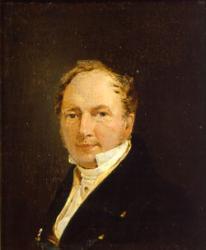
1774 - 1842 Composer of "[Lo, the Lord extends His hand]" in Hymnal for Church and Home Weyse, Christoph Ernst Friedrich; b. Mar. 5, 1774, Altona (now in W. Germany), d. Oct. 8, 1842, Copenhagen; Danish composer of German extraction
C. E. F. Weyse
R. M. McIntosh
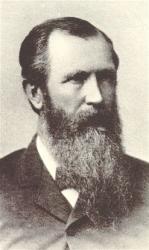
1836 - 1889 Composer of "[When our hearts are sad, the Saviour will extend]" in Good News Used Pseudonym: Robert M. McIntosh
==========
Rigdon (Robert) McCoy McIntosh USA 1836-1899 Born at Maury County, TN, into a farming family, he attended Jackson College in Columbia, TN, graduating in 1854. He studied music under Asa Everett in Richmond, VA, and became a traveling singing school teacher. He also served briefly in the Civil War. He wrote several hymns during this period of his life. In 1860 he married Sarah McGlasson, and they had a daughter, Loulie Everett. In 1875 he was appointed head of the Vanderbilt University Music Department in Nashville, TN. In 1877 he joined the faculty of Emory College, Oxford, GA. In 1895 he left Emory College to devote his time to the R M McIntosh Publishing Company. He also served as music editor of the Methodist Episcopal Church South Publishing House for over 30 years. His song book publications include: “Good news” (1876), “Light & life” (1881), “Prayer & praise” (1883), “New life” (1879), “New life #2” (1886), and “Songs of service” (1896). He died in Atlanta, GA.
John Perry
R. M. McIntosh
Pages




