You help make Hymnary.org possible. More than 10 million people from 200+ countries found hymns, liturgical resources and encouragement on Hymnary.org in 2025, including you. Every visit affirms the global impact of this ministry.

If Hymnary has been meaningful to you this year, would you take a moment today to help sustain it? A gift of any size—paired with a note of encouragement if you wish—directly supports the server costs, research work and curation that keep this resource freely available to the world.

Give securely online today, or mail a check to:
Hymnary.org
Calvin University
3201 Burton Street SE
Grand Rapids, MI 49546

Thank you for your partnership, and may the hope of Advent fill your heart.

Person Results

Tune Identifier:"^gott_sei_dank_freylinghausen$"
In:person

Planning worship? Check out our sister site, ZeteoSearch.org, for 20+ additional resources related to your search.
Showing 41 - 50 of 79Results Per Page: 102050

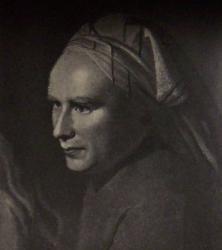
William Cowper

1731 - 1800 Author of "I Will Praise Thee Every Day" in The Cyber Hymnal William Cowper (pronounced "Cooper"; b. Berkampstead, Hertfordshire, England, 1731; d. East Dereham, Norfolk, England, 1800) is regarded as one of the best early Romantic poets. To biographers he is also known as "mad Cowper." His literary talents produced some of the finest English hymn texts, but his chronic depression accounts for the somber tone of many of those texts. Educated to become an attorney, Cowper was called to the bar in 1754 but never practiced law. In 1763 he had the opportunity to become a clerk for the House of Lords, but the dread of the required public examination triggered his tendency to depression, and he attempted suicide. His subsequent hospitalization and friendship with Morley and Mary Unwin provided emotional stability, but the periods of severe depression returned. His depression was deepened by a religious bent, which often stressed the wrath of God, and at times Cowper felt that God had predestined him to damnation. For the last two decades of his life Cowper lived in Olney, where John Newton became his pastor. There he assisted Newton in his pastoral duties, and the two collaborated on the important hymn collection Olney Hymns (1779), to which Cowper contributed sixty-eight hymn texts. Bert Polman ============ Cowper, William, the poet. The leading events in the life of Cowper are: born in his father's rectory, Berkhampstead, Nov. 26, 1731; educated at Westminster; called to the Bar, 1754; madness, 1763; residence at Huntingdon, 1765; removal to Olney, 1768; to Weston, 1786; to East Dereham, 1795; death there, April 25, 1800. The simple life of Cowper, marked chiefly by its innocent recreations and tender friendships, was in reality a tragedy. His mother, whom he commemorated in the exquisite "Lines on her picture," a vivid delineation of his childhood, written in his 60th year, died when he was six years old. At his first school he was profoundly wretched, but happier at Westminster; excelling at cricket and football, and numbering Warren Hastings, Colman, and the future model of his versification. Churchill, among his contemporaries or friends. Destined for the Bar, he was articled to a solicitor, along with Thurlow. During this period he fell in love with his cousin, Theodora Cowper, sister to Lady Hesketh, and wrote love poems to her. The marriage was forbidden by her father, but she never forgot him, and in after years secretly aided his necessities. Fits of melancholy, from which he had suffered in school days, began to increase, as he entered on life, much straitened in means after his father's death. But on the whole, it is the playful, humorous side of him that is most prominent in the nine years after his call to the Bar; spent in the society of Colman, Bonnell Thornton, and Lloyd, and in writing satires for The Connoisseur and St. James's Chronicle and halfpenny ballads. Then came the awful calamity, which destroyed all hopes of distinction, and made him a sedentary invalid, dependent on his friends. He had been nominated to the Clerkship of the Journals of the House of Lords, but the dread of appearing before them to show his fitness for the appointment overthrew his reason. He attempted his life with "laudanum, knife and cord,"—-in the third attempt nearly succeeding. The dark delusion of his life now first showed itself—a belief in his reprobation by God. But for the present, under the wise and Christian treatment of Dr. Cotton (q. v.) at St. Albans, it passed away; and the eight years that followed, of which the two first were spent at Huntingdon (where he formed his lifelong friendship with Mrs. Unwin), and the remainder at Olney in active piety among the poor, and enthusiastic devotions under the guidance of John Newton (q. v.), were full of the realisation of God's favour, and the happiest, most lucid period of his life. But the tension of long religious exercises, the nervous excitement of leading at prayer meetings, and the extreme despondence (far more than the Calvinism) of Newton, could scarcely have been a healthy atmosphere for a shy, sensitive spirit, that needed most of all the joyous sunlight of Christianity. A year after his brother's death, madness returned. Under the conviction that it was the command of God, he attempted suicide; and he then settled down into a belief in stark contradiction to his Calvinistic creed, "that the Lord, after having renewed him in holiness, had doomed him to everlasting perdition" (Southey). In its darkest form his affliction lasted sixteen months, during which he chiefly resided in J. Newton's house, patiently tended by him and by his devoted nurse, Mrs. Unwin. Gradually he became interested in carpentering, gardening, glazing, and the tendance of some tame hares and other playmates. At the close of 1780, Mrs. Unwin suggested to him some serious poetical work; and the occupation proved so congenial, that his first volume was published in 1782. To a gay episode in 1783 (his fascination by the wit of Lady Austen) his greatest poem, The Task, and also John Gilpin were owing. His other principal work was his Homer, published in 1791. The dark cloud had greatly lifted from his life when Lady Hesketh's care accomplished his removal to Weston (1786): but the loss of his dear friend William Unwin lowered it again for some months. The five years' illness of Mrs. Unwin, during which his nurse of old became his tenderly-watched patient, deepened the darkness more and more. And her death (1796) brought “fixed despair," of which his last poem, The Castaway, is the terrible memorial. Perhaps no more beautiful sentence has been written of him, than the testimony of one, who saw him after death, that with the "composure and calmness" of the face there “mingled, as it were, a holy surprise." Cowper's poetry marks the dawn of the return from the conventionality of Pope to natural expression, and the study of quiet nature. His ambition was higher than this, to be the Bard of Christianity. His great poems show no trace of his monomania, and are full of healthy piety. His fame as a poet is less than as a letter-writer: the charm of his letters is unsurpassed. Though the most considerable poet, who has written hymns, he has contributed little to the development of their structure, adopting the traditional modes of his time and Newton's severe canons. The spiritual ideas of the hymns are identical with Newton's: their highest note is peace and thankful contemplation, rather than joy: more than half of them are full of trustful or reassuring faith: ten of them are either submissive (44), self-reproachful (17, 42, 43), full of sad yearning (1, 34), questioning (9), or dark spiritual conflict (38-40). The specialty of Cowper's handling is a greater plaintiveness, tenderness, and refinement. A study of these hymns as they stood originally under the classified heads of the Olney Hymns, 1779, which in some cases probably indicate the aim of Cowper as well as the ultimate arrangement of the book by Newton, shows that one or two hymns were more the history of his conversion, than transcripts of present feelings; and the study of Newton's hymns in the same volume, full of heavy indictment against the sins of his own regenerate life, brings out the peculiar danger of his friendship to the poet: it tends also to modify considerably the conclusions of Southey as to the signs of incipient madness in Cowper's maddest hymns. Cowper's best hymns are given in The Book of Praise by Lord Selborne. Two may be selected from them; the exquisitely tender "Hark! my soul, it is the Lord" (q. v.), and "Oh, for a closer walk with God" (q. v.). Anyone who knows Mrs. Browning's noble lines on Cowper's grave will find even a deeper beauty in the latter, which is a purely English hymn of perfect structure and streamlike cadence, by connecting its sadness and its aspiration not only with the “discord on the music" and the "darkness on the glory," but the rapture of his heavenly waking beneath the "pathetic eyes” of Christ. Authorities. Lives, by Hayley; Grimshaw; Southey; Professor Goldwin Smith; Mr. Benham (attached to Globe Edition); Life of Newton, by Rev. Josiah Bull; and the Olney Hymns. The numbers of the hymns quoted refer to the Olney Hymns. [Rev. H. Leigh Bennett, M.A.] --John Julian, Dictionary of Hymnology (1907) ================ Cowper, W. , p. 265, i. Other hymns are:— 1. Holy Lord God, I love Thy truth. Hatred of Sin. 2. I was a grovelling creature once. Hope and Confidence. 3. No strength of nature can suffice. Obedience through love. 4. The Lord receives His highest praise. Faith. 5. The saints should never be dismayed. Providence. All these hymns appeared in the Olney Hymns, 1779. --John Julian, Dictionary of Hymnology, Appendix, Part II (1907) ===================== Cowper, W., p. 265, i. Prof. John E. B. Mayor, of Cambridge, contributed some letters by Cowper, hitherto unpublished, together with notes thereon, to Notes and Queries, July 2 to Sept. 24, 1904. These letters are dated from Huntingdon, where he spent two years after leaving St. Alban's (see p. 265, i.), and Olney. The first is dated "Huntingdon, June 24, 1765," and the last "From Olney, July 14, 1772." They together with extracts from other letters by J. Newton (dated respectively Aug. 8, 1772, Nov. 4, 1772), two quotations without date, followed by the last in the N. & Q. series, Aug. 1773, are of intense interest to all students of Cowper, and especially to those who have given attention to the religious side of the poet's life, with its faint lights and deep and awful shadows. From the hymnological standpoint the additional information which we gather is not important, except concerning the hymns "0 for a closer walk with God," "God moves in a mysterious way," "Tis my happiness below," and "Hear what God, the Lord, hath spoken." Concerning the last three, their position in the manuscripts, and the date of the last from J. Newton in the above order, "Aug. 1773," is conclusive proof against the common belief that "God moves in a mysterious way" was written as the outpouring of Cowper's soul in gratitude for the frustration of his attempted suicide in October 1773. --John Julian, Dictionary of Hymnology, New Supplement (1907)

George C. F. Haas

1854 - 1927 Harmonizer of "GOTT SEI DANK" in Luther League Hymnal Born: May 4, 1854, Philadelphia, Pennsylvania. Died: September 29, 1927, Staten Island, New York. Haas graduated from the University of Pennsylvania (BA 1876) and the Philadelphia Theological Seminary (1880). He pastored at St. Mark’s German Lutheran Church in Manhattan, New York, 1882-1921. Music: O CHRISTIANS, LEAGUED TOGETHER --www.hymntime.com/tch/

Isaac Williams

1802 - 1865 Translator (from Latin) of "First of Martyrs, Thou Whose Name" in The Cyber Hymnal Isaac Williams was born in London, in 1802. His father was a barrister. The son studied at Trinity College, Oxford, where he gained the prize for Latin verse. He graduated B.A. 1826, M.A. 1831, and B.D. 1839. He was ordained Deacon in 1829, and Priest in 1831. His clerical appointments were Windrush (1829), S. Mary the Virgin's, Oxford (1832), and Bisley (1842-1845). He was Fellow of Trinity College, Oxford, from 1832 to 1842. During the last twenty years of his life his health was so poor as to permit but occasional ministerial services. He died in 1865. He was the author of some prose writings, amongst which are Nos. 80, 86 and 87 of the "Oxford Tracts." His commentaries are favourably known. He also published quite a large number of poems and hymns and translations. --Annotations of the Hymnal, Charles Hutchins, M.A., 1872 ========================== Williams, Isaac, B.D., was born at Cwmcynfelin in Cardiganshire, Dec. 12, 1802, where his mother happened to be staying at her father's house at the time of his birth. But his parents' house was in Bloomsbury, London, his father beiug a Chancery barrister at Lincoln's Inn. He received his early education from a clergyman named Polehampton, with whom he was at first a day pupil in London, but whom he afterwards accompanied to a curacy at Worplesdon, near Guildford. All Mr. Polehampton's pupils (15), with the exception of Isaac Williams and his two elder brothers, were being prepared for Eton, where great stress was laid upon Latin versification; and it was in these early years that Isaac Williams acquired his fondness for, and proficiency in, this species of composition. In 1814 he was removed to Harrow, where Mr. Drury was his private tutor. He gained several school prizes, and became so used, not only to write, but to think, in Latin, that when he had to write an English theme he was obliged to translate his ideas, which were in Latin, into English. In 1821 he proceeded to Trinity College, Oxford, that college being chosen on the advice of Mr. Drury; and in his second term he was elected scholar of Trinity. In 1823 he won the University Prize for Latin Verse, the subject being Ars Geologica. The gaining of this prize was indirectly the turning point of his life, for it brought him into close relationship with John Keble, who may be termed his spiritual father. He had been previously introduced to Mr. Keble by the Vicar of Aberystwith, Mr. Richards, whom he had met at his grandfather's house. But there was no intimacy between them until he had won the Latin Verse Prize, when Mr. Keble came to his rooms and offered to look over the poem with him before it was recited and printed. This led to an intimate acquaintance which ripened into a warm friendship of infinite benefit to Isaac Williams's spiritual life. Mr. Keble offered to take him with him into the country and read with him during the Long Vacation, without any payment. Robert Wilberforce, then an undergraduate of Oriel, was also to be of the party. They settled at Southrop, near Fahford, a name familiar to the readers of Keble Life. Here Isaac Williams made the acquaintance of Hurrell Froude, who was also reading with Mr. Keble, and this acquaintance also ripened into a friendship which was terminated only by death. Keble was like a boy with his pupils, entering with zest into all their amusements, but he also exercised a deep influence over their religious characters, especially that of Isaac Williams. Williams spent this and all his subsequent Long Vacations at Southrop, and became more and more influenced for good by Mr. Keble. He also became a great friend of Sir George Prevost, then an undergraduate of Oriel, who afterwards married his only sister. During one of these sojourns at Southrop, Keble showed Williams and Froude a manuscript copy of the Christian Year, but, strange to say, the young men did not appreciate its beauties. Williams's intimacy with Keble caused alarm to Mr. Hughes, the successor of the Vicar of Aberystwith who had first brought the two together; Mr. Hughes was greatly shocked to hear that he was a friend of Mr. Keble of Oriel, and said he would introduce him to a most excellent and promising person there, a Mr. Newman, whom the evangelical vicar knew in connexion with the Church Missionary Society, and who would, he doubtless thought, supply an antidote to Keble's High Church opinions. While Williams was an undergraduate at Oxford, though he was a member of Trinity College, he spent much of his time at Oriel, attracted thither, not only because it was Keble's college, but also because he had many friends there, the chief of whom were the Wilberforces, Ryder, Anderson (now Sir C. Anderson), Hurrell Froude, and Sir G. Prevost. As an accomplished scholar who had the benefit of Keble's tuition, it was naturally expected that he would take a high degree; and so, no doubt, he would have done, had he not attempted too much. In spite of the warnings of friends, he resolved to aim at a "double first," and, as mathematical studies were not to his taste, the labour over this uncongenial work in addition to the necessary preparation for the classical school was too severe for him; his health broke down, and he was obliged to be content with a pass degree. In 1829 he was ordained to the curacy of Windrush, about twelve miles from Fairford where Keble then lived, and about twenty from Bisley, where his brother-in-law, Sir George Prevost, who was now married, was curate. But he did not stay long at Windrush. Passman though he was, he competed successfully for a Trinity Fellowship, and had to return to Oxford the same year as college tutor. He lived on terms of great intimacy with Hurrell Froude, then Fellow of Oriel, and was introduced by him to J. H. Newman, to whom he was much attracted, like almost all who were brought into contact with that remarkable man. The attraction appears to have been mutual, and Williams became Newman's curate at S. Mary's, Oxford, which then included the village or rather hamlet of Littlemore. In 1842 he married Caroline, the third daughter of Arthur Champernown, of Dartington Hall, Devon, left Oxford, and went to Bisley as curate to Mr. T. Keble. So far as his outer life went, little more need be said. Nothing seems to have occurred to ruffle its placid course, except one episode which occurred in 1841-2. When John Keble resigned the Poetry Professorship at Oxford, he was naturally anxious that his friend Williams should be his successor. Not only was there a warm personal friendship and an entire sympathy of opinion on the most important of all matters between the two men, but on the score of poetical merit, Williams seemed to him obviously the proper person. He had already published several of his poetical works, and his reputation as a sacred poet was second only to that of Keble himself. But he was also identified in a peculiar way with the Tract writers. He had actually written that Tract which, next to the memorable Tract 90, had given the greatest offence of all, viz.: Tract 80, on Reserve in the Communication of Religious Knowledge, and he was also known as the especial friend and late coadjutor of Newman. It is not, therefore, surprising that vehement opposition was raised against his election. A rival candidate was found in the person of Mr. Edward Garbett, of Brasenose, a First Classman, but quite unknown in the domain of poetry. There was really no comparison whatever between the fitness of the two candidates, but that counted for little when men's minds were heated by the "odium theologicum." It became simply a party question; but a public contest was happily averted by a private comparison of votes, when it was found that there was a large majority of votes in favour of Mr. Garbett. Mr. Williams was much hurt—not by the opposition of the Low Churchmen, for he expected that,—but by the desertion of several whom he counted upon as friends. He withdrew from Oxford and from public life (which had never possessed much attraction to a man of his retiring and studious habits) altogether. He remained at Bisley until 1848, when he removed to Stinchcombe; and there he lived until his death. From time to time some cultured and thoughtful work from his pen was given to the world, but that was all; and when the announcement that he had quietly passed away on SS. Philip and James Day, May 1, 1865, appeared, the outer world had almost forgotten that he was still living, though it had not forgotten, and will not, it is hoped, while the English language lasts, ever forget his writings. He died of a decline, the seeds of which had long been sown. As a devotional writer both in prose and verse the name of Isaac Williams stands deservedly high, but as a writer of hymns for congregational use, he does not, either for quantity or quality, at all reach the first rank. Indeed, it would have been very distressing to him if he had done so, for he shared the distaste which most of the early leaders of the Oxford movement felt for the congregational use of any metrical hymns apart from the Psalter, and it is said that he purposely made his translations of the Hymns from the Parisian Breviary rough, in order to prevent them from being so used. His poetical works are:— (1.) The Cathedral, his first publication in verse, issued in the early part of 1838. It was written about the same time as the famous Tract on Reserve, and "in pursuance of the same great object we had undertaken " (in the Tracts for the Times). What that object was is intimated in the alternative title, The Cathedral, or the Catholic and Apostolic Church in England. It followed very much the same lines as George Herbert's Temple, only it worked out the ideas far more in detail, connecting each part of the edifice with some portion of church doctrine or discipline. The whole volume is written in the true spirit of poetry, and some of the sonnets in it are good specimens of that difficult form of composition; but it contains scarcely any verses out of which even centos of hymns can be formed. (2.) Later on in the same year (1838) he published a volume, entitled Thoughts in Past Years, though, as the title implies, many of its contents were written at an earlier date. In fact the composition ranged over a period of at least twelve years. In the writer's own opinion there was more true, poetry in this volume than in The Cathedral, but the latter had the advantage of being written on one systematic plan, while the Thoughts was a collection of detached poems. The connexion between the four divisions of the volume was, that they were all suggested by the writer's surroundings. Thus the “Golden Valley" was the beautiful district in the neighbourhood of Stroud known by that name; "The Mountain Home" was the writer's own birthplace, Cwmcynfelin in Cardiganshire; "The River's Bank" was the River Windrush, on the banks of which was the writer's first curacy; "The Sacred City" is Oxford. In a later edition (1852) there is an additional division entitled "The side of the Hill," that is, Stinchcombe Hill, Gloucestershire. Like The Cathedral, this is rather a volume of sonnets and sacred poems for private use, than of hymns in the popular sense of the term. The same volume contains his Beliquiae Latinae; or Harrow School Exercises, and his Oxford Prize Poem, Ars Geologica. The Latinity of these poems fully bears out the writer's own remark, that in his early years he was more at home in Latin than he was in his own language. It also contained a translation of the "Dies Irse, Dies Ilia," to which, in the revised and enlarged edition of 1848, were added, under the title of Lyra Ecclesiastica, a number of translations from other Latin and Greek Hymns. These translations are for the most part very free, and are not adapted, as they were certainly not intended, for congregational use. (3.) His next publication was Hymns translated from the Parisian Breviary, 1839. He thought that "the ancient Latin hymns were the best source from which our acknowledged deficiency in metrical psalmody should be supplied, as being much more congenial to the spirit of our own Liturgy than those hymns which are too often made to take part in our ancient services;" and he had already published many of the translations which appear in this volume, at intervals from 1833 to 1837, in the British Magazine, the church organ which was edited by Hugh James Rose. A few hymns from this volume, e.g. "0 Heavenly Jerusalem," "Disposer Supreme," "0 Word of God above," have been adopted for congregational use, but most of these are, perhaps purposely, done into such irregular metres, that they are not available for the purpose. Indirectly, however, they have been highly serviceable to the cause of congregational psalmody, for Mr. Chandler tells us in the Preface to his Hymns of the Primitive Church that Mr. Williams's translations in the British Magazine led him to produce that work. (4.) The next little volume, Hymns on the Catechism, was written at Bisley and published in 1842. Its object was strictly practical; it was intended as "an aid towards following out that catechetical instruction which is so essential a part of the church system." It cannot be said that these hymns are likely to be so attractive to children, as, for example, those of Mrs. Alexander, but they are suitable for congregational, or at any rate, for Sunday school use, and one of them, "Be Thou my Guardian and my Guide," has found its way deservedly into most collections. (5.) In the same year (1842) a much more ambitious work, The Baptistery, also saw the light. One seems to recognize in this work the pupil of John Keble, for its leading idea is very much the same as that of Tract , viz.: that earthly things are a shadow of heavenly. It is divided into thirty-two "Images," as the author terms them; it is not easy reading, but it well repays the careful attention which it requires, for both in form and matter it is the product of a true poet. One of the "Images," the 20th, "The Day of Days, or the Great Manifestation," has supplied our well-known hymn, "Lord, in this, Thy mercy's day," but the general tenour of the work is quite apart from hymnody. (6.) The same may be said of The Altar, published in 1847, which takes the second great Sacrament of the Gospel, as The Baptistery took the first, for the basis of a series of devout meditations, 34 in number. The first edition was illustrated by 34 pictures, one to each meditation, after the fashion of a foreign book which the writer had seen; but the illustrations were thought unworthy of the subject, and the later editions appeared without them. The object of the work was to connect the various events which occurred at the time of our Blessed Lord's Passion with the Eucharistic Service. It consists exclusively of a series of sonnets, and supplies no hymns for congregational use. (7.) In the same year (1849) appeared another work of a very different type. It is entitled The Christian Scholar, and its object is "to render the study of the classics subservient to a higher wisdom." It incidentally gives us an interesting insight into the author's own training under Mr. Keble, for he tells us in the Preface that he himself "derived, not merely moral benefit, but actual religious training from this indirect mode of instruction in another to whom he owes everything that renders life valuable." The plan of the book is, in a word, to take passages from all the chief classical authors, and to give Christian comments on each. (8.) His only other poetical work was Ancient Hymns for Children, 1842, which consisted of a reprint, with slight alterations, of 30 of his translations from the Latin, previously published in 1838 and 1839 as above. Although Isaac Williams's prose writings are as valuable, and perhaps more popular than his verse, yet from the point of view of this article it will suffice to enumerate the principal of them. They include— Several reviews for The British Critic at various dates; Thoughts on the Study of the Gospels, 1842; Sermons on the Characters of the Old Testament, 1856; The Beginning of the Book of Genesis, with Notes and Reflections, 1861; The Psalms interpreted of Christ, vol. i., 1864 (no other volumes were published); A Memoir of the Rev. R. A. Suckling, late Perpetual Curate of Bussage, 1852; A Harmony of the Four Gospels, 1850; Sermons on the Epistles and Gospels, 3 vols., 1853; Sermons on the Female Characters of Holy Scripture, 1859; The Apocalypse, 1851, and many other minor works. Besides these, he edited a large number of Plain Sermons at different dates by various writers, and he also wrote some of the Tracts for the Times, notably Tract 80 (1838), and 87 (1840), on Reserve in Communicating Religious Knowledge. It is difficult to see why these should have given so much offence. The principles on which the conclusion is based are obviously correct. Perhaps the title Reserve was alarming when men's minds were excited by the fear that they were being led by the new Oxford school they knew not whither. These two Tracts, with Tract 86, also by Isaac Williams, would fill an octavo volume of more than 200 pages. Both the character and the writings of Isaac Williams are singularly attractive. They both present a striking combination of qualities which are not often found in union. He was as firm as a rock in the maintenance and expression of his principles, but so quiet and retiring that his personality came far less before the public than that of any of the other leaders of the Oxford movement. His writings are so Christian and unaggressive in their tone that we are won over to his side almost without knowing it. He was a most valuable ally on this very account to his party, and the hymnologist may well regret that he did not devote his exquisite poetical taste, his refined culture, and his ardent piety more to hymnwriting than he did. [Rev. J. H. Overton, D.D.] Isaac Williams's position in hymnody does not lie so much in the actual work which he did, as in the influence he had over others. His translation from the Latin, mainly through the metres which he deliberately adopted, have not had a wide acceptance in the hymnody of the Church. J. Chandler, however, has left it on record that Williams's translations in the British Magazine led him to undertake kindred work, and Chandlers translations are amongst the most popular in the English language. Williams's Hymns on the Catechism, 1842, were with, Dr. Neale's Hymns for Children of the same year the forerunners of the more popular productions on the same lines by later writers. Of his original hymns the following are also in common use:- 1. How solemn, silent, and how still. Obedience (1842.) 2. Jesus, most loving Lord. Hymn to Christ (1844.) 3. Lord, Thou dost abhor the proud. Humility. 4. Members of Christ are we. Members of Christ. 5. The child leans on its parent's breast. Trust in God. (1842.) 6. The High Priest once a year. Ascension. (1842.) The dates here given indicate the works in which these hymns appeared. -- John Julian, Dictionary of Hymnology (1907)

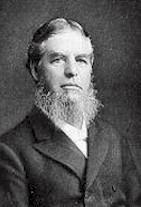
John Page Hopps

1834 - 1911 Person Name: J. P. Hopps Author of "The Daily Walk" in The Y.M.C.A. Hymnal Hopps, John Page, was born in London, Nov. 6, 1834, and educated at the G. Baptist College, Leicester. Commencing public work in 1856, after a brief ministry at Hugglescote and Ibstock, in Leicestershire, he became colleague with George Dawson at the Church of the Saviour, Birmingham. From 1860 to 1876 he ministered to Unitarian congregations at Sheffield, Dukinfield, and Glasgow. Since 1876 he has preached in Leicester. Mr. Hopps has published many books and pamphlets, chiefly volumes of Sermons and Lectures. Most of his smaller works are controversial. In 1863 he commenced a monthly periodical called The Truthseeker. He has compiled the following hymnbooks for Congregational, Mission, or School purposes:— (1) Hymns for Public Worship and the Home, 1858; (2) Hymns of Faith and Progress, c. 1865; (3) Hymns for Public Worship, 1873; (4) One hundred Hymns for Sunday Schools, 1873; (5) Hymns, Chants and Anthems for Public Worship, 1877; (6) The Children's Hymn Book, 1879; (7) The Young People's Book of Hymns, 1881; (8) and six different editions of Hymns for Special Services (for Sunday afternoon and evening gatherings in the Temperance Hall and Floral Hall, Leicester). Mr. Hopps has himself written various hymns, some of considerable merit. Several have appeared in Congregational, Baptist, Unitarian and other collections. Among the best known are the following:— 1. Cold and cheerless, dark and drear. Winter. 2. Father, lead me day by day. Child's Prayer for Divine Guidance. 3. Father, let Thy kingdom come. God's Kingdom desired. 4. God bless the little children. Prayer for Children. 5. We praise Thee oft for hours of bliss. The blessings of Sorrow. These hymns are from his Hymns, Chants, and Anthems, &c. 1877, and the Hymns for Special Services. The most popular is No. 2. [Rev. W. R .Stevenson, M.A.] --John Julian, Dictionary of Hymnology (1907)

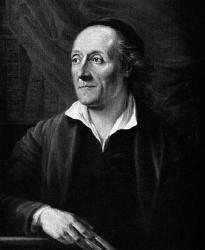
Johann Caspar Lavater

1741 - 1801 Person Name: J. R. Lavater Author of "Guter Geber, Dank sei dir" in Deutsches Liederbuch Lavater, Johann Caspar, son of Johann Heinrich Lavater, physician in Zürich, was born at Zürich, Nov. 15, 1741. He entered the Academic Gymnasium at Zürich in 1758, and in the end of 1759 began his studies in its theological department. After completing his course he was ordained in the spring of 1762, but did not undertake any regular clerical work till April 1769, when he was appointed diaconus of the Orphanage church at Zürich, where he became pastor in 1775. In July 1778 he was appointed diaconus of St. Peter's church, and in Dec. 1786 pastor there. When, during the Revolutionary period, the French laid the Swiss Cantons under contribution, and then in April 1799 deported ten of the principal citizens of Zürich, Lavater felt compelled to protest in the pulpit and in print. Consequently while on a visit to Baden, near Zürich, he was seized by French dragoons, May 14, 1799, and taken to Basel, but was allowed to return to Zürich, Aug. 16, 1799. When on Sept. 25, 1799, the French under Massena entered Zürich, Lavater was treacherously shot through the body by a French grenadier, who had just before thanked him for his charity, and from this wound he never entirely recovered. He resigned his charge in January 1800, and died at Zürich, Jan. 2, 1801. (Koch, vi. 499; Allgemeine Deutsche Biographie, xvii. 783, &c.) Lavater was one of the most celebrated and influential literary characters of his time; a most popular and striking preacher; and a lovable, genuine, frank-hearted man, who was the object of an almost incredible veneration. His devotional writings (Aussichten in die Ewigkeit, 4 vols., Zürich,1768-78, &c), and his works on Physiognomy (Von der Physiognomik, Leipzig, 1772; Physiognomische Fragmente, 4 vols., Leipzig and Winterthur, 1775-78), were eagerly read and admired all over Europe, but were very soon forgotten. He was no theologian, and his warm heart and fertile imagination led him into many untenable positions. His works on Physiognomy are without order or philosophical principles of connection, and their permanent interest is mainly in the very numerous and often well-executed engravings. Of his poems the Schweizerlieder (Bern, 1767, 4th enlarged ed., 1775), are the utterances of a true patriot, and are the most natural and popular of his productions. His Epic poems ((1) Jesus Messias, oder die Zukunft des Herrn, N.D., Zürich, 1780, a poetical version of the Apocalypse; (2) Jesus Messias, oder die Evangelien und Apostelgeschichte in Gesängen, 4 vols., Winterthur, 1733-86. (3) Joseph von Arimathea, Hamburg, 1794) have little abiding value. As a hymn-writer Lavater was in his day most popular. His hymns are well adapted for private or family use. Many of them are simple, fresh, and popular in style, and evangelical, earnest and devout in substance. But for church use he is too verbose, prolix, and rhetorical. Of his hymns (some 700) a considerable number survive in German collections compiled before 1850, e.g. the Berlin Geistliche Lieder, ed. 1840, has 13; the Württemberg Gesang-Buch, 1843 has 15; the Hamburg Gesang-Buch,1842, has 23,&c. But in the more recent collections almost all have disappeared, e.g., the new hymn-book for the Kingdom of Saxony, 1883, has not a single one. The most important appeared principally in the following works:—(1) Funfzig Christlicher Lieder, Zürich, 1771. (2) Lieder zum Gebrauche des Waysenhauses zu Zürich, Zürich, 1772. (3) Christliche Lieder der Vaterländischen Jugend, besonders auf der Landschaft, gewiedmet, Zürich, 1774. (4) Zweytes Funfzig Christlicher Lieder, Zürich, 1776. (5) Christliche Lieder . . . Zweytes Hundert, Zürich, 1780. (6) Sechszig Lieder nach dem Zürcherischen Catechismus, Zürich, 1780. [Nos.1-6 in the Royal Library, Berlin, and 3-6 in the British Museum] Those of his hymns which have passed into English include:— i. 0 du, der einst im Grabe lag. Sunday. In his Lieder, &c, 1772, No. 7, in 9 stanzas of 4 1., entitled "Sunday Hymn." Included in the Zürich Gesang-Buch, 1787 and 1853; Bunsen's Versuch, 1833, No. 6, &c. The translation in common use is :— 0 Thou, once laid within the grave. A good translation, omitting st. iii., vii., viii., by H. J. Buckoll, in his Hymns from the German, 1842, p. 9. Repeated, abridged, in the Dalston Hospital Hymn Book 1848, and the Rugby SchoolHymn Book, 1850 and 1876. Another translation is: "0 Thou who in the grave once lay," by R. Massie, in the British Herald, June, 1865. ii. 0 Jesus Christus, wachs in mir. Sanctification. His finest hymn. Founded on St. John iii. 30. First published in his Christlcehe Lieder, 1780, No. 85, in 10 stanzas of 4 1., marked as "On New Year's Day, 1780," and with the motto "Christ must increase, but I must decrease." In Knapp's Evangelischer Lieder-Schatz, 1837, No. 1644. The translation in common use is:— 0 Jesus Christ, grow Thou in me. A good and full translation in theBritish Messenger for Nov. 1, 1860. In Schaff's Christ in Song, 1870, p. 108, it is marked as translated by Mrs. E. L. Smith, the statement that this was its first appearance being an error. If the translation is really by her, it must have appeared in some American publication prior to Nov. 1860. It has passed, in varying centos, into the Baptist Hymnal, 1879, Snepp's Songs of Grace & Glory, 1872, Supplement of 1874 to the New Congregational Hymn Book, and others: also in Hymns & Songs of Praise, N. Y., 1874, Christian Hymnal Adelaide, 1872, &c. iii. 0 süssesteir der Namen all. Name of Jesus, or, New Year. First published in his Sechszig Lieder, 1780, No. 25, in 4 stanzas of 7 1., as the second hymn on "Jesus Christ, the only begotten Son of God, our Lord. Second article of the Christian Faith." It is appointed for the 16th Sunday, and for the 39th and 40th questions of the Zürich Catechism. In the Berg Mark Gesang-Buch, 1835, No. 319; and included in a number of the German Roman Catholic Hymn Books as those for St. Gall, 1863, Rottenburg, 1865, and others. The translation in common use is:— 0 Name, than every name more dear. A good translation of stanzas i., iii., iv., by A. T. Russell, in his Psalms & Hymns, 1851, No. 68. Repeated in Maurice's Choral Hymn Book, 1861, Methodist New Connexion Hymn Book, 1863, New Zealand Hymnal, 1872, &c. iv. Vereinigt zum Gebete war. Whitsuntide. First published in his Christliche Lieder, 1774, No. 23, in 15 stanzas of 4 lines. The form translation into English is that in Bunsen's Versuch, 1833, No. 225, which begins, "O Geist des Herrn! nur deine Kraft," and consists of stanza x. lines 3, 4; xi. lines 1, 2; xii.-xv. The translation is:— 0 Holy Ghost! Thy heavenly dew. A good translation from Bunsen, by Miss Cox, in her Sacred Hymns from the German, 1841, p. 43, and the Gilman-Schaff Library of Religious Poetry, ed. 1883, p. 814. Slightly altered in Lyra Messianica, 1864, p. 386, and thence in Alford's Year of Praise, 1867. Again slightly altered in Miss Cox's Hymns from the German, 1864, p. 67, and thence in J. L. Porter's Collection, 1876. Another translation is: "Blest Spirit, by whose heavenly dew," by Lady E. Fortescue, 1843, p. 10. The following are not in English common use:— v. Ach! nach deiner Gnade schmachtet. Cross and Consolation. Zweytes Funfzig, 1116, No. 5, in 8 stanzas, entitled "The Conflict of Prayer in hours of darkness." The translations are: (1) "As the hart for water panteth, So my soul," by R. Massie, in the British Herald, March 1865, p. 40. (2) "Lord for Thee my soul is thirsting," by R. Massie, in theDay of Rest, 1877, vol. vii. p. 58. vi. Auf dich, mein Vater, will ich trauen. Cross and Consolation. Christliche Lieder, 1774, No. 4, in 8 stanzas, entitled "Encouragement to trust upon God." The translations are (1) "On Thee will I depend, my Father," by R. Massie, in the British Herald, May, 1865, p. 66. (2) "On Thee I build, 0 heavenly Father," by R. Massie, in the Day of Rest, 1878, vol. viii. p. 378. vii, Von dir, o Vater, nimmt mein Herr. Cross and Consolation. Funfzig Christlicher Lieder, 1771, No. 33, in 15 stanzas, entitled "Encouragement to Patience." Translated as, "Father! from Thee my grateful heart," by Miss Knight, in her Translations from the German in Prose and Verse, 1812, p. 89. Besides the above a considerable number of pieces by Lavater have been translated by Miss Henrietta J. Fry, in herPastor's Legacy, 1842 (which consists entirely of translations from Lavater); in her Hymns of the Reformation, 1845; and in her Echoes of Eternity, 1859. [Rev. James Mearns, M.A.] --John Julian, Dictionary of Hymnology (1907)

Johann Scheffler

1624 - 1677 Author of "Jesus, Savior, Come to Me" in The Lutheran Hymnal Used Angelus Silesius as a pen name. See also Angelus Silesius, 1624-1677

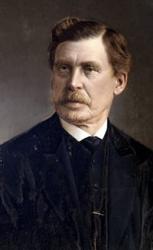
John White Chadwick

1840 - 1904 Author of "What has drawn us thus apart" in Services for Congregational Worship. The New Hymn and Tune Book Chadwick, John White, was born at Marblehead, Mass., U.S., Oct. 19, 1840; graduated at the Cambridge Divinity School, July 19, 1864, and ordained minister of the Second Unitarian Church, Brooklyn, N.Y., Dec. 21, 1864. A frequent contributor to the Christian Examiner; The Radical; Old and New; Harper's Magazine; and has published many poems in American periodicals. His hymn on Unity, "Eternal Ruler of the ceaseless round," was written for the graduating class of the Divinity School, Cambridge, June 19, 1864. It is in Horder's Congregational Hymns, 1884. It is a hymn of superior merit. [Rev. W. Garrett Horder] --John Julian, Dictionary of Hymnology (1907) ======================== Chadwick, J. W, p. 216, i. Mr. Chadwick's important prose works were the Life of Theodore Parker, 1890, and that of William Ellery Channing, 1903; and his poetical productions A Book of Poems, 1876, and In Nazareth Town and other Poems, 1883. He received his M.A. from Harvard in 1888; and d. Dec. 11, 1901. In addition to "Eternal Ruler of the ceaseless round," already noted on p. 216, ii., Mr. Chadwick's widow has supplied us with the following data concerning his hymns:— 1. A gentle tumult in the earth. [Easter.] Dated 1876. 2. Another year of setting suns. [New Year.] Written as a New Year's Hymn for 1873, and originally began "That this shall be a better year." In The Pilgrim Hymnal, Boston, 1904. 3. Come, let us sing a tender song, [Communion of Saints.] Dated 1901, and included in The Pilgrim Hymnal, 1904. 4. Everlasting Holy One. [Invocation.] 1875. 5. It singeth low in every heart. [In Memoriam.] Written in 1876, for the 25th Anniversary of the Dedication of his Church at Brooklyn. It has passed into a great many collections in America, and a few in Great Britain, including Horder's Worship Song, 1905. 6. Now sing we a song for the harvest. [Harvest.] Written for a Harvest Thanksgiving Service in 1871. Given in The Pilgrim Hymnal, 1904, and others. 7. 0 God, we come not as of old. [Perfect Law of Liberty.] Written in 1874, and entitled "The Perfect Law." 8. 0 Love Divine of all that is. [Trust.] Written in 1865, and included in his Book of Poems, 1876, as "A Song of Trust." In several American collections. 9. 0 Thou, Whose perfect goodness crowns. [For an Anniversary.] "Written for the 23th Anniversary of his Installation, Dec. 21, 1889." In The Pilgrim Hymnal, and other collections. 10. Thou Whose Spirit dwells in all. [Easter.] Written in 1890. 11. What has drawn us thus apart? [For Unity.] Undated, in the Boston Unitarian Hymns for Church and Home, 1895. During the past ten years Mr. Chadwick's hymns have become very popular in America, and especially with the compilers of Congrega¬tional and Unitarian collections. --John Julian, Dictionary of Hymnology, New Supplement (1907)

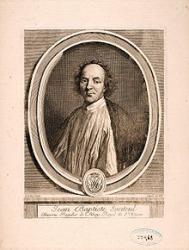
Jean-Baptiste de Santeul

1630 - 1697 Person Name: Jean B. de Santëuil Author of "First of Martyrs, Thou Whose Name" in The Cyber Hymnal Santeüil, Jean-Baptiste de, was born in Paris of a good family on May 12, 1630. He was one of the regular Canons of St. Victor, at Paris, and, under the name of Santolius Victorinus, was distinguished as a writer of Latin poetry. Many of his hymns appeared in the Cluniac Breviary 1686, and the Paris Breviaries 1680 and 1736, and several have been translated into English, and are in common use in Great Britain and America. He was very jocose in disposition and singular in his habits. When on a journey he died at Dijon, Aug. 5, 1697. His Hymni Sacri et Novi were published at Paris in 1689, and again, enlarged, in 1698. [George Arthur Crawford, M.A.] --John Julian, Dictionary of Hymnology (1907)

Johan Olof Wallin

1779 - 1839 Person Name: J. O. Wallin Translator of "Verldens Frälsare kom här" in Svenska Psalm-Boken af År 1819 Johan Olaf Wallin was born at Stora Tuna, in 1779, and early displayed his poetical powers. In 1805, and again in 1809, he gained the chief prize for poetry at Upsala. In the latter year he became pastor at Solna; here his ability as a preacher was so striking that he was transferred to Stockholm, in 1815, as "pastor primarius," a title for which we have no exact equivalent. In 1818 he was made Dean of Westeras, and set about the task of editing a revised hymn-book for the whole of Sweden. This task he completed in 1819, and published it as, Den Swenska Psalmboken, af Konungen gillad och stadfästad (The Swedish hymn-book, approved and confirmed by the King). To it he contributed some 150 hymns of his own, besides translations and recastings; and the book remains now in the form in which he brought it out. It is highly prized by the Swedes, and is in use everywhere. --John Julian, Dictionary of Hymnology, p. 1000 (1907)

Julie von Hausmann

1825 - 1901 Person Name: Julia Hausmann, 1825-1901 Author of "Señor, heme en tus manos" in Culto Cristiano Julie Katharina von Hausmann (born 7 March [O.S. 19 March] 1826 in Riga; died 2 August [O.S. 15 August] 1901 in Võsu, Estonia) was a Baltic German poet, known for the hymn Lord, Take My Hand and Lead Me (German: So nimm denn meine Hände) with a melody by Friedrich Silcher. Earlier translations had been made by Herman Brueckner as "O take my hand, dear Father" and Elmer Leon Jorgenson as "Take Thou My Hand, and Lead Me." The hymn has also been translated by Martha D. Lange, whose version appears in the Great Songs of the Church Revised (1986). Julie Hausmann was the daughter of a teach­er. She worked for a while as a gov­ern­ess, but due to her ill health she lived with and cared for her fa­ther, who had gone blind. Af­ter his death in 1864, she lived with her sis­ters in Ger­ma­ny, Southern France and St. Petersburg, Russia. She died during a summer vacation in Es­ton­ia. A legend circulates that Hausmann wrote her most famous poem "So nimm denn meine Hände" after journeying to see her fiancé at a mission and, on arriving, finding that he had just died. Various explorations of her biography have yet to confirm or deny the rumor. She never married. Her poetry was published by others, including Gustav Knak without mentioning her name, at her request. Maiblumen. Lieder einer Stillen im Lande.(May flowers) 2 volumes, 1862 (6th edition around 1880: Front cover Vol. 1) Bilder aus dem Leben der Nacht im Lichte des Evangeliums. 1868 Hausbrot. Schlichte Morgen- und Abend-Andachten. 1899 Blumen aus Gottes Garten. Lieder und Gedichte. 1902 (posthumous collection) --en.wikipedia.org/wiki/

Pages


Export as CSV
It looks like you are using an ad-blocker. Ad revenue helps keep us running. Please consider white-listing Hymnary.org or getting Hymnary Pro to eliminate ads entirely and help support Hymnary.org.