You help make Hymnary.org possible. More than 10 million people from 200+ countries found hymns, liturgical resources and encouragement on Hymnary.org in 2025, including you. Every visit affirms the global impact of this ministry.

If Hymnary has been meaningful to you this year, would you take a moment today to help sustain it? A gift of any size—paired with a note of encouragement if you wish—directly supports the server costs, research work and curation that keep this resource freely available to the world.

Give securely online today, or mail a check to:
Hymnary.org
Calvin University
3201 Burton Street SE
Grand Rapids, MI 49546

Thank you for your partnership, and may the hope of Advent fill your heart.

Person Results

Tune Identifier:"^grosser_gott_11171$"
In:person

Planning worship? Check out our sister site, ZeteoSearch.org, for 20+ additional resources related to your search.
Showing 41 - 50 of 74Results Per Page: 102050

Christian Heinrich Zeller

1779 - 1860 Person Name: Christ. Heinr. Zeller Author of "Sieh' ein weites Todtenfeld" in Die Glaubensharfe (With Melodies) Zeller, Christian Heinrich, son of Christian David Zeller, Hofrath at Hohenentringen, near Tubingen, was born at Hohenentringen, March 29, 1779. He matriculated at the University of Tübingen in 1797, as a student of law. After completing his studies he chose, however, the profession of teaching. He became director of the Latin School at Zoffingen, Switzerland, in 1809, and finally removed in April, 1820; to Beuggen on the Rhine (Baden), near Basel, as director of the newly founded Institution there, meant for the education of poor children and for the training of teachers for poor children. He died at Beuggen, May 18, 1860 (Koch, vii. 188, &c). Zeller was best known as an educationist, and in con¬nection with the working of the Institution at Beuggen. His hymns, which are simple, Scriptural and earnest, were written primarily for use at Beuggen, and mostly appeared in the Monatsblatt (begun in 1828), and other publications of the Institution. They came into notice through their reception into Knapp's Evangelischer Lieder-Schatz, 1837. They were collected by Zeller's son, and published in 1871, as Lieder der Armenschullehrer-Anstalt Beuggen, 58 being original. Two of these hymns have passed into English, viz.:— i. Gott bei mir an jedem Orte. Omnipresence. On the joy of God's Presence with us. This appeared in the Monatsblatt in 1828, and was included in the 1871 as above, p. 88. In Knapp's Evangelischer Lieder-Schatz , 1837, No. 32 (1865, No. 32), in 6 stanzas of 6 lines; in the Berlin Geistliche Lieder, ed. 1863, No. 1554, &c. The translation in common use is:— My God with me in every place. This is a good translation, omitting st. v., by Mrs. Findlater in Hymns from the Land of Luther, 1st Ser., 1854, p. 30 (1884, p. 33); repeated, omitting st. iv., in Holy Song, 1869, No. 588. In Miss Warner's Hymns of the Church Militant, 1858, it begins, "My God is with me every place." Another translation is: "God in every place is near me." By R. Massie, in the British Herald, May, 1865, p. 70, and in Reid's Praise Book, 1872, No. 438. ii. Treuer Heiland, wir sind hier. Public Worship. This is in the 1871 as above, p. 64. Included in Knapp's Evangelischer Lieder-Schatz 1837, No. 857 (1865, No. 1256), in 5 stanzas of 7 lines; and repeated in the Württemberg Gesang-Buch, 1842, No. 235. For this hymn Conrad Kocher wrote the well-known melody which in Hymns Ancient & Modern is called Dix, and which first appeared, set to Zeller's hymn, in Kocher's Stimmen aus dem Meiche Gottes, Stuttgart, 1838, No. 201. Translates as:— Saviour, here to Thee we come. This is a free translation of stanzas i., ii., v., marked as by "F. C. C.” as No. 155 in Dr. Pagenstecher's Collection, 1864. [Rev. James Mearns, M.A.] --John Julian, Dictionary of Hymnology (1907)

Ruth M. Glaeske

Person Name: Ruth M. Glaeske, b. 1941 Author (st. 3) of "Holy God, We Praise Your Name" in Christian Worship (1993)

Ed Nowak

Composer (descant) of "GROSER GOTT" in The United Methodist Hymnal Music Supplement

Saad Thamir

b. 1972 Author (Arabic) of "Großer Gott, wir loben dich" in Trimum

S. W. Straub

1842 - 1899 Arranger of "[Blessed are the pure in heart]" in Christian Life Songs Solomon.W Straub Solomon was the brother of Maria Straub. His father Joseph was a farmer. His parents, who were of German descent. From Hymnary user, via email

Serap Ermis

Author (Turkish) of "Großer Gott, wir loben dich" in Trimum

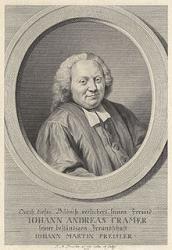
Johann Andreas Cramer

1723 - 1788 Person Name: J. A. Cramer Author of "Sanft, o Christ, ist Jesu Joch" in Gesangbuch der Evangelischen Gemeinschaft Cramer, Johann Andreas, born Jan. 27, 1723, at Jönstadt or Johann-Georgen-Stadt, in the Saxon Harz, where his father was pastor. After studying at the University of Leipzig, where he graduated M.A. in 1745, he was in 1748 appointed preacher at Crellwitz, near Lützen, and in 1750 Court Preacher and member of the Consistory at Quedlinburg. Four years later he became German Court Preacher to King Frederick V. of Denmark, at Copenhagen. There he obtained great fame as a preacher and teacher; and was appointed in 1765 Professor of Theology in the University. But after the accession of Charles VII., in 1766, the free-thinking party in the State gradually gained the ascendancy, and procured his removal; whereupon he was appointed, in 1771, Superintendent in Lubeck. When the orthodox party regained power in 1774, he was recalled to Denmark, as Vice-Chancellor, and First Professor of Theology in the University of Kiel, and in 1784 Chancellor. He died at Kiel on the night of June 11-12, 1788 (Koch, vi. 334-344; Allgemeine Deutsche Biographie, iv. 550-551; Bode, pp. 54-55—the last dating his birth, Jan. 29). Cramer was rather a writer of religious lyrics than of hymns, though at least 80 of his compositions passed Into the hymn-books of his times. Those that have been translated into English are all included either in the Allgemeines Gesang- Buch, Altona, 1780, which he edited for use in Schleswig-Holstein, or in his Sämmtliche Gedichtet Leipzig, 1782-3. They are:— i. Die ihr des Lebens edle Zeit. The duty of the Scholar. 1780, as above, No. 820, in 12 stanzas, repeated 1782, vol. ii. p. 319. Translated as, "O ye, who from your earliest youth," by Miss Winkworth, 1869, p. 321. ii. Erheb, erheb, 0 meine Seele. Ps. civ. In his Poetische Uebersetzung der Psalmen, Leipzig, 1763, pt. iii., p. 65, in 16 stanzas. Included, 1780, as above, No. 124. The form translated is that in the Württemberg Gesang-Buch 1791, No. 36 (1842, No. 59), beginning with stanza ii. “Herr, dir ist niemand zu vergleichen." Tr. as, "Lord, none to Thee may be compared," by Miss Burlingham, in the British Herald, Jan. 1866, p. 200, repeated in Reid's Praise Book, 1872, No. 373. iii. Erwachet, Harf’ und Psalter. Morning. Founded on Ps. cviii. First published in Zollikofer's Gesang-Buch, Leipzig, 1766, No. 71, in 6 stanzas. Repeated, 1780, as above, No. 2, and as No. 41 of the hymns appended to his Evangelische Nachahmungen der Psalmen Davids, Kopenhagen, 1769, p. 272. Translated by H. J. Buckoll, 1842, p. 59, as:—"Wake, harp and psaltery sounding." iv. Schuf mich Gott für Augenblicke. Immortality of the Soul. 1780, as above, No. 136, in 12 St., repeated, 1782, vol. i. p. 181. Tr. (beginning with st. vi., "Geist! das ist mein hoher Name"), by Dr. H. Mills, 1845, as:—"Man were better nam'd a spirit." v. Sterbend für das Heilder Sunder. Ascension. In the Bayreuth Gesang-Buch, 1779, No. 173, in 4 stanzas. Included, 1780, as above, No. 319, and 1782, vol. ii. p. 33. Translated by Dr. H. Mills, 1845, as:—"Dying a guilty world to save." vi. Unerforschlich sei mir immer. God's Wisdom. First published in his Andachten in Betrachtungen, Gebeten und Liedern, &c, vol. ii., pt. ii., Schleswig and Leipzig, 1768, and thence in Rambach, v. 54. Included in 1769 (see No. iii.), p. 250, and 1780 as above, No. 78. Translated (1) in Sacred Poems by S. R. Maxwell, 1857, p. 126, as:— “Though inscrutable may ever"; (2) by Dr. G. Walker, 1860, p. 94, as:—" Inscrutable to me although." [Rev. James Mearns, M.A.] --John Julian, Dictionary of Hymnology (1907)

Karl von Greyerz

1870 - 1949 Person Name: Kark von Greyerz Author (vs. 2-6) of "Großer Gott, wir loben dich" in Gesangbuch der Evangelisch-reformierten Kirchen der deutschsprachigen Schweiz

Christoph Carl Ludwig von Pfeil

1712 - 1784 Person Name: Christian Karl Ludwig von Pfeil Author of "Abba, Vater! der Du Dich" in Die Glaubensharfe (With Melodies) Pfeil, Christoph Carl Ludwig, Baron von, was born January 20, 1712, at Grünstadt, near Worms, where his father, Quirin Heinrich v. Pfeil, was then in the service of the Count of Leiningen. He matriculated at the University of Halle in 1728, as a student of law. After completing his course at the University of Tübingen, he was appointed, in 1732, Württemberg secretary of legation at Regensburg; then, in 1737, Justiz-und-Regierungsrath at Stuttgart; in 1745 Tutelar-raths-Präsident; in 1755 Kreisdirectorialgesandter to the Swabian Diet; in 1758 Geheim Legationsrath; and in 1759 Geheimrath. He found himself however at last no longer able to cooperate in carrying out the absolutism of the Württemberg prime minister Count Montmartin. When his resignation was accepted, April 13, 1763, he retired to the estate of Deufstetten, near Crailsheim, which he had purchased in 1761. In Sept., 1763, he was appointed by Frederick the Great as Geheimrath, and accredited Prussian minister or ambassador to the Diets of Swabia and Franconia. He was thereafter created Baron by the Emperor Joseph II., and in 1765 received the cross of the Red Eagle Order from Frederick the Great. An intermittent fever which developed itself in August, 1783, confined him to bed, where he remained till his death, at Deufstetten, Feb. 14, 1784 (Koch v. 176; Allgemeine Deutsche Biographie xxv. 646). v. Pfeil was a man of deep and genuine piety. His hymnwriting began immediately after the spiritual change which he experienced on the 10th Sunday after Trinity, 1730; and it continued to be a favourite occupation, especially in his later years at Deufstetten. He was one of the most productive of German hymnwriters, his printed hymns being about 950, besides many in manuscript. The other hymns printed in his lifetime appeared in his (1) Lieder von der offenbarten Herrlichkeit und ZuJcunft des Herrn, Esslingen, 1741, 2nd ed. Memmingen, 1749, as Apocalyptische Lieder von der, &c. (2) Evangelisches Gesangbuch, Memmingen, 1782, with 264 hymns dating from 1730 to 1781, edited by J. G. Schellhorn. (3) Evangelische Glaubens-und Herzens-gesänge, Dinkelsbühl, 1783, with 340 hymns dating from 1763 to 1783. In recent times a number of his hymns have come into German use (they originally appeared, it must be remembered, during the Rationalistic Period), and Knapp includes 26 of them in his Evangelischer Lieder-Schatz, 1850. Two have passed into English, viz.:— i. Am Grab der Christen singet man. Burial. Written in 1780. First published in No. 3, 1783, as above, p. 201, in 10 st., entitled, "We sing joyfully of Victory at the grave of the righteous: the right hand of the Lord hath gotten Him the victory." In the Berlin Geistliche Lieder,ed. 1863, No. 1433. Translated as, "The Christian's grave with joy we see," by Dr. G. Walker, 1860, p. 111. ii. Wohl einem Haus, da Jesus Christ. Family Prayer. First published in No. 2, 1782, as above, No. 61, in 8 st. of 4 1., entitled, "Delightful picture of a house that serves the Lord. On the Parents of Jesus." It was apparently written for the 1st Sunday after Epiphany, 1746. In the Unverfälschter Liedersegen, 1851, No. 682. Translated as:— Oh blest the house, whatever befall. A good translation omitting st. ii., vi., by Miss Winkworth, in her Chorale Book for England, 1863, No. 175. Including, omitting the trs. of st. iii., v.t and adding a translation of st. vi., as No. 344 in the Ohio Lutheran Hymnal, 1880. [Rev. James Mearns, M.A.] -- John Julian, Dictionary of Hymnology (1907)

Johann Gottfried Olearius

1635 - 1711 Person Name: Joh. G. Olearius, 1635-1711 Author of "Komm, du wertes Lösegeld" in Liederkranz für Sonntags-Schulen und Jugend-Vereine Olearius, Johann Gottfried, son of Dr. Gottfried Olearius, pastor of St. Ulrich's Church at Halle, was born at Halle, Sept. 25, 1635. He entered the University of Leipzig in 1653, and graduated M.A. 1656, residing also for short periods at other German Universities. In 1658 he was ordained as assistant to his father at St. Mary's Church in Halle, where he became diaconus in 1662, and in 1685 pastor and also superintendent of the second portion of the dis¬trict of the Saale. He was finally appointed, in 1688, as chief pastor, superintendent, and consistorialrath at Arnstadt, and also professor of Theology in the Gymnasium there. He died at Arnstadt, May 21, 1711, after having been for some years totally blind. (Allgemeine Deutsche Biographie xxiv. p. 280; Bode, p. 124, &c.) Olearius was the author of several devotional works, and composed a number of melodies to his own hymns. His hymns appeared in his (1) Jesus! Poetische Erstlinge an geistlichen Deutschen Liedern und Madrigalen, Halle, 1664 [Berlin], and the second edition enlarged and altered as (2) Geistliche Singe-Lust, Arnstadt, 1697 [Wernigerode] . A number passed into the Arnstadt Gesang-Buch 1705, and a few are still in German common use. Two have passed into English, one ("Es war die ganze Welt") being noted under J. A. Schlegel (q.v.), and the other being:— Komm du werthes Losegeld. Advent. Founded on St. Matt. xxi. 9. First published 1664 as above, p. 1 in 4 stanzas of 6 lines, and entitled, "On Advent." In the Berlin Geistliche Lieder, edition 1863, No. 137. Translated as:— Come, 0 Lord, our sacrifice. By A. T. Russell, omitting st. iii., as No. 10 in the Dalston Hospital Hymn Book, 1848, repeated in Dr. Pagenstecher's Collection, 1864, No. 2. [Rev. James Mearns, M.A.] --John Julian, Dictionary of Hymnology (1907)

Pages


Export as CSV
It looks like you are using an ad-blocker. Ad revenue helps keep us running. Please consider white-listing Hymnary.org or getting Hymnary Pro to eliminate ads entirely and help support Hymnary.org.