You help make Hymnary.org possible. More than 10 million people from 200+ countries found hymns, liturgical resources and encouragement on Hymnary.org in 2025, including you. Every visit affirms the global impact of this ministry.

If Hymnary has been meaningful to you this year, would you take a moment today to help sustain it? A gift of any size—paired with a note of encouragement if you wish—directly supports the server costs, research work and curation that keep this resource freely available to the world.

Give securely online today, or mail a check to:
Hymnary.org
Calvin University
3201 Burton Street SE
Grand Rapids, MI 49546

Thank you for your partnership, and may the hope of Advent fill your heart.

Browse People

Topics:scripture
In:people

Planning worship? Check out our sister site, ZeteoSearch.org, for 20+ additional resources related to your search.
Showing 421 - 430 of 953Results Per Page: 102050

Mary Rice Hopkins

Person Name: Mary Rice-Hopkins Topics: Praise, Scripture an Other Short Spiritual Songs Author of "Create In Me" in Songs

Hal H. Hopson

1933 - 2025 Topics: liturgical Scripture Songs Composer of "MERLE'S TUNE" in Voices United Hal H. Hopson (b. Texas, 1933) is a prolific composer, arranger, clinician, teacher and promoter of congregational song, with more than 1300 published works, especially of hymn and psalm arrangements, choir anthems, and creative ideas for choral and organ music in worship. Born in Texas, with degrees from Baylor University (BA, 1954), and Southern Baptist Seminary (MSM, 1956), he served churches in Nashville, TN, and most recently at Preston Hollow Presbyterian Church in Dallas, Texas. He has served on national boards of the Presbyterian Association of Musicians and the Choristers Guild, and taught numerous workshops at various national conferences. In 2009, a collection of sixty four of his hymn tunes were published in Hymns for Our Time: The Collected Tunes of Hal H. Hopson. Emily Brink

Peter J. Horrobin

b. 1943 Person Name: Horrobin Topics: The Church of Jesus Christ The Scriptures Adapter of "Tell me the stories of Jesus" in Complete Mission Praise

William Horsley

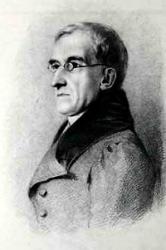
1774 - 1858 Person Name: William Horsley, 1774-1858 Topics: God: His Attributes, Works and Word The Holy Scriptures Composer of "HORSLEY" in The Book of Praise Born: November 15, 1774, Mayfair, London, England. Died: June 12, 1858, Kensington, London, England. Buried: Kensal Green Cemetery, London, England. Horsley studied music privately, then became organist of Ely Chapel, Holborn, London, in 1794. He assisted Dr. J. W. Callcott (who encouraged him in persevering at Glee-writing, at which he became successful) as organist of the Asylum for Female Orphans, and married Callcott’s daughter. He succeeded Callcott in 1802, holding that post 52 years. A difference of opinion with the Asylum Committee led to him being dismissed. In 1838 he also became organist of Charterhouse "at a salary of £70 and a room set apart and a fire provided when necessary for his use on those days upon which his duty requires his attendance at the Hospital." He founded the London Philharmonic Society, and in later years was a close friend of Felix Mendelssohn. J. C. Horsley, the eminent painter, relates in his Reminiscences the following experience when he went with his father to one of the services: "When I was four years old my father was organist to the Asylum for Female Orphans, which was a stately building on the Westminster Bridge Road; and one Sunday he took me in with him to the morning service and landed me in the organ-loft. Everything was new and surprising to me, especially the crowd of buxom girls, at least a hundred in number, all dressed alike, ranged right and left of the organ, and who, when the organ had played a bar or two of the opening hymn, sang out with open mouths and such energy that I was positively scared, and in continently accompanied the performance with a prolonged howl; upon which my father, continuing to play the accompaniment with one hand, supplied me promptly with paper out of his capacious pocket, where he always kept a store of backs of letters (envelopes were not invented then), and a silver pencil-case of heroic proportions, thus quieting me." Lightwood, pp. 171-72 --www.hymntime.com/tch/

Harold Horton

Topics: The Holy Scriptures Author of "Thy Words are Sweet" in Redemption Hymnal

Frank Houghton

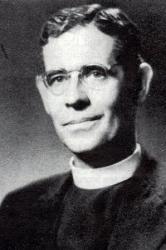
1894 - 1972 Person Name: Frank Houghton, 1894-1972 Topics: God: His Being, Word and Works The Holy Scriptures Author of "My Lord, Who in the desert fed" in The Book of Praise Born: April 24, 1894, Stafford, Staffordshire, England. Died: January 25, 1972, Cornford House, Tunbridge Wells, Kent, England. Buried: Tunbridge Wells, Kent, England. Son of Thomas Houghton, Curate of Stafford, Frank attended the University of London (BA 1913) London College of Divinity (now St. John’s College, Nottingham, graduated 1914). He was ordained a deacon in 1917, and priest the next year. He served as Curate of St. Benedict’s, Liverpool (1917-9); All Saints, Preston (1919-20). Inspired by missionary Hudson Taylor’s example, he joined the China Inland Mission, serving at Liangshan (1920-21) and Suiting (1921-24 ). In 1923, he married Dorothy Cassels, daughter of Bishop Cassels of West China. In 1924, he became principal of the Theological College in Paoning, Sichuan. He returned to England for medical reasons in 1928, expecting to stay only a short time, but he stayed to edit China’s Millions. He also served as Examining Chaplain to the Bishop of West China (1928-36). He went on to serve as Consecrated Bishop of East Szechwan at Nanchung (1934-40); General Director of the China Inland Mission (1940-51); Vicar of New Milverton, Leamington Spa (1953-60); and Rector of St. Peter, Drayton, Oxford (1960-63). Houghton retired in 1963, and he and his wife lived in Parkstone, Poole. © The Cyber Hymnal™ (www.hymntime.com/tch)

William Walsham How

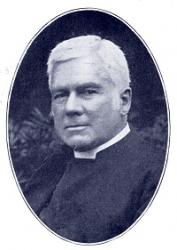
1823 - 1897 Person Name: William W. How Topics: The Book of the Church : Holy Scripture; Service Music Scripture Acclamations Author of "O Word of God Incarnate" in The United Methodist Hymnal William W. How (b. Shrewsbury, Shropshire, England, 1823; d. Leenane, County Mayo, Ireland, 1897) studied at Wadham College, Oxford, and Durham University and was ordained in the Church of England in 1847. He served various congregations and became Suffragan Bishop in east London in 1879 and Bishop of Wakefield in 1888. Called both the "poor man's bishop" and "the children's bishop," How was known for his work among the destitute in the London slums and among the factory workers in west Yorkshire. He wrote a number of theological works about controversies surrounding the Oxford Movement and attempted to reconcile biblical creation with the theory of evolution. He was joint editor of Psalms and Hymns (1854) and Church Hymns (1871). While rector in Whittington, How wrote some sixty hymns, including many for chil­dren. His collected Poems and Hymns were published in 1886. Bert Polman =============== How, William Walsham, D.D., son of William Wybergh How, Solicitor, Shrewsbury, was born Dec. 13, 1823, at Shrewsbury, and educated at Shrewsbury School and Wadham College, Oxford (B.A. 1845). Taking Holy Orders in 1846, he became successively Curate of St. George's, Kidderminster, 1846; and of Holy Cross, Shrewsbury, 1848. In 1851 he was preferred to the Rectory of Whittington, Diocese of St. Asaph, becoming Rural Dean in 1853, and Hon. Canon of the Cathedral in 1860. In 1879 he was appointed Rector of St. Andrew's Undershaft, London, and was consecrated Suffragan Bishop for East London, under the title of the Bishop of Bedford, and in 1888 Bishop of Wakefield. Bishop How is the author of the Society for Promoting Christian Knowledge Commentary on the Four Gospels; Plain Words , Four Series; Plain Words for Children; Pastor in Parochia; Lectures on Pastoral Work; Three All Saints Summers, and Other Poems , and numerous Sermons , &c. In 1854 was published Psalms and Hymns, Compiled by the Rev. Thomas Baker Morrell, M.A., . . . and the Rev. William Walsham How, M.A. This was republished in an enlarged form in 1864, and to it was added a Supplement in 1867. To this collection Bishop How contributed several hymns, and also to the S. P. C. K. Church Hymns , of which he was joint editor, in 1871. The Bishop's hymns in common use amount in all to nearly sixty. Combining pure rhythm with great directness and simplicity, Bishop How's compositions arrest attention more through a comprehensive grasp of the subject and the unexpected light thrown upon and warmth infused into facia and details usually shunned by the poet, than through glowing imagery and impassioned rhetoric. He has painted lovely images woven with tender thoughts, but these are few, and found in his least appreciated work. Those compositions which have laid the firmest hold upon the Church, are simple, unadorned, but enthusiastically practical hymns, the most popular of which, "O Jesu, Thou art standing"; "For all the Saints who from their labours rest," and "We give Thee but Thine own," have attained to a foremost rank. His adaptations from other writers as in the case from Bishop Ken, "Behold, the Master passeth by," are good, and his Children's hymns are useful and popular. Without any claims to rank as a poet, in the sense in which Cowper and Montgomery were poets, he has sung us songs which will probably outlive all his other literary works. The more important of Bishop How's hymns, including those already named, and "Lord, Thy children guide and keep"; "O Word of God Incarnate"; "This day at Thy creating word"; "Who is this so weak and helpless"; and others which have some special history or feature of interest, are annotated under their respective first lines. The following are also in common use:— i. From Psalms & Hymns, 1854. 1. Before Thine awful presence, Lord. Confirmation. 2. Jesus, Name of wondrous love [priceless worth]. Circumcision. The Name Jesus . 3. Lord Jesus, when we stand afar. Passiontide. 4. O blessing rich, for sons of men. Members of Christ. 5. 0 Lord of Hosts, the earth is Thine. In time of War. 6. O Lord, Who in Thy wondrous love. Advent. ii. From Psalms & Hymns, enlarged, 1864. 7. Lord, this day Thy children meet. Sunday School Anniversary. iii. From Supplement to the Psalms & Hymns, 1867. 8. Hope of hopes and joy of joys. Resurrection. 9. 0 daughters blest of Galilee. For Associations of Women. 10. O happy feet that tread. Public Worship. 11. With trembling awe the chosen three. Transfiguration. iv. From Parish Magazine, 1871, and Church Hymns, 1871. 12. O Jesu, crucified for man. Friday. 13. Yesterday, with worship blest. Monday. v. From the S. P. C. K. Church Hymns. 1871. 14. Bowed low in supplication. For the Parish. 15. Great Gabriel sped on wings of light. Annunciation, of the Blessed Virgin Mary. 16. O blest was he, whose earlier skill. St. Luke. 17. O God, enshrined in dazzling light. Omnipresence. Divine Worship . 18. O heavenly Fount of Light and Love. Witsuntide. 19. O Lord, it is a blessed thing. Weekdays. 20. 0 One with God the Father. Epiphany. 21. O Thou through suffering perfect made. Hospitals. 22. Rejoice, ye sons of men. Purification of the B. V. M. 23. Summer suns are glowing. Summer. 24. The year is swiftly waning. Autumn. 25. Thou art the Christ, O Lord. St. Peter. 26. To Thee our God we fly. National Hymn. 27. Upon the holy Mount they stood. Transfiguration and Church Guilds. 28. We praise Thy grace, 0 Saviour. St. Mark. vi. From the S. P. C. K. Children's Hymns, 1872. 29. Behold a little child. Jesus the Child's Example. 30. Come, praise your Lord and Saviour. Children's Praises. 31. It is a thing most wonderful. Sunday School Anniversary. 32. On wings of living light. Easter. Bishop How's hymns and sacred and secular pieces were collected and published as Poems and Hymns, 1886. The Hymns, 54 in all, are also published separately. He d. Aug. 10, 1897. --John Julian, Dictionary of Hymnology (1907) =================== How, W. W., p. 540, i. He died Aug. 10, 1897. His Memoir, by F. D. How, was published in 1898. --John Julian, Dictionary of Hymnology, New Supplement (1907)

Ian Howarth

b. 1955 Person Name: Ian Howarth, b. 1955 Topics: The Holy Scriptures Composer of "THAINAKY" in Singing the Faith

Julia Ward Howe

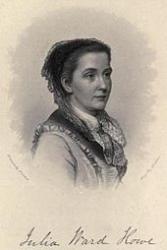
1819 - 1910 Topics: Service Music Scripture Acclamations Author of "The Battle Hymn of the Republic" in The United Methodist Hymnal Born: May 27, 1819, New York City. Died: October 17, 1910, Middletown, Rhode Island. Buried: Mount Auburn Cemetery, Cambridge, Massachusetts. Howe, Julia, née Ward, born in New York City in 1819, and married in 1843 the American philanthropist S. G. Howe. She has taken great interest in political matters, and is well known through her prose and poetical works. Of the latter there are Passion Flower, 1854; Words of the Hour, 1856; Later Lyrics, 1866; and From Sunset Ridge, 1896. Her Battle Hymn of the Republic, "eyes have seen the glory of the coming of the Lord," was written in 1861 at the outbreak of the Civil War, and was called forth by the sight of troops for the seat of war, and published in her Later Lyrics, 1806, p. 41. It is found in several American collections, including The Pilgrim Hymnal, 1904, and others. [M. C. Hazard, Ph.D.] --John Julian, Dictionary of Hymnology, New Supplement (1907) ============================ Howe, Julia Ward. (New York, New York, May 27, 1819--October 17, 1910). Married Samuel Gridley Howe on April 26, 1843. She was a woman with a distinguished personality and intellect; an abolitionist and active in social reforms; author of several book in prose and verse. The latter include Passion Flower, 1854; Words of the Hours, 1856; Later Lyrics, 1866; and From a Sunset Ridge, 1896. She became famous as the author of the poem entitled "Battle Hymn of the Republic," which, in spite of its title, was written as a patriotic song and not as a hymn for use in public worship, but which has been included in many American hymn books. It was written on November 19, 1861, while she and her husband, accompanied by their pastor, Rev. James Freeman Clarke, minister of the (Unitarian) Church of the Disciples, Boston, were visiting Washington soon after the outbreak of the Civil War. She had seen the troops gathered there and had heard them singing "John Brown's body lies a-mouldering in the grave" to a popular tune called "Glory, Hallelujah" composed a few years earlier by William Steffe of Charleston, South Carolina, for Sunday School use. Dr. Clarke asked Julie Howe if she could not write more uplifting words for the tune and as she woke early the next morning she found the verses forming in her mind as fast as she could write them down, so completely that later she re-wrote only a line or two in the last stanza and changed only four words in other stanzas. She sent the poem to The Atlantic Monthly, which paid her $4 and published it in its issue for February, 1862. It attracted little attention until it caught the eye of Chaplain C. C. McCable (later a Methodist bishop) who had a fine singing voice and who taught it first to the 122nd Ohio Volunteer Infantry regiment to which he was attached, then to other troops, and to prisoners in Libby Prison after he was made a prisoner of war. Thereafter it quickly came into use throughout the North as an expression of the patriotic emotion of the period. --Henry Wilder Foote, DNAH Archives

Jane Parker Huber

1926 - 2008 Person Name: Jane Parker Huber, 1926- Topics: Canticles and Scripture Paraphrases Paraphraser of "Creator God, creating still" in The Book of Praise

Pages


Export as CSV
It looks like you are using an ad-blocker. Ad revenue helps keep us running. Please consider white-listing Hymnary.org or getting Hymnary Pro to eliminate ads entirely and help support Hymnary.org.