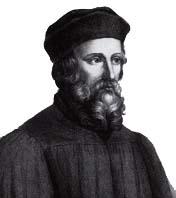
1369 - 1415 Person Name: John Hus, 1369-1415 Topics: Scriptures The Holy Composer of "HUS" in Hymnal and Liturgies of the Moravian Church [John Huss]
Jan Hus was born in Bohemia (part of the region, along with Moravia, we now call the Czech Republic), ca. 1370. He studied philosophy and theology at Prague University. Though only regarded as an average student, he received an undergraduate degree in 1396 and a Masters in 1398. In 1402 he was ordained as a priest in the Catholic Church and became rector and priest at Bethlehem Chapel. Hus lived in a time of great political and religious upheaval and to fully understand the man and his circumstances, some background is necessary. Domestic political turmoil was emerging in Bohemia and in the early 1400s the Catholic Church was enmeshed in the Great Schism in which three rival popes vied for control of the church. The schism led to the formation of the Council of Constance (1414-1418). This Council would prove pivotal to the fate of Jan Hus.
It could be said that the story of Hus actually began in Oxford, England. Although Hus never studied there, Oxford was the home of Hus' greatest human influence, Jon Wyclif. Wyclif died in 1384 but several Bohemians were students at Oxford in the late 1300s and, upon their return to Bohemia, they brought many of Wyclif's writings with them. These were soon translated into Czech. Hus himself translated some of Wyclif's work at the turn of the century.
Needless to say, the Catholic Church despised Wyclif. In 1415, the aforementioned Council of Constance condemned Wyclif, ordered his writings to be burned, and directed his bones to be exhumed and cast out of the consecrated ground where he was buried. In 1428, under papal command, his remains were dug up, burned, and the ashes were thrown in a nearby stream!
As the Wyclif movement waned in England, it found traction in Bohemia through the preaching of Hus. He became the chief exponent and defender of Wyclif at Prague University where he also was appointed dean of the faculty of Philosophy in 1402. Drawing large crowds, he became an extremely popular preacher among the common people and the aristocracy. Hus sought to reach the general populace with the word of God by preaching in Czech as well as Latin. Though not his intent, his Czech preaching stimulated an increasingly fervent nationalism.
Hus' themes were staunchly anti-clergy. His reputation for unblemished purity stood in sharp contrast with the corruption and worldliness of the existing religious clergy, especially in Bohemia. He denounced evil and immorality in the church. He once wrote, "The church shines in its walls, but starves in its poor saints; it clothes its stones with gold, but leaves its children naked." He held that Christ, not Peter, was the foundation of the church, and he taught, like Wyclif, that popes were not inerrant but some had been heretics! One might describe Hus as Wyclif in action.
In his premier work, De ecclesia, Hus followed Wyclif on several matters. He taught that the Roman pope and cardinals were not the church. He held that, "Not every priest is a saint, but every saint is a priest." E.H. Gillett summarized Hus' views on church organization: "In the early church there were but two grades of office, deacon and presbyter; all beside are of later and human invention. But God can bring back his church to the old pattern." In following Wyclif, Hus consistently elevated the Bible over church tradition and viewed it as the only binding principle in life. Even Wyclif's teachings were only accepted when Hus found them in agreement with scripture. These were dangerous ideas to hold in the early 15th century, especially in the cultural, religious, and political atmosphere of central Europe.
In 1408, Wyclif's Czech translations came under scrutiny from the Catholic hierarchy. In 1409, the archbishop of Prague became openly antagonistic toward both Wyclif and Hus. By 1410, Pope Alexander V issued a papal bull ordering the surrender and burning of all of Wyclif's writings. Hus refused to relinquish his copies and the archbishop excommunicated him. Hus defied this order and continued preaching in Bethlehem Chapel. Despite receiving support from the nobility, pressure was mounting. Yet, Hus would not be deterred. In a letter to the Pope, Hus stated that he was bound to speak the truth and that he was ready to suffer a dreadful death, rather than declare something contrary to the will of Christ. That same year he antagonized the pope when he publicly denounced the selling of indulgencies in order to finance a crusade against the king of Naples.
By 1412 Hus' preaching had alienated him from the archbishop, the university, and the clergy. At the advice of the king Hus withdrew from Prague. His popularity grew as he continued preaching in the fields, forests, and marketplaces of southern Bohemia. About this time he wrote that for one, "to cease from preaching, in obedience to the mandate of the pope or archbishop, would be to disobey God and imperil his own salvation." Czech sentiment remained with him, but Hus' writings and reputation began to draw negative attention across Europe.
In 1414, the Council of Constance began. Sigismund (king of the Romans and heir to the throne of Bohemia) convinced Hus to appear before the Council and guaranteed his safe conduct to Constance and back. Hus could have remained in Bohemia under the protection of many loyal princes, but he was hoping his arguments would be heard and was willing to be convinced if proven wrong. It was his goal to confirm his beliefs with the truth. He once wrote, if anyone can "instruct me by the sacred Scriptures or by good reasoning I am willing to follow him. From the outset of my studies, I have made it a rule to joyfully and humbly recede from a former opinion when in any matter I perceive a more rational opinion." Hus would not get this opportunity at Constance.
Almost immediately upon his arrival — despite the guarantee of safety — Hus was sent to prison on November 25, 1414. He was interrogated, abused, and fell ill. During his lengthy imprisonment, he was deprived of all books including the Bible. He was tried on several counts related to his embrace of Wyclif's writings. The Council repeatedly aligned Hus with the already regarded, though dead, heretic Wyclif. Among the final charges levied against him was that he defended Wyclif as a good Christian, salvation did not depend on the pope, and only God himself could excommunicate someone from the church.
Several attempts were made to get Hus to recant. He refused them all. His final sentence came on July 6, 1415. At the sentencing, he was placed on a high stool in the middle of the church and sentenced to death. The chronicler of the events noted that they placed a hood over his head, with pictures of the devil and the word "heresiarch" (a leader of heretics), then committed his soul to the devil. Hus responded, "And I commit myself to the most gracious Lord Jesus." In a letter written the night before his sentencing, Hus prayed that if his death would contribute anything to God's glory, then he might be able to meet it without fear. Hands bound behind his back, Hus was chained to the stake. Wood and hay were piled up to his chin. Rosin was sprinkled on it. He was given one last chance to recant and be set free. Bravely, he refused and said, "I shall die with joy today in the faith of the gospel which I have preached." As they lit the flames around him he sang out twice, "Christ thou Son of the Living God, have mercy upon me." He died singing and praying.
It is no wonder that historians refer to Wyclif and Hus as "pre-reformers." Luther was not directly influenced by Hus, and was unaware of his work when he began his own reform movement. But, as he learned of Hus he grew to admire him. Luther condemned the burning of Hus and wrote of him, "If such a man is to be regarded as a heretic, then no person under the sun can be looked upon as a true Christian." In the Prague library, there is a hymn to Hus' memory, dating from 1572, with three medallions pictured. On the first medallion is a picture of Wyclif striking sparks against a stone. The second shows Hus kindling fire from the sparks. And the third depicts Luther holding aloft a flaming torch.
--lavistachurchofchrist.org/ (excerpts)
Jan Hus


 My Starred Hymns
 My FlexScores
 My Hymnals
 My Purchased Files