You help make Hymnary.org possible. More than 10 million people from 200+ countries found hymns, liturgical resources and encouragement on Hymnary.org in 2025, including you. Every visit affirms the global impact of this ministry.

If Hymnary has been meaningful to you this year, would you take a moment today to help sustain it? A gift of any size—paired with a note of encouragement if you wish—directly supports the server costs, research work and curation that keep this resource freely available to the world.

Give securely online today, or mail a check to:
Hymnary.org
Calvin University
3201 Burton Street SE
Grand Rapids, MI 49546

Thank you for your partnership, and may the hope of Advent fill your heart.

Person Results

Topics:ordinary+time
In:people

Planning worship? Check out our sister site, ZeteoSearch.org, for 20+ additional resources related to your search.
Showing 481 - 490 of 956Results Per Page: 102050

Charles Nicks

Person Name: Charles H. Nicks Jr. Topics: Ordinary Time Week 29 Author of "Oh, Give Thanks" in Hymns and Devotions for Daily Worship (African American Edition)

Daniel Read

1757 - 1836 Topics: Ordinary Time Week 7 Composer of "WINDHAM" in Hymns and Devotions for Daily Worship Daniel Read; b. 1757, Rehoboth, Mass.; d. 1837, New Haven, Conn.An American composer and a primary figure in early American classical music. He was one of the “Yankee Tunesmiths” (1st New England School of Music) when classical music was popular in Europe. Read was a private in Massachusetts militia and later a comb maker and owner of a general store in New Haven, CN. He was only the 3rd composer in the U. S. to put out a collection of his own music. His work, “The American Singing Book” went through 5 editions, making him the most popular composer in the nation. Others often plagarized his tunes in those days. Tunebook sales supplemented his general store income, including “The Columbian Harmonist” (3 volumnes) with 3 revisions, and “The New Haven Collection of Sacred Music” 1818. Read also published “The American Musical magazine” in 12 annual issues in 1786 and 1787. In later years he came to appreciate European music more and imitated that styling in devotional music. Some of Read's music is still being performed, and selections have been published in “The Sacred Harp”, 1991 Edition, and the “Stoughton Music Society” (Centennial Collection 1980). John Perry

H. A. Pandopo

Topics: Year A, Ordinary Time after Pentecost, June 12-18 (if ater Trinity Sunday) Translator (into Indonesian) of "All People That on Earth Do Dwell" in Psalms for All Seasons Pseudonym. See also Dop, Hermanus Arie van, 1935-

Chris Fenner

Topics: Ordinary Time Week 8 Arranger of "NEW BRITAIN" in Hymns and Devotions for Daily Worship B.A., Western Michigan University (2003); M.A., The Southern Baptist Theological Seminary (2011); M.L.I.S, University of Kentucky (2017). Digital Archivist at The Southern Baptist Theological Seminary. Editor of The Psalms, Hymns, and Spiritual Songs of Isaac Watts (2016), Spurgeon's Own Hymn Book (2019), Amazing Love! How Can It Be: Studies on Hymns by Charles Wesley (2020), and Hymns & Devotions for Daily Worship (2024). Volunteer editor for Hymnary.org; contributor to the Canterbury Dictionary of Hymnology; founder and editor of Hymnology Archive (hymnologyarchive.com).

Cornelius Becker

1561 - 1604 Topics: Year A, Ordinary Time after Pentecost, June 12-18 (if ater Trinity Sunday) Translator (into German) of "All People That on Earth Do Dwell" in Psalms for All Seasons Becker, Cornelius, son of Adrian Becker, merchant of Leipzig, was born at Leipzig, Oct. 24, 1561. After studying at the University, where he graduated 1584, he kept a private school till his appointment, in the beginning of 1588, as one of the masters of the St. Thomas School, a post he vacated in Sept., 1588. on being appointed diaconus at Rochlitz. In 1592 he became diaconus, and in 1594, pastor of the church of St. Nicholas, Leipzig; and subsequently Professor of Theology in the University, from which, in 1599, he received the degree of D.D. On account of false accusations he was deprived of his charge on June 5, 1601, but was vindicated and restored on Nov. 29 following. He died suddenly at Leipzig, May 25, 1604 (Koch, ii. 219-223; Allgemeine Deutsche Biographie, ii. 221). He wrote a few hymns, but his principal work was his version of the Psalter, 1602. The only version translated into English is:— Der Herr ist mein getreuer Hirt, Dem ich mich ganz vertraue. [Ps. xxiii.] Appeared in S. Calvidus's Harmonia Cantionum Ecclesiasticarum, Leipzig, 1598, and then in Becker's Der Psalter Dauids Gesangweis, Leipzig, 1602. Thence in Wackernagel, v., p. 369, in 3 stanzas of 7 lines, entitled "The Good Shepherd." In Bunsen's Allgemeine Gesang-Buch, 1846, No. 2. It is translated as "My Shepherd is the Saviour dear," by Miss Dunn, 1857, p. 19. [Rev. James Mearns, M.A.] -- John Julian, Dictionary of Hymnology (1907)

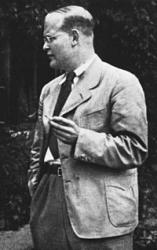
Dietrich Bonhoeffer

1906 - 1945 Author of "By Gracious Powers So Wonderfully Sheltered"

Mark A. Miller

Topics: Ordinary Time Week 11 Composer of "HIXON" in Hymns and Devotions for Daily Worship

Bernard Barton

1784 - 1849 Author of "Lamp of Our Feet, Whereby We Trace" Barton, Bernard, commonly known as the "Quaker Poet," was born in London Jan. 31, 1784, and educated at a Quaker school at Ipswich. In 1798 he was apprenticed to Mr. S. Jesup, a shopkeeper at Halstead, Essex, with whom he remained until 1806, when he removed to Woodbridge, Suffolk, and entered into business with his brother, as a coal and corn merchant. On the death of his wife at the end of the first year of their married life, he proceeded to Liverpool, where he acted as a private tutor for a short time. He returned to Woodbridge in 1810, where he secured an engagement in the local bank of the Messrs. Alexander. This appointment he held for 40 years. He died at Woodbridge, Feb. 19, 1849. During the same year his daughter published his Poems and Letters, with a Memoir. His poetical works were numerous, including:— (1) Metrical Effusions , 1812; (2) Poems by an Amateur, 1818; (3) Poems , 1820; (4) Napoleon, and other Poems, 1822; (5) Poetic Vigils, 1824; (6) Devotional Verses founded on Select Texts of Scripture, 1826; (7) A Widow's Tale, 1S27; (8) New Year's Eve, 1829; (9) The Reliquary, 1836; (10) Household Verses, 1845. A complete list of his works is given in Joseph Smith's Descriptive Catalogue of Friends' Books, Lond., J. Smith, 1867, vol. i. pp. 196-200. From these works about 20 pieces have come into common use as hymns. These are found principally in the Scottish Evangelical Union Hymnal, on the one hand, and various American Unitarian collections on the other. The best known are, “Lamp of our feet, whereby we trace," and "Walk in the light, so shalt thou know." From his Devotional Poems, &c, 1826, the following have passed into the Scottish Evangelical Union Hymnal, 1878:— 1. Fear not, Zion's sons and daughters. Gracious Promises. This is part of a poem on Isaiah xliii. 1, “Fear not, Jacob, tabulated." 2. Hath the invitation ended? Invitation. 3. See we not beyond the portal? Present vision Imperfect. This is part of the poem on 1 Cor. xiii. 12, “Dim and dark our present vision." 4. Those who live in love shall know. Peace. 5. Would'st thou share this benediction! Poor in Spirit. In addition, there are also in various collections:— 6. Around Bethesda's healing wave. Consolation. This is on pp. 182-185, in his Napoleon, and other Poems, 1822, in 10 stanzas of 6 lines. A cento therefrom is given in a few American hymnals, including Mr. Beecher's Plymouth Collection, No. 746, as, "The waters of Bethesda's pool." 7. There is a life more dear. Spiritual Life. From the Devotional Verses, 1826, p. 96, into Kennedy, 1863, No. 1177, with the omission of stanza v. 8. Say not the law divine. Spiritual Law. Also from the Devotional Verses, 1826, p. 34, into various American hymnals, generally Unitarian, as the Hymn and Tune Book, Boston, 1868, No. 342, &c, where, however, it is rewritten from an irregular metre to S.M. This had previously appeared in Hedge and Huntington's Hymns for the Church of Christ, Boston, U.S., 1853. Other hymns, given in great part in American Unitarian collections, are annotated under their respective first lines. -- John Julian, Dictionary of Hymnology (1907) ====================== Barton, Bernard, p. 116, i. Other hymns in common use:— 1. God made the country, yet in scenes. Country Life. This begins with stanza iii. of a poem "Addressed to a Friend in London" in The Reliquary, 1836, p. 83. 2. Lamp of our feet! whereby we trace. Holy Scriptures, published in The Reliquary, 1836, p. 116, in 11 stanzas of 4 lines. It is in common use in its full form, and also abbreviated as (1) "Word of the ever-living God"; and (2) "Word of the everlasting God." In extensive use. 3. There is a Friend more tender, true. Jesus, the Friend. This begins with stanza iii. of "But yet, however cheerless seem," in his Poems & Letters, 1853, p. 254. 4. Walk in the light! So shalt thou know. (Walking in the Light.) Published in his Devotional Verses, 1826, p. 242, in 6 stanzas of 4 lines. It is found in many modern collections, and is one of the most popular of his hymns. 5. We journey through a vale of tears. Heaven Anticipated. In his Poems & Letters, 1853, p. 193. Of these hymns, Nos. 3, 5, are of an earlier date than the Poems & Letters of 1853; but we have failed to find them in Barton's earlier works. --John Julian, Dictionary of Hymnology, Appendix, Part II (1907)

Nicholas Brady

1659 - 1726 Topics: Ordinary Time Week 12 Paraphraser of "Psalm 105" in Hymns and Devotions for Daily Worship Nicholas Brady, the son of an officer in the Royalist army, was born in Brandon, Ireland, 1659. He studied at Westminster School, and at Christ Church College, oxford, and graduated at Trinity College, Dublin. He held several positions in the ministry, but later in life retired to Richmond Surrey, where he established a school. Here he translated some of the Psalms. Several volumes of his sermons and smaller works were published, but his chief work, like that of his co-colabourer Tate, was the "Metrical Version of Psalms." This version was authorized by King William in 1696, and has, since that time, taken the place of the earlier translation by Sternhold and Hopkins, which was published in 1562. The whole of the Psalms, with tunes, appeared in 1698, and a Supplement of Church Hymns in 1703. Of this version, which has little poetic merit, Montgomery says "It is nearly as inanimate as the former, though a little more refined." None of the "Metrical Psalms" are to be compared with the Psalms of the Prayer Book Psalter, and very few of them are worthy a place in a collection of hymns. --Annotations of the Hymnal, Charles Hutchins, 1872.

Gerald H. Knight

1908 - 1979 Person Name: Gerald H. Knight, 1908-1979 Topics: 23rd Sunday in Ordinary Time Year A; 24th Sunday in Ordinary Time Year A Harmonizer of "DETROIT" in RitualSong Gerald Hocken Knight CBE (1908–1979) was an cathedral organist, who served at Canterbury Cathedral. Gerald Hocken Knight was born on 27 July 1908 in Par, Cornwall, and was educated at Truro Cathedral School and Peterhouse, Cambridge. He was an articled organ pupil of Hubert Stanley Middleton at Truro Cathedral. He was appointed a Fellow of the Royal School of Church Music in 1964. He published the following compositions and books: The Treasury of English Church Music. Volume one. 1100-1545. Edited by Denis Stevens, etc. 1965 Accompaniments for unison Hymn-singing. 1971 Christ whose Glory fills the Skies. [Anthem for treble voices and organ.] Words by Charles Wesley, etc. 1957 The Coventry Mass. Adapted from medieval sources. Accompaniment by G. H. Knight. 1966 Incidental Vocal Music to "The Devil to pay," Play by Dorothy L. Sayers. 1939 Incidental Music to The Zeal of Thy House, Dorothy L. Sayers. 1938 Twenty Questions on Church Music. Answered by G. H. Knight (Series. no. 3.), 1950 R.S.C.M. The first forty years. 1968 --en.wikipedia.org/

Pages


Export as CSV
It looks like you are using an ad-blocker. Ad revenue helps keep us running. Please consider white-listing Hymnary.org or getting Hymnary Pro to eliminate ads entirely and help support Hymnary.org.