You help make Hymnary.org possible. More than 10 million people from 200+ countries found hymns, liturgical resources and encouragement on Hymnary.org in 2025, including you. Every visit affirms the global impact of this ministry.

If Hymnary has been meaningful to you this year, would you take a moment today to help sustain it? A gift of any size—paired with a note of encouragement if you wish—directly supports the server costs, research work and curation that keep this resource freely available to the world.

Give securely online today, or mail a check to:
Hymnary.org
Calvin University
3201 Burton Street SE
Grand Rapids, MI 49546

Thank you for your partnership, and may the hope of Advent fill your heart.

Person Results

Topics:ordinary+time
In:people

Planning worship? Check out our sister site, ZeteoSearch.org, for 20+ additional resources related to your search.
Showing 491 - 500 of 956Results Per Page: 102050

Tony Alonso

b. 1980 Person Name: TA Topics: 23rd Sunday in Ordinary Time B Composer of "[Alaba, alma mía, al Señor]" in Oramos Cantando = We Pray In Song Tony Alonso has published several collections of liturgical music and his music appears in many hymnals throughout the world. He has an Bachelor of Music degree from Northwestern University and a M.A. degree in theology from Loyola Marymount University.

Calvin Seerveld

b. 1930 Topics: Year B, Ordinary Time after Pentecost, October 16-22; Year C, Ordinary Time after Pentecost, September 25-October 1 Author of "Whoever Shelters with the LORD" in Psalms for All Seasons Calvin Seerveld (b. 1930) was professor of aesthetics at the Institute for Christian Studies in Toronto from 1972 until he retired in 1995. Educated at Calvin College, Grand Rapids, Michigan; the University of Michigan; and the Free University of Amsterdam (Ph.D.), he also studied at Basel University in Switzerland, the University of Rome, and the University of Heidelberg. Seerveld began his career by teaching at Bellhaven College in Jackson, Mississippi (1958-1959), and at Trinity Christian College in Palos Heights, Illinois (1959-1972). A fine Christian scholar, fluent in various biblical and modern languages, he is published widely in aesthetics, biblical studies, and philosophy. His books include Take Hold of God and Pull (1966), The Greatest Song: In Critique of Solomon (1967), For God's Sake, Run with Joy (1972), Rainbows for the Fallen World: Aesthetic Life and Artistic Task (1980), and On Being Human (1988). He credits the Dutch musician Ina Lohr for influencing his compositions of hymn tunes. Most of his Bible versifications and hymns were written for the Psalter Hymnal (1987), on whose revision committee he ably served. Bert Polman

Thomas Cotterill

1779 - 1823 Author of "Thee We Adore, Eternal Lord!" Thomas Cotterill (b. Cannock, Staffordshire, England, 1779; d. Sheffield, Yorkshire, England, 1823) studied at St. John's College, Cambridge, England, and became an Anglican clergyman. A central figure in the dispute about the propriety of singing hymns, Cotterill published a popular collection of hymns (including many of his own as well as alterations of other hymns), Selection of Psalms and Hymns in 1810. But when he tried to introduce a later edition of this book in Sheffield in 1819, his congregation protested. Many believed strongly that the Church of England should maintain its tradition of exclusive psalm singing. In a church court the Archbishop of York and Cotterill reached a compromise: the later edition of Selection was withdrawn, and Cotterill was invited to submit a new edition for the archbishop's approval. The new edition was published in 1820 and approved as the first hymnal for the Anglican church of that region. Cotterill's suppressed book, however, set the pattern for Anglican hymnals for the next generation, and many of its hymns are still found in modern hymnals. Bert Polman =============== Thomas Cotterill was born in 1779; studied at S. John's College, Cambridge, graduating M.A.; ordained in 1806, and enterred upon parochial work at Tutbury; afterwards removed to Lane End, where he remained for nine years among the Potteries; in 1817, became perpetual Curate of S. Paul's, Sheffield. He died in 1823. He was the author of several books; among them, "A Selection of Psalms and Hymns for Public and Private Use, adapted to the Services of the Church of England." In the preparation of this collection (the 8th ed., 1819), he had the assistance of Montgomery, who in this work did what he condemned in others, viz., altering and remodeling other authors' hymns. --Annotations of the Hymnal, Charles Hutchins, M.A., 1872. ====================== Cotterill, Thomas, M.A., was the son of a woolstapler at Cannock, Staffordshire, where he was born Dec. 4, 1779. After attending the local boarding-school of the Rev. J. Lomax, he proceeded to the Free School, Birmingham. He graduated at St. John's College, Cambridge (B.A. 1801, M.A. 1805), of which he became a Fellow. Taking Holy Orders, he became Curate of Tutbury in June, 1803 (not 1806, as stated by Miller in Singers & Songs of the Church). His subsequent charges were the Incumbency of Lane End, Staffordshire, 1808-17, and the Perpetual Curacy of St. Paul's Sheffield, 1817-23. He died at Sheffield Dec. 29, 1823 (not Jan. 5, 1824, as in the Gentleman’s Magazine), aged 44. His volume of Family Prayers attained to the sixth edi¬tion in 1824. As a hymn-writer, Cotterill is less known than as the compiler of a Selection of Psalms and Hymns which has had a most marked effect on modern hymnals. The first edition of that Selection was published in 1810, and the 9th in 1820. All subsequent issues were reprints of the last. The most important edition is the 8th, 1819. To that Selection Cotterill contributed at various dates 25 original hymns and versions of individual psalms. These, in common with all the hymns in the Selection, are given without author's name. Through the aid, however, of marked copies [in the collections of Brooke and Julian] and of members of Cotterill's family, we are enabled to identify most, if not all, of his original productions. In addition to those which are annotated under their first lines, we have— i. In his Selection of Psalms & Hymns for Public and Private Use, adapted to the Festivals of the Church of England, &c, 1st ed., 1810:— 1. Awake, O sword, the Father cried. Atonement. 2. Before Thy throne of grace, O Lord. Lent. 3. From Sinai's mount, in might array'd. The Law and the Gospel. 4. From Thine all-seeing Spirit, Lord. Ps. 139. 5. In all the ways and works of God. Ps. 145. 6. Out of the deeps, O Lord, we call. Ps. 130. 7. The Lord, who once on Calvary. The Intercessor. This is based on “Where high the heavenly temple stands," q. v. ii. In the Appendix to the 6th ed. of the same Selection, Staffordshire, 1815:— 8. Blessed are they who mourn for sin. Lent. 9. Father of mercies, let our songs [way, ways]. Thanksgiving. 10. I was alive without the law. Lent. 11. Lord of the Sabbath, 'tis Thy day. Sunday. iii. In the 8th edition of the same, 1819 :— 12. Help us, O Lord, Thy yoke to wear. Charity Sermons. This is sometimes given as "Lord, let us learn Thy yoke to wear," as in Kennedy, 1863, &c. 13. I love the Lord, for He hath heard. Ps. 116. 14. Lo in the East a star appears. Epiphany. This in an altered form begins in Kennedy, 1863, No. 188, with stanza ii., "The ancient sages from afar." 15. Lord, cause Thy face on us to shine. For Unity. 16. When Christ, victorious from the grave. Easter. The 9th ed. of the Selection, 1820, was practically a new work. It was compiled by Cotterill, but revised by Dr. Harcourt, the Archbishop of York, and was dedi¬cated to him. It was the outcome of the compromise in the legal proceedings over the 8th ed., 1819. The 8th ed. contained 367 hymns in addition to 128 versions of the Psalms and 6 Doxologies, the 9th only 152. Its full title was A Selection of Psalms and Hymns for Public Worship, Lond., T. Cadell, 1820. It may be noted that copies of the 8th ed., 1819, are found with two distinct title-pages. One of these, accompanied with the preface, was for the general public, the second, without the preface, for the use of the congregations of St. James's and St. Paul's, Sheffield. Of Cotterill's hymns the most popular are, "O'er the realms of pagan darkness," "Let songs of praises fill the sky," and "Jesus exalted far on high," but these are not distinguished by any striking features of excellence. He was more happy in some of his alterations of older hymns, and in the com¬piling of centos. Many of the readings introduced into the great hymns of the Church first appeared in his Selection. The most notable amongst these are, "Rock of Ages," in 3 stanzas, as in Hymns Ancient & Modern, 1861, the Wesleyan Hymn Book, and other collections; "Lo! He comes with clouds descending;" and “Great God, what do I see and hear." Cotterill's connection with the Uttoxeter Psalms & Hymns, 1805, is given in detail in the article on Staffordshire Hymn-books, and his lawsuit over the 8th ed. of his Selection, 1819, in the article on England Hymnody, Church of. --John Julian, Dictionary of Hymnology (1907)

Julie von Hausmann

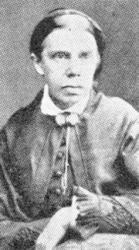
1825 - 1901 Author of "Lord, Take My Hand and Lead Me" Julie Katharina von Hausmann (born 7 March [O.S. 19 March] 1826 in Riga; died 2 August [O.S. 15 August] 1901 in Võsu, Estonia) was a Baltic German poet, known for the hymn Lord, Take My Hand and Lead Me (German: So nimm denn meine Hände) with a melody by Friedrich Silcher. Earlier translations had been made by Herman Brueckner as "O take my hand, dear Father" and Elmer Leon Jorgenson as "Take Thou My Hand, and Lead Me." The hymn has also been translated by Martha D. Lange, whose version appears in the Great Songs of the Church Revised (1986). Julie Hausmann was the daughter of a teach­er. She worked for a while as a gov­ern­ess, but due to her ill health she lived with and cared for her fa­ther, who had gone blind. Af­ter his death in 1864, she lived with her sis­ters in Ger­ma­ny, Southern France and St. Petersburg, Russia. She died during a summer vacation in Es­ton­ia. A legend circulates that Hausmann wrote her most famous poem "So nimm denn meine Hände" after journeying to see her fiancé at a mission and, on arriving, finding that he had just died. Various explorations of her biography have yet to confirm or deny the rumor. She never married. Her poetry was published by others, including Gustav Knak without mentioning her name, at her request. Maiblumen. Lieder einer Stillen im Lande.(May flowers) 2 volumes, 1862 (6th edition around 1880: Front cover Vol. 1) Bilder aus dem Leben der Nacht im Lichte des Evangeliums. 1868 Hausbrot. Schlichte Morgen- und Abend-Andachten. 1899 Blumen aus Gottes Garten. Lieder und Gedichte. 1902 (posthumous collection) --en.wikipedia.org/wiki/

Richard Massie

1800 - 1887 Topics: Ordinary Time Week 12 Translator of "The Lord's Prayer" in Hymns and Devotions for Daily Worship Massie, Richard, eldest son of the Rev. R. Massie, of Goddington, Cheshire, and Rector of Eccleston, was born at Chester, June 18, 1800, and resides at Pulford Hall, Coddington. Mr. Massie published a translation of Martin Luther’s Spiritual Songs, London, 1854. His Lyra Domestica, 1st series, London, 1860, contains translations of the 1st Series of Spitta's Psalter und Harfe. In 1864 he published vol. ii., containing translations of Spitta's 2nd Series, together with an Appendix of translations of German hymns by various authors. He also contributed many translations of German hymns to Mercer's Church Psalter & Hymn Book; to Reid's British Herald; to the Day of Rest, &c. He died Mar. 11,1887. -- John Julian, Dictionary of Hymnology (1907)

Johann Balthasar König

1691 - 1758 Person Name: Johann B. König Topics: Ordinary Time Week 20 Composer (attributed to) of "O DASS ICH TAUSEND ZUNGE HÄTTE" in Hymns and Devotions for Daily Worship Johann Balthasar König; b. 1691, Waltershausen, near Gotha; d. 1758, Frankfort Evangelical Lutheran Hymnal, 1908

John Ryland

1753 - 1825 Topics: Ordinary Time Week 9 Author of "Hinder Me Not" in Hymns and Devotions for Daily Worship Ryland, John, D.D., son of Rev. John Collett Ryland, was born at Warwick, Jan. 29, 1753. At that time his father was Baptist minister at Warwick, but in 1759 removed to Northampton. "J. Ryland, junior," as for many years he was accustomed to subscribe himself, was in 1781 ordained co-pastor with his father at Northampton. In 1794 he accepted the presidency of the Baptist College and the pastorate of the church in Broadmead, Bristol, and these offices he retained until his death on June 25, 1825. Dr. Ryland was a man of considerable literary culture, and received the degree of D.D. from Brown University, Rhode Island. He was one of the founders of the Baptist Missionary Society, and for the three years following the death of Rev. A. Fuller, in 1815, acted as its secretary. His prose works were Memoirs of Rev. B. Hall, Arnsby (2nd ed., 1852); A candid statement of the reasons which induce Baptists to differ from their Christian brethren; and many Sermons and Charges. After his death appeared 2 vols. of Discourses, selected from his manuscripts, and entitled Pastoral Memorial. To these discourses are appended many of his hymns, with their dates. Dr. Ryland's hymns were composed at different times, from his sixteenth year to the year of his death. The earliest were published when he was 16, in his Serious Essays, 1771. These 36 hymns were never republished. Several appeared in the Gospel Magazine from 1771 to 1782, and the Protestant Magazine, 1782-83; others in Rippon's Baptist Selection, 1787; 2 in the Collection for the Monthly Prayer Meeting at Bristol, 1797 ; 2 in Andrew Fuller's Memoirs, 1831; and 25 in the Pastoral Memorials, 1825. His Hymns and Verses on Sacred Subjects, to the number of 99, were reprinted from his mss. by D. Sedgwick, and were published, with a Memoir, in 1862. The hymns are dated therein from the mss. [Rev. W. R. Stevenson, M.A.] Those of Dr. Ryland's hymns now in common use include:— 1. For Zion's sake I'll not restrain. Missions. Dated 1798, and printed by D. Sedgwick from Ryland's manuscripts, 1862. 2. Had not the Lord, my soul may say [cry] . Ps. cxxiv. From his Serious Essays, 1771. It is No. 124 in Spurgeon's Our Own Hymn Book, 1866. Not in Sedgwick's reprint. 3. Holy, holy, holy Lord, self-existent Deity. Holy Trinity. Dated 1796. It was given in the tenth edition of Rippon's Baptist Selection, 1800, Pt. 2, No. 22; in the Pastoral Memorials, 1825; and Sedgwick's reprint, 1862, in 5 stanzas of 8 lines. It is in common use in Great Britain and America. 4. Look down, my soul, on hell's domain. Gratitude for escape. This is No. 881 in Spurgeon's Our Own Hymn Book. 1866, and dated 1777. We cannot trace it in any of Ryland's works or amongst his hymns. 5. Lord, teach a little child to pray. A Child's Prayer. Dated 1786. The note to this hymn by Dr. Ryland's son, in Sedgwick's reprint, 1862, p. 15, is:— "This and the following hymn ["God is very good to me “was composed at the request of Mrs. Fuller, wife of the Rev. Andrew Fuller, of Kettering, for the use of Miss Sarah Fuller, who died May 30th, 1789, aged six years and six months." It was published in Andrew Fuller's Memoirs, 1831, p. 442, andsin Sedgwick's reprint, 1862. 6. Now let the slumbering church awake. Activity in the Church desired. Dated "Feb. 20, 1798." Published in the Pastoral Memorials, 1825, and in Sedgwick's reprint, 1862. In Spurgeon's Our Own Hymn Book, 1866. 7. O Lord, I would delight in Thee. Delight in Christ. Dated "Dec. 3, 1777." Dr. Ryland added this note to the ms.:—-" I recollect deeper feelings of mind in composing this hymn, than perhaps I ever felt in making any other." It was published in Rippon's Selection 1798, No. 248; in the Pastoral Memorials, 1825; and in Sedgwick's reprint, 1862, in 7 st. of 41. It is in extensive use in its original, or an abbreviated form; or as "O Lord we would delight in Thee." In the American Methodist Episcopal Hymns, 1849; and their Hymn, 1878, st. i., ii., vi., vii. are rewritten in S. M. as "Lord, I delight in Thee." 8. Out of the depths of doubt and fear. Ps. cxxx. From the Serious Essays, 1771 (misdated in Spurgeon's Our Own Hymn Book 1775). It is not in the Pastoral Memorials, 1825, nor in Sedgwick's reprint, 1862. 9. Rejoice, the Saviour reigns. Missions. Dated "Jan. 19, 1792." In the 10th ed. of Rippon's Selection, 1800, 422 (2nd pt.) it is given in 6 st. of 6 1., as in the Ryland ms., and then after the word "Pause" two stanzas are added on, which are not in the ms. The 6 stanzas were repeated in the Pastoral Memorials, 1825; in Sedgwick's reprint, 1862; and in Spurgeon's Our Own Hymn Book, 1866 (abbreviated), and other modern hymnals. 10. Sovereign Ruler of the skies. Guidance, Peace, and Security in God. Dated "Aug. 1,1777." Included in Rippon's Selection, 1787, No. 545 ; the Pastoral Memorials, 1825 ; and Sedgwick's reprint, 1862, in 9 st. of 4 1. 11. Thou Son of God, and Son of Man. Praise to God, the Son. This is undated. It was given in the Pastoral Memorials, 1825; and Sedgwick's reprint, 1862. 12. When Abraham's servant to procure. Onward, Heavenward. Dr. Ryland's son, under the date of Nov. 4, 1861, informed D. Sedgwick that this hymn "was written with a slate pencil on a rusty iron blower by moonlight, past twelve o'clock, Dec. 30, 1773," and he gives these words as a quotation from his father's manuscript. It is almost needless to add that this account does not agree with the generally received history of the hymn, as set forth in Miller's Singers and Songs, 1869, p. 313. In the May number of the Gospel Magazine, 1775, p. 235, the hymn was given in 9 st. of 4 1., with the heading" Hinder me not-—Gen. xxiv. 56," and signed "Elachistoteros." It was repeated in Rippon's Selection, 1787, No. 447; and Sedgwick's reprint, 1862. In Rippon a note is added, "This hymn may begin with 6th verse." This direction has been followed in some modern collections, the result being the hymn commonly known as "In all my Lord's appointed ways." 13. When the Saviour dwelt below. Compassion of Christ. Dated 1806. Included in the Pastoral Memorials, 1825, and Sedgwick's reprint, 1862. Dr. Ryland's hymns are plain and simple, but they lack poetry and passion, and are not likely to be largely drawn upon, for future hymnals. --John Julian, Dictionary of Hymnology (1907)

George Mims

b. 1938 Person Name: George E. Mims, b. 1938 Topics: 10th Sunday in Ordinary Time Year A; 26th Sunday in Ordinary Time Year C; 31st Sunday in Ordinary Time Year C Harmonizer of "RESTORATION" in RitualSong

Richard Blanchard

1925 - 2004 Author of "Fill My Cup, Lord" Richard Blanchard Born at Chungking (now Chongqing) China to Methodist missionary parents, they returned to the U S, and lived in IN and NC. In his teens he moved from Wolcottville, IN, to Tryon, NC, bringing his family with him. In his senior year of high-school he worked at a bank. He saved his money, buying war bonds, and eventually purchased lakefront property on Lake Conway in FL. He attended Davidson College for a year, then enlisted in the U S Navy. He received a medical discharge and entered Mercer University, Macon, GA. In 1946 he married Anne Carlton of Oxford, GA, who attended Wesleyan University. They had three children: Richard, Jr, Carol Ann, and Emily. After graduating from Mercer, he enrolled at Candler School of Theology at Emory University, Atlanta, GA, receiving his Bachelor of Divinity that same year. In 1949 he was ordained a deacon, the next year an elder, after serving two years as pastor of the ‘Four-Church Snellville-Grayson’ circuit of the North GA Methodist Church. In 1950 he transferred to the FL circuit. He served congregations in Fort Lauderdale, Miami, Tampa, Jacksonville, Holiday, and Orlando, where he retired in 1988 after serving 40 years in ministry. He was musical and played the trombone. He also became a songwriter. In the 1980s he wrote a beautiful musical called ‘Francis of Assisi’. Some of his gospel songs were published and recorded. When younger, at Snellville, he wrote a weekly column called ‘Between You and Me’ for the Wesleyan Christian Advocate newsletter. He also wrote a story called ‘The Little Star’, published in Ideals magazine. He wrote an official biography of Bishop John Branscomb for the dedication of the Branscomb Memorial Auditorium in Lakeland, FL. Besides his music, Blanchard loved boating and dining by the water. He also traveled, visiting 75 countries. He loved fine art and visited art museums when possible. He also followed sports. He collected stamps, coins, and played word games. He loved meeting and helping others. In later years he and his wife moved to Swannanoa, NC, to be near their children. He eventually died there. John Perry

Ken Bible

b. 1950 Topics: Year B, Ordinary Time after Pentecost, October 16-22 Author of "The Mountains Stand in Awe" in Psalms for All Seasons

Pages


Export as CSV
It looks like you are using an ad-blocker. Ad revenue helps keep us running. Please consider white-listing Hymnary.org or getting Hymnary Pro to eliminate ads entirely and help support Hymnary.org.