You help make Hymnary.org possible. More than 10 million people from 200+ countries found hymns, liturgical resources and encouragement on Hymnary.org in 2025, including you. Every visit affirms the global impact of this ministry.

If Hymnary has been meaningful to you this year, would you take a moment today to help sustain it? A gift of any size—paired with a note of encouragement if you wish—directly supports the server costs, research work and curation that keep this resource freely available to the world.

Give securely online today, or mail a check to:
Hymnary.org
Calvin University
3201 Burton Street SE
Grand Rapids, MI 49546

Thank you for your partnership, and may the hope of Advent fill your heart.

Person Results

Topics:death+and+funeral
In:people

Planning worship? Check out our sister site, ZeteoSearch.org, for 20+ additional resources related to your search.
Showing 51 - 60 of 286Results Per Page: 102050

James Quinn

1919 - 2010 Person Name: James Quinn, 1919- Topics: Death; Devotion; Eternal Life; Funerals; Inner Peace; Jesus Christ Passion and Cross; Mystery of God's Love; Salvation; Sanctification; Satan Paraphraser of "May flights of angels lead you on your way" in Together in Song James Quinn (b. Glasgow, Scotland, April 21, 1919; d. Edinburgh, Scotland, April 8, 2010) was a Roman Catholic Jesuit priest who was ordained in 1950. As a consultant for the International Commission on English in the Liturgy, sparked by Vatican II, he has exerted influence far beyond his native Scotland. A collection of his hymn texts is available from Selah Publishing company. Sing a New Creation

John Hughes

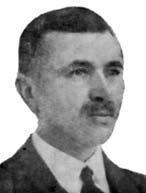
1873 - 1932 Topics: The Glory of the Triune God Providence; New Heaven and a New Earth Death and Eternal Life; Adoration and Praise; Assurance; Funerals and Memorial Services; Guidance; Pilgrimage; Providence Composer of "CWM RHONDDA" in The United Methodist Hymnal John Hughes (b. Dowlais, Glamorganshire, Wales, 1873; d. Llantwit Fardre, Wales, 1932) received little formal education; at age twelve he was already working as a doorboy at a local mining company in Llantwit Fardre. He eventually became an official in the traffic department of the Great Western Railway. Much of his energy was devoted to the Salem Baptist Church in Pontypridd, where he served as both deacon and precentor. Hughes composed two anthems, a number of Sunday school marches, and a few hymn tunes, of which CWM RHONDDA is universally known, the tune was composed in 1905 Baptist Cymanfa Ganu (song festival) in Capel Rhondda, Pontypridd, Wales. Bert Polman

Ralph Vaughan Williams

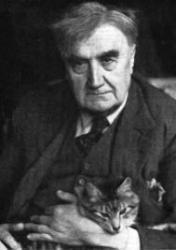
1872 - 1958 Topics: Life of Discipleship Death and Eternal Life; God's Church Life of Discipleship: Death and Eternal Life; Death; Eternal Life; Funerals and Memorial Services Composer of "SINE NOMINE" in Chalice Hymnal Through his composing, conducting, collecting, editing, and teaching, Ralph Vaughan Williams (b. Down Ampney, Gloucestershire, England, October 12, 1872; d. Westminster, London, England, August 26, 1958) became the chief figure in the realm of English music and church music in the first half of the twentieth century. His education included instruction at the Royal College of Music in London and Trinity College, Cambridge, as well as additional studies in Berlin and Paris. During World War I he served in the army medical corps in France. Vaughan Williams taught music at the Royal College of Music (1920-1940), conducted the Bach Choir in London (1920-1927), and directed the Leith Hill Music Festival in Dorking (1905-1953). A major influence in his life was the English folk song. A knowledgeable collector of folk songs, he was also a member of the Folksong Society and a supporter of the English Folk Dance Society. Vaughan Williams wrote various articles and books, including National Music (1935), and composed numerous arrange­ments of folk songs; many of his compositions show the impact of folk rhythms and melodic modes. His original compositions cover nearly all musical genres, from orchestral symphonies and concertos to choral works, from songs to operas, and from chamber music to music for films. Vaughan Williams's church music includes anthems; choral-orchestral works, such as Magnificat (1932), Dona Nobis Pacem (1936), and Hodie (1953); and hymn tune settings for organ. But most important to the history of hymnody, he was music editor of the most influential British hymnal at the beginning of the twentieth century, The English Hymnal (1906), and coeditor (with Martin Shaw) of Songs of Praise (1925, 1931) and the Oxford Book of Carols (1928). Bert Polman

Joseph Swain

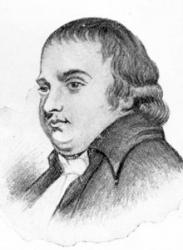
1761 - 1796 Topics: Comfort; Death and Eternal Life; Funeral / Memorial Service; God Presence of; Joy; Praying For Healing; Suffering Author of "O Thou, in Whose Presence" in Voices Together Swain, Joseph, was born at Birmingham in 1761, and after being apprenticed to an engraver, removed to London. After a time he became a decided Christian, and being of an emotional poetic temperament, began to give expression to his new thoughts and feelings in hymns. In 1783 he was baptized by the Rev. Dr. Rippon, and in 1791 became minister of a Baptist congregation in East Street, Walworth. After a short but popular and very useful ministry, he died April 16, 1796 Swain published the following:— (1) A Collection of Poems on Several Occasions, London, 1781; (2) Redemption, a Poem in five Books, London, 1789; (3) Experimental Essays on Divine Subjects, London, 1791; (4) Walworth Hymns, by J. Swain, Pastor of the Baptist Church Meeting there, London, 1792, 129 hymns; with a Supplement, 1794, 192 hymns; (5) A Pocket Companion and Directory, London, 1794. In addition to a limited number of Swain's hymns, annotated under their respective first lines, the following, from his Walworth Hymns1792, and the 2nd ed., 1796, are also in common use:— 1. Brethren, while we sojourn here. Mutual Encouragement. 2. Children of the King of grace. Holy Baptism. 3. Christ the Lord will come again. Second Advent. 4. Come, ye souls, by sin afflicted. The Yoke of Christ. 5. How sweet, how heavenly is the sight. Communion of Saints. 6. In expectation sweet. Second Advent. 7. Lift up your heads, ye gates. Ascension. 8. Love is the sweetest bud that blows. A Flower an Emblem of Christ. 9. 0 how the thought that I shall know. Heaven Anticipated. Sometimes it begins with st. ii., "For ever to behold Him shine". 10. On earth the song begins. Heaven Anticipated. 11. On the wings of faith upspringing. Passiontide. 12. Pilgrims we are to Canaan bound. Pilgrimage of Life. 13. Praise ye the Lord, the eternal King. Divinity of Christ. 14. Praise your Redeemer, praise His Name. Praise for Redemption. 15. 'Tis heaven begun below. Heaven Anticipated. 16. What is it for a saint to die? Death and Burial. 17. What must [will] it be to dwell above? Heaven Anticipated. 18. When firm I [we] stand on Zion's hill. Confidence. Sometimes as "I stand on Zion's mount," in American collections. 19. Who can forbear to sing? Praise of Jesus. From his Redemption, a Poem in Five Books, 1791, the following hymns are also in common use:-- 20. 0 Thou in whose presence my soul takes delight. In Affliction. 21. Ye daughters of Zion, declare, have you see? Comfort in Affliction. Of these hymns the most widely known are Nos. 1, 5, 6, and 20. We may add that several of Swain's hymns appeared in The Theological Miscellany, 1784-1789. [Rev. W. R. Stevenson, M.A.] -- John Julian, Dictionary of Hymnology (1907)

George Matheson

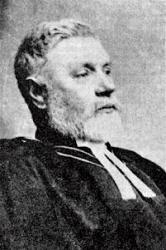
1842 - 1906 Topics: Conversion and New Life; Death and Eternal Life; Funeral / Memorial Service; Jesus Christ Images and Names of; New Creation Author of "O Love That Will Not Let Me Go" in Voices Together Matheson, George, D.D., was born at Glasgow, March 27, 1842, and although deprived of his eyesight in youth he passed a brilliant course at the University of Edinburgh, where he graduated M.A. in 1862. In 1868 he became the parish minister at Innellan; and subsequently of St. Bernard's, Edinburgh. He was the Baird Lecturer in 1881, and St. Giles Lecturer in 1882. He has published several important prose works. His poetical pieces were collected and published in 1890 as Sacred Songs, Edinburgh: W. Blackwood. In addition to his hymn "O Love that wilt not let me go" (q. v.), four others from his Sacred Songs are in Dr. A. C. Murphey's Book of Common Song, Belfast, 1890. --John Julian, Dictionary of Hymnology, Appendix, Part II (1907) ======================= Matheson, G., p. 1579, i. In addition to Dr. Matheson's hymn, "O Love, that wilt not let me go," p. 1583, i,, the following from his Sacred Songs, 1890, have come into common use since 1892:— 1. Come, let us raise a common song. Brotherhood. 2. Father divine, I come to Thee. Strength for Life. This, in Horder's Worship Song, 1905, is altered to”Saviour divine, I come to Thee." 3. Gather us in, Thou Love that fillest all. One in Christ. 4. Jesus, Fountain of my days. Christian's Polestar. 5. Lend me, O Lord, Thy softening cloud. The Fire and the Cloud. In the Sunday Magazine, 1875. 6. Lord, Thou hast all my frailty made. Strength for the Day. 7. Make me a captive, Lord. Christian Freedom. 8. There are coming changes great. The Glad New Time. 9. Three doors there are in the temple. Prayer. Dr. Matheson informed us that these hymns, together with the rest of his Sacred Songs, 1890, were written at Bow, Dumbartonshire, in 1890. The 3rd ed. of the Sacred Songs was published in 1904. He died suddenly at Avenelle, North Berwick, Aug. 28, 1906. --John Julian, Dictionary of Hymnology, New Supplement (1907)

E. O. Excell

1851 - 1921 Person Name: Edwin O. Excell Topics: Conversion and New Life; Heaven; Trials; Conversion and New Life; Death and Eternal Life; Funeral / Memorial Service; God Faithfulness of; Grace; Heaven; Hope; Salvation; Trials Adapter and Harmonizer of "NEW BRITAIN (AMAZING GRACE)" in Voices Together Edwin Othello Excel USA 1851-1921. Born at Uniontown, OH, he started working as a bricklayer and plasterer. He loved music and went to Chicago to study it under George Root. He married Eliza Jane “Jennie” Bell in 1871. They had a son, William, in 1874. A member of the Methodist Episcopal Church, he became a prominent publisher, composer, song leader, and singer of music for church, Sunday school, and evangelistic meetings. He founded singing schools at various locations in the country and worked with evangelist, Sam Jones, as his song leader for two decades. He established a music publishing house in Chicago and authored or composed over 2,000 gospel songs. While assisting Gypsy Smith in an evangelistic campaign in Louisville, KY, he became ill, and died in Chicago, IL. He published 15 gospel music books between 1882-1925. He left an estate valued at $300,000. John Perry

Carrie Ellis Breck

1855 - 1934 Person Name: Carrie E. Breck Topics: The Christian Life Death and Eternal Life; Funerals; Spiritual Conflict; Eternal Life; Funerals Author of "Face to Face" in The Worshiping Church Carrie Ellis Breck was born 22 January 1855 in Vermont and raised in a Christian home. She later moved to Vineland, New Jersey, and then to Portland, Oregon. She wrote verse and prose for religious and household publications, In 1884 she married Frank A. Breck. She has written between fourteen and fifteen hundred hymns. Dianne Shapiro, from "The Singers and Their Songs: sketches of living gospel hymn writers" by Charles Hutchinson Gabriel (Chicago: The Rodeheaver Company, 1916) See also Mrs. Frank A. Breck.

Robert Lowry

1826 - 1899 Topics: The Christian Life Death and Eternal Life; Funerals; Funerals; Heaven Author of "Shall We Gather at the River" in The Worshiping Church Robert Lowry was born in Philadelphia, March 12, 1826. His fondness for music was exhibited in his earliest years. As a child he amused himself with the various musical instruments that came into his hands. At the age of seventeen he joined the First Baptist Church of Philadelphia, and soon became an active worker in the Sunday-school as teacher and chorister. At the age of twenty-two he gave himself to the work of the ministry, and entered upon a course of study at the University of Lewisburg, Pa. At the age of twenty-eight he was graduated with the highest honors of his class. In the same year of his graduation, he entered upon the work of the ministry. He served as pastor at West Chester, Pa., 1851-1858; in New York City, 1859-1861; in Brooklyn, 1861-1869; in Lewisburg, Pa., 1869-1875. While pastor at Lewisburg, he was also professor of belles lettres in the University, and received the honorary degree of D. D. in 1875. He then went to Plainfield, N. J., where he became pastor of Park Avenue Church. In each of these fields his work was crowned with marked success. Dr. Lowry was a man of rare administrative ability, a most excellent preacher, a thorough Bible student, and whether in the pulpit or upon the platform, always a brilliant and interesting speaker. He was of a genial and pleasing disposition, and a high sense of humor was one of his most striking characteristics. Very few men had greater ability in painting pictures from the imagination. He could thrill an audience with his vivid descriptions, inspiring others with the same thoughts that inspired him. His melodies are sung in every civilized land, and many of his hymns have been translated into foreign tongues. While preaching the Gospel, in which he found great joy, was his life-work, music and hymnology were favorite studies, but were always a side issue, a recreation. In the year 1880, he took a rest of four years, visiting Europe. In 1885 he felt that he needed more rest, and resigned his pastorate at Plainfield, and visited in the South and West, also spending some time in Mexico. He returned, much improved in health, and again took up his work in Plainfield. On the death of Wm. B. Bradbury, Messrs. Biglow & Main, successors to Mr. Bradbury in the publishing business, selected Dr. Lowry for editor of their Sunday-school book, Bright Jewels, which was a great success. Subsequently Dr. W. Doane was associated with him in the issue of the Sunday-school song book, Pure Gold, the sales of which exceeded a million copies. Then came Royal Diadem, Welcome Tidings, Brightest and Best, Glad Refrain, Good as Gold, Joyful Lays, Fountain of Song, Bright Array, Temple Anthems, and numerous other volumes. The good quality of their books did much to stimulate the cause of sacred song in this country. When he saw that the obligations of musical editorship were laid upon him, he began the study of music in earnest, and sought the best musical text-books and works on the highest forms of musical composition. He possessed one of the finest musical libraries in the country. It abounded in works on the philosophy and science of musical sounds. He also had some musical works in his possession that were over one hundred and fifty years old. One of his labors of love some years ago was an attempt to reduce music to a mathematical basis. On the established fact that Middle C has two hundred and fifty-six vibrations per second, he prepared a scale and went to work on the rule of three. After infinite calculation and repeated experiments, he carried it far enough to discover that it would not work. A reporter once asked him what was his method of composition — "Do you write the words to fit the music, or the music to fit the words?" His reply was, "I have no method. Sometimes the music comes and the words follow, fitted insensibly to the melody. I watch my moods, and when anything good strikes me, whether words or music, and no matter where I am, at home or on the street, I jot it down. Often the margin of a newspaper or the back of an envelope serves as a notebook. My brain is a sort of spinning machine, I think, for there is music running through it all the time. I do not pick out my music on the keys of an instrument. The tunes of nearly all the hymns I have written have been completed on paper before I tried them on the organ. Frequently the words of the hymn and the music have been written at the same time." The Doctor frequently said that he regarded "Weeping Will Not Save Me" as the best and most evangelistic hymn he ever wrote. The following are some of his most popular and sweetest gospel melodies: "Shall We Gather at the River?," "One More Day's Work for Jesus," "Where is My Wandering Boy To-night?," "I Need Thee Every Hour," "The Mistakes of My Life," "How Can I Keep from Singing?," "All the Way My Saviour Leads Me," "Saviour, Thy Dying Love," "We're Marching to Zion," etc. "Shall We Gather at the River?" is perhaps, without question, the most widely popular of all his songs. Of this Mr. Lowry said: "It is brass band music, has a march movement, and for that reason has become popular, though for myself I do not think much of it." Yet he tells us how, on several occasions, he had been deeply moved by the singing of that hymn, "Going from Harrisburg to Lewisburg once I got into a car filled with half-drunken lumbermen. Suddenly one of them struck up, "Shall We Gather at the River?" and they sang it over and over again, repeating the chorus in a wild, boisterous way. I did not think so much of the music then as I listened to those singers, but I did think that perhaps the spirit of the hymn, the words so flippantly uttered, might somehow survive and be carried forward into the lives of those careless men, and ultimately lift them upward to the realization of the hope expressed in my hymn." "A different appreciation of it was evinced during the Robert Raikes' Centennial. I was in London, and had gone to meeting in the Old Bailey to see some of the most famous Sunday-school workers in the world. They were present from Europe, Asia, and America. I sat in a rear seat alone. After there had been a number of addresses delivered in various languages, I was preparing to leave, when the chairman of the meeting announced that the author of "Shall We Gather at the River?" was present, and I was requested by name to come forward. Men applauded and women waved their handkerchiefs as I went to the platform. It was a tribute to the hymn; but I felt, when it was over, that, after all, I had perhaps done some little good in the world, and I felt more than ever content to die when God called." On Children's Day in Brooklyn, in 1865, this song was sung by over forty thousand voices. While Dr. Lowry said, "I would rather preach a gospel sermon to an appreciative, receptive congregation than write a hymn," yet in spite of his preferences, his hymns have gone on and on, translated into many languages, preaching and comforting thousands upon thousands of souls, furnishing them expression for their deepest feelings of praise and gratitude to God for His goodness to the children of men. What he had thought in his inmost soul has become a part of the emotions of the whole Christian world. We are all his debtors. Rev. Robert Lowry, D. D., died at his residence in Plainfield, K J., November 25, 1899. Dead, yet he lives and his sermons in gospel song are still heard and are doing good. Dr. Lowry was a great and good man, and his life, well spent, is highly worthy of a place among the world's greatest gospel song and hymn writers. -- Biography of Gospel Song and Hymn Writers ------- Lowry, Robert, D.D., son of Crozier Lowry, was born at Philadelphia, Pennsylvania, March 12, 1826, and educated at Lewisburg University. Having received ordination as a Baptist Minister, his first charge was at West Chester, Pennsylvania. From thence he passed to New York City, and then to Brooklyn, N. Y. In 1876 he was appointed Professor of Rhetoric in his University. On resigning his Professorship he undertook the charge of the 2nd Baptist Church, New Jersey. Dr. Lowry has been associated with some of the most popular Sunday School hymn-books published in the States, including Happy Voices, 1865; Chapel Melodies, 1868; Bright Jewels, 1869; Pure Gold, 1871; Royal Diadem, 1873; Tidal Wave, 1874; Fountain of Song1877; Welcome Tidings, 1877, &c. Of Dr. Lowry's hymns those which have attained the widest circulation are:— 1. Jerusalem, for ever bright. Heaven. Appeared in the American Tract Society's Happy Voices, 1865, with music by the author. 2. Low in the grave He lay. Resurrection of Christ. Written in 1874 and published in Brightest and Best, 1875. 3. Marching on, marching on. Sunday School Battle Song. Appeared, with music by the author, in Happy Voices, 1865. 4. My home is in heaven, my rest is not here. In Happy Voices, 1865, with music by the author. 5. My life flows on in endless song. Joy in God. In Bright Jewels, 1869; the Royal Diadem, 1873, and others in America and Great Britain, with music by the author. 6. One more day's work for Jesus. Work for Christ. Published, with music by the author, in Bright Jewels, 1869. 7. Shall we gather at the river? Mutual recognition in the Hereafter. The origin of this hymn is thus set forth in E. W. Long's Illustrated History of Hymns and their Authors, Philadelphia, 1876, p. 64:— ”On a very hot summer day, in 1864, a pastor was seated in his parlour in Brooklyn, N. Y. It was a time when an epidemic was sweeping through the city, and draping many persons and dwellings in mourning. All around friends and acquaintances were passing away to the spirit land in large numbers. The question began to arise in the heart, with unusual emphasis, ‘Shall we meet again? We are parting at the river of death, shall we meet at the river of life?' ‘Seating myself at the organ,’ says he, ‘simply to give vent to the pent up emotions of the heart, the words and music of the hymn began to flow out, as if by inspiration:— ‘Shall we gather at the river, Where bright angel feet have trod?’" In 1865 the hymn and music were given in Happy Voices, No. 220, in 5 stanzas of 4 lines and a chorus. The hymn has since passed into a great number of hymnals in Great Britain and America. 8. Take the wings of the morning; speed quickly thy flight. Exhortation to Repentance. Written for, and published with music by the author in, the Royal Diadem, 1873. 9. Weeping will not save me. Salvation through Faith. Published in the Chapel Melodies, 1868. 10. What can wash away my stain? Precious Blood of Jesus. Given in the Welcome Tidings, 1877, with music by the author. 11. Where is my wandering boy tonight! The absent Child. In the Fountain of Song, 1877, together with music by the author. Most of these hymns are given in Mr. I. D. Sankey's Sacred Songs & Solos, Pts. i., ii. --John Julian, Dictionary of Hymnology (1907)

William Walsham How

1823 - 1897 Person Name: William W. How Topics: Life of Discipleship Death and Eternal Life; God's Church Life of Discipleship: Death and Eternal Life; Death; Eternal Life; Funerals and Memorial Services Author of "For All the Saints" in Chalice Hymnal William W. How (b. Shrewsbury, Shropshire, England, 1823; d. Leenane, County Mayo, Ireland, 1897) studied at Wadham College, Oxford, and Durham University and was ordained in the Church of England in 1847. He served various congregations and became Suffragan Bishop in east London in 1879 and Bishop of Wakefield in 1888. Called both the "poor man's bishop" and "the children's bishop," How was known for his work among the destitute in the London slums and among the factory workers in west Yorkshire. He wrote a number of theological works about controversies surrounding the Oxford Movement and attempted to reconcile biblical creation with the theory of evolution. He was joint editor of Psalms and Hymns (1854) and Church Hymns (1871). While rector in Whittington, How wrote some sixty hymns, including many for chil­dren. His collected Poems and Hymns were published in 1886. Bert Polman =============== How, William Walsham, D.D., son of William Wybergh How, Solicitor, Shrewsbury, was born Dec. 13, 1823, at Shrewsbury, and educated at Shrewsbury School and Wadham College, Oxford (B.A. 1845). Taking Holy Orders in 1846, he became successively Curate of St. George's, Kidderminster, 1846; and of Holy Cross, Shrewsbury, 1848. In 1851 he was preferred to the Rectory of Whittington, Diocese of St. Asaph, becoming Rural Dean in 1853, and Hon. Canon of the Cathedral in 1860. In 1879 he was appointed Rector of St. Andrew's Undershaft, London, and was consecrated Suffragan Bishop for East London, under the title of the Bishop of Bedford, and in 1888 Bishop of Wakefield. Bishop How is the author of the Society for Promoting Christian Knowledge Commentary on the Four Gospels; Plain Words , Four Series; Plain Words for Children; Pastor in Parochia; Lectures on Pastoral Work; Three All Saints Summers, and Other Poems , and numerous Sermons , &c. In 1854 was published Psalms and Hymns, Compiled by the Rev. Thomas Baker Morrell, M.A., . . . and the Rev. William Walsham How, M.A. This was republished in an enlarged form in 1864, and to it was added a Supplement in 1867. To this collection Bishop How contributed several hymns, and also to the S. P. C. K. Church Hymns , of which he was joint editor, in 1871. The Bishop's hymns in common use amount in all to nearly sixty. Combining pure rhythm with great directness and simplicity, Bishop How's compositions arrest attention more through a comprehensive grasp of the subject and the unexpected light thrown upon and warmth infused into facia and details usually shunned by the poet, than through glowing imagery and impassioned rhetoric. He has painted lovely images woven with tender thoughts, but these are few, and found in his least appreciated work. Those compositions which have laid the firmest hold upon the Church, are simple, unadorned, but enthusiastically practical hymns, the most popular of which, "O Jesu, Thou art standing"; "For all the Saints who from their labours rest," and "We give Thee but Thine own," have attained to a foremost rank. His adaptations from other writers as in the case from Bishop Ken, "Behold, the Master passeth by," are good, and his Children's hymns are useful and popular. Without any claims to rank as a poet, in the sense in which Cowper and Montgomery were poets, he has sung us songs which will probably outlive all his other literary works. The more important of Bishop How's hymns, including those already named, and "Lord, Thy children guide and keep"; "O Word of God Incarnate"; "This day at Thy creating word"; "Who is this so weak and helpless"; and others which have some special history or feature of interest, are annotated under their respective first lines. The following are also in common use:— i. From Psalms & Hymns, 1854. 1. Before Thine awful presence, Lord. Confirmation. 2. Jesus, Name of wondrous love [priceless worth]. Circumcision. The Name Jesus . 3. Lord Jesus, when we stand afar. Passiontide. 4. O blessing rich, for sons of men. Members of Christ. 5. 0 Lord of Hosts, the earth is Thine. In time of War. 6. O Lord, Who in Thy wondrous love. Advent. ii. From Psalms & Hymns, enlarged, 1864. 7. Lord, this day Thy children meet. Sunday School Anniversary. iii. From Supplement to the Psalms & Hymns, 1867. 8. Hope of hopes and joy of joys. Resurrection. 9. 0 daughters blest of Galilee. For Associations of Women. 10. O happy feet that tread. Public Worship. 11. With trembling awe the chosen three. Transfiguration. iv. From Parish Magazine, 1871, and Church Hymns, 1871. 12. O Jesu, crucified for man. Friday. 13. Yesterday, with worship blest. Monday. v. From the S. P. C. K. Church Hymns. 1871. 14. Bowed low in supplication. For the Parish. 15. Great Gabriel sped on wings of light. Annunciation, of the Blessed Virgin Mary. 16. O blest was he, whose earlier skill. St. Luke. 17. O God, enshrined in dazzling light. Omnipresence. Divine Worship . 18. O heavenly Fount of Light and Love. Witsuntide. 19. O Lord, it is a blessed thing. Weekdays. 20. 0 One with God the Father. Epiphany. 21. O Thou through suffering perfect made. Hospitals. 22. Rejoice, ye sons of men. Purification of the B. V. M. 23. Summer suns are glowing. Summer. 24. The year is swiftly waning. Autumn. 25. Thou art the Christ, O Lord. St. Peter. 26. To Thee our God we fly. National Hymn. 27. Upon the holy Mount they stood. Transfiguration and Church Guilds. 28. We praise Thy grace, 0 Saviour. St. Mark. vi. From the S. P. C. K. Children's Hymns, 1872. 29. Behold a little child. Jesus the Child's Example. 30. Come, praise your Lord and Saviour. Children's Praises. 31. It is a thing most wonderful. Sunday School Anniversary. 32. On wings of living light. Easter. Bishop How's hymns and sacred and secular pieces were collected and published as Poems and Hymns, 1886. The Hymns, 54 in all, are also published separately. He d. Aug. 10, 1897. --John Julian, Dictionary of Hymnology (1907) =================== How, W. W., p. 540, i. He died Aug. 10, 1897. His Memoir, by F. D. How, was published in 1898. --John Julian, Dictionary of Hymnology, New Supplement (1907)

Edmond Budry

1854 - 1932 Person Name: Edmond Budry (1854-1932) Topics: Christ Risen Resurrection and Exaltation; The Church Celebrates Death and Grieving; Christian Year Easter; Funerals general; Multi-cultrual and World-church Songs Author of "Thine be the glory, risen, conquering Son" in Church Hymnary (4th ed.)

Pages


Export as CSV
It looks like you are using an ad-blocker. Ad revenue helps keep us running. Please consider white-listing Hymnary.org or getting Hymnary Pro to eliminate ads entirely and help support Hymnary.org.