You help make Hymnary.org possible. More than 10 million people from 200+ countries found hymns, liturgical resources and encouragement on Hymnary.org in 2025, including you. Every visit affirms the global impact of this ministry.

If Hymnary has been meaningful to you this year, would you take a moment today to help sustain it? A gift of any size—paired with a note of encouragement if you wish—directly supports the server costs, research work and curation that keep this resource freely available to the world.

Give securely online today, or mail a check to:
Hymnary.org
Calvin University
3201 Burton Street SE
Grand Rapids, MI 49546

Thank you for your partnership, and may the hope of Advent fill your heart.

Person Results

Topics:proper+21
In:people

Planning worship? Check out our sister site, ZeteoSearch.org, for 20+ additional resources related to your search.
Showing 51 - 60 of 234Results Per Page: 102050

Cyril Taylor

1907 - 1991 Person Name: Cyril Taylor (1907-1991) Topics: Proper 21 Year C Composer of "ABBOT'S LEIGH" in Ancient and Modern Cyril V. Taylor (b. Wigan, Lancashire, England, 1907; d. Petersfield, England, 1991) was a chorister at Magdalen College School, Oxford, and studied at Christ Church, Oxford, and Westcott House, Cambridge. Ordained a priest in the Church of England in 1932, he served the church as both pastor and musician. His positions included being a producer in the religious broadcasting department of the BBC (1939­-1953), chaplain of the Royal School of Church Music (1953-1958), vicar of Cerne Abbas in Dorsetshire (1958-1969), and precentor of Salisbury Cathedral (1969-1975). He contributed twenty hymn tunes to the BBC Hymn Book (1951), which he edited, and other tunes to the Methodist Hymns and Psalms (1983). He also edited 100 Hymns for Today (1969) and More Hymns for Today (1980). Writer of the booklet Hymns for Today Discussed (1984), Taylor was chairman of the Hymn Society of Great Britain and Ireland from 1975 to 1980. Bert Polman

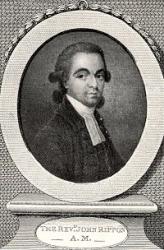
John Rippon

1751 - 1836 Topics: Year A Proper 21 Author (st. 4) of "All Hail the Power of Jesus' Name" in The New Century Hymnal Rippon, John, D.D., was born at Tiverton, Devon, April 29, 1751, and was educated for the ministry at the Baptist College, Bristol. In 1773 he became Pastor of the Baptist church in Carter Lane, Tooley Street (afterwards removed to New Park Street), London, and over this church he continued to preside until his death, on Dec. 17, 1836. The degree of D.D. was conferred on him in 1792 by the Baptist College, Providence, Rhode Island. Dr. Rippon was one of the most popular and influential Dissenting ministers of his time. From 1790 to 1802 he issued the Baptist Annual Register, a periodical containing an account of the most important events in the history of the Baptist Denomination in Great Britain and America during that period, and very valuable now as a book of reference. But his most famous work is his Selection of hymns for public worship, which appeared in 1787. The full title of the first edition is A selection of Hymns from the best authors, intended as an Appendix to Dr. Watts's Psalms and Hymns. In 1791 he published a Selection of Psalm and Hymn Tunes from the Best Authors, adapted to Dr. Watts's Psalms and Hymns, and to his own Selection, and from that time the names of tunes were prefixed to the hymns in the successive editions of his hymn-book. In 1800 he published the 10th ed. of his Selections, containing more than sixty additional hymns. In 1827 it was still further enlarged, and in 1844, after his death, appeared The Comprehensive Edition, commonly known as The Comprehensive Rippon, containing most of the additional hymns, with about 400 then first added, making in all upwards of 1170, in 100 metres. A rival to the Comprehensive was also afterwards published under the old title, somewhat enlarged. In the preparation of the original book, and its subsequent improvement, Dr. Rippon performed an important service to Baptist Hymnody, and also, it is said, gained for himself "an estate" through its immense sale. In the preface to the tenth edition lie claims for himself the authorship of some of the hymns, but as he refrained from affixing his name to any of the hymns it is impossible now to say with certainty which ought to be ascribed to him. There can, however, be no reasonable doubt that hymn 535, 3rd part, "The day has dawned, Jehovah comes" (q.v.), is one of his compositions. Other hymns, probably by him, are, "Amid the splendours of Thy state" (Love of God), 1800; and "There is joy in heaven, and joy on earth" (Joy over the Repenting Sinner), 1787. He also altered the texts of and made additions to several of the older hymns. Some of these altered texts are still in common use. In 1830 the additions given in the 27th ed., 1827, of Rippon's Selections were reprinted, with notes by Dr. Slater, as:— Hymns Original and Selected; interspersed in the Twenty-seventh edition of the Selection, with Numerous Doxologies, in the Usual, the Peculiar, and in the less Common metres. By John Rippon, D.D. A second edition of this pamphlet of 82 hymns and doxologies appeared in 1832. [Rev. W. R. Stevenson, M.A.] --John Julian, Dictionary of Hymnology (1907)

Caroline M. Noel

1817 - 1877 Person Name: Caroline Maria Noel Topics: Proper 21 Year A; Proper 21 Year B Author of "At the Name of Jesus" in Voices United Caroline Marie Noel (b. Teston, Kent, England, 1817; d. St. Marylebone, London, England, 1877) The daughter of an Anglican clergyman and hymn writer, she began to write poetry in her late teens but then abandoned it until she was in her forties. During those years she suffered frequent bouts of illness and eventually became an invalid. To encourage both herself and others who were ill or incapacitated, Noel began to write devotional verse again. Her poems were collected in The Name of Jesus and Other Verses for the Sick and Lonely (1861, enlarged in 1870). Bert Polman ================ Noel, Caroline Maria, daughter of the Hon. Gerard T. Noel (p. 809, ii.), and niece of the Hon. Baptist W. Noel, was born in London, April 10, 1817, and died at 39 Great Cumberland Place, Hyde Park, Dec. 7, 1877. Her first hymn, "Draw nigh unto my soul" (Indwelling), was written when she was 17. During the next three years she wrote about a dozen pieces: from 20 years of age to 40 she wrote nothing; and during the next 20 years the rest of her pieces were written. The first edition of her compositions was published as The Name of Jesus and Other Verses for the Sick and Lonely, in 1861. This was enlarged from time to time, and its title subsequently changed by the publishers to The Name of Jesus and Other Poems. The 1878 ed. contains 78 pieces. Miss Noel, in common with Miss Charlotte Elliott, was a great sufferer, and many of these verses were the outcome of her days of pain. They are specially adapted "for the Sick and Lonely" and were written rather for private meditation than for public use, although several are suited to the latter purpose. Her best known hymn is the Processional for Ascension Day, "At the Name of Jesus." It is in the enlarged edition of The Name of Jesus, &c, 1870, p. 59, and is dated 1870 by her family. --John Julian, Dictionary of Hymnology, Appendix, Part II (1907)

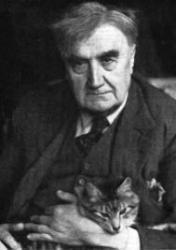
Ralph Vaughan Williams

1872 - 1958 Topics: Proper 21 Year A; Proper 21 Year B Composer of "KING'S WESTON" in Voices United Through his composing, conducting, collecting, editing, and teaching, Ralph Vaughan Williams (b. Down Ampney, Gloucestershire, England, October 12, 1872; d. Westminster, London, England, August 26, 1958) became the chief figure in the realm of English music and church music in the first half of the twentieth century. His education included instruction at the Royal College of Music in London and Trinity College, Cambridge, as well as additional studies in Berlin and Paris. During World War I he served in the army medical corps in France. Vaughan Williams taught music at the Royal College of Music (1920-1940), conducted the Bach Choir in London (1920-1927), and directed the Leith Hill Music Festival in Dorking (1905-1953). A major influence in his life was the English folk song. A knowledgeable collector of folk songs, he was also a member of the Folksong Society and a supporter of the English Folk Dance Society. Vaughan Williams wrote various articles and books, including National Music (1935), and composed numerous arrange­ments of folk songs; many of his compositions show the impact of folk rhythms and melodic modes. His original compositions cover nearly all musical genres, from orchestral symphonies and concertos to choral works, from songs to operas, and from chamber music to music for films. Vaughan Williams's church music includes anthems; choral-orchestral works, such as Magnificat (1932), Dona Nobis Pacem (1936), and Hodie (1953); and hymn tune settings for organ. But most important to the history of hymnody, he was music editor of the most influential British hymnal at the beginning of the twentieth century, The English Hymnal (1906), and coeditor (with Martin Shaw) of Songs of Praise (1925, 1931) and the Oxford Book of Carols (1928). Bert Polman

Peter Williams

1723 - 1796 Topics: Proper 21 Year A Translator (into English) of "Guide Me, O Thou Great Jehovah (Guide-moi, Berger fidèle)" in Voices United Peter Williams (b. Llansadurnin, Carmarthanshire, Wales, 1722; d. Llandyfeilog, Wales, 1796) was converted to Christianity by the preaching of George Whitefield and was ordained in the Church of England in 1744. His evangelical convictions soon made him suspect, however, and he left the state church to join the Calvinist Methodists in 1746. He served as an itinerant preacher for many years and was a primary figure in the Welsh revival of the eighteenth century. After being expelled by the Methodists in 1791 on a charge of heresy, he ministered in his own chapel during the last years of his life. He published the first Welsh Bible commentary (1767-1770) and a Bible concordance (1773); he was also one of the annotators for John Canne's Welsh Bible (1790). In addition Williams published a Welsh hymnal, Rhai Hymnau ac Odlau Ysbrydol (1759), as well as Hymns on Various Subjects (1771). Bert Polman

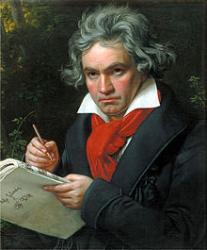
Ludwig van Beethoven

1770 - 1827 Topics: Proper 21 Year B Composer of "HYMN TO JOY" in Voices United A giant in the history of music, Ludwig van Beethoven (b. Bonn, Germany, 1770; d. Vienna, Austria, 1827) progressed from early musical promise to worldwide, lasting fame. By the age of fourteen he was an accomplished viola and organ player, but he became famous primarily because of his compositions, including nine symphonies, eleven overtures, thirty piano sonatas, sixteen string quartets, the Mass in C, and the Missa Solemnis. He wrote no music for congregational use, but various arrangers adapted some of his musical themes as hymn tunes; the most famous of these is ODE TO JOY from the Ninth Symphony. Although it would appear that the great calamity of Beethoven's life was his loss of hearing, which turned to total deafness during the last decade of his life, he composed his greatest works during this period. Bert Polman

Communauté de Taizé

Person Name: Taizé Community Topics: Year A Proper 21 Author of "Wait for the Lord" in Complete Anglican Hymns Old and New

Frederick C. Maker

1844 - 1927 Person Name: Frederick C. Maker, 1844-1927 Topics: Year C Proper 21 Composer of "ST CHRISTOPHER" in Complete Anglican Hymns Old and New Frederick C. Maker (b. Bristol, England, August 6, 1844; d. January 1, 1927) received his early musical training as a chorister at Bristol Cathedral, England. He pursued a career as organist and choirmaster—most of it spent in Methodist and Congregational churches in Bristol. His longest tenure was at Redland Park Congregational Church, where he was organist from 1882-1910. Maker also conducted the Bristol Free Church Choir Association and was a long-time visiting professor of music at Clifton College. He wrote hymn tunes, anthems, and a cantata, Moses in the Bulrushes. Bert Polman

Dorothy A. Thrupp

1779 - 1847 Topics: Children's Hymns about Children; Christ Shepherd Author (attributed to) of "Savior, Like a Shepherd Lead Us" Dorothy Ann Thrupp was born in London, June 10, 1779. She contributed some hymns, under the pseudonym of "Iota," to W. Carus Wilson's Friendly Visitor and his Children's Friend. Other hymns by her, signed "D.A.T.," appeared in Mrs. Herbert Mayo's Selection of Hymns and Poetry for the Use of Infant Schools and Nurseries, 1838. She was also the editor of Hymns for the Young, c. 1830, in which all the hymns were given anonymously. She died in London on December 15, 1847. --The Hymnal 1940 Companion ================================ Thrupp, Dorothy Ann, daughter of Joseph Thrupp, of Paddington Green, was born at London, June 20, 1779 and died there on Dec. 14, 1847. Her hymns, a few of which have come into extensive use, were contributed to the Rev. W. Carus Wilson's Friendly Visitor and his Children's Friend, under the nom de plume of Iota; to Mrs. Herbert Mayo's Selection of Hymns and Poetry for the use of Infant Schools and Nurseries, 1838 (3rd ed. 1846, with change of title to A Sel. . . . of Infant and Juvenile Schools and Families), in which her signature is "D.A.T."; and also to the Hymns for the Young, which she herself edited for the Religious Tract Society circa 1830, 4th ed., 1836. In 1836 and 1837 she also published Thoughts for the Day (2nd series), in which she embodied many hymns which previously appeared in the Friendly Visitor. In addition to her hymns, which are annotated under their respective first lines there are also in common use:— 1. Come, Holy Spirit, come, 0 hear an infant's prayer. Child's Prayer. Appeared in Mrs. Mayo's Selection of Hymns and Poetry, 1838, No. 14, and signed "D.A.T." 2. God loves the little child that prays. God's love for Children. Given in Miss Thrupp's Hymns for the Young, 4th ed., 1836; and again in Mrs. Mayo's Selection of Hymns and Poetry&c, 2nd ed., 1840, and signed " D.A.T." It is sometimes given as "God loves the child that humbly prays." 3. Have you read the wondrous story? Life and Death of Jesus. This appeared anonymously in Miss Thrupp's Hymns for the Young, R. T. S., 1830, No. 12, in 5 stanzas of 4 lines. In Miss Thrupp's later publications this hymn is omitted, a fact which suggests that it was not her composition, but possibly that of a friend. It is in theLeeds Sunday School Union Hymn Book, 1833-78. 4. Let us sing with one accord. Praise of Jesus. This hymn is usually associated with Miss Thrupp's name, but on insufficient evidence. We find it in the 4th edition of her Hymns for the Young, 1836, and again in the 3rd ed. of Mrs. H. Mayo's Selection of Hymns and Poetry for the Use of Infant and Juvenile Schools, &c, 1846, and in both instances without signature. We know of no evidence which justifies us in ascribing the authorship with certainty to Miss Thrupp. The hymn is in the Leeds S. S. Union Hymn Book, 1833-78, and several others. 5. Poor and needy though I be. Divine Providence. Appeared in Miss Thrupp's Hymns for the Young, 4th ed., 1836, No. 22; and again in Mrs. Mayo's Selection of Hymns and Poetry>, &c, 2nd ed., 1840, and signed "D.A.T." 6. See, my child, the mighty ocean. Love of God compared to the Sea. Given in the R. T. S.'s Hymns for the Young, 4th ed., 1836, No. 26, and in Mrs. Mayo's Selection of Hymns and Poetry, &c, 1st ed., 1838, and signed "D.A. T." In Kennedy, 1863, it begins "Have you seen the mighty ocean." 7. Thou Guardian of my earliest days. Jesus the Children's Friend. This hymn we have traced to her Hymns for the Young, 4th ed., 1836. It is sometimes given as “Thou Guardian of our earliest days." 8. What a strange and wondrous story. Life and Death of Jesus. This hymn is found without signature in her Hymns for the Young, 4th ed., 1836, and again in Mrs. H. Mayo's Selection of Hys. and Poetry, 1838, No. 173, in 4 st. of 4 1, We have found no authority for ascribing it to Miss Thrupp. 9. What led the Son of God? Love of God in Christ. This appeared anonymously in her Hymns for the Young, 1830, and again in the Leeds S. S. Union Hymn Book, 1833. In modern collections it is attributed to Miss Thrupp, on the ground that it is found in the Hys. for the Young, which she edited. 10. Who are they in heaven who stand? All Saints. Published in Mrs. Mayo's Selection of Hys. and Poetry, 3rd ed., 1846, No. 64, in 5 stanzas of 4 lines, and signed A. D.T." It is in the Prim. Methodist Sunday School Hymn Book, 1879, and others. Several additional hymns to those named above have also been attributed to Miss Thrupp on insufficient authority. This has probably arisen out of the fact that all the hymns in the Hymns for the Young, including her own, were given anonymously. -- Excerpts from John Julian, Dictionary of Hymnology (1907)

Frances Elizabeth Cox

1812 - 1897 Topics: Proper 21 Year B Translator of "Sing Praise to God, Who Reigns Above" in Voices United Cox, Frances Elizabeth, daughter of Mr. George V. Cox, born at Oxford, is well known as a successful translator of hymns from the German. Her translations were published as Sacred Hymns from the German, London, Pickering. The 1st edition, pub. 1841, contained 49 translations printed with the original text, together with biographical notes on the German authors. In the 2nd edition, 1864, Hymns from the German, London, Rivingtons, the translations were increased to 56, those of 1841 being revised, and with additional notes. The 56 translations were composed of 27 from the 1st ed. (22 being omitted) and 29 which were new. The best known of her translations are "Jesus lives! no longer [thy terrors] now" ; and ”Who are these like stars appearing ?" A few other translations and original hymns have been contributed by Miss Cox to the magazines; but they have not been gathered together into a volume. -- John Julian, Dictionary of Hymnology (1907)

Pages


Export as CSV
It looks like you are using an ad-blocker. Ad revenue helps keep us running. Please consider white-listing Hymnary.org or getting Hymnary Pro to eliminate ads entirely and help support Hymnary.org.