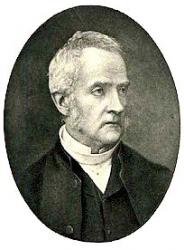
1815 - 1881 Person Name: A. P. Stanley Topics: Archangels Trumpet; Christ Judge; Christ Second Advent; Dies irae; Hope Of Heaven; Judgment Preparation for; Judgment Terrors of; Judgment and retribution; Pardon Sought; Trumpet Gospel Translator of "Day of wrath" in Hymnal of the Methodist Episcopal Church Stanley, Arthur Penrhyn, Dean of Westminster, one of the most distinguished English Churchmen of the nineteenth century, was the son of Rev. Edward Stanley, Bishop of Norwich, and was born at Alderly, in Cheshire, December 13, 1815. At the age of fourteen he became a pupil of Dr. Arnold, of Rugby, in whose famous school he displayed a strength of moral character which was a prophecy of the frank and courageous man that was to be. He took well-nigh all the honors at Oxford, where he graduated in 1837. Entering the ministry of the Church of England, he filled successively various positions of honor and responsibility until in 1855 he was appointed Regius Professor of Ecclesiastical History at Oxford. In 1864 he became Dean of Westminster. His marriage that same year to Lady Augusta Bruce, a personal friend and attendant of Queen Victoria, increased the freedom and intimacy of his already cordial relations with the royal family. He died July 18, 1881. He was a Churchman of broad and liberal views. His catholicity of spirit was one of his most notable characteristics. His contributions to theological literature are numerous and well known. His Life of Dr. Arnold, of Rugby, 1844, is one of the most successful volumes of biography in the English language. Among his historical writings his lectures on the Eastern Church, 1861, Jewish Church (two volumes), 1863-65, and the Church of Scotland, 1868, are accounted as of highest value. He is the author of about a dozen hymns, and of several translations. These, although of a high order of excellence, do not take rank with his prose writings, which for choice English diction, scholarly erudition, and Christian catholicity are not surpassed, perhaps, by anything in the religious literature of England in the nineteenth century.
Day of wrath, O dreadful day 599
He is gone; a cloud of light 170
O Master, it is good to be 131
From Hymn Writers of the Church by Charles S. Nutter, 1915
============================
Stanley, Arthur Penrhyn, D.D., was born at Alderley, in Cheshire, Dec. 13, 1815. His father, Edward Stanley, was the son of Sir Edward Stanley of Alderley, and younger brother of the first Lord Stanley of Alderley, and was rector of the parish until 1837, when he became Bishop of Norwich. His mother, Catherine Stanley, was daughter of tho Rev. Oswald Leycester, Rector of Stoke-upon-Tern, Shropshire. Arthur Stanley received his early education under the superintendence of his father; but in 1829 he was sent to Rugby to be under the direct charge of Dr. Arnold, who bad been appointed to the head-mastership the year before, and of whom Mr. Stanley had been an early friend and admirer. Arthur Stanley bore the stamp of Rugby and of its great headmaster to the end of his life. In 1834 he went up to Oxford, having won a Balliol scholarship, the "blue ribbon of undergraduate life," and commenced a career of unusual brilliancy at the University. He gained the Newdigate prize for English Verse (the subject being The Gypsies); the Ireland scholarship (the highest test of Greek scholarship), and a First Class in Classical Honours, all in 1837. He won the Prize for the Latin Essay in 1839, the Prize for the English Essay, and the Ellerton Prize for the Theological Essay in 1840, and was in the same year elected to a Fellowship at University College.
He was then appointed College Tutor, and held that office for twelve years. In 1845-6 he was Select Preacher for the University. From 1850 to 1852 he was Secretary to the Oxford University Commissioners. In 1851 he was appointed Canon of Canterbury, and held that post until 1855, when he was elected Regius Professor of Ecclesiastical History at Oxford, to which a Canonry at Christ Church was attached. He was also chosen in 1858 Examining Chaplain to the Bishop of London, his fellow Rugbeian, Dr. Tait. These offices he held until 1863, when, on the elevation of Dean Trench to the Archbishopric of Dublin, he was appointed to the Deanery of Westminster. In the same year he married Lady Augusta Bruce, a sister of the Earl of Elgin, and a personal friend and attendant of Queen Victoria. This marriage brought him into still closer relation with the Court, at which he had before been so highly valued, that he had been twice chosen to accompany the Prinoe of Wales in his travels in the East. He was singularly happy in his married life, and felt the death of Lady Augusta, which occurred in 1876, as an irreparable loss. In 1872, he took part in the Old Catholic Congress at Cologne; and at the close of the same year he was again appointed Select Preacher, not, however, without considerable opposition being made to the appointment on account of the Dean's theological views; the vote, however, was carried by 349 against 287. In 1875 he was installed Lord Rector of the University of St. Andrews, having received the degree of LL.D. from that University four years previously. He died at the Deanery, Westminster, on July 18, 1881, after a short illness.
Dr. Stanley was a voluminous and very popular writer, his pure and picturesque style being singularly fascinating. The first work by which he became known to the literary world was the Life and Correspondence of Dr. Arnold, published in 1844. This is an almost perfect model of biography. Though the writer is distinctly a hero-worshipper, he never allows his worship to violate the rules of good taste, while he brings out all the points in his hero's character most vividly, and exercises a most wise discretion in permitting him, as far as possible, to tell his own tale. This was followed in 1850 by Memoirs of Edward Stanley, Bishop of Norwich, and Catherine Stanley, which is very interesting both for its intrinsic merits, and also as a pious tribute of filial affection; but it does not reach the level of the Life of Arnold. In 1854 appeared the Epistles to the Corinthians, the value of which will be variously estimated according to the theological standpoint of the reader. But his next two works will command the admiration of all persons who are competent to judge. In his Historical Memorials of Canterbury, published in 1854, and Sinai and Palestine in connexion with their History, published in 1856, Dr. Stanley was again on his own proper ground where his almost unique powers of description had their full scope. The former was a very popular work, reaching a 6th edition in 1872; but Sinai and Palestine was still more warmly welcomed, and may be con¬sidered, with the Life of Dr. Arnold, as Dr. Stanley's chef-d'oeuvre.
Passing over for the present his sermons, we next come to his Lectures on the History of the Eastern Church, pub. in 1861; this also was very popular, reaching a 5th ed. in 1869. Then followed a series of Lectures on the History of the Jewish Church, in 2 volumes (1863-5). His next publication again showed him at his best. The Historical Memorials of Westminster Abbey, pub. in 1867, may be regarded as a companion volume to the Historical Memorials of Canterbury, and is, at least, worthy of its predecessor.
Dr. Stanley attained great eminence as a preacher, especially in his own Abbey. His manner was most solemn and impressive, and his style of composition was exactly suited for a sermon. It is fair to add that sermons would also, of course, be the species of composition in which what many considered the most unsatisfactory features of Dr. Stanley's intellectual character, his vagueness of doctrine and extreme breadth of statement, were most conspicuous. He published several volumes of sermons and single sermons. The chief are: Sermons and Essays on the Apostolical Age (1846), Sermons preached in Canterbury Cathedral (1857), Sermons on the Unity of Evangelical and Apostolical Teaching (1859), Sermons in the East preached before the Prince of Wales (1863), Address and Sermons at St. Andrews, 1877.
The point of view from which this sketch naturally regards Dean Stanley as a writer is that from which he appears at the least advantage. Thirteen of his hymns which had been published singly have been incorporated in the Westminster Abbey Hymn Book, but none of them have attained any extensive popularity; and, to tell the truth, they do not deserve it. That exquisite taste and felicity of diction which distinguish more or less all his prose writings seem to desert him when he is writing verse. This is all the more strange because one would have said that he regarded outward nature, as well as the works and history of man, with a poet's eye. Like another great writer, Jeremy Taylor, his prose is poetical, but his poetry is prosaic. The divine afflatus is wanting. Of course he always writes as a scholar; hence his translations are more successful than his original hymns; but in neither department has he produced anything that can at all be termed classical; and it is from his general eminence rather than from his contributions to hymnology that he requires even the small space which has been devoted to him in this article. [Rev. J. H. Overton, D.D.]
In addition to Dean Stanley's trsanslations from the Latin, and his popular hymns, "He is gone! beyond the skies,'' and "Master, it is good to be," the following are also in common use:—
1. Let us with a gladsome mind. National Hymn. The Accession. This hymn is called "Hymn for the Accession (June 20
2. 0 frail spirit, vital spark. Easter. Given in Macmillan's Magazine, May 1878, and headed "Our Future Hope."
3. Spirit unseen, our spirits' home. Whitsuntide.
This hymn was published in Macmillan's Magazine, May, 1879, in 7 stanzas of 8 lines, and 1 stanza of 9 lines, with the following note:—"Manzoni's Hymn for Whitsuntide.”
4. The Lord is come! On Syrian soil. Advent. This hymn appeared in Macmillan's Magazine, Dec. 1872, in 6 stanzas of 8 lines, with the following introduction:— “Hymn for Advent.”
5. When the Paschal evening fell. Holy Communion. This appeared in Macmillan's Magazine, Nov. 1874, in 5 st. of 8 1., 1 st. of 12 1., and 1 st. of 8 1., with this introduction:—" This do in Remembrance of Me. It is intended in the following lines to furnish a sacred hymn founded on the one common idea of commemoration which lies at the basis of all views of the Eucharist, whether material or spiritual, and to express this undoubted intention of the original institution apart from the metaphorical language by which the ordinance is often described."
6. Where is the Christian's Fatherland? The Christian's Fatherland. This poem (it cannot be called a hymn) was given in Macmillan's Magazine, Nov. 1872, in 7 st. of 8 1., with the following introduction:—"The Traveller's Hymn for All Saints' Day. Being an adaptation of Arndt's Poem, 'Was ist des Deutschen Vaterland.'"
7. Where shall we find the Lord? Epiphany. Given in Macmillan's Magazine, March 1880, in 7 st. of 8 1., and introduced thus: —"The Divine Life
8. Where shall we learn to die? Good Friday. This was published in Macmillan's Magazine, March 1880, in 7 st. of 8 1., with the simple heading, "The Perfect Death. Disce mori."
9. Who shall be the last great Seer? St. John Baptist. Appeared in Macmillan's Magazine, July 1879, in 4 st. of 8 1., as a "Hymn for St. John the Baptist Day, June 24."
All these hymns were given in full, and without alteration, in the Westminster Abbey Hymn Book, 1883. Their use is mainly confined to that collection.
--Excerpts from John Julian, Dictionary of Hymnology (1907)
Arthur Penrhyn Stanley


 My Starred Hymns
 My FlexScores
 My Hymnals
 My Purchased Files



