

 My Starred Hymns
 My FlexScores
 My Hymnals
 My Purchased Files
Planning worship?
Check out our sister site, ZeteoSearch.org,
for 20+ additional resources related to your search.
- |
User Links
Person Results
Matthew Bridges
1800 - 1894 Person Name: Rev. M. Bridges Author of "Crown Him with Many Crowns" in Glad Tidings Matthew Bridges
Matthew Bridges
William Owen
1813 - 1893 Person Name: W. Owen Composer of "[O listen to the wondrous story]" in Brotherhood Hymns Owen, William (‘William Owen of Prysgol,’ 1813-1893), musician; b. 12? Dec. 1813 [in Lônpopty], Bangor, the son of William and Ellen Owen. The father was a quarryman at Cae Braich-y-cafn quarry, Bethesda, and the son began to work in the same quarry when he was ten years old. He learnt music at classes held by Robert Williams (Cae Aseth), at Carneddi, and from William Roberts, Tyn-y-maes, the composer of the hymn-tune ‘Andalusia.’ He wrote his first hymn-tune when he was 18 — it was published in Y Drysorfa for June 1841. After the family had [removed] to [Caesguborwen], Bangor, [sometimes called Cilmelyn] — they had spent some years [at Tŷhen] near the quarry — William Owen formed a temperance choir which sang ‘Cwymp Babilon,’ the work of the conductor, at the Caernarvon temperance festival, 1849. In 1852, with the help of some friends at Bethesda, he published Y Perl Cerddorol yn cynnwys tonau ac anthemau, cysegredig a moesol; of this 3,000 copies were sold, A solfa edition appeared in 1886 of which 4,000 copies were sold. He composed several temperance pieces, some of which were sung in the Eryri temperance festivals held at Caernarvon castle. His anthem, ‘Ffynnon Ddisglair,’ and the hymn-tunes ALMA and DEEMSTER became popular, but it was the hymn-tune called BRYN CALFARIA which made the composer famous; this continues to have a considerable vogue in Wales and in England. He married the daughter of the house called Prysgol and went there to live; he also became precentor at Caeathro C.M. chapel. He died 20 July 1893, and was buried in Caeathro chapel burial ground.
--wbo.llgc.org.uk/en/
William Owen
William C. Poole
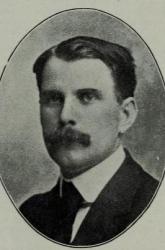
1875 - 1949 Author of "Just When I Need Him Most" in Baptist Hymnal 2008 William C. Poole was born and raised on a farm in Maryland. His parents belonged to the Methodist church. He graduated from Washington College and became a Methodist minister in Wilmington, Delaware area. He was pastor of McCabe Memorial, Richardson Park and other churches. In 1913 he was superintendent of the Anti-Saloon League of Delaware. He wrote about five hundred hymns. The writing was done as recreation and a diversion from his pastoral work. His goal in writing as well as in being a minister was to help people.
Dianne Shapiro, from "The Singers and Their Songs: sketches of living gospel hymn writers" by Charles Hutchinson Gabriel (Chicago: The Rodeheaver Company, 1916)
William C. Poole
Charles Coffin
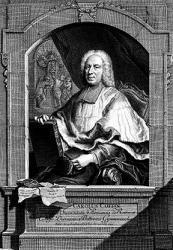
1676 - 1749 Person Name: C. Coffin Author of "On Jordan's bank the herald's cry" in The Lutheran Hymnary Coffin, Charles, born at Buzaney (Ardennes) in 1676, died 1749, was principal of the college at Beauvais, 1712 (succeeding the historian Rollin), and rector of the University of Paris, 1718. He published in 1727 some, of his Latin poems, for which he was already noted, and in 1736 the bulk of his hymns appeared in the Paris Breviary of that year. In the same year he published them as Hymni Sacri Auctore Carolo Coffin, and in 1755 a complete ed. of his Works was issued in 2 vols. To his Hymni Sacri is prefixed an interesting preface. The whole plan of his hymns, and of the Paris Breviary which he so largely influenced, comes out in his words.
"In his porro scribendis Hymnis non tam poetico indulgendunv spiritui, quam nitoro et pietate consulendum esse existimavi. Pleraque igitur, argumentis convenientia e purissiinis Scripturae Sacrae fontibus deprompsi quac idoneis Ecclesiae cantui numeris alligarem."
His hymns are described by a French critic as having less brilliancy than those of Santüil (q.v.), but more simplicity and unction. They number 100 in the edition of 1736. Translated into English by J. Chandler, I. Williams and others, are noted under their respective Latin first lines. [William T. Brooke]
-- John Julian, Dictionary of Hymnology (1907)
Charles Coffin
St. Ambrose
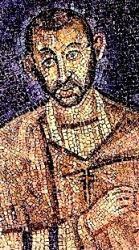
340 - 397 Person Name: Ambrose of Milan, 4th c. Author of "O Splendor of God's Glory Bright" in Psalms for All Seasons Ambrose (b. Treves, Germany, 340; d. Milan, Italy, 397), one of the great Latin church fathers, is remembered best for his preaching, his struggle against the Arian heresy, and his introduction of metrical and antiphonal singing into the Western church. Ambrose was trained in legal studies and distinguished himself in a civic career, becoming a consul in Northern Italy. When the bishop of Milan, an Arian, died in 374, the people demanded that Ambrose, who was not ordained or even baptized, become the bishop. He was promptly baptized and ordained, and he remained bishop of Milan until his death. Ambrose successfully resisted the Arian heresy and the attempts of the Roman emperors to dominate the church. His most famous convert and disciple was Augustine. Of the many hymns sometimes attributed to Ambrose, only a handful are thought to be authentic. Bert Polman =====================
Ambrosius (St. Ambrose), second son and third child of Ambrosius, Prefect of the Gauls, was born at Lyons, Aries, or Treves--probably the last--in 340 A.D. On the death of his father in 353 his mother removed to Rome with her three children. Ambrose went through the usual course of education, attaining considerable proficiency in Greek; and then entered the profession which his elder brother Satyrus had chosen, that of the law. In this he so distinguished himself that, after practising in the court of Probus, the Praetorian Prefect of Italy, he was, in 374, appointed Consular of Liguria and Aemilia. This office necessitated his residence in Milan. Not many months after, Auxentius, bishop of Milan, who had joined the Arian party, died; and much was felt to depend upon the person appointed as his successor. The church in which the election was held was so filled with excited people that the Consular found it necessary to take steps fur preserving the peace, and himself exhorted them to peace and order: when a voice suddenly exclaimed, "Ambrose is Bishop," and the cry was taken up on all sides. He was compelled to accept the post, though still only a catechumen; was forthwith baptized, and in a week more consecrated Bishop, Dec. 7, 374. The death of the Emperor Valentinian I., in 375, brought him into collision with Justina, Valentinian's second wife, an adherent of the Arian party: Ambrose was supported by Gratian, the elder son of Valentinian, and by Theodosius, whom Gratian in 379 associated with himself in the empire. Gratian was assassinated in 383 by a partisau of Maximus, and Ambrose was sent to treat with the usurper, a piece of diplomacy in which he was fairly successful. He found himself, however, left to carry on the contest with the Arians and the Empress almost alone. He and the faithful gallantly defended the churches which the heretics attempted to seize. Justina was foiled: and the advance of Maximus on Milan led to her flight, and eventually to her death in 388. It was in this year, or more probably the year before (387), that Ambrose received into the Church by baptism his great scholar Augustine, once a Manichaean heretic. Theodosius was now virtually head of the Roman empire, his colleague Valentinian II., Justina's son, being a youth of only 17. In the early part of 390 the news of a riot at Thessalonica, brought to him at Milan, caused him to give a hasty order for a general massacre at that city, and his command was but too faithfully obeyed. On his presenting himself a few days after at the door of the principal church in Milan, he was met by Ambrose, who refused him entrance till he should have done penance for his crime. It was not till Christmas, eight months after, that the Emperor declared his penitence, and was received into communion again by the Bishop. Valentinian was murdered by Arbogastes, a Frank general, in 392; and the murderer and his puppet emperor Eugenius were defeated by Theodosius in 394. But the fatigues of the campaign told on the Emperor, and he died the following year. Ambrose preached his funeral sermon, as he had done that of Valentinian. The loss of these two friends and supporters was a severe blow to Ambrose; two unquiet years passed, and then, worn with labours and anxieties, he himself rested from his labours on Easter Eve, 397. It was the 4th of April, and on that day the great Bishop of Milan is remembered by the Western Church, but Rome commemorates his consecration only, Dec. 7th. Great he was indeed, as a scholar, an organiser, a statesman; still greater as a theologian, the earnest and brilliant defender of the Catholic faith against the Arians of the West, just as Athanasius (whose name, one cannot but remark, is the same as his in meaning) was its champion against those of the East. We are now mainly concerned with him as musician and poet, "the father of Church song" as he is called by Grimm. He introduced from the East the practice of antiphonal chanting, and began the task, which St. Gregory completed, of systematizing the music of the Church. As a writer of sacred poetry he is remarkable for depth and severity. He does not warm with his subject, like Adam of St. Victor, or St. Bernard. "We feel," says Abp. Trench, "as though there were a certain coldness in his hymns, an aloofness of the author from his subject. "A large number of hymns has been attributed to his pen; Daniel gives no fewer than 92 called Ambrosian. Of these the great majority (including one on himself) cannot possibly be his; there is more or less doubt about the rest. The authorities on the subject are the Benedictine ed. of his works, the Psalterium, or Hymnary, of Cardinal Thomasius, and the Thesaurus Hymnologicus of Daniel. The Benedictine editors give 12 hymns as assignable to him, as follows:—1. Aeterna Christi munera. 2. Aeterne rerum Conditor. 3. Consors Paterni luminii. 4. Deus Creator omnium. 5. Fit porta Christi pervia, 6. Illuminans Altissimus. 7. Jam surgit hora tertia. 8. 0 Lux Beata Trinitas. 9. Orabo mente Dominum. 10. Somno refectis artubus. 11. Splendor Paternae gloriae. 12. Veni Redemptor gentium. Histories of these hymns, together with details of translations into English, are given in this work, and may be found under their respective first lines. The Bollandists and Daniel are inclined to attribute to St. Ambrose a hymn, Grates tibi Jesu novas, on the finding of the relics of SS. Gervasius and Protasius. These, we know, were discovered by him in 386, and it is by no means unlikely that the bishop should have commemorated in verse an event which he announces by letter to his sister Marcellina with so much satisfaction, not to say exultation.A beautiful tradition makes the Te Deum laudamus to have been composed under inspiration, and recited alternately, by SS. Ambrose and Augustine immediately after the baptism of the latter in 387. But the story rests upon a passage which there is every reason to consider spurious, in the Chronicon of Dacius, Bishop of Milan in 550. There is no hint of such an occurrence in the Confessions of St. Augustine, nor in Paulinue's life of St. Ambrose, nor in any authentic writing of St. Ambrose himself. The hymn is essentially a compilation, and there is much reason to believe, with Merati, that it originated in the 5th century, in the monastery of St. Honoratus at Lerins. [Te Deum.] -- John Julian, Dictionary of Hymnology (1907)
Also known as: Ambrotio, Ambrosio de Milán Ambrosius Mediolanensis Ambrosius Saint, Bp. of Milan Ambrosius von Mailand Aurelio Ambrogio, Saint, Bishop of Milan Aurelius Ambrosius, Saint, Bishop of Milan Milan, d. 397
St. Ambrose
Walter C. Smith
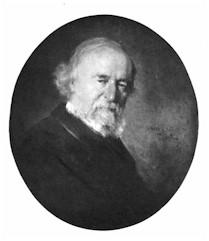
1824 - 1908 Author of "Immortal, Invisible, God Only Wise" in The New Century Hymnal Smith, Walter Chalmer, D.D., was born at Aberdeen Dec. 5, 1824, and educated at the Grammar School and University of that City. He pursued his Theological studies at Edinburgh, and was ordained Pastor of the Scottish Church in Chad well Street, Islington, London, Dec. 25, 1850. After holding several pastorates he became, in 1876, Minister of the Free High Church, Edinburgh. His contributions to poetical literature have been many and of great merit. His principal works are:—
(1) The Bishop's Walk, 1860; (2) Olrig Grange, 1872; (3) Borland Hall, 1874; (4) Hilda among the Broken Gods, 1878; (5) North Country Folk, 1883; (6) Kildrostan, 1884; (7) Hymns of Christ and Christian Life, 1876.
From his Hymns of Christ, &c, 1876, the following, after revision, were included in Horder's Congregational Hymns, 1884 :—
1. Immortal, Invisible, God only wise. God, All in All.
2. Lord, God, Omnipotent. Omnipotence.
3. Our portion is not here. Treasure in Heaven.
4. There is no wrath to be appeased. God is Love. In Horder's Congregational Hymns a new opening stanza was added to this hymn by Dr. Smith at the request of the editor, and in that collection the hymn begins "I vexed me with a troubled thought."
Dr. Smith's hymns are rich in thought and vigorous in expression. They deserve and probably will receive greater notice than hitherto at the hands of hymnal compilers. [Rev. W. Garrett Horder]
--John Julian, Dictionary of Hymnology (1907)
=================
Smith, W. C., p. 1064, i. The following additional hymns by Dr. Smith have come into common use, mainly through The Baptist Church Hymnal, 1900:—
1. Earth was waiting, spent and restless. Christmas.
2. Faint and weary Jesus stood. Our Lord's Temptation.
3. If any to the feast have come. Holy Communion.
4. The Lord hath hid His face from us. Providence.
5. To me to live is Christ. Union with Christ.
These hymns appeared in his Hymns of Christ and the Christian Life, 1867, pp. Ill, 122, 241, 10, and 36, respectively. A collected ed. of his Poetical Works (not including his hymns) appeared in 1902. Other hymns that have come into use are:—
1. Gird your loins about with truth. Manliness.
2. Jesus, unto Whom we pray. Christ the Way.
3. One thing I of the Lord desire. Consecration.
Nos. 1, 3 are from his Thoughts and Fancies for Sunday Evenings, 1887, pp. 3, 84. No. 2 is from his Hymns of Christ, 1867, p. 31.
--John Julian, Dictionary of Hymnology, New Supplement (1907)
Walter C. Smith
Aurelius Clemens Prudentius
348 - 410 Person Name: Aurelius Clemens Prudentius, 348-c. 413 Author of "Earth has many a noble city" in Complete Anglican Hymns Old and New Marcus Aurelius Clemens Prudentius, "The Christian Pindar" was born in northern Spain, a magistrate whose religious convictions came late in life. His subsequent sacred poems were literary and personal, not, like those of St. Ambrose, designed for singing. Selections from them soon entered the Mozarabic rite, however, and have since remained exquisite treasures of the Western churches. His Cathemerinon liber, Peristephanon, and Psychomachia were among the most widely read books of the Middle Ages. A concordance to his works was published by the Medieval Academy of America in 1932. There is a considerable literature on his works.
--The Hymnal 1940 Companion
=============
Prudentius, Aurelius Clemens , with the occasional prefix of Marcus (cf. Migne, vol. lix. p. 593, and Dressel, p. ii. n), is the name of the most prominent and most prolific author of sacred Latin poetry in its earliest days. Of the writer himself we know nothing, or next to nothing, beyond what he has himself told us in a short introduction in verse to his works. From that source we learn that he was a Spaniard, of good family evidently, and that he was born A.D. 348 somewhere in the north of Spain, either at Saragossa, Tarragona, or Calahorra, but at which is left uncertain, by his applying the same expression to all, which if applied only to one would have fixed his place of birth. After receiving a good education befitting his social status he applied himself for some years to practising as a pleader in the local courts of law, until he received promotion to a judgeship in two cities successively:—
"Bis legum moderanrine
Frenos nobilium reximus urbium
Jus civile bonis reddidimus, terruimus reos;"
and afterwards to a post of still higher authority:
"Tandem militiae gradu
Evectum pietas principis extulit."
Archbishop Trench considers this last to have been "a high military appointment at court," and such the poet's own words would seem to describe; but it may well be doubted whether a civilian and a lawyer would be eligible for such employment; in which case we may adopt the solution of the difficulty offered in the Prolegomena to our author's works (Migne, vol. lix. p. 601):—
"Evectus indeest ad superiorem rnilitia? gradum, nimirum militia? civil is, palatinae, aut praesidialis, non bellicae, castrensis, aut cohortalis; nam ii qui officiis jure consultorum praesidum, rectorum et similium funguntur, vulgo in cod. Theod. militare et ad superiores militias ascendere dicuntur."
It was after this lengthened experience at a comparatively early age of positions of trust and power that Prudentius, conscience-smitten on account of the follies and worldliness that had marked his youth and earlier manhood, determined to throw up all his secular employments, and devote the remainder of his life to advancing the interests of Christ's Church by the power of his pen rather than that of his purse and personal position. Accordingly we find that he retired in his 57th year into poverty and private life, and began that remarkable succession of sacred poems upon which his fame now entirely rests. We have no reason however to regard him as another St. Augustine, rescued from the "wretchedness of most unclean living" by this flight from the temptations and engrossing cares of official life into the calm seclusion of a wholly devotional leisure. He had probably rather learnt from sad experience the emptiness and vanity for an immortal soul of the surroundings of even the high places of this world. As he himself expresses it:—
"Numquid talia proderunt
Carnis post obitum vel bona, vel mala,
Cum jam, quicquid id est, quod fueram, mors aboleverit?"
and sought, at the cost of all that the world holds dear, those good things which God hath prepared for them that love Him. Beyond the fact of his retirement from the world in this way, and the fruits which it produced in the shape of his voluminous contributions to sacred poetry, we have no further information about our author. To judge from the amount he wrote, his life must have been extended many years after he began his new career, but how long his life was or where he died we are not told. Probably he died circa 413. His works are:—
(1) Liber Cathemerinon. "Christian Day, as we may call it" W. S. Lilly, "Chapters in European History," vol. i. p. 208).
(2) Liber Peristephanon. "Martyrs' Garlands" (id.).
(3) Apotheosis. A work on the Divine Nature, or the Deification of Human Nature in Christ.
(4) Hamartigenia. A treatise on the Origin of Sin, directed against the Marcionites.
(5) Psychomachia or "The Spiritual Combat"-—an allegorical work.
(6) Libri contra Symmachum. A controversial work against the restoration in the Senate House at Rome of the altar of Victory which Gratian had removed. Symmachus had petitioned Valentinian II. for its restoration in 384, but the influence of St. Ambrose had prevailed against him at that time. In 392 the altar was restored, but removed again by Theodosius in 394. After the death of the latter the attempt to restore it was renewed by Arcadius and Honorius, and it was at that time that Prudentius wrote his first book. The second (for there are two) was written in 405. Fague considers that the first may date in 395.
(7) The Dittochseon = the double food or double Testament, is a wordy collection of 49 sets of four verses each, on Old and New Testament scenes.
Of these different works the most important are the first two, and it is from them that the Liturgical hymns enumerated below have been chiefly compiled. The general character of Prudentius's writings it is not easy fairly to estimate, and to judge by the wholesale laudation he obtains from some of his critics, and the equally unsparing censure of others, his judges have so found it. In venturing upon any opinion upon such a subject, the reader must bear in mind the peculiar position in which the period at which he was writing found the poet. The poetry of classical Rome in all its exact beauty of form had long passed its meridian, and was being replaced by a style which was yet in its infancy, but which burst forth into new life and beauty in the hands of the Mediaeval hymnologists.
Prudentius wrote before rhyming Latin verse was thought of, but after attention had ceased to be given to quantities. Under such circumstances it were vain to look for very finished work from him, and such certainly we do not find. But amidst a good deal of what one must confess is tasteless verbiage or clumsy rhetorical ornament-—however varied the metres he employs, numbering some 17—-there are also passages to be found, not unfrequently, of dramatic vigour and noble expression, which may well hold their own with the more musical utterances of a later date. He writes as a man intensely in earnest, and we may gather much from his writings concerning the points of conduct which were deemed the most important in Christian living at a time when a great portion of mankind were still the victims or slaves of a morality which, heathen at the best, was lowered and corrupted the more as the universality of its influence was more and more successfully challenged by the spread of the Gospel of Christ. If, there¬fore, we can scarcely go as far in our author's praise as Barth—-much given to lavish commendation—-who describes him as "Poeta eximius eruditissimus et sanctissimus scriptor; nemo divinius de rebus Christianis unquam scripsit"; or as Bentley—-not given to praise--who calls him the "Horace and Virgil of the Christians," we shall be as loath, considering under what circumstances he wrote, to carp at his style as not being formed on the best ancient models but as confessedly impure; feeling with Archbishop Trench that it is his merit that "whether consciously or unconsciously, he acted on the principle that the new life claimed new forms in which to manifest itself; that he did not shrink from helping forward that great transformation of the Latin language, which it needed to undergo, now
that it should be the vehicle of truths which, were all together novel to it." (Sacred Latin Poetry, 1874, p. 121.)
The reader will find so exhaustive an account of the various writings of Prudentius in the account given of him and them in Smith and Wace's Dictionary of Christian Biography, and Smith's Dictionary of Greek and Roman Biography, that it is only necessary in this work to refer very briefly to them as above. The poems have been constantly reprinted and re-edited, till the editor who produced the best edition we have of them, Albert Dressel (Leipsic, 1860), is able to say that his is the sixty-third.
The use made of Prudentius's poems in the ancient Breviaries and Hymnaries was very extensive. In the form of centos stanzas and lines wore compiled and used as hymns; and it is mainly from these centos, and not from the original poems, that the translations into English were made. Daniel, i., Nos. 103-115, gives 13 genuine hymns as having been in use for "Morning," "Christmas," "Epiphany," "Lent," "Easter," "Transfiguration," "Burial," &c, in the older Breviaries. ….Many more which were used in like manner have been translated into English. When to these are added the hymns and those which have not been translated into English, we realise the position and power of Prudentius in the hymnody of the Church. [Rev. Digby S. Wrangham, M.A.]
--John Julian, Dictionary of Hymnology (1907)
==============
Prudentius, A. C, p. 915, ii. Two somewhat full versions of Prudentius are: (1) The Cathemerinon and other Poems of Aurelius Prudentius Clemens in English Verse, Lond., Rivington, 1845; and (2) Translations from Prudentius. By Francis St. John Thackeray, M.A.. F.S.A. Lond., Bell & Sons, 1890.
--John Julian, Dictionary of Hymnology, Appendix, Part II (1907)
Aurelius Clemens Prudentius
Charles Albert Tindley
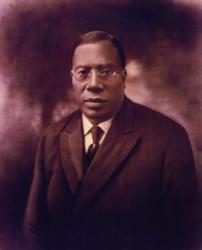
1851 - 1933 Person Name: C. A. Tindley Author of "Nothing Between" in Singing Youth
Charles Albert Tindley
C. H. Spurgeon
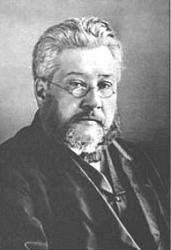
1834 - 1892 Alterer of "Vainly Through the Night" in Psalms of Grace Spurgeon, Charles Haddon, the world-famous preacher, was born June 19, 1834, at Kelvedon, in Essex, where his father was Congregational minister. He was educated at Colchester, and at an Agricultural College at Maidstone, after which he was for a few years usher in schools at Newmarket and Cambridge. In 1851 he became minister of a small Baptist church at Waterbeach, near Cambridge, and soon attained great popularity. In 1854 he removed to New Park Street, London, the place where Drs. Gill and Rippon had formerly ministered, and ere long the thronging of people to hear him led, first, to the temporary occupation of Exeter Hall, and of the Surrey Music Hall, and then to the erection of the great Metropolitan Tabernacle, where he still ministers.
Mr. Spurgeon is chiefly known as a preacher and as the author of many vols. of sermons, expositions, and other homiletical literature; but he is also a hymn writer, and the compiler of a well-known hymn book. This book was prepared, in 1866, primarily for the use of the congregation at the Tabernacle. Hence its title Our Own Hymnbook, a collection of Psalms & Hymns for public, social, and private worship. It contains 220 versions of the Psalms, and 910 hymns. Of Mr. Spurgeon's contributions noted below, only one, "Sweetly the holy hymn," can be regarded as possessing any particular merit. The others do not rise above respectable mediocrity. His psalm-versions and hymns, all dated 1866, are:—
1. Amidst us our Beloved stands. Holy Communion.
2. Behold, O Lord, my days are made. Ps. xxxix.
3. Blessed is the man that feareth. Ps. cxii.
4. Here, O ye faithful, see. Holy Baptism.
5. I will exalt Thee, Lord of hosts. Ps. xxx.
6. Jesus, poorest of the poor. Ps. xli.
7. Lord, I would dwell with Thee. Ps. xv.
8. Lord, make my conversation chaste. Ps. lxviii.
9. Lord, Thy church without a pastor. Election of a Minister.
10. Make haste, O Lord, my soul to bless. Ps. lxx.
11. O God, be Thou no longer still. Ps. lxxxiii.
12. O God, Thou hast cast off Thy saints. Ps. lx.
13. Our ears have heard, O glorious God. Ps. xliv.
14. Praise the Lord with exultation, My whole heart, &c. Ps. cxi.
15. Risen Lord, Thou hast received. Election of a Minister.
16. Sweetly the holy hymn. Prayer Meetings.
17. The foes of Zion quake for fright. Ps. liii.
18. The Holy Ghost is here. Prayer.
19. The Kings of earth are in the hands. Ps. lxxxii.
20. Thy strength, 0 Lord, makes glad our King. Ps. xxi.
In addition to these Mr. Spurgeon re-wrote or added to the hymns of others, as "Come ye who bow to sovereign grace"; "Great King of Zion, now"; "O God, before whose radiant throne"; and "Woe's me that I in Mesech am"; and composed two Graces for before, and two for after Meat. [Rev. W. R. Stevenson, M.A.]
-- John Julian, Dictionary of Hymnology (1907)
C. H. Spurgeon
Winfred Douglas
1867 - 1944 Person Name: C. W. Douglas, 1867-1944 Arranger of "IN BABILONE" in Evangelical Lutheran Hymnary Charles Winfred Douglas (b. Oswego, NY, 1867; d. Santa Rosa, CA, 1944), an influential leader in Episcopalian liturgical and musical life. Educated at Syracuse University and St. Andrews Divinity School, Syracuse, New York, he moved to Colorado for his health. There he studied at St. Matthew's Hall, Denver, and founded the Mission of the Transfiguration in Evergreen (1897). Ordained a priest in the Episcopal Church in 1899, he also studied in France, Germany and England, where he spent time with the Benedictines of Solesmes on the Island of Wight from 1903 to 1906. For much of his life, Douglas served as director of music at the Community of St. Mary in Peekskill, New York, and had associations with cathedrals in Denver, Colorado, and Fond du Lac, Wisconsin. He promoted chanting and plainsong in the Episcopal Church through workshops and publications such as The American Psalter (1929), the Plainsong Psalter (1932), and the Monastic Diurnal (1932). His writings include program notes for the Denver Symphony Orchestra, various hymn preludes; organ, as well as the book, Church Music in History and Practice (1937). He was editor of both the Hymnal 1916 and its significant successor, Hymnal 1940, of the Episcopal Church. Douglas's other achievements include a thorough knowledge of the life and culture of Hopi and Navajo natives, among whom he lived for a number of years.
Bert Polman
Winfred Douglas
Pages




