You help make Hymnary.org possible. More than 10 million people from 200+ countries found hymns, liturgical resources and encouragement on Hymnary.org in 2025, including you. Every visit affirms the global impact of this ministry.

If Hymnary has been meaningful to you this year, would you take a moment today to help sustain it? A gift of any size—paired with a note of encouragement if you wish—directly supports the server costs, research work and curation that keep this resource freely available to the world.

Give securely online today, or mail a check to:
Hymnary.org
Calvin University
3201 Burton Street SE
Grand Rapids, MI 49546

Thank you for your partnership, and may the hope of Advent fill your heart.

Person Results

Text Identifier:"^o_for_a_thousand_tongues_to_sing_my$"
In:person

Planning worship? Check out our sister site, ZeteoSearch.org, for 20+ additional resources related to your search.
Showing 61 - 70 of 128Results Per Page: 102050

John Chetham

1665 - 1746 Person Name: Rev. John Chetham (1685-176) Composer of "MARLOW" in Hymns of the Ages Baptized: Feb­ru­a­ry 4, 1665, Ash­ton-un­der-Lyne, Lan­ca­shire, Eng­land. Buried: 1746, Skip­ton, York­shire, Eng­land. After at­tend­ing Deck­er­field School, then tak­ing or­ders, Che­tham be­came Cur­ate of Skip­ton, North York­shire. His col­lection A Book of Psalmody was first pub­lished in 1718, and had at least ele­ven edi­tions, through 1787. Music: BARRAGH MARLOW WIRKSWORTH --www.hymntime.com/tch/

T. Martin Towne

1835 - 1912 Person Name: T. M. T. Arranger of "AWAY THE BOWL" in Welcome Songs Towne, T. Martin. (Coleraine, Franklin County, Massachusetts, May 31 [sic], 1835-- ). Methodist. Attended Williston's Seminary, East Hampton, Mass. 1855 to Hudson, New York, then Albany. Taught in Ypsilanti, Michigan, then Detroit. Settled in Janesville, Wisconsin. Served in the Civil War. Settled in Chicago; married Belle Kellogg. Keith C. Clark, DNAH Archives

Henry Lahee

1826 - 1912 Composer of "NATIVITY" in The Hymnal Born: April 11, 1826, Chelsea, London, England. Died: April 29, 1912, London, England. Lahee studied under John Goss and William Sterndale Bennett. He played the organ at several churches, including Holy Trinity Church, Brompton (1847-74). He won prizes for his compositions in Bristol, Manchester, Glasgow, and London, and set to music poems by Edgar Allen Poe ("The Bells"), Henry Wadsworth Longfellow ("Building of the Ship") and Alfred Tennyson ("Sleeping Beauty"). His works include: Metrical Psalter, with William Irons, 1855 Famous Singers of Today and Yesterday, 1898 One Hundred Hymn Tunes Sources: Frost, p. 680 CS Concordance, pp. 246-47 Nutter, p. 460 --www.hymntime.com/tch

Ruben Saillens

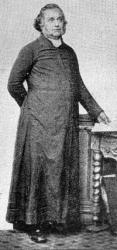
1855 - 1942 Person Name: Ruben Saillens, d. 1942 Translator (French) of "Oh, for a Thousand Tongues to Sing" in Global Songs for Worship

Joseph Funk

1778 - 1862 Person Name: Joseph Funk, 1788-1862 Composer of "LINGHAM" in The Christian Hymnary Joseph Funk USA 1778-1862. Born at Berks County, PA, grandson of the first Mennonite bishop in America. He lived most of his life in Rockingham County, VA. He was a farmer, a composer, publisher, and traveling singing teacher, covering hundreds of miles on horseback to teaching appointments. He married Elizabeth Rhodes, and they had five children: Jonathan, Henry, Elizabeth, Susan, and Barbara.. After her death, he married Rachel Britton in 1814, and they raised nine children: Mary, Joseph, David, Samuel. Hannah, John, Timothy, Solomon, and Benjamin. His advocacy for the use of musical instruments in church worship was in contention with the Mennonite position that musical instruments were not fit for the church. His sons also taught music and sang with instruments, a very progressive posture at the time. He collected songbooks and revised and updated hymn tunes. He invented a 4-shape-note music system in 1851 for the “Harmonia Sacra”, and later a 7-shape notation tunebook. At age 70 he established the first Mennonite printing business in America. His published works include: “A compilation of genuine church music” (1832) – later changed to “Harmonia Sacra”, “The confession of faith” (1837), “A collection of Psalms, hymns, and spiritual songs” (1847), “The reviewer reviewed” (1857), “The southern musical advocate & singer's friend” (a monthly periodical 1859-61). He died at Singers Glen, VA. John Perry

James Walch

1837 - 1901 Person Name: Walsh Composer of "[Oh, for a thousand tongues to sing]" in The Hymnal, Revised and Enlarged, as adopted by the General Convention of the Protestant Episcopal Church in the United States of America in the year of our Lord 1892 James Walch was a musician and composer, born near Bolton, Lancashire, England in 1837. He spent his early life in the town and was organist in several churches there, including the parish church of St George’s. From 1870-1877, he was conductor for the Bolton Philharmonic Society. He also composed at least four published hymn tunes, the best known of which is called “Tidings”. Written in 1875, it’s usually used as the tune to a hymn called “O Zion Haste”. James Walch was a musical instrument dealer by trade, and moved to Barrow-in-Furness in 1877. He later moved to Llandudno Junction in North Wales, where he died in August 1901 and was buried locally. His wife later donated money to pay for the organs in two local churches, St Paul's Llandudno and All Saints Deganwy, in his memory. Three decades later, an article in the London Gazette reported on a dispute arising from his will, and mentioned that he had a son, Harry West Walch, who was a pianist and lived in Hereford. St Paul's Church, Llandudno newsletter; used by permission of Christ Dearden (Walch's wife paid for the organ at St. Paul's Church)

Raphael Courteville

? - 1772 Person Name: R. Courteville Composer of "ST. JAMES" in Church Hymnal Courteville, Raphael or Ralph (d. 1772), organist and political writer, was the son or grandson of one of the gentlemen of the Chapel Royal who bore the same name, and who died on 28 Dec. 1675. The organ from the Chapel Royal was presented by Queen Mary in 1691 to the church of St. James's, Westminster, and on 7 Sept. in the same year a Ralph Courtaville, who had been strongly recommended by the Earl of Burlington, and who had previously been a chorister in the Chapel Royal, was appointed the first organist, with a salary of 20l. per annum for himself and 4l. for a blower. This Courteville, Courtaville, or Courtivill, was no doubt the composer of six ‘Sonatas composed and purposley (sic) contriv'd for two flutes,’ published by Walsh about 1690; of a song introduced in Wright's ‘Female Virtuosoes,’ and supposed to have been written by Ann, countess of Winchilsea; of a very graceful song, ‘To Convent Streams,’ in ‘Duke and no Duke,’ and of songs in ‘Oroonoko.’ He was one of the composers who furnished the music for part iii. of D'Urfey's ‘Don Quixote’ in 1695. The well-known hymn tune, ‘St. James's,’ is also by him. It has been supposed that this Courteville died about 1735, and was succeeded by his son of the same name; but as the vestry minutes of the parish, in which all appointments, &c. are carefully recorded, contain no mention of such a change of organists, while no record of the father's death can be found, we are compelled to believe that the existence of the son is a mere assumption, made in order to account for the long tenure of the post by a person or persons of the name of Courteville. This conclusion is strengthened by various entries in the vestry minutes; in January 1752–3, and again in June 1754, letters are written to him warning him that unless he attends personally to the duties of the post he will be dismissed. Whether he endeavoured to perform the duties himself after this we do not know, but he was certainly not dismissed, and shortly afterwards an assistant, ‘Mr. Richardson,’ was appointed. On 12 June 1771 it was reported to the vestry that Courteville gave this assistant only one quarter of his salary for doing the whole work, and he was thereupon ordered to share the payment equally with Richardson. Seven years before this, in 1764, the assistant, with two others, was consulted as to the state of the organ and the undertaking of repairs to its structure. Neither at this time, nor when the improved instrument, repaired by Byfield, was tried, was Courteville's advice asked in the matter, from which we may conclude that he was long past all work, although he was allowed to keep the post. This Raphael Courteville, whether or not he be identical with the first organist of the church, took a somewhat active part in politics towards the end of Sir Robert Walpole's administration. He is stated to have married, on 14 Sept. 1735, a lady named Miss Lucy Green, with a fortune of 25,000l. In 1738 he published ‘Memoirs of the Life and Administration of William Cecil, Baron Burleigh, &c., including a parallel between the State of Government then and now,’ with preface and appendix of original papers, dedicated to the Right Hon. Edward Walpole, secretary to the Duke of Devonshire. It is signed only ‘R. C.,’ and was printed for the author in London. He was the reputed author of ‘The Gazetteer,’ a paper written in defence of the government, and it was probably in consequence of this production that he acquired the nickname of ‘Court-evil.’ He also wrote a pamphlet published in 1761, entitled ‘Arguments respecting Insolvency.’ On 4 Dec. 1742 a letter appeared in No. 50 of the ‘Westminster Journal’ bearing his signature, to which were appended the words, ‘Organ-blower, Essayist, and Historiographer.’ The letter was undoubtedly written as a joke, probably upon his own genuine productions; it is of course not by himself, and the point of the joke is impossible now to discover, but the appearance of his name in this connection proves that he was more or less a well-known character. He died early in June 1772, as on the 10th of the month he was buried, and his place was declared vacant at the vestry meeting of that date. [Grove's Dict. of Music; Hawkins's Hist. of Music; Notes and Queries, 2nd ser. x. 496; Registers and Vestry Minutes of St. James's, Westminster; Cheque-books of the Chapel Royal; Westminster Journal, quoted above; Brit. Mus. Cat.] --en.wikisource.org/wiki/

Robert Hawkey Moreton

1844 - 1917 Person Name: Robert Hawkey Moreton, 1844-1917 Translator (Portuguese) of "O For a Thousand Tongues to Sing (Mil voces para celebrar)" in Santo, Santo, Santo Robert Hawkey Moreton was born in Argentina (1844-1917) and was instrumental in the founding of the Methodist Church (Mirante Chapel) in Oporto, Portugal. [Source?]

Henry J. Gauntlett

1805 - 1876 Person Name: Henry John Gauntlett, Mus.Doc. 1806-1876 Composer of "TUNE 419" in The Evangelical Hymnal with Tunes Henry J. Gauntlett (b. Wellington, Shropshire, July 9, 1805; d. London, England, February 21, 1876) When he was nine years old, Henry John Gauntlett (b. Wellington, Shropshire, England, 1805; d. Kensington, London, England, 1876) became organist at his father's church in Olney, Buckinghamshire. At his father's insistence he studied law, practicing it until 1844, after which he chose to devote the rest of his life to music. He was an organist in various churches in the London area and became an important figure in the history of British pipe organs. A designer of organs for William Hill's company, Gauntlett extend­ed the organ pedal range and in 1851 took out a patent on electric action for organs. Felix Mendelssohn chose him to play the organ part at the first performance of Elijah in Birmingham, England, in 1846. Gauntlett is said to have composed some ten thousand hymn tunes, most of which have been forgotten. Also a supporter of the use of plainchant in the church, Gauntlett published the Gregorian Hymnal of Matins and Evensong (1844). Bert Polman

W. Wheal

1690 - 1727 Person Name: William Weale, d.1727 Composer of "BEDFORD" in The Book of Praise William Wheal (Weale) c. 1690-1727 was the organist at St. Paul's, Bedford. He graduated with a Bachelor's in Music from Cambridge in 1719. The tune BEDFORD appeared in the "Psalm Singer's Magazine" of 1729, but it was probably first published earlier. It appears in The Divine Musick Scholars Guide by Francis Timbrell, which has an unknown date of publication, but copies found in personal libraries have dates beginning in 1723. Dianne Shapiro, from "The Musical Times" Vol. 49, #781 (Mar. 1, 1908) pp. 165-169

Pages


Export as CSV
It looks like you are using an ad-blocker. Ad revenue helps keep us running. Please consider white-listing Hymnary.org or getting Hymnary Pro to eliminate ads entirely and help support Hymnary.org.