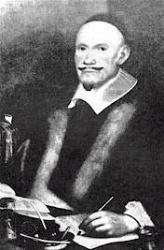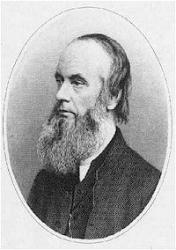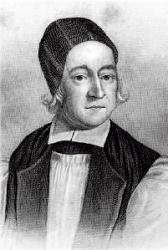
1637 - 1711 Topics: Self-Dedication Author of "Awake, my soul, and with the sun" in Magnify the Lord Thomas Ken (b. Berkampstead, Hertfordshire, England, 1637; d. Longleat, Wiltshire, England, 1711) studied at Winchester College, Hart Hall, and New College, Oxford, England. Ordained in the Church of England in 1662, he served variously as pastor, chaplain at Winchester College (1669-1679), chaplain to Princess (later Queen) Mary in The Hague, and bishop of Bath and Wells (1685-1691). He was a man of conscience and independent mind who did not shirk from confrontations with royalty. When King Charles II came to visit Winchester, he took along his mistress, the famous actress Nell Gwynne. Ken was asked to provide lodging for her. The story is told that Ken quickly declared his house under repair and had a builder take off the roof! He later was dismissed from the court at The Hague when he protested a case of immorality. Then, later in 1688, Bishop Ken refused to read King James II's Declaration of Indulgence in the churches, which granted greater religious freedom in England, and he was briefly imprisoned in the Tower of London. A few years later he refused to swear allegiance to King William, and he lost his bishopric.
Ken wrote many hymns, which were published posthumously in 1721 and republished in 1868 as Bishop Ken's Christian Year, or Hymns and Poems for the Holy Days and Festivals of the Church. But he is best known for his morning, evening, and midnight hymns, each of which have as their final stanza the famous doxology “Praise God, from Whom All Blessings Flow.”
Bert Polman
===============
Ken, Thomas, D.D. The bare details of Bishop Ken's life, when summarised, produce these results:—-Born at Berkhampstead, July, 1637; Scholar of Winchester, 1651; Fellow of New College, Oxford, 1657; B.A., 1661; Rector of Little Easton, 1663; Fellow of Winchester, 1666; Rector of Brighstone, 1667; Rector of Woodhay and Prebendary of Winchester, 1669; Chaplain to the Princess Mary at the Hague, 1679; returns to Winchester, 1680; Bishop of Bath and Wells, 1685; imprisoned in the Tower, 1688; deprived, 1691; died at Longleat, March 19, 1711.
The parents of Ken both died during his childhood, and he grew up under the guardianship of Izaak Walton, who had married Ken's elder sister, Ann. The dominant Presbyterianism of Winchester and Oxford did not shake the firm attachment to the English Church, which such a home had instilled. His life until the renewal of his connection with Winchester, through his fellowship, his chaplaincy to Morley (Walton's staunch friend, then bishop of Winchester), and his prebend in the Cathedral, calls for no special remark here. But this second association with Winchester, there seems little doubt, originated his three well-known hymns. In 1674 he published A Manual of Prayers for the Use of the Scholars of Winchester College, and reference is made in this book to three hymns, for "Morning," "Midnight," and "Evening," the scholars being recommended to use them. It can scarcely be questioned that the Morning, Evening, and Midnight hymns, published in the 1695 edition of The Manual, are the ones referred to. He used to sing these hymns to the viol or spinet, but the tunes he used are unknown. He left Winchester for a short time to be chaplain to the Princess Mary at the Hague, but was dismissed for his faithful remonstrance against a case of immorality at the Court, and returned to Winchester. A similar act of faithfulness at Winchester singularly enough won him his bishopric. He stoutly refused Nell Gwynne the use of his house, when Charles II. came to Winchester, and the easy king, either from humour or respect for his honesty, gave him not long afterwards the bishopric of Bath and Wells. Among the many acts of piety and munificence that characterised his tenure of the see, his ministration to the prisoners and sufferers after the battle of Sedgmoor and the Bloody Assize are conspicuous. He interceded for them with the king, and retrenched his own state to assist them. He attended Monmouth on the scaffold. James II. pronounced him the most eloquent preacher among the Protestants of his time; the judgment of Charles II. appears from his pithy saying that he would go and hear Ken "tell him of his faults." Among the faithful words of the bishops at Charles's death-bed, none were so noble in their faithfulness as his.
He was one of the Seven Bishops who refused to read the Declaration of Indulgence, and were imprisoned in the Tower by James for their refusal, but triumphantly acquitted on their trial. At the accession of William III, he refused, after some doubt on the subject, to take the oaths, and was at length (1691) deprived of his see. His charities had left him at this time only seven hundred pounds, and his library, as a means of subsistence; but he received hospitality for his remaining years with his friend Lord Weymouth, at Longleat. The see of Bath and Wells was again offered him, but in vain, at the death of his successor, Bishop Kidder. He survived all the deprived prelates. His attitude as a nonjuror was remarkable for its conciliatory spirit. The saintliness of Ken's character, its combination of boldness, gentleness, modesty and love, has been universally recognised. The verdict of Macaulay is that it approached "as near as human infirmity permits to the ideal perfection of Christian virtue." The principal work of Ken's that remains is that on the Catechism, entitled The Practice of Divine Love. His poetical works were published after his death, in four volumes. Among the contents are, the Hymns for the Festivals, which are said to have suggested to Keble the idea of The Christian Year; the Anodynes against the acute physical sufferings of his closing years; and the Preparatives for Death. Although many passages in them are full of tender devotion, they cannot rank either in style or strength with the three great hymns written at Winchester. The best biographies of Ken are he Life of Ken by a Layman, and, specially, his Life, by the Very Rev. E. H. Plumptre, Dean of Wells, 1888. [Rev. H. Leigh Bennett, M.A.]
Bishop Ken is known to hymnody as the author of the Morning, Evening, and Midnight Hymns, the first and second of which at least have found a place in almost every English collection for the last 150 years. The general history of these hymns, as we now know it, is as follows:—
1. In 1674 Ken published his Manual of Prayers for Winchester Scholars as
A Manual of Prayers For the Use of the Scholars of Winchester College [here arms of William of Wykeham within a border]. London, Printed for John Martyn, 1674, 12 mo, pp. 69.
From a passage in this work it may fairly be inferred that the author had already composed hymns for the use of the scholars. He says:—
“Be sure to sing the Morning and Evening Hymn in your chamber devoutly, remembering that the Psalmist, upon happy experience, assures you that it is a good thing to tell of the loving kindness of the Lord early in the morning and of his truth in the night season."
Two hymns only seem to be here referred to, but the expression "night season" may include both the Evening and Midnight hymns, and the latter would be only used occasionally. The hymns are not given in the Manual of 1674, or succeeding editions, until that of 1695, when the three hymns are added as an Appendix. The title of this edition is:—
A Manual of Prayers For the Use of the Scholars of Winchester College. And all other Devout Christians. To which is added three Hymns for Morning, Evening, and Midnight; not in former Editions: By the Same Author. Newly Revised. London, Printed for Ctarles Brome at the Ovn, at the West end of St. Paul's Church, 1695.
2. In 1704 Richard Smith, a London publisher, issued a book similar in appearance to the Manual, and entitled Conference between the Soul and Body concerning the Present and Future State. This edition contained a strong recommendation by Dodwell, an intimate friend of Ken, but no hymns. To the 2nd edition, however (1705), were added two (Morning and Evening) hymns, with Ken's name appended, but containing two additional verses to the Evening hymn, and differing in several other respects from the text of the Manual. Thereupon Charles Brome, to whom the copyright of the latter belonged, issued a new edition with an Advertisement stating that Ken "absolutely disowned" the hymns appended to the Conference, "as being very false and uncorrect," and that the genuine text was that given in the Manual only. Brome's Advertisementreads:—
"Advertisement—-Whereas at the end of a Book lately Publish'd call'd, 'A Conference between the Soul and Body,' there are some Hymns said to be writ by Bishop Ken, who absolutely disowns them, as being very false and uncorrect; but the Genuine ones are to be had only of Charles Brome, Bookseller, whose just Propriety the Original copy is."
3. In 1709, however, the spurious hymns were again published as Ken's in a book entitled A New Year's Gift: in Two Parts: to which is added A Morning and Evening Hymn. By Thomas, late L. B. of Bath and Wells. The Third Edition with additions. London Printed by W. Olney. 1709.
Brome met this, as before, with a new edition of the Manual, in which the Advertisement of 1705 as above was repeated, but the text of the hymns considerably revised. This revised text was followed in all subsequent editions of the Manual, but as, until lately, it was thought to have appeared first in the edition of 1712, published soon after Ken's death, its genuineness was suspected by many. The question as it then stood was fully discussed in an able letter by Sir Roundell Palmer (Lord Selborne), prefixed to the reprint of Ken's Hymns, published by D. Sedgwick in 1864. Since that time the discovery in the Bodleian Library of a copy of the Manual of 1709 shows that the revision was made in that year, and confirms the conclusion at which Lord Selborne had previously arrived, that it was Ken's genuine revised text. The title of this edition is:—
A Manual of Prayers For the Use of the Scholars of Winchester College, And all other Devout Christians, To which is added three Hymns for Morning, Evening, and Midnight; By the same Author. Newly Revised. London: Printed for Charles Brome at the Gun, the West end of St. Paul's Church, 1709.
The Advertisement before referred to is at p. 130. The alterations of 1709 may therefore be accepted as being made by Ken himself, and it seems not improbable that the revision was suggested by the recent republication of the spurious text in spite of Brome's disclaimer in 1705, and possibly by adverse criticism of the original text. Lord Selborne pointed out in his Letter that Ken altered a passage in his Practice of Divine Love (1st ed., 1685) because "some Roman Catholic writer professed to discover the doctrine of Transubstantiation" therein. This alteration was made in the 2nd ed., 1686, and explained in the Preface to have been made "to prevent all misunderstanding for the future." A passage also in the Manual—-"Help me, then, ye blessed Hosts of Heaven, to celebrate that unknown sorrow, &c." — was claimed in a Roman Catholic pamphlet as a passage which taught the scholars of Winchester to invocate the whole Court of Heaven." This passage Ken altered "to prevent all future misinterpretations," and prefixed an Advertisement to the 1687 edition of the Manual explaining why he had done so. In looking through the texts of the three hymns for 1695, and 1709, and especially at the doxologies, and at st. x. and xi. in the Evening Hymn, "You my Blest Guardian, whilst I sleep," &c. (1695); and "O may my Guardian while I sleep," &c. (1709), do we not see a good and sufficient reason to account for the revision of the hymns?
4. With regard to the text given in the Conference, Lord Selborne observes that it is not improbable that alterations and various readings, originating with Ken himself, might have obtained private circulation among his friends, long before he had made up his own mind to give them to the public; a suggestion which may possibly help to explain the fact, that a writer, patronised by Dodwell, was misled into believing (for such a writer ought not lightly to be accused of a wilful fraud) that the text, published in the Conference in Ken's name was really from his hand. That Ken occasionally altered passages in his writings when for any reason he considered it necessary, is certain ; and there can be little doubt that the text of the three Winchester hymns was more or less unsettled before 1695. At any rate, before their first appearance in that year in the Manual the Evening hymn had found its way into print. It was published in
”Harmonia Sacra; or Divine Hymns and Dialogues .. . Composed by the Best Masters . . . The Words by several Learned and Pious Persons. The Second Book," London, Henry Playford, 1693.
The first volume, of this work appeared in 1688, and was dedicated to Ken. It is not improbable therefore that Playford, when collecting materials for his second volume, obtained the words of the Evening Hymn directly from the author.
The hymn was set by Clarke as a Cantata for a solo voice, with the Doxology as a chorus in four parts.
5. The various Morning Hymns by Ken which have appeared in the Appendix to Tate and Brady's Version of the Psalms, and in most hymnals published during the past 150 years are compilations from this hymn, with, in many instances, slight alterations of the text either of 1695 or of that of 1709. In some modern hymnals the difficulty of the length of the hymn is overcome by dividing it into two or more parts.
A reference to the text given in Harmonia Sacra shows that the change from "Glory" to "All praise" in line 1. is only a restoration of the original reading; and without being aware of this fact, Lord Selborne points out that the expression "All praise" is remarkably consistent with Ken's frequent use of it in other writings. The same alteration was made in 1709 in the Morning Hymn, stanza 9, and in the Midnight Hymn, st. 7; while at the same time "Glory" in the Morning Hymn, st. v. 1. 4, is changed to "High Praise."
As in the case of "Awake my soul," this hymn has been divided, subdivided, and rearranged in a great many ways during the last 150 years. In one form or another it will be found in most hymnals published during that period.
Like the Morning and Evening Hymns, this hymn has been divided and rearranged in various ways, and is found in one form or another in most hymnals published during the last 150 years.
6. The various centos from these hymns which are in common use in English-speaking countries are:—
i. From the Morning Hymn.
1. All praise to Thee Who safe hast kept.
2. Awake, my soul, and with the sun.
3. Glory to Thee Who safe hast kept.
4. I wake, I wake, ye heavenly choirs.
5. I would not wake nor rise again.
6. Wake, and lift up thyself, my heart.
ii. From the Evening Hymn.
1. All praise to Thee, my God, this night.
2. Glory to Thee, my God, this night.
iii. From the Midnight Hymn.
1. All praise to Thee in light array'd.
2. Glory to Thee in light array'd.
3. Lord, now my sleep doth me forsake.
4. My God, now [when] I from sleep awake.
7. Bishop Ken has not escaped the not unusual charge of plagiarism, in connection with his celebrated hymns. Charges of this kind have been made from time to time, the nature and value of which we will endeavour to summarize. These are: (1) he borrowed from Sir Thomas Browne; (2) he did the same from Thomas Flatman; (3) he did neither, but Paraphrased from the Latin.
8. The title of Bishop Ken's hymns on the Festivals of the Church, published posthumously in 1721, is: Hymns for all the Festivals of the Year. They were republished by Pickering as: Bishop Ken's Christian Year or Hymns and Poems for the Holy Days and Festivals of the Church, Lond., 1868. From this work the following centos have come into common use:—
1. All human succours now are flown. Visitation of the Sick.
2. I had one only thing to do. A New Creature.
3. O purify my soul from stain. 10th Sunday after Trinity, or A Prayer for Purity.
4. 0 Lord, when near the appointed hour. Holy Communion.
5. Unction the Christian name implies. Confirmation. [George Arthur Crawford, M.A.]
-- John Julian, Dictionary of Hymnology (1907)
========================
Ken, T. , p. 422, i. Since this article was electrotyped the following details concerning Bishop Ken's three hymns have come to light:—In a Catalogue of the Society for Promoting Christian Knowledge, published in 1707, there appears an entry of a tract entitled, Three Hymns for Morning, Evening; and Midnight, by the Author of the Manual of Prayers for Winchester Scholars. A copy of this hitherto unknown tract has lately come into the hands of Mr. W. T. Brooke, and by him has been passed on to the British Museum Library. It is bound up in a volume with two other pamphlets, of which the respective titles are:
(1) An Exposition on the Church Catechism, or the Practice of Divine Love. Revised. Composed for the Diocese of Bath and Wells. Printed for Charles Brome, at the Gun of the West end of St. Paul's Churchyard, 1703; (2) Directions for Prayer for the Dioceses of Bath and Wells. Price 2d. pp. 16; (3) A Morning, Evening, and Midnight Hymn by the Author of the Manual of Prayers for Winchester Scholars. Nos. 2 and 3 have no title, but on the last page of No. 3 is "London, Printed at the Gun, at the West End of St. Paul's Church."
The text of this tract of the "Three Hymns" agrees absolutely with that of 1709, except that in the 10th stanza of the Morning Hymns it reads "not rise again," as in 1705. We may therefore conclude that Ken's revisions, with this exception, were made between 1705 and 1707, the date of the Society for Promoting Christian Knowledge Catalogue.
We may add that another cento from Ken's Midnight Hymn is "Blest Jesu! Thou, on heaven intent." in Rice's Hymns, 1870.
The Life of Bishop Ken by the late Dean Plumptre was published in 1888, in 2 volumes. It is by far the best and most exhaustive life of the Bishop, and is worthy of the author's great reputation. [George Arthur Crawford, M.A.]
--John Julian, Dictionary of Hymnology, Appendix I (1907)
Thomas Ken


 My Starred Hymns
 My FlexScores
 My Hymnals
 My Purchased Files