

 My Starred Hymns
 My FlexScores
 My Hymnals
 My Purchased Files
Planning worship?
Check out our sister site, ZeteoSearch.org,
for 20+ additional resources related to your search.
- |
User Links
Person Results
St. Teresa of Avila
1515 - 1582 Person Name: St Teresa of Avila, 1515-1582 Topics: Proper 7 Year C Author of "Nothing distress you" in Common Praise
St. Teresa of Avila
Alexander Robert Reinagle
1799 - 1877 Person Name: Alexander R. Reinagle Topics: Year C Proper 7 Composer of "ST. PETER" in The New Century Hymnal Alexander Robert Reinagle United Kingdom 1799-1877. Born at Brighton, Sussex, England, gf Austrian descent, he came from a family of musicians, studying music with his father (a cellist), then with Raynor Taylor in Edinburgh, Scotland. Reinagle became a well-known organ teacher. He became organist at St Peter’s Church, Oxford (1823-1853). He was also a theatre musician. He wrote Teaching manuals for stringed instruments as well. He also compiled books of hymn tunes, one in 1830: “Psalm tunes for the voice and the pianoforte”, the other in 1840: “A collection of Psalm and hymn tunes”. He also composed waltzes. In 1846 he married Caroline Orger, a pianist, composer, and writer in her own right. No information found regarding children. In the 1860s he was active in Oxford music-making and worked with organist, John Stainer, then organist at Magdalen College. Reinagle also composed a piano sonata and some church music. At retirement he moved to Kidlington, Oxfordshire, England. He died at Kidlington.
John Perry
Alexander Robert Reinagle
William Knapp
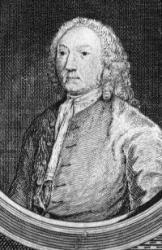
1698 - 1768 Topics: Year C Proper 7 Composer of "WAREHAM" in The New Century Hymnal Born: 1698, Wareham, Dorsetshire, England.
Died: September 26, 1768, Poole, Dorsetshire, England.
Buried: Poole, Dorsetshire, England.
William Knapp
Frederick William Faber
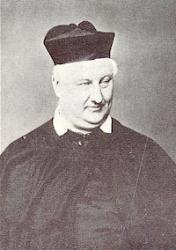
1814 - 1863 Topics: Proper 7 Year A Author of "There's a Wideness in God's Mercy" in Voices United Raised in the Church of England, Frederick W. Faber (b. Calverly, Yorkshire, England, 1814; d. Kensington, London, England, 1863) came from a Huguenot and strict Calvinistic family background. He was educated at Balliol College, Oxford, and ordained in the Church of England in 1839. Influenced by the teaching of John Henry Newman, Faber followed Newman into the Roman Catholic Church in 1845 and served under Newman's supervision in the Oratory of St. Philip Neri. Because he believed that Roman Catholics should sing hymns like those written by John Newton, Charles Wesley, and William Cowpe, Faber wrote 150 hymns himself. One of his best known, "Faith of Our Fathers," originally had these words in its third stanza: "Faith of Our Fathers! Mary's prayers/Shall win our country back to thee." He published his hymns in various volumes and finally collected all of them in Hymns (1862).
Bert Polman
=================
Faber, Frederick William, D.D., son of Mr. T. H. Faber, was born at Calverley Vicarage, Yorkshire, June 28, 1814, and educated at Balliol College, Oxford, graduating B.A. in 1836. He was for some time a Fellow of University College, in the same University. Taking Holy Orders in 1837, he became Rector of Elton, Huntingdonshire, in 1843, but in 1846 he seceded to the Church of Rome. After residing for some time at St. Wilfrid's, Staffordshire, he went to London in 1849, and established the London "Oratorians," or, "Priests of the Congregation of St. Philip Neri," in King William Street, Strand. In 1854 the Oratory was removed to Brompton. Dr. Faber died Sept. 26, 1863. Before his secession he published several prose works, some of which were in defence of the Church of England; and afterwards several followed as Spiritual Conferences, All for Jesus, &c. Although he published his Cherwell Waterlily and Other Poems, 1840; The Styrian Lake, and Other Poems, 1842; Sir Lancelot, 1844; and The Rosary and Other Poems, 1845; and his Lives of the Saints, in verse, before he joined the Church of Rome, all his hymns were published after he joined that communion. They were included in his:—
(1) A small book of eleven Hymns1849, for the School at St. Wilfrid's, Staffordshire. (2) Jesus and Mary: or, Catholic Hymns for Singing and Reading, London 1849. In 1852 the 2nd edition was published with an addition of 20 new hymns. (3) Oratory Hymns, 1854; and (4) Hymns, 1862, being a collected edition of what he had written and published from time to time.
Dr. Faber's account of the origin of his hymn-writing is given in his Preface to Jesus & Mary. After dwelling on the influence, respectively, of St. Theresa, of St. Ignatius, and of St. Philip Neri, on Catholicism; and of the last that "sanctity in the world, perfection at home, high attainments in common earthly callings…was the principal end of his apostolate," he says:—
“It was natural then that an English son of St. Philip should feel the want of a collection of English Catholic hymns fitted for singing. The few in the Garden of the Soul were all that were at hand, and of course they were not numerous enough to furnish the requisite variety. As to translations they do not express Saxon thought and feelings, and consequently the poor do not seem to take to them. The domestic wants of the Oratory, too, keep alive the feeling that something of the sort was needed: though at the same time the author's ignorance of music appeared in some measure to disqualify him for the work of supplying the defect. Eleven, however, of the hymns were written, most of them, for particular tunes and on particular occasions, and became very popular with a country congregation. They were afterwards printed for the Schools at St. Wilfrid's, and the very numerous applications to the printer for them seemed to show that, in spite of very glaring literary defects, such as careless grammar and slipshod metre, people were anxious to have Catholic hymns of any sort. The manuscript of the present volume was submitted to a musical friend, who replied that certain verses of all or nearly all of the hymns would do for singing; and this encouragement has led to the publication of the volume."
In the same Preface he clearly points to the Olney Hymns and those of the Wesleys as being the models which for simplicity and intense fervour he would endeavour to emulate. From the small book of eleven hymns printed for the schools at St. Wilfrid's, his hymn-writing resulted in a total of 150 pieces, all of which are in his Hymns, 1862, and many of them in various Roman Catholic collections for missions and schools. Few hymns are more popular than his "My God, how wonderful Thou art," "O come and mourn with me awhile," and "Sweet Saviour, bless us ere we go." They excel in directness, simplicity, and pathos. "Hark, hark, my soul, angelic songs are swelling," and "O Paradise, O Paradise," are also widely known. These possess, however, an element of unreality which is against their permanent popularity. Many of Faber's hymns are annotated under their respective first lines; the rest in common use include:—
i. From his Jesus and Mary, 1849 and 1852.
1. Fountain of love, Thyself true God. The Holy Ghost.
2. How shalt thou bear the Cross, that now. The Eternal Years.
3. I come to Thee, once more, O God. Returning to God.
4. Joy, joy, the Mother comes. The Purification.
5. My soul, what hast thou done for God? Self-Examination
6. O how the thought of God attract. Holiness Desired.
7. O soul of Jesus, sick to death. Passiontide. Sometimes this is divided into two parts, Pt. ii. beginning, “My God, my God, and can it be."
ii. From his Oratory Hymns, 1854.
8. Christians, to the war! Gather from afar. The Christian Warfare.
9. O come to the merciful Saviour that calls you. Divine Invitation. In many collections.
10. O God, Thy power is wonderful. Power and Eternity of God.
11. O it is sweet to think, Of those that are departed. Memory of the Dead.
12. O what are the wages of sin? The Wages of Sin.
13. O what is this splendour that beams on me now? Heaven.
14. Saint of the Sacred Heart. St. John the Evangelist.
iii. From his Hymns, 1862.
15. Father, the sweetest, dearest Name. The Eternal Father.
16. Full of glory, full of wonders, Majesty Divine. Holy Trinity.
17. Hark ! the sound of the fight. Processions.
18. How pleasant are thy paths, 0 death. Death Contemplated.
19. O God, Whose thoughts are brightest light. Thinking no Evil.
20. O why art thou sorrowful, servant of God? Trust in God.
21. Souls of men, why will ye scatter? The Divine Call.
22. The land beyond the sea. Heaven Contemplated.
23. The thought of God, the thought of thee. Thoughts of God.
24. We come to Thee, sweet Saviour. Jesus, our Rest.
In addition to these there are also several hymns in common use in Roman Catholic hymn-books which are confined to those collections. In the Hymns for the Year, by Dr. Rawes, Nos. 77, 110, 112, 117, 120, 121, 122, 125, 127, 128, 131, 140, 152, 154,169, 170, 174, 179, 180, 192, 222, 226, 230, 271, 272, are also by Faber, and relate principally to the Blessed Virgin Mary. Several of these are repeated in other Roman Catholic collections.
--John Julian, Dictionary of Hymnology (1907
==================
Faber, Frederick William, p. 361, i. To this article the following additions have to be made:—
1. Blood is the price of heaven. Good Friday. (1862.)
2. Exceeding sorrowful to death. Gethsemane. This in the Scottish Ibrox Hymnal, 1871, is a cento from "O soul of Jesus, sick to death," p. 362, i., 7.
3. From pain to pain, from woe to woe. Good Friday. (1854.)
4. I wish to have no wishes left. Wishes about death. (1862.)
5. Why is thy face so lit with smiles? Ascension. (1849.)
The dates here given are those of Faber's works in which the hymns appeared. In addition to these hymns there are also the following in common use:—
6. Dear God of orphans, hear our prayer. On behalf of Orphans. This appeared in a miscellaneous collection entitled A May Garland, John Philip, n.d. [1863], No. 1, in 7 stanzas of 4 lines. In the Roman Catholic Parochial Hymn Book, 1880, it begins, "O God of orphans, hear our prayer."
7. Sleep, sleep my beautiful babe. Christmas Carol. This carol we have failed to trace.
8. By the Archangel's word of love. Pt. i. Life of our Lord. This, and Pt. ii., “By the blood that flowed from Thee"; Pt. iii., "By the first bright Easter day"; also, "By the word to Mary given"; "By the name which Thou didst take"; in The Crown Hymn Book and other Roman Catholic collections, we have seen ascribed to Dr. Faber, but in the Rev. H. Formby's Catholic Hymns, 1853, they are all signed "C. M. C," i.e. Cecilia M. Caddell (p. 200, i.).
--John Julian, Dictionary of Hymnology, Appendix, Part II (1907)
======================
Faber, F. W., pp. 361, i.; 1562, ii. We are informed by members of Dr. Faber's family that his father was Mr. Thomas Henry Faber, sometime Lay Secretary of the Bishop of Durham. In addition to his hymns already noted in this Dictionary, the following are found in various Roman Catholic collections, viz.:—
i. From St. Wilfrid's Hymns, 1849:—
1. Dear Father Philip, holy Sire. S. Philip Neri.
2. Hail, holy Joseph, hail. S. Joseph.
3. Mother of Mercy, day by day. Blessed Virgin Mary.
ii. Jesus and Mary, 1849:—
4. Ah ! dearest Lord! I cannot pray. Prayer.
5. Dear Husband of Mary. S. Joseph.
6. Dear Little One, how sweet Thou art. Christmas.
7. Father and God! my endless doom. Predestination.
8. Hail, holy Wilfrid, hail. S. Wilfrid.
9. O Jesus, if in days gone by. Love of the World.
10. O turn to Jesus, Mother, turn. B. V. M.
11. Sing, sing, ye angel bands. Assum. B. V. M.
iii. Jesus and Mary, 1852:—
12. All ye who love the ways of sin. S. Philip Neri.
13. Day set on Rome! its golden morn. S. Philip Neri.
14. Hail, bright Archangel! Prince of heaven. S. Michael.
15. Hail, Gabriel, hail. S. Gabriel.
16. O Flower of Grace, divinest Flower. B. V. M.
17. Saint Philip! 1 have never known. S. Philip Neri.
18. Sweet Saint Philip, thou hast won us. S. Philip Neri. Previously in the Rambler, May, 1850, p. 425.
iv. Oratory Hymns, 1854:—
19. Day breaks on temple roofs and towers. Expect. of B. V. M.
20. How gently flow the silent years. S. Martin and S. Philip.
21. How the light of Heaven is stealing. Grace.
22. Like the dawning of the morning. Expect. of B. V. M.
23. Mother Mary ! at thine altar. For Orphans.
24. My God! Who art nothing but mercy and kindness. Repentance.
25. O blessed Father! sent by God. S. Vincent of Paul.
26. O do you hear that voice from heaven? Forgiveness.
27. The chains that have bound me. Absolution.
28. The day, the happy day, is dawning. B. V. M.
29. The moon is in the heavens above. B. V. M.
30. Why art thou sorrowful, servant of God? Mercy.
v. Hymns, 1862:—
31. At last Thou art come, little Saviour. Christmas.
32. By the spring of God's compassions. S. Raphael.
33. Fair are the portals of the day. B. V. M.
34. Father of many children. S. Benedict.
35. From the highest heights of glory. S. Mary Magdalene.
36. Like the voiceless starlight falling. B. V. M.
37. Mary! dearest mother. B. V. M.
38. Mother of God, we hail thy heart. B. V. M.
39. O Anne! thou hadst lived through those long dreary years. S. Anne. Previously in Holy Family Hymns, 1860.
40. O balmy and bright as moonlit night. B. V. M.
41. O Blessed Trinity! Thy children. Holy Trinity.
42. O dear Saint Martha, busy saint. S. Martha
43. O Mother, will it always be. B. V. M.
44. O vision bright. B. V. M.
45. Summer suns for ever shining. B. V. M.
46. There are many saints above. S. Joseph. Previously in Holy Family Hymns, 1860.
vi. Centos and altered forms:—
47. Confraternity men to the fight. From "Hark the sound of the fight," p. 362, i.
48. Hail, sainted Mungo, hail. From No. 8.
49. I bow to Thee, sweet will of God. From "I worship Thee," p. 559, ii.
50. They whom we loved on earth. From "0 it is sweet to think," p. 362, i.
51. Vincent! like Mother Mary, thou. From No. 25.
When Dr. Faber's hymns which are in common use are enumerated, the total falls little short of one hundred. In this respect he outnumbers most of his contemporaries. [Rev. James Mearns]
--John Julian, Dictionary of Hymnology, New Supplement (1907)
--------------
See also in:
Hymn Writers of the Church
Frederick William Faber
John Ernest Bode

1816 - 1874 Topics: Proper 7 Year B; Proper 7 Year C Author of "O Jesus, I Have Promised" in Voices United John E. Bode (b. St. Pancras, England, 1816; d. Castle Camps, Cambridgeshire, England, 1874) A fine student at Christ Church, Oxford, England, and a prominent scholar who gave the famous Bampton Lectures ("for the exposition and defense of the Christian faith") at Oxford in 1855, was a rector in Westwell, Oxfordshire, and in Castle Camps. This gifted poet and hymn writer published Hymns for the Gospel of the Day, for Each Sunday and Festivals of Our Lord in 1860.
Bert Polman
==============
Bode, John Ernest, M.A., son of Mr. William Bode, late of the General Post Office, b. 1816, and educated at Eton, the Charter House, and at Christ Church, Oxford, graduating B.A. 1837, and M.A. in due course. Taking Holy Orders in 1841, he became Rector of Westwell, Oxfordshire, 1847; and then of Castle Camps, Cambridgeshire, 1860. He was also for a time Tutor of his College, and Classical Examiner. His Bampton Lectures were delivered in 1855. He d. at Castle Camps, Oct. 6, 1874. In addition to his Bampton Lectures, and Ballads from Herodotus, he published Hymns from the Gospel of the Day for each Sunday and Festivals of our Lord, 1860; and Short Occasional Poems, Lond., Longmans, 1858. In addition to his well-known hymn, “O Jesu, I have promised " (q. v.), the following from his Hys. from the Gospel are also in common use:—
1. God of heaven, enthroned in might. H. Trinity.
2. Spirit of Truth, indwelling Light. Whitsuntide.
-John Julian, Dictionary of Hymnology (1907)
=================
Bode, John E. , p. 151, ii. Additional pieces from his Hys.from the Gospel of the Day, &c, 1800, are in common use :— (1) "Sweetly the Sabbath bell" (Sunday); (2) "Thou Who hast called us by Thy word" (20th S. after Trinity).
--John Julian, Dictionary of Hymnology, Appendix, Part II (1907)
John Ernest Bode
Johann Franck
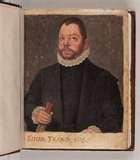
1618 - 1677 Person Name: Johann Franck, 1618-1677 Topics: Year C Proper 7 Author of "Jesu, priceless treasure" in Complete Anglican Hymns Old and New Johann Franck (b. Guben, Brandenburg, Germany, 1618; d. Guben, 1677) was a law student at the University of Köningsberg and practiced law during the Thirty Years' War. He held several positions in civil service, including councillor and mayor of Guben. A significant poet, second only to Paul Gerhardt in his day, Franck wrote some 110 hymns, many of which were published by his friend Johann Crüger in various editions of the Praxis Pietatis melica. All were included in the first part of Franck’s Teutsche Gedichte bestehend im geistliche Sion (1672).
Bert Polman
=============
Franck, Johann, son of Johann Franck, advocate and councillor at Guben, Brandenburg, was born at Guben, June 1, 1618. After his father's death, in 1620, his uncle by marriage, the Town Judge, Adam Tielckau, adopted him and sent him for his education to the schools at Guben, Cottbus, Stettin and Thorn. On June 28, 1638, he matriculated as a student of law at the University of Königsberg, the only German university left undisturbed by the Thirty Years' War. Here his religious spirit, his love of nature, and his friendship with such men as Simon Dach and Heinrich Held, preserved him from sharing in the excesses of his fellow students. He returned to Guben at Easter, 1640, at the urgent request of his mother, who wished to have him near her in those times of war during which Guben frequently suffered from the presence of both Swedish and Saxon troops. After his return from Prague, May, 1645, he commenced practice as a lawyer. In 1648 he became a burgess and councillor, in 1661 burgomaster, and in 1671 was appointed the deputy from Guben to the Landtag (Diet) of Lower Lusatia. He died at Guben, June 18, 1677; and on the bicentenary of his death, June 18, 1877, a monumental tablet to his memory was affixed to the outer wall of the Stadtkirche at Guben (Koch, iii. 378-385; Allgemeine Deutsche Biographie, vii. 211-212; the two works by Dr. Hugo Jentsch of Guben, Johann Franck, 1877, and Die Abfassungszeit der geistlichen Lieder Johann Franck's, 1876).
Of Franck's secular poems those before 1649 are much the best; his later productions becoming more and more affected and artificial, long-winded and full of classical allusions, and much inferior to those of Dach or Opitz. As a hymn writer he holds a high rank and is distinguished for unfeigned and firm faith, deep earnestness, finished form, and noble, pithy, simplicity of expression. In his hymns we miss the objectivity and congregational character of the older German hymns, and notice a more personal, individual tone; especially the longing for the inward and mystical union of Christ with the soul as in his "Jesus, meine Freude." He stands in close relationship with Gerhardt, sometimes more soaring and occasionally more profound, but neither on the whole so natural nor so suited for popular comprehension or Church use.
His hymns appeared mostly in the works of his friends Weichmann, Crüger and Peter. They were collected in his Geistliches Sion, Guben, 1674, to the number of 110; and of these the 57 hymns (the other 53 being psalm versions of no great merit) were reprinted with a biographical preface by Dr. J. L. Pasig as Johann Franck's Geistliche Lieder, Grimma, 1846. Two of those translated into English are from the Latin of J. Campanus (q. v.). Four other hymns are annotated under their own first lines:—"Brunquell aller Güter"; "Dreieinigkeit der Gottheit wahrer Spiegel"; "Jesu, meine Freude"; "Schmücke dich, o liebe Secle." The rest are:—
i. Hymns in English common use: --
i. Erweitert eure Pforten . [Advent]. Founded on Psalm xxiv. 7-10. First published in C. Peter's Andachts-Zymbeln, Freiberg, 1655, p. 25, in 7 stanzas of 8 lines; repeated 1674, p. 3, and 1846, p. 3, as above. Included in the 1688 and later editions of Crüger's Praxis pietatis, in Bollhagen's Gesang-Buch, 1736, &c.
The only translation in common use is:—-
Unfold your gates and open, a translation of st. 1, 3, 6, by A. T. Russell, as No. 30 in his Hymns & Psalms, 1851; repeated altered as No. 30 in Kennedy, 1863, and thus as No. 102 in Holy Song, 1869.
ii. Herr Gott dich loben wir, Regier. Thanksgiving for Peace. Evidently written as a thanksgiving for the conclusion of the Thirty Years' War, by the Peace of Westphalia, Oct. 24, 1648. First published in the Crüger-Runge Gesang-Buch, Berlin, 1653, No. 306, in 9 st. of 8 l., as the first of the "Hymns of Thanksgiving for Peace attained"; and repeated 1674, p. 182, and 1846, p. 77, as above. Included in Crüger's Praxis, 1653, and many later collections, and, as No. 591, in the Unverfälschter Liedersegen, 1851. The only translation in common use is:—
Lord God, we worship Thee, a very good version of st. 2, 3, 6, 8, by Miss Winkworth in her Chorale Book for England, 1863, No. 183. Repeated in full in the Society for Promoting Christian Knowledge Church Hymns, 1871; the Hymnary, 1872; the Psalmist, 1878; and in America in the Pennsylvania Lutheran Church Book, 1868. In the American Protestant Episcopal Collection, 1871; the Hymns & Songs of Praise, N. Y. 1874; and the Ohio Lutheran Hymnal, 1880, the translation of stanza 8 is omitted.
iii. Herr ich habe missgehandelt. Lent. Of this fine hymn of penitence stanza i. appeared as No. 19 in Cruger's Geistliche Kirchenmelodien , Leipzig, 1649. The full form in 8 stanzas of 6 lines is No. 41 in the Crüger-Runge Gesang-Buch, Berlin, 1653, entitled "For the forgiveness of sins," repeated 1674, p. 39, and 1846, p. 37, as above. Included in Crüger's Praxis, 1653, and others, and in the Unverfälschter Liedersegen, 1851. The only translation in common use is:—
Lord, to Thee I make confession, a very good translation, omitting st. 4, 5, 6, by Miss Winkworth in her Chorale Book for England, 1863, No. 44, repeated in the Appendix to the Hymnal for St. John's, Aberdeen, 1865-1870; and in the Pennsylvania Lutheran Ch. Book, 1868; Evangelical Hymnal, N. Y., 1880; Ohio Lutheran Hymnal, 1880. Another translation is: "Lord, how oft I have offended," by N. L. Frothingham, 1870, p. 177.
iv. Herr Jesu, Licht der Heiden. Presentation in the Temple. Founded on the account in St. Luke ii., and probably the finest hymn on the subject. Dr. Jentsch, 1876, p. 9, thinks it was written before Dec. 8, 1669, as C. Peter, who died then, left a melody for it. We have not found the full text earlier than 1674, as above, p. 10, in 6 stanzas of 8 lines, entitled "On the Festival of the Purification of Mary" (1846, p. 10). Included in the 1688 and later editions of Crüger's Praxis, and in the Unverfälschter Liedersegen, 1851, No. 197. The translations in common use are:—
1. Light of the Gentile world , a translation, omitting st. 6, by Miss Winkworth in the first service of her Lyra Germanica, 1855, p. 193 (ed. 1876, p. 195), and thence as No. 147 in the Pennsylvania Lutheran Hymn Book, 1865. This version is in S.M. Double.
2. Light of the Gentile Nations, a good translation, omitting st. 6, by Miss Winkworth in her Chorale Book for England, 1863, No. 80. Repeated in Dr. Thomas's Augustine Hymn Book, 1866, and in America in the Pennsylvania Lutheran Church Book, 1868, and the Ohio Lutheran Hymnal, 1880.
ii. Hymns not in English common use:
v. Du geballtes Weltgebäude. Christ above all earthly things. Stanza i. in Cruger's Kirchenmelodien, 1649, No. 116. The full text (beginning "Du o schönes) is No. 239 in the Crüger-Runge Gesang-Buch, 1653, in 8 stanzas, entitled "Longing after Eternal Life." Repeated, 1674, p. 194, and 1846, p. 60, as above. The translations are: (1) "Let who will in thee rejoice," by Miss Winkworth, 1855, p. 180 (1876, p. 182). (2) "O beautiful abode of earth," by Miss Warner, 1858 (1861, p. 233). (3) "Thou, O fair Creation-building," by N. L. Frothingham, 1870, p. 232.
vi. Unsre müden Augenlieder. Evening. Probably written while a student at Königsberg. First published in J. Weichmann's Sorgen-lägerin, Königsberg, 1648, Pt. iii., No. 4, in 7 st.; repeated 1674, p. 213, and 1846, p. 91, as above. The only translation is by H. J. Buckoll, 1842, p. 79, beginning with st. vi., "Ever, Lord, on Thee relying." [Rev. James Mearns, M.A.]
--John Julian, Dictionary of Hymnology (1907)
Johann Franck
Charles William Everest
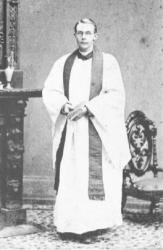
1814 - 1877 Topics: Proper 7 Year A Author of "Take up your cross, the Saviour said" in Voices United Everest, Charles William, M.A., born at East Windsor, Connecticut, May 27, 1814, graduated at Trinity College, Hartford, 1838, and took Holy Orders in 1842. He was rector at Hamden, Connecticut, from 1842 to 1873, and also agent for the Society for the Increase of the Ministry. He died at Waterbury, Connecticut, Jan. 11, 1877 (See Poets of Connecticut, 1843). In 1833 he published Visions of Death, and Other Poems; from this work his popular hymn is taken:—
Take up thy cross, the Saviour said. Following Jesus. The original text of this hymn differs very materially from that which is usually found in the hymn-books. The most widely known form of the text is that in Hymns Ancient & Modern, where it appeared in 1861. It was copied by the Compilers from another collection, but by whom the alterations were made is unknown. The nearest approach to the original is in Horder's Congregational Hymn Book, 1884. Original text in Biggs's English Hymnology, 1873, p. 24. [Rev. F. M. Bird, M.A.]
-- John Julian, Dictionary of Hymnology (1907)
Charles William Everest
William Williams
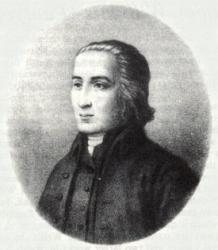
1717 - 1791 Topics: Proper 7 Year C Author (Welsh) and Translator (Englsih) of "Guide Me, O Thou Great Jehovah (Guide-moi, Berger fidèle)" in Voices United William Williams, called the "Watts of Wales," was born in 1717, at Cefn-y-coed, near Llandovery, Carmarthenshire. He originally studied medicine, but abandoned it for theology. He was ordained Deacon in the Church of England, but was refused Priest's Orders, and subsequently attached himself to the Calvinistic Methodists. For half a century he travelled in Wales, preaching the Gospel. He died in 1791. Williams composed his hymns chiefly in the Welsh language; they are still largely used by various religious bodies in the principality. Many of his hymns have appeared in English, and have been collected and published by Sedgwick. His two principal poetical works are "Hosannah to the Son of David," and "Gloria in Excelsis."
--Annotations of the Hymnal, Charles Hutchins, M.A. 1872.
=====================
Williams, William, of Pantycelyn, was the Sweet Singer of Wales. He was born at Cefn-y-Coed, in the Parish of Llanfair-y-bryn, near Llandovery, in 1717. He was ordained a deacon of the Established Church in 1740, by Dr. Claget, Bishop of St. Davids, and for three years he served the Curacies of Llan-wrtyd and Llanddewi-Abergwesyn. He never received Priest's Orders. He became early acquainted with the revivalist Daniel Rowlands, and for thirty-five years he preached once a month at Llanllian and Caio and Llansawel, besides the preaching journeys he took in North and South Wales. He was held in great esteem as a preacher. In 1744 his first book of hymns appeared under the title of Halleluiah, and soon ran through three editions. In1762, he published another book under the title of Y Môr o Wydr, which soon went through five editions. His son John published an excellent edition of his hymns in the year 181lines In addition to his Welsh hymns Williams also published several in English as:—
(1.) Hosannah to the Son of David; or, Hymns of Praise to God, For our glorious Redemption by Christ. Some few translated from the Welsh Hymn-Book, but mostly composed on new Subjects. By William Williams. Bristol: Printed by John Grabham, in Narrow-Wine Street, 1759. This contains 51 hymns of which 11 are translated from his Welsh hymns. This little book was reprinted by D. Sedgwick in 1859.
(2.) Gloria in Excelsis: or, Hymns of Praise to God and the Lamb. By W. Williams . . . Carmarthen. Printed for the Author by John Ross, removed to Priory Street, near the Church, M.DCC.LXXI. This contains 70 hymns, not including parts.
From these volumes the following hymns are in common use:—
i. From the Hosannah, 1759:—
1. Jesus, my Saviour is enough. Jesus, All in All.
2. My God, my God, Who art my all. Communion with God desired.
3. The enormous load of human guilt. God's love unspeakable.
ii. From the Gloria in Excelsis, 1772.
4. Awake, my soul, and rise. Passiontide.
5. Beneath Thy Cross I lay me down. Passiontide.
6. Hark! the voice of my Beloved. The Voice of Jesus.
7. Jesus, lead us with Thy power. Divine Guidance Desired. Sometimes given as "Father, lead us with Thy power."
8. Jesus, Whose Almighty sceptre. Jesus as King.
9. Saviour, look on Thy beloved. The Help of Jesus desired.
10. White and ruddy is my Beloved. Beauties of Jesus.
Williams is most widely known through his two hymns, "Guide me, O Thou great Jehovah," and "O'er those gloomy hills of darkness." Williams died at Pantycelyn, Jan. 11, 1791. [Rev. W. Glanffrwd Thomas]
-- John Julian, Dictionary of Hymnology (1907)
=================
See also in:
Hymn Writers of the Church
William Williams
M. P. Ferguson
1850 - 1932 Person Name: Manie Payne Ferguson, b. 1850 Topics: Year B Proper 7 Author of "Joys Are Flowing like a River (Blessed Quietness)" in The New Century Hymnal Manie Payne Ferguson United Kingdom 1850-1932. Born in Carlow, Ireland, in 1883 she married Theodore Pollock Ferguson, a past Presbyterian minister from Ohio, who had become an itinerant evangelical preacher. They moved to Los Angeles, CA, in 1885. He became a pioneer leader in the American Holiness Movement, a Christian evangelist, and social worker, founding, along with her husband, the non-denominational Peniel Mission in 1886. In 1894 they received a significant financial donation from George Studd allowing them to expand the mission. They constructed a 900-seat auditorium and ministry centre there in Los Angeles. They partnered with Studd and Phineas Bresee, each acting as a superintendent of the mission organization. In 1894 Dr. Joseph Widney, President of USC, led the dedication Praise service, and Bresee preached the later service. Widney and Bresee separated from the mission in 1895 to form the Church of the Nazarene, and Manie Fergusion provided primary leadership of the Peniel Mission. The mission provided ministry especially for single women, who lived in rented rooms near the auditorium, where evangelical services were held. The Fergusions managed to live on income from three small houses they owned, and mission rents and donations covered mission expenses. Street-corner meetings were held in the afternoon, evangelical services at night, and a meal was served afterward. Converts were asked to join a local church of their choice. Manie continued the mission work after her husband's death until her own death. In 1947 the mission became part of the World Gospel Mission enterprise. Manie wrote many poems and also authored hymn lyrics. She died in Los Angeles.
John Perry
M. P. Ferguson
Charles Wesley
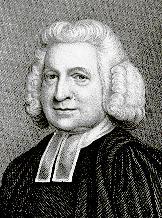
1707 - 1788 Topics: Proper 7 Year B Author of "Love Divine, All Loves Excelling" in Voices United Charles Wesley, M.A. was the great hymn-writer of the Wesley family, perhaps, taking quantity and quality into consideration, the great hymn-writer of all ages. Charles Wesley was the youngest son and 18th child of Samuel and Susanna Wesley, and was born at Epworth Rectory, Dec. 18, 1707. In 1716 he went to Westminster School, being provided with a home and board by his elder brother Samuel, then usher at the school, until 1721, when he was elected King's Scholar, and as such received his board and education free. In 1726 Charles Wesley was elected to a Westminster studentship at Christ Church, Oxford, where he took his degree in 1729, and became a college tutor. In the early part of the same year his religious impressions were much deepened, and he became one of the first band of "Oxford Methodists."
In 1735 he went with his brother John to Georgia, as secretary to General Oglethorpe, having before he set out received Deacon's and Priest's Orders on two successive Sundays. His stay in Georgia was very short; he returned to England in 1736, and in 1737 came under the influence of Count Zinzendorf and the Moravians, especially of that remarkable man who had so large a share in moulding John Wesley's career, Peter Bonier, and also of a Mr. Bray, a brazier in Little Britain. On Whitsunday, 1737, [sic. 1738] he "found rest to his soul," and in 1738 he became curate to his friend, Mr. Stonehouse, Vicar of Islington, but the opposition of the churchwardens was so great that the Vicar consented that he "should preach in his church no more." Henceforth his work was identified with that of his brother John, and he became an indefatigable itinerant and field preacher. On April 8, 1749, he married Miss Sarah Gwynne. His marriage, unlike that of his brother John, was a most happy one; his wife was accustomed to accompany him on his evangelistic journeys, which were as frequent as ever until the year 1756," when he ceased to itinerate, and mainly devoted himself to the care of the Societies in London and Bristol. Bristol was his headquarters until 1771, when he removed with his family to London, and, besides attending to the Societies, devoted himself much, as he had done in his youth, to the spiritual care of prisoners in Newgate. He had long been troubled about the relations of Methodism to the Church of England, and strongly disapproved of his brother John's "ordinations." Wesley-like, he expressed his disapproval in the most outspoken fashion, but, as in the case of Samuel at an earlier period, the differences between the brothers never led to a breach of friendship. He died in London, March 29, 1788, and was buried in Marylebone churchyard. His brother John was deeply grieved because he would not consent to be interred in the burial-ground of the City Road Chapel, where he had prepared a grave for himself, but Charles said, "I have lived, and I die, in the Communion of the Church of England, and I will be buried in the yard of my parish church." Eight clergymen of the Church of England bore his pall. He had a large family, four of whom survived him; three sons, who all became distinguished in the musical world, and one daughter, who inherited some of her father's poetical genius. The widow and orphans were treated with the greatest kindness and generosity by John Wesley.
As a hymn-writer Charles Wesley was unique. He is said to have written no less than 6500 hymns, and though, of course, in so vast a number some are of unequal merit, it is perfectly marvellous how many there are which rise to the highest degree of excellence. His feelings on every occasion of importance, whether private or public, found their best expression in a hymn. His own conversion, his own marriage, the earthquake panic, the rumours of an invasion from France, the defeat of Prince Charles Edward at Culloden, the Gordon riots, every Festival of the Christian Church, every doctrine of the Christian Faith, striking scenes in Scripture history, striking scenes which came within his own view, the deaths of friends as they passed away, one by one, before him, all furnished occasions for the exercise of his divine gift. Nor must we forget his hymns for little children, a branch of sacred poetry in which the mantle of Dr. Watts seems to have fallen upon him. It would be simply impossible within our space to enumerate even those of the hymns which have become really classical. The saying that a really good hymn is as rare an appearance as that of a comet is falsified by the work of Charles Wesley; for hymns, which are really good in every respect, flowed from his pen in quick succession, and death alone stopped the course of the perennial stream.
It has been the common practice, however for a hundred years or more to ascribe all translations from the German to John Wesley, as he only of the two brothers knew that language; and to assign to Charles Wesley all the original hymns except such as are traceable to John Wesley through his Journals and other works.
The list of 482 original hymns by John and Charles Wesley listed in this Dictionary of Hymnology have formed an important part of Methodist hymnody and show the enormous influence of the Wesleys on the English hymnody of the nineteenth century.
-- Excerpts from John Julian, Dictionary of Hymnology (1907)
==================
Charles Wesley, the son of Samuel Wesley, was born at Epworth, Dec. 18, 1707. He was educated at Westminster School and afterwards at Christ Church, Oxford, where he graduated M.A. In 1735, he took Orders and immediately proceeded with his brother John to Georgia, both being employed as missionaries of the S.P.G. He returned to England in 1736. For many years he engaged with his brother in preaching the Gospel. He died March 29, 1788. To Charles Wesley has been justly assigned the appellation of the "Bard of Methodism." His prominence in hymn writing may be judged from the fact that in the "Wesleyan Hymn Book," 623 of the 770 hymns were written by him; and he published more than thirty poetical works, written either by himself alone, or in conjunction with his brother. The number of his separate hymns is at least five thousand.
--Annotations of the Hymnal, Charles Hutchins, M.A., 1872.
Charles Wesley
Pages




