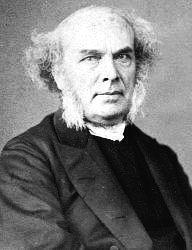
1808 - 1889 Person Name: Horatius Bonar, 1808-1889 Topics: Rites of the Church Order of Christian Funerals: Funeral Liturgy Author of "I Heard the Voice of Jesus Say" in Glory and Praise (3rd. ed.) Horatius Bonar was born at Edinburgh, in 1808. His education was obtained at the High School, and the University of his native city. He was ordained to the ministry, in 1837, and since then has been pastor at Kelso. In 1843, he joined the Free Church of Scotland. His reputation as a religious writer was first gained on the publication of the "Kelso Tracts," of which he was the author. He has also written many other prose works, some of which have had a very large circulation. Nor is he less favorably known as a religious poet and hymn-writer. The three series of "Hymns of Faith and Hope," have passed through several editions.
--Annotations of the Hymnal, Charles Hutchins, M.A. 1872
================================
Bonar, Horatius, D.D. Dr. Bonar's family has had representatives among the clergy of the Church of Scotland during two centuries and more. His father, James Bonar, second Solicitor of Excise in Edinburgh, was a man of intellectual power, varied learning, and deop piety.
Horatius Bonar was born in Edinburgh, Dec. 19th, 1808; and educated at the High School and the University of Edinburgh. After completing his studies, he was "licensed" to preach, and became assistant to the Rev. John Lewis, minister of St. James's, Leith. He was ordained minister of the North Parish, Kelso, on the 30th November, 1837, but left the Established Church at the "Disruption," in May, 1848, remaining in Kelso as a minister of the Free Church of Scotland. The University of Aberdeen conferred on him the doctorate of divinity in 1853. In 1866 he was translated to the Chalmers Memorial Church, the Grange, Edinburgh; and in 1883 he was chosen Moderator of the General Assembly of of the Free Church of Scotland.
Dr. Bonar's hymns and poems were, he tells us, composed amid a great variety of circumstances; in many cases he cannot himself recall these circumstances; they also appeared in several publications, but nearly all have boen published or republished in the following:— (i) Songs for the Wilderness, 1843-4. (2) The Bible Hymn Book, 1845. (3) Hymns, Original and Selected, 1846. (4) Hymns of Faith and Hope, First Series, 1857; Second Series, 1861; Third Series, 1866. (5) The Song of the New Creation, 1872. (6) My Old Letters, a long poem, 1877. (7) Hymns of the Nativity, 1879. (8) Communion Hymns, 1881. In addition to numerous prose works, he has also edited The New Jerusalem; a Hymn of the Olden Time, 1852, &c.
Dr. Bonar's poems—-including many beautiful lyrics, several psalm versions, and translations from the Greek and Latin, a large number of hymns, and a long meditative poem—-are very numerous, too numerous, perhaps, for their permanent fame as a whole.
Dr. Bonar's scholarship is thorough and extensive; and his poems display the grace of style and wealth of allusion which are the fruit of ripe culture. Affected very slightly by current literary moods, still less by the influence of other religious poetry, they reveal extreme susceptibility to the emotional power which the phases of natural and of spiritual life exercise; the phases of natural life being recognised chiefly as conveying and fashioning spiritual life, used chiefly for depicting spiritual life, and handled for this purpose with greater delicacy of touch than in the Olney Hymns, and with less conscious purpose than in the Christian Year. As a result of this susceptibility, and from habitual contemplation of the Second Advent as the era of this world's true bliss, his hymns and poems are distinguished by a tone of pensive reflection, which some might call pessimism. But they are more than the record of emotion; another element is supplied by his intellectual and personal grasp of Divine truth, these truths particularly:—The gift of a Substitute, our Blessed Saviour; Divine grace, righteous, yet free and universal in offer; the duty of immediate reliance upon the privilege of immediate assurance through that grace; communion with God, especially in the Lord's Supper, respecting which he insists on the privilege of cherishing the highest conceptions which Scripture warrants; and finally, the Second Advent of our Lord: by his vigorous celebration of these and other truths as the source and strength of spiritual life, his hymns are protected from the blight of unhealthy, sentimental introspection.
To sum up: Dr. Bonar's hymns satisfy the fastidious by their instinctive good taste; they mirror the life of Christ in the soul, partially, perhaps, but with vivid accuracy; they win the heart by their tone of tender sympathy; they sing the truth of God in ringing notes; and although, when taken as a whole, they are not perfect ; although, in reading them, we meet with feeble stanzas, halting rhythm, defective rhyme, meaningless Iteration; yet a singularly large number have been stamped with approval, both in literary circles and by the Church.
In Great Britain and America nearly 100 of Dr. Bonar's hymns are in common use. They are found in almost all modern hymnals from four in Hymns Ancient & Modern to more than twenty in the American Songs for the Sanctuary, N. Y., 1865-72. The most widely known are, "A few more years shall roll;" "Come, Lord, and tarry not;" "Here, O my Lord, I see Thee face to face;" "I heard the Voice of Jesus say;" "The Church has waited long;" and "Thy way, not mine, O Lord."
In addition to these and others which are annotated under their respective first lines, the following are also in common use:—
From Songs for the Wilderness, No. 1, 1843.
1. For Thee we long and pray. Sunday Morning.
2. Holy Father, hear my cry. A Child's Prayer.
3. I thought upon my sins and I was sad. Christ our Peace.
4. Peace to the world, our Lord is come. A Millennial Song.
5. Spirit of everlasting grace. The Vision of Dry Bones.
ii. From Songs for the Wilderness, No. 2,1844.
6. Ho, ye thirsty, parched and fainting. Invitation.
7. 0 'tis not what we fancied it. The world renounced.
8. Sing them, my children, sing them still. Children exhorted to Praise.
9. Time's sun is fast setting. Advent.
10. Weep, pilgrim, weep, yet 'tis not for the sorrow. Faith.
11. Yes, for me, for me He careth. Christ the Elder Brother .
iii. From The Bible Hymn Book, 1845.
12. Jesus, my sorrow lies too deep. Jesus, the Great High Priest.
13. There is a Morning Star, my soul. The Morning Star.
14. This is not my place of resting. Pressing towards heaven.
iv. From Hymns, Original and Selected, 1845.
15. Let there be light, Jehovah said. Creation.
v. From Hymns of Faith and Hope, 1st series, 1857.
16. Be brave, my brother. The Fight of Faith.
17. Blessed be God, our God. Good Friday.
18. Everlasting praises. Doxology.
19. Go up, go up, my heart. Heavenly aspirations desired.
20. I close my heavy eye. Evening. Sometimes given as "We close our heavy eyes."
21. I see the crowd in Pilate's hall. Good Friday.
22. Jesus, while this rongh desert soil. Strength by the Way.
23. Jesus, Whom angel-hosts adore. The Word made Flesh. From "The Son of God, in mighty love."
24. Make haste, 0 man, to live. Exhortation to lay hold of Life.
25. No seas again shall sever. Heaven.
26. Oppressed with noonday's scorching heat. Shadow of the Cross.
27. Rest for the toiling hand. Burial. From "Lie down, frail body, here."
28. Shall this life of mine be wasted? Exhortation to Duty.
29. These are the crowns that we shall wear. Heaven.
30. Thy works, not mine, O Christ [Lord]. The Sin-bearer.
31. Where the faded flower shall freshen. Heaven.
vi. From Hymns of Faith and Hope. 2nd series, 1861.
32. Be still, my soul, Jehovah loveth Thee. Rest in the Love of God.
33. Christ has done the mighty work. Good Friday.
34. Come, mighty Spirit, penetrate. Whitsuntide.
35. Deep down beneath the unresting surge. Burial at Sea.
36. Fear not the foe, thou flock of God [thou little flock]. Battle-Song of the Church.
37. For lack of love I languish. Lent.
38. From this bleak hill of storms. Eternal Rest desired.
39. He liveth long who liveth well. The True Life.
40. Here shall death's triumph end: the rock-barred door. Easter. From "The tomb is empty: wouldst thou have it full."
41. Jesus, Sun and Shield art Thou. Jesus the First and Last.
42. Jesus, the Christ of God. Praise to Christ.
43. Light of the world, for ever, ever shining. Christ the Light of the World. From "Why walk in darkness? Has the dear light vanished?"
44. Make use of me, my God. Duty desired.
45. Not what I am, 0 Lord, but what Thou art. The Love of God.
46. 0 Light of Light, shine in. Cry of the Weary.
47. 0 love of God, how strong and true. Love of God.
48. 0 love that casts out fear. Love of God.
49. 0 strong to save and bless. Lent.
50. 0 this soul, how dark and blind. Lent.
51. Safe across the waters. Thanksgiving at end of a journey.
52. Silent, like men in solemn haste. Pressing onwards.
53. Speak, lips of mine. Exhortation to Praise.
54. The Bridegroom comes. Advent.
vii. From Hymns of Faith and Hope. 3rd series, 1866.
55. Bear Thou my burden, Thou Who bar'st my sin. Lent or Passiontide.
56. Done is the work that saves. Easter.
57. Father, our children keep. Prayer on behalf of Children.
58. Fill Thou my life, 0 Lord my God. Life's Praise.
59. Finish Thy work, the time is short. Earnest labour to the end.
60. From the Cross the blood is falling. Good Friday.
61. He called them, and they left. Obedience.
62. Help me, my [0] God to speak. Truth desired.
63. Holy Father, Mighty God. Holy Trinity.
64. How are my troubles multiplied. Ps. iii.
65. How sweetly doth He show His face Flower Service.
66. Light hath arisen, we walk in its brightness. Sustaining power of Faith.
67. Lo, God, our God has come. Christmas.
68. Lord, give me light to do Thy work. Divine guidance desired.
69. No, not despairingly. Lent.
70. Not to ourselves again. Life in Christ, or, Living unto God.
71. Now in parting, Father, bless us. Post Communion.
72. Sounds the trumpet from afar. Battle-Song of the Church.
73. Thee in the loving bloom of morn. God in all.
74. Through good report and evil, Lord. Faithfulness.
75. To Jehovah, God of might. Praise to the Father.
76. To the name of God on high. Doxology.
77. Upward, where the stars are burning. Heavenward Aspirations.
78. We take the peace which He hath won. The Gift of Peace.
79. When the weary, seeking rest. Intercession for all Conditions of Men.
viii. From The Song of the New Creation,1872.
80. For the Bread and for the Wine. Holy Communion.
81. Light of life so softly shining. Light of Life.
82. Yet there is room. The Lamb's bright hall of song. Home Missions.
ix. From Hymns of the Nativity, 1879.
83. Great Ruler of the land and sea. Sailors' Liturgy. From Communion Hymns, 1881.
84. Beloved, let us love. Brotherly Love.
In several instances these hymns are given in an abbreviated form, and sometimes alterations are also introduced. In this latter respect however Dr. Bonar has suffered less than most modern hymn-writers. [Rev. James Mearns, M.A.]
-- John Julian, Dictionary of Hymnology (1907)
====================
Bonar, Horatius, p. 161, i. He died at Edinburgh, July 31, 1889. In 1890 his son published a posthumous volume of his poetical pieces as Until the Day Break and other Hymns and Poems left behind. The following additional hymns are in common use:—
1. Almighty Comforter and Friend. (1866.) Whitsuntide.
2. Father, make use of me. An altered form of No. 44, p. 162, ii.
3. I ask a perfect creed. (1861.) Creed not Opinions. From this is also taken "O True One, give me truth."
4. Long, long deferred, now come at last. Marriage of the Lamb. Part of "Ascend, Beloved, to the joy." (1861.)
5. Nay 'tis not what we fancied it. (1857.) Vanity of the World.
6. No blood, no altar now. (1861.) The Finished Sacrifice.
7. No shadows yonder. (1857.) Heaven Anticipated.
8. Not with the light and vain. (1857.) Godly Companionship.
9. O Love invisible, yet infinite. (1866.) Divine Love.
10. On the great love of God I lean. (1866.) Love of God our Resting-place.
11. On Thee, O Jesus, strongly leaning. (1866.) Fellowship with Christ.
12. Peace upon peace, like wave on wave. (1866.) Divine Peace.
13. Sower divine, sow the good seed in me. (1857.) Heavenly Sowing.
14. Speaketh the sinner's sin within my heart. (1866.) Ps. xxxvi.
15. Still one in life and one in death. (1857.) Communion of Saints. Part of "'Tis thus they press the hand and part."
16. Surely, yon heaven, where angels see God's face. (1857.) Heaven Anticipated.
17. That city with the jewelled crest. (1857.) Heaven. Part of "These are the crowns that we shall wear." Another cento from the same is "Yon city, with the jewelled crest."
18. That clime is not like this dull clime of ours. (1843.) Heaven.
19. The Free One makes you free: He breaks the rod. (1857.) Freedom in Christ. From "Of old they sang the song of liberty."
20. There is a Morning-star, my soul. (1357.) Christ the Morning Star.
21. This is the day of toil. (1866.) Pressing Onwards.
22. Thy thoughts are here, my God. (1866.) Holy Scripture.
23. Till the day dawn. (1857.) Life's Journey.
24. To Him Who spread the skies. (1866.) Creation's Song.
25. Trustingly, trustingly. (1866.) Trust.
26. Unto th' eternal hills. (1866.) Ps. cxxi.
The above dates are: 1843, Songs in the Wilderness; 1857, Hymns of Faith and Hope, 1st Series; 1861, same, 2nd Ser. (not 1864); 1866, same, 3rd Ser. (not 1867), The dates 1857, 1864,1867, were given by Dr. Bonar, but the British Museum copies are 1857, 1861, 1866 respectively.
--John Julian, Dictionary of Hymnology, Appendix, Part II (1907)
==============
Bonar, H., pp. 161, i.; 1554, i. The Rev. H. N. Bonar, Dr. Bonar's son, published in 1904, Hymns by Horatius Bonar, Selected and Arranged by his Son H. N. Bonar, With a brief History of some of the Hymns, &c. (London: H. Frowde). From this work we must correct the date of his Song of the New Creation to 1872. We have also enriched our pages by additional and expanded notes on several of Dr. Bonar's most widely used hymns. In his biographical notes, Mr. Bonar refers to Dr. Bonar's work as editor of the Quarterly Journal of Prophecy, begun in 1848, to which he contributed a hymn for each number. We find that the number of hymns contributed thereto is 101.
With Dr. Bonar's poetical productions great difficulty has been encountered by the historian and annotator because of his absolute indifference to dates and details. It was enough for him that he had written, and that the Church of Christ approved and gladly used what, out of the fulness of his heart, he had given her.
--Excerpt from John Julian, Dictionary of Hymnology, New Supplement (1907)
Horatius Bonar


 My Starred Hymns
 My FlexScores
 My Hymnals
 My Purchased Files



