

 My Starred Hymns
 My FlexScores
 My Hymnals
 My Purchased Files
Planning worship?
Check out our sister site, ZeteoSearch.org,
for 20+ additional resources related to your search.
- |
User Links
Person Results
James Merrick
1720 - 1769 Topics: Twenty Second Sunday after Trinity Author of "Author of good! To Thee we turn" in Church Book Merrick, James , M.A., was born in 1720, and educated at Oxford, where he became a Fellow of Trinity College. He entered Holy Orders, but his health would not admit of parish work. He died at Reading, 1769. His publications include:—
(1) Messiah, a Divine Essay. Humbly dedicated to the Reverend the Vice-Chancellor of the University of Oxford and the Visitors of the Free School in Reading. By James Merrick, Ætat. 14, Senior Scholar of the School at their last Terminal Visitation, the 7th of October, 1734. Reading. (2) The Destruction of Troy. Translated from the Greek of Tryphiodorus into English Verse, with Notes, &c. 1742. (3) Poems on Sacred Subjects. Oxford . 1763. (4) The Psalms of David Translated or Paraphrased in English Verse. By James Merrick, M.A., late Fellow of Trinity College, Oxford. Reading. J. Carnan and Co. 1765. 2nd ed. 1766. A few only of these paraphrases were divided into stanzas. In 1797 the Rev. W. D. Tattersall pulished the work "Divided into stanzas for Parochial Use, and paraphrased in such language as will be intelligible to every capacity . . . with a suitable Collect to each Psalm from the Works of Archbishop Parker."
Merrick's paraphrases, although weak and verbose, were in extensive use in the early part of the present century, both in the Church of England and with Nonconformists. They have, however, fallen very much into disuse. Those in modern hymn-books, mainly in the form of centos, include:—
1. Blest Instructor, from Thy ways. Ps. xix.
2. Descend, O Lord! from heaven descend. Ps. cxliv. (In time of National Peril.)
3. Far as creation's bounds extend. Ps. cxlv.
4. God of my strength, the wise, the just. Ps. xxxi.
5. He who with generous pity glows. Ps. xli.
6. How pleasant, Lord.Thy dwellings are. Ps. lxxxiv.
7. Lift up your voice and thankful sing. Ps. cxxxvi.
8. Lo, my Shepherd's hand divine. Ps. xxiii.
9. Lord, my Strength, to Thee I pray. Ps. xxviii.
10. My heart its noblest theme has found. Ps.xlv.
11. O let me, [gracious] heavenly Lord extend. Ps. xxxix.
12. O turn, great Ruler of the skies. Ps. li.
13. Praise, O praise the Name divine. Ps. cl.
14. Sing, ye sons of [men] might, O sing. Ps. xxix.
15. Teach me, O teach me, Lord, Thy way. Ps. cxix.
16. The festal morn, my [O] God, is come. Ps. cxxii, (Sunday Morning.)
17. The morn and eve Thy praise resound. Ps. lxv. (Harvest.)
18. To Thy pastures, fair and large. Ps. xxiii.
From his Poems on Sacred Subjects, 1763, the following centos have also come into common use: --
19. Author of good, to Thee we turn. Resignation.
20. Eternal God, we look to Thee. Resignation.
21. 'Tis enough, the hour is come. Nunc Dimittis.
John Julian, Dictionary of Hymnology (1907)
James Merrick
Selina Hastings, Countess of Huntingdon
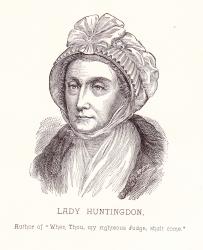
1707 - 1791 Person Name: Selina, Countess of Huntingdon Topics: Death and Eternity Judgment; Advent, Second Sunday; Twenty Sixth Sunday after Trinity; Twenty Seventh Sunday after Trinity Author of "When Thou, my righteous Judge, shalt come" in Church Book Born: August 24, 1707, Astwell House, Nottinghamshire, England.
Died: June 17, 1791, London, England.
Buried: St. Helen’s Church, Ashby-de-la-Zouch, Leicester, England.
Selena Huntingdon, née Shirley, Countess of, daughter of Washington, Earl Ferrers, was born Aug. 24, 1707; married to Theophilus Hastings, 9th Earl of Huntindon, June, 1728; and d. in London, June 17, 1701. At an early age she received serious religious impressions, which continued with her, and ruled her conduct through life. She was a member of the first Methodist Society, in Fetter Lane, London, and the first Methodist Conference was held at her house in June, 1744. Her sympathies, however, were with the Calvinism of G. Whitefield, and when the breach took place between Whitefield and Wesley she joined the former. Her money was freely expended in chapel building, in the founding of Trevecca College, South Wales (now Cheshunt), and in the support of her preachers. A short time before her death the Connection which is known by her name was founded; and at her death it numbered more than sixty chapels. For use in these chapels she compiled A Select Collection of Hymns. Her own part in hymn-writing is most uncertain. The hymns, "Come, Thou Fount of every blessing," and "O when my righteous Judge shall come", have been specially claimed for her, but upon insufficient testimony. No mention of these hymns as being by her is made in her Life and Times, 1839. Miller says, "although the Countess was not much known as a hymn-writer, yet it is proved beyond doubt that she was the author of a few hymns of great excellence" (Singers & Songs, 1869, p. 183): but he neither names the hymns, nor submits the evidence. It is most uncertain that she ever wrote a hymn; and it is quite clear that upon reliable evidence not one has yet been ascertained to be of her composing. Her history and that of her Connexion are elaborately set forth in The Life and Times of Selina, Countess of Huntingdon, London, Painter, 1839.
--Dictionary of Hymnology, John Julian, 1907.
Selina Hastings, Countess of Huntingdon
Sir Walter Scott
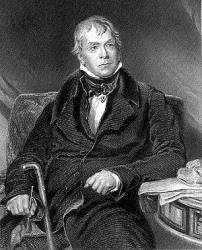
1771 - 1832 Topics: Death and Eternity Judgment; Advent, Second Sunday; Twenty Sixth Sunday after Trinity Author of "That Day of wrath, that dreadful Day" in Church Book Walter Scott was born in Edinburgh, August 15, 1771. In 1786, he commenced his apprenticeship as writer to the Signet. In 1796, he first appeared before the public in a translation of Burger's "William and Helen." Many poetical works followed, until in 1814, he began the series of "Waverly Novels." He died at Abbotsford, September 21, 1832. It is related that on his death-bed he distinctly repeated portions of the Latin original, upon which "That day of wrath, that dreadful day" is based.
--Annotations of the Hymnal, Charles Hutchins, M.A., 1872
======================
Scott, Sir Walter, Bart., was born in Edinburgh, Aug. 15, 1771, and died at Abbotsford, Sept. 21, 1832. Although so successful and widely known as a poet, he made no direct contributions to hymnody whatever. His condensed rendering of the “Dies Irae", and his hymn of Rebecca in Ivanhoe, "When Israel of the Lord beloved" (q.v.) were utilized as hymns for congregational use by others, but were never intended for such a purpose by himself. His work and rank as poet, novelist, and historian are fully set forth in his Life by J. G. Lockhart.
--John Julian, Dictionary of Hymnology (1907)
Sir Walter Scott
Johann Scheffler
1624 - 1677 Person Name: J. Scheffler Topics: Kristi Himmelfarts Dag Til Høimesse; Christ's Ascension High Mass; God's Call; Guds Kald; Jesu Efterfølgelse og Verdens Fornægtelse; Followers of Jesus and teh World's Forgiveness; Haab og Længsel efter det Himmelske; Hope and Longing for the Heavenly; Herliggjørelsen; Glorification; Første Paaskedag Til Aftensang; First Easter Day For Evening; Anden Pintesdag Til Aftensang; Second Pentecost Day For Evening; 1 Søndag efter Trefoldigheds Fest Til Hoimesse; First Sunday after Trinity Sunday High Mass; 15 Søndag efter Trefoldigheds Fest Til Hoimesse; Fifteenth Sunday after Trinity Sunday High Mass; 23 Søndag efter Trefoldigheds Fest Til Aftensang; Twenty-third Sunday after Trinity Sunday For Evening; 26 Søndag efter Trefoldigheds Fest Til Aftensang; Twenty-sixth Sunday after Trinity Sunday For Evening Author of "Bort, Verden, af mit Sind og Øie" in M. B. Landstads Kirkesalmebog og "Nokre Salmar" ved Professor Dr. E. Blix, samt følgende tillæg Used Angelus Silesius as a pen name. See also Angelus Silesius, 1624-1677
Johann Scheffler
Wilhelm A. F. Schulthes
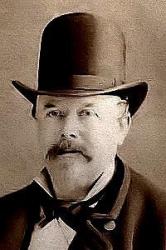
1816 - 1879 Topics: Christian Conduct and Services; Epiphany, Second Sunday; Epiphany, Fourth Sunday; Third Sunday after Easter; Trinity, First Sunday; Trinity, Eighteenth Sunday; Trinity, Twenty-second Sunday; God is Love; Prayer for Love Composer of "LAMBETH" in The Hymnal and Order of Service Wilhelm August Ferdinand Schulthes Germany 1816-1879. Born at Hesse Castle, Germany, son of a German army officer, he was raised Lutheran, but turned to Roman Catholicism around 1852. He directed the Brompton Oratory choir (1852-1872). He taught music at the Convent of the Sacred Heart, Roehampton (1868-1879). He also wrote poetry. No information found regarding family or other life events. He died at Bois-de-Colombes, France.
John Perry
Wilhelm A. F. Schulthes
Paul Gerhardt
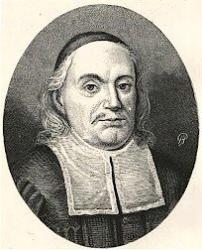
1607 - 1676 Topics: Første Søndag i Advent Til Høimesse; Første Søndag I Advent Til Høimesse -Til Tredje Teksxtækkes Evangelium; Tredje Søndag i Advent Til Høimesse; Third Sunday in Advent; Fjerde Søndag I Advent Til Høimesse -Til Sekund Tekstrækkes Evangelium; Fourth Sunday in Advent; Andre Søndag I Faste Til Høimesse -Til Sekund Tekstrækkes Evangelium; Second Sunday in Lent; Palmesøndag Til Aftengudstjeneste - Til Tredje Tekstrækkes Lektie; Palm Sunday; Almindelig Bededag Til Aftengudstjeneste - Til Sekund Tekstrækkes Lektie; Ordinary Prayer Day; Syttende Søndag efter Trefoldiheds Fest Til Høimesse -Til Sekund Tekstrækkes Evangelium; Seventeenth Sunday after Trinity Sunday; Tjuetredje Søndag efter Trefoldiheds Fest Til Aftengudstjeneste - Til Sekund Tekstrækkes Epistel; Twenty third Sunday after Trinity Sunday; Ansegtelse og Trøst; Occupation and Comfort; Evangeliets Indbydelse; Gospel Invitaion; Hengivelse til Jesus; Devotion to Jesus; Jesus, vor Forsoner; Jesus, Our Atonement; Jesus, vor Ven; Jesus, Our Friend; First Sunday in Advent Author of "Hvorledes skal jeg møde " in Salmebog for Lutherske Kristne i Amerika Paul Gerhardt (b. Gräfenheinichen, Saxony, Germany, 1607; d. Lubben, Germany, 1676), famous author of Lutheran evangelical hymns, studied theology and hymnody at the University of Wittenberg and then was a tutor in Berlin, where he became friends with Johann Crüger. He served the Lutheran parish of Mittenwalde near Berlin (1651-1657) and the great St. Nicholas' Church in Berlin (1657-1666). Friederich William, the Calvinist elector, had issued an edict that forbade the various Protestant groups to fight each other. Although Gerhardt did not want strife between the churches, he refused to comply with the edict because he thought it opposed the Lutheran "Formula of Concord," which condemned some Calvinist doctrines. Consequently, he was released from his position in Berlin in 1666. With the support of friends he became archdeacon at Lubben in 1669 and remained there until his death. Gerhardt experienced much suffering in his life; he and his parishioners lived in the era of the Thirty Years' War, and his family experienced incredible tragedy: four of his five children died young, and his wife died after a prolonged illness. In the history of hymnody Gerhardt is considered a transitional figure-he wrote at a time when hymns were changing from a more objective, confessional, and corporate focus to a pietistic, devotional, and personal one. Like other German hymns, Gerhardt's were lengthy and intended for use throughout a service, a group of stanzas at a time. More than 130 of his hymns were published in various editions of Cruger's Praxis Pietatis Melica, the Crüger-Runge Gesangbuch (1653), and Ebeling's Das andere Dutzeud geistliche Andachtslieder Herrn Paul Gerhardts (1666-1667). John Wesley and Catherine Winkworth both made famous English translations of Gerhardt's texts.
Bert Polman
======================
Gerhardt, Paulus, son of Christian Gerhardt, burgomaster of Gräfenhaynichen, near Wittenberg, was born at Grafenhaynichen, Mar. 12, 1607. On January 2, 1628, he matriculated at the University of Wittenberg. In the registers of St. Mary's church, Wittenberg, his name appears as a godfather, on July 13, 1641, described still as "studiosus," and he seems to have remained in Wittenberg till at least the end of April, 1642. He appears to have gone to Berlin in 1642 or 1643, and was there for some time (certainly after 1648) a tutor in the house of the advocate Andreas Barthold, whose daughter (Anna Maria, b. May 19, 1622, d. March 5, 1668) became his wife in 1655. During this period he seems to have frequently preached in Berlin. He was appointed in 1651, at the recommendation of the Berlin clergy, Lutheran Probst (chief pastor) at Mittenwalde, near Berlin, and ordained to this post Nov. 18, 1651. In July, 1657, he returned to Berlin as third diaconus of St. Nicholas's church; but becoming involved in the contest between the Elector Friedrich Wilhelm (who was of the Reformed Church) and the Lutheran clergy of Berlin, he was deposed from his office in February, 1666, though he still remained in Berlin. In Nov. 1668, he accepted the post of archidiaconus at Lübben, on the Spree, was installed in June, 1669, and remained there till his death on June 7, 1676 (Koch, iii. 297-326; Allgemeine Deutsche Biographie, viii. 774-783, &c).
The outward circumstances of Gerhardt's life were for the most part gloomy. His earlier years were spent amid the horrors of the Thirty Years' War. He did not obtain a settled position in life till he was 44 years of age. He was unable to marry till four years later; and his wife, after a long illness, died during the time that he was without office in Berlin; while of the five children of the marriage only one passed the period of childhood. The sunniest period of his life was during the early years of his Berlin ministry (i.e. 1657-1663), when he enjoyed universal love and esteem; while his latter years at Lübben as a widower with one surviving child were passed among a rough and unsympathising people. The motto on his portrait at Lübben not unjustly styles him "Theologus in cribro Satanae versatus."
Gerhardt ranks, next to Luther, as the most gifted and popular hymnwriter of the Lutheran Church. Gervinus (ed. 1842, pt. iii. p. 366), the well-known historian of German literature, thus characterises him:—
"He went back to Luther's most genuine type of hymn in such manner as no one else had done, only so far modified as the requirements of his time demanded. In Luther's time the belief in Free Grace and the work of the Atonement, in Redemption and the bursting of the gates of Hell was the inspiration of his joyful confidence; with Gerhardt it is the belief in the Love of God. With Luther the old wrathful God of the Romanists assumed the heavenly aspect of grace and mercy; with Gerhardt the merciful Righteous One is a gentle loving Man. Like the old poets of the people he is sincerely and unconstrainedly pious, naive, and hearty; the bliss fulness of his faith makes him benign and amiable; in his way of writing he is as attractive, simple, and pleasing as in his way of thinking."
With a firm grasp of the objective realities of the Christian Faith, and a loyal adherence to the doctrinal standpoint of the Lutheran Church, Gerhardt is yet genuinely human; he takes a fresh, healthful view both of nature and of mankind. In his hymns we see the transition to the modern subjective tone of religious poetry. Sixteen of his hymns begin with, “I." Yet with Gerhardt it is not so much the individual soul that lays bare its sometimes morbid moods, as it is the representative member of the Church speaking out the thoughts and feelings he shares with his fellow members; while in style Gerhardt is simple and graceful, with a considerable variety of verse form at his command, and often of bell-like purity in tone.
From the first publication of Gerhardt's hymns they at once came into favour among all ranks and creeds; and a large proportion are among the hymns most cherished and most widely used by German-speaking Christians at the present day. They appeared principally in the various editions of Crüger's Praxis, and the Crüger-Runge Gesang-Buch, 1653. The first collected edition was prepared by J. G. Ebeling, and published in separate "Dozens" 1-4 in 1666, 5-10 in 1667, i.e. 120 in all. In the edition of J. H. Feustking, Zerbst, 1707, a few stanzas were intercalated (from manuscripts in the possession of Gerhardt's surviving son), but no new hymns were added.
Among modern editions of Gerhardt's hymns (mostly following the text of Ebeling) may be mentioned those by Langbecker, 1842; Schultz, 1842; Wackernagel, 1843; Becker, 1851; Goedeke, 1877, and Gerok, 1878. The Historico-Critical edition of Dr. J. F. Bachmann, 1866, is the most complete (with 11 additional pieces hardly Church hymns), and reverts to the pre-Ebeling text.
The length of many of Gerhardt's hymns ("Ein Lämmlein" is 10 stanzas of 10 lines; "Fröhlich soil," 15 stanzas of 8 lines, &c), and the somewhat intricate metres of others, have caused his hymns to be less used in English than otherwise might have been the case; but a considerable proportion have come in some form or other into English hymnbooks. A large selection, translated with scrupulous faithfulness but not retaining much of the lyric grace of the originals, was published by the Rev. John Kelly, in 1867, as Paul Gerhardt’s Spiritual Songs; while many individual hymns have been translated by John Wesley, Miss Winkworth, Miss Cox, Miss Borthwick, and many others. His translations from St. Bernard are noted under "O Haupt voll Blut." There are separate notes on 19 of his greater hymns. Besides these the following have passed into English:—
I. Hymns in English common use:
i. Auf den Nebel folgt die Sonn. Thanksgiving after great sorrow and affliction. In Crüger's Praxis, 1656, No. 249, in 15 stanzas of 7 1.; thence in Wackernagel’s ed. of his Geistliche Lieder, No. 87, and Bachmann's ed., No. 64. In the Unverfälschter Liedersegen, 1851, No. 402. Translated as:—
Cometh sunshine after rain. A good translation, omitting stanzas iv.-vii., x., xi., by Miss Winkworth, in her Lyra Germanica, 1st Ser., 1855, p. 100 (translations of x., xi. added to 2nd ed., 1856). Repeated, omitting the translations of stanzas ii., x.-xii., as No. 4 in her Chorale Book for England, 1863. In the Christian Hymn Book, Cincinnati, 1865, No. 799, begins with st. xiii., "Now as long as here I roam."
Another translation is:—"After clouds we see the sun," by J. Kelly, 1867, p. 261.
ii. Die Zeit ist nunmehr nah. Day of Judgment—Second Advent. Founded on Acts iii. 20. In the Crüger-Runge Gesang-Buch 1653, No. 367, iii 18 stanzas of 6 lines, and thence in Wackernagel's edition of his Geistliche Lieder, 1843, No. 119 (1874, No. 124), and Bachmann's edition, No. 40. In the Berlin Geistliche Lieder S., ed. 1863, No. 1517. Translated as:—
O Christ! how good and fair. Being a translation of stanzas iii., iv., vi., vii., x.-xiii., xvii., by Mrs. Charles, in her Voice of Christian Life in Song, 1858, p. 242. Her translations of stanzas iii., x., xii., are No. 150 in G. S. Jellicoe's Collection, 1867.
Other trs. are:—(1) "May I when time is o'er," of stanzas vii., viii. as part of No. 831 in the Moravian Hymn Book, 1789; in the 1801 and later eds. (1886, No. 1229), beginning, "I shall, when time is o'er." (2) “The time is very near," by J. Kelly, 1867, p. 341.
iii. Gottlob, nun ist erschollen. Peace. Thanksgiving for the Proclamation of the Peace of Westphalia, in 1648, after the Thirty Years’ War. In Crüger's Praxis 1656, No. 409, in 6 stanzas of 12 lines, and thence in Wackernagel's edition of his Geistliche Lieder, No. 64, and Bachmann's ed., No. 84; and in the Unverfälschter Liedersegen, 1851, No. 589. Translated as: —
Thank God it hath resounded. A full and good tr. by Miss Winkworth, in her Lyra Germanica, 2nd Ser., 1858, p. 156, repeated, omitting stanza ii., in her Chorale Book for England, 1863. St. i., v., vi., form No. 49 in M. W. Stryker's Christian Chorals, 1885.
Another tr. is: ”Praise God! for forth hath sounded," by J. Kelly, 1867, p. 251.
iv. Ich, der ich oft in tiefes Leid. Ps. cxlv. First published in J. G. Ebeling's edition of his Geistliche Andachten Dritte Dutzet, 1666, No. 27, in 18 stanzas of 7 lines. Thence in Wackernagel's ed., No. 95, and Bachmann's ed., No. 103; also in the Berlin Geistliche LiederSchatz, ed. 1863, No. 1004. Translated as:—
I who so oft in deep distress . A good translation, omitting stanzas ii.-iv., by Miss Winkworth, in her Lyra Germanica, 2nd Ser., 1858, p. 149. Her translations of stanzas i., xiii.-xvi., xviii., were included as No. 224, and of stanzas vi., viii., ix., xi. altered, and beginning, "O God! how many thankful songs," as No. 168, in Holy Song, 1869.
Another tr. is:—-"Who is so full of tenderness," of stanza viii. as stanza iv. of No. 1075 in the Supplement of 1808 to the Moravian Hymn Book, 1801 (1886, No. 537).
v. Ich steh an deiner Krippen bier. Christmas. Included in Crüger's Praxis, 1656, No. 105, in 15 stanzas of 7 lines. Thence in Wackernagel's ed., No. 9, and Bachmann's ed., No. 45; and in the Berlin Geistliche LiederSchatz, ed. 1863, No. 167. A beautiful hymn, in which the poet puts himself in the place of the shepherds and the wise men visiting Bethlehem; and in praise and adoration tenders his devotion, his love and his all, to the Infant Saviour in the manger. Translated as:—
My faith Thy lowly bed beholds. A translation of stanzas i., iv., vii., xv., by A. T. Russell, as No. 57 in his Psalms & Hymns, 1851.
Other trs. are:— (1) "I stand beside Thy manger-bed," by Miss Manington, 1864, p. 38. (2) "Now at the manger here I stand," by J. Kelly, 1867, p. 32.
vi. Ich weiss dass mein Erlöser lebt. Easter. Founded on Job xix. 25-27. First published in J. G. Ebeling's ed. of his Geistliche Andachten Zehende Dutzet, 1667, No. 119, in 9 stanzas of 7 lines; repeated in Wackernagel's ed., 1843, No. 118 (1874, No. 123); in Bachmann's ed., No. 119; and in the Berlin Geistliche Lieder S. ed. 1863, No. 301. Translated as:—
I know that my Redeemer lives, In this my faith is fast. A full and spirited translation by J. Oxenford, in Lays of the Sanctuary, 1859, p. 122. His translations of stanzas i., iii., vii.-ix., were included, altered, as No. 779 in Kennedy, 1863.
Another tr. is:— "I know that my Redeemer lives, This hope," &c, by Miss Manington, 1863, p. 78.
vii. Ich weiss, mein Gott, dass all mein Thun. Supplication. A prayer for success in all Christian works and purpose; founded on Jeremiah x. 23, and Acts v. 38, 39. Included in Crüger's Praxis, 1656, No. 332, in 18 stanzas of 5 lines. In Wackernagel's ed., No. 40; Bachmann's ed., No. 71, and the Berlin Geistliche Lieder S., ed. 1863. Translated as:—
I know, my God, and I rejoice. A good translation of stanzas i.-iii., viii., xi., ix., by Miss Winkworth, as No. 121 in her Chorale Book for England, 1863.
Another translation is:— "My God! my works and all I do” by J. Kelly, 1867, p. 102.
viii. Kommt, und lasst uns Christum ehren. Christmas. Founded on St. Luke ii. 15. First published in J. G. Ebeling's ed. of his Geistliche Andachten Fünffte Dutzet, 1667, No. 56, in 8 stanzas of 4 lines. Thence in Wackemagel's ed., No. 6; Bachmann's ed., No. 110; and the Unverfälschter Liedersegen, 1851, No. 43. Translated as:—
1. Come, unite in praise and singing. Omitting stanzas vi., vii., contributed by A. T. Russell to Maurice's Choral Hymnbook, 1861, No. 707.
2. Bring to Christ your best oblation. A full and good translation by P. Massie in his Lyra Domestica, 1864, p. 96; repeated in Snepp's Songs of Grace & Glory and Reid's Praise Book, 1872.
Other translations are:— (1) "Come, and let us Christ revere now," by Miss Manington, 1864, p. 25. (2) "Come, and Christ the Lord be praising," by J. Kelly, 1867, p. 24.
ix. Lobet den Herren, alle die ihn fürchten. Morning. Included in the Crüger-Runge Gesang-Buch 1653, No. 7, in 10 stanzas of 5 lines. In Wackernagel's ed., No. 100, and Bachmann's ed., No. 21, and in the Berlin Geistliche Lieder S. edition 1863, No. 1063. Translated as:—
Praise God! revere Him! all ye men that fear Him! This is from the version in Bunsen's Allgemeine Gesangbücher, 1846, No. 167, stanza i. being from Gerhardt, and st. ii., iii., from "Lobet den Herren, denn er ist sehr freundlich" (q. v.); and appeared in the Dalston Hospital Hymnbook, 1848, No. 55, signed "A. G."
Other translations are:— (1) "Our Lord be praising, All His glory raising," by H. J. Buckoll, 1842, p. 27. (2) "Praise ye Jehovah, all ye men who fear Him," by J. Kelly, 1867, p. 279.
x. Micht so traurig, nicht so sehr. Christian Contentment. In the 3rd edition, 1648, of Crüger's Praxis, No. 251, in 15 stanzas of 6 1., repeated in Wackernagel's ed., No. 53; Bachmann's ed., No. 16, and the Berlin Geistliche Lieder S., ed. 1863, No. 851. It is founded on Ps. cxvi. 7; Ps. xlii. 6-12; 1 Tim. vi. 6. Translated as:—
Ah! grieve not so, nor so lament. A free translation by Mrs. Findlater, of stanzas i., ii., vii.-x., xiii., xv., in the 1st Ser., 1854, of the Hymns from the Land of Luther, p. 48 (1884, p. 50). Repeated, abridged, in Holy Song, 1869, and Dale's English Hymnbook, 1875.
Other translations are:- (l) "Why this sad and mournful guise," by Miss Dunn, 1857, p. 85. (2) "Not so darkly, not so deep," by Miss Warner, 1858 (1861, p. 58). (3) “0 my soul, why dost thou grieve," by J. Kelly, 1867.
xi. Nun lasst uns gehn und treten. New Year. Included in the Crüger-Runge Gesang-Buch, 1653, No. 106, in 15 st. of 4 1. Thence in Wackernagel's ed., No. 12; Bachmann's ed., No. 24, and the Berlin Geistliche Lieder S., ed. 1863, No. 200. Evidently written during the Thirty Years' War. Translated as:—
In pray'r your voices raise ye. In full, by J. Kelly, 1867, p. 45. From this, 8 st. are included as No. 48 in the Ohio Lutheran Hymnal, 1880.
Other translations are:— (1) "Now let each humble Creature," in the Supplement to German Psalter, ed. 1765, p. 4, and Select Hymns from German Psalter, Tranquebar, 1754. p. 7. In the Moravian Hymnbook, 1789, No. 507 (1849, No. 1106), greatly altered, and beginning, “Year after year commenceth." (2) "0 come with prayer and singing," by R. Massie in the British Herald , Jan., 1865, p. 8. (3) “Christians all, with one accord," by E. Massie, 1867, p. 168. (4) "With notes of joy and songs of praise," by Dr. R. Maguire, 1883, p. 24.
xii. Schaut! Schaut! was ist für Wunder dar? Christmas. First published in J. G. Ebeling's ed. of his Geistliche Andachten Fünffte Dutzet, 1667, No. 55, in 18 stanzas of 4 1. Thence in Wackernagel’s ed., No. 4; Bachmann's ed., No. 109. Translated as:—
Behold! Behold! what wonders here. In full, by J. Kelly, 1867, p. 14. From this, 12 st. were included in the Ohio Lutheran Hymnal, 1880, as Nos. 25, 26: No. 26 beginning with the translation of st. xiii., "It is a time of joy today."
xiii. Warum willt du draussen stehen. Advent. Suggested by Gen. xxiv. 31. Appeared in the Crüger-Runge Gesang-Buch, 1653, No. 78, in 9 stanzas of 8 lines; viz., stanzas i.—vii., xi., xii., of the full form; st. viii.-x. being added in Ebeling's Geistliche Andachten Fünffte Dutzet, 1667, No. 50. The full text, in 12 stanzas, is also in Wackernagel's ed., No. 2; Bachmann's ed., No. 23, and Geistliche Lieder S., 1851, No. 20. Translated as:—
Wherefore dost Thou longer tarry. A good translation, omitting st. viii.-x., by Miss Winkworth, in her Lyrica Germanica, 2nd Ser., 1858, p. 6. In her Chorale Book for England, 1863, No. 153, the translations of st. iii., v., xi., are omitted.
Other trs. are:- (l) “Wherefore dost Thou, blest of God," by R. Massie, in Lyra Domestica, 1864, p. 90. (2) “Why, without, then, art Thou staying," by J. Kelly, 1867, p. 5.
xiv. Was alle Weisheit in der Welt. Trinity Sunday. In Crüger's Praxis, 1656, No. 212, in 8 stanzas of 9 lines. Thence in Wackernagel's ed., No. 1, and Bachmann's ed., No, 59, and the Berlin Geistliche Lieder S., ed. 1863, No. 50. Translated as:—
Scarce tongue can speak, ne'er human ken. In full, by J. Kelly, 1867, p. 1, repeated as No. 111 in the Ohio Lutheran Hymnal, 1880.
Another translation is:—"The mystery hidden from the eyes," by R. Massie, in Lyra Domestica, 1864, p. 87.
xv. Was Gott gefällt, mein frommes Kind. Resignation. This beautiful hymn, on resignation to “what pleases God," first appeared in the Crüger-Runge Gesang-Buch, 1653, No. 290, in 20 stanzas of 5 lines. Thence in Wackernagel's ed., No. 60; Bachmann's ed., No. 37, and the Unverfälschter Liedersegen, 1851, No. 723. Translated as:—-
What God decrees, child of His love. A good translation of stanzas i., ii., v., vi., viii., xii., xv., xviii., xx., by Mrs. Findlater, in the 3rd Ser., 1858, of the Hymns from the Land of Luther, p. 49 (1884, p. 170). Included, in full, in Bishop Ryle's Collection, 1860, No. 171; and abridged in Christian Hymns, Adelaide, 1872, and beginning, "What God decrees, take patiently," in Kennedy, 1863, No. 1344.
Other translations are:— (1) "What pleaseth God with joy receive," by Miss Dunn, 1857, p. 94. (2) “What pleases God, 0 pious soul," by Miss Winkworth, 1858, p. 193, (3) ”What pleaseth God, my faithful child," by J. Kelly, 1867, p. 189.
xvi. Wie schőn ists doch, Herr Jesu Christ. For Married Persons. Founded on Ps. cxxviii. First published in Ebeling's ed. of his Geistliche Andachten Vierte Dutzet, 1666, No. 38, in 8 st. of 12 1. Thence in Wackernagel's ed., 1843, No. 108 (1874, No. 109); Bachmann's ed., No. 105, and the Unverfälschter Liedersegen S., 1851, No. 680. Translated as:—
Oh, Jesus Christ! how bright and fair. In full, by J. Kelly, 1867, p. 307, repeated, altered, and omitting st. iii.—v., in the Ohio Lutheran Hymnal, 1880, No. 339.
II. Hymns not in English common use:
xvii. Also hat Gott die Welt geliebt. Good Friday. On St. John iii. 16. In Crüger's Praxis, 1661, No. 372, in 17 stanzas. Translated as, "Be of good cheer in all your wants,” by P. H. Molther, of stanza 16, as No. 181 in the Moravian Hymnbook, 1789 (1886, No. 217).
xviii. Auf, auf, mein Herz mit Freuden. Easter. In Crüger's Praxis, 1648, No. 141, in 9 stanzas. The translations are:-- (1) "Up! Up! my heart with gladness, See," by J. Kelly, 1867, p. 71. (2) "Up, up, my heart, with gladness; Receive," by N. L. Frothingham, 1870, p. 228.
xix. Du bist zwar mein und bleibest mein. For the Bereaved. A beautiful hymn of consolation for parents on the loss of a son. Written on the death of Constantin Andreas, younger son of Johannes Berkov, pastor of St. Mary's Church, Berlin, and first printed as one of the "Dulcia amicorum solatia" at the end of the funeral sermon by Georg Lilius, Berlin, 1650. Included in Ebeline's ed. of Gerhardt's Geistliche Andachten Sechste Dutzet, Berlin, 1667, No. 72, in 12 stanzas. The translations are: (1) "Thou'rt mine, yes, still thou art mine own”, by Miss Winkworth, 1858, p. 123. (2) "Yes, thou art mine, still mine, my son," by J. D. Burns, in the Family Treasury, 1861, p. 8, and his Remains, 1869, p. 249. (3) "Mine art thou still, and mine shalt be," by J. Kelly, 1867, p. 333. (4) "Thou art mine own, art still mine own," by Dr. J. Guthrie, 1869, p. 100.
xx. Du, meine Seele, singe. Ps. cxlvi. In the Crüger-Runge Gesang-Buch, Berlin, 1653, No. 183, in 10 stanzas. Translated as, “O come, my soul, with singing," by Miss Burlingham, in the British Herald, Jannary, 1866, p. 207, and as No. 423 in Reid's Praise Book, 1872.
xxi. Gieb dich zufrieden, und sei stille. Cross and Consolation—-Ps. xxxvii. 7. In Ebeling Erstes Dutzet, 1666, No. 11, in 15 stanzas. Translated as: (1) “Be thou content: be still before," by Miss Winkworth, 1855, p. 156, and in Bishop Ryle's Collection, 1860, No. 269. (2) “Be thou contented! aye relying," by J. Kelly, 1867, p. 202. (3) “Tranquilly lead thee, peace possessing," by N. L. Frothingham, 1870, p. 246.
xxii. Hőr an! mein Herz, die sieben Wort. Passiontide. On the Seven Words from the Cross. Founded on the hymn noted under Bőschenstein, J. (q.v.). In Crüger's Praxis, 1656, No. 137, in 15 stanzas. Translated as: (1) “Come now, my soul, thy thoughts engage," by Dr. H. Mills, 1845 (1856, p. 309). (2) "Seven times the Saviour spake my heart," by R. Massie, in the British Herald, Sept., 1865, p. 133. (3) "My heart! the seven words hear now," by J. Kelly, 1867, p. 63.
xxiii. Ich hab in Gottes Herz und Sinn. Resignation. In Crüger's Praxis, 1648, No. 249, in 12 st. Translated as: (1) "I into God's own heart and mind," by J. Kelly, 1867, p. 219. (2) "To God's all-gracious heart and mind”, by Miss Winkworth, 1869, p. 213, repeated in Statham's Collection, Edinburgh, 1869 and 1870.
xxiv. 0 Jesu Christ! dein Kripplein ist. Christmas. At the Manger of Bethlehem. In Crüger's Praxis, 1656, No. 101, in 15 stanzas. Translated as: (1) Be not dismay'd—-in time of need" (st. xi.) in the Moravian Hymnbook, 1789, No. 236. (2) "O blessed Jesus! This," by Miss Winkworth, 1858, p, 18. (3) "O Jesus Christ! Thy cradle is," by Miss Manington, 1864, p. 41. (4) "Thy manger is my paradise," by J. Kelly, 1867, p. 26.
xxv. Voller Wunder, voller Kunst. Holy Matrimony. In Ebeling Vierte Dutzet, 1666, No. 40, in 17 st. Often used in Germany at marriages on the way to church. Translated as: (1) "Full of wonder, full of skill," by Dr. H. Mills, 1845 (1856, p. 215). (2) "Full of wonder, full of skill," in Mrs. Stanley Carr's translation of Wildenhahn's Paul Gerhardt, ed. 1856, p. 52. (3) "Full of wonder, full of art," by J. Kelly, 1867, p. 302. (4) "Full of wonder, full of art," by Miss Winkworth, 1869, p. 215.
xxvi. Warum machet solche Schmerzen. New Year. On St. Luke ii. 21. In Crüger's Praxis, 1648, No. 97, in 4 stanzas. Bunsen, in his Versuch, 1833, No. 120, gives st. iii., iv. altered to "Freut euch, Sünder, allerwegen." Tr. as: (1) "Mortals, who have God offended," by Miss Cox, 1841, p. 21, from Bunsen. (2) "Why should they such pain e'er give Thee," by J. Kelly, 1867, p. 43.
xxvii. Weg, mein Herz, mit den Gedanken. Lent. On St. Luke xv. In Crüger's Praxis, 1648, No. 36, in 12 stanzas. Translated as: (1) "Let not such a thought e'er pain thee," by J. Kelly, 1867, p. 83. (2) "Hence, my heart, with such a thought," by Miss Winkworth, 1869, p. 210.
Besides the above, a considerable number of other hymns by Gerhardt have been translated by Mr. Kelly, and a few by Dr. Mills, Miss Manington, and others. The limits of our space forbid detailed notes on these versions. [Rev. James Mearns, M.A.]
-- John Julian, Dictionary of Hymnology (1907)
=============================
Gerhardt, Paulus, pp. 409, ii., 1565, i. The most recent edition of Gerhardt's hymns is in vol. iii. of the Fischer-Tümpel Deutsche evangelische Kirchenlied des Siebzehnten Jahr-hunderts, 1906, Nos. 389-495. In fixing the text the compilers have been enabled to use the recently discovered 1647, 1653 and 1657 Berlin editions of Cruger's Praxis Pietatis Melica. [Rev. James Mearns, M.A.]
--John Julian, Dictionary of Hymnology, New Supplement (1907)
Paul Gerhardt
William J. Irons
1812 - 1883 Person Name: William Joseph Irons Topics: Death and Eternity Judgment; Advent, Second Sunday; Twenty Sixth Sunday after Trinity; Twentieth Sunday after Trinity Translator of "Day of wrath, that Day of mourning!" in Church Book Irons, William Josiah, D.D., son of Joseph Irons, was born at Hoddesdon, Herts, Sep. 12, 1812, and educated at Queen's College, Oxford (B.A. 1833, D.D. 1854), and took Holy Orders 1835. In 1837 he became Incumbent of St. Peter's, Walworth, and was subsequently Vicar of Barkway, Incumbent of Brompton, Rector of Wadingham; and in 1872, Rector of St. Mary-Woolnoth, formerly held by his father's friend, John Newton. He was also Bampton Lecturer in 1870, and Prebendary of St. Paul's Cathedral. He died June 18, 1883. Dr. Irons took a somewhat prominent part in the ecclesiastical controversies of his day, and published extensively thereon in the form of Sermons, Letters, Pamphlets, &c. His important work, the Bampton Lectures, 1870, was on Christianity as taught by St. Paul. His hymnwriting and translating began during his Curacy at St. Mary, Newington, 1835-1837, and was continued to his death. Many were first printed as broadsheets, and subsequently included in the Rev. R. T. Lowe's (Rector of Lea, Lincolnshire) Hymns for the Christian Seasons, Gainsburgh, 1st ed., 1854, and in his own collections. Of these separate publications the most important were his translation of the Dies Irae, and Quicumque vult, and a few special Hymns (Hayes) in 1867. His hymnological works, in addition to these, were:—
(1) Metrical Psalter, 1857; (2) Appendix to the Brompton Metrical Psalter, 1861 (22 hymns); (3) Hymns for Use in Church, 1866 (100 hymns). These contained hymns by Dr. Irons, and others. The next contains his Translations and Original Hymns only. (4) Psalms and Hymns for the Church, 1st ed., 1873 (126 h.); 2nd ed., 1875 (190 h.); 3rd ed., 1883 (308 h.). The principal object of this last work was to supply special hymns on the Collects, Epistles, and Gospels, and for Advent and Lent, together with special hymns for the Festivals; and this to a great extent Dr. Irons was enabled to accomplish. His versions of individual Psalms are directly from the Hebrew, line for line.
In addition to those of Dr. Irons's hymns and translations, which are annotated under their respective first lines, the following are in common use outside of his own collections, the details appended being from his MS. notes:—
1. Blest voice of love, 0 Word divine. Confirmation. Written for a Confirmation at Brompton, and published in Lowe's Hymns for the Christian Seasons, 1854, No. 184; in the Appendix to the Brompton Metrical Psalter, 1861; and the author's later collections.
2. Can earthly voices fitly sing. Public Opening of a School. Written at Brompton on the occasion of the opening of a School, and published in the 1861Appendix as above, and in the author's later collections.
3. Children of earth, for heaven we seek. Epiphany. A meditation on the Collect for the first Sunday after the Epiphany, and published in his Psalms & Hymns, 1875.
4. Eternal Spirit, God of Grace. Whitsuntide. Written in 1865, and published in his Hymns for Use in Church, 1866, and in a revised form in his Psalms & Hymns, 1873.
5. Faithful Creator, Lord Divine. Consecration to God. Published in his Psalms & Hymns, &c, 1873.
6. Father of love, our Guide and Friend. Confirmation. Written for a large Confirmation at Brompton, in 1844, and published in Lowe's Hymns for the Christian Seasons, 1854, No. 185, and in the 1861 Appendix as above, and the author's later collections.
7. Hail, holy rest, calm herald of that day. Sunday. Published in his Psalms & Hymns, &c, 1873.
8. Is not this our King and Prophet? Palm Sunday. Published in his Psalms & Hymns, &c, 1873.
9. It is not finished, Lord of grace. Preparation for Heaven. Written in 1850. It is No. 45 of his Hymns, 1866, in 6 stanzas of 5 lines.
10. Jesu, Who for us didst bear. Words from the Cross. In his Hymns, 1866, No. 42.
11. Joy of joys, He lives, He lives. Easter. Written in 1873. In the New Mitre, 1875; and the author's Hymns, 1875.
12. Lord, hear my prayer, bow down Thine ear. Lent. Published in Psalms & Hymns, 1873.
13. Lord, in Thy wrath Thou thinkest yet. Lent. In his Hymns, 1866, No. 91.
14. Lord, Thy voice hath spoken. The Beatitudes. In Hymns for use in the Church of Saint Ethelburga, Bishopsgate, 1873, and Dr. Irons's Psalms & Hymns, 1875.
15. No sorrow and no sighing. Heaven. Published in his Psalms & Hymns, 1873, in 5 stanzas of 4 lines. In Thring's Collection 1882, stanzas i.-iii. were given from the 1875 text, and a new stanza was added by Dr. Irons at Prebendary Thring's request.
16. 0 God with us, the Saviour. For use during a Retreat. Given in Psalms & Hymns, 1873.
17. 0 how long, how long. Ps. xiii. Appeared in his Psalms & Hymns, &c, 1873.
18. 0 Saviour, now at God's right hand. Jesus the High Priest. Published in the 1861 Appendix as above, and revised in the author's latter collections. In the Psalms & Hymns, 1873., stanzas i., ii., v. are from 1861, iv. from 1866; and iii. is new.
19. 0 who are they so pure and bright? Holy Innocents . Written on the death of Infants in the Epidemic of 1837, and published in Lowe's Hymns for the Christian Seasons, 1854, No. 20, and in the 1861 Appendix as above, in 3 stanzas of 8 lines. In the 1866 Hymns it was divided into 6 stanzas of 4 lines, and this arrangement was repeated in the 1873 Psalms & Hymns.
20. Sing with all the sons of men. Easter. Given in his Psalms & Hymns, 1873.
21. Thanks be to God for meet and right. Processional. Published in his Hymns, &c, 1866, and again in his Psalms & Hymns, 1873.
22. To whom but Thee, 0 God of Grace. Passiontide. Appeared in his Hymns, &c, 1866; and in his Psalms & Hymns, 1873.
23. Triumphant Lord, Thy work is done. Ascension. Published in the 1861 Appendix as above, in 3 st. of 4 1. In the 1866 Hymns the st. (iii.) “0 by Thy spotless, wondrous birth " was added; and in this enlarged form the hymn was repeated in the Psalms & Hymns, 1873.
24. We praise Thee, 0 our God--to Thee. Children's Hymn of Praise to the Holy Trinity. Written for the Schools at St. Mary's Newington, and published in the 1861 Appendix as above, and repeated in the Hymns, &c, 1866, and the Psalms & Hymns, 1873.
25. Who is this from Bethlehem coming? Purification of Blessed Virgin Mary. Appeared in the Psalms & Hymns, 1873.
26. Why art thou weary, 0 my soul? Ps. lxi. Given in his Hymns, &c, 1866, and his Psalms & Hymns, 1873, in 6 stanzas of 7 lines. In Thring's Collection, 1882, stanza iii. is omitted.
Amongst modern hymnwriters, Dr. Irons ranks with the first. His hymns have not been largely used outside of his own congregation; but their high excellence, variety of subjects and metres, intense earnestness, powerful grasp of the subject, and almost faultless rhythm must commend them to the notice of hymnbook compilers. Prebendary Thring has enriched his Collection (1882) with most of those named above. They are of more than usual excellence, and others remain of equal merit.
-- John Julian, Dictionary of Hymnology (1907)
======================
Irons, W. J., p. 571, ii. Of the hymns noted under his name, Nos. 13, 21, and 26, appeared in Chope's Hymnal, 1862.
--John Julian, Dictionary of Hymnology, Appendix, Part II (1907)
William J. Irons
Hans Chr. Sthen
1544 - 1610 Person Name: Hans Sthen Topics: Fjerde Søndag efter Trefoldigheds Fest Til Aftengudstjeneste; Fourth Sunday after Trinity Sunday; Second Sunday in Advent; Sjette Søndag efter Hellig 3 Kongers Dag Til Aftengudstjeneste; Sixth Sunday after Epiphany; Marias Bebudelses Dag Til Aftengudstjeneste - Til Tredje Tekstrækkes Lektie; Annunciation; Ascension of Christ; Fjerde Søndag efter Trefoldiheds Fest Til Aftengudstjeneste; Fourth Sunday after Trinity Sunday; Tolvte Søndag efter Trefoldiheds Fest Til Aftengudstjeneste - Til Tredje Tekstrækkes Epistel; Twelfth Sunday after Trinity Sunday; Nittende Søndag efter Trefoldiheds Fest Til Aftengudstjeneste - Til Tredje Tekstrækkes Epistel; Nineteenth Sunday after Trinity Sunday; Tjuesjete Søndag efter Trefoldiheds Fest Til Høimesse -Til Tredje Teksxtækkes Evangelium; Twenty sixth Sunday after Trinity Sunday; Aarvaagenhed; Alertness; Himmellængsel; Longing for Heaven; Pilgrimsvandring, de Kristnes; The Christian Pilgrimage; Anden Søndag I Advent Til Høimesse -Til Anden Tekstrækkes Evangelium; Kristi Himmelfarts Dag Til Høimesse -Til Anden Tekstrækkes Evangelium Translator (attributed to) of "Min største Hjertens Glæde" in Salmebog for Lutherske Kristne i Amerika
Hans Chr. Sthen
Gioacchino A. Rossini
1792 - 1868 Person Name: Gioachimo Rossini, 1792-1808 Topics: The Catechism Faith; Third Sunday after Epiphany; Second Sunday in Lent; Twenty First Sunday after Trinity Composer of "MANOAH" in Evangelical Lutheran hymnal Gioacchino A. Rossini; b. 1792, Pesaro; d. 1868, Ruelle near Parise
Evangelical Lutheran Hymnal, 1908
Gioacchino A. Rossini
Electress Luise Henriette
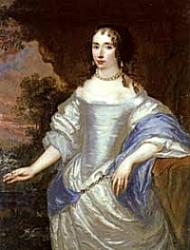
1627 - 1667 Person Name: Louisa Henrietta of Brandenburg Topics: Easter; Lent, Third Sunday; Easter Sunday; Easter Season, Second Sunday; Easter Season, Fourth Sunday; Sixteenth Sunday after Trinity; Twenty Fourth Sunday after Trinity Author of "Jesus Christ, my sure defence" in Church Book Luise Henriette, Electress of Brandenburg, daughter of Friedrich Heinrich, Prince of Nassau-Orange and Stadtholder of the United Netherlands, was born at 'S Gravenhage (The Hague), Nov. 27, 1627. She received a careful Christian training, not only in literature, but also in domestic economy and feminine handicrafts. On Dec. 7, 1646, she was married, at the Hague, to the Elector Friedrich Wilhelm of Brandenburg, who was then residing at Cleve, but remained at the Hague to nurse her father, who died March 14, 1647. She then, in June, 1647, joined her husband at Cleve, where her first child, Wilhelm Heinrich, was born in May 1648. In the autumn of 1619 she set out with her husband and child on the way to Berlin, but in the inclement weather the child sickened and died at Wesel, Oct. 24,1649, and it was not till April 10, 1650, that she entered Berlin. On the birth of her second son, Carl Emil (who died 1674), at Oranienburg, near Berlin, on Feb. 16, 1655, she founded an orphanage there as a thank-offering (now the Oranienburg Orphanage at Berlin). On July 11, 1657, her third son, afterwards King Friedrich I. of Prussia, was born at Königsberg. After the birth of her youngest son, Ludwig, at Cleve, in 1666, she never entirely recovered. In the spring of 1667 she was conveyed to Berlin in a litter, and died there June 18, 1667. (Koch, iv. 158; Allgemeine Deutsche Biographie, xix. 623; Goedeke's Grundrias, vol. iii., 1887, p. 319, &c.)
Luise Henriette was a woman of noble character; a devoted wife who accompanied her husband in many of his expeditions, and was his right-hand counsellor in matters of state; and a true mother of her people, introducing the culture of the potato, founding model farms, establishing elementary schools, and in many ways interesting herself in restoring their welfare after the ravages of the Thirty Years' War. She was, like the Elector, a member of the Reformed Church, but earnestly desired to promote peace between the Lutheran and Reformed communions, and exerted herself especially on behalf of P. Gerhardt. Another of her efforts in this direction was by means of the Union Hymn Book, which Christoph Runge edited at her direction, and published in 1653. To this book she herself contributed four hymns. In his dedication to the Electress, Runge says she had "augmented and adorned it with your own hymns, viz.: ‘Ein ander stelle sein Vertrauen'; ‘Gott der Reichthumb deiner Güter'; 'Jesus meine Zuversicht'; 'Ich wil von meiner Missethat.' Your Electoral Highness has not only in those your now mentioned hymns (itzt gemeldten geistreichen Ihren eigenen Liedern) made known to all the world your Christian spirit; how your confidence is directed to God alone; how you ascribe to him with thankful heart all the benefits you enjoy; and how you rest the hope of your future everlasting life in Heaven on Christ alone as on a steadfast rock, but have also," &c. &c.
The question however remains. Did Runge here mean more than that she had sent for insertion certain hymns which were favourites of her own, perhaps written for her, but not necessarily written by her? Such cases were common enough at an earlier period. It is certainly strange that her name should not be given in any of the many hymn-books in which the third of these ("Jesus meine Zuversicht") was included during the next century. It was not till 1769 that Runge's dedication suggested to D. G. Schöber, and, after him, to other compilers, the idea of the Electress's authorship; but once suggested it was soon generally accepted. Fischer, i. 390-396, gives various additional reasons that make this theory unlikely; such as that while in Runge's dedication they are mentioned as above, yet her name is not affixed to the individual hymns in the body of the book; that in the funeral oration by her private chaplain, no mention is made of her poetical gifts; that Crüger gave them in his Praxis pietatis melica without her name (in the 1664 and later editions the first was omitted), and that in particular the third is too classic and correct in style to have been written by so poor a German scholar as the Electress. This last objection would of course be met if we could suppose with Koch (iv. p. 169) that the hymn was originally written in Dutch, or with Dutch idioms, and was revised and corrected by her minister, Otto von Schwerin, or by Runge.
In view of the present evidence we can only say that if the Electress were not the author of these hymns there is at least no proof of any kind to show that they were composed by any of those whose names have sometimes been attached to them; such as Otto von Schwerin (b. 1616, d. 1679), Caspar Ziegler (b. 1621, d. 1690), Hans von Assig (b. 1650, d. 1694), and others. In this state of uncertainty the case must be left till definite proof be forthcoming.
Two of these hymns have passed into English, viz.:—
i. Ich will von meiner Missethat. Lent. This beautiful hymn first appeared in the Crüger-Runge Gesang-Buch, 1653, No. 45, in 16 st. of 7 1., entitled, "Hymn of Penitence," and without signature. Koch, iv. 160, conjectures that it may have been written at Cleve in 1648. In the Unverfälschter Liedersegen 1851, No. 380. The translations are :—
(1) "With sorrow now for past misdeeds," by Miss Cox, 1864, p, 204. (2) "I will return unto the Lord," by Miss Winkworth, 1869, p. 221.
ii. Jesus meine Zuversicht. Easter. This beautiful hymn, founded on Job xix. 25-27 and 1 Cor. xv. 35 ff., appeared in the Crüger-Runge Gesang-Buch, 1653, No. 140, in 10 st. of 6 l., and without signature. Its origin is thus given by Lauxmann, in Koch, viii. 69:—
"It dates from the early years of her married life. In the autumn of 1649 she lost her first child, the Crown Prince Wilhelm Heinrich, at Wesel, while on her journey [to Berlin], by which death for a long time the hope of succession in the Electoral House and in the Hohenzollern family line seemed to be lost. At Tangermünde, in the Altmark [on the Elbe], she had to spend some quiet winter months, and here probably the princess of twenty-two years poured out her heart before the Lord in this hymn."
This, however, is conjecture rather than history; for, as stated above, it is not yet clearly proved that the Electress wrote any hymns. The hymn itself is of the first rank; and A. J. Rambach calls it "an acknowledged masterpiece of Christian poetry;" while C. von Winterfeld says, "it will ever remain a treasure among the hallowed songs of the Evangelical Church." It bears a certain resemblance to the concluding section of the Apotheosis of A. C. Prudentius (lines 1063-1085, with the subtitle "De resurrectione carnis humanae," and beginning, "Nosco meum in Christo corpus consurgere. Quid me"); but can hardly be called a translation of it. It was included in Crüger's Praxis, 1656, No. 182, passed into almost all later hymn-books, and is No. 866 in the Unverfälschter Liedersegen, 1851.
The beautiful chorale (as in the Chorale Book for England) appeared in its first form in 1653, along with the hymn. C. von Winterfeld conjectured that it may have been by the Electress. The form now in use is modified from that given by Crüger in his Praxis, 1656. Translated as:—
1. Christ, my Rock, my sure Defence. Omitting st. ix., as No. 51 in the Moravian Hymn Book 1769. In the edition of 1789. No. 833, st. viii. was omitted, and a translation from Christian Gregor’s "Nein, ach nein, er lasst mich nicht," was added as st. iii. (ed. 1886, No. 1241). Abridged forms are in J. A. Latrobe's Collection, 1841, and Dr. Hook's Church School Hymn Book, 1850.
2. Jesus, on Whose name I rest. A good translation of st. i.-iv., vi., by A. T. Russell, as No. 264, in his Psalms & Hymns, 1851.
3. Jesus, my Redeemer, lives. A good translation, omitting st. iv., v., by Miss Winkworth, in her Lyra Germanica 1st Ser., 1855, p. 93. Repeated, in full, in the Ohio Evangelical Lutheran Hymnal
Electress Luise Henriette
Pages




