You help make Hymnary.org possible. More than 10 million people from 200+ countries found hymns, liturgical resources and encouragement on Hymnary.org in 2025, including you. Every visit affirms the global impact of this ministry.

If Hymnary has been meaningful to you this year, would you take a moment today to help sustain it? A gift of any size—paired with a note of encouragement if you wish—directly supports the server costs, research work and curation that keep this resource freely available to the world.

Give securely online today, or mail a check to:
Hymnary.org
Calvin University
3201 Burton Street SE
Grand Rapids, MI 49546

Thank you for your partnership, and may the hope of Advent fill your heart.

Person Results

Topics:progress
In:people

Planning worship? Check out our sister site, ZeteoSearch.org, for 20+ additional resources related to your search.
Showing 81 - 90 of 250Results Per Page: 102050

William Pierson Merrill

1867 - 1954 Person Name: Wm. P. Merrill Topics: Social Progress Author of "Not Alone for Mighty Empire" in Union Hymnal, Songs and Prayers for Jewish Worship. 3rd ed. Revised and enlarged. William Pierson Merrill (January 10, 1867 - June 19, 1954) was an American Presbyterian clergyman. He is most remembered for his work on behalf of peace, and for several hymns, most notably "Rise up, O men of God" and "Not alone for mighty empire". Leland Ross

Charles Edward Pollock

1853 - 1928 Topics: Christian Life Spiritual Progress (Application, Goal) Composer of "LEAD ME SAFELY ON" in The Christian Hymnary Charles Edward Pollock USA 1853-1928. Born at Newcastle, PA, he moved to Jefferson City, MO, when age 17. He was a cane maker for C W Allen. He also worked 20 years for the MO Pacific Railroad, as a depot clerk and later as Assistant Roadmaster. He was a musician and prolific songwriter, composing 5000+ songs, mostly used in Sunday school settings and church settings. He took little remuneration for his compositions, preferring they be freely used. He produced three songbooks: “Praises”, “Beauty of praise”, and “Waves of melody”. In 1886 he married Martha (Mattie) Jane Harris, and they had three children: Robert, Edward, and a daughter. He died in Merriam, KS. John Perry ================= Pollock, Charles Edward. (Jefferson City, Missouri, 1853-1924). Records of Jefferson City indicate the following: 1897 clerk at depot; residence at 106 Broadway (with Mildred Pollock) 1904-1905 cane maker for C. W. Allen 1908-1909 musician; residence at 106 Broadway (with wife Matty) 1912-1913 residence at St. Louis Road, east city limits --Wilmer Swope, DNAH Archives Note: not to be confused with Charles Edward Pollock (c.1871-1924).

Henry Percy Smith

1825 - 1898 Person Name: H. Percy Smith, 1825-1898 Topics: Kingdom of Christ (See Missions) Progress and triumph of Composer of "MARYTON" in Methodist Hymn and Tune Book Henry Percy Smith (b. Malta, 1825; d. Bournemouth, Hampshire, England, 1898) was educated at Balliol College, Oxford, England, and ordained a priest in the Church of England in 1850. He served five churches, including St. Michael's York Town in Farnborough (1851-1868), Great Barton in Suffolk (1868-1882), Christ Church in Cannes, France (1882-1892), and the Cathedral in Gibraltar (1892-1898). MARYTON is his only tune found in contemporary hymnals and is thought to be the only tune he published. Bert Polman

W. G. Tarrant

1853 - 1928 Person Name: William G. Tarrant Topics: Social Progress Author of "Come let us join with faithful souls" in The Hymnal Tarrant, William George, B.A., b. 1853. Since 1883 Minister of the Wandsworth Unitarian Christian Church. Editor of The Inquirer, 1888-97. One of the editors of the Essex Hall Hymnal. 1890, and of the Revised ed., 1902. 1. Come, let us Join with faithful souls. The Faithful. 2. Draw nigh to God; He will draw nigh to you. The Divine Helper. 3. Long ago the lilies faded. The Constant Presence. 4. The Light along the ages. Easter. 5. With happy voices ringing. Children's Praise. --John Julian, Dictionary of Hymnology, New Supplement (1907)

Bernhard Severin Ingemann

1789 - 1862 Person Name: Bernhard S. Ingeman Topics: Progress Author of "Through the night of doubt and sorrow" in The Hymnal, Revised and Enlarged, as adopted by the General Convention of the Protestant Episcopal Church in the United States of America in the year of our Lord 1892 Ingemann, Bernhardt Severin, was born at Thor Kildstrup, Island of Falster, May 28, 1789. From 1822 to his death in 1862, he was Professor of the Danish Language and Literature at the Academy of Sorö, Zealand, Denmark. He was a poet of some eminence. His collected works were pub, in 1851, in 34 volumes. Seven of his hymns translated into English are given in Gilbert Tait's Hymns of Denmark, 1868. The only hymn by him in English common use is:— Igjennem Nat og Traengael. Unity and Progress. It is dated 1825, and is given in the Nyt Tillaeg til Evangelisk-christelig. Psalmebog, Copenhagen, 1859, No. 502. In its translated form as "Through the night of doubt and sorrow," by the Rev. S. Baring-Gould, it has become widely known in most English-speaking countries. The translation was published in the People's Hymnal, 1861. It was greatly improved in Hymns Ancient & Modern, 1875, and has been specially set to music by several composers. --John Julian, Dictionary of Hymnology (1907)

Samuel W. Beazley

1873 - 1944 Topics: Progress Composer of "[Onward, Christian soldiers]" in Pentecostal Hymns Nos. 5 and 6 Combined Samuel W. Beazley was born in Sparta, Virginia in 1873. He was a music scholar and taught music at Shenandoah College for five years. He composed over 4,000 gospel songs during his lifetime. Samuel W. Beazley maintained a successful publishing business in Chicago, Illinois. He died in Chicago on September 16, 1944. He was inducted into the Gospel Music Hall of Fame in 1992. NN, Hymnary editor. Source: Gospel Music Hall of Fame

James Turle

1802 - 1882 Topics: The Nation Home Mission and Social Progress Composer of "WESTMINSTER" in The Hymnal of Praise TURLE, JAMES (1802–1882), organist and composer, son of James Turle, an amateur 'cello-player, was born at Taunton, Somerset, on 5 March 1802. From July 1810 to December 1813 he was a chorister at Wells Cathedral under Dodd Perkins, the organist. At the age of eleven he came to London, and was articled to John Jeremiah Goss, but he was largely self-taught. He had an excellent voice and frequently sang in public. John Goss [q. v.], his master's nephew, was his fellow student, and thus the future organists of St. Paul's Cathedral and Westminster Abbey were pupils together. Turle was organist of Christ Church, Surrey (Blackfriars Road), 1819–1829, and of St. James's, Bermondsey, 1829–31. His connection with Westminster Abbey began in 1817, when he was only fifteen. He was at first pupil of and assistant to G. E. Williams, and subsequently deputy to Thomas Greatorex [q. v.], Williams's successor as organist of the abbey. On the death of Greatorex on 18 July 1831, Turle was appointed organist and master of the choristers, an office which he held for a period of fifty-one years. Turle played at several of the great musical festivals, e.g. Birmingham and Norwich, under Mendelssohn and Spohr, but all his interests were centred in Westminster Abbey. His playing at the Handel festival in 1834 attracted special attention. At his own request the dean and chapter relieved him of the active duties of his post on 26 Sept. 1875, when his service in D was sung, and Dr. (now Professor Sir John Frederick) Bridge, the present organist, became permanent deputy-organist. Turle continued to hold the titular appointment till his death, which took place at his house in the Cloisters on 28 June 1882. The dean offered a burial-place within the precincts of the abbey, but he was interred by his own express wish beside his wife in Norwood cemetery. A memorial window, in which are portraits of Turle and his wife, was placed in the north aisle of the abbey by one of his sons, and a memorial tablet has been affixed to the wall of the west cloister. Turle married, in 1823, Mary, daughter of Andrew Honey, of the exchequer office. She died in 1869, leaving nine children. Henry Frederic Turle [q. v.] was his fourth son. His younger brother Robert was for many years organist of Armagh Cathedral. Turle was an able organist of the old school, which treated the organ as essentially a legato instrument. He favoured full ‘rolling’ chords, which had a remarkable effect on the vast reverberating space of the abbey. He had a large hand, and his ‘peculiar grip’ of the instrument was a noticeable feature of his playing. His accompaniments were largely traditional of all that was best in his distinguished predecessors, and he greatly excelled in his extemporaneous introductions to the anthems. Like Goss, he possessed great facility in reading from a ‘figured bass.’ Of the many choristers who passed through his hands, one of the most distinguished is Mr. Edward Lloyd, the eminent tenor singer. His compositions include services, anthems, chants, and hymn-tunes. Several glees remain in manuscript. In conjunction with Professor Edward Taylor [q. v.] he edited ‘The People's Music Book’ (1844), and ‘Psalms and Hymns’ (S. P. C. K. 1862). His hymn-tunes were collected by his daughter, Miss S. A. Turle, and published in one volume (1885). One of these, ‘Westminster,’ formerly named ‘Birmingham,’ has become widely known, and is very characteristic of its composer. --en.wikisource.org/

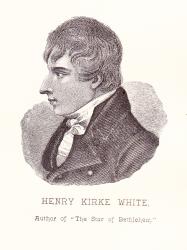
Henry Kirke White

1785 - 1806 Person Name: H. K. White Topics: Progress Author of "Oft in danger, oft in woe" in The Hymnal, Revised and Enlarged, as adopted by the General Convention of the Protestant Episcopal Church in the United States of America in the year of our Lord 1892 White, Henry Kirke, a gifted English poet who died early in life, was born in Nottingham, England, March 21, 1785. Very early he manifested a remarkable love for books and a decided talent for composition. But his parents were poor, and he was apprenticed in early boyhood to a stocking weaver, from which uncongenial servitude he escaped as soon as he could and began the study of law; but later he was converted and felt called to the ministry. The story of his conversion from deism to Christianity is briefly but beautifully told in the poem titled "The Star of Bethlehem." He entered St. John's College, Cambridge, in 1805 as a servitor; but died October 19, 1806, in the second year of his college course, when only twenty-one years of age. In 1803 he published a small volume of poems. Some of them are very fine, but no doubt he would have produced others far better if he had lived to the ordinary age of man. His rare poetic genius, his victory over skepticism and subsequent faith and piety, his hard struggle with poverty and early death invest the story of his life with more than ordinary pathos. His hymns, ten in number, appeared in Collyer's Collection, 1812. Oft in danger, oft in woe 412 The Lord our God is clothed with 99 When marshaled on the mighty 124 Hymn Writers of the Church, 1911 ============================ White, Henry Kirk, remarkable both for the early development of his genius and for the untimely termination of his brief life of splendid promise, was born at Nottingham, March 21, 1785. His father was a butcher, but his mother must have been a superior woman, since for a number of years she successfully conducted a boarding-school for girls. The writing-master in her establishment was for some time Henry's teacher, and under his instruction he made remarkable progress in Latin and other subjects. At the age of 13 he composed the lines "To an early Primrose," which were subsequently printed with his poems. At 14 he left school, and was put to the stocking-frame in order to learn prac¬tically the business of a hosier; but, disliking the employment, he was removed to an attorney's office in Nottingham, with a view to the legal profession. All his spare time was now devoted to literary pursuits, the acquisition of languages, and the composition of poetical and other contributions for the periodicals of the day. At the age of 15 he obtained from the Monthly Preceptor a silver medal for a translation from Horace, and a pair of globes for the best description of an imaginary tour from London to Edinburgh. When only 17 he was encouraged to publish his Clifton Grove and other Poems, which were certainly excellent as the compositions of a mere boy. About this time he was inclined to scepticism, but. through the perusal of Scott's Force of Truth and the arguments and appeals of a young friend, R. W. Almond (afterwards Rector of St. Peter's, Nottingham), he was led to earnest faith in Christianity. His well-known hymn "When marshall'd on the nightly plain" is understood to be a figurative description of his spiritual experience at this period. He now desired to become a Christian minister, and through the generosity of his employers he was released from his articles in 1804. With the help of the Rev. C. Simeon and other friends, he became a student of St. John's College, Cambridge. There he speedily distinguished himself, and the highest honours seemed within his grasp; but over application to study destroyed his health, and he fell ill and died Oct. 19, 1806, in the 22nd year of his age. Universal regret was expressed at his untimely end. Southey published his Remains, accompanied by a short memoir. Lord Byron composed some beautiful lines on the sad event. Josiah Conder and others wrote commemorative verses. The entire literary young manhood of England and America seemed moved with sympathy. A monumental tablet, with a medallion by Chantrey, was erected in All Saints Church, Cambridge, at the expense of a citizen of Boston, in the United States. Ten hymns are ascribed to H. K. White, which were printed by the Rev. Dr. W. B. Collyer in his Supplement to Dr. Watts's Psalms & Hymns, London, 1812. Of these four of the most popular are annotated as follows: "Awake, sweet harp of Judah, wake"; "Christians, brethren, ere we part"; "Much in sorrow, oft in woe"; “When marshalled on the nightly plain." These are all in extensive use. The rest, all in common use at the present time, are:— 1. 0 Lord, another day has flown. Evening. From this the hymn "0 let Thy grace perform its part" is taken. 2. 0 Lord, my God, in mercy turn. Penitence and Faith. 3. The Lord our God is full [clothed in] of might. Divine Sovereignty. 4. The Lord our God is Lord of all. Divine Sovereignty. 5. Through sorrow's night and danger's path. The Resurrection. Sometimes given as "When sorrow's path and danger's road." 6. What is this passing scene? Human Frailty. This hymn consists of selected stanzas from his “Ode on Disappointment." [Rev. W. R. Stevenson, M.A.] -- John Julian, Dictionary of Hymnology (1907)

Arthur Henry Brown

1830 - 1926 Person Name: A. H. Brown (1830- ) Topics: The Nation Home Mission and Social Progress Composer of "HOLY CHURCH" in The Hymnal of Praise Born: Ju­ly 24, 1830, Brent­wood, Es­sex, Eng­land. Died: Feb­ru­a­ry 15, 1926, Brent­wood, Es­sex, Eng­land. Almost com­plete­ly self taught, Brown be­gan play­ing the or­gan at the age 10. He was or­gan­ist of the Brent­wood Par­ish Church, Es­sex (1842-53); St. Ed­ward’s, Rom­ford (1853-58); Brent­wood Par­ish Church (1858-88); St. Pe­ter’s Church, South Weald (from 1889); and Sir An­tho­ny Browne’s School (to 1926). A mem­ber of the Lon­don Gre­gor­i­an As­so­ci­a­tion, he helped as­sem­ble the Ser­vice Book for the an­nu­al fes­tiv­al in St. Paul’s Ca­thed­ral. He sup­port­ed the Ox­ford Move­ment, and pi­o­neered the res­tor­a­tion of plain­chant and Gre­gor­i­an mu­sic in Ang­li­can wor­ship. Brown ed­it­ed var­i­ous pub­li­ca­tions, in­clud­ing the Al­tar Hym­nal. His other works in­clude set­tings of the Can­ti­cles and the Ho­ly Com­mun­ion Ser­vice, a Child­ren’s Fes­tiv­al Serv­ice, an­thems, songs, part songs, and over 800 hymn tunes and car­ols. Music: Alleluia! Sing the Tri­umph Arthur Dale Ab­bey Fields of Gold Are Glow­ing Gerran Holy Church Holy Rood If An­gels Sang Our Sav­ior’s Birth Lammas O, Sing We a Car­ol Purleigh Redemptor Mun­di Ring On, Ye Joy­ous Christ­mas Bells Saffron Wal­den St. An­a­tol­i­us St. Aus­tell St. John Dam­as­cene St. Ma­byn St. So­phro­ni­us Story of the Cross Sweet Child Di­vine --www.hymntime.com/tch

Henry Baker

1835 - 1910 Topics: Social Progress Composer of "QUEBEC" in The Hymnal Henry Baker, Mus. Bac., son of the Rev. James Baker, Chancellor of the diocese of Durham; born at Nuneham, Oxfordshire; educated at Winchester School; graduated Bachelor in Music at the University of Oxford in 1867. He also worked as a civil engineer. Scottish Church Music, its composers and sources by James Love; William Blackwwod and Sons, Edinburgh and London, 1891

Pages


Export as CSV
It looks like you are using an ad-blocker. Ad revenue helps keep us running. Please consider white-listing Hymnary.org or getting Hymnary Pro to eliminate ads entirely and help support Hymnary.org.