You help make Hymnary.org possible. More than 10 million people from 200+ countries found hymns, liturgical resources and encouragement on Hymnary.org in 2025, including you. Every visit affirms the global impact of this ministry.

If Hymnary has been meaningful to you this year, would you take a moment today to help sustain it? A gift of any size—paired with a note of encouragement if you wish—directly supports the server costs, research work and curation that keep this resource freely available to the world.

Give securely online today, or mail a check to:
Hymnary.org
Calvin University
3201 Burton Street SE
Grand Rapids, MI 49546

Thank you for your partnership, and may the hope of Advent fill your heart.

Person Results

Topics:safety+-+security
In:people

Planning worship? Check out our sister site, ZeteoSearch.org, for 20+ additional resources related to your search.
Showing 81 - 90 of 322Results Per Page: 102050

Timothy R. Matthews

1826 - 1910 Topics: Safety and Comfort Composer of "CHENIES" in The Pilgrim Hymnal Timothy Richard Matthews MusB United Kingdom 1826-1910. Born at Colmworth, England, son of the Colmworth rector, he attended the Bedford and Gonville Schools and Caius College, Cambridge. In 1853 he became a private tutor to the family of Rev Lord Wriothesley Russell, a canon of St. George’s Chapel, Windsor Castle, where he studied under organist, George Elvey, subsequently a lifelong friend. He married Margaret Mary Thompson, and they had 11 children: Norton, Mary, George, Cecil, Evelyn, Eleanor, Anne, Arthur, Wilfred, Stephen, and John. Matthews served as Curate and Curate-in-Charge of St Mary’s Church, Nottingham (1853-1869). While there, he founded the Nottingham Working Men’s Institute. He became Rector at North Coates, Lincolnshire (1869-1907). He retired in 1907 to live with his eldest son, Norton, at Tetney vicarage. He edited the “North Coates supplemental tune book” and “Village organist”. An author, arranger, and editor, he composed morning and evening services, chants, and responses, earning a reputation for simple but effective hymn tunes, writing 100+. On a request he wrote six tunes for a children’s hymnal in one day. He composed a Christmas carol and a few songs. His sons, Norton, and Arthur, were also known as hymn tune composers. He died at Tetney, Lincolnshire, England. John Perry

Thomas Hastings

1784 - 1872 Person Name: T. Hastings, 1784-1872 Topics: Christian Living Safety and Peace Composer of "BREMEN" in The Sanctuary Hymnal, published by Order of the General Conference of the United Brethren in Christ Hastings, Thomas, MUS. DOC., son of Dr. Seth Hastings, was born at Washington, Lichfield County, Connecticut, October 15, 1784. In 1786, his father moved to Clinton, Oneida Co., N. Y. There, amid rough frontier life, his opportunities for education were small; but at an early age he developed a taste for music, and began teaching it in 1806. Seeking a wider field, he went, in 1817, to Troy, then to Albany, and in 1823 to Utica, where he conducted a religious journal, in which he advocated his special views on church music. In 1832 he was called to New York to assume the charge of several Church Choirs, and there his last forty years were spent in great and increasing usefulness and repute. He died at New York, May 15, 1872. His aim was the greater glory of God through better musical worship; and to this end he was always training choirs, compiling works, and composing music. His hymn-work was a corollary to the proposition of his music-work; he wrote hymns for certain tunes; the one activity seemed to imply and necessitate the other. Although not a great poet, he yet attained considerable success. If we take the aggregate of American hymnals published duriug the last fifty years or for any portion of that time, more hymns by him are found in common use than by any other native writer. Not one of his hymns is of the highest merit, but many of them have become popular and useful. In addition to editing many books of tunes, Hastings also published the following hymnbooks:— (1) Spiritual Songs for Social Worship: Adapted to the Use of Families and Private Circles in Seasons of Revival, to Missionary Meetings, &c, Utica, 1831-2, in which he was assisted by Lowell Mason; (2) The Mother's Hymn-book, 1834; (3) The Christian Psalmist; or, Watts's Psalms and Hymns, with copious Selections from other Sources, &c, N. Y., 1836, in connection with "William Patton; (4) Church Melodies, N. Y., 1858, assisted by his son, the Rev. T. S. Hastings; (5) Devotional Hymns and Poems, N. Y., 1850. The last contained many, but not all, of his original hymns. (6) Mother's Hymn-book, enlarged 1850. The authorship of several of Hastings's hymns has been somewhat difficult to determine. All the hymns given in the Spiritual Songs were without signatures. In the Christian Psalmist some of his contributions were signed "Anon." others "M. S.," whilst others bore the names of the tune books in which they had previously appeared; and in the Church Melodies some were signed with his name, and others were left blank. His MSS [manuscript] and Devotional Hymns, &c, enable us to fix the authorship of over 50 which are still in common use. These, following the chronological order of his leading work, are:— i. From the Spiritual Songs, 1831:— 1. Before Thy footstool kneeling. In Sickness. No. 358, in 3 stanzas of 8 lines. 2. Bleeding hearts defiled by sin. Fulness of Christ. No. 261, in 5 stanzas of 4 lines. 3. Child of sin and sorrow, Filled with dismay. Lent. No. 315, in 2 stanzas of 8 lines. It is sometimes given as "Child of sin and sorrow, Where wilt thou flee?" It is in extensive use. 4. Delay not, delay not, 0 sinner draw near. Exhortation to Repentance. No. 145, in 5 stanzas of 4 lines. Given in several important collections. 5. Forgive us, Lord, to Thee we cry. Forgiveness desired. No. 165, in 4 stanzas of 4 lines. 6. Gently, Lord, 0 gently lead us. Pilgrimage of Life. No. 29, in 2 stanzas of 8 lines. It is given in several collections. The first two lines are taken from a hymn which appeared in the Christian Lyre, 1830. 7. Go forth on wings of fervent prayer. For a blessing on the distribution of Books and Tracts. No. 250, in 4 stanzas of 5 lines. It is sometimes given as “Go forth on wings of faith and prayer," as in the Baptist Praise Book, N. Y., 1871, No. 1252; but the alterations are so great as almost to constitute it a new hymn. 8. Hail to the brightness of Zion's glad morning. Missionary Success. No. 239, in 4 stanzas of 4 lines. In several hymnbooks in Great Britain and America. 9. How calm and beautiful the morn. Easter. No. 291, in 5 stanzas of 6 lines. Very popular. 10. In this calm, impressive hour. Early Morning. No. 235, pt. i. in 3 stanzas of 6 lines. In several collections. 11. Jesus, save my dying soul. Lent. No. 398, in 4 stanzas of 4 lines. A deeply penitential hymn. 12. Now be the gospel banner. Missions. No. 178, in 2 stanzas of 8 lines. In several collections (see below). 13. Now from labour, and from care. Evening. No. 235. Pt. ii. in 3 stanzas of 6 lines. This hymn, with No. 10 above, "In this calm," &c, constitute one hymn of 6 st. in the Spiritual Songs, but divided into two parts, one for Morning and the other for Evening. Both parts are popular as separate hymns. 14. 0 God of Abraham, hear. Prayer on behalf of Children. No. 288, in 5 stanzas of 4 lines. In use in Great Britain. 15. 0 tell me, Thou Life and delight of my soul. Following the Good Shepherd. No. 151, in 5 stanzas of 4 lines, on Cant. i. 7, 8. 16. Return, O wanderer, to thy home. The Prodigal recalled. No. 183, in 3 stanzas of 4 lines, with the refrain, " Return, return " (see below). 17. Soft and holy is the place. Public Worship. No. 351, in 4 stanzas of 4 lines. In Dr. Hatfield's Church Hymn Book, N. Y., 1872, and some other collections, the opening line is altered to "Sweet and holy is the place." 18. That warning voice, 0 sinner, hear. Exhortation to Repentance. No. 231, in 4 stanzas of 6 lines. 19. To-day the Saviour calls. Lent. No. 176, in 4 stanzas of 4 lines. Dr. Hastings says, in a communication to Dr. Stevenson (Hymns for Church and Home, 1873), this hymn “was offered me in a hasty sketch which I retouched." The sketch was by the Rev. S. F. Smith. 20. Why that look of sadness. Consolation. No. 268, in 3 stanzas of 8 lines. 21. Zion, dreary and in anguish. The Church Comforted. No. 160, in 4 stanzas of 4 lines. Concerning the two hymns, No. 12, "Now be the gospel banner"; and No. 16, "Beturn, O wanderer, to thy home," Dr. Stevenson has the following note in his Hymns for Church and Home, London, 1873:— "In a letter to the Editor, Dr. Hastings wrote, not more than a fortnight before his death, 'These two hymns of mine were earlier compositions, the former ["Now be," &c.] for a Utica Sunday School celebration, the latter ["Return, 0 wanderer," &c.] after hearing a stirring revival sermon on the Prodigal Son, by the Rev. Mr. Kint, at a large union meeting in the Presbyterian Church, where two hundred converts were present. The preacher at the close eloquently exclaimed with tender emphasis, "Sinner, come home! come home! come home!" It was easy afterwards to write, "Return, 0 wanderer."'" Several additional hymns in the Spiritual Songs, 1831, have been ascribed to Dr. Hastings, but without confirmation. The sum of what can be said on his behalf is that the hymns are in his style, and that they have not been claimed by others. They are:— 22. Drooping souls, no longer mourn. Pardon promised. No. 40, in 3 stanzas of 8 1., of which st. i., ii. are altered from J. J. Harrod's Public, Parlour, and Cottage Hymns, Baltimore, 1823, that is, 8 years before the Spiritual Songs were published. 23. Dying souls, fast bound in sin. Pardon offered. No. 41, in 5 stanzas of 8 lines. It is usually given in an abridged form. ii. From his Mother's Hymn Book, 1834:—- 24. Forbid them not, the Saviour cried. Holy Baptism. No. 44. 25. God of mercy, hear our prayer. On behalf of Cliildrcn, No. 48, in 5 stanzas of 4 lines. It was included in J. Campbell's Comprehensive Hymn Book, Lond., 1837, and subsequently in several collections. 26. God of the nations, bow Thine ear. Missions. No. 115, in 4 stanzas of 6 lines. In several collections. 27. How tender is Thy hand. Affliction. No. 99, in 5 stanzas of 41. 28. Jesus, while our hearts are bleeding. Death. Resignation. No. 95, in 5 stanzas of 4 lines. This is in extensive use and is one of his best and most popular hymns. 29. Lord, I would come to Thee. Self-dedication of a Child. No. 72, in 4 stanzas of 4 lines. 30. 0 Lord, behold us at Thy feet. Lent. No. 59, in 4 stanzas of 4 lines. It is doubtful if this is by Hastings. It is sometimes signed "Mrs. T." 31. The rosy light is dawning. Morning. No. 11, in 3 stanzas of 8 lines. 32. The Saviour bids us [thee] watch and pray. Watch and Pray. No. 119, in 4 stanzas of 4 lines. 33. Thou God of sovereign grace. On behalf of Children. No. 66, in 6 stanzas of 4 lines. 34. Wherever two or three may meet. Divine Service. No. 56. 35. Within these quiet walls, 0 Lord. Mothers' Meetings. No. 58, in 5 stanzas of 4 lines. In Spurgeon's Our Own Hymn Book, 1866, No. 1010, it begins, "Within these peaceful walls." This reading is from J. Campbell's Comprehensive Hymn Book, London, 1837. It is very doubtful if this is by Hastings. iii. From the Christian Psalmist, 1836:— 36. Children, hear the melting story. On the life of Christ. No. 430, in 3 stanzas of 6 lines. It is given as from the Union Minstrel, and the statement that it is by Hastings is very doubtful, no evidence to that effect being in the possession of his family. Dr. Hatfield, in his Church Hymn Book, dates it 1830, and gives it as "Anon." 37. Go, tune thy voice to sacred song. Praise No. 190, in 5 stanzas of 5 lines, and given as from "ms." 38. He that goeth forth with weeping. Missions No. 212, in 2 stanzas of 8 lines, and given as from "ms." It is in several collections. 39. I love the Lord, Whose gracious ear. Ps. cxvi. Page 186, in 4 stanzas of 6 lines, as from "ms." 40. Lord of the harvest, bend Thine ear. For the Increase of the Ministry. No. 407, in 6 stanzas of 4 lines, as from "ms." This hymn Dr. Hastings altered for his Devotional Hymns & Poems, 1850, but it has failed to replace the original in the hymnbooks. iv. From the Reformed Dutch Additional Hymns, 1846:— 41. Child of sorrow, child of care [woe]. Trust. No. 168, in 2 stanzas of 8 lines, appeared in W. Hunter's Minstrel of Zion, 1845. 42. Heirs of an immortal crown. Christian Warfare. No. 136, in 2 stanzas of 8 lines. 43. O Saviour, lend a listening ear. Lent. No. 175. Stanzas vi., i., iv., v., altered. 44. The Lord Jehovah lives. Ps. xviii. No. 26, in 4 stanzas of 6 lines. These three hymns, together with many others, are given in the Dutch Reformed Hymns of the Church, N. Y., 1869. In the 1847 Psalms & Hymns there were, including these, 38 hymns by Hastings, and 2 which are doubtful. v. From Dr. Hastings's Devotional Hymns and Religious Poems, 1850:— 45. In time of fear, when trouble's near. Encouragement in Trial. Page 95, in 3 stanzas of 4 lines. In use in Great Britain. vi. From Church Melodies, 1858:—- 46. For those in bonds as bound with them. Missions. No. 416, in 5 stanzas of 4 lines, on Heb. xiii. 3. 47. Forget thyself, Christ bids thee come. Holy Communion. No. 683, in 3 stanzas of 6 lines. 48. Jesus, Merciful and Mild. Leaning on Christ. No. 585, in 4 stanzas of 8 1. In several collections. 49. Pilgrims in this vale of sorrow. Self-denial. No. 397, in 4 stanzas of 4 lines. 50. Saviour, I look to Thee. Lent. In time of Trouble. No. 129, in 4 stanzas of 7 lines. 51. Saviour of our ruined race. Holy Communion. No. 379, in 3 stanzas of 6 lines. 52. Why that soul's commotion? Lent. No. 211, in 3 stanzas of 8 lines. It is doubtful if this is by Hastings. vii. In Robinson's Songs of the Church, 1862: 53. Be tranquil, 0 my soul. Patience in Affliction. No. 519, in 4 stanzas of 4 lines. Altered in Robinson's Songs for the Sanctuary, 1865. 54. Peace, peace, I leave with you. Peace, the benediction of Christ. No. 386, in 3 stanzas of 7 lines. 55. Saviour, Thy gentle voice. Christ All in All. No. 492, in 3 stanzas of 7 lines. viii. In Bobinson's Songs for the Sanctuary, 1865:— 56. God of the morning ray. Morning. No. 53, in 2 stanzas of 7 lines. Of Hastings's hymns about 40 are in the Reformed Dutch Psalms & Hymns, 1847; 39 in Robinson's Songs for the Sanctuary, 1865; 15 in Hatfield's Church Hymn Book, 1872; and 13 in the Lyra Sacra Americana, 1868. They are also largely represented in other collections. Many other of his compositions are found in collections now or recently in common use, but these are not of the highest merit. [Rev. F. M. Bird, M.A.] --John Julian, Dictionary of Hymnology (1907) ======================== Hastings, T., p. 494, i. Additional hymns are:— 1. Children hear the wondrous story; and "Sinners, hear the melting story," are altered forms of No. 36, on p. 495, i. 2. Father, we for our children plead. On behalf of Children. 3. Forgive my folly, O Lord most holy. Lent. 4. Hosanna to the King, That for, &c. Praise to Jesus. 5. I look to Thee, O Lord, alone. Pardon desired. 6. Jesus, full of every grace. Pardon desired. 7. O why should gloomy thoughts arise? The Mourner Encouraged. 8. Peace to thee, O favoured one. Peace in Jesus. 9. Saviour, hear us through Thy merit. Forgiveness. Of these hymns, No. 3 is in Hasting’s Spiritual Songs, 1831; No. 9 in his Mother's Hymn Book, 1834, and his Devotional Hymns, 1850; and Nos. 4, 5 & 8 in his Devotional Hymns, 1850. --John Julian, Dictionary of Hymnology, Appendix, Part II (1907)

Alexander Robert Reinagle

1799 - 1877 Person Name: Alexander R. Reinagle Topics: Assurance Declared; Assurance Enjoyed; Christ Communion with; Christ Confessing; Christ The Saviour; Christians Believers; Christians Christ the Life of; Christians Conscious of Safety; Christians Fellowship of; Christians Heirs of Heaven; Companions Good; Faith Blessedness of; Faith Confession of; Fidelity; God Source of All Good; Idolatry; Joy Reasons for; Praise For Spiritual Blessings; Prayer For Deliverance from Enemies; Preservation; Providence of God Over Saints; Resurrection; The Christian's Reward; The Wicked Separation from; Zeal False Composer of "ST. PETER" in The Psalter Alexander Robert Reinagle United Kingdom 1799-1877. Born at Brighton, Sussex, England, gf Austrian descent, he came from a family of musicians, studying music with his father (a cellist), then with Raynor Taylor in Edinburgh, Scotland. Reinagle became a well-known organ teacher. He became organist at St Peter’s Church, Oxford (1823-1853). He was also a theatre musician. He wrote Teaching manuals for stringed instruments as well. He also compiled books of hymn tunes, one in 1830: “Psalm tunes for the voice and the pianoforte”, the other in 1840: “A collection of Psalm and hymn tunes”. He also composed waltzes. In 1846 he married Caroline Orger, a pianist, composer, and writer in her own right. No information found regarding children. In the 1860s he was active in Oxford music-making and worked with organist, John Stainer, then organist at Magdalen College. Reinagle also composed a piano sonata and some church music. At retirement he moved to Kidlington, Oxfordshire, England. He died at Kidlington. John Perry

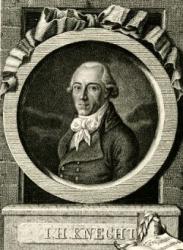
Justin Heinrich Knecht

1752 - 1817 Person Name: Justin H. Knecht, 1752-1817 Topics: Christians Safety of; Creation and Providence; Dependence on God; Mourners; Trust and Resignation Composer of "ST. EDITH" in Hymnal and Liturgies of the Moravian Church Justin Heinrich Knecht Germany 1752-1817. Born at Biberach Baden-Wurttemberg, Germany, he attended a Lutheran college in Esslingen am Neckar from 1768-1771. Having learned the organ, keyboard, violin and oratory, he became a Lutheran preceptor (professor of literature) and music director in Biberach. It was a free imperial city until 1803 and had a rich cultural life. He became organist of St. Martin’s Church in 1792, used by both Lutherans and Catholics, and was there for many years. He led an energetic, busy musical life, composing for both the theatre and church, organizing subscription concerts, teaching music theory, acoustics, aesthetics, composition, and instruments at the Gymnasium, affiliated to the Musikschule in 1806. He went to Stuttgart in 1806 in hopes of a post there as Kapellmeister, serving two years as Konzertmeister, but he was appointed Direktor Beim Orchester by the King of Wurttemberg in 1807. However, he returned to his former life in 1808 and remained there the rest of his life. He died at Biberach. He wrote 10 vocals, 11 opera and stage works, one symphony, 3 chamber music instrumentals, 7 organ works, 4 piano works, and 6 music theories. He was an author composer, editor, contributor, musician, compiler, and lyricist. John Perry

Simeon Butler Marsh

1798 - 1875 Person Name: Simeon Butler Marsh, 1798-1875 Topics: Hymns, Songs, Chorales Jesus Christ Refuge, Safety Composer of "MARTYN" in The Christian Hymnary Simeon Butler Marsh USA 1798-1875. Born at Sherburne, NY, he was raised on a farm. A Presbyterian, he became a gifted organist and teacher. He sang in a choir at age seven and studied music at age 16. By age 19 he was teaching in the local singing schools in Geneva, NY, and had met hymnist, Thomas Hastings from Geneva, NY, who gave him much encouragement. He married Eliza Carrier, and they had a son, John, and a daughter, Jane. In 1837 he became publisher of the Amsterdam, NY, paper “Intelligencer” (later called ‘Recorder’), and ran it for seven years, even setting his own type. He moved back to Sherburne and founded the Sherburne News. He taught music to choirs and children for almost 30 years in and around the Albany Presbytery, and also served as a Sunday school superintendent for six years and a choir leader for three years. He set type for three juvenile books as well. For thirteen years he gave free music instruction to students in the Schenectedy area. In 1859 he returned to Sherburne and gave music instruction to large classes of men, women, and children. He wrote two cantatas: “The Savior” and “The king of the forest”. He wrote a number of hymns, but most have not survived over time. His wife died in 1873. He died at Albany, NY, and is buried in Schenectady, NY. John Perry

John E. Gould

1821 - 1875 Topics: Afflictions Comfort under; Afflictions Promises for; Afflictions Refuge in; Christ Preciousness of; Christ The Saviour; Covenant Promises; Faith Act of; Faith Walking by; God Our Guardian; God Our Refuge; Prayer Promise to; Preservation; Protection Unceasing; The Righteous Honor and Safety of; Royalty of Christ Guarantee of Salvation; Safety Assured; Sin Salvation from Composer of "PILOT" in The Psalter John Edgar Gould USA 1821-1875. Born in Bangor, ME, he became a musician. He managed music stores in New York City and Philadelphia, PA., the latter with composer partner, William Fischer. He married Josephine Louisa Barrows, and they had seven children: Blanche, Marie, Ida, John, Josephine, Josephine, and Augusta. He compiled eight religious songbooks from 1846 thru 1869. He died while traveling in Algiers, Africa, and was buried in Philadelphia, PA. John Perry

Daniel Read

1757 - 1836 Topics: Christian Living Safety and Peace Composer of "LISBON" in The Sanctuary Hymnal, published by Order of the General Conference of the United Brethren in Christ Daniel Read; b. 1757, Rehoboth, Mass.; d. 1837, New Haven, Conn.An American composer and a primary figure in early American classical music. He was one of the “Yankee Tunesmiths” (1st New England School of Music) when classical music was popular in Europe. Read was a private in Massachusetts militia and later a comb maker and owner of a general store in New Haven, CN. He was only the 3rd composer in the U. S. to put out a collection of his own music. His work, “The American Singing Book” went through 5 editions, making him the most popular composer in the nation. Others often plagarized his tunes in those days. Tunebook sales supplemented his general store income, including “The Columbian Harmonist” (3 volumnes) with 3 revisions, and “The New Haven Collection of Sacred Music” 1818. Read also published “The American Musical magazine” in 12 annual issues in 1786 and 1787. In later years he came to appreciate European music more and imitated that styling in devotional music. Some of Read's music is still being performed, and selections have been published in “The Sacred Harp”, 1991 Edition, and the “Stoughton Music Society” (Centennial Collection 1980). John Perry

W. Stillman Martin

1862 - 1935 Person Name: Walter S. Martin (1862-1935) Topics: La Vida Christian Confianza y seguridad; The Christian Life Trust and safety Composer of "[Nunca desmayes, que en el afán]" in Himnario Adventista del Séptimo Día Born: March 8, 1862, Rowley, Massachusetts. Died: December 16, 1935, Atlanta, Georgia. Buried: Westview Cemetery, Atlanta, Georgia. Husband of hymnist Civilla Martin, Stillman attended Harvard University and was ordained a Baptist minister, though he later switched to the Disciples of Christ denomination. In 1916, he became a professor of Bible studies at Atlantic Christian College in Wilson, North Carolina. Three years later, he moved to Atlanta, Georgia. It was from there he went all over America to run Bible conferences and evangelistic meetings. Sources: Hustad, p. 282 http://www.hymntime.com/tch/bio/m/a/r/t/martin_ws.htm

John Ryland

1753 - 1825 Topics: Safety and Comfort Author of "The Soul's Joy in God" in The Pilgrim Hymnal Ryland, John, D.D., son of Rev. John Collett Ryland, was born at Warwick, Jan. 29, 1753. At that time his father was Baptist minister at Warwick, but in 1759 removed to Northampton. "J. Ryland, junior," as for many years he was accustomed to subscribe himself, was in 1781 ordained co-pastor with his father at Northampton. In 1794 he accepted the presidency of the Baptist College and the pastorate of the church in Broadmead, Bristol, and these offices he retained until his death on June 25, 1825. Dr. Ryland was a man of considerable literary culture, and received the degree of D.D. from Brown University, Rhode Island. He was one of the founders of the Baptist Missionary Society, and for the three years following the death of Rev. A. Fuller, in 1815, acted as its secretary. His prose works were Memoirs of Rev. B. Hall, Arnsby (2nd ed., 1852); A candid statement of the reasons which induce Baptists to differ from their Christian brethren; and many Sermons and Charges. After his death appeared 2 vols. of Discourses, selected from his manuscripts, and entitled Pastoral Memorial. To these discourses are appended many of his hymns, with their dates. Dr. Ryland's hymns were composed at different times, from his sixteenth year to the year of his death. The earliest were published when he was 16, in his Serious Essays, 1771. These 36 hymns were never republished. Several appeared in the Gospel Magazine from 1771 to 1782, and the Protestant Magazine, 1782-83; others in Rippon's Baptist Selection, 1787; 2 in the Collection for the Monthly Prayer Meeting at Bristol, 1797 ; 2 in Andrew Fuller's Memoirs, 1831; and 25 in the Pastoral Memorials, 1825. His Hymns and Verses on Sacred Subjects, to the number of 99, were reprinted from his mss. by D. Sedgwick, and were published, with a Memoir, in 1862. The hymns are dated therein from the mss. [Rev. W. R. Stevenson, M.A.] Those of Dr. Ryland's hymns now in common use include:— 1. For Zion's sake I'll not restrain. Missions. Dated 1798, and printed by D. Sedgwick from Ryland's manuscripts, 1862. 2. Had not the Lord, my soul may say [cry] . Ps. cxxiv. From his Serious Essays, 1771. It is No. 124 in Spurgeon's Our Own Hymn Book, 1866. Not in Sedgwick's reprint. 3. Holy, holy, holy Lord, self-existent Deity. Holy Trinity. Dated 1796. It was given in the tenth edition of Rippon's Baptist Selection, 1800, Pt. 2, No. 22; in the Pastoral Memorials, 1825; and Sedgwick's reprint, 1862, in 5 stanzas of 8 lines. It is in common use in Great Britain and America. 4. Look down, my soul, on hell's domain. Gratitude for escape. This is No. 881 in Spurgeon's Our Own Hymn Book. 1866, and dated 1777. We cannot trace it in any of Ryland's works or amongst his hymns. 5. Lord, teach a little child to pray. A Child's Prayer. Dated 1786. The note to this hymn by Dr. Ryland's son, in Sedgwick's reprint, 1862, p. 15, is:— "This and the following hymn ["God is very good to me “was composed at the request of Mrs. Fuller, wife of the Rev. Andrew Fuller, of Kettering, for the use of Miss Sarah Fuller, who died May 30th, 1789, aged six years and six months." It was published in Andrew Fuller's Memoirs, 1831, p. 442, andsin Sedgwick's reprint, 1862. 6. Now let the slumbering church awake. Activity in the Church desired. Dated "Feb. 20, 1798." Published in the Pastoral Memorials, 1825, and in Sedgwick's reprint, 1862. In Spurgeon's Our Own Hymn Book, 1866. 7. O Lord, I would delight in Thee. Delight in Christ. Dated "Dec. 3, 1777." Dr. Ryland added this note to the ms.:—-" I recollect deeper feelings of mind in composing this hymn, than perhaps I ever felt in making any other." It was published in Rippon's Selection 1798, No. 248; in the Pastoral Memorials, 1825; and in Sedgwick's reprint, 1862, in 7 st. of 41. It is in extensive use in its original, or an abbreviated form; or as "O Lord we would delight in Thee." In the American Methodist Episcopal Hymns, 1849; and their Hymn, 1878, st. i., ii., vi., vii. are rewritten in S. M. as "Lord, I delight in Thee." 8. Out of the depths of doubt and fear. Ps. cxxx. From the Serious Essays, 1771 (misdated in Spurgeon's Our Own Hymn Book 1775). It is not in the Pastoral Memorials, 1825, nor in Sedgwick's reprint, 1862. 9. Rejoice, the Saviour reigns. Missions. Dated "Jan. 19, 1792." In the 10th ed. of Rippon's Selection, 1800, 422 (2nd pt.) it is given in 6 st. of 6 1., as in the Ryland ms., and then after the word "Pause" two stanzas are added on, which are not in the ms. The 6 stanzas were repeated in the Pastoral Memorials, 1825; in Sedgwick's reprint, 1862; and in Spurgeon's Our Own Hymn Book, 1866 (abbreviated), and other modern hymnals. 10. Sovereign Ruler of the skies. Guidance, Peace, and Security in God. Dated "Aug. 1,1777." Included in Rippon's Selection, 1787, No. 545 ; the Pastoral Memorials, 1825 ; and Sedgwick's reprint, 1862, in 9 st. of 4 1. 11. Thou Son of God, and Son of Man. Praise to God, the Son. This is undated. It was given in the Pastoral Memorials, 1825; and Sedgwick's reprint, 1862. 12. When Abraham's servant to procure. Onward, Heavenward. Dr. Ryland's son, under the date of Nov. 4, 1861, informed D. Sedgwick that this hymn "was written with a slate pencil on a rusty iron blower by moonlight, past twelve o'clock, Dec. 30, 1773," and he gives these words as a quotation from his father's manuscript. It is almost needless to add that this account does not agree with the generally received history of the hymn, as set forth in Miller's Singers and Songs, 1869, p. 313. In the May number of the Gospel Magazine, 1775, p. 235, the hymn was given in 9 st. of 4 1., with the heading" Hinder me not-—Gen. xxiv. 56," and signed "Elachistoteros." It was repeated in Rippon's Selection, 1787, No. 447; and Sedgwick's reprint, 1862. In Rippon a note is added, "This hymn may begin with 6th verse." This direction has been followed in some modern collections, the result being the hymn commonly known as "In all my Lord's appointed ways." 13. When the Saviour dwelt below. Compassion of Christ. Dated 1806. Included in the Pastoral Memorials, 1825, and Sedgwick's reprint, 1862. Dr. Ryland's hymns are plain and simple, but they lack poetry and passion, and are not likely to be largely drawn upon, for future hymnals. --John Julian, Dictionary of Hymnology (1907)

Lewis Edson

1748 - 1820 Topics: Christian Living Safety and Peace Composer of "LENOX" in The Sanctuary Hymnal, published by Order of the General Conference of the United Brethren in Christ Lewis EdsonBorn in Massachusetts,he began working as a blacksmith and farmer. After marrying, he became a singing teacher, notable in his day. He taught singing in MA NY and CN, moving to NY in 1817. He was also an author. His 35 works consist of tunebooks, anthems, Psalm music, music scores and chants for choir use. John Perry

Pages


Export as CSV
It looks like you are using an ad-blocker. Ad revenue helps keep us running. Please consider white-listing Hymnary.org or getting Hymnary Pro to eliminate ads entirely and help support Hymnary.org.