

 My Starred Hymns
 My FlexScores
 My Hymnals
 My Purchased Files
Planning worship?
Check out our sister site, ZeteoSearch.org,
for 20+ additional resources related to your search.
- |
User Links
Browse People
Jane Borthwick
1813 - 1897 Person Name: Jane L. Borthwick Topics: Scripture Songs; Scripture Songs; Scripture Songs; Scripture Songs; Scripture Songs; Scripture Songs; Scripture Songs; Scripture Songs; Scripture Songs; Scripture Songs; Scripture Songs; Scripture Songs; Scripture Songs; Scripture Songs Translator of "The Final Sentence" Miss Jane Borthwick, the translator of this hymn and many others, is of Scottish family. Her sister (Mrs. Eric Findlater) and herself edited "Hymns from the Land of Luther" (1854). She also wrote "Thoughts for Thoughtful Hours (1859), and has contributed numerous poetical pieces to the "Family Treasury," under the signature "H.L.L."
--Annotations of the Hymnal, Charles Hutchins, M.A. 1872.
=================================
Borthwick, Jane, daughter of James Borthwick, manager of the North British Insurance Office, Edinburgh, was born April 9, 1813, at Edinburgh, where she still resides. Along with her sister Sarah (b. Nov. 26, 1823; wife of the Rev. Eric John Findlater, of Lochearnhead, Perthshire, who died May 2, 1886) she translated from the German Hymns from the Land of Luther, 1st Series, 1854; 2nd, 1855; 3rd, 1858; 4th, 1862. A complete edition was published in 1862, by W. P. Kennedy, Edinburgh, of which a reprint was issued by Nelson & Sons, 1884.
These translations, which represent relatively a larger proportion of hymns for the Christian Life, and a smaller for the Christian Year than one finds in Miss Winkworth, have attained a success as translations, and an acceptance in hymnals only second to Miss Winkworth's. Since Kennedy's Hymnologia Christiana, 1863, in England, and the Andover Sabbath Hymn Book, 1858, in America, made several selections therefrom, hardly a hymnal in England or America has appeared without containing some of these translations. Miss Borthwick has kindly enabled us throughout this Dictionary to distinguish between the 61 translations by herself and the 53 by her sister. Among the most popular of Miss Borthwick's may be named "Jesus still lead on," and "How blessed from the bonds of sin;" and of Mrs. Findlater's "God calling yet!" and "Rejoice, all ye believers."
Under the signature of H. L. L. Miss Borthwick has also written various prose works, and has contributed many translations and original poems to the Family Treasury, a number of which were collected and published in 1857, as Thoughts for Thoughtful Hours (3rd edition, enlarged, 1867). She also contributed several translations to Dr. Pagenstecher's Collection, 1864, five of which are included in the new edition of the Hymns from the Land of Luther, 1884, pp. 256-264. Of her original hymns the best known are “Come, labour on” and "Rest, weary soul.” In 1875 she published a selection of poems translated from Meta Heusser-Schweizer, under the title of Alpine Lyrics, which were incorporated in the 1884 edition of the Hymns from the Land of Luther. She died in 1897. [Rev. James Mearns, M.A.]
-- John Julian, Dictionary of Hymnology (1907)
========================
Borthwick, Jane, p. 163, ii. Other hymns from Miss Borthwick's Thoughtful Hours, 1859, are in common use:—
1. And is the time approaching. Missions.
2. I do not doubt Thy wise and holy will. Faith.
3. Lord, Thou knowest all the weakness. Confidence.
4. Rejoice, my fellow pilgrim. The New Year.
5. Times are changing, days are flying. New Year.
Nos. 2-5 as given in Kennedy, 1863, are mostly altered from the originals.
--John Julian, Dictionary of Hymnology, Appendix, Part II (1907)
=============
Works:
Hymns from the Land of Luther
Jane Borthwick
Dmitriĭ Stepanovich Bortnianskiĭ
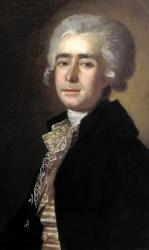
1751 - 1825 Person Name: Dmitri Bortniansky, 1752-1825 Topics: The Holy Scriptures Composer of "ST. PETERSBURG" in Hymnal and Liturgies of the Moravian Church Dimitri Stepanovitch Bortniansky (1751-1825) Ukraine 1751-1825
Born in Glukhov, Ukraine, he joined the imperial choir at age 8 and studied with Galuppi, who later took the lad with him to Italy, where he studied for 10 years, becoming a composer, harpsichordist, and conductor. While in Italy he composed several operas and other instrumental music, composing more operas and music later in Russia. In 1779 he returned to Russia, where he was appointed Director to the Imperial Chapel Choir, the first as a native citizen. In 1796 he was appointed music director. With such a great instrument at his disposal, he produced many compositions, 100+ religious works, sacred concertos, cantatas, and hymns. He influenced Rachmaninoff and Tchaikovshy, the latter editing Bortniansky's sacred work, amassing 10 volumnes. He died in St. Petersburg. He was so popular in Russia that a bronze statue was erected in his honor in the Novgorod Kremlin. He composed in different musical styles, including choral works in French, Italian, Latin, German, and Church Slavonic.
John Perry
Dmitriĭ Stepanovich Bortnianskiĭ
Matt Boswell
b. 1979 Topics: Scripture Author of "O, What High and Holy Privilege" in The Sing! Hymnal
Matt Boswell
Francis Bottome
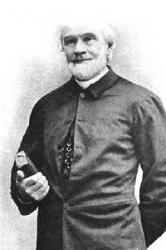
1823 - 1894 Topics: Holy Scriptures; Scriptures Author of "O Spread the Tidings Round" in Great Songs of the Church (Revised) Bottome, F., S.T.D., was born in Derbyshire, England, May 26, 1823. In 1850, having removed to America, he entered the ministry of the Methodist Episcopalian Church; and in 1872 he received the degree of S.T.D. from Dickinson's College, Carlisle, Penn. In addition to assisting in the compilation of B. P. Smith's Gospel Hymns, London, 1872: Centenary Singer, 1869; Hound Lake, 1872, he has written:—
1. Come, Holy Ghost, all sacred fire. Invocation of the Holy Spirit. Appeared in R. P. Smith's Gospel Hymns, 1872. It is in several collections, including the Ohio Hymn Book of the Evangelical Association, 1881, No. 364.
2. Full salvation, full salvation. Joy of full Salvation. Written in 1871, and published in a collection by Dr. Cullis of Boston, 1873. Also in the Ohio Hymn Book, 1881, No. 384.
3. Love of Jesus, all divine. Love of Jesus. Written in 1872, and published in his Hound Lake, 1872. It is in several collections.
4. O bliss of the purified, bliss of the free. Sanctification. Written in 1869, and published in the Revivalist, and numerous hymn-books in America, including the Ohio Hymn Book as above, 1881, No. 477, &c.
His hymns, "Sweet rest in Jesus"; and "Oneness in Jesus," are also found in several collections for evangelistic services.
-- John Julian, Dictionary of Hymnology (1907)
Francis Bottome
Louis Bourgeois
1510 - 1561 Topics: liturgical Scripture Songs Composer of "GENEVAN 42" in Voices United Louis Bourgeois (b. Paris, France, c. 1510; d. Paris, 1561). In both his early and later years Bourgeois wrote French songs to entertain the rich, but in the history of church music he is known especially for his contribution to the Genevan Psalter. Apparently moving to Geneva in 1541, the same year John Calvin returned to Geneva from Strasbourg, Bourgeois served as cantor and master of the choristers at both St. Pierre and St. Gervais, which is to say he was music director there under the pastoral leadership of Calvin. Bourgeois used the choristers to teach the new psalm tunes to the congregation.
The extent of Bourgeois's involvement in the Genevan Psalter is a matter of scholarly debate. Calvin had published several partial psalters, including one in Strasbourg in 1539 and another in Geneva in 1542, with melodies by unknown composers. In 1551 another French psalter appeared in Geneva, Eighty-three Psalms of David, with texts by Marot and de Beze, and with most of the melodies by Bourgeois, who supplied thirty four original tunes and thirty-six revisions of older tunes. This edition was republished repeatedly, and later Bourgeois's tunes were incorporated into the complete Genevan Psalter (1562). However, his revision of some older tunes was not uniformly appreciated by those who were familiar with the original versions; he was actually imprisoned overnight for some of his musical arrangements but freed after Calvin's intervention. In addition to his contribution to the 1551 Psalter, Bourgeois produced a four-part harmonization of fifty psalms, published in Lyons (1547, enlarged 1554), and wrote a textbook on singing and sight-reading, La Droit Chemin de Musique (1550). He left Geneva in 1552 and lived in Lyons and Paris for the remainder of his life.
Bert Polman
Louis Bourgeois
Antoinette Bourignon
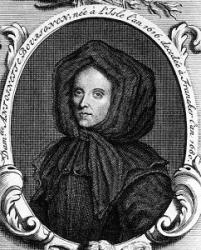
1616 - 1680 Person Name: Madame Bourignon Topics: Christian Ordinances and Institutions - The Holy Scriptures Author of "Come, O thou Prophet of the Lord" in Methodist Hymn-Book Bourignon, Antoinette, was born at Lisle in 1616. From a very early period she was under the influence of religion, which took, in course of time, a mystical turn. Undertaking the work of a religious reformer, she visited France, Holland, England, and Scotland; and published several works dealing with The Testimony of Truth; The Renovation of the Gospel Spirit, &c. Her enthusiasm, peculiarity of views, and disregard of all sects raised on the one hand zealous persecutors, and on the other warm adherents. At her death at Franeker, in Friesland, Oct. 30, 1680, she left a large number of followers, especially in Scotland and France. Her works were published in 19 vols. at Amsterdam, 1686. She is known to hymnology through her hymn, "Venez Jesus, mon salutaire" (q.v.).
-- John Julian, Dictionary of Hymnology (1907)
Antoinette Bourignon
John E. Bowers
1923 - 2019 Person Name: John Edward Bowers (b. 1923) Topics: Scripture Author of "The prophets spoke in days of old" in Ancient and Modern
John E. Bowers
John Bowring
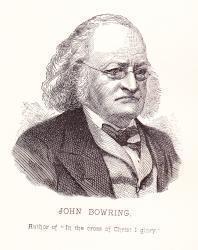
1792 - 1872 Topics: Scripture, Bible Author of "Upon the Gospel's sacred page" in Church Hymns and Gospel Songs James Bowring was born at Exeter, in 1792. He possessed at an early age a remarkable power of attaining languages, and acquired some reputation by his metrical translations of foreign poems. He became editor of "The Westminster Review" in 1825, and was elected to Parliament in 1835. In 1849, he was appointed Consul at Canton, and in 1854, was made Governor of Hong Kong, and received the honour of knighthood. He is the author of some important works on politics and travel, and is the recipient of several testimonials from foreign governments and societies. His poems and hymns have also added to his reputation. His "Matins and Vespers" have passed through many editions. In religion he is a Unitarian.
--Annotations of the Hymnal, Charles Hutchins, M.A., 1872
=======================================
Bowring, Sir John, LL.D., a distinguished man of letters, was born at Exeter, Oct. 17, 1792. His studies extended to philology, poetry, politics, and other branches of learning, whilst as editor of the Westminster Review for some years (he received the appointment in 1825) he did considerable work as a reviewer. He held several official appointments under the Government as Commissioner to France on commercial matters (1831-5); British Consul at Hong Kong (1849); and Governor of Hong Kong (1854). He was twice Member of Parliament, and was knighted in 1854. He died Nov. 23rd, 1872. His published works are very numerous, and display an astonishing acquaintance with various languages. Those specially bearing on poetry include:—
(1) Russian Anthology, with Biographical and Critical notices of the Poets of Russia, 1821; (2) Specimens of the Russian Poets, 1823; (3) Ancient Poetry and Romance of Spain, 1824; (4) Batavian Anthology, or Specimens of Dutch Poets, 1824; (5) Servian Popular Poetry, 1821; (6) Specimens of Polish Poets, 1827; (1) Poetry of the Magyars, 1830; (8) History of the Poetical Literature of Bohemia, 1832, &c.
In addition to these works, which are mainly translations, Sir John Bowring wrote original verse. This was published interspersed with a few translations, as follows:—
(1) Matins and Vespers with Hymns and Occasional Devotional Pieces, Lond., 1823; 2nd edition, enlarged, 1824; 3rd edition, again enlarged, 1841; and the 4th, still further enlarged, in 1851. (2) Hymns: as a Sequel to the Matins, 1825. In addition he contributed to a few Unitarian hymnals, especially that of the Rev. J. R. Beard of Manchester, 1837. In that Collection many of the hymns added to the 3rd edition of Matins, &c, 1841, were first published A selection from these, together with a biographical sketch, was published by Lady Bowring in 1873, as a Memorial Volume of Sacred Poetry. This work contains hymns from the Matins and Vespers, together with others from Periodicals, and from his manuscripts.
Of his hymns a very large percentage have come into common use. A few have been adopted by almost all denominations, as, "God is love, His mercy brightens;" "How sweetly flow'd the gospel sound;" "In the Cross of Christ I glory;" "Watchman, tell us of the night;"; and others, but the greater portion are confined to the Unitarian collections of Great Britain and America, of which denomination he was a member. In addition to the more important, which are annotated under their first lines, there are also the following in common use:—-
1. Clay to clay, and dust to dust. Burial. From his Hymns, 1825, into the Hymn & Tune Book, Boston, U.S., 1868, &c.
2. Come the rich, and come the poor. Divine Worship. Contributed to Beard's Collection, 1837, No. 290, and repeated in Bowring's Matins, &c., 3rd edition, 1841. It is in a few American collections.
3. Drop the limpid waters now. Holy Baptism. From Matins and Vespers, 3rd edition, 1841, into Kennedy, 1863.
4. Earth's transitory things decay. The Memory of the Just. From his Hymns, 1825, into Beard, 1837; the American Plymouth Collection, 1855; and the Songs for the Sanctuary, N.Y., 1865, &c.
5. Father, glorify Thy name. The Father glorified. Also from Hymns, 1825, into Beard, 1837; the Hymns of the Spirit, Boston, U.S., 1864, &c.
6. Father and Friend, Thy light, Thy love. Omnipresence. From Matins and Vespers, 2nd edition, 1824, into several collections, and sometimes in an abbreviated form.
7. Father of Spirits, humbly bent before Thee. Also in Hymns, 1825, and Dr. Martineau's Hymns of Praise & Prayer, 1873. In Longfellow and Johnson's Hymns of the Spirit, Boston, U.S., 1864, it is given as, "Father of Spirits, gathered now before Thee."
8. From all evil, all temptation. Preservation implored. Contributed to Beard's Collection, 1837.
9. From the recesses of a lowly spirit. Prayer of trust. From Matins and Vespers, 1st edition, 1823, into several American collections.
10. Gather up, 0 earth, thy dead. Published in his Matins & Vespers, 3rd ed., 1841, in 3 stanzas of 8 lines and repeated, slightly altered, in Kennedy, 1863, No. 753.
11. Gently the shades of night descends Evening. A cento from his poem on "Sunday Evening," in the Matins, &c, 1st edition, 1823, p. 6. It is given in the Boston Hymns of the Spirit, 1864; the Boston Hymn & Tune Book, 1868, and other collections.
12. How dark, how desolate. Hope. 1st published in his Matins, &c, 1823, p. 246. In Dr. Martineau's Hymns of Praise & Prayer, 1873, it is No. 515.
13. How shall we praise Thee, Lord of Light! Evening. A cento from the same poem as No. 7 above. It is given in the Hymns of the Spirit, 1864, and other American collections.
14. Lead us with Thy gentle sway. Divine Guidance desired. Hymns, 1825, into Hymns of the Spirit, 1864, and others.
15. Lord, in heaven, Thy dwelling-place. Praise. Contributed to Beard's Collection, 1837, No. 70, repeated in the author's Matins, &c, 3rd edition 1841, p. 235, and given in a few American collections. In the Hymns of the Spirit, 1864, it is altered to "Lord of every time and place."
16. 0 let my [thy] trembling soul be still. Resignation. From the 1st edition of the Matins, &c, 1823, p. 251, in 3 stanzas of 6 lines, into Beard's Collection, 1837; the Hymns of the Spirit, 1864, and others. It is sometimes given as, "0 let thy," &c.
17. 0, sweet it is to feel and know. Monday Morning. A poem in 16 stanzas of 4 lines, given in his Matins, &c, 1823, p. 60. In 1837 stanzas i.-iii. were given in Beard's Collection as No. 448, and entitled "God near in sorrow." In the 3rd edition of the Matins, &c, 1841, this cento was repeated (p. 245), with the same title, notwithstanding the full poem was in the same book.
18. On the dust I'm doomed to sleep. Resurrection. Appeared in his Matins, &c, 1st edition, 1823, p. 252, in 2 stanzas of 8 lines. In the 2nd edition, 1824, p. 232, it was altered to "In the dust," &c. This was repeated in 1841. In some hymnals it reads:—
19. The heavenly spheres to Thee, 0 God. Evening. This "Hymn to the Deity" appeared in the 2nd edition of his Matins, &c, 1824, pp. 235-6, in 4 stanzas of 4 double lines. It is also in the 3rd edition, 1841; the Boston Hymns of the Spirit, 1864 and other American collections.
20. When before Thy throne we kneel. Divine Worship. From his Hymns, 1825, into Beard's Collection, 1837, No. 93; the Boston Hymn & Tune Book, 1868, No. 21, and others.
21. Where is thy sting, 0 death! Death. Also from the Hymns, 1825, into the same collections as No. 20 above.
It will be noted that Beard's Collection, 1837, is frequently named above. The full title of that hymnal is—
A Collection of Hymns for Public and Private Worship. Compiled by John R. Board, Lond., John Green, 1837.
The Rev. John Relly Beard was an Unitarian Minister in Manchester, and the collection is dedicated "To the Manchester Meeting of Ministers." It contained a large number of original hymns. Bowring contributed 82, of which 33 were published therein for the first time. Some of his hymns are of great merit, and most of them are characterised by great earnestness and deep devotion.
-- John Julian, Dictionary of Hymnology (1907)
==================
Bowring, Sir John, p. 166, i. In the article on Bowring the hymns numbered therein as 4 and 20 are stated to have appeared in his Hymns, 1825, but in error. The earliest date to which we can positively trace them is Beard's Collection, 1837. From the Hymns, 1825, we find, however, that the following are in modern hymnals:—
1. Our God is nigh. Divine Presence.
2. 'Tis not the gift; but 'tis the spirit. Outward and Inward Virtue.
3. When the storms of sorrow gather. God our Guide.
From the various editions of his Matins and Vespers additional hymns arc also in modern use:—
4. If all our hopes and all our fears. Heaven Anticipated. (1823.)
5. In Thy courts let peace be found. Public Worship. (1841.)
6. The offerings to Thy throne which rise. Heart Worship. (1824.)
7. Who shall roll away the stone? Easter. In Beard's Collection, 1837, and Matins & Vespers, 1841.
--John Julian, Dictionary of Hymnology, Appendix, Part II (1907)
John Bowring
William Boyce
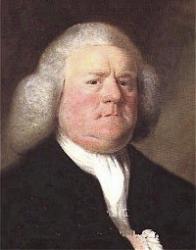
1711 - 1779 Person Name: William Boyce (1710-1779) Topics: Scripture Composer of "KINGSLAND" in Common Praise (1998) William Boyce (baptised 1711 – d. 7 February 1779) was an English composer and organist.
See also in:
Wikipedia
William Boyce
Pages




