You help make Hymnary.org possible. More than 10 million people from 200+ countries found hymns, liturgical resources and encouragement on Hymnary.org in 2025, including you. Every visit affirms the global impact of this ministry.

If Hymnary has been meaningful to you this year, would you take a moment today to help sustain it? A gift of any size—paired with a note of encouragement if you wish—directly supports the server costs, research work and curation that keep this resource freely available to the world.

Give securely online today, or mail a check to:
Hymnary.org
Calvin University
3201 Burton Street SE
Grand Rapids, MI 49546

Thank you for your partnership, and may the hope of Advent fill your heart.

Person Results

Tune Identifier:"^dundee_ravenscroft$"
In:people

Planning worship? Check out our sister site, ZeteoSearch.org, for 20+ additional resources related to your search.
Showing 91 - 100 of 145Results Per Page: 102050

Eva Kushner

Person Name: Eva Dubska-Kushner Translator (French) of "Awake, my soul, stretch ev'ry nerve" in Cantate Domino

Benjamin Waugh

1839 - 1908 Person Name: B. Waugh Author of "Now let us see thy beauty, Lord" in Isles of Shoals Hymn Book and Candle Light Service Waugh, Benjamin, was born at Settle, in Yorkshire, Feb. 20, 1839, and educated for the Congregational Ministry at Airedale College, Bradford. He has held pastorates at Newbury, Berkshire, Greenwich, and New Southgate. He has been for several years editor of The Sunday Magazine, and a large contributor to its pages. He has published (1) The Goal Cradle, Who rocks it; (2) Sunday Evenings with my Children; (3) The Children's Sunday Hour; (4) The Child of the English Savage; (5) Imperial Legislation and Street Children. Mr. Waugh's hymns have appeared from time to time in The Sunday Magazine, and have not been separately published. Those which have come into common use include:— 1. Jesus, the Friend of friendless men. Jesus the Sinner's Friend. 1874. 2. 0 happy pair of Nazareth. The Child Jesus. 3. O let me see Thy beauty. Lord. The Beauty of the Lord. This is given in a revised form as “Now let us see Thy beauty, Lord," in Horder's Congregational Hymns, 1884. Mr. Waugh's hymns are for children's use, and are exceedingly fresh and unconventional. Several others of merit might be selected from the Sunday Magazine with advantage to children's hymnody. [Rev. W. Garrett Horder] -- John Julian, Dictionary of Hymnology (1907) ================= Waugh, B., p. 1241, ii. He has published a collection of 93 original Hymns for Children, 1892. Nos. 1, 3 of those noted here are in the Sunday School Hymnary, 1905; No. 2 is in Worship Song, 1905. 1. Heavenly Father, I would serve Thee. [Childlike Service.] Written 1890; 1892, as above, p. 64. 2. I'll come to Thee, 0 Jesus Christ, [Following Jesus.] Written 1879; first published in the Sunday Magazine in 1882. 3. Where is Jesus, little children. [Jesus ever present.) Written 1890; 1892, p. 54; also in School Hymns, 1891, No. 422. Mr. Waugh's work at p. 1241, ii., as The Good Cradle, &c, should be The Goal Cradle, &c. [Rev. James Mearns, M.A.] --John Julian, Dictionary of Hymnology, New Supplement (1907)

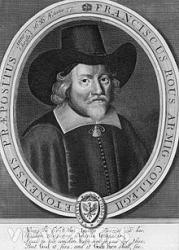
Francis Rous

1579 - 1659 Person Name: F Rous Author of "(Psalm 121) I to the Hills will Lift mine Eyes" in Redemption Hymnal Rous, Francis (Rouse), was born at Halton, Cornwall, in 1579, and educated at Oxford. He adopted the legal profession, and way M.P. for Truro during the reigns of James and of Charles I. He also represented Truro in the Long Parliament, and took part against the King and the Bishops. He was appointed a member of the Westminster Assembly; of the High Commission; and of the Triers for examining and licensing candidates for the ministry. He also held other appointments under Cromwell, including that of Provost of Eton College. He died at Acton, Jan. 7, 1659, and was buried in the Chapel of Eton College. Wood, in his Athenae Oxmienses, gives a list of his numerous works. --Excerpts from John Julian, Dictionary of Hymnology (1907) ==================== Rous, Francis, pp. 918, ii.; 927, ii.; 979, i., 1023, i. The.history of the Rous version of the Psalms is still rather obscure. At p. 918, ii., it is said to have been first published 1641, and reprinted with "further changes" in 1643. The present writer has been allowed to compare the— Booke of Psalmes in English Meeter. Printed for Henry Tutill, Bookseller at Rotterdam, 1638, with the Psalmes of David in English Meeter, set forth by Francis Rous . . . London, Printed by James Young, for Philip Nevill, at the signe of the Gun in Ivie-lane, 1643. The preface is the same in both, and a careful collation of a considerable number of the versions showed no variations except in spelling, the only variation observed being that the ed. of 1643 adds, after Ps. 150, a supplement of— Psalmes of harder and lesse usuall Tunes corrected, and the Tunes not altered; with versions of Pss. 51, 111, 112, 113, 120, 121, 122, 124, 125, 126, 127, 130, and 148. The Psalter of 1647, said to be in the B. M. by Mr. Glass, p. 85 (see p. 926, ii.), is not by Rous, but is a reprint of the Bay Psalm Book noted by Glass at p. 82. [Rev. James Mearns, M.A.] --John Julian, Dictionary of Hymnology, New Supplement (1907)

N. L. Frothingham

1793 - 1870 Person Name: Nathaniel Langdon Frothingham Author of ""Remember me," the Master said" in Hymns of the Spirit for Use in the Free Churches of America Frothingham, Nathaniel Langdon, D.D., born at Boston July 23rd, 1793, and graduated at Harvard 1811, where he was also sometime Tutor. From 1815 to 1850 he was Pastor of the First Church (Unitarian), Boston, and subsequently attended as a worshipper the church where he had been 35 years minister till his sight and strength failed him. He died April 4th, 1870. His Metrical Pieces, in 2 volumes, were published in 1855 and 1870. 1. O God, Whose presence glows in all. Ordination. This was written in 1828 for the ordination of W. B. Lunt, New York. 2. We meditate the day . Installation. Written in 1835 for Mr. Lunt's installation at Quincy, Mass., as Co-pastor with Peter Whitney. 3. O Lord of life and truth and grace . Ordination. Also a special hymn. It was composed for the ordination of H. W. Bellowes, New York, 1839. It is found in common with Nos. 1 and 2 in Frothingham's Metrical Pieces, 1855. These Metrical Pieces are unknown to the English Collections. [Rev. F. M. Bird, M.A.] --John Julian, Dictionary of Hymnology (1907) ================ Frothingham, N. L. , p. 400, ii. Other hymns are:— 1. O Saviour, Whose immortal word. Opening of a Place of Worship. Written "For the Dedication of the Church of the Saviour, Boston, November 16, 1847." 2. Remember Me, the Saviour said. Holy Communion. 3. They passed away from sight. Death and Burial. 4. When I am weak, I'm strong. Spiritual Strength. Nos. l, 2, and 4 are from his Metrical Pieces, Translated and Original, 1855, --John Julian, Dictionary of Hymnology, Appendix, Part II (1907)

John Cadvan Davies

1846 - 1923 Person Name: J. C. Davies, M.A. (Cyf.) of "O! Dduw ein nerth drwy'r oesau gynt (O God, our help in ages past)" in Cân a Mawl

Ernest Edwin Ryden

1886 - 1981 Person Name: Ernest E. Ryden Author of "Didst Thou, Dear Jesus, Pray For Me" in American Lutheran Hymnal Ernest Edwin Ryden is a distinguished Lutheran clergyman who has been a life-long student of hymns. At present he is pastor of Emanuel Lutheran Church in North Grosvenordale, Connecticut. This is the latest of a long series of services he has rendered in the Lutheran Church. For twenty-seven years he was editor of "The Lutheran Companion," the official organ of the former Augustana Lutheran Church. His contributions to hymnody were many. He was a member of the Committee which created the Augustana Hymnal of 1925 to which he contributed eight original hymns and translations. He was co-editor of the Junior Hymnal for which he wrote a number of hymns. He was secretary of the committee which prepared the Service Book and Hymnal. Here again he has contributed new hymns and translations. He is the author of two volumes, "The Story of Our Hymns," and "The Story of Christian Hymnody." In 1949 he was made a Knight of the Royal Order of the North Star by the King of Sweden for his work in the field of hymnological research. He is the author of one of the Children's Hymns published by the Hymn Society. ----Twelve New Lord’s Day Hymns, 1968. Used by permission. ============================== In 1948 [Ryden] was one of the official representatives of his Church at the constituting Assembly of the World Council of Churches in Amsterdam. --Twelve New Hymns for Children, 1965. Used by permission.

John Fawcett

1740 - 1817 Person Name: Rev. John Fawcett Author of "How precious is the book Divine" in The Haverford School Hymnal An orphan at the age of twelve, John Fawcett (b. Lidget Green, Yorkshire, England, 1740; d. Hebden Bridge, Yorkshire, 1817) became apprenticed to a tailor and was largely self-educated. He was converted by the preaching of George Whitefield at the age of sixteen and began preaching soon thereafter. In 1765 Fawcett was called to a small, poor, Baptist country church in Wainsgate, Yorkshire. Seven years later he received a call from the large and influential Carter's Lane Church in London, England. Fawcett accepted the call and preached his farewell sermon. The day of departure came, and his family's belongings were loaded on carts, but the distraught congregation begged him to stay. In Singers and Songs of the Church (1869), Josiah Miller tells the story associated with this text: This favorite hymn is said to have been written in 1772, to commemorate the determination of its author to remain with his attached people at Wainsgate. The farewell sermon was preached, the wagons were loaded, when love and tears prevailed, and Dr. Fawcett sacrificed the attraction of a London pulpit to the affection of his poor but devoted flock. Fawcett continued to serve in Wainsgate and in the nearby village of Hebden Bridge for the remainder of his active ministry. Bert Polman =============== Fawcett, John, D.D., was born Jan. 6, 1739 or 1740, at Lidget Green, near Bradford, Yorks. Converted at the age of sixteen under the ministry of G. Whitefield, he at first joined the Methodists, but three years later united with the Baptist Church at Bradford. Having begun to preach he was, in 1765, ordained Baptist minister at Wainsgate, near Hebden Bridge, Yorks. In 1772 he was invited to London, to succeed the celebrated Dr. J. Gill, as pastor of Carter's Lane; the invitation had been formally accepted, the farewell sermon at Wainsgate had been preached and the wagons loaded with his goods for removal, when the love and tears of his attached people prevailed and he decided to remain. In 1777 a new chapel was built for him at Hebden Bridge, and about the same time he opened a school at Brearley Hall, his place of residence. In 1793 he was invited to become President of the Baptist Academy at Bristol, but declined. In 1811 he received from America the degree of D.D., and died in 1817, at the age of 78. Dr. Fawcett was the author of a number of prose works on Practical Religion, several of which attained a large circulation. His poetical publications are:— (1) Poetic Essays, 1767; (2) The Christian's Humble Plea, a Poem, in answer to Dr. Priestley against the Divinity of our Lord Jesus Christ, 1772; (3) Three hymns, in the Gospel Magazine, 1777; (4) The Death of Eumenio, a Divine Poem, 1779; (5) Another poem, suggested by the decease of a friend, The Reign of Death, 1780; and (6) Hymns adapted to the circumstances of Public Worship and Private Devotion, Leeds, G. Wright & Son. 1782. They are 166 in number, and were mostly composed to be sung after sermons by the author. Whilst not attaining a high degree of excellence as poetry, they are "eminently spiritual and practical," and a number of them are found in all the Baptist and Congregational hymn-books that have appeared during the last 100 years. The best known of these are, “Infinite excellence is Thine;" "How precious is the Book divine;" "Thus far my God hath led me on;" "Religion is the chief concern;" "Blest be the tie that binds;" “I my Ebenezer raise;" and "Praise to Thee, Thou great Creator." These hymns, together with others by Fawcett, are annotated under their respective first lines. [Rev. W. R. Stevenson, M.A.] In addition the following hymns, also by Fawcett, but of less importance, are in common use: 1. Behold the sin-atoning Lamb. Passiontide. No. 60 of his Hymns, 1782, in 7 stanzas of 4 lines. In several hymnals in Great Britain and America. 2. I my Ebenezer raise. Birthday. No. 102 of his Hymns, in 10 stanzas of 4 lines. Usually given in an abbreviated form. 3. Infinite excellence is Thine. Jesus the Desire of Nations. No. 42 of his Hymns, in 12 stanzas of 4 lines. In several hymn-books in Great Britain and America in an abridged form. 4. Jesus, the heavenly Lover, gave. Redemption in Christ. No. 10 of his Hymns, &c., 1782, in 7 stanzas of 4 lines, and headed, "The marriage between Christ and the Soul." In Snepp's Songs of Grace & Glory, 1872, it reads, “Jesus, the heavenly Bridegroom, gave," and stanza v. is omitted. 5. Lord, hast Thou made me know Thy ways? Perseverance. No. 122 of his Hymns, &c., 1782, in 8 stanza of 4 lines. In the Baptist Hymnal, 1879, No. 451, stanzas iv.-vii. are omitted. 6. 0 God, my Helper, ever near. New Year. No. 108 of his Hymns, &c., 1782, in 6 stanzas of 4 lines. The New Congregational Hymn Book, 1859-69 omits st. vi. 7. 0, my soul, what means this sadness? Sorrow turned to Joy. No. 111 of his Hymns, &c., 1782, in 5 stanzas of 6 lines, and based upon the words, "Why art Thou cast down, O my soul?" &c. It is in common use in America, and usually with the omission of stanza ii. as in Dr. Hatfield's Church Hymn Book, 1872. 8. Sinners, the voice of God regard. Invitation to Repentance. No. 63 of his Hymns, &c., 1782, in 7 stanzas of 4 lines on Isaiah lv. 7, "Let the wicked forsake his way," &c. It is in common use in America, but usually in an abbreviated form. 9. Thy presence, gracious God, afford. Before Sermon. No 165 in his Hymns, &c., in 4 stanzas of 4 lines, and a chorus of two lines. In Dr. Hatfield's Church Hymnbook, 1872, No. 126, the chorus is omitted. Fawcett has another hymn on the same subject (No. 79) and beginning, "Thy blessing, gracious God, afford," but this is not in common use. 10. Thy way, 0 God, is in the sea. Imperfect Knowledge of God. No. 66 in his Hymns, &c., 1782, in 7 stanzas of 4 lines on 1 Corinthians xiii. 9, "We know in part," &c. It is in several American collections, usually abbreviated, and sometimes as, "Thy way, O Lord, is in the sea." In this form it is in The Sabbath Hymn Book, 1858, &c. 11. With humble heart and tongue. Prayer for Guidance in Youth. No. 86 in his Hymns, &c., 1782, in 7 stanzas of 4 lines on Psalms cxix. 9. "Wherewith shall a young man cleanse his way." It is No. 954 in the Baptist Psalms and Hymns, 1858-80. About 20 of Fawcett's hymns are thus still in common use. Two hymns which have been ascribed to him from time to time, but concerning which there are some doubts, are fully annotated under their respective first lines. These are," Humble souls that seek salvation," and "Lord, dismiss us with Thy blessing." -- John Julian, Dictionary of Hymnology (1907)

J. S. De Silva

1868 - 1940 Person Name: John Simon de Silva Translator of "විසඳන්ට මෙලෝ නැණින්" in The Cyber Hymnal

John Marckant

Person Name: John Markant Author of "O Lord, turn not Thy face away" in Church Hymns and Tunes Marckant, John, fl. 1562; one of contributors to the Sternhold & Hopkins metrical psalter of 1562; inducted vicar of Clacton-Magna 1559; Vicar of Shopland, Essex 1563-8. LOC Name Authority Files ================== 16th Century Marckant was Incumbent of Clacton Magna (1559) & Shopland (1563-68), England. He wrote only few small pieces: a political poem on Lord Wentworth (1558-59); a New Year’s gift entitled With Speed Return to God; and Verses to Divers Good Purposes (circa 1580). He also contributed four entries to the metrical version of the Psalms known as the Old Version. Sources: Hughes, pp. 141-46 Julian, p. 863 http://www.hymntime.com/tch/bio/m/a/r/c/marckant_j.htm ================ http://en.wikipedia.org/wiki/John_Marckant

Granton Douglas Hay

b. 1943 Person Name: Granton Douglas Hay, 1943- Adapter of "I to the hills will lift my eyes" in Together in Song

Pages


Export as CSV
It looks like you are using an ad-blocker. Ad revenue helps keep us running. Please consider white-listing Hymnary.org or getting Hymnary Pro to eliminate ads entirely and help support Hymnary.org.