You help make Hymnary.org possible. More than 10 million people from 200+ countries found hymns, liturgical resources and encouragement on Hymnary.org in 2025, including you. Every visit affirms the global impact of this ministry.

If Hymnary has been meaningful to you this year, would you take a moment today to help sustain it? A gift of any size—paired with a note of encouragement if you wish—directly supports the server costs, research work and curation that keep this resource freely available to the world.

Give securely online today, or mail a check to:
Hymnary.org
Calvin University
3201 Burton Street SE
Grand Rapids, MI 49546

Thank you for your partnership, and may the hope of Advent fill your heart.

Person Results

Topics:progress
In:people

Planning worship? Check out our sister site, ZeteoSearch.org, for 20+ additional resources related to your search.
Showing 91 - 100 of 250Results Per Page: 102050

Is. Smith

1734 - 1805 Person Name: I. Smith Topics: Progress Composer of "SILVER STREET" in The Church Hymnal Isaac Smith; published "A Collection of Psalm Tunes" about 1770 Evangelical Lutheran Hymnal, 1908

Jane Borthwick

1813 - 1897 Topics: Kingdom of Christ Progress of Author of "And is the time approaching" in The Hymnal Miss Jane Borthwick, the translator of this hymn and many others, is of Scottish family. Her sister (Mrs. Eric Findlater) and herself edited "Hymns from the Land of Luther" (1854). She also wrote "Thoughts for Thoughtful Hours (1859), and has contributed numerous poetical pieces to the "Family Treasury," under the signature "H.L.L." --Annotations of the Hymnal, Charles Hutchins, M.A. 1872. ================================= Borthwick, Jane, daughter of James Borthwick, manager of the North British Insurance Office, Edinburgh, was born April 9, 1813, at Edinburgh, where she still resides. Along with her sister Sarah (b. Nov. 26, 1823; wife of the Rev. Eric John Findlater, of Lochearnhead, Perthshire, who died May 2, 1886) she translated from the German Hymns from the Land of Luther, 1st Series, 1854; 2nd, 1855; 3rd, 1858; 4th, 1862. A complete edition was published in 1862, by W. P. Kennedy, Edinburgh, of which a reprint was issued by Nelson & Sons, 1884. These translations, which represent relatively a larger proportion of hymns for the Christian Life, and a smaller for the Christian Year than one finds in Miss Winkworth, have attained a success as translations, and an acceptance in hymnals only second to Miss Winkworth's. Since Kennedy's Hymnologia Christiana, 1863, in England, and the Andover Sabbath Hymn Book, 1858, in America, made several selections therefrom, hardly a hymnal in England or America has appeared without containing some of these translations. Miss Borthwick has kindly enabled us throughout this Dictionary to distinguish between the 61 translations by herself and the 53 by her sister. Among the most popular of Miss Borthwick's may be named "Jesus still lead on," and "How blessed from the bonds of sin;" and of Mrs. Findlater's "God calling yet!" and "Rejoice, all ye believers." Under the signature of H. L. L. Miss Borthwick has also written various prose works, and has contributed many translations and original poems to the Family Treasury, a number of which were collected and published in 1857, as Thoughts for Thoughtful Hours (3rd edition, enlarged, 1867). She also contributed several translations to Dr. Pagenstecher's Collection, 1864, five of which are included in the new edition of the Hymns from the Land of Luther, 1884, pp. 256-264. Of her original hymns the best known are “Come, labour on” and "Rest, weary soul.” In 1875 she published a selection of poems translated from Meta Heusser-Schweizer, under the title of Alpine Lyrics, which were incorporated in the 1884 edition of the Hymns from the Land of Luther. She died in 1897. [Rev. James Mearns, M.A.] -- John Julian, Dictionary of Hymnology (1907) ======================== Borthwick, Jane, p. 163, ii. Other hymns from Miss Borthwick's Thoughtful Hours, 1859, are in common use:— 1. And is the time approaching. Missions. 2. I do not doubt Thy wise and holy will. Faith. 3. Lord, Thou knowest all the weakness. Confidence. 4. Rejoice, my fellow pilgrim. The New Year. 5. Times are changing, days are flying. New Year. Nos. 2-5 as given in Kennedy, 1863, are mostly altered from the originals. --John Julian, Dictionary of Hymnology, Appendix, Part II (1907) ============= Works: Hymns from the Land of Luther

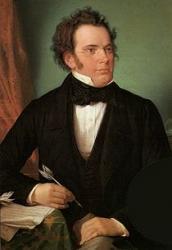
Franz Schubert

1797 - 1828 Person Name: Schubert Topics: Kingdom of Christ Progress of Composer of "SCHUBERT" in The Hymnal Franz Peter Schubert, 31 January 1797 – 19 November 1828) was an Austrian composer. In a short lifespan of just 31 years, Schubert was a prolific composer, writing some 600 Lieder, nine symphonies (including the famous "Unfinished Symphony"), liturgical music, operas, some incidental music, and a large body of chamber and solo piano music. Appreciation of Schubert's music during his lifetime was limited, but interest in his work increased significantly in the decades following his death. Franz Liszt, Robert Schumann, Johannes Brahms and Felix Mendelssohn, among others, discovered and championed his works in the 19th century. Today, Schubert is seen as one of the leading exponents of the early Romantic era in music and he remains one of the most frequently performed composers. Early life and education Schubert was born in Himmelpfortgrund (now a part of Alsergrund), Vienna, on 31 January 1797. His father, Franz Theodor Schubert, the son of a Moravian peasant, was a parish schoolmaster; his mother, Elisabeth Vietz, was the daughter of a Silesian master locksmith, and had also been a housemaid for a Viennese family prior to her marriage. Of Franz Theodor's fourteen children (one illegitimate child was born in 1783), nine died in infancy; five survived. Their father was a well-known teacher, and his school in Lichtental, a part of Vienna's 9th district, was well attended. He was not a musician of fame or with formal training, but he taught his son some elements of music. At the age of five, Schubert began receiving regular instruction from his father and a year later was enrolled at his father's school. His formal musical education also started around the same time. His father continued to teach him the basics of the violin, and his brother Ignaz gave him piano lessons. At the age of seven, Schubert began receiving lessons from Michael Holzer, the local church organist and choirmaster. Holzer's lessons seem to have mainly consisted of conversations and expressions of admiration and the boy gained more from his acquaintance with a friendly joiner's apprentice who used to take him to a neighboring pianoforte warehouse where he had the opportunity to practice on better instruments. He also played the viola in the family string quartet, with brothers Ferdinand and Ignaz on violin and his father on the cello. Schubert wrote many of his early string quartets for this ensemble. Schubert first came to the attention of Antonio Salieri, then Vienna's leading musical authority, in 1804, when his vocal talent was recognized. In October 1808, he became a pupil at the Stadtkonvikt (Imperial seminary) through a choir scholarship. At the Stadtkonvikt, Schubert was introduced to the overtures and symphonies of Mozart. His exposure to these pieces and various lighter compositions, combined with his occasional visits to the opera set the foundation for his greater musical knowledge. One important musical influence came from the songs of Johann Rudolf Zumsteeg, who was an important Lied composer of the time, which, his friend Joseph von Spaun reported, he "wanted to modernize". Schubert's friendship with Spaun began at the Stadtkonvikt and endured through his lifetime. In those early days, the more well-to-do Spaun furnished the impoverished Schubert with manuscript paper. Meanwhile, his genius began to show in his compositions. Schubert was occasionally permitted to lead the Stadtkonvikt's orchestra, and Salieri decided to begin training him privately in musical composition and theory in these years. It was the first germ of that amateur orchestra for which, in later years, many of his compositions were written. During the remainder of his stay at the Stadtkonvikt he wrote a good deal of chamber music, several songs, some miscellaneous pieces for the pianoforte and, among his more ambitious efforts, a Kyrie (D. 31) and Salve Regina (D. 27), an octet for wind instruments (D. 72/72a, said to commemorate the 1812 death of his mother), a cantata for guitar and male voices (D. 110, in honor of his father's birthday in 1813), and his first symphony (D. 82). At the end of 1813, he left the Stadtkonvikt, and returned home for studies at the Normalhauptschule to train as a teacher. In 1814, he entered his father's school as teacher of the youngest students. For over two years, the young man endured the drudgery of the work, which he performed with very indifferent success. There were, however, other interests to compensate. He continued to receive private lessons in composition from Salieri, who did more for Schubert’s musical training than any of his other teachers. Salieri and Schubert would part ways in 1817. In 1814, Schubert met a young soprano named Therese Grob, the daughter of a local silk manufacturer. Several of his songs (Salve Regina and Tantum Ergo) were composed for her voice, and she also performed in the premiere of his first Mass (D. 105) in September 1814. Schubert intended to marry Grob, but was hindered by the harsh marriage consent law of 1815, which required the ability to show the means to support a family. In November 1816, after failing to gain a position at Laibach, Schubert sent Grob's brother Heinrich a collection of songs, which were retained by her family into the 20th century. One of Schubert's most prolific years was 1815. He composed over 20,000 bars of music, more than half of which was for orchestra, including nine church works, a symphony, and about 140 Lieder. In that year, he was also introduced to Anselm Hüttenbrenner and Franz von Schober, who would become his lifelong friends. Another friend, Johann Mayrhofer, was introduced to him by Spaun in 1814. Maynard Solomon suggested that Schubert was erotically attracted to men, a thesis that has, at times, been heatedly debated. Musicologist and Schubert expert Rita Steblin claimed that he was "chasing women". Supported by friends Significant changes happened in 1816. Schober, a student of good family and some means, invited Schubert to room with him at his mother's house. The proposal was particularly opportune, for Schubert had just made the unsuccessful application for the post of Kapellmeister at Laibach, and he had also decided not to resume teaching duties at his father's school. By the end of the year, he became a guest in Schober's lodgings. For a time, he attempted to increase the household resources by giving music lessons, but they were soon abandoned, and he devoted himself to composition. "I compose every morning, and when one piece is done, I begin another." During this year, he focused on orchestral and choral works, although he also continued to write Lieder. Much of this work was unpublished, but manuscripts and copies circulated among friends and admirers. In early 1817, Schober introduced Schubert to Johann Michael Vogl, a prominent baritone twenty years Schubert's senior. Vogl, for whom Schubert went on to write a great many songs, became one of Schubert's main proponents in Viennese musical circles. He also met Joseph Hüttenbrenner (brother to Anselm), who also played a role in promoting Schubert's music. These, and an increasing circle of friends and musicians, became responsible for promoting, collecting, and, after his death, preserving his work. In late 1817, Schubert's father gained a new position at a school in Rossau (not far from Lichtental). Schubert rejoined his father and reluctantly took up teaching duties there. In early 1818, he was rejected for membership in the prestigious Gesellschaft der Musikfreunde, something that might have furthered his musical career. However, he began to gain more notice in the press, and the first public performance of a secular work, an overture performed in February 1818, received praise from the press in Vienna and abroad. Schubert spent the summer of 1818 as music teacher to the family of Count Johann Karl Esterházy at their château in Zseliz (then in Hungary, now in Slovakia). His duties were relatively light (teaching piano and singing to the two daughters, Marie and Karoline), and the pay was relatively good. As a result, he happily continued to compose during this time. It may have been at this time that he wrote one of his now world-famous compositions, the Marche militaire No. 1 in D major. Marie and Karoline both being his piano students, and the original score of "Marche Militaire" being a piano duet, lend credence to this view. On his return from Zseliz, he took up residence with his friend Mayrhofer. The respite at Zseliz led to a succession of compositions for piano duet. During the early 1820s, Schubert was part of a close-knit circle of artists and students who had social gatherings together that became known as "Schubertiaden". The tight circle of friends with which Schubert surrounded himself was dealt a blow in early 1820. Schubert and four of his friends were arrested by the Austrian police, who (in the aftermath of the French Revolution and Napoleonic Wars) were on their guard against revolutionary activities and suspicious of any gathering of youth or students. One of Schubert's friends, Johann Senn, was put on trial, imprisoned for over a year, and then permanently forbidden to enter Vienna. The other four, including Schubert, were "severely reprimanded", in part for "inveighing against [officials] with insulting and opprobrious language". While Schubert never saw Senn again, he did set some of his poems, "Selige Welt" and "Schwanengesang", to music. The incident may have played a role in a falling-out with Mayrhofer, with whom he was living at the time. He was nicknamed "Schwämmerl" by his friends, which Gibbs describes as translating to "Tubby" or "Little Mushroom". "Schwammerl" is Austrian (and other) dialect for mushroom; the umlaut makes it a diminutive. Musical maturity The compositions of 1819 and 1820 show a marked advance in development and maturity of style. The unfinished oratorio "Lazarus" (D. 689) was begun in February; later followed, amid a number of smaller works, by the 23rd Psalm (D. 706), the Gesang der Geister (D. 705/714), the Quartettsatz in C minor (D. 703), and the "Wanderer Fantasy" for piano (D. 760). Of most notable interest is the staging in 1820 of two of Schubert's operas: Die Zwillingsbrüder (D. 647) appeared at the Theater am Kärntnertor on 14 June, and Die Zauberharfe (D. 644) appeared at the Theater an der Wien on 21 August. Hitherto, his larger compositions (apart from his masses) had been restricted to the amateur orchestra at the Gundelhof, a society which grew out of the quartet-parties at his home. Now he began to assume a more prominent position, addressing a wider public. Publishers, however, remained distant, with Anton Diabelli hesitantly agreeing to print some of his works on commission. The first seven opus numbers (all songs) appeared on these terms; then the commission ceased, and he began to receive the meager pittances which were all that the great publishing houses ever paid him. The situation improved somewhat in March 1821 when Vogl sang "Der Erlkönig" at a concert that was extremely well received. That month, Schubert composed a variation on a waltz by Anton Diabelli (D. 718), being one of the fifty composers who contributed to Vaterländischer Künstlerverein. The production of the two operas turned Schubert's attention more firmly than ever in the direction of the stage, where, for a variety of reasons, he was almost completely unsuccessful. All in all, he produced seventeen stage works, each of them failures which were quickly forgotten. In 1822, Alfonso und Estrella was refused, partly owing to its libretto. Fierrabras (D. 796) was rejected in the fall of 1823, but this was largely due to the popularity of Rossini and the Italian operatic style, and the failure of Carl Maria von Weber's Euryanthe. Die Verschworenen (The Conspirators, D. 787) was prohibited by the censor (apparently on the grounds of its title), and Rosamunde (D. 797) was withdrawn after two nights, owing to the poor quality of the play for which Schubert had written incidental music. Of these works, the two former are written on a scale which would make their performances exceedingly difficult (Fierrabras, for instance, contains over 1,000 pages of manuscript score), but Die Verschworenen is a bright attractive comedy, and Rosamunde contains some of the most charming music that Schubert ever composed. In 1822, he made the acquaintance of both Weber and Beethoven, but little came of it in either case. Beethoven is said to have acknowledged the younger man's gifts on a few occasions, but some of this is likely legend and in any case he could not have known the real scope of Schubert's music – especially not the instrumental works – as so little of it was printed or performed in the composer's lifetime. On his deathbed, Beethoven is said to have looked into some of the younger man's works and exclaimed, "Truly, the spark of divine genius resides in this Schubert!" but what would have come of it if he had recovered we can never know. Last years and masterworks Despite his preoccupation with the stage, and later with his official duties, Schubert found time during these years for a significant amount of composition. He completed the Mass in A flat (fr) (D. 678) and, in 1822, embarked suddenly on a work which more decisively than almost any other in those years showed his maturing personal vision, the "Unfinished Symphony" in B minor. The reason he left it unfinished after two movements and sketches some way into a third remains an enigma, and it is also remarkable that he did not mention it to any of his friends even though, as Brian Newbould notes, he must have felt thrilled by what he was achieving. The event has been debated endlessly without resolution. In 1823 Schubert, in addition to Fierrabras, also wrote his first song cycle, Die schöne Müllerin (D. 795), setting poems by Wilhelm Müller. This series, together with the later cycle "Winterreise" (D. 911, also setting texts of Müller in 1827) is widely considered one of the pinnacles of Lieder. He also composed the song Du bist die Ruh ("You are stillness/peace") D. 776 during this year. Also in that year, symptoms of syphilis first appeared. In 1824, he wrote the variations for flute and piano on "Trockne Blumen", from the cycle Die schöne Müllerin, and several string quartets. He also wrote the Arpeggione Sonata (D. 821), at a time when there was a minor craze over that instrument. In the spring of that year he wrote the Octet in F (D. 803), "A Sketch for a Grand Symphony"; and in the summer went back to Zseliz. There he became attracted to Hungarian musical idiom, and wrote the Divertissement à la hongroise (D. 818) for piano duet and the String Quartet in A minor (D. 804). It has been said that he held a hopeless passion for his pupil, the Countess Karoline Eszterházy, but the only work he dedicated to her was his Fantasie in F minor (D. 940) for piano duet. The setbacks of previous years were compensated for by the prosperity and happiness of 1825. Publication had been moving more rapidly; the stress of poverty was for a time lightened; and in the summer he had a pleasant holiday in Upper Austria, where he was welcomed with enthusiasm. It was during this tour that he produced his "Songs from Sir Walter Scott". This cycle contains Ellens dritter Gesang (D. 839), a setting of Adam Storck's German translation of Scott's hymn from The Lady of the Lake, which is widely, though mistakenly, referred to as "Schubert's Ave Maria". It opens with the greeting Ave Maria, which recurs in the refrain; the entire Scott/Storck text in Schubert's song is frequently substituted with the complete Latin text of the traditional Ave Maria prayer. In 1825, Schubert also wrote the Piano Sonata in A minor (Op. 42, D. 845), and began the "Great" C major

Frank Mason North

1850 - 1935 Topics: Social Progress Author of "Where cross the crowded ways of life" in The Hymnal North, Frank Mason, D.D., b. at New York, Dec. 3, 1850, graduated at Wesleyan University 1872, and entered the ministry of the Methodist Episcopal Church 1872. In 1892 he became Correspondence Secretary of the New York City Church Extension and Missionary Society, and is now (1905) editor of The Christian City. His hymns in common use include:— 1. Jesus, the calm that fills my breast. [Peace.] In The Plymouth Hymnal,1894; Sursum Corda, 1898; The Methodist Hymnal, 1905, &c. 2. When cross the crowded ways of life. [City Missions.] In The Methodist Hymnal, 1905. [Rev. L. F. Benson, D.D.] --John Julian, Dictionary of Hymnology, New Supplement (1907) ================= North, Frank Mason, D.D. (December 3, 1850--December 17, 1935). The Appendix Index reference, p.1607 in Julian, to Dr. North is to John Post Attwater who used "Frank North" as his nom de plume. In addition to the information included in the short biographical sketch at p.1677 it should be added that Dr. North continued his studies at Wesleyan University, advancing to the M.A. degree in 1875, later being honored by that institution's D.D., 1894, and L.L.D., 1918. He was a member of the New York East Conference of the Methodist Episcopal Church and served several pastorates in New York State and City as well as one at Middletown, Connecticut, 1887-1892. During the years 1892-1912, while Corresponding Secretary of the New York City Extension and Missionary Society and the editor of The Christian City, he was also Corresponding Secretary of the National City Evangelical Union of the Methodist Episcopal Church. From 1912 to 1924 he was the Secretary of the Board of Foreign Missions of his church and through these years he served as Chairman of its Executive Committee. He was also Secretary, Chairman of the Executive Committee, and President of the Federal Council of the Churches of Christ in America. It was largely through his efforts and influence that the Federal Council was organized. Trustee and member of governing boards of numerous institutions in the United States, China, and Japan, among the additional honors which came to him were Chevalier Legion of Honor and "Officer de l'Instruction Publique," France; Officer of the Royal Order of George I, Greece. He was one of the great Protestant leaders of his generation. The leading article in The Hymn, 30 April 1950, was an excellent appreciation of Dr. North and his work. Sources: Handbooks of various hymnals; Who Was Who I; Foote, Henry Wilder, Three Centuries of American Hymnody; Ninde, Edward S., Story of the American Hymn; Bailey, ALbert E., The Gospel in Hymns; Pratt, John Barnes, Present Day Hymns; correspondence. --Robert G. McCutchan, DNAH Archives

Ignaz Pleyel

1757 - 1831 Person Name: Ignaz J. Pleyel Topics: Social Progress Composer (arr. from) of "[PLEYEL'S HYMN]" in The Hymnal Ignaz Joseph Pleyel; b. Ruppertstahl, near Vienna, 1757; d. Parice France, 1831 Evangelical Lutheran Hymnal, 1908

Edward Denny

1796 - 1889 Person Name: Sir Edward Denny, Bart., 1796-1889 Topics: Kingdom of Christ (See Missions) Progress and triumph of Author of "Light of the lonely pilgrim's heart" in Methodist Hymn and Tune Book Denny, Sir Edward, Bart . Sir Edward Denny, son of Sir E. Denny, 4th baronet, of Tralee Castle, County of Kerry, was born 2 Oct., 1796, and succeeded his father in August, 1831. He is a member of the Plymouth Brethren, and has contributed largely to their hymnody. His first publication, in which many of his hymns appeared, was A Selection of Hymns, Lond. Central Tract Depot, 1839. This was followed by Hymns & Poems , Lond., 1848 (third ed., 1870). He has also published several prose works. Many of his hymns are popular, and are in extensive use as:—" A pilgrim through this lonely world"; "Bride of the Lamb, rejoice, rejoice"; “Bright with all His crowns of glory"; “Light of the lonely pilgrim's heart”; "Sweet feast of love divine," and several others. In addition to these, which are separately annotated, and those which are confined in their use to the congregations of the "Brethren," there are also nearly 20 in limited use in Great Britain and America. Of these the following appeared, first in his Selection of Hymns, 1839; then, in the Appendix to Hymns for the Poor of the Flock, 1841; and then in his Hymns & Poems, 1848-70 :— 1. Break forth, 0 earth, in praises. Praise for Redemption. This is given in several collections in Great Britain and America. 2. Children of God, in all your need. The Great High Priest. In limited use. 3. Children of light, arise and shine. Looking unto Jesus. In numerous hymnals in G. Britain and America. 4. Children of light, awake, awake. Advent . This hymn is an application of the Parable of the Ten Virgins to the Second Coming of Christ. 5. Dear Lord, amid the throng that pressed. The Holy Women at the Cross. The use of this hymn in America is somewhat extensive. 6. Hope of our hearts, 0 Lord, appear. The Second Advent desired. In the Hymns for the Poor of the Flock, 1837; and the author's Hymns & Poems, 1848-60, and various collections in Great Britain and America. 7. Joy to the ransomed earth. Jesus the King. Its use is limited. 8. Lo 'tis the heavenly army. The Second Advent. The original of this hymn is in 4 stanzas of 10 lines and as such it is usually given: but in the Peoples Hymnal, 1867, it is arranged in 4 stanzas of 8 lines, and is also slightly altered. 9. 0 grace divine! the Saviour shed. Good Friday. In limited use. 10. 0 what a bright and blessed world. The New Earth. This hymn is based upon Gen. v. 29, as interpreted from a Millennial point of view. Christ is regarded as the Rest (Noah-Rest) of His people, and the remover of the curse from the earth. 11. Sweet was the hour, 0 Lord, to Thee. Christ at the Well of Sychar. Limited in use. 12. Thou vain deceitful world, farewell. Forsaking the World for Christ. In several collections. 13. Through Israel's land the Lord of all . Mission to the Jews. In addition to its use in its full form, it is also given as: "O Zion, when thy Saviour came," as in Dr. Walker's Psalms & Hymns, 1855-71; Snepp's Songs of Grace & Glory, and others. This opens with stanza ii. 14. 'Tis finish'd all—our souls to win. Jesus the Guide and Friend. In several collections. 15. 'Tis He, the Mighty Saviour comes . Missions . Given in Snepp, and one or two others. 16. 'Tis night, but O the joyful morn. Hope. In a few hymnals; also, beginning with stanzas ii., "Lord of our hearts, beloved of Thee," in Dr. Hatfield's Church Hymn Book, N. Y., 1872. 17. To Calvary, Lord, in Spirit now. Good Friday. This is given in several hymnals, including Spurgeon's Our Own Hymn Book, 1866, &c. The next is in the Selection of 1839, and the Hymns & Poems, 1848-70:— 18. 0 Blessed Lord, Thy feeble Sheep. The Good Shepherd. Its use is limited. The three with which we close are from J. G, Deck's Psalms & Hymns, 1842, Pt. ii., and the Hymns & Poems, 1848-70:— 19. Hark to the trump! behold it breaks . The Resurrection . The design of this hymn is thus described, by the author: "These lines are supposed to be the utterance of the saints at the blessed moment when they are actually ascending to meet the Lord in the air, as described in 1 Cor. xv. 51-57 and 1 Thess. iv. 16-18. It is given in several collections." 20. Isles of the deep, rejoice, rejoice. Missions. 21. Where, in this waste unlovely [and desert] world! Rest for the Weary. Its use is limited. -- John Julian, Dictionary of Hymnology (1907) ===================== Denny, Sir Edward, Bart., p. 287, ii., died in London, June 13, 1889. Additional pieces from his Selection of Hymns, 1839, are in modern collections including:— 1. O wondrous hour! when, Jesus, Thou. Good Friday . 2. 'Tis past, the dark and dreary night. Easter. 3. While in sweet communion feeding. Holy Communion. --John Julian, Dictionary of Hymnology, Appendix, Part II (1907)

Samuel A. Ward

1848 - 1903 Topics: Social Progress Composer of "MATERNA" in Elmhurst Hymnal

Michael Bruce

1746 - 1767 Person Name: Michael Bruce, 1746-1767 Topics: Kingdom of Christ (See Missions) Progress and triumph of Author of "Behod! the mountain of the Lord" in Methodist Hymn and Tune Book Bruce, Michael, son of a Scottish weaver, was born at Kinnesswood, Portmoak, Kinrossshire, Scotland, March 27,1746, and educated at the village school, Edinburgh University (where he first became acquainted with John Logan), and the Theological Hall of the Associate Synod, held at Kinross, under the Rev. John Swanston, intending ultimately to enter the ministry, a hope which was frustrated by his untimely death. To assist in procuring University fees and maintenance he for some time conducted a school, during the recess, at Gairney Bridge, and subsequently at Forrest Mill, near Tillicoultry. Whilst yet a student he died at Kinnesswood, July 5th, 1767. [Also, see Logan, John] The names of Michael Bruce and John Logan are brought together because of the painful controversy which has long prevailed concerning the authorship of certain Hymns and Paraphrases of Holy Scripture which are in extensive use in the Christian Church both at home and abroad. During the latter years of Bruce's short life he wrote various Poems, and also Hymns for a singing class at Kinnesswood, which were well known to his family and neighbours, and were eventually copied out by Bruce himself in a quarto MS. book, with the hope that some day he might see them in print. Immediately upon his death, in 1767, Logan called upon his father and requested the loan of this book that he might publish the contents for the benefit of the family. This was granted. Not till three years afterwards did a certain work, containing seventeen poems, and entitled Poems on Several Occasions , by Michael Bruce, 1770, appear, with a Preface in which it was stated that some of the Poems were by others than Bruce. -- John Julian, Dictionary of Hymnology (1907)

William Augustus Muhlenberg

1796 - 1877 Person Name: W. A. Muhlenberg Topics: The Church Its Progress and Triumph Author of "Shout the Glad Tidings" in Westminster Sabbath School Hymnal, a collection of hymns and tunes for use in sabbath-schools and social meetings Mühlenberg, William Augustus, D.D., son of the Rev. Dr. Mühlenberg, and grandson of Henry Melchior Mühlenberg, the patriarch of Lutheranism in America, was born in Philadelphia Sept. 16, 1796. He graduated at the University of Pennsylvania in 1814. Entering Holy Orders in 1817, he was successively Assistant Rector of St. James's Lancaster, 1823; Rector of the Church of the Holy Communion, New York, 1843; St. Paul's College, Flushing (1828); St. Luke's Hospital, New York (1855); St. John's and Long Island (1865), were established by him. He died April 6, 1877. His poetical gift was genuine, but not largely used. In 1826 he contributed four hymns to the Prayer Book Collection (of which he was one of the Committee). His Poems appeared in 1859. He had previously published Church Poetry, 1823; and The People's Psalter, 1858. I would not live alway followed in 1859 (revised in 1871). This last contains 26 pieces, the hymns in the Prayer Book Collection, 1826, with the exception of "I would not live alway," being omitted. The following are his principal lyrics:— 1. Carol, brothers, carol. Christmas Carol. "Made for the boys of St. Paul's College—-the Chorus adapted from one of the Rev.[Bishop] A.C. Coxe's Christian Ballads"-—in 1840. 2. How short the race our friend has run. Death of a Young Person. Contributed to the Prayer Book Collection, 1826. 3. I would not live alway. Eternal rest desired. Four texts of this poem are extant: 1st the Original; 2nd the version given in the Prayer Book Collection, 1826; 3rd the author's revised version of 1859; and 4th his rewritten text of 1871, the second of these being that known to the hymnbooks. The history of the poem is somewhat complicated. We quote it here as given by us in the History of the American Episcopal Church, 1885, p.637, as we have nothing further to add thereto:-— "The most famous of these (Dr. Mühlenberg's hymns) was probably first written. 'I will not live alway' has an intricate history, which was not simplified by the author's lapse of memory in his later years. In his brief ‘story of the hymn,' printed with its ‘evangelized’ text in 1871, every date is wrong by two or three years; and his assertion, ‘The legend that it was written on an occasion of private grief is a fancy,' hardly agrees with the clear and minute recollections of persons of the highest character, still living, and who knew the circumstances thoroughly. The date of composition assigned, 1824, is probably (not certainly) correct; it was written at Lancaster, in a lady's album, and began:— I would not live alway; no, no, holy man, Not a day, not an hour, should lengthen my span.' In this shape it seems to have had six eight-line stanzas. The album was still extant in 1876, at Pottstown, Pa., and professed to contain the original manuscript. Said the owner's sister, ‘It was au impromptu. He had no copy, and, wanting it for some occasion, he sent for the album.' In 1826 he entrusted his copy to a friend, who called on him on the way from Harrisburg to Philadelphia, to carry to the Episcopal Recorder, and in that paper it appeared June 3, 1826 (not 1824). For these facts we have the detailed statement of Dr. John B. Clemson, of Claymont, Del., the Ambassador mentioned, who also chances to have preserved that volume of the paper. Thus appearing (without name) it was adopted by the sub-committee [of the Prayer Book Collection, 1826]. When their report was presented to the entire committee in 1826—-not 1829, as Dr. Mühlenberg had it—-'each of the hymns was passed upon. When this came up one of the members remarked that it was very sweet and pretty, but rather sentimental, upon which it was unanimously thrown out. Not suspected as the author, I voted against myself. That, I supposed, was the end of it.’ The committee, which sat until late at night at the house of Bishop White, agreed upon their report to the Convention, and adjourned. But the next morning Dr. Onderdonk (who was not one of their number, but who, on invitation, had acted with the sub-committee, which in fact consisted of him and myself), called on me to inquire what had been done. Upon my telling him that among the rejected hymns was this one of mine, he said, 'That will never do,' and went about among the members of the committee soliciting them to restore the hymn in their report, which accordingly they did; so that to him is due the credit of giving it to the Church.' As thus adopted it was a small and altered selection from the original lines, made by Dr. Onderdonk ‘with some revision' by the author. He was never satisfied with these texts, but revised the poem in 1859, and re¬wrote it in 1871….The authorship of this, as of many another popular lyric, has been disputed. The claim of Henry Ward, a printer of Lichfield, Conn., has been vehemently urged, and revived but a few years ago. Of course it is unsupported by adequate evidence. When Dr. Mühlenberg was asked to assure ‘some of his brethren, editors of Church papers,' of his paternity, his manly reply was, ‘If they thought I was capable of letting the work of another pass for so many years as my own, they would not be sure of anything I might say.'" 4. Jesus' Name shall ever be. The Holy Name, Jesus. This is entitled "The Blessed Name of Jesus. An Evangelical Rosary." It was written in 1842, and revised for Schaff's Christ in Song in Aug., 1868. 5. King of kings, and wilt Thou deign. Submission to Jesus. Appeared in his Poems, 1859. 6. Like Noah's weary dove. The Ark of the Church. Contributed to the Prayer Book Collection, 1826, No. 24, in 5 st. of 4 1. It sometimes begins with st. ii., "0 cease, my wandering soul;" and again with st. in., "Behold the Ark of God." 7. Saviour, Who Thy flock art feeding. Holy Baptism. This is the most widely known of Dr. Mühlenberg's hymns. It was contributed to the Prayer Book Collection, 1826, No. 86, in 4 st. of 4 1. It is sometimes given as "Jesus, Who Thy flock art feeding." 8. Shout the glad tidings, exultingly sing. Christmas. Contributed to the Prayer Book Collection, 1826, No. 46, in 3 st. of 4 1., with the chorus :— "Shout the glad tidings, exultingly sing, Jerusalem triumphs, Messiah is King;" the opening lines, followed by the first stanza, and a repetition of the chorus, and so on to the end. Sometimes the hymn opens with st. i.: "Zion, the marvellous story be telling," or as “Sion the marvellous story be telling," instead of the chorus. Dr. Mühlenberg says that the hymn was written— "at the particular request of Bishop Hobart, who wanted something that would go to the tune by Avison, then popular, to the words of Moore, ‘Sound the loud timbrel,' &c. He liked the verses I made so well that he had them struck off before the hymns (Prayer Book Collection] were published, and sung in Trinity Church on Christmas day." 9. Since o'er Thy footstool here below. Earth and Heaven. Appeared in the Episcopal Register, 1824, and in his Poems, 1859. 10. The mellow eve is gliding. Evening. Dated 1825 (?) and published in his Poems, 1859. 11. The throne of his glory—-as snow it is white. Advent. Dated 1839, and published in his Poems, 1859. 12. Thine handmaid,Saviour, can it be? Admission of a Nursing Sister. Written on the words, "Come, follow me," for the reception of a Sister at St. Luke's Hospital, New York, 1859. [Rev. F. M. Bird, M.A.] --John Julian, Dictionary of Hymnology (1907) See also in: Hymn Writers of the Church

Louis Spohr

1784 - 1859 Person Name: Louis Spohr, 1784-1859 Topics: Kingdom of Christ (See Missions) Progress and triumph of Composer of "SPOHR" in Methodist Hymn and Tune Book Also: Spohr, Ludwig, 1784-1859 Shpor, Lui, 1784-1859 Spohr, L. (Louis), 1784-1859 Shpor, Ludvig, 1784-1859 Spohr, Ludewig, 1784-1859

Pages


Export as CSV
It looks like you are using an ad-blocker. Ad revenue helps keep us running. Please consider white-listing Hymnary.org or getting Hymnary Pro to eliminate ads entirely and help support Hymnary.org.