You help make Hymnary.org possible. More than 10 million people from 200+ countries found hymns, liturgical resources and encouragement on Hymnary.org in 2025, including you. Every visit affirms the global impact of this ministry.

If Hymnary has been meaningful to you this year, would you take a moment today to help sustain it? A gift of any size—paired with a note of encouragement if you wish—directly supports the server costs, research work and curation that keep this resource freely available to the world.

Give securely online today, or mail a check to:
Hymnary.org
Calvin University
3201 Burton Street SE
Grand Rapids, MI 49546

Thank you for your partnership, and may the hope of Advent fill your heart.

Person Results

Topics:trinity+2
In:people

Planning worship? Check out our sister site, ZeteoSearch.org, for 20+ additional resources related to your search.
Showing 91 - 100 of 234Results Per Page: 102050

G. W. Kitchin

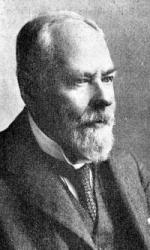
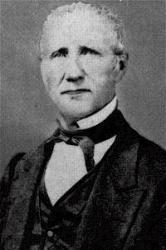
1827 - 1912 Person Name: George William Kitchin Topics: The Christian Year Holy Week; Adoration and Praise; Angels; Choruses and Refrains; Christian Year Passion/Palm Sunday; Commitment; Confirmation; Discipleship and Service; Jesus Christ Cross; Jesus Christ Guide and Leader; Jesus Christ High Priest; Jesus Christ Kingship, Conqueror; Jesus Christ Lamb of God; Jesus Christ name; Jesus Christ Reign; Jesus Christ Saviour; Kingdom of God; Music and Singing; New Creation; Opening Hymns; Peace (World); Processionals (Opening of Worship); Proclamation; Recessionals; Testimony; Unity; Victory; Vocation; Warfare (Spiritual); Worship; Zeal; Lent 2 Year A; Palm/Passion Sunday Year A; Lent 4 Year B; Trinity Sunday Year B; Proper 19 Year B; Easter 4 Year C Author of "Lift High the Cross" in Voices United A scholar and Anglican clergyman, George W. Kitchin (b. Naughton, Suffolk, England, 1827; d. Durham, England, 1912) spent most of his life in academic institu­tions. Educated at Christ Church, Oxford, England, he was ordained in the Church of England in 1852. He served initially as a headmaster in Twyford, Hampshire, and then as a tutor at Oxford (1863-1883). Later he served as Dean of Winchester Cathedral from 1883 to 1894 and of Durham Cathedral from 1894 to 1912; Kitchin was also chancellor of Durham University the last few years of his life. His publications include A Life of Pope Pius II (1881), a three ­volume work entitled A History of France (1877), and archeological writings. Bert Polman

Basil Harwood

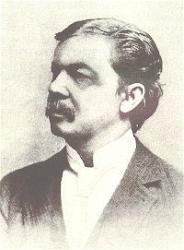
1859 - 1949 Topics: Trinity 2 Gospel Composer of "THORNBURY" in Magnify the Lord Basil Harwood (11 April 1859 – 3 April 1949) was an English organist and composer. Basil Harwood was born in Woodhouse, Gloucestershire (the second youngest of 12 children) on 11 April 1859. His mother died in 1867 when Basil was eight. His parents were Quakers but his elder sister Ada, on reaching 21 in 1867, converted to the Anglican Church. Basil was allowed to attend the ceremony at the Church of England in Almondsbury and this is where he was first drawn to organ music and choral singing. His father, Edward, remarried two years later in 1869 to a lady from an Anglican family. Basil was now sent to the Montpellier School in Weston-super-Mare for a year. In 1871, at 12 he was enrolled in Clevedon, the preparatory school for Charterhouse where he was first to formally study music. He went up to Charterhouse in 1874 and left in 1876 having won a leaving Exhibition to Trinity College, Oxford where he initially studied Classics (1879) and Modern History (1880). He then studied for a further two years, 1881–1882, at the Leipzig Conservatory under Carl Reinecke and Salomon Jadassohn. It was here in 1882, Basil composed his first anthem for chorus and organ "O Saving Grace." He returned from Leipzig to realise that he had now passed the age limit to study music formally. In 1883, Basil became organist of St. Barnabas Church, Pimlico completing his Sonata in C# Minor here in 1885, selling the copyright to the publisher Schott for one shilling a year or two later. After this success, he then moved to Ely Cathedral in 1887 where he wrote the bulk of Dithyramb, possibly his greatest organ work. His final appointment was as organist at Christ Church, Oxford and as precentor of Keble College, Oxford from 1892 to 1909. Whilst there he co-founded and conducted the Oxford Bach Choir which helped to earn him his degree as Doctor of Music. He conducted the Oxford Orchestral Association (1892–1898). He was musical editor of the 1908 Oxford Hymn Book and Examiner for Musical Degrees (1900–1925). During this time, he met and married Mabel Ada Jennings (the daughter of George Jennings) (who had become a pupil of his in 1896) at All Souls St. Marylebone, London (27 December 1899). Mabel had studied music herself, piano and composition, and was also a writer. She may well have composed lyrics for some of his lesser known tunes. At an advanced age she wrote a small volume of collected poems named Questing Soul. He retired early at 50 (in 1909) after the death of his father, Edward Harwood, from whom he inherited the family estate of Woodhouse having outlived his seven older brothers. Soon after moving in he had a three manual chamber organ built in the library by Bishop & Sons of Ipswich (now in Minehead Parish Church), on which he promptly finished his Sonata in F# Minor. He continued to compose prolifically. He was a keen walker, and named many of his hymn tunes after local places that he loved to visit, the most notable being the hymn tunes such as Tockington, Olveston, Almondsbury and Thornbury. In 1936 advancing in years, he let the Woodhouse estate and moved to Bournemouth. Part of the estate, Woodhouse Down, was later sold to his contemporary Robert Baden-Powell who was two years older than he was and who had also attended Charterhouse School, and is used as a Scout Camp to this day. In 1939, at eighty, he moved to London, taking a flat in Fleet Street. After a long life, he died on 3 April 1949, eight days short of his 90th birthday, at Courtfield Gardens in the Royal Borough of Kensington, London. A memorial service was held in St Paul's Cathedral on 22 April 1949. Mabel survived him, dying shortly before her 103rd birthday on 20 July 1974. He was survived by two sons; Major John Edward Godfrey Harwood (1900–1996) and Basil Antony Harwood (1903–1990) Senior Master of the Supreme Court, Q.B.D. and Queen's Remembrancer. His remains are interred in St. Barnabas Church, Pimlico and marked by a plaque inset in floor of the chancel, close to where he would have stood to conduct the choir. He composed cantatas, church music and works for the organ; his Service in A flat, the anthem O how Glorious and the hymn tunes LUCKINGTON ("Let all the world in every corner sing") and THORNBURY ("Thy hand O God has guided"), first used during a festival of the London Church Choir Association, remain in the Anglican repertory. --en.wikipedia.org/wiki

Martin Luther

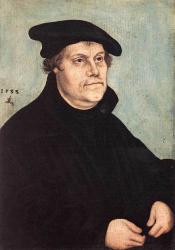
1483 - 1546 Person Name: M. Luther (1483-1546) Topics: God's Church Conflict and Endurance; Lent 2, The King and the Kingdom Conflict; Trinity Sunday The Trinity; Pentecost 3 The Church's Confidence in Christ; Pentecost 9 The Whole Armour of God; Pentecost 12 The Witnessing Community; Pentecost 13 The Suffering Community; Pentecost 20 Endurance Composer of "EIN' FESTE BURG" in Hymns for Today's Church (2nd ed.) Luther, Martin, born at Eisleben, Nov. 10, 1483; entered the University of Erfurt, 1501 (B.A. 1502, M.A.. 1503); became an Augustinian monk, 1505; ordained priest, 1507; appointed Professor at the University of Wittenberg, 1508, and in 1512 D.D.; published his 95 Theses, 1517; and burnt the Papal Bull which had condemned them, 1520; attended the Diet of Worms, 1521; translated the Bible into German, 1521-34; and died at Eisleben, Feb. 18, 1546. The details of his life and of his work as a reformer are accessible to English readers in a great variety of forms. Luther had a huge influence on German hymnody. i. Hymn Books. 1. Ellich cristlich lider Lobgesang un Psalm. Wittenberg, 1524. [Hamburg Library.] This contains 8 German hymns, of which 4 are by Luther. 2. Eyn Enchiridion oder Handbuchlein. Erfurt, 1524 [Goslar Library], with 25 German hymns, of which 18 are by Luther. 3. Geystliche Gesangk Buchleyn. Wittenberg, 1524 [Munich Library], with 32 German hymns, of which 24 are by Luther. 4. Geistliche Lieder auffs new gebessert. Wittenberg. J. Klug, 1529. No copy of this book is now known, but there was one in 1788 in the possession of G. E. Waldau, pastor at Nürnberg, and from his description it is evident that the first part of the Rostock Gesang-Buch, 1531, is a reprint of it. The Rostock Gesang-Buch, 1531, was reprinted by C. M. Wiechmann-Kadow at Schwerin in 1858. The 1529 evidently contained 50 German hymns, of which 29 (including the Litany) were by Luther. 5. Geistliche Lieder auffs new gebessert. Erfurt. A. Rauscher, 1531 [Helmstädt, now Wolfenbüttel Library], a reprint of No. 4. 6. Geistliche Lieder. Wittenberg. J. Klug, 1535 [Munich Library. Titlepage lost], with 52 German hymns, of which 29 are by Luther. 7. Geistliche Lieder auffs new gebessert. Leipzig. V. Schumann, 1539 [Wernigerode Library], with 68 German hymns, of which 29 are by Luther. 8. Geistliche Lieder. Wittenberg. J. Klug, 1543 [Hamburg Library], with 61 German hymns, of which 35 are by Luther. 9. Geystliche Lieder. Leipzig. V. Babst, 1545 [Gottingen Library]. This contains Luther's finally revised text, but adds no new hymns by himself. In pt. i. are 61 German hymns, in pt. ii. 40, of which 35 in all are by Luther. For these books Luther wrote three prefaces, first published respectively in Nos. 3, 4, 9. A fourth is found in his Christliche Geseng, Lateinisch und Deudsch, zum Begrebnis, Wittenberg, J. Klug, 1542. These four prefaces are reprinted in Wackernagel’s Bibliographie, 1855, pp. 543-583, and in the various editions of Luther's Hymns. Among modern editions of Luther's Geistliche Lieder may be mentioned the following:— Carl von Winterfeld, 1840; Dr. C. E. P. Wackernagel, 1848; Q. C. H. Stip, 1854; Wilhelm Schircks, 1854; Dr. Danneil, 1883; Dr. Karl Gerok, 1883; Dr. A. F. W. Fischer, 1883; A. Frommel, 1883; Karl Goedeke, 1883, &c. In The Hymns of Martin Luther. Set to their original melodies. With an English version. New York, 1883, ed. by Dr. Leonard Woolsey Bacon and Nathan H. Allen, there are the four prefaces, and English versions of all Luther's hymns, principally taken more or less altered, from the versions by A. T. Russell, R. Massie and Miss Winkworth [repub. in London, 1884]. Complete translations of Luther's hymns have been published by Dr. John Anderson, 1846 (2nd ed. 1847), Dr. John Hunt, 1853, Richard Massie, 1854, and Dr. G. Macdonald in the Sunday Magazine, 1867, and his Exotics, 1876. The other versions are given in detail in the notes on the individual hymns. ii. Classified List of Luther's Hymns. Of Luther's hymns no classification can be quite perfect, e.g. No. 3 (see below) takes hardly anything from the Latin, and No. 18 hardly anything from the Psalm. No. 29 is partly based on earlier hymns (see p. 225, i.). No. 30 is partly based on St. Mark i. 9-11, and xvi., 15, 16 (see p. 226, ii.). No. 35 is partly based on St. Luke ii. 10-16. The following arrangement, however, will answer all practical purposes. A. Translations from the Latin. i. From Latin Hymns: 1. Christum wir sollen loben schon. A solis ortus cardine 2. Der du bist drei in Einigkeit. O Lux beata Trinitas. 3. Jesus Christus unser Heiland, Der von. Jesus Christus nostra salus 4. Komm Gott Schopfer, heiliger Geist. Veni Creator Spiritus, Mentes. 5. Nun komm der Beidenheiland. Veni Redemptor gentium 6. Was flirchst du Feind Herodes sehr. A solis ortus cardine ii. From Latin Antiphons, &c.: 7. Herr Gott dich loben wir. Te Deum laudamus. 8. Verleih uns Frieden gnädiglich. Dapacem, Domine 9. Wir glauben all an einen Gott. iii. Partly from the Latin, the translated stanzas being adopted from Pre-Reformation Versions: 10. Komm, heiliger Geist, Herre Gott. 11. Mitten wir im Leben sind. Media vita in morte sumus. B. Hymns revised and enlarged from Pre-Reformation popular hymns. 12. Gelobet seist du Jesus Christ. 13. Gott der Vater wohn uns bei. 14. Gott sei gelobet und gebenedeiet. 15. Nun bitten wir den heiligen Geist. C. Psalm versions. 16. Ach Gott vom Himmel, sieh darein. 17. Aus tiefer Noth schrei ich zu dir. 18. Ein' feste Burg ist unser Gott. 19. Es spricht der Unweisen Mund wohl. 20. Es wollt uns Gott genädig sein. 21. War Gott nicht mit uns diese Zeit. 22. Wohl dem, der in Gotten Furcht steht. D. Paraphrases of other portions of Holy Scripture. 23. Diess sind die heilgen zehn Gebot. 24. Jesaia dem Propheten das geschah. 25. Mensch willt du leben seliglich. 26. Mit Fried und Freud ich fahr dahin. 27. Sie ist mir lieb die werthe Magd. 28. Vater unser im Himmelreich. E. Hymns mainly Original. 29. Christ lag in Todesbanden. 30. Christ unser Herr zum Jordan kam. 31. Ein neues Lied wir heben an. 32. Erhalt uns Herr bei deinem Wort. 33. Jesus Christus unser Heiland, Der den, 34. Nun freut euch lieben Christengemein. 35. Vom Himmel hoch da komm ich her. 36. Vom Himmel kam der Engel Schaar. In addition to these — 37. Fur alien Freuden auf Erden. 38. Kyrie eleison. In the Blätter fur Hymnologie, 1883, Dr. Daniel arranges Luther's hymns according to what he thinks their adaptation to modern German common use as follows:— i. Hymns which ought to be included in every good Evangelical hymn-book: Nos. 7-18, 20, 22, 28, 29, 30, 32, 34, 35, 36, 38. ii. Hymns the reception of which into a hymn-book might be contested: Nos. 2, 3, 4, 19, 21, 22, 23, 24, 25, 33. iii. Hymns not suited for a hymn-book: Nos. 1, 5, 6, 27, 31, 37. [Rev. James Mearns, M.A.] --John Julian, Dictionary of Hymnology (1907)

James R. Murray

1841 - 1905 Topics: God Creation and Providence; Blessings; Communion with Christ and God; Creation; God Creator; God Kingdom, Majesty, Realm; God Power/Might; God Presence; God Works; Gratitude; Heaven(s)/Paradise; Life; Brevity of Life; Nature; Petition; Praise; Service Music Gathering, Call to Worship, Greeting; Water; Word of God; Christmas Eve Year A; Lent 2 Year A; Pentecost Year A; Trinity Sunday Year A; Easter 6 Year B; Proper 7 Year B; Proper 24 Year B; Trinity Sunday Year C; Proper 18 Year C; New Year Year ABC Harmonizer of "LACQUIPARLE" in Voices United L.P.M. (1905, April 12). Obituary. New Church Messenger, p.209. Murray.--At Cincinnati, March 10, 1905, James Ramsey Murray. Funeral services in the Church of the New Jersualem, March 13th. James R. Murray was widely known in the musical world as the author of many songs and song books, and in the New Church in Chicago and Cincinnati as an affectionate, intelligent, and loyal New Churchman. He was born in Andover (Ballard Vale), Mass., March 17, 1841. In early life he developed musical talent, and composed many minor pieces for local and special occasions. Later at North Reading, Mass., he attended Dr. George F. Root's School of Music, and was associated with William Bradbury and Dr. Lowell Mason. He enlisted in the Fourteenth Regiment of infantry, commonly known as the Essex County Regiment, and afterwards was changed to the First Regiment, Massachusetts Heavy Artillery, which was engaged in most of the battles fought by the Second Army Corps up to the surrender of General Lee. "Daisy Deane," the first and most popular of his early song successes, was composed in 1863 in Virginia while in camp, words by his cousin, Thomas F. Winthrop. This song is known all over the world, and the Salvation Army is using an arrangement of it for one of their war cry songs. In 1868 Mr. Murray married Isabella Maria Taylor of Andover; and they removed to Chicago. Here three children were born to them, two passing early to their heavenly home, the youngest, Winthrop Root Murray, is still living. It was during these first years in Chicago that Mr. and Mrs. Murray became interested in the New Church, while he was engaged with Root and Cady as editor of the Long Visitor, afterwards merged with the Musical Visitor. After the great fire of 1871 Mr. and Mrs. Murray returned East, where he was engaged in teaching in Lawrence and Andover, and as organist at the Old South Church in Andover. In 1881 they removed to Cincinnati and Mr. Murray became the editor of the Musical Viistor [sic] and head of the publication department of the John Church Company. Among the most popular of his books are "Pure Diamonds," "Royal Gems," "The Prize" and "Murray's Sacred Songs." The following titles will recall some of his best loved sacred songs: "At Last," "Calm on the Listening Ear of Night," "I Shall Be Satisfied," "There Shall No Evil Befall Thee," "Thine, O Lord, Is the Greatness," "The Way Was Mine," "How Beautiful Upon the Mountains," "Angels from the Realms of Glory." His last great labor in the publishing department of the John Church Company was the seeing through the press five volumes of Wagner's music dramas, with full score and original German text, and an English translation. The immense and careful labor involved in the preparation of these volumes, with a really smooth and excellent English translation, had perhaps, as it was done under pressure, something to do with Mr. Murray's breakdown. Although for some reason Mr. Murray's name does not appear on the title page of these volumes, his friends knew of the place the work held in his affections and ambition. Mr. Murray was a member of the Church Council of the Cincinnati Society for the last four years and took a deep interest in the building of the New Church, and in the inauguration of services, with all the changes looking to the improvement of the musical part of the service. The vested choir, organized by Mr. and Mrs. Lawson, which Mr. Murray as councilman had urged from the beginning, in their entrance to the church each Sunday singing the processional hymn participated in the funeral service, with a congregation of brethren and friends, all moved by deep love and profound respect for the consistent life and faith of a worthy Churchman and beloved friend. --DNAH Archives =================================== For a discussion of Murray and the tune MUELLER, see: Stulken, M.K. (1981). Hymnal companion to the Lutheran Book of Worship. Philadelphia : Fortress Press, p.170. =================================== Also available in the DNAH Archives: 1. An excerpt from Christie, George A. (1927). New Free Church. In Music in Andover. Papers read at "Fagot Party" of the Andover Natural History Society. 2. Unsourced essay about Murray written soon after his death, likely from Andover, Mass., perhaps authored by Charlotte Helen Abbott.

Bernard Barton

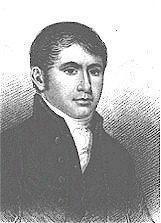
1784 - 1849 Topics: Advent 2 Collect; Trinity 8 Old Testament; Trinity 9 Old Testament; Holy Scriptures; Truth Author of "Lamp of our feet, whereby we trace Our path when wont to stray" in Magnify the Lord Barton, Bernard, commonly known as the "Quaker Poet," was born in London Jan. 31, 1784, and educated at a Quaker school at Ipswich. In 1798 he was apprenticed to Mr. S. Jesup, a shopkeeper at Halstead, Essex, with whom he remained until 1806, when he removed to Woodbridge, Suffolk, and entered into business with his brother, as a coal and corn merchant. On the death of his wife at the end of the first year of their married life, he proceeded to Liverpool, where he acted as a private tutor for a short time. He returned to Woodbridge in 1810, where he secured an engagement in the local bank of the Messrs. Alexander. This appointment he held for 40 years. He died at Woodbridge, Feb. 19, 1849. During the same year his daughter published his Poems and Letters, with a Memoir. His poetical works were numerous, including:— (1) Metrical Effusions , 1812; (2) Poems by an Amateur, 1818; (3) Poems , 1820; (4) Napoleon, and other Poems, 1822; (5) Poetic Vigils, 1824; (6) Devotional Verses founded on Select Texts of Scripture, 1826; (7) A Widow's Tale, 1S27; (8) New Year's Eve, 1829; (9) The Reliquary, 1836; (10) Household Verses, 1845. A complete list of his works is given in Joseph Smith's Descriptive Catalogue of Friends' Books, Lond., J. Smith, 1867, vol. i. pp. 196-200. From these works about 20 pieces have come into common use as hymns. These are found principally in the Scottish Evangelical Union Hymnal, on the one hand, and various American Unitarian collections on the other. The best known are, “Lamp of our feet, whereby we trace," and "Walk in the light, so shalt thou know." From his Devotional Poems, &c, 1826, the following have passed into the Scottish Evangelical Union Hymnal, 1878:— 1. Fear not, Zion's sons and daughters. Gracious Promises. This is part of a poem on Isaiah xliii. 1, “Fear not, Jacob, tabulated." 2. Hath the invitation ended? Invitation. 3. See we not beyond the portal? Present vision Imperfect. This is part of the poem on 1 Cor. xiii. 12, “Dim and dark our present vision." 4. Those who live in love shall know. Peace. 5. Would'st thou share this benediction! Poor in Spirit. In addition, there are also in various collections:— 6. Around Bethesda's healing wave. Consolation. This is on pp. 182-185, in his Napoleon, and other Poems, 1822, in 10 stanzas of 6 lines. A cento therefrom is given in a few American hymnals, including Mr. Beecher's Plymouth Collection, No. 746, as, "The waters of Bethesda's pool." 7. There is a life more dear. Spiritual Life. From the Devotional Verses, 1826, p. 96, into Kennedy, 1863, No. 1177, with the omission of stanza v. 8. Say not the law divine. Spiritual Law. Also from the Devotional Verses, 1826, p. 34, into various American hymnals, generally Unitarian, as the Hymn and Tune Book, Boston, 1868, No. 342, &c, where, however, it is rewritten from an irregular metre to S.M. This had previously appeared in Hedge and Huntington's Hymns for the Church of Christ, Boston, U.S., 1853. Other hymns, given in great part in American Unitarian collections, are annotated under their respective first lines. -- John Julian, Dictionary of Hymnology (1907) ====================== Barton, Bernard, p. 116, i. Other hymns in common use:— 1. God made the country, yet in scenes. Country Life. This begins with stanza iii. of a poem "Addressed to a Friend in London" in The Reliquary, 1836, p. 83. 2. Lamp of our feet! whereby we trace. Holy Scriptures, published in The Reliquary, 1836, p. 116, in 11 stanzas of 4 lines. It is in common use in its full form, and also abbreviated as (1) "Word of the ever-living God"; and (2) "Word of the everlasting God." In extensive use. 3. There is a Friend more tender, true. Jesus, the Friend. This begins with stanza iii. of "But yet, however cheerless seem," in his Poems & Letters, 1853, p. 254. 4. Walk in the light! So shalt thou know. (Walking in the Light.) Published in his Devotional Verses, 1826, p. 242, in 6 stanzas of 4 lines. It is found in many modern collections, and is one of the most popular of his hymns. 5. We journey through a vale of tears. Heaven Anticipated. In his Poems & Letters, 1853, p. 193. Of these hymns, Nos. 3, 5, are of an earlier date than the Poems & Letters of 1853; but we have failed to find them in Barton's earlier works. --John Julian, Dictionary of Hymnology, Appendix, Part II (1907)

Michael Forster

b. 1946 Person Name: Michael Forster, b. 1946 Topics: Confirmation; Grace and Providence; Redemption and Salvation; The Holy Trinity; Year A Epiphany 3; Year A Second Sunday Before Lent; Year A Palm Sunday: Liturgy of the Passion; Year A Proper 21; Year A Proper 23; Year A Proper 24; Year B All Saints; Year B Baptism of Christ; Year B Christ the King; Year B Easter 2; Year B Lent 1; Year B Palm Sunday: Liturgy of the Passion; Year B Second Sunday Before Lent; Year C Baptism of Christ; Year C Easter 2; Year C Easter 5; Year C Easter 7; Year C Lent 2; Year C Palm Sunday: Liturgy of the Passion; Year C Proper 25; Years A, B, and C Christmas 2 Author of "God is our strength from days of old" in Complete Anglican Hymns Old and New

John Milton

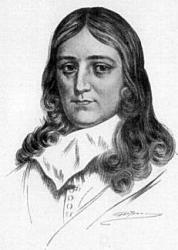
1608 - 1674 Topics: Advent 1 Old Testament; Advent 2 Old Testament; Advent 2 Gospel; Advent 3 Old Testament; Epiphany 5 Old Testament; Monday before Easter Epistle; Trinity 21 Old Testament; Trinity 24 Old Testament; St. Thomas Epistle; Presentation of Christ/Purification Epistle; St. John Baptist Old Testament; Eschaton; God Wrath of Author of "The Lord will come and not be slow" in Magnify the Lord Milton, John, was born in London, Dec. 9, 1608, and died there Nov. 8, 1674. His poetical excellences and his literary fame are matters apart from hymnology, and are fully dealt with in numerous memoirs. His influence on English hymn-writing has been very slight, his 19 versions of various Psalms having lain for the most part unused by hymnal compilers. The dates of his paraphrases are:— Ps. cxiv. and cxxxvi., 1623, when he was 15 years of ago. These were given in his Poems in English and Latin 1645. Ps. lxxx.-lxxxviii., written in 1648, and published as Nine Psalmes done into Metre, 1645. Ps. i., 1653; ii., “Done August 8, 1653;" iii., Aug. 9, 1653; iv. Aug. 10, 1653; v., Aug. 12, 1653; vi., Aug. 13, 1653; vii.Aug. 14, 1653; viii., Aug. 14, 1653. These 19 versions were all included in the 2nd ed. of his Poems in English and Latin, 1673. From these, mainly in the form of centos, the following have come into common use:— 1. Cause us to see Thy goodness, Lord. Ps. lxxxv. 2. Defend the poor and desolate. Ps. lxxxii. 3. God in the great assembly stands. Ps. lxxxii. 4. How lovely are Thy dwellings fair. Ps. lxxxiv. From this, "They pass refreshed the thirsty vale," is taken. 5. Let us with a gladsome [joyful] mind. Ps. cxxxvi. 6. O let us with a joyful mind. Ps. cxxxvi. 7. The Lord will come and not be slow. Ps. lxxxv. Of these centos Nos. 4 and 5 are in extensive use. The rest are mostly in Unitarian collections. There are also centos from his hymn on the Nativity, "This is the month, and this the happy morn" (q.v.). --John Julian, Dictionary of Hymnology (1907)

William Walker

1809 - 1875 Person Name: W. Walker Topics: Advent 1 Old Testament; Advent 2 Old Testament; Advent 2 Gospel; Advent 3 Old Testament; Epiphany 5 Old Testament; Monday before Easter Epistle; Trinity 21 Old Testament; Trinity 24 Old Testament; St. Thomas Epistle; Presentation of Christ/Purification Epistle; St. John Baptist Old Testament; Eschaton; God Wrath of Composer of "THE SAINT'S DELIGHT" in Magnify the Lord

Graham Kendrick

b. 1950 Topics: Confirmation; Epiphany; Evangelism; Grace and Providence; Gradual Hymn; Morning; Opening Hymn; Year A Proper 1; Year A Second Sunday Before Lent; Year A Pentecost; Year A Proper 18; Year B Baptism of Christ; Year B Pentecost; Year B Proper 4; Year B Sunday Next Before Lent; Year B Trinity Sunday; Year C Pentecost; Year C Proper 1; Year C Sunday Next Before Lent; Years A, B, and C Christmas 2; Years A, B, and C Easter Vigil Author of "Lord, the light of your love (Shine, Jesus, shine)" in Complete Anglican Hymns Old and New Graham Kendrick (b. England, August 2, 1950), the son of a Baptist minister in Northamptonshire, is one of the most prolific Christian singer-songwriters in the United Kingdom. He’s written music for over thirty years, and to date has released thirty-eight albums. He is best known for his songs “Shine, Jesus, Shine,” “Knowing You,” and “The Servant King.” Kendrick has received honorary doctorates in divinity from Brunel University and Wycliffe College. In 1987 he helped co-found the March for Jesus, which today is a global phenomenon in which Christians take their faith to the streets in a celebration of Christ. In 1995 Kendrick received a Dove Award for his international work, and he remains an active advocate for Compassion International, which is a Christian child sponsorship organization dedicated to the long-term development of children living in poverty around the world, and also is a contributor to CompassionArt, an organization with the aim of generating income from works of art to assist in the relief of suffering around the planet. Laura de Jong

Timothy Dudley-Smith

1926 - 2024 Person Name: Timothy Dudley-Smith (born 1926) Topics: God's Church Unity and Growth; Pentecost The Holy Spirit; Trinity Sunday The Trinity; Pentecost 2 The People of God; Pentecost 2 The Church's Unity and Fellowship Author of "Lord of the church, we pray for our renewing" in Hymns for Today's Church (2nd ed.) Timothy Dudley-Smith (b. 1926) Educated at Pembroke College and Ridley Hall, Cambridge, Dudley-Smith has served the Church of England since his ordination in 1950. He has occupied a number of church posi­tions, including parish priest in the diocese of Southwark (1953-1962), archdeacon of Norwich (1973-1981), and bishop of Thetford, Norfolk, from 1981 until his retirement in 1992. He also edited a Christian magazine, Crusade, which was founded after Billy Graham's 1955 London crusade. Dudley-Smith began writing comic verse while a student at Cambridge; he did not begin to write hymns until the 1960s. Many of his several hundred hymn texts have been collected in Lift Every Heart: Collected Hymns 1961-1983 (1984), Songs of Deliverance: Thirty-six New Hymns (1988), and A Voice of Singing (1993). The writer of Christian Literature and the Church (1963), Someone Who Beckons (1978), and Praying with the English Hymn Writers (1989), Dudley-Smith has also served on various editorial committees, including the committee that published Psalm Praise (1973). Bert Polman

Pages


Export as CSV
It looks like you are using an ad-blocker. Ad revenue helps keep us running. Please consider white-listing Hymnary.org or getting Hymnary Pro to eliminate ads entirely and help support Hymnary.org.