You help make Hymnary.org possible. More than 10 million people from 200+ countries found hymns, liturgical resources and encouragement on Hymnary.org in 2025, including you. Every visit affirms the global impact of this ministry.

If Hymnary has been meaningful to you this year, would you take a moment today to help sustain it? A gift of any size—paired with a note of encouragement if you wish—directly supports the server costs, research work and curation that keep this resource freely available to the world.

Give securely online today, or mail a check to:
Hymnary.org
Calvin University
3201 Burton Street SE
Grand Rapids, MI 49546

Thank you for your partnership, and may the hope of Advent fill your heart.

Person Results

Text Identifier:"^dark_mighty_ocean_rolling_to_our_feet$"
In:people

Planning worship? Check out our sister site, ZeteoSearch.org, for 20+ additional resources related to your search.
Showing 1 - 2 of 2Results Per Page: 102050

Jane Borthwick

1813 - 1897 Translator of "The Missionary On the Sea Shore" Miss Jane Borthwick, the translator of this hymn and many others, is of Scottish family. Her sister (Mrs. Eric Findlater) and herself edited "Hymns from the Land of Luther" (1854). She also wrote "Thoughts for Thoughtful Hours (1859), and has contributed numerous poetical pieces to the "Family Treasury," under the signature "H.L.L." --Annotations of the Hymnal, Charles Hutchins, M.A. 1872. ================================= Borthwick, Jane, daughter of James Borthwick, manager of the North British Insurance Office, Edinburgh, was born April 9, 1813, at Edinburgh, where she still resides. Along with her sister Sarah (b. Nov. 26, 1823; wife of the Rev. Eric John Findlater, of Lochearnhead, Perthshire, who died May 2, 1886) she translated from the German Hymns from the Land of Luther, 1st Series, 1854; 2nd, 1855; 3rd, 1858; 4th, 1862. A complete edition was published in 1862, by W. P. Kennedy, Edinburgh, of which a reprint was issued by Nelson & Sons, 1884. These translations, which represent relatively a larger proportion of hymns for the Christian Life, and a smaller for the Christian Year than one finds in Miss Winkworth, have attained a success as translations, and an acceptance in hymnals only second to Miss Winkworth's. Since Kennedy's Hymnologia Christiana, 1863, in England, and the Andover Sabbath Hymn Book, 1858, in America, made several selections therefrom, hardly a hymnal in England or America has appeared without containing some of these translations. Miss Borthwick has kindly enabled us throughout this Dictionary to distinguish between the 61 translations by herself and the 53 by her sister. Among the most popular of Miss Borthwick's may be named "Jesus still lead on," and "How blessed from the bonds of sin;" and of Mrs. Findlater's "God calling yet!" and "Rejoice, all ye believers." Under the signature of H. L. L. Miss Borthwick has also written various prose works, and has contributed many translations and original poems to the Family Treasury, a number of which were collected and published in 1857, as Thoughts for Thoughtful Hours (3rd edition, enlarged, 1867). She also contributed several translations to Dr. Pagenstecher's Collection, 1864, five of which are included in the new edition of the Hymns from the Land of Luther, 1884, pp. 256-264. Of her original hymns the best known are “Come, labour on” and "Rest, weary soul.” In 1875 she published a selection of poems translated from Meta Heusser-Schweizer, under the title of Alpine Lyrics, which were incorporated in the 1884 edition of the Hymns from the Land of Luther. She died in 1897. [Rev. James Mearns, M.A.] -- John Julian, Dictionary of Hymnology (1907) ======================== Borthwick, Jane, p. 163, ii. Other hymns from Miss Borthwick's Thoughtful Hours, 1859, are in common use:— 1. And is the time approaching. Missions. 2. I do not doubt Thy wise and holy will. Faith. 3. Lord, Thou knowest all the weakness. Confidence. 4. Rejoice, my fellow pilgrim. The New Year. 5. Times are changing, days are flying. New Year. Nos. 2-5 as given in Kennedy, 1863, are mostly altered from the originals. --John Julian, Dictionary of Hymnology, Appendix, Part II (1907) ============= Works: Hymns from the Land of Luther

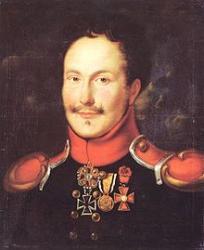
Friedrich Heinrich Karl, Freiherr de La Motte-Fouqué

1777 - 1843 Person Name: Freiherr de La Motte-Fouqué Author of "The Missionary On the Sea Shore" Fouqué, Friedrich Heinrich Carl de la Motte, was born Feb. 12,1777, at Brandenburg on the Havel, where his father, of an ancient and noble Huguenot family, was a retired officer of dragoons. Educated under the training of the French Reformed Church, it was intended that he should enter the University of Halle as a student of law. By his own preference however he entered the army, and in 1794 was appointed cornet in the Duke of Weimar's regiment of cuirassiers. In 1803 he married and retired to Nennhausen near Rathenow, Brandenburg. When, in March, 1813, the King of Prussia invited his people to arm against France, Fouqué offered himself as a volunteer and served as a lieutenant of cavalry till he was disabled at the battle of Lützen, May 2, 1813, and with the rank of major retired once more to Nennhausen. After the death of his wife, in 1831, he resided for some time at Halle, where he gave lectures in the University on the history of poetry; and finally settled in Berlin, where, two days after a stroke of apoplexy, he died Jan. 23,1843 (Koch, vii.6-20; Allgemeine Deutsche Biographie, vii. 198-201, &c). Fouqué is best known as one of the leaders of the "Romantic" school of German literature, and by his wonderfully successful efforts to make the best features of the knight and minstrel life of the 12th century, live again in the pages of his romances as an example and incitement to his own times. His fame rests not on his poems, but on his romances, especially that of Undine (1st ed. Berlin, 1811, 17th ed. 1870—frequently translated into English). His hymns, while affording a true and thought¬ful reflex of his religious feelings, cannot be said to have either great depth of Christian experience or genuine churchly ring, and hardly any have come into Church use in Germany. He himself only published 15 Mission hymns at Leipzig, 1822, as Geistliche Lieder, Erstes Bandchen. From his papers his second wife issued two collections, the Geistliche Gedichte, Berlin, 1846, and Christlicher Liederschatz, Berlin, 186', but they contain few compositions that can be called hymns, and of these hardly any are suitable for church use. Of his hymns those translated into English are:— i. Was du vor tausend Jahren. Christ our Light. Founded on St. Mark x. 46-52, and included 1846, p. 1, in 6 stanzas of 8 lines, entitled, "The Faithfulness of the Saviour." Previously in Bunsen's Versuch, 1833, No. 761. Translated as:— A thousand years have fleeted, a good and full translated by Miss Cox in her Sacred Hymns from the Germans, 1841, p. 105, repeated, omitting stanzas ii.-iv., as No. 567 in Hedge and Huntington's Hymns for the Church of Christ, Boston, U.S., 1853. Other translations are: (1) "Thy mercy, Lord, is still the same," by Lady E. Fortescue, 1843. (2) "My Saviour, what Thou didst of old," by Miss Winkworth, 1855, p. 53. His hymns not in English common use are:— ii. In die Segel sanft und linde. Missions. 1822, p. 13, in 4 stanzas entitled “Prosperous Voyage," i.e. to the mission field. Translated as "In our sails all soft and sweetly," by Miss Winkworth, 1858, p. 115. iii. Wie schäumt so feierlich zu unsern Füssen. Missions. For missionaries about to set out on their voyage. 1822, p. 11, in 8 stanzas, entitled "At the Sea." The translations are: (1) "Thou solemn Ocean, rollest to the strand," by Miss Winkworth, 1858, p. 112. (2) "Dark, mighty Ocean, rolling to our feet," by Miss Borthwick, in Hymns from the Land of Luther , 1858, p. 26, repeated in L. Rehfuess's Church at Sea, 1868, p. 5. [Rev. James Mearns, M.A.] --John Julian, Dictionary of Hymnology (1907)

Export as CSV
It looks like you are using an ad-blocker. Ad revenue helps keep us running. Please consider white-listing Hymnary.org or getting Hymnary Pro to eliminate ads entirely and help support Hymnary.org.




