

 My Starred Hymns
 My FlexScores
 My Hymnals
 My Purchased Files
Planning worship?
Check out our sister site, ZeteoSearch.org,
for 20+ additional resources related to your search.
- |
User Links
Person Results
William Hunter
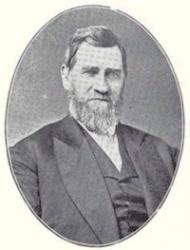
1811 - 1877 Meter: 10.10.10.10 D Author of "Joyfully, Joyfully, Onward I Move" in The Cyber Hymnal Hunter, William, D.D, son of John Hunter, was born near Ballymoney, County Antrim, Ireland, May 26, 1811. He removed to America in 1817, and entered Madison College in 1830. For some time he edited the Conference Journal, and the Christian Advocate. In 1855 he was appointed Professor of Hebrew in Alleghany College: and subsequently Minister of the Methodist Episcopal Church, at Alliance, Stark Country, Ohio. He died in 1877. He edited Minstrel of Zion, 1845; Select Melodies, 1851; and Songs of Devotion, 1859. His hymns, over 125 in all, appeared in these works. Some of these have been translated into various Indian languages. The best known are :—
1. A home in heaven; what a joyful thought. Heaven a Home. From his Minstrel of Zion, 1845, into the Methodist Scholar's Hymn Book, London, 1870, &c.
2. Joyfully, joyfully onward I [we] move. Pressing towards Heaven. This hymn is usually dated 1843. It was given in his Minstrel of Zion, 1845, and Select Melodies, 1851, and his Songs of Devotion, 1859. It has attained to great popularity. Two forms of the hymn are current, the original, where the second stanza begins "Friends fondly cherished, have passed on before"; and the altered form, where it reads: “Teachers and Scholars have passed on before." Both texts are given in W. F. Stevenson's Hymns for Church & Home, 1873, Nos. 79, 80, c.
3. The [My] heavenly home is bright and fair. Pressing towards Heaven. From his Minstrel of Zion, 1845, into the Cottage Melodies, New York, 1859, and later collections.
4. The Great Physician now is near. Christ the Physician. From his Songs of Devotion, 1859
5. Who shall forbid our grateful[chastened]woe? This hymn, written in 1843, was published in his Minstrel of Zion, 1845, and in his Songs of Devotion, 1859. [ Rev. F. M. Bird, M.A.]
--John Julian, Dictionary of Hymnology (1907)
William Hunter
Fanny Crosby
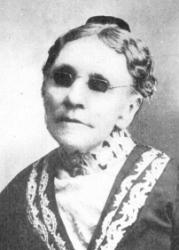
1820 - 1915 Person Name: Fanny Crosby Meter: 10.10.10.10 D Author of "God Will Take Care of You (Crosby)" in The Cyber Hymnal Pseudonymns: A.V., Mrs. A. E. Andrews, Mrs. E. A. Andrews, Mrs. E. L. Andrews, James L. Black, Henrietta E. Blair, Charles Bruce, Robert Bruce, Leah Carlton, Eleanor Craddock, Lyman G. Cuyler, D.H.W., Ella Dare, Ellen Dare, Mrs. Ellen Douglass, Lizzie Edwards. Miss Grace Elliot, Grace J. Frances, Victoria Frances, Jennie Garnett, Frank Gould, H. D. K., Frances Hope, Annie L. James, Martha J. Lankton [Langton], Grace Lindsey, Maud Marion, Sallie Martin, Wilson Meade, Alice Monteith, Martha C. Oliver, Mrs. N. D. Plume, Kate Smiley, Sallie Smith, J. L. Sterling, John Sterling, Julia Sterling, Anna C. Storey, Victoria Stuart, Ida Scott Taylor, Mary R. Tilden, Mrs. J. B. Thresher, Hope Tryaway, Grace Tureman, Carrie M. Wilson, W.H.D.
Frances Jane Crosby, the daughter of John and Mercy Crosby, was born in Southeast, Putnam County, N. Y., March 24, 1820. She became blind at the age of six weeks from maltreatment of her eyes during a spell of sickness. When she was eight years old she moved with her parents to Ridgefield, Conn., the family remaining there four years. At the age of fifteen she entered the New York Institution for the Blind, where she received a good education. She became a teacher in the institution in 1847, and continued her work until March 1, 1858. She taught English grammar, rhetoric and American history.
This was the great developing period in her life. During the vacations of 1852 and 1853, spent at North Reading, Mass., she wrote the words to many songs for Dr. Geo. F. Root, then the teacher of music at the blind institution. Among them were, "Hazel Dell,", "The Honeysuckle Glen," "Rosalie, the Prairie Flower," "Music in the Air," "Proud World, Good-bye, I'm Going Home," "All Together", "Never Forget the Dear Ones," and others. Subsequently she wrote the words for the cantatas of The Flower Queen and The Pilgrim Fathers, all of which were very popular in their day, though it was not generally known at the time that she was the author.
While teaching at the institution she met Presidents Van Buren and Tyler, Hon. Henry Clay, Governor Wm. H. Seward, General Winfield Scott, and other distinguished characters of American history. Concerning Mr. Clay, she gives the following: "When Mr. Clay came to the institution during his last visit to New York, I was selected to welcome him with a poem. Six months before he had lost a son at the battle of Monterey, and I had sent him some verses. In my address I carefully avoided any allusion to them, in order not to wound him. When I had finished he drew my arm in his, and, addressing the audience, said through his tears: 'This is not the first poem for which I am indebted to this lady. Six months ago she sent me some lines on the death of my dear son.' Both of us were overcome for a few moments. Soon, by a splendid effort, Mr. Clay recovered himself, but I could not control my tears." In connection with her meeting these notable men, we might add that Miss Fanny Crosby had the honor of being the first woman whose voice was heard publicly in the Senate Chamber at Washington. She read a poem there on one occasion. In addition to the thousands of hymns that she has written (about eight thousand poems in all), many of which have not been set to music, she has published four volumes of verses. The first was issued in 1844 and was entitled The Blind Girl, and Other Poems, a second volume, Monterey, and Other Poems, followed in 1849, and the third, A Wreath of Columbia's Flowers, in 1858. The fourth, Bells at Evening and Other Verses, with a biographical sketch by Rev. Robert Lowry, and a fine half-tone portrait, in 1897, the sales of which have reached a fourth edition. The book is published by The Biglow & Main Co., New York.
Though these show the poetical bent of her mind, they have little to do with her world-wide fame. It is as a writer of Sunday-school songs and gospel hymns that she is known wherever the English language is spoken, and, in fact, wherever any other language is heard.
Fanny was married March 5, 1858, to Alex. Van Alstyne, who was also a scholar in the same institution in which she was educated.
She began to write Sunday-school hymns for Wm. B. Bradbury in 1864. Her first hymn,
"We are going, we are going
To a home beyond the skies",
was written at the Ponton Hotel on Franklin Street, New York City, on February 5th of that year. This hymn was sung at Mr. Bradbury's funeral in January, 1868. Since 1864 she supported herself by writing hymns. She resided in New York City nearly all her life, where, she says, she is "a member of the Old John Street M. E. Church in good standing." She spent regular hours on certain days at the office of The Biglow & Main Co., the firm for which she did most of her writing, and for whom she has composed over four thousand hymns. Her hymns have been in great demand and have been used by many of our most popular composers, among whom may be mentioned Wm. B. Bradbury, Geo. F. Root, W. H. Doane, Rev. Robert Lowry, Ira D. Sankey, J. R. Sweney, W. J. Kirkpatrick, H. P. Main, H. P. Danks, Philip Phillips, B. G. Unseld, and others. She could compose at any time and did not need to wait for any special inspiration, and her best hymns have come on the spur of the moment. She always composed with an open book in her hand, generally a copy of Golden Hymns, held closely over her eyes, bottom side up. She learned to play on the guitar and piano while at the institution, and has a clear soprano voice. She also received a technical training in music, and for this reason she could, and did, compose airs for some of her hymns. One of these is,
"Jesus, dear, I come to Thee,
Thou hast said I may,"
both words and music of which are wonderfully sweet. "Safe in the arms of Jesus", probably one of her best known hymns, was her own favorite. Fanny loved her work, and was happy in it. She was always ready either to sympathize or join in a mirthful conversation, as the case may be. The secret of this contentment dates from her first composition at the age of eight years. "It has been the motto of my life," she says. It is:
"O what a happy soul am I!
Although I cannot see,
I am resolved that in this world
Contented I will be;"
This has continued to be her philosophy. She says that had it not been for her affliction she might not have so good an education, nor so great an influence, and certainly not so fine a memory. She knows a great many portions of the Bible by heart, and had committed to memory the first four books of the Old Testament, and also the four Gospels before she was ten years of age.
Her scope of subjects is wide, embracing everything from a contemplation of heaven, as in "The Bright Forever" and "The Blessed Homeland", to an appeal to the work of this world, as in "To the Work" and "Rescue the Perishing." The most of Fanny's published hymns have appeared under the name of Fanny J. Crosby or Mrs. Yan Alstyne, but quite a large number have appeared under the nom de plumes of Grace J. Frances, Mrs. C. M. Wilson, Lizzie Edwards, Ella Dale, Henrietta E. Blair, Rose Atherton, Maud Marion, Leah Carlton, nearly two hundred different names.
-Biographies of Gospel Song and Hymn Writers (excerpts)
=======================
Van Alstyne, Frances Jane, née Crosby, a member of the Methodist Episcopal Church, was born at South East, Putnam County, New York, March 24, 1823. When six weeks old she lost her sight. About 1835 she entered the New York City Institution for the Blind. On completing her training she became a teacher therein from 1847 to 1858. In 1858 she was married to Alexander Van Alstyne, a musician, who was also blind. Her first poem was published in 1831; and her first volumes of verse as A Blind Girl, and Other Poems, 1844; Monteresy, and Other Poems, 1849; and A Wreath of Columbia's Flowers, 1858. Her first hymn was "We are going, we are going" (Death and Burial), which was written for Mr. Bradbury and published in the Golden Censer, 1864. From 1853 to 1858 she wrote 20 songs, which were set to music by G. F. Root. Her songs and hymns number some 2,000 or more, and have been published mainly in several of the popular American Sunday school collections, and often under a nom de plume. About 60 have come into common use in Great Britain. The majority of these are taken from the following American collections:—
i. From The Shining Star, 1864.
1. Softly on the breath of evening. Evening.
ii. From Fresh Laurels, 1867.
2. Beautiful Mansions, home of the blest. Heaven.
3. Jesus the Water of Life has given. The Water of Life.
4. Light and Comfort of my soul. In Affliction.
5. There's a cry from Macedonia. Missions.
6. We are marching on with shield and banner bright. Sunday School Anniversary.
iii. From Musical Leaves, 1868.
7. 0 what are you going to do, brother? Youth for God.
iv. From Sabbath Carols, 1868.
8. Dark is the night, and cold the wind is blowing. Affliction anticipated.
9. Lord, at Thy mercy seat, Humbly I fall. Lent.
v. From Silver Spray, 1868.
10. If I come to Jesus, He will make me glad. Peace in Jesus.
11. 'Twill not be long—our journey here. Heaven anticipated.
vi. From Notes of Joy, 1869.
12. Little beams of rosy light. The Divine Father.
13. Press on! press on! a glorious throng. Pressing towards the Prize.
vii. From Bright Jewels, 1869.
14. Christ the Lord is risen today, He is risen indeed. Easter.
15. Holy, holy, holy is the Lord! Sing 0 ye people, &c. Holiness of God.
16. Jesus, keep me near the Cross. Near the Cross of Christ.
17. Saviour, bless a little child. A Child's Prayer. Written Feb. 6, 1869.
viii. From Songs of Devotion, 1870.
18. Pass me not, 0 gentle Saviour. Lent. Written in 1868.
19. Rescue the perishing, care for the dying. Home Missions.
ix. From Pure Gold, 1871.
20. Great is Jehovah. King of kings. Greatness of God.
21. I would be Thy little lamb. The Good Shepherd.
22. Lead me to Jesus, lead me to Jesus. Desiring Jesus.
23. To the work, to the work, we are servants of God. Home Missions.
24. Why labour for treasures that rust and decay? The Fadeless Crown.
x. From the Royal Diadem, 1873.
25. I am Jesus' little friend. For Infant Schools.
26. Jesus I love Thee. Loving Jesus.
27. Mourner, wheresoe'er thou art. To the Sorrowing and Penitent. Written Oct. 3, 1871.
28. Never be faint or weary. Joy in Jesus.
29. Only a step to Jesus. Invitation.
xi. From Winnowed Hymns, 1873-4.
30. Loving Saviour, hear my cry. Lent.
xii. From Echoes of Zion, 1874.
31. Say, where is thy refuge, my brother? Home Missions.
xiii. From Songs of Grace and Glory, 1874.
32. Thou my everlasting Portion. Christ the Portion of His People.
xiv. From Brightest and Best, 1875.
33. All the way my Saviour leads me. Jesus the Guide.
34. I am Thine, O Lord: I have heard Thy voice. Holiness desired.
35. O come to the Saviour, believe in His name. Invitation. Written, Sep. 7, 1874.
36. O how sweet when we mingle. Communion of Saints. Written in 1866.
37. O my Saviour, hear me. Prayer to Jesus for blessing and love.
38. Only Jesus feels and knows. Jesus the Divine Friend.
39. Revive Thy work, O Lord. Home Missions.
40. Saviour, more than life to me. Jesus All and in All.
41. To God be the glory, great things He hath done. Praise for Redemption.
xv. From Calvary Songs, 1875.
42. Come, O come with thy broken heart. Invitation.
xvi. From Gospel Music, 1876.
43. Here from the world we turn. Divine Worship.
44. When Jesus comes to reward His servants. Watching,
xvii. From Welcome Tidings, 1877.
45. O hear my cry, be gracious now to me. For Pardon and Peace.
xviii. From The Fountain of Song, 1877.
46. Lord, my trust I repose on Thee. Trusting in Jesus.
xix. From Good as Gold, 1880.
47. In Thy cleft, O Rock of Ages. Safety in Jesus.
48. Sound the alarm ! let the watchman cry. Home Missions.
49. Tenderly He leads us. Christ the Leader.
50. 'Tis the blessed hour of prayer. The Hour of Prayer.
In addition to these hymns, all of which are in common use in Great Britain (mainly through I. D. Sankey's Sacred Songs and Solos, the Methodist Sunday School Hymn Book, the Silver Street Sunday Scholars Companion, and other collections for Sunday schools), there are also "A blessing for you, will you take it?" (Pardon through Jesus); "My song shall be of Jesus" (Praise of Jesus); “Now, just a word for Jesus"(Home Missions); "Onward, upward, Christian soldier" (Pressing Heavenward); 44 Sinner, how thy heart is troubled" (Invitation); "'Tis a goodly, pleasant land" (Heaven anticipated); and "When the dewy light was fading" (Death anticipated). All of these are in I. D. Sankey's Sacred Songs & Solos. Mrs. Van Alstyne's most popular composition is "Safe in the arms of Jesus" (Safety in Jesus). This was written in 1868, at the request of Mr. W. H. Doane, to his well-known melody with which it is inseparably associated, and published in Bright Jewels, 1869. Mrs. Van Alstyne's hymns have sometimes been published anonymously; but the greater part are signed by a bewildering number of initials.
The combined sales of the volumes of songs and hymns named above have amounted in English-speaking countries to millions of copies. Notwithstanding the immense circulation thus given to Mrs. Van Alstyne's hymns, they are, with few exceptions, very weak and poor, their simplicity and earnestness being their redeeming features. Their popularity is largely due to the melodies to which they are wedded.
Since the above was in type we have found that the following are also in common use in Great Britain:—
51. Suppose the little cowslip. Value of Little Things.
52. Sweet hour of prayer. The Hour of Prayer. These are in Bradbury's Golden Chain, 1861.
53. Never lose the golden rule. Love to our Neighbours. In Bradbury's Golden Censer, 1864.
54. I will not be afraid at night. Trust in God. In Bradbury's Fresh Laurels, 1867.
55. Praise Him, praise Him, Jesus our, &c. Praise of Jesus. In Biglow & Main's Bright Jewels, 1869.
56. More like Jesus would I be. More like Jesus. In Perkins & Taylor's Songs of Salvation, 1870.
57. Behold me standing at the door. Christ at the Door. In Biglow & Main's Christian Songs, 1872.
58. If I come to Jesus. Jesus the Children's Guide.
59. Jesus, Lord, I come to Thee. Trust in Jesus.
60. Let me learn of Jesus. Jesus the Children's Friend.
61. Singing for Jesus, O singing for Jesus. Singing for Jesus.
62. There is a Name divinely sweet Holy Name of Jesus.
Of these hymns Nos. 58-62 we have not been able to trace.
--Excerpts from John Julian, Dictionary of Hymnology (1907
================
Van Alstyne, Frances J., p. 1203, ii. From the American collections of recent date we find that Mrs. Van Alstyne is still actively engaged in hymn-writing. In the Funk and Wagnalls Company Gloria Deo, 1903, there are about 30 of her hymns, most of which are new. They are all signed, and some are dated, but we have not space to quote the first lines and subjects, as this hymnal is not an official collection of any denomination. Another name, "Mrs. S. K. Bourne" is credited in the same hymnal with about 40 new hymns. If this signature is not another pen-name of Mrs. Van Alstyne's (and these pen-names and initials of hers are very numerous), we can only say that she has a very successful understudy in "Mrs. S. K. Bourne."
--John Julian, Dictionary of Hymnology, New Supplement (1907)
Fanny Crosby
Ira David Sankey

1840 - 1908 Meter: 10.10.10.10 D Composer of "BERMUDA" in The Cyber Hymnal Sankey, Ira David, was born in Edinburgh, Pennsylvania, in 1840, of Methodist parents. About 1856 he removed with his parents to New Castle, Pennsylvania, where he became a member of the Methodist Episcopal Church. Four years afterwards he became the Superintendent of a large Sunday School in which he commenced his career of singing sacred songs and solos. Mr. Moody met with him and heard him sing at the International Convention of the Young Men's Christian Association, at Indianapolis, and through Mr. Moody's persuasion he joined him in his work at Chicago. After some two or three years' work in Chicago, they sailed for England on June 7, 1872, and held their first meeting at York a short time afterwards, only eight persons being present. Their subsequent work in Great Britain and America is well known.
Mr. Sankey's special duty was the singing of sacred songs and solos at religious gatherings, a practice which was in use in America for some time before he adopted it. His volume of Sacred Songs and Solos is a compilation from various sources, mainly American and mostly in use before. Although known as Sankey and Moody’s Songs, only one song, "Home at last, thy labour done" is by Mr. Sankey, and not one is by Mr. Moody. Mr. Sankey supplied several of the melodies. The English edition of the Sacred Songs & Solos has had an enormous sale; and the work as a whole is very popular for Home Mission services. The Songs have been translated into several languages.
--John Julian, Dictionary of Hymnology (1907)
Pseudonymns:
Harry S. Lower
Rian A. Dykes
====================
Sankey, I. D., p. 994, i. During the past fifteen years Mr. Sankey's Sacred Songs and Solos have had a very large sale, which has justified him in increasing the number of songs and hymns, including " New Hymns and Solos," to 1200. In 1906 he published My Life and Sacred Songs (London : Morgan & Scott). In addition to the "Story of his Own Life," the work contains an account of the most popular of his solos, with interesting reminiscences of the spiritual awakening of many who were influenced through his singing of them in public. In this respect it corresponds in some measure with G. J. Stevenson's Methodist Hymn Book, &c, 1883 (p. 1094, i.). It is an addition to the Sacred Songs and Solos, which will be held in esteem by many. In addition to his hymn, noted on p. 994, ii., Mr. Sankey gives details of the following:—
1. Out of the shadow-land into the sunshine. [Heaven Anticipated.] Mr. Sankey's account of this hymn is:—
"I wrote this hymn specially for the memorial service held for Mr. Moody in Carnegie Hall, where 1 also sang it as a solo. It is the last sacred song of which I wrote both the words and music. The idea was suggested by Mr. Moody's last words, 'Earth recedes; heaven opens before me . . . God is calling me, and I must go.' On account of its peculiar association with my fellow-labourer in the Gospel for so many years, the words are here given in full."
The hymn follows on p. 185, in 3 stanzas of 4 lines and a chorus.
2. Rejoice! Rejoice! our King is coming, [Advent.] Mr. Sankey writes concerning this hymn:—
"During one of my trips to Great Britain on the SS. City of Rome a storm raged on the sea. The wind was howling through the rigging, and waves like mountains of foam were breaking over the bow of the vessel. A great fear had fallen upon the passengers. When the storm was at its worst, we all thought we might soon go to the bottom of the sea. The conviction came to me that the Lord would be with us iu the trying hour, and sitting down in the reading room, I composed this hymn. Before reaching England the tune had formed itself in my mind, and on arriving in London I wrote it out, and had it published in Sacred Songs and Solos, where it is No. 524 in the edition. of 1888.
From Mr. Sankey's autobiographical sketch we gather that he was born at Edinburgh, in Western Pennsylvania, Aug. 28, 1840, joined Mr. Moody in 1871, and visited England for the first time in 1873. The original of the Sacred Songs, &c, of 23 pieces only, was offered as a gift to the London publishers of P. Phillips's Hallowed Song, and declined by them. It was subsequently accepted by Mr. K. O. Morgan, of Morgan & Scott, and is now a volume of 1200 hymns.
From a return kindly sent us by Messrs. Morgan & Scott, we find that the various issues of the Sacred Songs and Solos were:—
In 1873, 24 pp.; 1874, 72 pp. ; 1876, 153 hymns; 1877, 271 hymns; 1881, 441 hymns; 1888, 750 hymns; 1903, 1200 hymns.
In addition, The Christian Choir, which is generally associated with the Sacred Songs and Solos, was issued in 1884 with 75 hymns, and in 1896 with 281. The New Hymns & Solos, by the same firm, were published in 1888.
--John Julian, Dictionary of Hymnology, New Supplement (1907)
Ira David Sankey
Adelaide A. Pollard
1862 - 1934 Meter: 10.10.10.10 D Author of "Shepherd Of Israel" in The Cyber Hymnal Not to be confused with Adelaide A. Procter
Adelaide A. Pollard
George C. Stebbins

1846 - 1945 Person Name: George Coles Stebbins Meter: 10.10.10.10 D Composer of "JAMAICA BAY" in The Cyber Hymnal Stebbins studied music in Buffalo and Rochester, New York, then became a singing teacher. Around 1869, he moved to Chicago, Illinois, to join the Lyon and Healy Music Company. He also became the music director at the First Baptist Church in Chicago. It was in Chicago that he met the leaders in the Gospel music field, such as George Root, Philip Bliss, & Ira Sankey.
At age 28, Stebbins moved to Boston, Massachusetts, where he became music director at the Claredon Street Baptist Church; the pastor there was Adoniram Gordon. Two years later, Stebbins became music director at Tremont Temple in Boston. Shortly thereafter, he became involved in evangelism campaigns with Moody and others. Around 1900, Stebbins spent a year as an evangelist in India, Egypt, Italy, Palestine, France and England.
(www.hymntime.com/tch)
George C. Stebbins
George F. Root
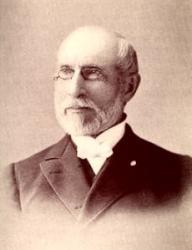
1820 - 1895 Person Name: George Frederick Root, 1820-1895 Meter: 10.10.10.10 D Composer of "EIN KAREM" in The Cyber Hymnal Root, George F., MUS. DOC, born in Sheffield, Berkshire County, Mass., Aug. 30, 1820. He is much more widely known as a composer of popular music than as a hymn writer. Four of his hymns are in I. D. Sankey's Sacred Songs & Solos, 1878. Nos. 16, 100, 293, and 297. A sympathetic biographical sketch, with portrait, is in The Tonic Sol-Fa Reporter, Sep. 1886. He died Aug. 6, 1895.
--John Julian, Dictionary of Hymnology, Appendix, Part II (1907)
=====================
George Frederick Root was born in Sheffield, Mass., August 30, 1820. His father moved to North Reading, near Boston, when the boy was six years old, and there his youth was spent.
He was always fond of music— not singing at all as a boy, but played upon every kind of instrument that came in his way. At thirteen it was his pride that he could "play a tune" on as many instruments as he was years old. His dream of life was to be a musician, although such an ambition was looked down upon by all his relatives and friends, excepting a fond mother. In the fall of 1838 he went to Boston and made an engagement to work for Mr. A. N. Johnson and take lessons on the piano.
His father and one of the brothers were at the time in South America, and the mother, with six younger children, was at home on the farm. When he secured the engagement with Mr. Johnson to receive three dollars a week and board and lessons, the neighbors became interested and encouraged him to go ahead, they promising to help look after the farm and see that the family got along. The young man's happiness over these events can better be imagined than described.
On the second day of October, 1838, he entered upon his duties in his new heaven on earth located at Harmony Hall, Mr. Johnson's music-room, in Boston. His duties were to see to the fires, care for the room, answer callers, give information about Mr. Johnson when he was out, and practice his lessons when not otherwise engaged. He worked industriously and made steady progress. It was but a few weeks till Mr. Johnson had him playing for the prayer-meeting, and but a few more till he began turning over pupils to him. In about seven weeks' time Mr. Johnson encouraged him by a considerable increase of salary. A most important event to him was meeting Dr. Lowell Mason and being accepted as a bass singer in the celebrated Bowdoin Street choir. Also, on Mr. Johnson's recommendation, he began taking private voice lessons of Mr. Geo. Jas. Webb, the then celebrated voice teacher of Boston. He continued at least a year with Mr. Webb.
His first real singing class was taught the following fall, 1839, at the North End. It lasted nearly through the winter, and on the closing night his class made him a present of a silver goblet, suitably engraved, which he kept among his treasures.
Before the first year was up Mr. Johnson proposed a five year partnership, by which Mr. Root was to receive one-third of their earnings, and the former was to have the privilege of visiting Germany part of the time if he chose. They then changed their quarters to three rooms in the basement of Park Street Church. The annual rental was six hundred dollars. They were kept quite busy.
At this time Dr. Mason's music teaching in the public schools was a growing success, and Messrs. Johnson and Root were employed to assist him. Drs. Mason and Webb had introduced what is now called Musical Conventions a year or two previous to this. They called them "The Teachers' Class." Teachers and singers were called to Boston from surrounding territory to study and practice pretty much as they do now at normals.
In 1841 Mr. Root became one of the teachers in this class. He taught vocal training and continued this work for years afterward in Dr. Mason's teachers' classes, and later incorporated the same method in his own normals. During this year Mr. Johnson went to Germany, and left the two large church choirs (Winter Street and Park Street) in charge of Mr. Root. One of the organs was played by a pupil — Mr. S. A. Bancroft.
Everything went smoothly during Mr. Johnson's absence as it did also after his return. During the last year of the five-year partnership, Mr. Root was called to take the organ at Bowdoin Street, Mr. Mason changing to Winter Street. An amicable settlement was made between Messrs. Johnson and Root, and the partnership dissolved.
In 1811, Mr. Jacob Abbott (father of Lyman Abbott)and his three brothers had established a young ladies' school in New York City. They wanted a music teacher, and offered the position to Mr. Root. They also secured him the organ and choir of the Mercer Street Church, with prospects for other good work. It required pretty strong persuasive arguments to tempt Mr. Root to leave Boston, he was doing well there, and as the sequel shows, there was an attraction in Boston that held him in too tight a grasp to be relinquished by the mere offer of greater power and place. He made up his mind, however, only after getting the consent of the powders of Boston to take with him this [to him] the greatest attraction of the city — Miss Mary Olive Woodman — an accomplished lady, a sweet singer, and a member of a prominent family of musicians. He went to New York first to prepare a home, and in August, 1845, returned for his bride, who took her place in his New York choir as leading soprano, and through his long and eventful career she was ever at his side, a true helpmeet.
He was soon employed at Rutger's Female Institute, Miss Haines' School for Young Ladies, Union Theological Seminary and the New York State Institution for the Blind. Within six weeks after he arrived in New York his time was fully occupied. He continued with Mr. Abbott's young ladies' school ten years.
While teaching in New York he continued his summer work with Messrs. Mason and Webb in Teachers' Classes. Up to the year 1849 he had written but little music; only a few hymn tunes while in Boston. He needed more music for the young ladies of his schools, so he made his first book, The Young Ladies' Choir, of which he had enough copies made for his own use, as he had no thought of offering it to the public. Then in connection with Mr. J. E. Sweetser, they compiled the Root and Sweetser's Collection.
Mr. Root did work enough for two men, hence broke down in health. Mr. Abbott suggested that he take a trip to Paris. After weighing the matter carefully, in December, 1853, he sailed, and in due time arrived at Paris, where he began studying French, voice culture and piano under celebrated teachers. After spending nearly a year abroad, he returned home in improved health and ready for active work. He began to feel the need of new music for his classes, and after some thought decided upon a musical play ; the subject and title, The Flower Queen.
At the Institution for the Blind was a young lady, a former pupil, but now a teacher who had shown some poetical talent. He asked her to help him with the words. He would suggest in prose what the flowers might say and she would put it into rhyme. She did it so well that it seldom needed any alteration. This lady was the now famous Fanny Crosby. The cantata became very popular. About this time Mr. Root wrote a half dozen simple songs for the people. They all sold pretty well, but Hazel Dell and Rosalie, the Prairie Flower, became the most popular, and had a large sale.
It was in the summer of 1853 that the first real normal was held. Mr. Root originated it, and held it in New York. The principal teachers were Messrs. Mason, Root, Hastings, and Bradbury. This school became famous. Sessions were also held at North Reading, Mass., a village near Mr. Root's "Willow Farm Home," with Dr. Mason, Mr. Webb, Mr. Bradbury and himself as principal teachers.
About this time Mr. Root decided to give up his work in New York, and devote himself entirely to conventions, normal work and authorship. He was eminently successful. Among the most eminent teachers and composers of our country have been students in Dr. Geo. F. Root's Normal Musical Institute.
In 1860 Dr. Root settled in Chicago and entered the music publishing business with his brother E. T. Root, and C. M. Cady, as "Root & Cady," Mr. Root's reputation being the most important capital of the firm. His books and popular songs soon made the new firm prosperous. Then came the war with its horror. Dr. Root wielded his musical sword in the way of writing war songs, which made him famous. The Battle Cry of Freedom, Just Before the Battle, Mother, and others, made thousands of dollars for the music house.
In the great Chicago fire of 1871 the interests of the firm of Root & Cady became engulfed in the general ruin. Their loss was upward of a quarter of a million dollars. They then sold their book catalogue, plates and copyrights to John Church & Co., of Cincinnati, and the sheet music plates and copyrights to S. Brainard's Sons, Cleveland. These sales realized about §130,000. The final result was that Dr. Root, his talented son F. W., and others became connected with John Church & Co. Under this new business relationship Mr. Root went right on with his normal and convention work; also issued a great many new books and cantatas. In 1872 the Chicago University very worthily conferred upon him the degree Doctor of Music.
In 1886 he made a trip to Scotland and England, and arranged with publishers to issue some of his cantatas. He was royally received.
Dr. Root was the author of about seventy-five books, nearly two hundred songs in sheet form, and many popular gospel songs. Dr. Root occupies a prominent place in the musical history of this country. It was Dr. Mason who lifted music from almost nothing and gave it an impetus, but he left no better follower than Dr. Root to carry on his work. He was a man of spotless integrity and high Christian character, and to know him was to love him.
At the time of Dr. Root's death he was at Bailey Island, Maine, a summer resort, where he and other relatives had cottages. On August 6, 1895, he was seized with neuralgia of the heart — and died within one hour. He was buried at North Reading, Mass., his old home.
--Hall, J. H. (c1914). Biographies of Gospel Song and Hymn Writers. New York: Fleming H. Revell Company.
George F. Root
Chas. H. Gabriel
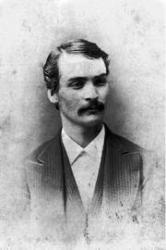
1856 - 1932 Person Name: Charles Hutchinson Gabriel Meter: 10.10.10.10 D Composer of "ASHFORD" in The Cyber Hymnal Pseudonyms: C. D. Emerson, Charlotte G. Homer, S. B. Jackson, A. W. Lawrence, Jennie Ree
=============
For the first seventeen years of his life Charles Hutchinson Gabriel (b. Wilton, IA, 1856; d. Los Angeles, CA, 1932) lived on an Iowa farm, where friends and neighbors often gathered to sing. Gabriel accompanied them on the family reed organ he had taught himself to play. At the age of sixteen he began teaching singing in schools (following in his father's footsteps) and soon was acclaimed as a fine teacher and composer. He moved to California in 1887 and served as Sunday school music director at the Grace Methodist Church in San Francisco. After moving to Chicago in 1892, Gabriel edited numerous collections of anthems, cantatas, and a large number of songbooks for the Homer Rodeheaver, Hope, and E. O. Excell publishing companies. He composed hundreds of tunes and texts, at times using pseudonyms such as Charlotte G. Homer. The total number of his compositions is estimated at about seven thousand. Gabriel's gospel songs became widely circulated through the Billy Sunday-Homer Rodeheaver urban crusades.
Bert Polman
Chas. H. Gabriel
J. Edwin Orr
1912 - 1987 Person Name: J. Edwin Orr, 1912-1987 Meter: 10.10.10.10 D Author of "Search Me" in Rejoice Hymns Rv James Edwin Orr MA ThD EdD PhD United Kingdom/USA. Born at Belfast, Northern Ireland, son of a jeweler with both British and American citizenship (so his children did as well), he studied at the College of Technology, Belfast, Ireland. After spending some years as a baker, he began evangelizing in Britian and in Europe. In 1937 he married Ivy Carol Carlson, and they had a daughter: Eileen. After their marriage, the Orrs evangelized in Australia (1939), China, Canada, South America, and the U.S. In 1939 he enrolled at Northwest University, and in 1940 was ordained into the Baptist Christian ministry at Newark, NJ. He received a MA from Northwest University in 1941 and a ThD from Northern Baptist Seminary in 1943. During WWII he served as a chaplain in the U.S. Air Force in the Pacific region. During these years he also wrote several accounts of his preaching tours. After the war he continued his studies and took his PhD at Oxford University in 1948, with his thesis on the second evangelical awakening in Britain. In 1949 he and his wife made the U.S. their permanent base and continued to travel the world promoting church revival and renewal. They evangelized in 150 countries on several continents. In 1966 he became a professor at the School of World Missions, Fuller Theological Seminary, Pasadena, CA. In 1971 he received his EdD degree from UCLA. He remained at Fuller until 1981., and as professor emeritus thereafter. He also received honorary degrees from an Indian seminary and the university of South Africa. Billy Graham wrote: “Dr J Edwn Orr, in my opinion, is one of the greatest authorities on the history of religious revivals in the Protestant world.” From 1951 on he was influential in Campus Crusade for Christ, and was one of its five original board members. He authored 40+ works, mostly on revival work. He also wrote a few hymn lyrics. He was a Fellow of the Royal Geographical Society, the American Geographical Society, the Royal Historical Society, and the Royal Society of Literature. He died at Ridgecrest, NC. Burial: Camarillo, CA.
John Perry
J. Edwin Orr
Ron Hamilton
1950 - 2023 Person Name: Ron Hamilton, 1950- Meter: 10.10.10.10 D Author of "Search Me" in Rejoice Hymns
Ron Hamilton
Johnson Oatman, Jr.
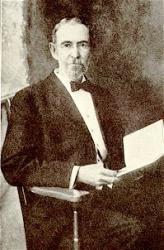
1856 - 1922 Meter: 10.10.10.10 D Author of "Take Off The Old Coat" in The Cyber Hymnal Johnson Oatman, Jr., son of Johnson and Rachel Ann Oatman, was born near Medford, N. J., April 21, 1856. His father was an excellent singer, and it always delighted the son to sit by his side and hear him sing the songs of the church.
Outside of the usual time spent in the public schools, Mr. Oatman received his education at Herbert's Academy, Princetown, N. J., and the New Jersey Collegiate Institute, Bordentown, N. J. At the age of nineteen he joined the M.E. Church, and a few years later he was granted a license to preach the Gospel, and still later he was regularly ordained by Bishop Merrill. However, Mr. Oatman only serves as a local preacher.
For many years he was engaged with his father in the mercantile business at Lumberton, N. J., under the firm name of Johnson Oatman & Son. Since the death of his father, he has for the past fifteen years been in the life insurance business, having charge of the business of one of the great companies in Mt. Holly, N. J., where he resides.
He has written over three thousand hymns, and no gospel song book is considered as being complete unless it contains some of his hymns.
In 1878 he married Wilhelmina Reid, of Lumberton, N.J. and had three children, Rachel, Miriam, and Percy.
Excerpted from Biography of Gospel Song and Hymn Writers by Jacob Henry Hall; Fleming H. Revell, Co. 1914
Johnson Oatman, Jr.
Pages




