You help make Hymnary.org possible. More than 10 million people from 200+ countries found hymns, liturgical resources and encouragement on Hymnary.org in 2025, including you. Every visit affirms the global impact of this ministry.

If Hymnary has been meaningful to you this year, would you take a moment today to help sustain it? A gift of any size—paired with a note of encouragement if you wish—directly supports the server costs, research work and curation that keep this resource freely available to the world.

Give securely online today, or mail a check to:
Hymnary.org
Calvin University
3201 Burton Street SE
Grand Rapids, MI 49546

Thank you for your partnership, and may the hope of Advent fill your heart.

God Invisible

Representative Text

Lord, we are blind, we mortals blind,
We can't behold thy bright abode;
O 'tis beyond a creature mind
To glance a thought half way to God!

Infinite leagues beyond the sky
The great Eternal reigns alone,
Where neither wings nor souls can fly,
Nor angels climb the topless throne.

The Lord of glory builds his seat
Of gems insufferably bright,
And lays beneath his sacred feet
Substantial beams of gloomy night.

Yet, glorious Lord, thy gracious eyes
Look through and cheer us from above
Beyond our praise thy grandeur flies,
Yet we adore, and yet we love.


Source: Psalms and Hymns of Isaac Watts, The #II.26

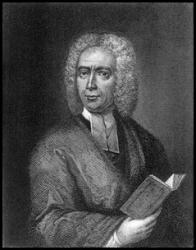
Author: Isaac Watts

Isaac Watts was the son of a schoolmaster, and was born in Southampton, July 17, 1674. He is said to have shown remarkable precocity in childhood, beginning the study of Latin, in his fourth year, and writing respectable verses at the age of seven. At the age of sixteen, he went to London to study in the Academy of the Rev. Thomas Rowe, an Independent minister. In 1698, he became assistant minister of the Independent Church, Berry St., London. In 1702, he became pastor. In 1712, he accepted an invitation to visit Sir Thomas Abney, at his residence of Abney Park, and at Sir Thomas' pressing request, made it his home for the remainder of his life. It was a residence most favourable for his health, and for the prosecution of his literary… Go to person page >

Text Information

First Line: Lord, we are blind, we mortals blind
Title: God Invisible
Author: Isaac Watts
Meter: 8.8.8.8
Language: English
Copyright: Public Domain

Notes

Lord, we are blind, we mortals blind. I. Watts. [God Invisible.] Published in his Hymns & Spiritual Songs, 1707, Book ii., No. 26, in 4 stanzas of 4 lines, and headed "God Invisible." In the American Plymouth Collection, 1855, it begins with stanza ii., "Infinite leagues beyond the sky."

--John Julian, Dictionary of Hymnology (1907)

Tune

SESSIONS


OLD HUNDREDTH

This tune is likely the work of the composer named here, but has also been attributed to others as shown in the instances list below. According to the Handbook to the Baptist Hymnal (1992), Old 100th first appeared in the Genevan Psalter, and "the first half of the tune contains phrases which may ha…

Go to tune page >


DUKE STREET

First published anonymously in Henry Boyd's Select Collection of Psalm and Hymn Tunes (1793), DUKE STREET was credited to John Hatton (b. Warrington, England, c. 1710; d, St. Helen's, Lancaster, England, 1793) in William Dixon's Euphonia (1805). Virtually nothing is known about Hatton, its composer,…

Go to tune page >


Timeline

Media

The Cyber Hymnal #4087
  • Adobe Acrobat image (PDF)
  • Noteworthy Composer score (NWC)
  • XML score (XML)

Instances in all hymnals

Instances (1 - 2 of 2)

Old-Line Primitive Baptist Hymn and Tune Book #10

TextScoreAudio

The Cyber Hymnal #4087

Include 24 pre-1979 instances
Suggestions or corrections? Contact us
It looks like you are using an ad-blocker. Ad revenue helps keep us running. Please consider white-listing Hymnary.org or getting Hymnary Pro to eliminate ads entirely and help support Hymnary.org.