

 My Starred Hymns
 My FlexScores
 My Hymnals
 My Purchased Files
Planning worship?
Check out our sister site, ZeteoSearch.org,
for 20+ additional resources related to your search.
- |
User Links
Person Results
Peter Ritter
1760 - 1846 Person Name: Ritter Composer of "[O sel'ges Licht, Dreifaltigkeit]" in Jubel-Klänge Peter Ritter; b. 1760, Mannheim; d. 1846
Evangelical Lutheran Hymnal, 1908
Peter Ritter
St. Ambrose
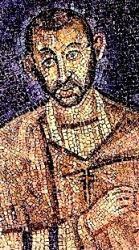
340 - 397 Person Name: St. Ambrose Author of "O sel'ges Licht, Dreifaltigkeit" Ambrose (b. Treves, Germany, 340; d. Milan, Italy, 397), one of the great Latin church fathers, is remembered best for his preaching, his struggle against the Arian heresy, and his introduction of metrical and antiphonal singing into the Western church. Ambrose was trained in legal studies and distinguished himself in a civic career, becoming a consul in Northern Italy. When the bishop of Milan, an Arian, died in 374, the people demanded that Ambrose, who was not ordained or even baptized, become the bishop. He was promptly baptized and ordained, and he remained bishop of Milan until his death. Ambrose successfully resisted the Arian heresy and the attempts of the Roman emperors to dominate the church. His most famous convert and disciple was Augustine. Of the many hymns sometimes attributed to Ambrose, only a handful are thought to be authentic. Bert Polman =====================
Ambrosius (St. Ambrose), second son and third child of Ambrosius, Prefect of the Gauls, was born at Lyons, Aries, or Treves--probably the last--in 340 A.D. On the death of his father in 353 his mother removed to Rome with her three children. Ambrose went through the usual course of education, attaining considerable proficiency in Greek; and then entered the profession which his elder brother Satyrus had chosen, that of the law. In this he so distinguished himself that, after practising in the court of Probus, the Praetorian Prefect of Italy, he was, in 374, appointed Consular of Liguria and Aemilia. This office necessitated his residence in Milan. Not many months after, Auxentius, bishop of Milan, who had joined the Arian party, died; and much was felt to depend upon the person appointed as his successor. The church in which the election was held was so filled with excited people that the Consular found it necessary to take steps fur preserving the peace, and himself exhorted them to peace and order: when a voice suddenly exclaimed, "Ambrose is Bishop," and the cry was taken up on all sides. He was compelled to accept the post, though still only a catechumen; was forthwith baptized, and in a week more consecrated Bishop, Dec. 7, 374. The death of the Emperor Valentinian I., in 375, brought him into collision with Justina, Valentinian's second wife, an adherent of the Arian party: Ambrose was supported by Gratian, the elder son of Valentinian, and by Theodosius, whom Gratian in 379 associated with himself in the empire. Gratian was assassinated in 383 by a partisau of Maximus, and Ambrose was sent to treat with the usurper, a piece of diplomacy in which he was fairly successful. He found himself, however, left to carry on the contest with the Arians and the Empress almost alone. He and the faithful gallantly defended the churches which the heretics attempted to seize. Justina was foiled: and the advance of Maximus on Milan led to her flight, and eventually to her death in 388. It was in this year, or more probably the year before (387), that Ambrose received into the Church by baptism his great scholar Augustine, once a Manichaean heretic. Theodosius was now virtually head of the Roman empire, his colleague Valentinian II., Justina's son, being a youth of only 17. In the early part of 390 the news of a riot at Thessalonica, brought to him at Milan, caused him to give a hasty order for a general massacre at that city, and his command was but too faithfully obeyed. On his presenting himself a few days after at the door of the principal church in Milan, he was met by Ambrose, who refused him entrance till he should have done penance for his crime. It was not till Christmas, eight months after, that the Emperor declared his penitence, and was received into communion again by the Bishop. Valentinian was murdered by Arbogastes, a Frank general, in 392; and the murderer and his puppet emperor Eugenius were defeated by Theodosius in 394. But the fatigues of the campaign told on the Emperor, and he died the following year. Ambrose preached his funeral sermon, as he had done that of Valentinian. The loss of these two friends and supporters was a severe blow to Ambrose; two unquiet years passed, and then, worn with labours and anxieties, he himself rested from his labours on Easter Eve, 397. It was the 4th of April, and on that day the great Bishop of Milan is remembered by the Western Church, but Rome commemorates his consecration only, Dec. 7th. Great he was indeed, as a scholar, an organiser, a statesman; still greater as a theologian, the earnest and brilliant defender of the Catholic faith against the Arians of the West, just as Athanasius (whose name, one cannot but remark, is the same as his in meaning) was its champion against those of the East. We are now mainly concerned with him as musician and poet, "the father of Church song" as he is called by Grimm. He introduced from the East the practice of antiphonal chanting, and began the task, which St. Gregory completed, of systematizing the music of the Church. As a writer of sacred poetry he is remarkable for depth and severity. He does not warm with his subject, like Adam of St. Victor, or St. Bernard. "We feel," says Abp. Trench, "as though there were a certain coldness in his hymns, an aloofness of the author from his subject. "A large number of hymns has been attributed to his pen; Daniel gives no fewer than 92 called Ambrosian. Of these the great majority (including one on himself) cannot possibly be his; there is more or less doubt about the rest. The authorities on the subject are the Benedictine ed. of his works, the Psalterium, or Hymnary, of Cardinal Thomasius, and the Thesaurus Hymnologicus of Daniel. The Benedictine editors give 12 hymns as assignable to him, as follows:—1. Aeterna Christi munera. 2. Aeterne rerum Conditor. 3. Consors Paterni luminii. 4. Deus Creator omnium. 5. Fit porta Christi pervia, 6. Illuminans Altissimus. 7. Jam surgit hora tertia. 8. 0 Lux Beata Trinitas. 9. Orabo mente Dominum. 10. Somno refectis artubus. 11. Splendor Paternae gloriae. 12. Veni Redemptor gentium. Histories of these hymns, together with details of translations into English, are given in this work, and may be found under their respective first lines. The Bollandists and Daniel are inclined to attribute to St. Ambrose a hymn, Grates tibi Jesu novas, on the finding of the relics of SS. Gervasius and Protasius. These, we know, were discovered by him in 386, and it is by no means unlikely that the bishop should have commemorated in verse an event which he announces by letter to his sister Marcellina with so much satisfaction, not to say exultation.A beautiful tradition makes the Te Deum laudamus to have been composed under inspiration, and recited alternately, by SS. Ambrose and Augustine immediately after the baptism of the latter in 387. But the story rests upon a passage which there is every reason to consider spurious, in the Chronicon of Dacius, Bishop of Milan in 550. There is no hint of such an occurrence in the Confessions of St. Augustine, nor in Paulinue's life of St. Ambrose, nor in any authentic writing of St. Ambrose himself. The hymn is essentially a compilation, and there is much reason to believe, with Merati, that it originated in the 5th century, in the monastery of St. Honoratus at Lerins. [Te Deum.] -- John Julian, Dictionary of Hymnology (1907)
Also known as: Ambrotio, Ambrosio de Milán Ambrosius Mediolanensis Ambrosius Saint, Bp. of Milan Ambrosius von Mailand Aurelio Ambrogio, Saint, Bishop of Milan Aurelius Ambrosius, Saint, Bishop of Milan Milan, d. 397
St. Ambrose
Christian Karl Josias, Freiherr von Bunsen
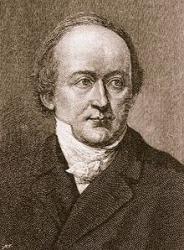
1791 - 1860 Person Name: J. v. Bunsen Translator of "O selges Licht, Dreifaltigkeit" in Evangelisches Gesangbuch. Nach Zustimmung der Provinszialsznode vom Jahre 1884 zur Einfürung in der Provinz Brandenburg mit Genehmigung des Evangelischen Oberkirchenrats Bunsen, Christian Carl Josias, Baron, Prussian Minister at Rome, 1823-1838; at Berne, 1839-1841; Ambassador to England, 1841-1854; was born at Corbach in Waldeck, 25th August, 1791; died at Bonn, November 28th, 1860. Having gained high honours in the Universities of Marburg and Gottingen, he began life as an assistant master in the Gymnasium of Gottingen, but soon quitted that post to prosecute the enquiries which he felt to be the true aim of his life, and for which he had already, at the age of 24, conceived the idea of a comprehensive plan of philological and historical research, culminating in a synthesis of philology, history and philosophy, with the application of that synthesis to religious and civil legislation. To the accomplishment of this youthful scheme it may truly be said that his whole life was dedicated; for though employed in the diplomatic service of his country fur 37 years, he unremittingly carried on his labours as a scholar, and always regarded public questions under the aspect of their bearing on the moral and religious welfare of man, governing his publications by his convictions on these points, in the pursuit of the aims thus indicated, he studied successively the languages and antiquities of the Germanic, Indo-Peraie, Semitic, and Egyptian peoples, the fruit of his investigations being enbodied in his:—
(1) "Description of Borne," 1819; (2) "Egypt's Place in the World's History," 1848; (3) "Hippolytus and his Age," 1852; (4) "Outlines of a Philosophy of Cniversal History," 1854; (5) "Signs of the Times," 1855; (6) "God in History," 1857-58; and lastly his (8) "Bibel-Werk," or Critical Text of the Bible, with com¬mentaries, which he did not live to complete.
The titles of these writings will indicate the fact that the studies and employments which aver came nearest to his heart lay in the direction of theology, believing as he did that the revivification of practical Christianity was the "essential condition of universal well-being"—of "the salvation of Church and State."
” It is my conviction," he says (1821, set. 29), "that all communion essentially consists in a common belief in the facts of the redemption of the human race through Christ; but when ... a congregation is to be thereby formed, three points must be considered: first, agreement by means of a theological expression of the points of faith; secondly, congregational discipline; thirdly, a common form of worship."
It was for the third of these that Bunsen felt himself especially called to labour; writing in 1821:—
"When I thought myself in my late illness on the brink of eternity ... I enquired what I ought to make my calling if God should prolong my life . . . and upon my theological labours I rested as the quarter in which my calling was to be sought. My thoughts were bent principally on my liturgical enquiries."
In 1822 he composed the Liturgy still in use at the German Chapel on the Capitol, followed in 1833 by his Versuch eines allgemeinen evangelischen Gesang- und Gebeibuclis, containing 934 Hymns and 350 prayers. In Germany the tendency of the centuries that had elapsed since the great age of hymn-writers had been to adapt their language and modify their thoughts in accordance with modern taste till, as Bunsen says, "Almost everywhere do weo find the admirable ancient hymns driven out of use by modern ones which are feeble and spiritless." Luther's asperities of diction and metre had to be softened down, in order to fit them to be sung in an age rejecting nearly all but iambic or trochaic verses, and moreover each government, sect, or school of opinion, thought them¬selves justified in remodelling the older National Hymnody according to their own ideas, till at length little remained of their pristine rugged glory, they were defaced past recognition.
Bunsen's object in his Versuch was to provide materials for a national hymn-book for the whole of Protestant Germany, irrespective of territorial, ecclesiastical or sectarian divisions. To this end he sought out the finest German hymns, and his selection includes a large pro¬portion of the best hymns in the language with no limitations of party. The success of Bunsen's work in Germany at large was attested by the rapid sale of an enormous edition, but when a reprint was called for he published instead a smaller edition of 440 hymns. The motive was his patriotic ambition to produce a handy volume like the English Book of Common Prayer, and he fondly hoped that when the volume was printed at the Rauhe Haus in 1846, it would speedily supplant the locally introduced Gesangbücher of the 18th and 19th centuries. This hymn-book has in fact been adopted for public worship by some individual congregations in Germany, and by many scattered throughout Australia, New Zealand, &c, but it never became a National Hymn-book. Bunsen was among the first to go back to the authors and their original texts, and the abridgments and alterations he made were done with tact and circumspection. Perhaps nothing, however, can better prove the high estimation in which Bunsen's first "epoch-making" work is held than the fact that his work of 1833 has been republished as:—
Allgemeines Eoangelisches Gesang-und-Gebet-bueh turn, Kirchen-und-Hausgebrauch: In vollig neuer Bearleitung von Albert Fischer. Gotha, F. A. Perthes, 1881.
and that this republication, or rather recast, was conducted by the first German hymnologist living. A parallel case of inability to command universal acceptance for public use on the one hand, and of renovating influence on national hymnody on the other, is that of Lord Selborne's Book of Praise. Before the date of its publication in 1862, little or no regard was paid to original texts. Since then, however, few collections have been published in Gt. Britain and America in which the principle laid down by him has not been followed with more or less fidelity.
But it is not Germany alone, or even perhaps most widely, that has profited by Bunsen's zeal for hymnology: Through the medium of translations such as those of Miss Catherine Winkworth, Mr. Massie, Miss Cox, and others, many German hymns are as familiar to English and American readers as to Germans. The Lyra Germanica (of which more than 30,000 copies have been sold in England and probably as many more in America; is a household book wherever English is spoken, and few, if any, collections of hymns that have appeared in England or America since its publication have been compiled without some hymns taken from the Lyra.
But no sketch of Bunsen would be complete without mentioning that he himself had no mean talent as a writer of sacred poems. Some of these pieces are given in his Biography, and one is noted under "O lux beata Trinitas." Perhaps the whole scope of Bunsen's life-work can scarcely be summed up better than in his own words written in 1817 [aet. 26].
"To study and then to set forth the consciousness of God in the mind of man, and that which, in and through that consciousness, he has accomplished, especially in language and religion." [Susanna Winkworth]
-- John Julian, Dictionary of Hymnology (1907)
Christian Karl Josias, Freiherr von Bunsen




