

 My Starred Hymns
 My FlexScores
 My Hymnals
 My Purchased Files
Planning worship?
Check out our sister site, ZeteoSearch.org,
for 20+ additional resources related to your search.
- |
User Links
Person Results
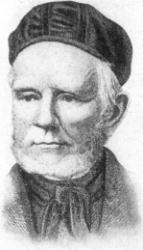
John Cennick

1718 - 1755 Person Name: J. Cennick Topics: The Church Year Fifteenth Sunday after Trinity; The Church Year Fifteenth Sunday after Trinity Author of "Children of the heavenly King" in The Lutheran Hymnary John Cennick was born at Reading, Berkshire, in the year 1717. He became acquainted with Wesley and Whitefield, and preached in the Methodist connection. On the separation of Wesley and Whitefield he joined the latter. In 1745, he attached himself to the Moravians, and made a tour in Germany to fully acquaint himself with the Moravian doctrines. He afterwards ministered in Dublin, and in the north of Ireland. He died in London, in 1755, and was buried in the Moravian Cemetery, Chelsea. He was the author of many hymns, some of which are to be found in every collection.
--Annotations of the Hymnal, Charles Hutchins, M.A. 1872.
=======================
Cennick, John, a prolific and successful hymnwriter, was descended from a family of Quakers, but brought up in the Church of England. He assisted J. Wesley and then G. Whitefield in their labours for a time, and then passed over to, and died as a minister of, the Moravian Church. Born at Reading, Dec. 12, 1718, he was for some time a land surveyor at Reading, but becoming acquainted with the Wesleys in 1739, he was appointed by J. Wesley as a teacher of a school for colliers' children at Kingswood in the following year. This was followed by his becoming a lay preacher, but in 1740 he parted from the Wesleys on doctrinal grounds. He assisted Whitefield until 1745, when he joined the Mora¬vians, and was ordained deacon, in London, in 1749. His duties led him twice to Germany and also to the North of Ireland. He died in London, July 4, 1755. In addition to a few prose works, and some sermons, he published:— (1) Sacred Hymns, for the Children of God in the Days of their Pilgrimage, Lond., J. Lewis, n.d. (2nd ed. Lond., B. Milles, 1741), Pts. ii., iii., 1742; (2) Sacred Hymns for the Use of Religious Societies, &c, Bristol, F. Farley, 1743; (3) A Collection of Sacred Hymns, &c, Dublin, S. Powell, 3rd ed., 1749; (4) Hymns to the honour of Jesus Christ, composed for such Little Children as desire to be saved. Dublin, S. Powell, 1754. Additional hymns from his manuscripts were published by his son-in-law, the Rev. J. Swertner, in the Moravian Hymn Book, 1789, of which he was the editor. There are also 16 of his hymns in his Sermons, 2 vols., 1753-4, some being old hymns rewritten, and others new.
Many of Cennick's hymns are widely known, as, "Lo, He cometh, countless trumpets;" “Brethren, let us join to bless;" "Jesus, my all, to heaven is gone;" "Children of the heavenly King;" "Ere I sleep, for every favour;" "We sing to Thee, Thou Son of God;" and the Graces: " Be present at our table, Lord;" and "We thank Thee, Lord;" &c. Some of the stanzas of his hymns are very fine, but the hymns taken as a whole are most unequal. Some excellent centos might be compiled from his various works. His religious experiences were given as a preface to his Sacred Hymns, 1741. In addition to the hymns named, and others annotated under their first lines, the following are in common use:—
1. Be with me [us] Lord, where'er I [we] go. Divine Protection. [1741.]
2. Cast thy burden on the Lord. Submission. [1743.]
3. Not unto us, but Thee alone. Praise to Jesus. [1743.]
4. Thou dear Redeemer, dying Lamb. Priesthood of Christ. [1743.]
5. We sing to Thee, Thou Son of God. Praise to Jesus. [1743.]
6. When, 0 dear Jesus, when shall I? Sunday Evening. [1743.]
--John Julian, Dictionary of Hymnology (1907)
John Cennick
Lowell Mason
1792 - 1872 Person Name: L. Mason Topics: The Church Year Fifteenth Sunday after Trinity Composer of "[My faith looks up to Thee]" in The Lutheran Hymnary Dr. Lowell Mason (the degree was conferred by the University of New York) is justly called the father of American church music; and by his labors were founded the germinating principles of national musical intelligence and knowledge, which afforded a soil upon which all higher musical culture has been founded. To him we owe some of our best ideas in religious church music, elementary musical education, music in the schools, the popularization of classical chorus singing, and the art of teaching music upon the Inductive or Pestalozzian plan. More than that, we owe him no small share of the respect which the profession of music enjoys at the present time as contrasted with the contempt in which it was held a century or more ago. In fact, the entire art of music, as now understood and practiced in America, has derived advantage from the work of this great man.
Lowell Mason was born in Medfield, Mass., January 8, 1792. From childhood he had manifested an intense love for music, and had devoted all his spare time and effort to improving himself according to such opportunities as were available to him. At the age of twenty he found himself filling a clerkship in a banking house in Savannah, Ga. Here he lost no opportunity of gratifying his passion for musical advancement, and was fortunate to meet for the first time a thoroughly qualified instructor, in the person of F. L. Abel. Applying his spare hours assiduously to the cultivation of the pursuit to which his passion inclined him, he soon acquired a proficiency that enabled him to enter the field of original composition, and his first work of this kind was embodied in the compilation of a collection of church music, which contained many of his own compositions. The manuscript was offered unavailingly to publishers in Philadelphia and in Boston. Fortunately for our musical advancement it finally secured the attention of the Boston Handel and Haydn Society, and by its committee was submitted to Dr. G. K. Jackson, the severest critic in Boston. Dr. Jackson approved most heartily of the work, and added a few of his own compositions to it. Thus enlarged, it was finally published in 1822 as The Handel and Haydn Society Collection of Church Music. Mason's name was omitted from the publication at his own request, which he thus explains, "I was then a bank officer in Savannah, and did not wish to be known as a musical man, as I had not the least thought of ever making music a profession." President Winchester, of the Handel and Haydn Society, sold the copyright for the young man. Mr. Mason went back to Savannah with probably $500 in his pocket as the preliminary result of his Boston visit.
The book soon sprang into universal popularity, being at once adopted by the singing schools of New England, and through this means entering into the church choirs, to whom it opened up a higher field of harmonic beauty. Its career of success ran through some seventeen editions. On realizing this success, Mason determined to accept an invitation to come to Boston and enter upon a musical career. This was in 1826. He was made an honorary member of the Handel and Haydn Society, but declined to accept this, and entered the ranks as an active member. He had been invited to come to Boston by President Winchester and other musical friends and was guaranteed an income of $2,000 a year. He was also appointed, by the influence of these friends, director of music at the Hanover, Green, and Park Street churches, to alternate six months with each congregation. Finally he made a permanent arrangement with the Bowdoin Street Church, and gave up the guarantee, but again friendly influence stepped in and procured for him the position of teller at the American Bank.
In 1827 Lowell Mason became president and conductor of the Handel and Haydn Society. It was the beginning of a career that was to win for him as has been already stated the title of "The Father of American Church Music." Although this may seem rather a bold claim it is not too much under the circumstances. Mr. Mason might have been in the average ranks of musicianship had he lived in Europe; in America he was well in advance of his surroundings. It was not too high praise (in spite of Mason's very simple style) when Dr. Jackson wrote of his song collection: "It is much the best book I have seen published in this country, and I do not hesitate to give it my most decided approbation," or that the great contrapuntist, Hauptmann, should say the harmonies of the tunes were dignified and churchlike and that the counterpoint was good, plain, singable and melodious.
Charles C. Perkins gives a few of the reasons why Lowell Mason was the very man to lead American music as it then existed. He says, "First and foremost, he was not so very much superior to the members as to be unreasonably impatient at their shortcomings. Second, he was a born teacher, who, by hard work, had fitted himself to give instruction in singing. Third, he was one of themselves, a plain, self-made man, who could understand them and be understood of them."
The personality of Dr. Mason was of great use to the art and appreciation of music in this country. He was of strong mind, dignified manners, sensitive, yet sweet and engaging.
Prof. Horace Mann, one of the great educators of that day, said he would walk fifty miles to see and hear Mr. Mason teach if he could not otherwise have that advantage.
Dr. Mason visited a number of the music schools in Europe, studied their methods, and incorporated the best things in his own work. He founded the Boston Academy of Music. The aim of this institution was to reach the masses and introduce music into the public schools. Dr. Mason resided in Boston from 1826 to 1851, when he removed to New York. Not only Boston benefited directly by this enthusiastic teacher's instruction, but he was constantly traveling to other societies in distant cities and helping their work. He had a notable class at North Reading, Mass., and he went in his later years as far as Rochester, where he trained a chorus of five hundred voices, many of them teachers, and some of them coming long distances to study under him. Before 1810 he had developed his idea of "Teachers' Conventions," and, as in these he had representatives from different states, he made musical missionaries for almost the entire country. He left behind him no less than fifty volumes of musical collections, instruction books, and manuals.
As a composer of solid, enduring church music. Dr. Mason was one of the most successful this country has introduced. He was a deeply pious man, and was a communicant of the Presbyterian Church. Dr. Mason in 1817 married Miss Abigail Gregory, of Leesborough, Mass. The family consisted of four sons, Daniel Gregory, Lowell, William and Henry. The two former founded the publishing house of Mason Bros., dissolved by the death of the former in 1869. Lowell and Henry were the founders of the great organ manufacturer of Mason & Hamlin. Dr. William Mason was one of the most eminent musicians that America has yet produced.
Dr. Lowell Mason died at "Silverspring," a beautiful residence on the side of Orange Mountain, New Jersey, August 11, 1872, bequeathing his great musical library, much of which had been collected abroad, to Yale College.
--Hall, J. H. (c1914). Biography of Gospel Song and Hymn Writers. New York: Fleming H. Revell Company.
Lowell Mason
Johann Heermann
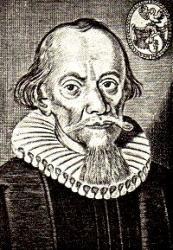
1585 - 1647 Person Name: J. Heermann Topics: Fifteenth Sunday after Trinity Sunday Evening Author of "O Gud, du fromme Gud" in M. B. Landstads Kirkesalmebog og "Nokre Salmar" ved Professor Dr. E. Blix, samt følgende tillæg Johann Heermann's (b. Raudten, Silesia, Austria, 1585; d. Lissa, Posen [now Poland], 1647) own suffering and family tragedy led him to meditate on Christ's undeserved suffering. The only surviving child of a poor furrier and his wife, Heermann fulfilled his mother's vow at his birth that, if he lived, he would become a pastor. Initially a teacher, Heermann became a minister in the Lutheran Church in Koben in 1611 but had to stop preaching in 1634 due to a severe throat infection. He retired in 1638. Much of his ministry took place during the Thirty Years' War. At times he had to flee for his life and on several occasions lost all his possessions. Although Heermann wrote many of his hymns and poems during these devastating times, his personal faith and trust in God continued to be reflected in his lyrics. He is judged to be the finest hymn writer in the era between Martin Luther and Paul Gerhardt, one whose work marks a transition from the objective hymns of the Reformation to the more subjective hymns of the seventeenth century. His hymn texts were published in collections such as Devoti Musica Cordis, Hauss- und Hertz-Musica (1630, expanded in 1636, 1644), and Sontags- und Fest-evangelia (1636).
Bert Polman
===================
Heermann, Johann, son of Johannes Heermann, furrier at Baudten, near Wohlau, Silesia, was born at Baudten, Oct. 11, 1585. He was the fifth but only surviving child of his parents, and during a severe illness in his childhood his mother vowed that if he recovered she would educate him for the ministry, even though she had to beg the necessary money. He passed through the schools at Wohlau; at Fraustadt (where he lived in the house of Valerius Herberger, q. v., who took a great interest in him); the St. Elizabeth gymnasium at Breslau; and the gymnasium at Brieg. At Easter, 1609, he accompanied two young noblemen (sons of Baron Wenzel von Rothkirch), to whom he had been tutor at Brieg, to the University of Strassburg; but an affection of the eyes caused him to return to Baudten in 1610. At the recommendation of Baron Wenzel he was appointed diaconus of Koben, a small town on the Oder, not far from Baudten, and entered on his duties on Ascension Day, 1611, and on St. Martin's Day, 1611, was promoted to the pastorate there. After 1623 he suffered much from an affection of the throat, which compelled him to cease preaching in 1634, his place being supplied by assistants. In October, 1638, he retired to Lissa in Posen, and died there on Septuagesima Sunday (Feb. 17), 1647. (Koch, iii. 16-36; Allgemeine Deutsche Biographie, xi. 247-249, &c.)
Much of Heermann's manhood was spent amid the distressing scenes of the Thirty Years' War; and by his own ill health and his domestic trials he was trained to write his beautiful hymns of “Cross and Consolation." Between 1629 and 1634, Koben was plundered four times by the Lichtenstein dragoons and the rough hordes under Wallenstein sent into Silesia by the King of Austria in order to bring about the Counter-Reformation and restore the Roman Catholic faith and practice; while in 1616 the town was devastated by fire, and in 1631 by pestilence. In these troublous years Heermann several times lost all his moveables; once he had to keep away from Koben for seventeen weeks; twice he was nearly sabred; and once, while crossing the Oder in a frail boat loaded almost to sinking, he heard the bullets of the pursuing soldiers whistle just over his head. He bore all with courage and patience, and he and his were wonderfully preserved from death and dishonour. He was thus well grounded in the school of affliction, and in his House and Heart Music some of his finest hymns are in the section entitled "Songs of Tears. In the time of the persecution and distress of pious Christians."
As a hymnwriter Heermann ranks with the beat of his century, some indeed regarding him as second only to Gerhardt. He had begun writing Latin poems about 1605, and was crowned as a poet at Brieg on Oct. 8, 1608. He marks the transition from the objective standpoint of the hymnwriters of the Reformation period to the more subjective and experimental school that followed him. His hymns are distinguished by depth and tenderness of feeling; by firm faith and confidence in face of trial; by deep love to Christ, and humble submission to the will of God. Many of them became at once popular, passed into the hymnbooks, and still hold their place among the classics of German hymnody. They appeared principally in—
(1) Devoti Musica Cordis. Hauss-und Hertz-Musica &c. Leipzig and Breslau, 1630, with 49 hymns (2nd edition 1636, with 64; 3rd edition 1644, with 69). The first section is entitled "Hymns of Penitence and Consolation from the words of the Ancient Fathers of the Church." Seven of these, however, have no mention in their individual titles of the sources from which they are derived; and the remainder are mostly based not on Latin hymns, but on the prose meditations in Martin Moller's Meditationes sanctorum patrum, or on the mediaeval compilations known as the Meditationes and the Manuale of St. Augustine. (2) Sontags-und Fest-Evangelia. Leipzig and Breslau, 1636, being hymns on the Gospels for Sundays and festivals. (3) Poetische Erquickstunden, Nürnberg, 1656; and its Fernere Fortsetzung, also Nürnberg, 1656 [both in Wernigerode], are poems rather than hymns. The hymns of the Hauss-und Hertz-Musica, with a representative selection from Heermann's other poetical works, were edited by C. E. P. Wackernagel, prefaced by a long biographical and critical introduction, and published at Stuttgart, 1855.
Six of the most important of Heermann's hymns are annotated under their respective first lines. The other hymns by Heermann which have passed into English are :—
I. Hymns in English common use:--
i. 0 Jesu, du mein Bräutigam. Holy Communion. In his Devoti Musica Cordis, Breslau, 1630, p. 78, in 12 stanzas of 4 lines. Thence in Mützell, 1858, No. 34, in Wackernagel's ed. of his Geistliche Lieder, No. 22, and the Unverfälschter Liedersegen, 1851, No. 283. Seems to be founded on Meditation xi. in the mediaeval compilation known as St. Augustine's Manuale. Translated as:—
0 Jesu, Lord, who once for me, a good translation of stanzas i., ii., iv., v., viii., by A. T. Russell, as No. 158 in his Psalms & Hymns, 1851.
Other translations are: (l) 0 Jesu! Bridegroom of my Soul," by J. C. Jacobi, 1722, p. 44 (1732, p. 73). (2) "Dear Saviour, who for me hast borne," by Miss Dunn, 1857.
ii. Rett, 0 Herr Jesu, rett dein Ehr. In Time of Trouble. A prayer for deliverance and peace for the Church. In his Devoti Musica Cordis, 1630, p. 119, in 5 stanzas of 4 lines, among the "Songs of Tears." Thence in Mützell, 1858, No. 48, in Wackernagel’s ed., No. 36, and the Unverfälschter Liedersegen, 1851, No. 245. Translated as:—
Thine honour rescue, righteous Lord, in full, by Dr. M. Loy, in the Ohio Lutheran Hymnal, 1880.
iii. Treuer Wächter Israel. In Time of War. 1630, p. 115, in 13 stanzas of 7 lines, among the "Songs of Tears." In Mützell, 1858, No. 47; in Wackernagel's edition, No. 35, and the Unverfälschter Liedersegen, 1851, No. 594. Lauxmann, in Koch, viii. 549, says of it:—
"It is a powerful hymn filled with that prevailing prayer that takes heaven by force," and relates of st. vii.,11. v-7, "Eine Mauer um uns bau," that on Jan. 6, 1814, the Allied Forces were about to enter Schleswig. A poor widow with her daughter and grandson lived in a little house near the entrance of the town. The grandson was reading in his hymnbook those in time of war, and when he came to this said, “It would be a good thing, grandmother, if our Lord God would build a wall around us." Next day all through the town cries of distress were heard, but all was still before their door. On the following morning they had courage to open the door, and lo a snowdrift concealed them from the view of the enemy. On this incident Clemens Brentano composed a beautiful poem "Draus vor Schleswig."
It is translated as:—
Jesu! as a Saviour, aid. A good tr. of st; vii., viii., xiii., by A. T. Russell, as No. 138 in his Psalms & Hymns, 1851.
iv. Zionklagt mit Angst und Schmerzen. Church of Christ. First published in his Devoti Musica Cordis, 2nd ed., 1636 (1644, p. 196), in 6 stanzas of 8 lines, entitled, "From the beautiful golden saying of Isaiah, Chapter xlix." In Mützell, 1858, No. 101, in Wackernagel’s ed., No. 53, and the Unverfälschter Liedersegen, 1851, No. 256. Translated as:—
Sion bow'd with anguish weepeth A good translation of stanzas i., iii., v., by A. T. Russell, as No. 141 in his Psalms & Hymns, 1851.
Another translation is: "Zion mourns in fear and anguish," by Miss Winkworth, 1869, p. 198.
II. Hymns not in English common use:--
v. Ach Jesu! dessen Treu. Love to Christ. 1630, p. 144, in 33 stanzas. One of his finest hymns, full of deep love to Christ, but from its great length very little used in Germany. Translated as, "Ah! Jesus! Lord! whose faithfulness," by Miss Burlingham, in the British Herald, May, 1867, p. 72.
vi. Der Tod klopft bei mir an. For the Dying. 1656, p. 22, in 121. Translated as, "That Death is at my door," by Miss Winkworth, 1869, p. 201.
vii. Du weinest für Jerusalem. Christ weeping over Jerusalem. 1630, p. 81, in 6 stanzas, entitled, "On the Tears of Christ." Founded on St. Luke xix. 41-44, part of the Gospel for the 10 Sundays after Trinity. The translations are: (1) "With tears o'er lost Jerusalem," by Miss Cox, 1841, p. 159. (2) "Our Lord wept o'er Jerusalem," by Dr. H. Mills, 1845 (1856, p. 295). (3) "Thou weepest o'er Jerusalem," by Miss Winkworth, 1855,p. 70.
viii. Herr Jesu Christe mein getreuer Hirte. Holy Communion. 1630, p. 74, in 9 stanzas, founded on M. Moller's Meditationes sanctorum patrum, pt. i. c. 11, and pt. v. c. 2. The translations are: (1) "Dear Saviour, Thou my faithful Shepherd, come” by Miss Dunn, 1857, p. 111. (2) "Lord Jesus Christ, my faithful Shepherd, hear," by Miss Winkworth, 1858, p. 93, repeated in Lyra Eucharistica, 1863-64.
ix. Herr unser Gott, lass nicht zu Schanden werden. Christ's Church. 1630, p. 114, as one of the "Songs of Tears," in 5 stanzas. Translated as, "Ah! Lord our God, let them not be confounded," by Miss Winkworth, 1869, p. 197.
x. Hilf mir, mein Oott, hilf dass nach dir. Christian Conduct. 1630, p. 32, in 7 stanzas, entitled, "For a better life. From the words of Augustine." Founded on No. i. of the Meditationes current under the name of St. Augustine. This meditation is apparently by St. Anselm of Canterbury. Translated as, "Lord, raise in me a constant Flame," by J. C. Jacobi, 1725, p. 27 (1732, p. 105).
xi. Jesu, der du tausend Schmerzen. In Sickness. 1656, in the Fernere Fortsetzung, p. 79, in 12 lines, entitled, "In great bodily pain." Translated as, “Jesu, who didst stoop to prove," by Miss Winkworth, 1869, p. 200.
xii. Jesu Tilger meiner Sünden. Lent. 1656, in the Fernere Fortsetzung, p. 1, in 10 lines, entitled, "For Victory in Temptation." Translated as, "Jesu, Victor over sin," by Miss Winkworth, 1869, p. 201.
xiii. 0 Jesu, Jesu, Gottes Sohn. Love to Christ, 1630, p. 83, in 7 stanzas, entitled, “Of the Love, which a Christian heart bears to Christ, and will still bear." A beautiful expansion of his motto "Mihi omnia Jesus." The translations are: (1) "What causes me to mourn is this," a translation of stanza ii. by P. H. Molther, as No. 371, in the Moravian Hymn Book, 1789 (1886, No. 461). (2) "O Jesus, Jesus, Son of God," by Miss Burlingham, in the British Herald, Oct. 1865, p. 153, and in Reid's Praise Book, 1872.
xiv. Treuer Gott ich muss dir klagen. In Trouble. 1630, p. 103, in 12 stanzas, entitled, "Hymn of a sorrowful heart for increase of faith." Translated as, "Faithful God! I lay before Thee," by J. C. Jacobi, 1720, p. 9(1722, p. 70; 1732, p. 117), and as No. 538 in pt. i. of the Moravian Hymn Book, 1754.
xv. Wollt ihr euch nicht, o ihr frommen Christen. Second Advent. 1636, p. 210, in 9 stanzas, entitled, "On the day of the Holy Bishop Nicolaus. Gospel of Luke, 12 Chapter." Translated as: (l) "0 dear Christians, as 'tis needful, wou'd ye," as No. 153 in pt. i. of the Moravian Hymn Book, 1754. (2) “Help us, 0 Christ, to watch and pray," a tr. of st. ix. as st. iii. of No. 868 in the Moravian Hymn Book, 1789 (1849, No. 1221).
xvi. Wo soll ich fliehen hin. Lent. 1630, p. 20, in 11 stanzas, entitled, "A hymn of consolation in which a troubled heart lays all its sins in true faith upon Christ. From Tauler." Based on M. Moller's Meditationes, vol. i. pt. i., No. 10. Translated as, "0 whither shall I fly," as No. 447 in pt. i. of the Moravian Hymn Book, 1754. In 1886, No. 279, it begins with "0 Jesus, source of Grace" (stanza ii.). [Rev. James Mearns, M.A.]
--John Julian, Dictionary of Hymnology (1907)
Johann Heermann
William Cowper
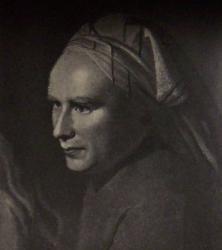
1731 - 1800 Topics: The Church Year Fifteenth Sunday after Trinity; The Church Year Fifteenth Sunday after Trinity Author of "In holy contemplation " in The Lutheran Hymnary William Cowper (pronounced "Cooper"; b. Berkampstead, Hertfordshire, England, 1731; d. East Dereham, Norfolk, England, 1800) is regarded as one of the best early Romantic poets. To biographers he is also known as "mad Cowper." His literary talents produced some of the finest English hymn texts, but his chronic depression accounts for the somber tone of many of those texts. Educated to become an attorney, Cowper was called to the bar in 1754 but never practiced law. In 1763 he had the opportunity to become a clerk for the House of Lords, but the dread of the required public examination triggered his tendency to depression, and he attempted suicide. His subsequent hospitalization and friendship with Morley and Mary Unwin provided emotional stability, but the periods of severe depression returned. His depression was deepened by a religious bent, which often stressed the wrath of God, and at times Cowper felt that God had predestined him to damnation.
For the last two decades of his life Cowper lived in Olney, where John Newton became his pastor. There he assisted Newton in his pastoral duties, and the two collaborated on the important hymn collection Olney Hymns (1779), to which Cowper contributed sixty-eight hymn texts.
Bert Polman
============
Cowper, William, the poet. The leading events in the life of Cowper are: born in his father's rectory, Berkhampstead, Nov. 26, 1731; educated at Westminster; called to the Bar, 1754; madness, 1763; residence at Huntingdon, 1765; removal to Olney, 1768; to Weston, 1786; to East Dereham, 1795; death there, April 25, 1800.
The simple life of Cowper, marked chiefly by its innocent recreations and tender friendships, was in reality a tragedy. His mother, whom he commemorated in the exquisite "Lines on her picture," a vivid delineation of his childhood, written in his 60th year, died when he was six years old. At his first school he was profoundly wretched, but happier at Westminster; excelling at cricket and football, and numbering Warren Hastings, Colman, and the future model of his versification. Churchill, among his contemporaries or friends. Destined for the Bar, he was articled to a solicitor, along with Thurlow. During this period he fell in love with his cousin, Theodora Cowper, sister to Lady Hesketh, and wrote love poems to her. The marriage was forbidden by her father, but she never forgot him, and in after years secretly aided his necessities. Fits of melancholy, from which he had suffered in school days, began to increase, as he entered on life, much straitened in means after his father's death. But on the whole, it is the playful, humorous side of him that is most prominent in the nine years after his call to the Bar; spent in the society of Colman, Bonnell Thornton, and Lloyd, and in writing satires for The Connoisseur and St. James's Chronicle and halfpenny ballads. Then came the awful calamity, which destroyed all hopes of distinction, and made him a sedentary invalid, dependent on his friends. He had been nominated to the Clerkship of the Journals of the House of Lords, but the dread of appearing before them to show his fitness for the appointment overthrew his reason. He attempted his life with "laudanum, knife and cord,"—-in the third attempt nearly succeeding. The dark delusion of his life now first showed itself—a belief in his reprobation by God. But for the present, under the wise and Christian treatment of Dr. Cotton (q. v.) at St. Albans, it passed away; and the eight years that followed, of which the two first were spent at Huntingdon (where he formed his lifelong friendship with Mrs. Unwin), and the remainder at Olney in active piety among the poor, and enthusiastic devotions under the guidance of John Newton (q. v.), were full of the realisation of God's favour, and the happiest, most lucid period of his life. But the tension of long religious exercises, the nervous excitement of leading at prayer meetings, and the extreme despondence (far more than the Calvinism) of Newton, could scarcely have been a healthy atmosphere for a shy, sensitive spirit, that needed most of all the joyous sunlight of Christianity. A year after his brother's death, madness returned. Under the conviction that it was the command of God, he attempted suicide; and he then settled down into a belief in stark contradiction to his Calvinistic creed, "that the Lord, after having renewed him in holiness, had doomed him to everlasting perdition" (Southey). In its darkest form his affliction lasted sixteen months, during which he chiefly resided in J. Newton's house, patiently tended by him and by his devoted nurse, Mrs. Unwin. Gradually he became interested in carpentering, gardening, glazing, and the tendance of some tame hares and other playmates. At the close of 1780, Mrs. Unwin suggested to him some serious poetical work; and the occupation proved so congenial, that his first volume was published in 1782. To a gay episode in 1783 (his fascination by the wit of Lady Austen) his greatest poem, The Task, and also John Gilpin were owing. His other principal work was his Homer, published in 1791. The dark cloud had greatly lifted from his life when Lady Hesketh's care accomplished his removal to Weston (1786): but the loss of his dear friend William Unwin lowered it again for some months. The five years' illness of Mrs. Unwin, during which his nurse of old became his tenderly-watched patient, deepened the darkness more and more. And her death (1796) brought “fixed despair," of which his last poem, The Castaway, is the terrible memorial. Perhaps no more beautiful sentence has been written of him, than the testimony of one, who saw him after death, that with the "composure and calmness" of the face there “mingled, as it were, a holy surprise."
Cowper's poetry marks the dawn of the return from the conventionality of Pope to natural expression, and the study of quiet nature. His ambition was higher than this, to be the Bard of Christianity. His great poems show no trace of his monomania, and are full of healthy piety. His fame as a poet is less than as a letter-writer: the charm of his letters is unsurpassed. Though the most considerable poet, who has written hymns, he has contributed little to the development of their structure, adopting the traditional modes of his time and Newton's severe canons. The spiritual ideas of the hymns are identical with Newton's: their highest note is peace and thankful contemplation, rather than joy: more than half of them are full of trustful or reassuring faith: ten of them are either submissive (44), self-reproachful (17, 42, 43), full of sad yearning (1, 34), questioning (9), or dark spiritual conflict (38-40). The specialty of Cowper's handling is a greater plaintiveness, tenderness, and refinement. A study of these hymns as they stood originally under the classified heads of the Olney Hymns, 1779, which in some cases probably indicate the aim of Cowper as well as the ultimate arrangement of the book by Newton, shows that one or two hymns were more the history of his conversion, than transcripts of present feelings; and the study of Newton's hymns in the same volume, full of heavy indictment against the sins of his own regenerate life, brings out the peculiar danger of his friendship to the poet: it tends also to modify considerably the conclusions of Southey as to the signs of incipient madness in Cowper's maddest hymns. Cowper's best hymns are given in The Book of Praise by Lord Selborne. Two may be selected from them; the exquisitely tender "Hark! my soul, it is the Lord" (q. v.), and "Oh, for a closer walk with God" (q. v.). Anyone who knows Mrs. Browning's noble lines on Cowper's grave will find even a deeper beauty in the latter, which is a purely English hymn of perfect structure and streamlike cadence, by connecting its sadness and its aspiration not only with the “discord on the music" and the "darkness on the glory," but the rapture of his heavenly waking beneath the "pathetic eyes” of Christ.
Authorities. Lives, by Hayley; Grimshaw; Southey; Professor Goldwin Smith; Mr. Benham (attached to Globe Edition); Life of Newton, by Rev. Josiah Bull; and the Olney Hymns. The numbers of the hymns quoted refer to the Olney Hymns. [Rev. H. Leigh Bennett, M.A.]
--John Julian, Dictionary of Hymnology (1907)
================
Cowper, W. , p. 265, i. Other hymns are:—
1. Holy Lord God, I love Thy truth. Hatred of Sin.
2. I was a grovelling creature once. Hope and Confidence.
3. No strength of nature can suffice. Obedience through love.
4. The Lord receives His highest praise. Faith.
5. The saints should never be dismayed. Providence. All these hymns appeared in the Olney Hymns, 1779.
--John Julian, Dictionary of Hymnology, Appendix, Part II (1907)
=====================
Cowper, W., p. 265, i. Prof. John E. B. Mayor, of Cambridge, contributed some letters by Cowper, hitherto unpublished, together with notes thereon, to Notes and Queries, July 2 to Sept. 24, 1904. These letters are dated from Huntingdon, where he spent two years after leaving St. Alban's (see p. 265, i.), and Olney. The first is dated "Huntingdon, June 24, 1765," and the last "From Olney, July 14, 1772." They together with extracts from other letters by J. Newton (dated respectively Aug. 8, 1772, Nov. 4, 1772), two quotations without date, followed by the last in the N. & Q. series, Aug. 1773, are of intense interest to all students of Cowper, and especially to those who have given attention to the religious side of the poet's life, with its faint lights and deep and awful shadows. From the hymnological standpoint the additional information which we gather is not important, except concerning the hymns "0 for a closer walk with God," "God moves in a mysterious way," "Tis my happiness below," and "Hear what God, the Lord, hath spoken." Concerning the last three, their position in the manuscripts, and the date of the last from J. Newton in the above order, "Aug. 1773," is conclusive proof against the common belief that "God moves in a mysterious way" was written as the outpouring of Cowper's soul in gratitude for the frustration of his attempted suicide in October 1773.
--John Julian, Dictionary of Hymnology, New Supplement (1907)
William Cowper
Richard Baxter
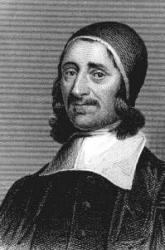
1615 - 1691 Topics: Fifteenth Sunday after Trinity Author of "Lord, it belongs not to my care" in Church Book Baxter, Richard. Only s. of Richard Baxter, yeoman, Eaton Constantine, Shropshire, b. at Rowton, Shropshire, Nov. 12,1615. He was educated at Wroxeter School, and for a time held the Mastership of the Dudley Grammar School. On taking Holy Orders, he became, in 1640, Ourate of Kidderminster. Subsequently he was for some time chaplain to one of Cromwell's regiments. Through weakness he had to take an enforced rest, during which he wrote his Saints’ Everlasting Rest. On regaining his health he returned to Kidderminster, where he remained until 1660, when he removed to London. At the Restoration he became chaplain to Charles II and was offered the bishopric of Hereford, which he refused. On the passing of the Act of Uniformity, he retired from active duty as a Minister of the Church of England. In or about 1673 he took out a licence as a Nonconformist Minister and commenced lecturing in London. He d. Dec. 8, 1691. His prose works are very numerous. His poetical are :—
(1) Poetical Fragments: Heart Imployment with God and Itself; The Concordant Discord of a Broken-healed Heart, tendon, Printed by T. Snowdon for B. Simmons, at the 3 Golden Cocks, &c, 1681 (2nd ed. 1689; 3rd ed. 1699). It consists of accounts of his religious experiences in verse, and is dated "London, at the Door of Eternity; Rich. Baxter, Aug. 1, 1681." (2) Additions to the Poetical Fragments of Rich. Baxter, written for himself, and Communicated to such as are more for serious Verse than smooth, London, Printed for B. Simmons at the Three Golden Cocks at the Westend of St. Pauls, 1683. (3) A Paraphrase on the Psalms, With other Hymns Left fitted for the Press, pub. the year following his death (1692). [Early English Hymnody, x., and English Psalters, 6 xii.] The Poetical Fragments were republished by Pickering, Lond., 1821. From this work his well-known hymn, " Now [Lord] it belongs not to my care," is taken (see "My whole, though broken, heart, O Lord.")
-John Julian, Dictionary of Hymnology (1907)
See also in:
Hymn Writers of the Church
Richard Baxter
Jane Borthwick
1813 - 1897 Topics: Fifteenth Sunday after Trinity Translator of "My Jesus, as Thou wilt!" in Evangelical Lutheran hymnal Miss Jane Borthwick, the translator of this hymn and many others, is of Scottish family. Her sister (Mrs. Eric Findlater) and herself edited "Hymns from the Land of Luther" (1854). She also wrote "Thoughts for Thoughtful Hours (1859), and has contributed numerous poetical pieces to the "Family Treasury," under the signature "H.L.L."
--Annotations of the Hymnal, Charles Hutchins, M.A. 1872.
=================================
Borthwick, Jane, daughter of James Borthwick, manager of the North British Insurance Office, Edinburgh, was born April 9, 1813, at Edinburgh, where she still resides. Along with her sister Sarah (b. Nov. 26, 1823; wife of the Rev. Eric John Findlater, of Lochearnhead, Perthshire, who died May 2, 1886) she translated from the German Hymns from the Land of Luther, 1st Series, 1854; 2nd, 1855; 3rd, 1858; 4th, 1862. A complete edition was published in 1862, by W. P. Kennedy, Edinburgh, of which a reprint was issued by Nelson & Sons, 1884.
These translations, which represent relatively a larger proportion of hymns for the Christian Life, and a smaller for the Christian Year than one finds in Miss Winkworth, have attained a success as translations, and an acceptance in hymnals only second to Miss Winkworth's. Since Kennedy's Hymnologia Christiana, 1863, in England, and the Andover Sabbath Hymn Book, 1858, in America, made several selections therefrom, hardly a hymnal in England or America has appeared without containing some of these translations. Miss Borthwick has kindly enabled us throughout this Dictionary to distinguish between the 61 translations by herself and the 53 by her sister. Among the most popular of Miss Borthwick's may be named "Jesus still lead on," and "How blessed from the bonds of sin;" and of Mrs. Findlater's "God calling yet!" and "Rejoice, all ye believers."
Under the signature of H. L. L. Miss Borthwick has also written various prose works, and has contributed many translations and original poems to the Family Treasury, a number of which were collected and published in 1857, as Thoughts for Thoughtful Hours (3rd edition, enlarged, 1867). She also contributed several translations to Dr. Pagenstecher's Collection, 1864, five of which are included in the new edition of the Hymns from the Land of Luther, 1884, pp. 256-264. Of her original hymns the best known are “Come, labour on” and "Rest, weary soul.” In 1875 she published a selection of poems translated from Meta Heusser-Schweizer, under the title of Alpine Lyrics, which were incorporated in the 1884 edition of the Hymns from the Land of Luther. She died in 1897. [Rev. James Mearns, M.A.]
-- John Julian, Dictionary of Hymnology (1907)
========================
Borthwick, Jane, p. 163, ii. Other hymns from Miss Borthwick's Thoughtful Hours, 1859, are in common use:—
1. And is the time approaching. Missions.
2. I do not doubt Thy wise and holy will. Faith.
3. Lord, Thou knowest all the weakness. Confidence.
4. Rejoice, my fellow pilgrim. The New Year.
5. Times are changing, days are flying. New Year.
Nos. 2-5 as given in Kennedy, 1863, are mostly altered from the originals.
--John Julian, Dictionary of Hymnology, Appendix, Part II (1907)
=============
Works:
Hymns from the Land of Luther
Jane Borthwick
Isaac Watts
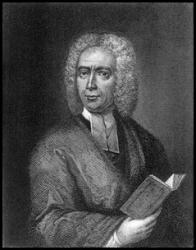
1674 - 1748 Person Name: Watts Topics: Fifteenth Sunday after Trinity Author of "The Lord my Shepherd is" in Church Book Isaac Watts was the son of a schoolmaster, and was born in Southampton, July 17, 1674. He is said to have shown remarkable precocity in childhood, beginning the study of Latin, in his fourth year, and writing respectable verses at the age of seven. At the age of sixteen, he went to London to study in the Academy of the Rev. Thomas Rowe, an Independent minister. In 1698, he became assistant minister of the Independent Church, Berry St., London. In 1702, he became pastor. In 1712, he accepted an invitation to visit Sir Thomas Abney, at his residence of Abney Park, and at Sir Thomas' pressing request, made it his home for the remainder of his life. It was a residence most favourable for his health, and for the prosecution of his literary labours. He did not retire from ministerial duties, but preached as often as his delicate health would permit.
The number of Watts' publications is very large. His collected works, first published in 1720, embrace sermons, treatises, poems and hymns. His "Horae Lyricae" was published in December, 1705. His "Hymns" appeared in July, 1707. The first hymn he is said to have composed for religious worship, is "Behold the glories of the Lamb," written at the age of twenty. It is as a writer of psalms and hymns that he is everywhere known. Some of his hymns were written to be sung after his sermons, giving expression to the meaning of the text upon which he had preached. Montgomery calls Watts "the greatest name among hymn-writers," and the honour can hardly be disputed. His published hymns number more than eight hundred.
Watts died November 25, 1748, and was buried at Bunhill Fields. A monumental statue was erected in Southampton, his native place, and there is also a monument to his memory in the South Choir of Westminster Abbey. "Happy," says the great contemporary champion of Anglican orthodoxy, "will be that reader whose mind is disposed, by his verses or his prose, to imitate him in all but his non-conformity, to copy his benevolence to men, and his reverence to God." ("Memorials of Westminster Abbey," p. 325.)
--Annotations of the Hymnal, Charles Hutchins, M.A., 1872.
=================================
Watts, Isaac, D.D. The father of Dr. Watts was a respected Nonconformist, and at the birth of the child, and during its infancy, twice suffered imprisonment for his religious convictions. In his later years he kept a flourishing boarding school at Southampton. Isaac, the eldest of his nine children, was born in that town July 17, 1674. His taste for verse showed itself in early childhood. He was taught Greek, Latin, and Hebrew by Mr. Pinhorn, rector of All Saints, and headmaster of the Grammar School, in Southampton. The splendid promise of the boy induced a physician of the town and other friends to offer him an education at one of the Universities for eventual ordination in the Church of England: but this he refused; and entered a Nonconformist Academy at Stoke Newington in 1690, under the care of Mr. Thomas Rowe, the pastor of the Independent congregation at Girdlers' Hall. Of this congregation he became a member in 1693.
Leaving the Academy at the age of twenty, he spent two years at home; and it was then that the bulk of the Hymns and Spiritual Songs (published 1707-9) were written, and sung from manuscripts in the Southampton Chapel. The hymn "Behold the glories of the Lamb" is said to have been the first he composed, and written as an attempt to raise the standard of praise. In answer to requests, others succeeded. The hymn "There is a land of pure delight" is said to have been suggested by the view across Southampton Water. The next six years of Watts's life were again spent at Stoke Newington, in the post of tutor to the son of an eminent Puritan, Sir John Hartopp; and to the intense study of these years must be traced the accumulation of the theological and philosophical materials which he published subsequently, and also the life-long enfeeblement of his constitution.
Watts preached his first sermon when he was twenty-four years old. In the next three years he preached frequently; and in 1702 was ordained pastor of the eminent Independent congregation in Mark Lane, over which Caryl and Dr. John Owen had presided, and which numbered Mrs. Bendish, Cromwell's granddaughter, Charles Fleetwood, Charles Desborough, Sir John Hartopp, Lady Haversham, and other distinguished Independents among its members. In this year he removed to the house of Mr. Hollis in the Minories. His health began to fail in the following year, and Mr. Samuel Price was appointed as his assistant in the ministry. In 1712 a fever shattered his constitution, and Mr. Price was then appointed co-pastor of the congregation which had in the meantime removed to a new chapel in Bury Street. It was at this period that he became the guest of Sir Thomas Abney, under whose roof, and after his death (1722) that of his widow, he remained for the rest of his suffering life; residing for the longer portion of these thirty-six years principally at the beautiful country seat of Theobalds in Herts, and for the last thirteen years at Stoke Newington. His degree of D.D. was bestowed on him in 1728, unsolicited, by the University of Edinburgh. His infirmities increased on him up to the peaceful close of his sufferings, Nov. 25, 1748. He was buried in the Puritan restingplace at Bunhill Fields, but a monument was erected to him in Westminster Abbey.
His learning and piety, gentleness and largeness of heart have earned him the title of the Melanchthon of his day. Among his friends, churchmen like Bishop Gibson are ranked with Nonconformists such as Doddridge. His theological as well as philosophical fame was considerable. His Speculations on the Human Nature of the Logos, as a contribution to the great controversy on the Holy Trinity, brought on him a charge of Arian opinions. His work on The Improvement of the Mind, published in 1741, is eulogised by Johnson. His Logic was still a valued textbook at Oxford within living memory. The World to Come, published in 1745, was once a favourite devotional work, parts of it being translated into several languages. His Catechisms, Scripture History (1732), as well as The Divine and Moral Songs (1715), were the most popular text-books for religious education fifty years ago. The Hymns and Spiritual Songs were published in 1707-9, though written earlier. The Horae Lyricae, which contains hymns interspersed among the poems, appeared in 1706-9. Some hymns were also appended at the close of the several Sermons preached in London, published in 1721-24. The Psalms were published in 1719. The earliest life of Watts is that by his friend Dr. Gibbons. Johnson has included him in his Lives of the Poets; and Southey has echoed Johnson's warm eulogy. The most interesting modern life is Isaac Watts: his Life and Writings, by E. Paxton Hood. [Rev. H. Leigh Bennett, M.A.]
A large mass of Dr. Watts's hymns and paraphrases of the Psalms have no personal history beyond the date of their publication. These we have grouped together here and shall preface the list with the books from which they are taken.
(l) Horae Lyricae. Poems chiefly of the Lyric kind. In Three Books Sacred: i.To Devotion and Piety; ii. To Virtue, Honour, and Friendship; iii. To the Memory of the Dead. By I. Watts, 1706. Second edition, 1709. (2) Hymns and Spiritual Songs. In Three Books: i. Collected from the Scriptures; ii. Composed on Divine Subjects; iii. Prepared for the Lord's Supper. By I. Watts, 1707. This contained in Bk i. 78 hymns; Bk. ii. 110; Bk. iii. 22, and 12 doxologies. In the 2nd edition published in 1709, Bk. i. was increased to 150; Bk. ii. to 170; Bk. iii. to 25 and 15 doxologies. (3) Divine and Moral Songs for the Use of Children. By I. Watts, London, 1715. (4) The Psalms of David Imitated in the Language of the New Testament, And apply'd to the Christian State and Worship. By I. Watts. London: Printed by J. Clark, at the Bible and Crown in the Poultry, &c, 1719. (5) Sermons with hymns appended thereto, vol. i., 1721; ii., 1723; iii. 1727. In the 5th ed. of the Sermons the three volumes, in duodecimo, were reduced to two, in octavo. (6) Reliquiae Juveniles: Miscellaneous Thoughts in Prose and Verse, on Natural, Moral, and Divine Subjects; Written chiefly in Younger Years. By I. Watts, D.D., London, 1734. (7) Remnants of Time. London, 1736.
454 Hymns and Versions of the Psalms, in addition to the centos are all in common use at the present time.
--Excerpts from John Julian, Dictionary of Hymnology (1907)
==================================
Watts, I. , p. 1241, ii. Nearly 100 hymns, additional to those already annotated, are given in some minor hymn-books.
--John Julian, Dictionary of Hymnology, Appendix, Part II (1907)
=================
Watts, I. , p. 1236, i. At the time of the publication of this Dictionary in 1892, every copy of the 1707 edition of Watts's Hymns and Spiritual Songs was supposed to have perished, and all notes thereon were based upon references which were found in magazines and old collections of hymns and versions of the Psalms. Recently three copies have been recovered, and by a careful examination of one of these we have been able to give some of the results in the revision of pp. 1-1597, and the rest we now subjoin.
i. Hymns in the 1709 ed. of Hymns and Spiritual Songs which previously appeared in the 1707 edition of the same book, but are not so noted in the 1st ed. of this Dictionary:—
On pp. 1237, L-1239, ii., Nos. 18, 33, 42, 43, 47, 48, 60, 56, 58, 59, 63, 75, 82, 83, 84, 85, 93, 96, 99, 102, 104, 105, 113, 115, 116, 123, 124, 134, 137, 139, 146, 147, 148, 149, 162, 166, 174, 180, 181, 182, 188, 190, 192, 193, 194, 195, 197, 200, 202.
ii. Versions of the Psalms in his Psalms of David, 1719, which previously appeared in his Hymns and Spiritual Songs, 1707:—
On pp. 1239, U.-1241, i., Nos. 241, 288, 304, 313, 314, 317, 410, 441.
iii. Additional not noted in the revision:—
1. My soul, how lovely is the place; p. 1240, ii. 332. This version of Ps. lxiv. first appeared in the 1707 edition of Hymns & Spiritual Songs, as "Ye saints, how lovely is the place."
2. Shine, mighty God, on Britain shine; p. 1055, ii. In the 1707 edition of Hymns & Spiritual Songs, Bk. i., No. 35, and again in his Psalms of David, 1719.
3. Sing to the Lord with [cheerful] joyful voice, p. 1059, ii. This version of Ps. c. is No. 43 in the Hymns & Spiritual Songs, 1707, Bk. i., from which it passed into the Ps. of David, 1719.
A careful collation of the earliest editions of Watts's Horae Lyricae shows that Nos. 1, 7, 9, 10, 11, 12, 14, 16, p. 1237, i., are in the 1706 ed., and that the rest were added in 1709. Of the remaining hymns, Nos. 91 appeared in his Sermons, vol. ii., 1723, and No. 196 in Sermons, vol. i., 1721. No. 199 was added after Watts's death. It must be noted also that the original title of what is usually known as Divine and Moral Songs was Divine Songs only.
--John Julian, Dictionary of Hymnology, New Supplement (1907)
===========
See also in:
Hymn Writers of the Church
Isaac Watts
Joseph P. Holbrook
1822 - 1888 Person Name: J. P. Holbrook Topics: Fifteenth Sunday after Trinity Arranger of "JEWETT" in Evangelical Lutheran hymnal Joseph P. Holbrook was a tune writer in the parlor music style, and used the popular melodies of Mason and Hastings, Bradbury and Root, Greatorex and Kingsley in his collections. He furnished settings for the choir hymns in Songs for the Sanctuary in his Quartet and chorus Choir (New York, 1871, and sought more recogniation than had been given him in a hymnal of his own, Worship in Song (New York, 1880); a book that found no welcome.
from The English hymn: its development and use in worship
By Louis FitzGerald Benson
Joseph P. Holbrook
Melchior Teschner
1584 - 1635 Person Name: M. Teschner Topics: The Church Year Fifteenth Sunday after Trinity; The Church Year Fifteenth Sunday after Trinity Composer of "[In holy contemplation]" in The Lutheran Hymnary Melchior Teschner (b. Fraustadt [now Wschowa, Poland], Silesia, 1584; d. Oberpritschen, near Fraustadt, 1635) studied philosophy, theology, and music at the University of Frankfurt an-der-Oder and later studied at the universities of Helmstedt and Wittenberg, Germany. From 1609 until 1614 he served as cantor in the Lutheran church in Fraustadt, and from 1614 until his death he was pastor of the church in Oberpritschen.
Bert Polman
Melchior Teschner
Joseph Addison
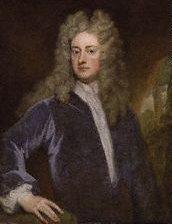
1672 - 1719 Topics: Fifteenth Sunday after Trinity Author of "When all Thy mercies, O my God" in Church Book Addison, Joseph, born at Milston, near Amesbury, Wiltshire, May 1, 1672, was the son of the Rev. Lancelot Addison, sometime Dean of Lichfield, and author of Devotional Poems, &c, 1699. Addison was educated at the Charterhouse, and at Magdalen College, Oxford, graduating B.A. 1691 and M.A. 1693. Although intended for the Church, he gave himself to the study of law and politics, and soon attained, through powerful influence, to some important posts. He was successively a Commissioner of Appeals, an Under Secretary of State, Secretary to the Lord Lieutenant of Ireland, and Chief Secretary for Ireland. He married, in 1716, the Dowager Countess of Warwick, and died at Holland House, Kensington, June 17, 1719. Addison is most widely known through his contributions to The Spectator, The Toiler, The Guardian, and The Freeholder. To the first of these he contributed his hymns. His Cato, a tragedy, is well known and highly esteemed. Addison's claims to the authorship of the hymns usually ascribed to him, or to certain of them, have been called in question on two occasions. The first was the publication, by Captain Thompson, of certain of those hymns in his edition of the Works of Andrew Marvell, 1776, as the undoubted compositions of Marvell; and the second, a claim in the Athenaeum, July 10th, 1880, on behalf of the Rev. Richard Richmond. Fully to elucidate the subject it will be necessary, therefore, to give a chronological history of the hymns as they appeared in the Spectator from time to time.
i. The History of the Hymns in The Spectator. This, as furnished in successive numbers of the Spectator is :—
1. The first of these hymns appeared in the Spectator of Saturday, July 26, 1712, No. 441, in 4 stanzas of 6 lines. The article in which it appeared was on Divine Providence, signed “C." The hymn itself, "The Lord my pasture shall prepare," was introduced with these words:—
"David has very beautifully represented this steady reliance on God Almighty in his twenty-third psalm, which is a kind of pastoral hymn, and filled with those allusions which are usual in that kind of writing As the poetry is very exquisite, I shall present my readers with the following translation of it." (Orig. Broadsheet, Brit. Mus.)
2. The second hymn appeared in the Spectator on Saturday, Aug. 9, 1712, No. 453, in 13 st. of 4 1., and forms the conclusion of an essay on " Gratitude." It is also signed " C," and is thus introduced:—
“I have already obliged the public with some pieces of divine poetry which have fallen into my hands, and as they have met with the reception which they deserve, I shall, from time to time, communicate any work of the same nature which has not appeared in print, and may be acceptable to my readers." (Orig. Broadsheet, British Museum)
Then follows the hymn:—"When all Thy mercies, 0 my God."
3. The number of the Spectator for Tuesday, Aug. 19, 1712, No. 461, is composed of three parts. The first is an introductory paragraph by Addison, the second, an unsigned letter from Isaac Watts, together with a rendering by him of Ps. 114th; and the third, a letter from Steele. It is with the first two we have to deal. The opening paragraph by Addison is:—
“For want of time to substitute something else in the Boom of them, I am at present obliged to publish Compliments above my Desert in the following Letters. It is no small Satisfaction, to have given Occasion to ingenious Men to employ their Thoughts upon sacred Subjects from the Approbation of such Pieces of Poetry as they have seen in my Saturday's papers. I shall never publish Verse on that Day but what is written by the same Hand; yet shall I not accompany those Writings with Eulogiums, but leave them to speak for themselves." (Orig. Broadsheet, British Museum
Joseph Addison
Pages




