

 My Starred Hymns
 My FlexScores
 My Hymnals
 My Purchased Files
Planning worship?
Check out our sister site, ZeteoSearch.org,
for 20+ additional resources related to your search.
- |
User Links
Person Results
Andrew Reed
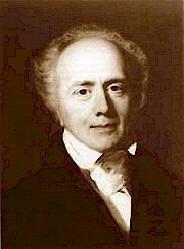
1787 - 1862 Topics: Holy Scriptures Author of "Holy Spirit, Light Divine" in Great Songs of the Church (Revised) Reed, Andrew, D.D., son of Andrew Reed, was born in London on Nov. 27, 1787, and educated for the Congregational Ministry at Hackney College, London. He was first the pastor of the New Road Chapel, St. George's-in-the-East, and then of the Wycliffe Chapel, which was built through his exertions in 1830. His degree was conferred by Yule College, America. He died Feb. 25, 1862. As the founder of "The London Orphan Asylum," "The Asylum for Fatherless Children," “The Asylum for Idiots” "The Infant Orphan Asylum," and "The Hospital for Incurables," Dr. Reed is more fully known, and will be longer remembered than by his literary publications. His Hymn Book was the growth of years. The preparation began in 1817, when he published a Supplement to Watts, in which were a few originals. This was enlarged in 1825; and entirely superseded by his collection The Hymn Book, prepared from Dr. Watts's Psalms & Hymns and Other Authors, with some Originals, in 1842 (Preface). His hymns, mostly of a plain and practical character, numbering 21, were contributed to these various editions, and were republished with those of his wife in the Wycliffe Supplement, 1872. The best known are "Ah Jesus, let me hear Thy voice” and ”Spirit Divine, attend our prayer." All Dr. and Mrs. Reed's hymns are anonymous in The Hymn Book, 1842, but are given with their names in the Wyclife Supplement, 1872. His hymns now in common use include, in addition to those annotated under their respective first lines :—
1. Come, let us strike our harps afresh. Praise.
2. Come, my Redeemer, come. Desiring Christ's Presence.
3. Gentle Saviour, look on me. Christ's protection Desired.
4. Gracious Lord, as Thou hast taught us. Public Worship.
5. Hark, hark, the notes of joy. Missions.
6. Holy Ghost, with light divine (1817). Prayer to the Holy Spirit. Sometimes given as "Holy Ghost, Thou light divine;" and again as "Holy Spirit, Light divine."
7. Listen, sinner, mercy hails you. Invitation. Generally given as "Hear, O Sinner, mercy hails you."
8. Rich are the joys of solitude. Retirement. Some-times given as "How deep and tranquil is the joy."
9. There [comes] is an hour when I must part. Death anticipated.
10. Ye saints your music bring. Praise of the Cross.
--John Julian, Dictionary of Hymnology (1907)
Andrew Reed
P. P. Bliss
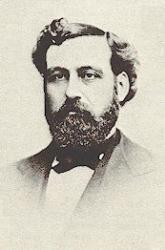
1838 - 1876 Person Name: Philip P. Bliss, 1838-1876 Topics: The Holy Scriptures; Holy Scripture Author of "Sing Them Over Again to Me (Wonderful Words of Life)" in African Methodist Episcopal Church Hymnal Philip P. Bliss (b. Clearfield County, PA, 1838; d. Ashtabula, OH, 1876) left home as a young boy to make a living by working on farms and in lumber camps, all while trying to continue his schooling. He was converted at a revival meeting at age twelve. Bliss became an itinerant music teacher, making house calls on horseback during the winter, and during the summer attending the Normal Academy of Music in Genesco, New York. His first song was published in 1864, and in 1868 Dwight L. Moody advised him to become a singing evangelist. For the last two years of his life Bliss traveled with Major D. W. Whittle and led the music at revival meetings in the Midwest and Southern United States. Bliss and Ira D. Sankey published a popular series of hymn collections entitled Gospel Hymns. The first book of the series, Gospel Songs, was published in 1874. Bliss's tragic death at the age of thirty-eight happened near the end of 1876. Philip P. Bliss and his wife were traveling to Chicago to sing for the evangelistic services led by Daniel W. Whittle at Dwight L. Moody's Tabernacle. But a train wreck and fire en route claimed their lives.
Bert Polman
=================
Bliss, Philip, b. at Clearfield County, Pennsylvania, July 9, 1838. In 1864 he went to Chicago in the employ of Dr. George F. Root, the musician, where he was engaged in conducting musical Institutes, and in composing Sunday School melodies. Originally a Methodist, he became, about 1871, a choirman of the First Congregational Church, Chicago, and the Superintendent of its Sunday Schools. In 1874 he joined D. W. Whittle in evangelical work. To this cause he gave (although a poor man) the royalty of his Gospel Songs, which was worth some thirty thousand dollars. His death was sudden. It occurred in the railway disaster at Ashtabula, Ohio, Dec. 30, 1876. ... Some of his verses have obtained wide popularity in most English-speaking countries. The more widely known, and specially those which are found in collections in use in G. Britain, are in the following American works:—
i. The Prize, 1870.
1. I should like to die. Death anticipated. This is one of his earliest compositions, and is unworthy of the position it holds.
2. Through the valley of the shadow I must go. Death anticipated.
3. Whosoever heareth, shout, shout the sound. Jesus the Way. Written during the winter of 1869-70 after hearing Mr. H. Moorhouse (from England) preach on St. John iii. 16.
ii. The Charm, 1871.
4. Almost persuaded now to believe. Procrastination. This was suggested by the following passage in a sermon by the Rev. Mr. Brundnge, Bliss being present at its delivery:—" He who is almost persuaded is almost saved, but to be almost saved is to be entirely lost."
5. Ho! my comrades! see the signal. Faithfulness.
6. O! Jerusalem, the golden city, bright, &c. Heaven.
7. On what Foundation do [did] you build? Christ the Foundation.
iii. The Song Tree, 1872.
8. Light in the darkness, sailor, day is at hand. Safety. This hymn, “The Life-Boat," has attained to great popularity. The incident upon which it is based, that of the rescue of a ship's crew by a life-boat, is given in detail by Mr. Sankey in his Sacred Songs, &c, No. 99 (large ed.). It is sometimes known by its refrain, "Pull for the shore," &c.
iv. The Joy, 1873.
9. In me ye may have peace. Peace.
10. To die is gain. Death anticipated.
v. Sunshine, 1873.
11. Down life's dark vale we wander. Death anticipated.
12. More holiness give me. For Holiness.
13. Only an armour-bearer. Soldiers of the Cross.
14. Standing by a purpose true. Faithfulness.
15. This loving Saviour stands patiently. Invitation.
vi. Gospel Songs, 1874.
16. A long time I wandered. Peace and Joy.
17. Brightly beams our Father's mercy. Mercy.
18. Come, brethren, as we march along. Praise.
19. Free from the law, O happy condition. Redemption.
20. Have you on the Lord believed? Fullness of Grace. This hymn arose out of the following circumstances :—" A vast fortune was left in the hands of a minister for one of his poor parishioners. Fearing that it might be sqmandered if suddenly bestowed upon him, the wise minister sent him a little at a time, with a note saying, “This is thine; use it wisely; there is more to follow.” Hence also the refrain ‘More to follow,’ by which the hymn is known."
21. How much owest thou? Divine Claims.
22. I know not the hour when my Lord will come. Death anticipated. Suggested by reading the book, The Gates Ajar.
23. See the gentle Shepherd standing. The Good Shepherd.
24. Though the way be sometimes dreary. Divine Leading.
25. Will you meet me at the fountain? Fountain of Living Water. The incident out of which this hymn arose is thus stated in The Christian, No. 365, "At the Industrial Exposition at Chicago it was an everyday appointment to meet at the Central Fountain. Mr. P. P. Bliss, whose mind seemed always set on things above, caught up the words, and wrote this hymn, 'Meet me at the Fountain.'"
vii. Gospel Hymns, No. 1, 1875.
26. One offer of salvation. The Name of Jesus.
27. Wandering afar from the dwellings of men. The Lepers.
viii. The International Lesson Monthly, 1875.
28. Weary gleaner, whence comest thou? Duty.
29. The whole world was lost in the darkness of Sin. Light of the world.
30. Man of sorrows! what a name. Redemption.
31. The Spirit, O sinner, in mercy doth move. Holy Spirit.
ix. Gospel Hymns, No. 2, 1876.
32. At the feet of Jesus. The good choice.
33. Come, sing the Gospel's joyful sound. Salvation.
34. Cut it down, cut it down. Justice and Mercy.
35. Do you see the Hebrew captive? Prayer.
36. Hallelujah, He is risen. Easier. Written in the spring of 1876 and first sung by Bliss on Easter afternoon, 1876, in the Court House Square, Augusta, Georgia, to 5900 people.
37. In Zion's rock abiding. Safety.
38. Repeat the story o'er and o'er. Grace and Peace.
39. Tenderly the Shepherd. The Good Shepherd.
x. Gospel Hymns, No. 3, 1878.
40. Hear ye the glad good news from heaven. Faith and Salvation.
41. I will sing of my Redeemer. Praise.
xi. Gospel Hymns, No. 4, 1881.
42. 'Tis known on earth and heaven too. More about Jesus.
xii. Various.
43. Sing over again to me. Words of Life. This appeared in a paper entitled Words of Life, 1874, The following are undated:—
44. March to the battle-field. Duty and Victory.
45. There is sin in the camp. Hinderances.
46. 'Tis the promise of God. Praise.
47. While the silvery moon-beams, fall, New Birth.
48. God is always near me. Omnipresence.
Two hymns," I am so glad that our Father in heaven," and " Sowing the seed by the daylight [dawnlight] fair," (sometimes given as " Sowing our seed in the morning fair ") are usually attributed to Mr. Bliss. In his Gospel Songs, Cincinnati, 1874, however, he lays claim to the music only. Mr. Sankey attributes this last to "E. A. Oakey." With the exception of No. 48, these hymns are given in Mr. Sankey's Sacred Songs & Solos, Pts. i. and ii. Their popularity is far beyond their literary merits, and is mainly due to the simple melodies to which they are wedded. As a writer of hymns of this class Mr. Bliss is second only to Mrs. Van Alstyne. Many anecdotes concerning hymns of this class are given in American Evangelists; an Account of their work in England and America, by the Rev. Elias Nason, Boston, U.S., Lathrop & Co., 1877.
Mr. Bliss is usually known as "P. P. Bliss." This is found on the title-pages of his collections. On his own authority, however, we are enabled to say that his name originally stood thus : “Philipp Bliss.” Early in life he separated the final p from his Christian name, constituted it a capital P, and thus produced "P. P. Bliss." (For this article we are mainly indebted to Professor F. M. Bird, and Mr. H. P. Main.)
-John Julian, Dictionary of Hymnology (1907)
========================
Bliss, Philip , p. 151, i. "Sowing the seed by the daylight fair" is in the Family Treasury , Edinburgh, 1861, pt. i., p. 84. It is said to be by Miss Emily Sullivan Oakey; born at Albany, N. York, Oct. 8, 1829, died May 11, 1883. Note also that Bliss's hymn, No. 43. on p. 150, ii., should read, "Sing them over again to me."
--John Julian, Dictionary of Hymnology, Appendix, Part II (1907)
=====================
Bliss, P., p. 150, i. Two works have been brought to our notice, since the issue of our first edition of this Dictionary, which concern this author, viz.:—
1. Memoirs of Philip P. Bliss. Edited by D. W. Whittle. Contributions by Rev. E. P. Goodwin, Ira D. Sankey, and Geo. F. Root. Introduction by D. L. Moody. New York, &c.: A. S. Barnes & Co., 1877.
2. My Life and Sacred Songs. By Ira D. Sankey. With an Introduction by Theodore L. Cuyler, D.D). London: Hodder & Stoughton, and Morgan & Scott, 1906.
These works have a special interest for those who use I. D. Sankey's Sacred Songs & Solos, and all of P. Bliss's publications. To Mr. Sankey's My Life, &c, we direct special attention for P. Bliss's hymns:—
“Do you see the Hebrew captive kneeling?" p. 294.
"Down life's dark vale we wander." p. 285.
"Ho! my comrades, see the signal." p. 105.
"'Tis the promise of God full salvation to give." p. 99.
--John Julian, Dictionary of Hymnology, New Supplement (1907)
P. P. Bliss
Francis Bottome
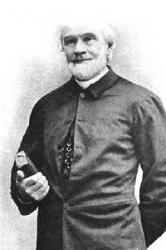
1823 - 1894 Topics: Holy Scriptures Author of "O Spread the Tidings Round" in Great Songs of the Church (Revised) Bottome, F., S.T.D., was born in Derbyshire, England, May 26, 1823. In 1850, having removed to America, he entered the ministry of the Methodist Episcopalian Church; and in 1872 he received the degree of S.T.D. from Dickinson's College, Carlisle, Penn. In addition to assisting in the compilation of B. P. Smith's Gospel Hymns, London, 1872: Centenary Singer, 1869; Hound Lake, 1872, he has written:—
1. Come, Holy Ghost, all sacred fire. Invocation of the Holy Spirit. Appeared in R. P. Smith's Gospel Hymns, 1872. It is in several collections, including the Ohio Hymn Book of the Evangelical Association, 1881, No. 364.
2. Full salvation, full salvation. Joy of full Salvation. Written in 1871, and published in a collection by Dr. Cullis of Boston, 1873. Also in the Ohio Hymn Book, 1881, No. 384.
3. Love of Jesus, all divine. Love of Jesus. Written in 1872, and published in his Hound Lake, 1872. It is in several collections.
4. O bliss of the purified, bliss of the free. Sanctification. Written in 1869, and published in the Revivalist, and numerous hymn-books in America, including the Ohio Hymn Book as above, 1881, No. 477, &c.
His hymns, "Sweet rest in Jesus"; and "Oneness in Jesus," are also found in several collections for evangelistic services.
-- John Julian, Dictionary of Hymnology (1907)
Francis Bottome
Edwin Hatch
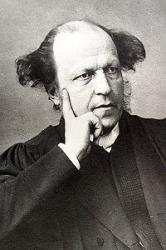
1835 - 1889 Topics: Holy Scriptures Author of "Breathe on Me, Breath of God" in Great Songs of the Church (Revised) Hatch, Edwin, D.D., was born at Derby, Sep. 4, 1835, and educated at Pembroke College, Oxford, B.A., in honours, in 1857. After holding important appointments in Canada, he returned to England and became Vice-Principal of St. Mary Hall, Oxford, 1867; and Rector of Purleigh, 1883. (See also Crockford). He died Nov. 10, 1889. His hymn-writing was limited. One, and that a very spirited lyric, is in Allon's Congregational Psalmist Hymnal, 1886 "Breathe on me, Breath of God." (Whitsuntide.) Dr. Hatch's hymns were published in his posthumous Towards Fields of Light, London 1890.
--John Julian, Dictionary of Hymnology, Appendix, Part II (1907)
Edwin Hatch
William Henry Monk
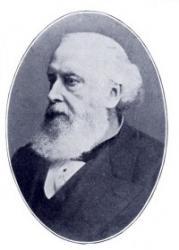
1823 - 1889 Person Name: William Henry Monk, 1823-1889 Topics: God: His Attributes, Works and Word The Holy Scriptures; Hymns for the Young The Holy Scriptures Adapter of "RAVENSHAW" in The Book of Praise William H. Monk (b. Brompton, London, England, 1823; d. London, 1889) is best known for his music editing of Hymns Ancient and Modern (1861, 1868; 1875, and 1889 editions). He also adapted music from plainsong and added accompaniments for Introits for Use Throughout the Year, a book issued with that famous hymnal. Beginning in his teenage years, Monk held a number of musical positions. He became choirmaster at King's College in London in 1847 and was organist and choirmaster at St. Matthias, Stoke Newington, from 1852 to 1889, where he was influenced by the Oxford Movement. At St. Matthias, Monk also began daily choral services with the choir leading the congregation in music chosen according to the church year, including psalms chanted to plainsong. He composed over fifty hymn tunes and edited The Scottish Hymnal (1872 edition) and Wordsworth's Hymns for the Holy Year (1862) as well as the periodical Parish Choir (1840-1851).
Bert Polman
William Henry Monk
William J. Kirkpatrick
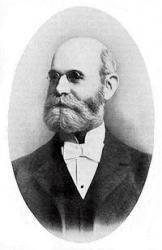
1838 - 1921 Topics: Holy Scriptures Composer of "COMFORTER" in Great Songs of the Church (Revised) William J. Kirkpatrick (b. Duncannon, PA, 1838; d. Philadelphia, PA, 1921) received his musical training from his father and several other private teachers. A carpenter by trade, he engaged in the furniture business from 1862 to 1878. He left that profession to dedicate his life to music, serving as music director at Grace Methodist Church in Philadelphia. Kirkpatrick compiled some one hundred gospel song collections; his first, Devotional Melodies (1859), was published when he was only twenty-one years old. Many of these collections were first published by the John Hood Company and later by Kirkpatrick's own Praise Publishing Company, both in Philadelphia.
Bert Polman
William J. Kirkpatrick
Juan Bautista Cabrera Ivars
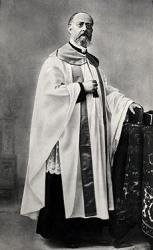
1837 - 1916 Person Name: Juan Bautista Cabrera Topics: Holy Scripture Author of "Padre, tu palabra es" in Mil Voces para Celebrar Juan Bautista Cabrera Ivars was born in Benisa, Spain, April 23, 1837. He attended seminary in Valencia, studying Hebrew and Greek, and was ordained as a priest. He fled to Gibraltar in 1863 due to religious persecution where he abandoned Catholicism. He worked as a teacher and as a translator. One of the works he translated was E.H. Brown's work on the thirty-nine articles of the Anglican Church, which was his introduction to Protestantism. He was a leader of a Spanish Reformed Church in Gibraltar. He continued as a leader in this church when he returned to Spain after the government of Isabel II fell, but continued to face legal difficulties. He then organized the Spanish Reformed Episcopal Church and was consecrated as bishop in 1894. He recognized the influence of music and literature on evangelism which led him to write and translate hymns.
Dianne Shapiro, from Real Academia de la Historia (https://dbe.rah.es/biografias/39825/juan-bautista-cabrera-ivars) and Himnos Cristanos (https://www.himnos-cristianos.com/biografia-juan-bautista-cabrera/) (accessed 7/30/2021)
Juan Bautista Cabrera Ivars
George Frideric Handel
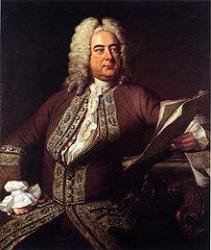
1685 - 1759 Person Name: George Frederick Handel, 1685-1759 Topics: The Church of God The Holy Scriptures Composer (Adapted from) of "SAMSON" in The Hymnary of the United Church of Canada George Frideric Handel (b. Halle, Germany, 1685; d. London, England, 1759) became a musician and composer despite objections from his father, who wanted him to become a lawyer. Handel studied music with Zachau, organist at the Halle Cathedral, and became an accomplished violinist and keyboard performer. He traveled and studied in Italy for some time and then settled permanently in England in 1713. Although he wrote a large number of instrumental works, he is known mainly for his Italian operas, oratorios (including Messiah, 1741), various anthems for church and royal festivities, and organ concertos, which he interpolated into his oratorio performances. He composed only three hymn tunes, one of which (GOPSAL) still appears in some modern hymnals. A number of hymnal editors, including Lowell Mason, took themes from some of Handel's oratorios and turned them into hymn tunes; ANTIOCH is one example, long associated with “Joy to the World.”
Bert Polman
George Frideric Handel
Richard Redhead
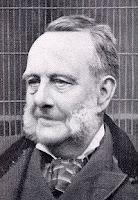
1820 - 1901 Topics: Holy Scriptures Composer of "REDHEAD NO. 76" in Great Songs of the Church (Revised) Richard Redhead (b. Harrow, Middlesex, England, 1820; d. Hellingley, Sussex, England, 1901) was a chorister at Magdalen College, Oxford. At age nineteen he was invited to become organist at Margaret Chapel (later All Saints Church), London. Greatly influencing the musical tradition of the church, he remained in that position for twenty-five years as organist and an excellent trainer of the boys' choirs. Redhead and the church's rector, Frederick Oakeley, were strongly committed to the Oxford Movement, which favored the introduction of Roman elements into Anglican worship. Together they produced the first Anglican plainsong psalter, Laudes Diurnae (1843). Redhead spent the latter part of his career as organist at St. Mary Magdalene Church in Paddington (1864-1894).
Bert Polman
Richard Redhead
Mary A. Lathbury
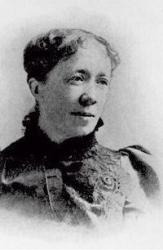
1841 - 1913 Topics: Holy Scriptures; The Holy Scriptures Author of "Break Thou the bread of life" in The Hymnal Lathbury, Mary Ann, was born in Manchester, Ontario County, New York, Aug. 10, 1841. Miss Lathbury writes somewhat extensively for the American religious periodical press, and is well and favourably known (see the Century Magazine, Jan., 1885, p. 342). Of her hymns which have come into common use we have:—
1. Break Thou the bread of life. Communion with God. A "Study Song" for the Chautauqua Literary and Scientific Circle, written in the summer of 1880. It is in Horder's (Eng.) Congregational Hymns, 1884.
2. Day is dying in the west. Evening. "Written at the request of the Rev. John H. Vincent, D.D., in the summer of 1880. It was a "Vesper Song," and has been frequently used in the responsive services of the Chautauqua Literary and Scientific Circle." It is in the Laudes Domini, N. Y., 1884.
For these details we are indebted to S. W. Duffield's English Hymns, &c, N. Y., 1886.
--John Julian, Dictionary of Hymnology (1907)
==================
Lathbury, Mary A., p. 640, i. Another hymn by this writer is, "Lift up, lift up thy voice with singing." [Praise to Christ), in Sankey's Sacred Songs & Solos, 1878.
--John Julian, Dictionary of Hymnology, Appendix, Part II (1907)
Mary A. Lathbury
Pages




