

 My Starred Hymns
 My FlexScores
 My Hymnals
 My Purchased Files
Planning worship?
Check out our sister site, ZeteoSearch.org,
for 20+ additional resources related to your search.
- |
User Links
Person Results
Christopher Wordsworth
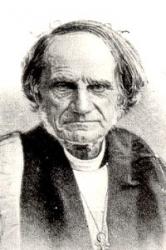
1807 - 1885 Person Name: Chr. Wordsworth Topics: The Sabbath Author of "O Day of Rest and Gladness!" in Sacred Songs and Solos Christopher Wordsworth--nephew of the great lake-poet, William Wordsworth--was born in 1807. He was educated at Winchester, and at Trinity College, Cambridge, where he graduated B.A., with high honours, in 1830; M.A. in 1833; D.D. in 1839. He was elected Fellow of his College in 1830, and public orator of the University in 1836; received Priest's Orders in 1835; head master of Harrow School in 1836; Canon of Westminster Abbey in 1844; Hulsean Lecturer at Cambridge in 1847-48; Vicar of Stanford-in-the-Vale, Berks, in 1850; Archdeacon of Westminster, in 1865; Bishop of Lincoln, in 1868. His writings are numerous, and some of them very valuable. Most of his works are in prose. His "Holy Year; or, Hymns for Sundays, Holidays, and other occasions throughout the Year," was published in [1862], and contains 127 hymns.
--Annotations of the Hymnal, Charles Hutchins, M.A., 1872.
===================
Wordsworth, Christopher, D.D., was born at Lambeth (of which parish his father was then the rector), Oct. 30, 1807, and was the youngest son of Christopher Wordsworth, afterwards Master of Trinity College, Cambridge, and Priscilla (née Lloyd) his wife. He was educated at Winchester, where he distinguished himself both as a scholar and as an athlete. In 1826 he matriculated at Trinity College, Cambridge, where his career was an extraordinarily brilliant one. He swept off an unprecedented number of College and University prizes, and in 1830 graduated as Senior Classic in the Classical Tripos, and 14th Senior Optime in the Mathematical, won the First Chancellor's Medal for classical studies, and was elected Fellow of Trinity. He was engaged as classical lecturer in college for some time, and in 1836 was chosen Public Orator for the University. In the same year he was elected Head Master of Harrow School, and in 1838 he married Susan Hatley Freere. During his head-mastership the numbers at Harrow fell off, but he began a great moral reform in the school, and many of his pupils regarded him with enthusiastic admiration. In 1844 he was appointed by Sir Robert Peel to a Canonry at Westminster; and in 1848-49 he was Hulsean lecturer at Cambridge. In 1850 he took the small chapter living of Stanford-in-the-Vale cum Goosey, in Berkshire, and for the next nineteen years he passed his time as an exemplary parish priest in this retired spot, with the exception of his four months' statutable residence each year at Westminster. In 1869 he was elevated to the bishopric of Lincoln, which he held for more than fifteen years, resigning it a few months before his death, which took place on March 20th, 1885. As bearing upon his poetical character, it may be noted that he was the nephew of the poet-laureate, William Wordsworth, whom he constantly visited at Rydal up to the time of the poet's death in 1850, and with whom he kept up a regular and lengthy correspondence. Christopher Wordsworth was a very voluminous writer, his principal works being:—
(1) Athens and Attica, 1836; (2) Pompeian Inscriptions, 1837; (3) Greece Pictorial and Descriptive, 1839; (4) King Edward VIth's Latin Grammar, 1841; (5) Bentley's Correspondence, 1842; (6) Theophilus Anglicanus, 1843; (7) Memoirs of William Wordsworth, 1851; (8) Hippolytus, 1853; (9) Notes at Paris, 1854; (10) A Commentary on the whole Bible, 1856-1870;
(11) The Holy Year, 1862; (12) Church History, 1881-1883; many volumes of Sermons, and an enormous amount of Pamphlets, Addresses, Letters, Speeches, on almost every subject in which the interests of the church were concerned, and also on subjects connected with classical literature.
Of his many works, however, the only one which claims notice from the hynmologist's point of view is The Holy Year, which contains hymns, not only for every season of the Church's year, but also for every phase of that season, as indicated in the Book of Common Prayer. Dr. Wordsworth, like the Wesleys, looked upon hymns as a valuable means of stamping permanently upon the memory the great doctrines of the Christian Church. He held it to be "the first duty of a hymn-writer to teach sound doctrine, and thus to save souls." He thought that the materials for English Church hymns should be sought (1) in the Holy Scriptures, (2) in the writings of Christian Antiquity, and (3) in the Poetry of the Ancient Church. Hence he imposed upon himself the strictest limitations in his own compositions. He did not select a subject which seemed to him most adapted for poetical treatment, but felt himself bound to treat impartially every subject, and branch of a subject, that is brought before us in the Church's services, whether of a poetical nature or not. The natural result is that his hymns are of very unequal merit; whether his subject inspired him with poetical thoughts or not, he was bound to deal with it; hence while some of his hymns (such as "Hark! the sound of holy voices," &c, “See the Conqueror mounts in triumph," &c, "O, day of rest and gladness") are of a high order of excellence, others are prosaic. He was particularly anxious to avoid obscurity, and thus many of his hymns are simple to the verge of baldness. But this extreme simplicity was always intentional, and to those who can read between the lines there are many traces of the "ars celans artem." It is somewhat remarkable that though in citing examples of early hymnwriters he almost always refers to those of the Western Church, his own hymns more nearly resemble those of the Eastern, as may be seen by comparing The Holy Year with Dr. Mason Neale's Hymns of the Eastern Church translated, with Notes, &c. The reason of this perhaps half-unconscious resemblance is not far to seek. Christopher Wordsworth, like the Greek hymnwriters, drew his inspiration from Holy Scripture, and he loved, as they did, to interpret Holy Scripture mystically. He thought that ”the dangers to which the Faith of England (especially in regard to the Old Testament) was exposed, arose from the abandonment of the ancient Christian, Apostolic and Patristic system of interpretation of the Old Testament for the frigid and servile modern exegesis of the literalists, who see nothing in the Old Testament but a common history, and who read it (as St. Paul says the Jews do) ‘with a veil on their heart, which veil' (he adds) 'is done away in Christ.'" In the same spirit, he sought and found Christ everywhere in the New Testament. The Gospel History was only the history of what "Jesus began to do and to teach" on earth; the Acts of the Apostles and all the Epistles were the history of what he continued to do and to teach from Heaven; and the Apocalypse (perhaps his favourite book) was "the seal and colophon of all." Naturally he presents this theory, a theory most susceptible of poetical treatment, in his hymns even more prominently than in his other writings. The Greek writers took, more or less, the same view; hence the resemblance between his hymns and those of the Eastern Church. [Rev. J. H. Overton, D.D.]
During the time that Bishop Wordsworth was Canon of Westminster, and Vicar of Stanford-in-the-Vale cum Goosey, he published his collection of hymns as:—
The Holy Year; or Hymns for Sundays and Holy-days, And other Occasions. London, Rivingtons, 1862.
This work contained an extended Preface; a Calendar of Hymns; 117 Original Compositions; and a Supplement of 82 hymns from other sources. In the 3rd edition, 1863, the Supplement was omitted, and the Original hymns were increased to 127. Several of these hymns are annotated under their respective first lines, the rest in common use are:—
From The Holy Year, first edition, 1862:—
1. Five pebbles from the brook. Temptation. Stanza ix. added in 1863.
2. Giver of law is God's [Thy] dear Son. Circumcision. Doxology added in 1863.
3. Gracious Spirit, Holy Ghost. Quinquagesima.
4. Holy, holy, holy, Lord, God of Hosts, Eternal King. Holy Trinity.
5. Holy of Holies! awful name. Epistle 5th Sunday in Lent.
6. How blest are hearts which Christ the Lord. Holy Matrimony. In 1863 in two parts, Pt. ii. being "Bless these Thy servants, gracious Lord."
7. How blessed is the force of prayer. St. Peter. In 1863, in two parts, Pt. i. being "Behold! at hand is Herod's doom."
8. How wondrous and mysterious are. Holy Baptism. In the 1863 ed. it is divided into four parts:— Pt. ii. "In Jordan Thou didst sanctify"; Pt. iii. "Thee, risen in triumph from the grave"; Pt. iv." Baptized in Christ we put on Christ." The cento, "By Water and the Holy Ghost," is also from this hymn.
9. In sorrow and distress. Ash Wednesday.
10. In Thy glorious Resurrection . Easter. In the 1863 ed. it begins, "Lord, Thy glorious Resurrection," and the doxology was added.
11. Lord, may we never, save to One. Against False Worship. Stanza viii. was added in 1863.
12. Lord not with [by] poor and paltry gifts. Offertory.
13. Lord, Who didst the Prophets teach. 2nd Sunday in Advent, or, Holy Scripture. The doxology was added in 1863.
14. Man fell from grace by carnal appetite. Gospel 1st S. in Lent.
15. Mankind in Adam fell. Good Friday. In the 1863 ed. it is divided into three parts: Pt. ii. being "We fell by Adam's sin;" and Pt. iii. "Thy Cross a Trophy is."
16. Not bound by chains, nor pent in cells. The Gifts of the Holy Ghost. This hymn is preceded by a special note on the Holy Spirit and His gifts.
17. Not gifts of prophecy can save. Self Discipline, or, 8th Sunday after Trinity.
18. 0 Jerusalem beloved, joyful morn has dawned on Thee. Purification of Blessed Virgin Mary, or, The Presentation. In the 1863 edition it is divided into two parts, Pt. ii. Being “Light the Gentile world to lighten, and thy glory Israel."
19. 0 Saviour, Who at Nain's gate. The Raising of the Widow's Son.
20. 0 Son of God, the Eternal Word. The Queen's Accession.
21. Once all the nations were as one. Babel and Sion a Contrast.
22. Sing, 0 sing this blessed morn. Christmas. In the 1863 edition a doxology was added, and the hymn was divided into two parts, Pt. ii. being, "God comes down that man may rise."
23. The banner of the Cross. Missions. In the 1863 ed. it is in three parts, Pt. ii., "Now for the Lord our God"; Pt. iii. "The earth from East to West."
24. The Galilean Fishers toil. Collect 4th Sunday in Advent. From this "0 Lord, when storms around us howl" is taken.
25. Thou bidd'st us visit in distress. The Promise of the Comforter, or, Sunday before Ascension. In the 1863 edition it is in two parts, Pt. ii. being “At Thy first birth, Thou, Lord, didst wait."
26. Thou hast a Temple founded. The Christian Temple; or, Epistle 11th Sunday after Trinity.
27. To-day, 0 Lord, the Holy James. St. James. In the 1863 ed. in two parts, Pt. ii. being "God in His word does not display."
28. Today with bright effulgence shine. Conversion of St. Paul. In the 1863 ed. it begins "Today in Thine Apostle shine," and is in two parts, Pt. ii being "From East to West, from North to South."
29. Upon the sixth day of the week. Easter Eve. Stanzas x., xi. of the 1863 text were added then, and the hymn was given in two parts, Pt. ii. being "By tasting the forbidden fruit."
30. We hear the tolling bell. Burial. The doxology was added in 1863, and the hymn was divided, Pt. ii. being "0 gracious Lord, to Thee." The cento "We see the open grave" is from this hymn.
31. When from the City of our God. The Good Samaritan. From this is taken “What beams of grace and mercy, Lord."
32. When Thou, 0 Lord, didst send the Twelve. SS. Simon and Jude. In the 1863 ed. stanza x. is new, and Pt. ii. begins, "Zeal, swollen with passion's cloudy smoke."
ii. From the Holy Year, 3rd ed., 1863.
33. Heavenly Father, send Thy blessing. For Schools. In extensive use.
34. Holy, holy, holy Lord, Maker of this worldly frame. Septuagesima. Based on the Epistle and Gospel of the week.
35. Lo He comes! Whom every nation. Advent. This is headed "The First Advent of Christ, coming to save."
36. 0 fear not though before thee lies. Communion of the Sick. Pt. ii. begins, "The Resurrection and the Life."
37. On every new-born babe of earth. Churching of Women. Pt. ii. begins, "Bright angels of the King of kings."
38. Peace to this house! O Thou Whose way. Visitation of the Sick. Pt. ii. "0 Conqueror by suffering; Pt. iii. "Restore us to Thine house of prayer."
39. The day is gently sinking to a close. Evening. A beautiful hymn.
40. We all, 0 God, unrighteous are. The Lord our Righteousness. Sometimes "We all, O Lord, unrighteous are." Based upon the Epistle of the Sunday next before Advent. Pt. ii. begins "Behold the day, the glorious day."
In addition to many of the hymns in the 1863 edition of The Holy Year being divided into parts, the texts of most of them were revised by the author, and are authorized.
-- John Julian, Dictionary of Hymnology (1907)
================
Wordsworth, Bp. C. (Lincoln) , p. 1294, i. Of his hymns, noted on p. 1294, i., ii., we find that No. 39 appeared in his Holy Year in 1864; and Nos. 34, 35, and 40 in 1862. The first edition in which the longer hymns were divided into parts was that of 1868. With regard to the date of Bp. Wordsworth's death, we find this reference thereto in his Biography: "He expired soon after midnight on Friday, March 20, or perhaps, it might be said, early on the Saturday morning." This gives the date of his death as March 21, 1885.
--John Julian, Dictionary of Hymnology, New Supplement (1907)
===========================
See also in:
Hymn Writers of the Church
Christopher Wordsworth
Henry Francis Lyte
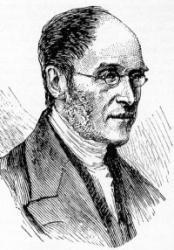
1793 - 1847 Topics: The Sabbath Author of "Pleasant are Thy Courts Above" in The New Canadian Hymnal Lyte, Henry Francis, M.A., son of Captain Thomas Lyte, was born at Ednam, near Kelso, June 1, 1793, and educated at Portora (the Royal School of Enniskillen), and at Trinity College, Dublin, of which he was a Scholar, and where he graduated in 1814. During his University course he distinguished himself by gaining the English prize poem on three occasions. At one time he had intended studying Medicine; but this he abandoned for Theology, and took Holy Orders in 1815, his first curacy being in the neighbourhood of Wexford. In 1817, he removed to Marazion, in Cornwall. There, in 1818, he underwent a great spiritual change, which shaped and influenced the whole of his after life, the immediate cause being the illness and death of a brother clergyman. Lyte says of him:—
"He died happy under the belief that though he had deeply erred, there was One whose death and sufferings would atone for his delinquencies, and be accepted for all that he had incurred;"
and concerning himself he adds:—
"I was greatly affected by the whole matter, and brought to look at life and its issue with a different eye than before; and I began to study my Bible, and preach in another manner than I had previously done."
From Marazion he removed, in 1819, to Lymington, where he composed his Tales on the Lord's Prayer in verse (pub. in 1826); and in 1823 he was appointed Perpetual Curate of Lower Brixham, Devon. That appointment he held until his death, on Nov. 20, 1847. His Poems of Henry Vaughan, with a Memoir, were published in 1846.
His own Poetical works were:—
(1) Poems chiefly Religious 1833; 2nd ed. enlarged, 1845. (2) The Spirit of the Psalms, 1834, written in the first instance for use in his own Church at Lower Brixham, and enlarged in 1836; (3) Miscellaneous Poems (posthumously) in 1868. This last is a reprint of the 1845 ed. of his Poems, with "Abide with me" added. (4) Remains, 1850.
Lyte's Poems have been somewhat freely drawn upon by hymnal compilers; but by far the larger portion of his hymns found in modern collections are from his Spirit of the Psalms. In America his hymns are very popular. In many instances, however, through mistaking Miss Auber's (q. v.) Spirit of the Psalms, 1829, for his, he is credited with more than is his due. The Andover Sabbath Hymn Book, 1858, is specially at fault in this respect. The best known and most widely used of his compositions are "Abide with me, fast falls the eventide;” “Far from my heavenly home;" "God of mercy, God of grace;" "Pleasant are Thy courts above;" "Praise, my soul, the King of heaven;" and "There is a safe and secret place." These and several others are annotated under their respective first lines: the rest in common use are:—
i. From his Poems chiefly Religious, 1833 and 1845.
1. Above me hangs the silent sky. For Use at Sea.
2. Again, 0 Lord, I ope mine eyes. Morning.
3. Hail to another Year. New Year.
4. How good, how faithful, Lord, art Thou. Divine care of Men.
5. In tears and trials we must sow (1845). Sorrow followed by Joy.
6. My [our] rest is in heaven, my [our] rest is not here. Heaven our Home.
7. 0 Lord, how infinite Thy love. The Love of God in Christ.
8. Omniscient God, Thine eye divine. The Holy Ghost Omniscient.
9. The leaves around me falling. Autumn.
10. The Lord hath builded for Himself. The Universe the Temple of God.
11. Vain were all our toil and labour. Success is of God.
12. When at Thy footstool, Lord, I bend. Lent.
13. When earthly joys glide swift away. Ps. cii.
14. Wilt Thou return to me, O Lord. Lent.
15. With joy we hail the sacred day. Sunday.
ii. From his Spirit of the Psalms, 1834.
16. Be merciful to us, O God. Ps. lvii.
17. Blest is the man who knows the Lord. Ps. cxii.
18. Blest is the man whose spirit shares. Ps. xli.
19. From depths of woe to God I cry. Ps. cxxxx.
20. Gently, gently lay Thy rod. Ps. vi.
21. Glorious Shepherd of the sheep. Ps. xxiii.
22. Glory and praise to Jehovah on high. Ps. xxix.
23. God in His Church is known. Ps. lxxvi.
24. God is our Refuge, tried and proved. Ps. xlvi.
25. Great Source of my being. Ps. lxxiii.
26. Hear, O Lord, our supplication. Ps. lxiv.
27. How blest the man who fears the Lord. Ps.cxxviii.
28. Humble, Lord, my haughty spirit. Ps. cxxxi.
29. In this wide, weary world of care. Ps. cxxxii.
30. In vain the powers of darkness try. Ps.lii.
31. Jehovah speaks, let man be awed. Ps. xlix.
32. Judge me, O Lord, and try my heart. Ps. xxvi.
33. Judge me, O Lord, to Thee I fly. Ps. xliii.
34. Lord, I have sinned, but O forgive. Ps. xli.
35. Lord, my God, in Thee I trust. Ps. vii.
36. Lord of the realms above, Our Prophet, &c. Ps.xlv.
37. Lone amidst the dead and dying. Ps. lxii.
38. Lord God of my salvation. Ps. lxxxviii.
39. Lord, I look to Thee for all. Ps. xxxi.
40. Lord, I would stand with thoughtful eye. Ps. lxix.
41. Lord, my God, in Thee I trust. Ps. vii.
42. My God, my King, Thy praise I sing. Ps. cviii.
43. My God, what monuments I see. Ps. xxxvi.
44. My spirit on [to] Thy care. Ps. xxxi.
45. My trust is in the Lord. Ps. xi.
46. Not unto us, Almighty Lord [God]. Ps. cxv.
47. O God of glory, God of grace. Ps. xc.
48. O God of love, how blest are they. Ps. xxxvii.
49. O God of love, my God Thou art. Ps. lxiii.
50. O God of truth and grace. Ps. xviii.
51. O had I, my Saviour, the wings of a dove. Ps. lv.
52. O how blest the congregation. Ps. lxxxix.
53. O how safe and [how] happy he. Ps. xci.
54. O plead my cause, my Saviour plead. Ps. xxxv.
55. O praise the Lord, 'tis sweet to raise. Ps. cxlvii.
56. O praise the Lord; ye nations, pour. Ps. cxvii.
57. O praise ye the Lord With heart, &c. Ps. cxlix.
58. O that the Lord's salvation. Ps. xiv.
59. O Thou Whom thoughtless men condemn. Ps. xxxvi.
60. Of every earthly stay bereft. Ps. lxxiv.
61. Our hearts shall praise Thee, God of love. Ps. cxxxviii.
62. Pilgrims here on earth and strangers. Ps. xvi.
63. Praise for Thee, Lord, in Zion waits. Ps. lxv.
64. Praise to God on high be given. Ps. cxxxiv.
65. Praise ye the Lord, His servants, raise. Ps. cxiii.
66. Redeem'd from guilt, redeem'd from fears. Ps. cxvi.
67. Save me by Thy glorious name. Ps. liv.
68. Shout, ye people, clap your hands. Ps. xlvii.
69. Sing to the Lord our might. Ps. lxxxi.
70. Strangers and pilgrims here below. Ps. cix.
71. Sweet is the solemn voice that calls. Ps. cxxii.
72. The Church of God below. Ps. lxxxvii.
73. The Lord is King, let earth be glad. Ps. xcvii.
74. The Lord is on His throne. Ps. xciii.
75. The Lord is our Refuge, the Lord is our Guide. Ps. xlvii.
76. The mercies of my God and King. Ps. lxxxix.
77. The Lord Who died on earth for men. Ps. xxi.
78. Tis a pleasant thing to fee. Ps. cxxxiii.
79. Thy promise, Lord, is perfect peace. Ps. iii.
80. Unto Thee I lift mine [my] eyes. Ps. cxxiii.
81. Whom shall [should] we love like Thee? Ps. xviii.
Lyte's versions of the Psalms are criticised where their sadness, tenderness and beauty are set forth. His hymns in the Poems are characterized by the same features, and rarely swell out into joy and gladness.
--John Julian, Dictionary of Hymnology (1907)
==================
Lyte, Henry Francis, p. 706, i. Additional versions of Psalms are in common use:--
1. Lord, a thousand foes surround us. Psalms lix.
2. Praise, Lord, for Thee in Zion waits. Psalms lxv.
3. The Christian like his Lord of old. Psalms cxl.
4. The Lord of all my Shepherd is. Psalms xxiii.
5. The Lord of heaven to earth is come. Psalms xcviii.
6. Thy mercy, Lord, the sinner's hope. Psalms xxxvi.
7. To Thee, O Lord, in deep distress. Psalms cxlii. Sometimes given as "To God I turned in wild distress."
8. Uphold me, Lord, too prone to stray. Psalms i.
9. When Jesus to our [my] rescue came. Psalms cxxvi. These versions appeared in the 1st edition of Lyte's Spirit of the Psalms, 1834. It must be noted that the texts of the 1834, the 1836, and the 3rd ed., 1858, vary considerably, but Lyte was not responsible for the alterations and omissions in the last, which was edited by another hand for use at St. Mark's, Torquay.
Lyte's version of Psalms xxix., "Glory and praise to Jehovah on high" (p. 706, ii., 22), first appeared in his Poems, 1st ed., 1833, p. 25. Read also No. 39 as "Lord, I look for all to Thee."
--John Julian, Dictionary of Hymnology, Appendix, Part II (1907)
Henry Francis Lyte
Isaac Watts
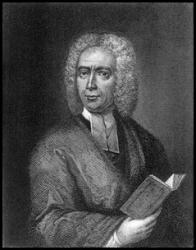
1674 - 1748 Topics: Worship and Praise The Sabbath Author of "Welcome Sweet Day of Rest" in The Baptist Standard Hymnal Isaac Watts was the son of a schoolmaster, and was born in Southampton, July 17, 1674. He is said to have shown remarkable precocity in childhood, beginning the study of Latin, in his fourth year, and writing respectable verses at the age of seven. At the age of sixteen, he went to London to study in the Academy of the Rev. Thomas Rowe, an Independent minister. In 1698, he became assistant minister of the Independent Church, Berry St., London. In 1702, he became pastor. In 1712, he accepted an invitation to visit Sir Thomas Abney, at his residence of Abney Park, and at Sir Thomas' pressing request, made it his home for the remainder of his life. It was a residence most favourable for his health, and for the prosecution of his literary labours. He did not retire from ministerial duties, but preached as often as his delicate health would permit.
The number of Watts' publications is very large. His collected works, first published in 1720, embrace sermons, treatises, poems and hymns. His "Horae Lyricae" was published in December, 1705. His "Hymns" appeared in July, 1707. The first hymn he is said to have composed for religious worship, is "Behold the glories of the Lamb," written at the age of twenty. It is as a writer of psalms and hymns that he is everywhere known. Some of his hymns were written to be sung after his sermons, giving expression to the meaning of the text upon which he had preached. Montgomery calls Watts "the greatest name among hymn-writers," and the honour can hardly be disputed. His published hymns number more than eight hundred.
Watts died November 25, 1748, and was buried at Bunhill Fields. A monumental statue was erected in Southampton, his native place, and there is also a monument to his memory in the South Choir of Westminster Abbey. "Happy," says the great contemporary champion of Anglican orthodoxy, "will be that reader whose mind is disposed, by his verses or his prose, to imitate him in all but his non-conformity, to copy his benevolence to men, and his reverence to God." ("Memorials of Westminster Abbey," p. 325.)
--Annotations of the Hymnal, Charles Hutchins, M.A., 1872.
=================================
Watts, Isaac, D.D. The father of Dr. Watts was a respected Nonconformist, and at the birth of the child, and during its infancy, twice suffered imprisonment for his religious convictions. In his later years he kept a flourishing boarding school at Southampton. Isaac, the eldest of his nine children, was born in that town July 17, 1674. His taste for verse showed itself in early childhood. He was taught Greek, Latin, and Hebrew by Mr. Pinhorn, rector of All Saints, and headmaster of the Grammar School, in Southampton. The splendid promise of the boy induced a physician of the town and other friends to offer him an education at one of the Universities for eventual ordination in the Church of England: but this he refused; and entered a Nonconformist Academy at Stoke Newington in 1690, under the care of Mr. Thomas Rowe, the pastor of the Independent congregation at Girdlers' Hall. Of this congregation he became a member in 1693.
Leaving the Academy at the age of twenty, he spent two years at home; and it was then that the bulk of the Hymns and Spiritual Songs (published 1707-9) were written, and sung from manuscripts in the Southampton Chapel. The hymn "Behold the glories of the Lamb" is said to have been the first he composed, and written as an attempt to raise the standard of praise. In answer to requests, others succeeded. The hymn "There is a land of pure delight" is said to have been suggested by the view across Southampton Water. The next six years of Watts's life were again spent at Stoke Newington, in the post of tutor to the son of an eminent Puritan, Sir John Hartopp; and to the intense study of these years must be traced the accumulation of the theological and philosophical materials which he published subsequently, and also the life-long enfeeblement of his constitution.
Watts preached his first sermon when he was twenty-four years old. In the next three years he preached frequently; and in 1702 was ordained pastor of the eminent Independent congregation in Mark Lane, over which Caryl and Dr. John Owen had presided, and which numbered Mrs. Bendish, Cromwell's granddaughter, Charles Fleetwood, Charles Desborough, Sir John Hartopp, Lady Haversham, and other distinguished Independents among its members. In this year he removed to the house of Mr. Hollis in the Minories. His health began to fail in the following year, and Mr. Samuel Price was appointed as his assistant in the ministry. In 1712 a fever shattered his constitution, and Mr. Price was then appointed co-pastor of the congregation which had in the meantime removed to a new chapel in Bury Street. It was at this period that he became the guest of Sir Thomas Abney, under whose roof, and after his death (1722) that of his widow, he remained for the rest of his suffering life; residing for the longer portion of these thirty-six years principally at the beautiful country seat of Theobalds in Herts, and for the last thirteen years at Stoke Newington. His degree of D.D. was bestowed on him in 1728, unsolicited, by the University of Edinburgh. His infirmities increased on him up to the peaceful close of his sufferings, Nov. 25, 1748. He was buried in the Puritan restingplace at Bunhill Fields, but a monument was erected to him in Westminster Abbey.
His learning and piety, gentleness and largeness of heart have earned him the title of the Melanchthon of his day. Among his friends, churchmen like Bishop Gibson are ranked with Nonconformists such as Doddridge. His theological as well as philosophical fame was considerable. His Speculations on the Human Nature of the Logos, as a contribution to the great controversy on the Holy Trinity, brought on him a charge of Arian opinions. His work on The Improvement of the Mind, published in 1741, is eulogised by Johnson. His Logic was still a valued textbook at Oxford within living memory. The World to Come, published in 1745, was once a favourite devotional work, parts of it being translated into several languages. His Catechisms, Scripture History (1732), as well as The Divine and Moral Songs (1715), were the most popular text-books for religious education fifty years ago. The Hymns and Spiritual Songs were published in 1707-9, though written earlier. The Horae Lyricae, which contains hymns interspersed among the poems, appeared in 1706-9. Some hymns were also appended at the close of the several Sermons preached in London, published in 1721-24. The Psalms were published in 1719. The earliest life of Watts is that by his friend Dr. Gibbons. Johnson has included him in his Lives of the Poets; and Southey has echoed Johnson's warm eulogy. The most interesting modern life is Isaac Watts: his Life and Writings, by E. Paxton Hood. [Rev. H. Leigh Bennett, M.A.]
A large mass of Dr. Watts's hymns and paraphrases of the Psalms have no personal history beyond the date of their publication. These we have grouped together here and shall preface the list with the books from which they are taken.
(l) Horae Lyricae. Poems chiefly of the Lyric kind. In Three Books Sacred: i.To Devotion and Piety; ii. To Virtue, Honour, and Friendship; iii. To the Memory of the Dead. By I. Watts, 1706. Second edition, 1709. (2) Hymns and Spiritual Songs. In Three Books: i. Collected from the Scriptures; ii. Composed on Divine Subjects; iii. Prepared for the Lord's Supper. By I. Watts, 1707. This contained in Bk i. 78 hymns; Bk. ii. 110; Bk. iii. 22, and 12 doxologies. In the 2nd edition published in 1709, Bk. i. was increased to 150; Bk. ii. to 170; Bk. iii. to 25 and 15 doxologies. (3) Divine and Moral Songs for the Use of Children. By I. Watts, London, 1715. (4) The Psalms of David Imitated in the Language of the New Testament, And apply'd to the Christian State and Worship. By I. Watts. London: Printed by J. Clark, at the Bible and Crown in the Poultry, &c, 1719. (5) Sermons with hymns appended thereto, vol. i., 1721; ii., 1723; iii. 1727. In the 5th ed. of the Sermons the three volumes, in duodecimo, were reduced to two, in octavo. (6) Reliquiae Juveniles: Miscellaneous Thoughts in Prose and Verse, on Natural, Moral, and Divine Subjects; Written chiefly in Younger Years. By I. Watts, D.D., London, 1734. (7) Remnants of Time. London, 1736.
454 Hymns and Versions of the Psalms, in addition to the centos are all in common use at the present time.
--Excerpts from John Julian, Dictionary of Hymnology (1907)
==================================
Watts, I. , p. 1241, ii. Nearly 100 hymns, additional to those already annotated, are given in some minor hymn-books.
--John Julian, Dictionary of Hymnology, Appendix, Part II (1907)
=================
Watts, I. , p. 1236, i. At the time of the publication of this Dictionary in 1892, every copy of the 1707 edition of Watts's Hymns and Spiritual Songs was supposed to have perished, and all notes thereon were based upon references which were found in magazines and old collections of hymns and versions of the Psalms. Recently three copies have been recovered, and by a careful examination of one of these we have been able to give some of the results in the revision of pp. 1-1597, and the rest we now subjoin.
i. Hymns in the 1709 ed. of Hymns and Spiritual Songs which previously appeared in the 1707 edition of the same book, but are not so noted in the 1st ed. of this Dictionary:—
On pp. 1237, L-1239, ii., Nos. 18, 33, 42, 43, 47, 48, 60, 56, 58, 59, 63, 75, 82, 83, 84, 85, 93, 96, 99, 102, 104, 105, 113, 115, 116, 123, 124, 134, 137, 139, 146, 147, 148, 149, 162, 166, 174, 180, 181, 182, 188, 190, 192, 193, 194, 195, 197, 200, 202.
ii. Versions of the Psalms in his Psalms of David, 1719, which previously appeared in his Hymns and Spiritual Songs, 1707:—
On pp. 1239, U.-1241, i., Nos. 241, 288, 304, 313, 314, 317, 410, 441.
iii. Additional not noted in the revision:—
1. My soul, how lovely is the place; p. 1240, ii. 332. This version of Ps. lxiv. first appeared in the 1707 edition of Hymns & Spiritual Songs, as "Ye saints, how lovely is the place."
2. Shine, mighty God, on Britain shine; p. 1055, ii. In the 1707 edition of Hymns & Spiritual Songs, Bk. i., No. 35, and again in his Psalms of David, 1719.
3. Sing to the Lord with [cheerful] joyful voice, p. 1059, ii. This version of Ps. c. is No. 43 in the Hymns & Spiritual Songs, 1707, Bk. i., from which it passed into the Ps. of David, 1719.
A careful collation of the earliest editions of Watts's Horae Lyricae shows that Nos. 1, 7, 9, 10, 11, 12, 14, 16, p. 1237, i., are in the 1706 ed., and that the rest were added in 1709. Of the remaining hymns, Nos. 91 appeared in his Sermons, vol. ii., 1723, and No. 196 in Sermons, vol. i., 1721. No. 199 was added after Watts's death. It must be noted also that the original title of what is usually known as Divine and Moral Songs was Divine Songs only.
--John Julian, Dictionary of Hymnology, New Supplement (1907)
===========
See also in:
Hymn Writers of the Church
Isaac Watts
César Malan
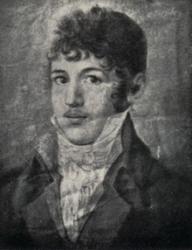
1787 - 1864 Person Name: C. H. A. Malan Topics: Worship and Praise The Sabbath Composer of "HENDON" in The Baptist Standard Hymnal Rv Henri Abraham Cesar Malan, 1787-1864. Born in Geneva, Switzerland, into a bourgeois family that moved to Switzerland to escape religious persecution during the French Revolution, he attended the university in Marseilles, France, intending to become a businessman. Although having some grounding in religious faith by his mother, he decided to attend the Academy at Geneva (founded by Calvin) in preparation for ministry. He was ordained in 1810, after being appointed a college master (teaching Latin) in 1809. Malan was in accord with the National Church of Geneva as a Unitarian, but the Reveil Movement caused him to become a dissident (evangelical) instead of a proponent of the Reformed Church (believing works, not faith, was what mattered). In 1811 he married (wife’s name not found). They had at least two children (one son was Solomon, referenced below). From 1813 on Malan slowly became an evangelical, after being given an understanding of true salvation through grace (not works) in 1816 by two German Lutherans from Geneva. He became saved upon this realization and was so changed that he burned his prized collection of classical authors and manuscripts. In 1817 he preached around Geneva, and one sermon in particular, “Man only justified by faith alone” created a firestorm and brought him into conflict with religious authorities of the region. From then on he wished to help reform the national church from within, but the forces of the Venerable Company were too strong for him and excluded him from the pulpits and caused his dismissal from his regentsship at the college in 1818. Others in agreement with Malan were Charles Spurgeon, Robert Wilcox, Robert Haldane, and Henry Drummond. In 1820 he built a chapel in his garden and obtained the license of the State for it as a separatist place of worship. He preached in that chapel 43 years. In 1823 he was formally deprived of his status as a minister of the national Church. Various events caused his congregation to diminish over the next few years, and he began long tours of evangelization subsidized by religious friends in his land, Belgium, France, England and Scotland. He often preached to large congregations. Malan also authorized a hymn book, “Chants de Sion” (1841). A strong Calvinist, Malan lost no opportunity to evangelize. On one occasion an old man he visited pulled Malan’s hymnal out and told him he had prayed to see the author of it before he died. On a visit to England Malan also inspired author, Charlotte Elliott, to write the hymn lyrics for “Just as I am”, when seeking an answer to her conversion she asked and he advised her to come to Christ ‘just as she was’. Malan published a score of books and also produced many religious tracts and pamphlets largely on questions in dispute between the National and evangelical churches of Rome. He also wrote articles in the “Record” and in American reviews. His hymns were set to his own melodies. He was an artist, a mechanic, a carpenter, a metal forger, and a printer. He had his own workshop, forge and printing press. One of his greatest joys was the meeting of the evangelical alliance at Geneva in 1861 which helped change church views. He retired to his home, Vandoeuvres, in the countryside near Geneva in 1857, dying there seven years later.. He was honored by a visit from the Queen of Holland two years before his death. He is mainly remembered as a hymn writer, having written 1000+ hymn lyrics and tunes. One son, Solomon, a gifted linguist and theologian, became Vicar of Broadwindsor. About a dozen of his hymns appeared translated in the publication “Friendly visitor” (1826). He was an author, creator, composer, editor, correspondent, contributor, translator, owner, and performer.
John Perry
=================
Malan, Henri Abraham César. The family of Malan traces its origin to the valleys of Piedmont. A branch of it settled at Mérindol, in Dauphiné, but was driven from France by the persecutions that followed the Revocation of the Edict of Nantes. Pierre Malan [Cesar's father], after seeing his sister fall a victim to persecution, left Mérindol (1714), and arrived at Geneva (1722). Henri Abraham César Malan was born at Geneva in 1787. After an education at the College, he went to Marseilles, with the intention of learning business: but, soon after, entered the Academy at Geneva, as a preparation for the ministry, to which he was ordained in 1810. He had been appointed one of the masters at the College in the previous year. The National Church of Geneva was at that time almost Unitarian, and Malan's convictions were in accord with it. But the great movement known as the Réveil, of which the first products were the dissident church of Bourg de Four and at a later date that founded by Malan himself, and which finally imbued the whole Swiss Church with its spirit, was silently preparing itself. The germ of the movement may be traced in the Société des Amis (1810), of which Empeytaz and A. Bost were leaders; and in Malan's independent attainment to the doctrines of the Divinity of the Saviour and the free gifts of salvation through Him (1816). But the human agency, which gave it force, and determined its Calvinistic direction, was the visit of Robert Haldane (in the autumn of 1816), to whom not only these pioneers of the movement, but F. Monod, E. Rieu, Guers, Gonthier, Merle d'Aubigné, and others, always pointed as their spiritual father. Empeytaz and others sought to attain enfranchisement by the establishment of the "petite Eglise of Bourg de Four." Malan wished to reform the national Church from within: and a sermon at Geneva, which brought on him the obloquy of the professors and theologians that composed his audience, and which Haldane characterized as a republication of the Gospel, was his first overt act (Jan. 19, 1817). But the opposing forces were far too strong for him. The Venerable Company excluded him from the pulpits, and achieved his dismissal from his regentship at the College (1818). In 1820 he built a chapel (Chapelle du Temoignage) in his garden, and obtained the licence of the State for it, as a separatist place of worship. In 1823 he was formally deprived of his status as a minister of the national Church. The seven years that succeeded were the palmy days of the little chapel. Strangers, especially from England, mingled with the overflowing Swiss congregation. But (in 1830) a secession to Bourg de Four, and then the foundation of the Oratoire and the Société Evangelique, which in 1849 absorbed the congregation of Bourg de Four under the title of the Église Evangélique, thinned more and more the number of his adherents. His burning zeal for the conversion of souls found a larger outlet in long tours of evangelization, subsidized by religious friends, in his own land and Belgium and France, and also in Scotland and England, where he had friends among many religious bodies, and where he preached to large congregations. The distinguishing characteristic of these tours was his dealing with individuals. On the steamboat or the diligence, in the mountain walk, at the hotel, no opportunity was lost. On one occasion an old,man whom he visited drew from under his pillow a copy of his great hymnbook, Chants de Sion, 1841, and told him how he had prayed to see the author of it before he died.
It is as the originator of the modern hymn movement in the French Reformed Church that Malan's fame cannot perish. The spirit of his hymns is perpetuated in the analysis of Christian experience, the never-wearied delineation of the hopes and fears, the joys and sorrows of the believer's soul, which are still the staple of French Protestant hymns. To this was added, in Malan himself, a marked didactic tone, necessitated by the great struggle of the Réveil for Evangelical doctrine; and an emphatic Calvinism, expressing itself with all the despondency of Newton and Cowper, but, in contrast with them, in bright assurance, peace and gladness. French criticism has pronounced his hymns unequal, and full of literary defects; but their unaffected freshness and fervent sincerity are universally allowed. In the Chants de Sion, hymns 20, ”Hosanna! Béni soit"; 165, “Mon coeur joyeux, plein d'espérance"; 199, "Du Rocher de Jacob"; 200, "Agneau de Dieu"; 239, "Trois fois Jehovah," are in every Protestant French hymnbook; and several others are very widely used.
Besides his hymns Malan produced numberless tracts and pamphlets on the questions in dispute between the National and Evangelical Churches and the Church of Rome, as well as articles in the Record and in American reviews. He was a man of varied acquirements. His hymns were set to his own melodies. He was an artist, a mechanic: his little workshop had its forge, its carpenter's bench, its printing press. To the end of his life his strong Calvinism, and his dread of mere external union in church government, kept him distinct from all movements of church comprehension, though freely joining in communion with all the sections of Evangelical thought in Geneva and Scotland. At one time there seemed a prospect of his even rejoining the national Church, which had driven him from her. One of his greatest joys was the meeting of the Evangelical Alliance at Geneva (1861). He left no sect; one of his latest orders was the demolition of his decayed chapel, in which he had preached for 43 years. He died at Vandoeuvres, near Geneva, in 1864, leaving a numerous family, one of whom, the Rev. S. C. Malan, D.D., sometime Vicar of Broadwindsor, is well known as a linguist and a theologian of the English Church. To English readers Malan is chiefly known as a hymn-writer through translations of his "Non, ce n'est pas mourir" (q.v.): "It is not death to die", &c. About a dozen of his hymns appear in a translated form in the Friendly Visitor for 1826. [Rev. H. Leigh Bennett, M.A.]
-- John Julian, Dictionary of Hymnology (1907)
=================
http://en.wikipedia.org/wiki/César_Malan
César Malan
Samuel Stennett
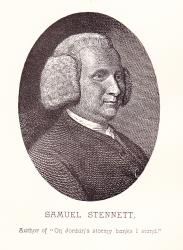
1727 - 1795 Person Name: S. Stennett (1727-1795) Topics: The Church and Doctrines The Sabbath Author of "Another Six Days' Work Is Done" in The Church Hymnal Samuel Stennett was born at Exeter, in 1727. His father was pastor of a Baptist congregation in that city; afterwards of the Baptist Chapel, Little Wild Street, London. In this latter pastorate the son succeeded the father in 1758. He died in 1795. Dr. Stennett was the author of several doctrinal works, and a few hymns.
--Annotations of the Hymnal, Charles Hutchins, M.A. 1872.
======================
Stennett, Samuel, D.D., grandson of Joseph Stennett, named above, and son of the Rev. Joseph Stennett, D.D., was born most pro;bably in 1727, at Exeter, where his father was at that time a Baptist minister. When quite young he removed to London, his father having become pastor of the Baptist Church in Little Wild Street, Lincoln's Inn Fields. In 1748, Samuel Stennett became assistant to his father in the ministry, and in 1758 succeeded him in the pastoral office at Little Wild Street. From that time until his death, on Aug. 24, 1795, he held a very prominent position among the Dissenting ministers of London. He was much respected by some of the statesmen of the time, and used his influence with them in support of the principles of religious freedom. The celebrated John Howard was a member of his congregation and an attached friend. In 1763, the University of Aberdeen conferred on him the degree of D.D. Dr. S. Stennett's prose publications consist of volumes of sermons, and pamphlets on Baptism and on Nonconformist Disabilities. He wrote one or two short poems, and contributed 38 hymns to the collection of his friend, Dr. Rippon (1787). His poetical genius was not of the highest order, and his best hymns have neither the originality nor the vigour of some of his grandfather's. The following, however, are pleasing in sentiment and expression, and are in common use more especially in Baptist congregations:—
1. And have I, Christ, no love for Thee? Love for Christ desired.
2. And will the offended God again? The Body the Temple of the Holy Ghost.
3. As on the Cross the Saviour hung. The Thief on the Cross.
4. Behold the leprous Jew. The healing of the Leper.
5. Come, every pious heart. Praise to Christ.
6. Father, at Thy call, I come. Lent.
7. Great God, amid the darksome night. God, a Sun.
8. Great God, what hosts of angels stand. Ministry of Angels.
9. Here at Thy Table, Lord, we meet. Holy Communion.
10. How charming is the place. Public Worship.
11. How shall the sons of men appear? Acceptance through Christ alone.
12. How soft the words my [the] Saviour speaks. Early Piety.
13. How various and how new. Divine Providence.
14. Not all the nobles of the earth. Christians as Sons of God.
15. On Jordan's stormy banks I stand. Heaven anticipated.
16. Prostrate, dear Jesus, at thy feet. Lent. Sometimes, "Dear Saviour, prostrate at Thy feet."
17. Should bounteous nature kindly pour. The greatest of these is Love. From this, "Had I the gift of tongues," st. iii., is taken.
18. Thy counsels of redeeming grace. Holy Scripture. From "Let avarice, from shore to shore."
19. Thy life 1 read, my dearest Lord. Death in Infancy. From this "'Tis Jesus speaks, I fold, says He."
20. 'Tis finished! so the Saviour cried. Good Friday.
21. To Christ, the Lord, let every tongue. Praise of Christ. From this,"Majestic sweetness sits enthroned," st. iii., is taken.
22. To God, my Saviour, and my King. Renewing Grace.
23. To God, the universal King. Praise to God.
24. What wisdom, majesty, and grace. The Gospel. Sometimes, “What majesty and grace."
25. Where two or three with sweet accord. Before the Sermon.
26. Why should a living man complain? Affliction. From this, "Lord, see what floods of sorrow rise," st. iii., is taken.
27. With tears of anguish I lament. Lent.
28. Yonder amazing sight I see. Good Friday.
All these hymns, with others by Stennett, were given in Rippon's Baptist Selection, 1787, a few having previously appeared in A Collection of Hymns for the use of Christians of all Denominations, London. Printed for the Booksellers, 1782; and No. 16, in the 1778 Supplement to the 3rd edition of the Bristol Baptist Selection of Ash and Evans. The whole of Stennett's poetical pieces and hymns were included in vol. ii. of his Works, together with a Memoir, by W. J. Jones. 4 vols., 1824. [Rev. W. R. Stevenson, M.A.]
--John Julian, Dictionary of Hymnology (1907)
Samuel Stennett
John Ellerton

1826 - 1893 Topics: The Sabbath Author of "The Lord be With Us" in The New Canadian Hymnal John Ellerton (b. London, England, 1826; d. Torquay, Devonshire, England, 1893) Educated at King William's College on the Isle of Man and at Trinity College, Cambridge, England, he was ordained in the Church of England in 1851. He served six parishes, spending the longest time in Crewe Green (1860-1872), a church of steelworkers and farmers. Ellerton wrote and translated about eighty hymns, many of which are still sung today. He helped to compile Church Hymns and wrote its handbook, Notes and Illustrations to Church Hymns (1882). Some of his other hymn texts were published in The London Mission Hymn Book (1884).
Bert Polman
=========================
Ellerton, John, M.A., son of George Ellerton, was born in London, Dec. 16, 1826, and educated at Trinity College, Cambridge (B.A. 1849; M.A. 1854). Taking Holy Orders he was successively Curate of Easebourne, Sussex, 1850; Brighton, and Lecturer of St. Peter's, Brighton, 1852; Vicar of Crewe Green, and Chaplain to Lord Crewe, 1860; Rector of Hinstock, 1872; of Barnes, 1876; and of White Roding, 1886. Mr. Ellerton's prose writings include The Holiest Manhood, 1882; Our Infirmities, 1883, &c. It is, however, as a hymnologist, editor, hymnwriter, and translator, that he is most widely known. As editor he published: Hymns for Schools and Bible Classes, Brighton, 1859. He was also co-editor with Bishop How and others of the Society for Promoting Christian Knowledge Church Hymns, 1871. His Notes and Illustrations of Church Hymns, their authors and translators, were published in the folio edition of 1881. The notes on the hymns which are special to the collection, and many of which were contributed thereto, are full, accurate, and of special value. Those on the older hymns are too general for accuracy. They are written in a popular form, which necessarily precludes extended research, fulness, and exactness of detail. The result is acceptable to the general public, but disappointing to the hymnological expert. Mr. Ellerton's original hymns number about fifty, and his translations from the Latin ten or more. Nearly every one of these are in common use and include:—
1. Before the day draws near its ending. Afternoon. Written April 22, 1880, for a Festival of Choirs at Nantwich, and first published in the Nantwich Festival Book, 1880. In 1883 it passed into the Westminster Abbey Hymn Book.
2. Behold us, Lord, a little space. General for Weekdays. Written in 1870 for a mid-day service in a City Church, and published in Church Hymns in 1871. It has passed into several collections.
3. Come forth, 0 Christian brothers. Processional for Choral Festival. Written for a Festival of Parochial Choirs held at Chester, May, 1870, and 1st printed in the Service-book of the same. In 1871 it passed into Church Hymns.
4. Father, Name of love and fear. Confirmation. Written in 1871 for a Confirmation in the North of England, and published in Church Hymns, 1871, and other collections.
5. God, Creator and Preserver. In Time of Scarcity. Written for and first published in The Hymnary, 1870; and again in the revised edition, 1872, and other hymnbooks.
6. Hail to the Lord Who comes. Presentation of Christ in the Temple. Written Oct. 6, 1880, for Mrs. Brock's Children's Hymn Book, and published therein, 1881.
7. In the Name which earth and heaven. Foundation of a Church. Written for and first published in Church Hymns, 1871, and repeated in several collections. The hymn sung at the re-opening of the Nave of Chester Cathedral, January 25, 1872, was compiled by Mr. Ellerton from this hymn, and his "Lift the strain of high thanksgiving.”
8 King Messiah, long expected. The Circumcision. Written Jan. 14, 1871, and first published in Church Hymns, 1871. It has passed into other collections.
9. King of Saints, to Whom the number. St. Bartholomew. Written for and first published in Church Hymns., 1871. It is very popular, and has been repeated in many hymnals.
10. Mary at the Master's feet. Catechizing. Written for and first published in Church Hymns, 1871.
11. O Father, all-creating. Holy Matrimony. Written Jan. 29, 1876, at the request of the Duke of Westminster, for the marriage of his daughter to the Marquess of Ormonde. It was published in Thring's Collection, 1880 and 1882.
12 O! how fair the morning broke. Septuagesima. Written March 13, 1880, for Mrs. Brock's Children's Hymn Book, and included therein, 1881.
13. O Lord of life and death, welcome. In Time of Pestilence. Written for and first published in Church Hymns, 1871.
14. O shining city of our God. Concerning the Hereafter. First published in the Rev. R. Brown-Borthwick's Sixteen Hymns with Tunes, &c, 1870; and again in Church Hymns, 1871.
15. O Son of God, our Captain of Salvation. St. Barnabas. Written April 5, 1871, and first published in Church Hymns, 1871; and again in Hymns Ancient & Modern, 1875, Thring's Collection, 1882, and others.
16. O Thou in Whom Thy saints repose. Consecration of a Burial Ground. Written for the consecration of an addition to the Parish Churchyard of Tarporley, Cheshire, 1870, and published in Church Hymns, 1871.
17. O Thou Whose bounty fills the earth. Flower Services. Written for a Flower Service at St. Luke's Church, Chelsea, June 6, 1880, and published in Mrs. Brock's Children's Hymn Book, 1881.
18. Praise to our God, Whose bounteous hand. National Thanksgiving. Written in 1870 for Church Hymns, but first published in the Rev. R. Brown-Borthwick's Select Hymns, &c., 1871, and then in Church Hymns later the same year.
19. The day Thou gavest, Lord, is ended. The darkness, &c. Evening. Written in 1870 for A Liturgy for Missionary Meetings (Frome, Hodges), and revised for Church Hymns, 1871. The revised form has passed into other collections.
20. The Lord be with us when we bend. Close of Afternoon Service. Written [in 1870] at the request of a friend for use at the close of Service on Sunday afternoons when (as in summer) strictly Evening hymns would be unsuitable. It was published in Church Hymns, 1871, Thring's Collection, 1882, and others.
21. This day the Lord's disciples met. Whitsuntide. "Originally written in 1855 for a class of children, as a hymn of 8 verses of 5 lines each, beginning, 'The Fiftieth day was come at last.’ It was abridged, revised, and compressed into C.M. for Mrs. Brock's Children's Hymn Book, 1880," and published therein, 1881.
22. Thou in Whose Name the two or three. Wednesday. Appeared in the Parish Magazine, May, 1871, as a hymn for Wednesday. After revision it was included in Church Hymns, 1871, and repeated in other collections.
23. Thou Who sentest Thine Apostles. SS. Simon and Jude. Written in June, 1874, for the revised edition of Hymns Ancient & Modern, and published in the same in 1875.
24. We sing the glorious conquest. Conversion of St. Paul. Written Feb. 28, 1871, for and published later the same year in Church Hymns. It was repeated in Hymns Ancient & Modern, 1875.
25. When the day of toil is done. Eternal Best. Written in Jan., 1870, and first published in the Rev. R. Brown-Borthwick's Sixteen Hymns with Tunes, &c. 1870, Church Hymns, 1871, and subsequently in several Scottish hymn-books. The tune "Preston," in Church Hymns was written for this hymn.
To these hymns must be added those which are annotated under their respective first lines, and the translations from the Latin. The grandest of his original compositions is, "Throned upon the awful tree," and the most beautiful and tender, "Saviour, again to Thy dear Name we raise"; and of his translations, "Sing Alleluia forth in duteous praise," and "Welcome, happy morning, age to age shall say," are the most successful and popular. The subjects of Mr. Ellerton's hymns, and the circumstances under which they were written, had much to do with the concentration of thought and terseness of expression by which they are characterized. The words which he uses are usually short and simple; the thought is clear and well stated; the rhythm is good and stately. Ordinary facts in sacred history and in daily life are lifted above the commonplace rhymes with which they are usually associated, thereby rendering the hymns bearable to the cultured, and instructive to the devout. His antitheses are frequent and terse, almost too much so for devotional verse, and are in danger of interrupting the tranquil flow of devotion. His sympathy with nature, especially in her sadder moods, is great; he loves the fading light and the peace of eve, and lingers in the shadows. Unlike many writers who set forth their illustrations in detail, and then tie to them the moral which they are to teach, he weaves his moral into his metaphor, and pleases the imagination and refreshes the spirit together. Now and again he falls into the weakness of ringing changes on words; but taken as a whole his verse is elevated in tone, devotional in spirit, and elegant in diction.
-- John Julian, Dictionary of Hymnology (1907)
=====================
Ellerton, John, p. 326, i. Other hymns are:—
1. O Father, bless the children. Holy Baptism. Written in 1886, and published in his Hymns, &c, 1888, in 4 stanzas of 8 lines. Also in the 1889 Suppl. Hymns to Hymns Ancient & Modern.
2. O Thou Who givest food to all. Temperance. Written Aug. 30, 1882, and printed in the Church of England Temperance Chronicle, Sept. 1882. Also in his Hymns, &c, 1888.
3. Praise our God for all the wonders. St. Nicholas's Day. Dated in his Hymns, 1888, "December 1882." It was written for the Dedication Festival of St. Nicholas's Church, Brighton, and first printed as a leaflet in 1882.
4. Praise our God, Whose open hand. Bad Harvest. Written as a hymn for the bad harvest of 1881, and printed in the Guardian in August of that year. Also in his Hymns, &c, 1888.
5. Praise to the Heavenly Wisdom. St. Matthias's Day. Dated in his Hymns, &c, 1888, "January, 1888." Also in the 1889 Suppl. Hymns to Hymns Ancient & Modern.
6. Shine Thou upon us, Lord. For a Teachers' Meeting. Contributed to the 1889 Suppl. Hymns to Hymns Ancient & Modern.
7. Thou Who wearied by the well. Temperance. Written for the Opening of a Workmen's Coffee Tavern, and dated in his Hymns, &c, 1888, "September 23, 1882." It was printed in the Church of England Temperance Chronicle the same year.
8. Throned upon the awful Tree. Good Friday. Written in 1875, and published in the 1875 ed. of Hymns Ancient & Modern. It has passed into many collections, and is one of the finest of Mr. Ellerton's productions.
Mr. Ellerton's original and translated hymns to the number of 76 were collected, and published by Skeffington & Son in 1888, as Hymns, Original and Translated. By John Ellerton, Rector of White Roding.
--John Julian, Dictionary of Hymnology, Appendix, Part II (1907)
===================
Ellerton, J., pp. 326, ii.; 1561, ii. He was appointed Hon. Canon of St. Albans in 1892. and died June 15, 1893. His Life and Works, by H. Housman, was published in 1896.
--John Julian, Dictionary of Hymnology, New Supplement (1907)
John Ellerton
Joseph Barnby
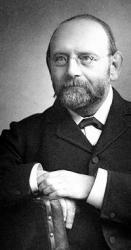
1838 - 1896 Person Name: J. Barnby Topics: The Sabbath Composer of "HOLY TRINITY" in The New Canadian Hymnal Joseph Barnby (b. York, England, 1838; d. London, England, 1896) An accomplished and popular choral director in England, Barnby showed his musical genius early: he was an organist and choirmaster at the age of twelve. He became organist at St. Andrews, Wells Street, London, where he developed an outstanding choral program (at times nicknamed "the Sunday Opera"). Barnby introduced annual performances of J. S. Bach's St. John Passion in St. Anne's, Soho, and directed the first performance in an English church of the St. Matthew Passion. He was also active in regional music festivals, conducted the Royal Choral Society, and composed and edited music (mainly for Novello and Company). In 1892 he was knighted by Queen Victoria. His compositions include many anthems and service music for the Anglican liturgy, as well as 246 hymn tunes (published posthumously in 1897). He edited four hymnals, including The Hymnary (1872) and The Congregational Sunday School Hymnal (1891), and coedited The Cathedral Psalter (1873).
Bert Polman
Joseph Barnby
Harriet Auber
1773 - 1862 Topics: Worship The Sabbath Author of "Sweet is the work, O Lord" in The Seventh-Day Adventist Hymn and Tune Book Auber, Harriet, daughter of Mr. James Auber, b. in London, Oct. 4, 1773. During the greater part of her quiet and secluded life she resided at Broxbourne and Hoddesdon, Herts, and died at the latter place on the 20th Jan., 1862. Miss Auber wrote devotional and other poetry, but only a portion of the former was published in her Spirit of the Psalms, in 1829. This collection is mainly her work, and from it some useful versions of the Psalms have been taken and included in modern hymn-books, about 20 appearing in Spurgeon's Our Own Hymn Book, 1866. Miss Auber's name is widely known, but it is principally through her exquisite lyric, "Our blest Redeemer, ere He breathed," and the Epiphany hymn, "Bright was the guiding star that led." (For criticism of her work, see English Psalters, §. 17.)
In addition to these and other hymns by Miss Auber, which are annotated under their respective first lines, the following are also in C. V., but principally in America:—
1. Arise, ye people, and adore. Easter.
2. As Thy chosen people, Lord. Ps. lxciii.
3. Can guilty man indeed believe? Ps. xciv.
4. Delightful is the task to sing. Ps. cxlvii.
5. Father of Spirits, Nature's God. Ps. cxxxi.
6. Hail, gracious Source of every good. Ps. Ixv.
7. Hasten, Lord, the glorious time. Ps. lxxii.
8. Jehovah reigns, O earth, rejoice. Ps. xccii.
9. Join, all ye servants of the Lord. H. Scriptures.
10. Jesus, Lord, to Thee we sing. Ps. cx.
11. O all ye lands, rejoice in God. Ps. lxvi.
12. O God our Strength, to Thee the song. Ps. lIxxxi.
13. O praise our great and gracious Lord. Ps. lxxviii.
14. On thy church, O power divine. Ps. lxvii.
15. Sweet is the work, O Lord. Sunday.
16. That Thou, O Lord, art ever nigh. Ps. lxxv.
17. The Lord, Who hath redeemed our souls. Ps. xxxi.
18. When all bespeaks a Father's love. Ps. set.
19. When dangers press and fears invade. Ps. lxii.
20. Who, O Lord, when life is o'er. Ps. xv.
21. Whom have we Lord, in heaven, but Thee. Ps. lxxiii.
22. Wide, ye heavenly gates, unfold. Ascension.
23. With hearts in love abounding. Ps. xlv.
24. With joy we hail the sacred day. Sunday.
25. Vainly through the night the ranger. Ps. cxvii.
All these psalm-versions and hymns are from her Spirit of the Psalms, London, 1829.
- John Julian, Dictionary of Hymnology (1907)
=========================
Auber, Harriet, p. 90, ii. The following versions of psalms from her Spirit of the Psalms, 1829, are also in common use:-
1. Great God, wert Thou extreme to mark. Ps. cxxx. "Thy servants in the temple watched," begins with stanza ii. of this.
2. How blest are they who daily prove. Ps. xli.
3. How blest the children of the Lord. Altered from Ps. cxii.
4. Jehovah, great and awful name. Part of Ps. Ixxviii.
5. 0 Thou Whom heaven's bright host revere. Ps. Ixxxiv.
6. Praise the Lord, our mighty King. Ps. cxxxv.
7. Spirit of peace, Who as a [celestial] Dove. Ps. cxxxiii.
8. Thou by Whose strength the mountains stand. Ps. Ixv.
9. To heaven our longing eyes we raise. Ps. cxxi.
10. Vainly through night's weary hours. Ps. cxxvii. Sometimes "Vainly through the night the ranger."
11. While all the golden harps above. Easter.
--John Julian, Dictionary of Hymnology, Appendix, Part II (1907)
See also in:Hymn Writers of the Church
Harriet Auber
William Knapp
1698 - 1768 Topics: The Sabbath Composer of "WAREHAM" in Sacred Songs and Solos Born: 1698, Wareham, Dorsetshire, England.
Died: September 26, 1768, Poole, Dorsetshire, England.
Buried: Poole, Dorsetshire, England.
William Knapp
George Kingsley
1811 - 1884 Topics: Worship The Sabbath Composer of "ELIZABETHTOWN" in The Seventh-Day Adventist Hymn and Tune Book Born: July 7, 1811, Northampton, Massachusetts.
Died: March 14, 1884, Northampton, Massachusetts.
Kingsley played the organ at the Old South Church and Hollis Street Church in Boston, Massachusetts. He also taught music at Girard College in Philadelphia, Pennsylvania, served as music supervisor for public schools in Philadelphia, and compiled a number of music books, including:
Sunday School Singing Book, 1832
The Harmonist, 1833
The Social Choir, 1836
The Sacred Choir, 1838
The Harp of David, 1844
The Young Ladies’ Harp, 1847
Templi Carmina (Northampton, Massachusetts: 1853)
The Juvenile Choir, 1865
--www.hymntime.com/tch
George Kingsley
Pages




