

 My Starred Hymns
 My FlexScores
 My Hymnals
 My Purchased Files
Planning worship?
Check out our sister site, ZeteoSearch.org,
for 20+ additional resources related to your search.
- |
User Links
Person Results
Philip Doddridge

1702 - 1751 Person Name: Philip Doddridge, 1702-1751 Topics: Community in Christ Author of "O God of Jacob" in Lutheran Book of Worship Philip Doddridge (b. London, England, 1702; d. Lisbon, Portugal, 1751) belonged to the Non-conformist Church (not associated with the Church of England). Its members were frequently the focus of discrimination. Offered an education by a rich patron to prepare him for ordination in the Church of England, Doddridge chose instead to remain in the Non-conformist Church. For twenty years he pastored a poor parish in Northampton, where he opened an academy for training Non-conformist ministers and taught most of the subjects himself. Doddridge suffered from tuberculosis, and when Lady Huntington, one of his patrons, offered to finance a trip to Lisbon for his health, he is reputed to have said, "I can as well go to heaven from Lisbon as from Northampton." He died in Lisbon soon after his arrival. Doddridge wrote some four hundred hymn texts, generally to accompany his sermons. These hymns were published posthumously in Hymns, Founded on Various Texts in the Holy Scriptures (1755); relatively few are still sung today.
Bert Polman
========================
Doddridge, Philip, D.D., was born in London, June 26, 1702. His grandfather was one of the ministers under the Commonwealth, who were ejected in 1662. His father was a London oilman. He was offered by the Duchess of Bedford an University training for ordination in the Church of England, but declined it. He entered Mr. Jennings's non-conformist seminary at Kibworth instead; preached his first sermon at Hinckley, to which Mr. Jennings had removed his academy. In 1723 he was chosen pastor at Kibworth. In 1725 he changed his residence to Market Harborough, still ministering at Kibworth. The settled work of his life as a preceptor and divine began in 1729, with his appointment to the Castle Hill Meeting at Northampton, and continued till in the last stage of consumption. He sailed to Lisbon, in 1751, where he died October 26, the same year. Two hundred pupils in all, gathered from England, Scotland and Holland, were prepared in his seminary, chiefly for the dissenting ministry, but partly for professions. The wide range of subjects, including daily readings in Hebrew and Greek, Algebra, Trigonometry, Watts' Logic, outline of Philosophy, and copious Divinity, is itself a proof of Doddridge's learning. He was presented with his D.D. degree by the University of Aberdeen. His fame as a divine, combined with his wide sympathies and gentle, unaffected goodness, won for him the friendship of Watts, Col. Gardiner and Hervey, and the esteem of Seeker and Warburton. He welcomed the work of Wesley and Whitefield, and entertained the latter on his visit to Northampton. His Rise and Progress of Religion in the Soul and The Family Expositor both did good work in their day. For criticism of his hymns see English Hymnody, Early, § XIV. [Rev. H. Leigh Bennett, M.A.]
After Dr. Doddridge's death his hymns were published by his friend Job Orton, in 1755, as:—
"Hymns founded on Various Texts in the Holy Scriptures. By the late Reverend Philip Doddridge, D.D. Published from the Author's Manuscript by Job Orton . . . Salop. Printed by J. Eddowes and J. Cotton, &c.
MDCCLV."
Concerning the text of the hymns, Orton says in his Preface:—
"There may perhaps be some improprieties, owing to my not being able to read the author's manuscript in particular places, and being obliged, without a poetical genius, to supply those deficiencies, whereby the beauty of the stanza may be greatly defaced, though the sense is preserved."
The 1st edition contained 370 hymns; the 2nd, 1759, 374; and the 3rd, 1766, and later editions, 375. In 1839 Doddridge's great-grandson re-edited the hymns from the original manuscript and published the same as:—
Scriptural Hymns by the Rev. Philip Doddridge, D.D. New and corrected edition containing many hymns never before printed. Edited from the Original Documents by the Author's great-grandson, John Doddridge Humphreys, Esq. Lond. Darton & Clark, 1839.
This work contains 22 additional hymns. The text differs in many instances from Orton's, but these changes have not come into common use. In addition to the manuscript used by Orton and J. D. Humphreys, another containing 100 hymns (five of which are not in any edition of the Hymns), all in the author's handwriting, and most of them dated, is referred to in this Dictionary as the "D. Manuscripts." It is the property of Mr. W. S. Booker and family. A manuscript, not in Doddridge's handwriting, of 77 "Hymns by P. Doddridge, Mar. 16, 1739/1740," is in the possession of Mr. W. T. Brooke. The existence of these manuscripts is accounted for from the fact that Doddridge's hymns were freely circulated in manuscript during his lifetime. It is from his correspondence with R. Blair (q.v.) that the few compositions traceable to him in the Scottish Trans. & Paraphrases were derived.
The hymns by Doddridge which have attained to the greatest popularity are:— “Awake, my soul, stretch every nerve"; " Do not I love Thee, O my Lord? " "Grace 'tis a charming sound”; " Hark, the glad sound, the Saviour comes"; "My God, and is Thy table spread?" "O happy day, that fixed my choice"; "O God of Jacob [Bethel], by Whose hand”; " See Israel's gentle Shepherd stand"; "Ye servants of the Lord." These hymns, with many besides, are annotated under their respective first lines. Of the rest, taken from the Hymns, &c, 1755, the following are also in common use:—
1. Behold the gloomy vale. Death anticipated.
2. Behold the Great Physician stands. Christ the Physician.
3. Captives of Israel, hear. Spiritual Deliverance.
4. Eternal God, our wondering souls. Enoch's Piety and Translation.
5. Eternal Source of life and thought. Subjection to the Father.
G. Exalted Prince of Life, we own. Christ the Prince and Saviour.
7. Father Divine, the Saviour cried. Christ's Submission to the Father.
8. Father Divine, Thy piercing eye. Secret Prayer.
9. Father of mercies, send Thy grace. Sympathy. The Good Samaritan.
10. Go, saith the Lord, proclaim my grace. Forgiveness.
11. God of Eternity, from Thee. Redeeming the Time.
12. God of my life, through all its [my] days. Praising God continually.
13. God. of salvation, we adore. Praise to God for Redemption.
14. Great Father of mankind. Gentiles brought into the Church.
15. Great God, we sing that mighty hand. The New Tear.
16. Great Leader of Thine Israel's host. During Persecution.
17. Great Lord of angels, we adore. Ordination.
18. Great Spirit of immortal love. Purity of Heart desired.
19. Great Teacher of Thy Church, we own. The Divine Precepts.
20. Hail, everlasting Prince of Peace. Sympathy.
21. Hail to the Prince of life and peace. Praise to Christ.
22. Hear, gracious [Saviour] Sovereign, from Thy throne. The Blessings of the Holy Spirit desired.
23. How gentle God's commands. God's Care of His Own.
24. How rich Thy favours, God of grace. God and His Living Temple.
25. How swift the torrent flows [rolls]. Our Fathers, where are they?
26. Jesus the Lord, our souls adore. Christ the Forerunner.
27. Jesus, we own Thy Sovereign hand. Christ to be fully known hereafter.
28. Loud let the tuneful trumpet sound. Gospel Jubilee.
29. My gracious Lord, I own Thy right. Life in Jesus.
30. My [Dear] Saviour, I am [we are] Thine. Joined to Christ through the Spirit.
31. My soul, with all thy waking powers. The Choice of Moses.
32. Now let our voices join. Singing in the ways of God.
33. 0 injured Majesty of heaven. Lent.
34. 0 Zion, tune thy voice. Glory of the Church of Christ.
35. Peace, 'tis the Lord Jehovah's hand. Resignation.
36. Praise the Lord of boundless might. The Father of Lights.
37. Praise to Thy Name, Eternal God. Growth in Grace desired.
38. Remark, my soul, the narrow bounds. The New Year.
39. Repent, the Voice celestial cries. Lent.
40. Return, my roving heart, return. Heart communing.
41. Salvation, O melodious sound. God our Salvation.
42. Saviour of men, and Lord of love. Ministry and Death of Christ.
43. Searcher of hearts, before Thy face. Peter to Simon Magus.
44. Shepherd of Israel, Thou dost keep. Induction or Settlement of a Minister.
45. Shine forth, eternal Source of light. Knowledge of God desired.
46. Shine on our souls, eternal God. Sunday.
47. Sing, ye redeemed of the Lord. Joy on the Homeward Way.
48. Sovereign of life, before Thine eye. Life and Death in God's hands.
49. The darkened sky, how thick it lours. Sorrow followed by Joy.
50. The day approacheth, O my soul. Judgment anticipated.
51. The King of heaven His table spreads. The Gospel Feast.
52. The promises I sing. The unchanging promises of God.
53. The swift-declining day. Walk in the Light.
54. These mortal joys, how soon they fade. Treasures, Perishable and Eternal.
55. Thy judgments cry aloud. Retributive Providence.
56. Thy presence, Everlasting God. Omnipresence of the Father.
57. 'Tis mine, the covenant of His grace. Death anticipated.
58. To Thee, my God; my days are known. Life under the eye of God.
59. Tomorrow, Lord, is Thine. Uncertainty of Life.
60. Triumphant Lord, Thy goodness reigns. The Divine Goodness.
61. Triumphant Zion, lift thy head. The Church Purified and Guarded.
62. Unite my roving thoughts, unite. Peace.
63. What mysteries, Lord, in Thee combine. Christ, the First and Last.
64. While on the verge of life I stand. Death anticipated with Joy.
65. With ecstacy of Joy. Christ the Living Stone.
66. Ye golden lamps of heaven, farewell. Heaven opening.
67. Ye hearts with youthful vigour warm. The Young encouraged.
68. Ye humble souls, that seek the Lord. Easter.
69. Ye sons of men, with joy record. Praise of the Works of God.
70. Yes, the Redeemer rose. Easter
In Dr. Hatfield's Church HymnBook, N. Y., 1872, Nos. 9, 12, 14, 15, 21, 23, 25, 29, 30, 32, 34, 35, 39, 40, 44, 47, 51, 61, 64, 65, 67, 69, 70, as above, are dated 1740. What authority there may be for this date we cannot say, these hymns not being in any “D. MSS." with which we are acquainted, and no dates are given in the Hymns, &c, 1755. Some later American editors have copied this date from Dr. Hatfield.
Doddridge's hymns are largely used by Unitarians both in Great Britain and America. As might be expected, the Congregationalists also draw freely from his stores. The Baptists come next. In the hymnals of the Church of England the choicest, only are in use. Taken together, over one-third of his hymns are in common usage at the present time.
-- John Julian, Dictionary of Hymnology (1907)
================
Doddridge, Philip, D.D. At p. 305 an account is given of a manuscript volume of Doddridge's Hymns, which is the property of the Rooker family. Since that article was written another manuscript vol. has been found. It was the property of Lady Frances Gardiner, née Erskine, an intimate friend of Doddridge, and wife of Col. Gardiner. It is a copy of the Rooker manuscipt, with the revised text, as in the margin of that ms., and is in Doddridge's hand¬writing. It was from this manuscript that the Doddridge hymns were taken for the Scottish Translationsand Paraphrases, 1745. Additional hymns by Dr. Doddridge still in common use include:—
1. My God, how cheerful is the sound. All in Christ.
2. My Saviour, let me hear Thy voice. Pardon desired.
3. My soul, triumphant in the Lord. Divine Guidance assured.
4. No «iore, ye wise, your wisdom boast. Glorying in God alone. From Hymns, No. 128.
5. Now be that Sacrifice survey'd. Christ our Sacrifice.
6. 0 Israel, blest beyond compare. Happiness of God's Israel.
7. Our fathers, where are they? Considering the Past. From Hymns, No. 164.
8. Praise to the Lord on high. Missions.
9. Praise to the radiant Source of bliss. Praise for Divine Guidance.
10. Return, my soul, and seek thy rest. Rest in Jesus.
11. Salvation doth to God belong. National Thanksgiving.
12. Sovereign of Life, I own Thy hand. On Recovery from Sickness.
13. The sepulchres, how thick they stand. Burial.
14. There is a Shepherd kind and strong. The Good Shepherd. From Hymns, No. 216.
15. Wait on the Lord, ye heirs of hope. Waiting on God.
16. We bless the eternal Source of light. Christ's care of the Church.
17. With transport, Lord, our souls proclaim. Immutability of Christ.
18. Ye mourning saints, whose streaming tears. Death and Burial.
These all appeared in Dr. Doddridge's Hymns, 1755.
--John Julian, Dictionary of Hymnology, Appendix, Part II (1907)
Philip Doddridge
Johann Crüger
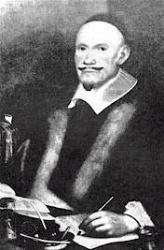
1598 - 1662 Person Name: Johann Crüger, 1598-1662 Topics: Community in Christ Composer of "NUN DANKET ALLE GOTT" in Evangelical Lutheran Worship Johann Crüger (b. Grossbriesen, near Guben, Prussia, Germany, 1598; d. Berlin, Germany, 1662) Crüger attended the Jesuit College at Olmutz and the Poets' School in Regensburg, and later studied theology at the University of Wittenberg. He moved to Berlin in 1615, where he published music for the rest of his life. In 1622 he became the Lutheran cantor at the St. Nicholas Church and a teacher for the Gray Cloister. He wrote music instruction manuals, the best known of which is Synopsis musica (1630), and tirelessly promoted congregational singing. With his tunes he often included elaborate accompaniment for various instruments. Crüger's hymn collection, Neues vollkomliches Gesangbuch (1640), was one of the first hymnals to include figured bass accompaniment (musical shorthand) with the chorale melody rather than full harmonization written out. It included eighteen of Crüger's tunes. His next publication, Praxis Pietatis Melica (1644), is considered one of the most important collections of German hymnody in the seventeenth century. It was reprinted forty-four times in the following hundred years. Another of his publications, Geistliche Kirchen Melodien (1649), is a collection arranged for four voices, two descanting instruments, and keyboard and bass accompaniment. Crüger also published a complete psalter, Psalmodia sacra (1657), which included the Lobwasser translation set to all the Genevan tunes.
Bert Polman
===============================
Crüger, Johann, was born April 9, 1598, at Gross-Breese, near Guben, Brandenburg. After passing through the schools at Guben, Sorau and Breslau, the Jesuit College at Olmütz, and the Poets' school at Regensburg, he made a tour in Austria, and, in 1615, settled at Berlin. There, save for a short residence at the University of Wittenberg, in 1620, he employed himself as a private tutor till 1622. In 1622 he was appointed Cantor of St. Nicholas's Church at Berlin, and also one of the masters of the Greyfriars Gymnasium. He died at Berlin Feb. 23, 1662. Crüger wrote no hymns, although in some American hymnals he appears as "Johann Krüger, 1610,” as the author of the supposed original of C. Wesley's "Hearts of stone relent, relent" (q.v.). He was one of the most distinguished musicians of his time. Of his hymn tunes, which are generally noble and simple in style, some 20 are still in use, the best known probably being that to "Nun danket alle Gott" (q.v.), which is set to No. 379 in Hymns Ancient & Modern, ed. 1875. His claim to notice in this work is as editor and contributor to several of the most important German hymnological works of the 16th century, and these are most conveniently treated of under his name. (The principal authorities on his works are Dr. J. F. Bachmann's Zur Geschichte der Berliner Gesangbücher 1857; his Vortrag on P. Gerhard, 1863; and his edition of Gerhardt's Geistliche Lieder, 1866. Besides these there are the notices in Bode, and in R. Eitner's Monatshefte für Musik-Geschichte, 1873 and 1880). These works are:—
1. Newes vollkömmliches Gesangbuch, Augspur-gischer Confession, &c, Berlin, 1640 [Library of St. Nicholas's Church, Berlin], with 248 hymns, very few being published for the first time.
2. Praxis pietatis melica. Das ist: Ubung der Gottseligkeit in Christlichen und trostreichen Gesängen. The history of this, the most important work of the century, is still obscure. The 1st edition has been variously dated 1640 and 1644, while Crüger, in the preface to No. 3, says that the 3rd edition appeared in 1648. A considerable correspondence with German collectors and librarians has failed to bring to light any of the editions which Koch, iv. 102, 103, quotes as 1644, 1647, 1649, 1650, 1651, 1652, 1653. The imperfect edition noted below as probably that of 1648 is the earliest Berlin edition we have been able to find. The imperfect edition, probably ix. of 1659, formerly in the hands of Dr. Schneider of Schleswig [see Mützell, 1858, No. 264] was inaccessible. The earliest perfect Berlin edition we have found is 1653.
The edition printed at Frankfurt in 1656 by Caspar Röteln was probably a reprint of a Berlin edition, c. 1656. The editions printed at Frankfurt-am-Main by B. C. Wust (of which the 1666 is in the preface described as the 3rd) are in considerable measure independent works.
In the forty-five Berlin and over a dozen Frankfurt editions of this work many of the hymns of P. Gerhardt, J. Franck, P. J. Spener, and others, appear for the first time, and therein also appear many of the best melodies of the period.
3. Geistliche Kirchen-Melodien, &c, Leipzig, 1649 [Library of St. Katherine's Church, Brandenburg]. This contains the first stanzas only of 161 hymns, with music in four vocal and two instrumental parts. It is the earliest source of the first stanzas of various hymns by Gerhardt, Franck, &c.
4. D. M. Luther's und anderer vornehmen geisU reichen und gelehrten Manner Geistliche Lieder und Psalmen, &c, Berlin, 1653 [Hamburg Town Library], with 375 hymns. This was edited by C. Runge, the publisher, and to it Crüger contributed some 37 melodies. It was prepared at the request of Luise Henriette (q.v.), as a book for the joint use of the Lutherans and the Re¬formed, and is the earliest source of the hymns ascribed to her, and of the complete versions of many hymns by Gerhardt and Franck.
5. Psalmodia Sacra, &c, Berlin, 1658 [Royal Library, Berlin]. The first section of this work is in an ed. of A. Lobwasser's German Psalter; the second, with a similar title to No. 4, and the date 1657, is practically a recast of No. 4,146 of those in 1653 being omitted, and the rest of the 319 hymns principally taken from the Praxis of 1656 and the hymn-books of the Bohemian Brethren. New eds. appeared in 1676, 1700, 1704, 1711, and 1736.
[Rev. James Mearns, M.A.]
-- Excerpt from John Julian, Dictionary of Hymnology (1907)
=======================
Crüger, Johann, p. 271, ii. Dr. J. Zahn, now of Neuendettelsau, in Bavaria, has recently acquired a copy of the 5th ed., Berlin, 1653, of the Praxis.
--John Julian, Dictionary of Hymnology, Appendix, Part II (1907)
Johann Crüger
Henri F. Hemy
1818 - 1888 Person Name: Henri Frederick Hemy Topics: Church Community in Christ Composer of "ST CATHERINE" in Voices United Henri F. Hemy, born in the United Kingdom. Hemy spent time at sea as a young man, emigrating to Australia in 1850 with his family. Unable to make a decent living in Melbourne, he returned to Newcastle England. He was organist at St. Andrews Roman Catholic Church in Newcastle, later teaching professor of music at Tynemouth and at St. Cuthbert's College in Durham. He was pianist to Lord Ravensworth, Music Director of Ushaw College, and his orchestra played at fashionable venues in the region. He sang baritone as well. He composed waltzes, polkas, quadrilles, and galops. 3 music works: Easy Hymn Tunes for Catholic Schools; Royal Modern Tutor for Pianoforte; Crown of Jesus. He was active in local politics and published a manifesto in the daily newspaper. He lost a ward election. He also painted artwork. He set most of Longfellow's works to music.
John Perry
Henri F. Hemy
A. J. Showalter
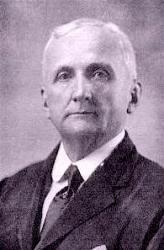
1858 - 1924 Person Name: Anthony J. Showalter, 1858-1924 Topics: Community in Christ Composer of "SHOWALTER" in Evangelical Lutheran Worship Anthony Johnson Showalter USA 1858-1924/ Born in Cherry Grove, VA, he became an organist, gospel music composer, author, teacher, editor, and publisher. He was taught by his father and in 1876 received training at the Ruebush-Kieffer School of Music, Dayton, VA. He also attended George Root’s National Normal school at Erie, PA, and Dr Palmer’s International Normal at Meadville, PA. He was teaching music in shape note singing schools by age 14. He taught literary school at age 19, and normal music schools at age 22, when he also published his first book. In 1881 he married Lucy Carolyn (Callie) Walser of TX, and they had seven children: Tennie, Karl, Essie, Jennie, Lena, Margaret, and Nellie. At age 23 he published his “Harmony & composition” book, and years later his “Theory of music”. In 1884 he moved to Dalton, GA, and in 1890 formed the Showalter Music Company of Dalton. His company printed and published hymnals, songbooks, schoolbooks, magazines, and newspapers, and had offices in Texarkana, AR, and Chattanooga, TN. In 1888 he became a member of the M T N A (Music Teachers National Association) and was vice-president for his state for several years. In 1895 he went abroad to study methods of teachers and conductors in Europe. He held sessions of his Southern Normal Music Institute in a dozen or more states. He edited “The music teacher & home magazine” for 20 years. In 1895 he issued his “New harmony & composition” book. He authored 60+ books on music theory, harmony, and song. He published 130+ music books that sold over a million copies. Not only was he president of the A J Showalter Music Company of Dalton, GA, but also of the Showalter-Patton Company of Dallas, TX, two of the largest music publishing houses in the American south. He was a choir leader and an elder in the First Presbyterian Church in Dalton (and his daughter, Essie, played the organ there). He managed his fruit farm, looking after nearly 20,000 trees , of which 15,000 are the famous Georgia Elberta peaches, the rest being apples, plums, pecans, and a dozen other varieties of peaches. He was also a stockholder and director of the Cherokee Lumber Company of Dalton, GA, furnishing building materials to a large trade in many southern, central and eastern states. He died in Chattanooga, TN, and is buried in Dalton, GA. He loved hymns, and kept up with many of his students over the years, writing them letters of counsel and encouragement. In 2000 Showalter was inducted into the Southern Gospel Music Hall of Fame.
Note: Showalter received two letters one evening from former music students, both of who were grieving over the death of their wives. He had heard a sermon about the arms of Moses being held up during battle, and managed to form a tune and refrain for a hymn, but struggled to find words for the verses that fit. He wrote to his friend in OH, Rev Elisha Hoffman, who had already composed many hymns and asked if he could write some lyrics, which he gladly did.
John Perry
A. J. Showalter
Martin Rinckart
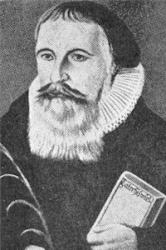
1586 - 1649 Person Name: Martin Rinkhart, 1586-1649 Topics: Community in Christ Author of "Now Thank We All Our God" in Evangelical Lutheran Worship Rinkart, Martin, son of Georg Rinkart or Rinckart, cooper at Eilenburg on the Mulde, Saxony, was born at Eilenburg, April 23, 1586.* After passing through the Latin school at Eilenburg, he became, in Nov., 1601, a foundation scholar and chorister of the St. Thomas's School at Leipzig. This scholarship also allowed him to proceed to the University of Leipzig, where he matriculated for the summer session of 1602, as a student of Theology; and after the completion of his course he remained for some time in Leipzig (he did not take his M.A. till 1616). In March 1610 he offered himself as a candidate for the post of diaconus at Eilenburg, and was presented by the Town Council, but the Superintendent refused to sanction this arrangement, nominally on the ground that Rinkart was a better musician than theologian, but really because he was unwilling to have a colleague who was a native of Eilenburg, and who appeared to have a will of his own. Rinkart, not wishing to contest the matter, applied for a vacant mastership in the gymnasium at Eisleben, and entered on his duties there in the beginning of June, 1610, as sixth master, and also cantor of the St. Nicholas Church. After holding this appointment for a few months, he became diaconus of St. Anne's Church, in the Neustadt of Eisleben, and began his work there May 28, 1611; and then became pastor at Erdeborn and Lyttichendorf (Lütjendorf), near Eisleben, entering on his duties there on Dec. 5, 1613. Finally he was invited by the Town Council of Eilenburg to become archidiaconus there, and in Nov. 1617 came into residence at Eilenburg. He died at Eilenburg, Dec. 8, 1649. A memorial tablet to his memory, affixed to the house where he lived, was unveiled at Eilenburg on Easter Monday, April 26, 1886. (Martin Rinkart’s Geistliche Lieder, ed., with a biographical introduction, and an extensive bibliography, by Heinrich Rembe and Johannes Linke, D.D., Gotha, F. A. Perthes, 1886; K. Goedeke's Grundris, vol. iii., 1887, pp. 169, 211, &c.)
The greater part of Rinkart's professional life was passed amid the horrors of the Thirty Years War. Eilenburg being a walled town became a refuge for fugitives from all around, and being so overcrowded, not unnaturally suffered from pestilence and famine. During the great pestilence of 1637 the Superintendent went away for change of air, and could not be persuaded to return; and on Aug. 7 Rinkart had to officiate at the funerals of two of the town clergy and two who had had to leave their livings in the country. Rinkart thus for some time was the only clergyman in the place, and often read the service over some 40 to 50 persons a day, and in all over about 4,480. At last the refugees had to be buried in trenches without service, and during the whole epidemic some 8,000 persons died, including Rinkart's first wife, who died May 8, 1637. The next year he had an epidemic of marriages to encounter, and himself fell a victim on June 24. Immediately thereafter came a most severe famine, during which Rinkart's resources were strained to the uttermost to help his people. Twice also he saved Eilenburg from the Swedes, once in the beginning of 1637, and again in 1639 (see p. 319, i.). Unfortunately the services he rendered to the place seemed to have made those in authority the more ungrateful, and in his latter years he was much harassed by them in financial and other matters, and by the time that the long-looked-for peace came (Oct. 24, 1648) he was a worn-out and prematurely aged man.
Rinkart was a voluminous writer and a good musician, but a considerable number of his books seem to have perished, and others survive only in single copies. He early began to write poetry, and was crowned as a poet apparently in 1614. Among other things he wrote a cycle of seven so-called "Comedies," or rather dramas, on the Reformation Period, suggested by the centenary of the Reformation in 1617. Three of these were printed respectively in 1613, 1618, and 1625, and two of them were acted in public. Rinkart's hymns appeared principally in the following works:—
(1) Jesu Hertz-Büchlein. This was completed in 1630, and first published at Leipzig in 1636. No copy is now known. The second edition, published at Leipzig, 1663, is in the Royal Library at Hannover. (2) Der Meissnische Thränen Saat, Leipzig, 1637. In the Royal Library at Berlin. (3) xlv. Epithalami Salomoneo—Sulamitici cantica canticorum . . . Leibliche Geistliche und Uimmlische Braut Messe, Leipzig, 1642. In Wolfenbüttel Library. (4) Catechismus-wolthaten, und Catechismus-Lieder, Leipzig, 1645. In the Berlin Library.
Dr. Linke, 1886, as above, gives a list of the first lines of all the hymns in the works of Rinkart which have come under his notice, and prints a selection from them, including 66 in all. The best of them are characterised by a true patriotism, a childlike devotion to God, and a firm confidence in God's mercy, and His promised help and grace. A few passed into the German hymn-books. Those which have been translated into English are:—
1. Alleluja, Lob, Preis und Ehr. This hymn… seems to be based on two hymns, beginning with the same first line, and both found in Rinkart's Braut Messe, 1642. Dr. Linke does not print the full text. (See Blätter für Hymnologie, 1886, p. 91.)
ii. Nun danket alle Gott. Thanksgiving. The oldest text now accessible is in J. Crüger's Praxis, 1648, No. 183, in 3 stanzas of 8 lines; also in the Crüger-Runge Gesang-Buch, 1653, No. 187. It is also in Rinkart's Jesu Hertz-Büchlein, 1663, where the text slightly varies, and is entitled "Grace" ("Tisch-Gebetlein," i.e. a short prayer at table). There does not seem any good reason for supposing that it did not appear in the first ed., 1636, of the Hertz-Büchlein, and in any case it has no connection with the Peace of Westphalia. (A good specimen of the way in which stories of hymns are manufactured is in the Sunday at Home, Aug., 1888, p. 539, where a full and particular account is given of its legendary origin in Nov. 1648.) It is founded on Ecclesiasticus 1. 22-24; and st. i., ii. are indeed little more than a paraphrase of these verses, st. iii. being a version of the Gloria Patri. The fact that the regimental chaplains, when holding the special service of thanksgiving for the conclusion of the peace, were commanded to preach from this passage, may have suggested the theory that Rinkart's hymn was written for the same occasion. It gradually came into general use, successfully survived the period of Rationalism, and is now to be found in every German hymnbook, e.g. in the Berlin Geistliche Lieder, ed. 1863, No. 1022. It may be called the German Te Deum, and as such is used at all national festivals or special occasions of thanksgiving. It was recently used at the festal celebration of the completion of Cologne Cathedral, on Aug. 14, 1880, at the laying of the foundation stone of the new Reichstags building in Berlin, by the Emperor William, June 9, 1884, &c.
The fine melody (set to the hymn in Hymns Ancient & Modern and most recent English collections) appears in the Praxis, 1648 (Crüger's Kirchenmelodien, 1649, No. 94), and in the Crüger-Runge Gesang-Buch, 1653, is marked with Crüger's initials. It has been described as adapted from a melody by Lucas Marenzo (choirmaster at Rome, who died 1598), or as adapted from a motet by Rinkart; but to prove either statement, very little evidence is forthcoming.
The translations of the hymn into English are:—
1. Let all men praise the Lord. This is a tr. of st. i., iii., by Alfred Novello, as part of his version of the word-book to Mendelssohn's Lobgesang, or Hymn of Praise, 1843, p. 89. This form has passed into a number of hymnals, including the New Congregational Hymn Book, 1859; Dale's English Hymn Book 1874, and others. In the Baptist Hymnal, 1879, a tr. of st. ii. is added, of which 11. 1—4 are from Miss Winkworth's translation.
2. Now praise the Lord on high. In full as No. 53 in the Dalston Hospital Hymn Book, 1848. This appears to be the version which Kübler, in his Historical Notes to the Lyra Germanica, 1865, p. 247, says was made by Baron C. K. J. von Bunsen, for the opening of the German Hospital at Dalston, on Oct. 15, 1845.
3. Now let us all to God. In full, by A. T. Russell, as No. 201, in his Psalms & Hymns, 1851.
4. 0 let us praise the Lord, From hearts by true love guided. This is No. 240 in the Winchester Church Hymn Book, 1857, and seems to be intended as a paraphrase of the German.
5. Now thank we all our God. A full and very good translation by Miss Winkworth, in her Lyra Germanica, 2nd Serv. 1858, p. 145, repeated in her Chorale Book for England, 1863, No. 11, and her Christian Singers, 1869, p. 181. It has been included in many recent English and American hymnals, e. g. Hymns Ancient & Modern, 1861; People's Hymnal, 1867; Congregational Hymnal, 1887, &c, and in America in the Episcopal Hymnal, 1871; Presbyterian Hymnal, 1874, and many others, generally in full and unaltered.
6. Now all give thanks to God. In full as No. 264 in the Anglican Hymn Book, 1868 (1871, No. 307), marked as a versification by R. C. Singleton. Repeated in J. L. Porter's Collection, 1876.
7. Now all men thank ye God. In full by T. E. Brown, as No. 37 in the Clifton College Hymn Book, 1872.
Other translations are:—
(l) "Now let us praise the Lord." In full by J. C. Jacobi, 1722, p. 85 (1732, p. 144), repeated, altered, in the Moravian Hymn Book, 1754 to 1886. (2) "Now all, to God give thanks." By Dr. H. Mills, in the Evangelical Review, Gettysburg, 1851, p. 293, and his Horae Germanica, 1856, p. 14. (3) "Lift heart, and hands, and voice." By Miss Cox, 1864, p. 239. (4) “Now all give thanks to God." By J. D. Burns, 1869, p. 252. (5) “All hearts and tongues and hands." By N. L. Frothingham, 1870, p. 212.
iii. So fahr ich hin mit Freuden. For the Dying. In his Meissnische Thränen-Saat, 1637, No. 24, p. 19, in 5 st.anzas of 8 lines, entitled "Even the same, and her soul-rejoicing Farewell Hymn. On May 8." St. i. is,
"So fahr ich hin mit Frewden
Aus diesem Jammerthal,
Aus Angst, Gefahr und Leiden
In Himmels-Frewden Saal,
Da wir und alle Frommen
Durch Gottes Wundermacht
Zusaminen wiederkominen:
In des zu guter Nacht."
The title refers to the preceding hymn, which is in 19 stanzas, the initials of the stanzas forming the acrostic Christina Rinckardi. Dr. Linke abridges it and misprints the title, which is:—
"Die Teutsche Jobs-Schwester (Christina M. Rinckart's Hertzgetrewe Ehe- und Creutz-genossin) und ihr Tagliches und behägliches Trost Lied. Aus ihrem längst erwählten und am 10. [not 30] Tage des Trosthühlen Meyen dieses 1637. Jahres zum letzten Ehrengedächtniss abgehandelten Leich-Text: des 77. Psalms."
From this it is clear that both hymns are in memory of his wife, that she died on May 8, 1637, and that her funeral sermon was preached by her husband on May 10, 1637. The form translation into English is the greatly altered, or rather practically new text. [Rev. James Mearns, M.A.]
* His own statement was that he “was born Anno 1586, Jubilate Sunday, on St. George's day, which was the 23rd of April, between 6 and 7 a.m." In 1586 however Jubilate S. (3rd Sunday after Easter) fell on April 24, while St. George's day is April 23. The entry in the Registers at Eilenburg says that he was baptised "Monday after Jubilate, the 25th of April," which is quite correct.
--John Julian, Dictionary of Hymnology (1907)
Martin Rinckart
Thomas Haweis
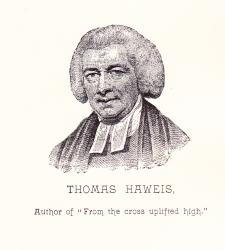
1734 - 1820 Person Name: Thomas Haweis, 1734-1820 Topics: Church--Community in Christ Author of "Our Children, Lord in Faith and Prayer" in Moravian Book of Worship Thomas Haweis (b. Redruth, Cornwall, England, 1734; d. Bath, England, 1820) Initially apprenticed to a surgeon and pharmacist, Haweis decided to study for the ministry at Oxford and was ordained in the Church of England in 1757. He served as curate of St. Mary Magdalen Church, Oxford, but was removed by the bishop from that position because of his Methodist leanings. He also was an assistant to Martin Madan at Locke Hospital, London. In 1764 he became rector of All Saints Church in Aldwinkle, Northamptonshire, and later served as administrator at Trevecca College, Wales, a school founded by the Countess of Huntingdon, whom Haweis served as chaplain. After completing advanced studies at Cambridge, he published a Bible commentary and a volume on church history. Haweis was strongly interested in missions and helped to found the London Mission Society. His hymn texts and tunes were published in Carmino Christo, or Hymns to the Savior (1792, expanded 1808).
Bert Polman
============================
Haweis, Thomas, LL.B., M.D., born at Truro, Cornwall, 1732. After practising for a time as a Physician, he entered Christ's College, Cambridge, where he graduated. Taking Holy Orders, he became Assistant Preacher to M. Madan at the Lock Hospital, London, and subsequently Rector of All Saints, Aldwincle, Northamptonshire. He was also Chaplain to Lady Huntingdon, and for several years officiated at her Chapel in Bath. He died at Bath, Feb. 11, 1820. He published several prose works, including A History of the Church, A Translation of the New Testament, and A Commentary on the Holy Bible. His hymns, a few of which are of more than ordinary merit, were published in his
Carmina Christo; or, Hymns to the Saviour. Designed for the Use and Comfort of Those who worship the Lamb that was slain. Bath, S. Hayward, 1792 (139 hymns), enlarged. London, 1808 (256 hymns). In 1794, or sometime after, but before the enlarged edition was published, two hymns "For the Fast-day, Feb. 28, 1794," were added to the first edition. These were, "Big with events, another year," and "Still o'er the deep the cannon's roar."
The most popular and widely used of his hymns are, "Behold the Lamb of God, Who bore," &c.; "Enthroned on high, Almighty Lord"; and “O Thou from Whom all goodness flows." The rest, all being from Carmina Christo, first edition 1792, are:—
1. Dark was the night and cold the ground. Gethsemane.
2. From the cross uplifted high. Christ in Glory.
3. Great Spirit, by Whose mighty power. Whitsuntide.
4. Submissive to Thy will, my God. Resignation.
5. The happy morn is come. Easter.
6. Thou Lamb of God, that on the tree. Good Friday. The hymn, "Thy Head, the crown of thorns that wears," in Stryker & Main's Church Praise Book, N. Y., 1882, begins with st. ii. of this hymn.
7. To Thee, my God and Saviour, My heart, &c. Praise for Redemption.
--John Julian, Dictionary of Hymnology (1907)
Thomas Haweis
David Gambrell
Topics: Community in Christ Author of "Jesus, Light of Joy" in Glory to God Rev. David Gambrell is associate for worship in the PC(USA) Office of Theology
and Worship and editor of Call to Worship, and an ex officio advisor to the hymnal committee.
Education: Ph.D., liturgical studies
Garrett-Evangelical Theological Seminary
Austin Presbyterian Theological Seminary
--www.presbyterianmission.org/ministries
David Gambrell
Doreen Potter
1925 - 1980 Person Name: Doreen Potter, 1925-1980 Topics: Community in Christ Adapter of "LINSTEAD" in Evangelical Lutheran Worship Doreen Potter was born in 1925 in Panama, but lived in Jamaica during her childhood. She studied music at St. Katharine's College in Liverpool, UK and at Trinity College, London. She was a violinist, pianist, and teacher. She married Philip Potter, general secretary of the World Council of Churches in Geneva. Through her husband she met Fred Kaan and composed tunes for Kaan's texts, as well as other hymn tunes.
Dianne Shapiro, from biography published by Hope Publishing Company (accessed online 8/5/2020)
Doreen Potter
Andrew Donaldson
b. 1951 Person Name: Andrew Donaldson, b. 1951 Topics: Community in Christ; Community in Christ Author of "Although I Speak with Angel's Tongue" in Evangelical Lutheran Worship Andrew Donaldson, a composer and church musician, grew up in northern Ontario, Canada. He attended Glendon College, York University in Toronto, receiving a Bachelor of Arts degree in 1974. He went on to study classical guitar performance at the Royal Conservatory of Music in Toronto, receiving its ARCT (Associate of Royal Conservatory Teachers) degree in 1979. Since then he has worked as a composer and performer in many contexts, in both French and English.
Andrew co-edited the Book of Praise (1997), Presbyterian Church in Canada, with Donald Anderson. Their company, Binary Editions, continues to administer copyright for the PCC.
In 2007 he was made a Doctor of Divinity, honoris causa, by Knox College of the University of Toronto, for his body of work in congregational song in the Presbyterian Church in Canada.
In 2011 Andrew and his wife, Wendy, moved to Geneva, Switzerland where Andrew works as a worship consultant to the World Council of Churches.
--Submitted by Andrew and Wendy Donaldson, 13 August 2013
Andrew Donaldson
A. T. Olá Olude
1908 - 1980 Person Name: A. T. Olajide Olude Topics: Church--Community in Christ Composer of "JESU A FE PADE" in Moravian Book of Worship Revd. (Dr.) Abraham Taiwo Olajide OLUDE was born at Abeokuta on July 16, 1908, to the family of Chief & Mrs. Joseph Sotayo Olude of Ikereku-Ikija, Abeokuta, Nigeria. He had his primary education at Ikereku Anglican Primary School, Abeokuta and later at Agbeni Methodist School, Ibadan. In 1921, he enrolled at Wesley College, Ibadan, where he distinguished himself as a brilliant scholar and a keen sportsman. He obtained the then Junior Cambridge Certificate and successfully completed the Sub-Pastor’s course in 1925. He remained at the same College till 1934 when he passed out as a full fledge Minister of Religion and was eventually ordained a Methodist Minister in 1938. He served the Church at various location both within the Northern and Southern parts of the country and was at a time, the Chairman of the Western Nigeria District of the old Methodist Church.
He was a musician of great repute, a highly prolific writer and composer, who along with his pastoral responsibilities, composed several melodious songs and folklore tunes in his native dialect – Yoruba. He was convinced that the Great Commission was easier achieved through musical compositions using the native language and available musical instruments of talking drums, flutes, etc, as accompaniments. A number of such local gospel songs and melodies, he incorporated in his much sort-after songbooks –“MAYOKUN, IYE ati IYIN, - folklore tunes, composed to suit various occasions, times and seasons.” These became the arrow-head and vehicle utilized in propagating the Word of God and his other Ministry at large. Among his small court of admirers and friends were the likes of Dr. Fela Sowande, the world-acclaimed musicologist of is time, who in no small measure greatly assisted Revd. Olude in attaining both national and international recognition. Others included erudite organists like Sir. M. O. Ajose, Messrs. Olaoluwa Omideyi, T. A. Bankole and G. Pope Dopemu – the young organist of the ‘Mayokun Musical Party’ with which Rev. A. T. Olude carried out his scriptural and musical crusades across the nation
Revd. A. T. Olude was accorded the National honour of the Member of the Order of Niger- (M.O.N) in 1965 and honorary Doctorate Degree in Music by the University of Ife on May 15. 1967 – Both, awards in recognition of his great efforts at promoting indigenous Yoruba Church Music in Nigeria. Along his musical composition, he published other powerful prayer books which greatly assist – (i) relieving the heart of stress and the fears associated with daily living, and (ii) lifting up the soul in penitence and thanksgiving to God. These titles are:
• So fun Jesu
• Ipin Ayo l’oni
• Ase L’oruko Oluwa
On May 30 1980, this great soldier of the cross finally breathed his last to join the Church Triumphant. His body was buried in Lagos. In his memory, the Conference of the Methodist Church of Nigeria in 1992, posthumously awarded him, the Knighthood of Charles Wesley (KCW) , in appreciation of his laudable contributions to the growth and development of indigenous Sacred music in Nigeria and in particular, the Methodist Church.
Wale Ogunbekun, with information provided by Olude's son
A. T. Olá Olude
Pages




