You help make Hymnary.org possible. More than 10 million people from 200+ countries found hymns, liturgical resources and encouragement on Hymnary.org in 2025, including you. Every visit affirms the global impact of this ministry.

If Hymnary has been meaningful to you this year, would you take a moment today to help sustain it? A gift of any size—paired with a note of encouragement if you wish—directly supports the server costs, research work and curation that keep this resource freely available to the world.

Give securely online today, or mail a check to:
Hymnary.org
Calvin University
3201 Burton Street SE
Grand Rapids, MI 49546

Thank you for your partnership, and may the hope of Advent fill your heart.

Search Results

Topics:consecration+of+churches

Planning worship? Check out our sister site, ZeteoSearch.org, for 20+ additional resources related to your search.

Texts

text icon
Text authorities
TextPage scansFlexScoreFlexPresent

Spirit divine, attend our prayers

Author: A. Reed Meter: 8.6.8.6 Appears in 402 hymnals Topics: Consecration of Churches Lyrics: 1 Spirit divine, attend our prayers, And make this house Thy home; Descend with all Thy gracious powers, Oh, come, great Spirit, come! 2 Come as the light; to us reveal Our emptiness and woe: And lead us in those paths of life Where all the righteous go. 3 Come as the fire, and purge our hearts Like sacrificial flame; Let our whole soul an offering be To our Redeemer's Name. 4 Come as the dove, and spread Thy wings, The wings of peaceful love; And let Thy Church on earth become Blest as Thy Church above. 5 Spirit divine, attend our prayers; Make a lost world Thy home; Descend with all Thy gracious powers, Oh, come, great Spirit, come! Amen. Used With Tune: NOX PRAECESSIT
TextPage scans

Jesu! where'er Thy people meet

Author: W. Cowper Meter: 8.8.8.8 Appears in 526 hymnals Topics: Consecration of Churches Lyrics: 1 Jesu! where'er Thy people meet, There they behold Thy mercy-seat; Where'er they seek Thee, Thou art found, And ev'ry place is hallowed ground. 2 And since within no walls confined, Thou dwellest in the humble mind: Let all within Thy house who come, Departing, take Thee to their home. 3 Yet everywhere Thou guid'st Thine own To raise for Thee an earthly throne; And where Thy Name Thou dost record, There Thou wilt come and bless them, Lord! [4* Behold at Thy commanding word, We stretch the curtain and the cord; Come Thou and fill this wider space, And bless us with a large increase.] 5 Great Shepherd of Thy chosen few, Thy former mercies here renew; And here to wayward hearts proclaim The sweetness of Thy saving Name! 6 Here may we prove the might of prayer, To strengthen faith and sweeten care: To teach our faint desires to rise, And bring all heaven before our eyes! 7 Here to the babe new-born on earth, Grant Thou the newer, better birth; By water and the Holy Ghost Restoring all that Adam lost. 8 Here to the weary, hungry, soul, Give Thou the gift that maketh whole; The bread that is Christ's flesh, for food, The wine that is the Saviour's blood. 9 Lord, we are few, but Thou art near; Nor short Thine arm, nor deaf Thine ear; Oh, rend the heavens, come quickly down, And make a thousand hearts Thine own! Amen. * For enlargement of the Church Used With Tune: HEBRON
Page scans

With one consent let all the earth

Meter: 8.8.8.8 Appears in 181 hymnals Topics: Consecration of Churches and Chapels Used With Tune: OLD 100TH

Tunes

tune icon
Tune authorities
Audio

AUSTRIAN HYMN

Meter: 8.7.8.7 D Appears in 789 hymnals Composer and/or Arranger: Franz Joseph Haydn Topics: Aspiration and Consecration; The Living Church Family of Believers Tune Key: E Flat Major Incipit: 12324 32716 54323 Used With Text: We Are Called to Be God's People
Page scansFlexScoreAudio

NOX PRAECESSIT

Meter: 8.6.8.6 Appears in 122 hymnals Composer and/or Arranger: J. B. Calkin Topics: Consecration of Churches Incipit: 33312 33421 35431 Used With Text: Spirit divine, attend our prayers
FlexScoreAudio

MOZART

Meter: 7.7.7.7 Appears in 231 hymnals Composer and/or Arranger: Unknown; John T. Wilkinson Topics: The Church at Worship Profession of Faith, Ordination, Commissioning, Installation; Acceptance of Christ; Commissioning; Commitment; Confirmation; Consecration; Décision; Discipleship and Service; Installation Services; Jesus Christ Love For; Love; Love for God/Christ; Ministry; Obedience; Ordination; Stewardship; Surrender; Witness; Youth; Proper 16 Year A; Proper 24 Year A; Epiphany 2 Year B; Proper 13 Year B; Proper 19 Year B; Proper 20 Year B; Proper 23 Year B; Baptism of Jesus Year C; Epiphany 2 Year C; Epiphany 5 Year C; Epiphany 7 Year C; Lent 5 Year C; Proper 11 Year C; Proper 18 Year C; Proper 21 Year C; Proper 24 Year C; Thanksgiving Year C Tune Key: F Major Incipit: 11765 44353 54213 Used With Text: Take My Life and Let It Be

Instances

instance icon
Published text-tune combinations (hymns) from specific hymnals
Page scan

Christ is made the sure foundation

Author: J. M. Neale Hymnal: The Church Hymnal #483a (1898) Meter: 8.7.8.7.8.7 Topics: Consecration of Churches Tune Title: REGENT SQUARE
Page scan

Christ is made the sure foundation

Author: J. M. Neale Hymnal: The Church Hymnal #483b (1898) Meter: 8.7.8.7.8.7 Topics: Consecration of Churches Tune Title: CORNER-STONE
Page scan

Pleasant are Thy courts above

Author: H. F. Lyte Hymnal: The Church Hymnal #489a (1898) Meter: 7.7.7.7 D Topics: Consecration of Churches Tune Title: MAIDSTONE

People

person icon
Authors, composers, editors, etc.

John Darwall

1732 - 1789 Person Name: J. Darwall Topics: Consecration of Churches Composer of "DARWALL" in The Church Hymnal John Darwall (b. Haughton, Staffordshire, England, 1731; d. Walsall, Staffordshire, England, 1789) The son of a pastor, he attended Manchester Grammar School and Brasenose College, Oxford, England (1752-1756). He became the curate and later the vicar of St. Matthew's Parish Church in Walsall, where he remained until his death. Darwall was a poet and amateur musician. He composed a soprano tune and bass line for each of the 150 psalm versifications in the Tate and Brady New Version of the Psalms of David (l696). In an organ dedication speech in 1773 Darwall advocated singing the "Psalm tunes in quicker time than common [in order that] six verses might be sung in the same space of time that four generally are." Bert Polman

Samuel Sebastian Wesley

1810 - 1876 Topics: Consecration of a Church Composer of "AURELIA" in The Hymnal of the Protestant Episcopal Church in the United States of America 1940 Samuel Sebastian Wesley (b. London, England, 1810; d. Gloucester, England, 1876) was an English organist and composer. The grandson of Charles Wesley, he was born in London, and sang in the choir of the Chapel Royal as a boy. He learned composition and organ from his father, Samuel, completed a doctorate in music at Oxford, and composed for piano, organ, and choir. He was organist at Hereford Cathedral (1832-1835), Exeter Cathedral (1835-1842), Leeds Parish Church (1842­-1849), Winchester Cathedral (1849-1865), and Gloucester Cathedral (1865-1876). Wesley strove to improve the standards of church music and the status of church musicians; his observations and plans for reform were published as A Few Words on Cathedral Music and the Music System of the Church (1849). He was the musical editor of Charles Kemble's A Selection of Psalms and Hymns (1864) and of the Wellburn Appendix of Original Hymns and Tunes (1875) but is best known as the compiler of The European Psalmist (1872), in which some 130 of the 733 hymn tunes were written by him. Bert Polman

Ludwig van Beethoven

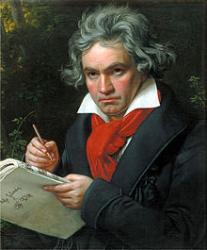
1770 - 1827 Person Name: Beethoven Topics: Consecration of Churches Composer of "GERMANY" in The Church Hymnal A giant in the history of music, Ludwig van Beethoven (b. Bonn, Germany, 1770; d. Vienna, Austria, 1827) progressed from early musical promise to worldwide, lasting fame. By the age of fourteen he was an accomplished viola and organ player, but he became famous primarily because of his compositions, including nine symphonies, eleven overtures, thirty piano sonatas, sixteen string quartets, the Mass in C, and the Missa Solemnis. He wrote no music for congregational use, but various arrangers adapted some of his musical themes as hymn tunes; the most famous of these is ODE TO JOY from the Ninth Symphony. Although it would appear that the great calamity of Beethoven's life was his loss of hearing, which turned to total deafness during the last decade of his life, he composed his greatest works during this period. Bert Polman
It looks like you are using an ad-blocker. Ad revenue helps keep us running. Please consider white-listing Hymnary.org or getting Hymnary Pro to eliminate ads entirely and help support Hymnary.org.