You help make Hymnary.org possible. More than 10 million people from 200+ countries found hymns, liturgical resources and encouragement on Hymnary.org in 2025, including you. Every visit affirms the global impact of this ministry.

If Hymnary has been meaningful to you this year, would you take a moment today to help sustain it? A gift of any size—paired with a note of encouragement if you wish—directly supports the server costs, research work and curation that keep this resource freely available to the world.

Give securely online today, or mail a check to:
Hymnary.org
Calvin University
3201 Burton Street SE
Grand Rapids, MI 49546

Thank you for your partnership, and may the hope of Advent fill your heart.

Search Results

Topics:constancy

Planning worship? Check out our sister site, ZeteoSearch.org, for 20+ additional resources related to your search.

Texts

text icon
Text authorities
TextPage scansFlexScoreFlexPresent

"Having done all, stand"

Author: George Duffield Appears in 1,884 hymnals Topics: Constancy First Line: Stand up!--stand up for Jesus! Lyrics: 1 Stand up!--stand up for Jesus! Ye soldiers of the cross; Lift high his royal banner, It must not suffer loss: From victory unto victory His army shall he lead, Till every foe is vanquished, And Christ is Lord indeed. 2 Stand up!--stand up for Jesus! The trumpet call obey; Forth to the mighty conflict, In this his glorious day: "Ye that are men, now serve him," Against unnumbered foes; Let courage rise with danger, And strength to strength oppose. 3 Stand up!--stand up for Jesus! Stand in his strength alone; The arm of flesh will fail you-- Ye dare not trust your own; Put on the gospel armor, And, watching unto prayer, Where duty calls, or danger, Be never wanting there. 4 Stand up!--stand up for Jesus! The strife will not be long; This day, the noise of battle, The next, the victor's song; To him that overcometh, A crown of life shall be; He with the King of glory Shall reign eternally! Scripture: Psalm 60:4 Used With Tune: WEBB
Page scans

Teach me, my God and King

Author: George Herbert; John Wesley Meter: 6.6.8.6 Appears in 269 hymnals Topics: Constancy Used With Tune: ST. ANDREW
Page scans

Awake, my soul, stretch every nerve

Author: Philip Doddridge Meter: 8.6.8.6 Appears in 1,076 hymnals Topics: Constancy Used With Tune: CHRISTMAS Text Sources: publ. 1755

Tunes

tune icon
Tune authorities
Page scansFlexScoreAudio

FAITHFULNESS

Meter: 11.10.11.10 with refrain Appears in 189 hymnals Composer and/or Arranger: William M. Runyan; Joachim Segger Topics: Constancy Tune Key: D Major Incipit: 33332 24444 36765 Used With Text: Great Is Thy Faithfulness
Page scansAudio

STUTTGART

Meter: 8.7.8.7 Appears in 455 hymnals Topics: Constancy Tune Sources: Psalmodia Sacra, Gotha, 1715; arr. Tune Key: F Major Incipit: 55112 23155 64253 Used With Text: God, My King, Thy Might Confessing
Page scansFlexScoreAudio

SPARROW

Meter: Irregular Appears in 128 hymnals Composer and/or Arranger: Charles H. Gabriel Topics: Constancy Tune Key: C Major Incipit: 56531 23456 11554 Used With Text: God's Eye Is on the Sparrow

Instances

instance icon
Published text-tune combinations (hymns) from specific hymnals
TextPage scan

"Shall we forget"

Author: William Mitchell Hymnal: Laudes Domini #195 (1888) Topics: Constancy First Line: Jesus! thy love shall we forget Lyrics: 1 Jesus! thy love shall we forget, And never bring to mind The grace that paid our hopeless debt, And bade us pardon find? 2 Shall we thy life of grief forget, Thy fasting and thy prayer; Thy locks with mountain vapors wet, To save us from despair? 3 Gethsemane can we forget-- Thy struggling agony When night lay dark on Olivet, And none to watch with thee? 4 Our sorrows and our sins were laid On thee, alone on thee; Thy precious blood our ransom paid-- Thine all the glory be! 5 Life's brightest joys we may forget-- Our kindred cease to love; But he who paid our hopeless debt, Our constancy shall prove. Scripture: Luke 22:44 Languages: English Tune Title: HELENA

We Who Would Valiant Be

Author: John Bunyan Hymnal: The New Century Hymnal #494 (1995) Meter: 6.5.6.5.6.6.6.5 Topics: Constancy Languages: English Tune Title: ST. DUNSTAN'S
TextPage scanAudioFlexScore

He Who Would Valiant Be

Author: John Bunyan Hymnal: Trinity Hymnal (Rev. ed.) #603 (1990) Meter: 6.5.6.5.6.6.6.5 Topics: Constancy Lyrics: 1 He who would valiant be 'gainst all disaster, let him in constancy follow the Master. There's no discouragement shall make him once relent his first avowed intent to be a pilgrim. 2 Who so beset him round with dismal stories, do but themselves confound– his strength the more is. No foes shall stay his might; though he with giants fight, he will make good his right to be a pilgrim. 3 Since, Lord, thou dost defend us with thy Spirit, we know we at the end shall life inherit. Then, fancies, flee away! I'll fear not what men say, I'll labor night and day to be a pilgrim. Scripture: Matthew 10:38 Languages: English Tune Title: ST. DUNSTAN'S

People

person icon
Authors, composers, editors, etc.

Jean Sibelius

1865 - 1957 Topics: Constancy Composer of "FINLANDIA" in The New Century Hymnal Johann Julius Christian [Jean] Sibelius DM Finland 1865-1957. Born at Hameenlinna, Finland, the son of a Swedish-speaking medical doctor, he lost his father to typhoid in 1868, leaving the family in substantial debt. His mother, again pregnant, had to sell their property and move in with her widowed mother. His aunt Julia gave him piano lessons when he was seven on the family upright piano, wrapping him on the knuckles when he played a wrong note. He learned to improvise as he played. His uncle, Pehr Ferdinand Sibelius, was interested in music, especially the violin, and gave Jean a violin when he was 10. As his musical advisor his uncle encouraged him to play and compose music. He played music with sister on piano, brother on cello, and himself on violin. He attended a Finnish-speaking prep school in 1874 and continued his education at the Hameenlinna Normal Lyceum thereafter. Jean also showed a strong interest in nature, frequently walking around the countryside when the family moved to the Loviisa coast for the summer months. In 1881 he took violin lessons from the local bandmaster, and developed a strong interest in violin. He became an accomplished player, and thought of becoming a virtuoso, but realizing he began study too late in life for that, instead opted to compose. He often played music in quartets with neighboring families, adding to his chamber music experience. He took the French form of his name, Jean. He studied law at the Imperial Alexander University in Finland, but showed far more interest in music. He then studied music at the Helsinki Music Institute (now Sibelius Academy) from 1885-1889. The school’s founder, Martin Wegelius, did much to support education development in Finland and gave Sibelius his first lessons in composition. Another teacher,,Ferruccio Busoni, a pianist-composer, helped him as well and became a life-long friend. Other friends, pianist Adolf Paul, and conductor-to-be, Armas Jarnefelt, also helped him. In 1892 he married Armas ‘s sister, Aino Jarnefelt, daughter of General Alexander Jarnefelt, governor of Vaasa. They had six daughters, Eva, Ruth, Kirsti, Katarina, Margareta, and Heidi. He continued his musical studies in Berlin (1889-1890) with Albert Becker, and in Vienna (1890-1891) with Robert Fuchs and Karl Goldmark. In Berlin he had opportunity to attend concerts and operas. In Vienna he turned to orchestral composition and had much success, although he had gallstone surgery during that period. He also traveled to the UK, France, Germany, and the USA during this time in his life, composing, conducting, and socializing. In 1892 he took on teaching assignments at the Music Institute and at Kajanus’s conducting school, but this left him with little time for composing. Sibelius’ works were more and more appreciated in Helsinki concert halls as he composed and conducted symphonies in the mid-1890s. In 1898 he was awarded a substantial grant, initially for 10 years, and later extended for life, allowing him to concentrate on composition. Much of his music became popular in Finland and in Germany. In 1899 he began work on his first symphony. It went well, but other patriotic music hehad composed did even better, since Russia was trying to restrict the powers of the Grand Duchy of Finland. In 1900 Sibelius went on an international tour with Kajanus and his orchestra, presenting his recent works. In 1901 he wrote his second symphony, which received rave reviews. He continued to compose as he became popular and well-known. In 1903 he had a new home built near Lake Tuusula north of Helsinki, calleed Ainola (after his wife). He gave concerts in and around Finland, spending more and more time away from home, to the chagrin of his wife. After a time he returned home and composed from there. He spent much time wining and dining in Helsinki, and it had a disastrous effect on his wife, who finally entered a sanitorium. He resolved again to give up drinking and concentrate on composing his 3rd symphony. He met Gustav Mahler in Helsinki and they became friends. He performed his 3rd symphony in St Petersburg, Russia. In 1907 he underwent a serious operation for suspected throat cancer, and spent time in the hospital in 1908. His smoking and drinking had now become life-threatening. He cancelled concerts for Rome, Warsaw, and Berlin, but kept one in London. His health deteriorated further, And his brush with death inspired him to compose his 4th symphony. In 1909 his successful throat operation resulted in renewed happiness for him and his wife, Aino. He continued conducting concerts, and met Claude Debussy, who further encouraged his musical efforts. He began working on his 4th symphony in 1910, but had to write other music to compensate for dwindling funds. He finished his 4th symphony in Berlin and conducted concerts in Sweden in 1911. In 1912 he completed short orchestral works. Over the next several years he continued producing a variety of pieces of music, well-received, especially in America. He was given an honorary DM degree from Yale University and also another from the University of Helsinki about the same time. WW1 interrupted his music royalties in 1915, and he was forced to compose smaller works for publication to make ends meet. He completed his 5th symphony at age 50, but he was dissatisfied with it and reworked it three times In 1917 he starting drinking again, triggering arguments with his wife. The Russian Revolution in 1917 caused an improvement in their personal relationship, and he wrote his ‘Jager March’ to celebrate Finnish independence from Russia. The next year the Finnish Civil War began, putting a damper on his march. In 1919, after the war, he completed his 6th symphony. In 1920 George Eastman , of Eastman Kodak, asked him to teach for a year in New York, but he declined. He did enjoy a trip conducting several concerts in England in 1921. He premiered his 6th symphony in 1923. In 1924 he completed his 7th symphony. The next year he composed a number of small pieces. He began drinking again. He did write a few more major works, but for the last thirty years of his life he avoided publicly talking about his music. He tried to write an 8th symphony, but was unsatisfied with it and burned the scores. In fact, he burned a laundry basket full of music he had written, to the chagrin of his wife. But, afterward, he became calmer and gradually had a lighter mood. In 1935 he was awarded the Goethe-Metal, with a certificate signed by Adolf Hitler. A Soviet invasion of Finland in 1939 was repelled, but Finland gave up territory to Russia as a result. In 1941 Sibelius and his wife returned to their Finland home, Ainola, after a long absence. He did not compose much the last few years, and died at Ainola. His wife outlived him by 12 years. John Perry

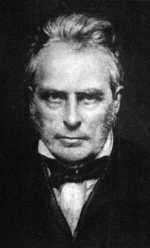
J. N. Darby

1800 - 1882 Person Name: John N. Darby Topics: Constancy Author of ""Faint, yet pursuing"" in Laudes Domini Darby, John Nelson, M.A., youngest son of John Darby of Leap, King's Co., Ireland, was born at Westminster, Nov. 18, 1800; educated at Trinity College, Dublin, where he graduated in 1819; and in due course was called to the Bar. He subsequently took Holy Orders; but in a short time allied himself with the Plymouth Brethren. In the exercise of his ministry amongst them he visited most parts of the world, and translated the Bible into English, French, and German. His published works, including a Synopsis of the Books of the Bible; Notes on Revelations, &c, are numerous. He died at Bournemouth, April 29, 1882. His hymns in common use are:— 1. Hark, ten thousand voices crying. The Second Advent anticipated. Praise. Appeared in Hymns for the Poor of the Flock, 1837, and repeated in Psalms and Hymns and Sacred Songs, Lend., Walther, 1842, and A Few Hymns, &c, 1856. It is also given in a few collections other than those for use amongst the “Brethren." 2. O Lord, thy love's unbounded, So sweet, &c. God's unchanging Love. Given in A Few Hymns, &c., 1856, No. 82, in 8 stanzas of 4 lines. Another hymn in the same collection, No. 85, begins with the same first line: "O Lord, Thy love's unbounded! So full, so vast, so free!" This is in 2 stanzas of 8 lines, and is attributed in the "S. MSS." to J. N. Darby, in common with the first. 3. Rest of the saints above. Heaven. In A Few Hymns, &c, 1856, No. 79, in 14 stanzas of 4 lines. 4. Rise, my soul, thy God directs thee. Divine Guidance. 1st published in Hymns for the Poor of the Flock, 1837; and again in Psalms and Hymns, 1842 (as above); and A Few Hymns, &c, 1856, in 10 stanzas of 41. It is also in Dr. Walker's Cheltenham Psalms and Hymns, 1855-1831. 5. This world is a wilderness wide. Following Christ. This is No. 139, in 8 stanzas of 4 lines, in A Few Hymns, &c, 1856. 6. Though faint, yet pursuing, we go on our way. Divine Strength and Defence. This hymn was given anonymously in the Baptist Psalms and Hymns, 1858, No. 558, in 5 stanzas of 8 lines. In the 1871 ed. of the same collection, it appeared as by "John N. Darby (?) 1861." Here we have a doubt and an error. The doubt is with respect to the authorship; and the error is in the date. A hymn published in 1858 cannot be accurately dated "1861." The evidence for the J. N. Darby authorship is most unsatisfactory. We can simply name it "Anon." All these hymns were published anonymously; and the ascriptions of authorship of 1-5 are given from the "S. MSS." The same manuscripts say that he edited the work above referred to: A Few Hymns and some Spiritual Songs, Selected, 1856, for the Little Flock. Lond. Groombridge & Sons. -- John Julian, Dictionary of Hymnology (1907) ================== Darby, John N. , p. 279, ii. Respecting the hymn "Though faint, yet pursuing, &c." (No. 6), Miller says in his Singers & Songs of the Church, 1869, p. 587, that Mr. Darby told him that he was not its author. --John Julian, Dictionary of Hymnology, Appendix, Part II (1907)

Samuel Webbe

1740 - 1816 Topics: Constancy Composer of "[MELCOMBE]" in The Hymnal Samuel Webbe (the elder; b. London, England, 1740; d. London, 1816) Webbe's father died soon after Samuel was born without providing financial security for the family. Thus Webbe received little education and was apprenticed to a cabinet­maker at the age of eleven. However, he was determined to study and taught himself Latin, Greek, Hebrew, French, German, and Italian while working on his apprentice­ship. He also worked as a music copyist and received musical training from Carl Barbant, organist at the Bavarian Embassy. Restricted at this time in England, Roman Catholic worship was freely permitted in the foreign embassies. Because Webbe was Roman Catholic, he became organist at the Portuguese Chapel and later at the Sardinian and Spanish chapels in their respective embassies. He wrote much music for Roman Catholic services and composed hymn tunes, motets, and madrigals. Webbe is considered an outstanding composer of glees and catches, as is evident in his nine published collections of these smaller choral works. He also published A Collection of Sacred Music (c. 1790), A Collection of Masses for Small Choirs (1792), and, with his son Samuel (the younger), Antiphons in Six Books of Anthems (1818). Bert Polman
It looks like you are using an ad-blocker. Ad revenue helps keep us running. Please consider white-listing Hymnary.org or getting Hymnary Pro to eliminate ads entirely and help support Hymnary.org.