You help make Hymnary.org possible. More than 10 million people from 200+ countries found hymns, liturgical resources and encouragement on Hymnary.org in 2025, including you. Every visit affirms the global impact of this ministry.

If Hymnary has been meaningful to you this year, would you take a moment today to help sustain it? A gift of any size—paired with a note of encouragement if you wish—directly supports the server costs, research work and curation that keep this resource freely available to the world.

Give securely online today, or mail a check to:
Hymnary.org
Calvin University
3201 Burton Street SE
Grand Rapids, MI 49546

Thank you for your partnership, and may the hope of Advent fill your heart.

Search Results

Topics:invocation

Planning worship? Check out our sister site, ZeteoSearch.org, for 20+ additional resources related to your search.

Texts

text icon
Text authorities
TextPage scansFlexScoreFlexPresent

Lord Jesus Christ, Be Present Now

Author: C. Winkworth, 1827-78 Meter: 8.8.8.8 Appears in 74 hymnals Topics: Invocation Lyrics: 1 Lord Jesus Christ, be present now, And let Thy Holy Spirit bow All hearts in love and fear today To hear the truth and keep Thy way. 2 Open our lips to sing Thy praise, Our hearts in true devotion raise, Our faith increase, our minds enlight That we may know Thy name aright 3 Until we join the host that cry "Holy art Thou, O Lord most High!" And 'mid the light of that blest place Shall gaze upon Thee face to face. 4 Glory to God, the Father, Son, And Holy Spirit, Three in One! To Thee, O blessed Trinity, Be praise throughout eternity! Used With Tune: HERR JESUS CHRIST, DICH ZU UNS WEND Text Sources: Lutherische Hand-Büchlein, 2nd ed., Altenburg, 1648
TextPage scansFlexScoreFlexPresent

This Is the Day the Lord Hath Made

Author: I. Watts, 1674-1748 Meter: 8.6.8.6 Appears in 605 hymnals Topics: Invocation Lyrics: 1 This is the day the Lord hath made; He calls the hours His own, Let heav'n rejoice, let earth be glad And praise surround the throne. 2 Today He rose and left the dead, And Satan's empire fell; Today the saints His triumphs spread And all His wonders tell. 3 Hosanna to th'anointed King, To David's holy Son! Help us, O Lord; descend and bring Salvation from the throne. 4 Blest be the Lord, who comes to men With messages of grace, Who comes in God His Father's Name To save our sinful race. 5 Hosanna in the highest strains The Church on earth can raise; The highest heav'ns in which He reigns Shall give Him nobler praise. Scripture: Psalm 118 Used With Tune: NUN DANKET ALL

Sweet the Time, Exceeding Sweet

Author: George Burder, 1752-1832 Appears in 103 hymnals Topics: Invocation Scripture: Psalm 50:5-6 Used With Tune: HENDON

Tunes

tune icon
Tune authorities
Audio

INVOCATION

Appears in 30 hymnals Topics: Invocation Tune Sources: Old Tune. Tune Key: G Major Incipit: 11112 32355 3211 Used With Text: Lord, We Come Before Thee Now
Audio

SLANE

Meter: 10.11.11.12 Appears in 285 hymnals Composer and/or Arranger: Jack Schrader, 1942- Topics: Invocation Tune Sources: Irish folk melody Tune Key: E Flat Major Incipit: 11216 56112 32222 Used With Text: Gather Your Children
Page scansAudio

FARRANT

Appears in 143 hymnals Composer and/or Arranger: R. Farrant Topics: Prayer and Invocation Incipit: 11232 14223 45545 Used With Text: Prayer is the breath of God in man

Instances

instance icon
Published text-tune combinations (hymns) from specific hymnals

Eternal God, before Your Thone

Author: Ernest E. Ryden, 1886-1981 Hymnal: Lutheran Book of Worship #354 (1978) Meter: 10.10.10.10.10.10 Topics: Invocation First Line: Eternal God, before your throne we bend Languages: English Tune Title: INVOCATION

Lord, We Come Before Thee Now

Author: William Hammond, 1719-1783 Hymnal: Hymns of the Saints #10 (1982) Topics: Invocation Scripture: Isaiah 26:3-4 Languages: English Tune Title: INVOCATION
Page scan

Come, thou almighty King

Author: Anonymous Hymnal: Hymns for Christian Devotion #2 (1871) Meter: Irregular Topics: Invocation; Solemn Invocation Languages: English

People

person icon
Authors, composers, editors, etc.

Theodore Baker

1851 - 1934 Person Name: Theodore Baker, 1851-1914 Topics: Invocation Translator of "We Gather Together" in Hymns of the Saints Theodore Baker (b. New York, NY, 1851; d. Dresden, Germany, 1934). Baker is well known as the compiler of Baker's Biographical Dictionary of Musicians (first ed. 1900), the first major music reference work that included American composers. Baker studied music in Leipzig, Germany, and wrote a dissertation on the music of the Seneca people of New York State–one of the first studies of the music of American Indians. From 1892 until his retirement in 1926, Baker was a literary editor and translator for G. Schirmer, Inc., in New York City. In 1926, he returned to Germany. Psalter Hymnal Handbook, 1987

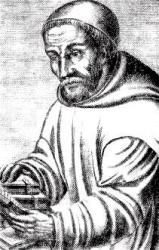
Rabanus Maurus

776 - 856 Person Name: Rhabanus Maurus, 776-856 Topics: Invocation Author (attributed to) of "Come, Holy Ghost, Creator Blest" in Evangelical Lutheran Hymnary Rabanus Maurus (c. 776-856) or Hrabanus Magnentius Maurus, was born of noble parents at Mainz, and educated at Fulda and Tours under Alcuin, who is reputed to have given him the surname, Maurus, after the saint of that name. In 803, he became director of the school at the Benedictine Abbey at Fulda. He was ordained priest in 814, spending the following years in a pilgrimage to Palestine. In 822, he became Abbott at Fulda, retiring in 842. In 847, he became archbishop of Mainz. He died at Winkel on the Rhine, February 4, 856. This distinguished Carolingian poet-theologian wrote extensive biblical commentaries, the Encyclopaedic De Universo, De Institutione Clericorum, and other works which circulated widely during the Middle Ages. Some of his poems, with English translations, are in Helen Waddell's Mediaeval Latin Lyrics. He is the author of: O Come, Creator Spirit, come Christ, the fair glory of the holy angels Come, Holy Ghost, our souls inspire Come, Holy Ghost, Creator blest Creator Spirit, by whose aid --The Hymnal 1940 Companion, New York: The Church Pension Fund (1949) =========================== Hrabanus (Rabanus) Maurus, son of one Ruthard, was born probably at Mainz, about 776. At an early age he was sent to the Monastery of Fulda to receive a religious education. In 801 he was ordained Deacon, and the following year he went to the monastic school of St. Martin at Tours to study under Alcuin, a celebrated teacher of that time, who gave to Hrabanus the name of Maurus to which Hrabanus added Magnentius. On his return to Fulda in 804 he became the head of the school connected with the Monastery. Towards him Ratgar the abbot showed great unkindness, which arose mainly from the fact that Ratgar demanded the students to build additions to the monastery, whilst Hrabanus required them at the same time for study. Hrabanus had to retire for a season, but Ratgar's deposition by Ludwig the Pious, in 817, opened up the way for his return, and the reopening of the school In the meantime, in 814, he had been raised to the Priesthood. Egil, who succeeded Ratgar as abbot, died in 822, and Hrabanus was appointed in his stead. This post he held for some time, until driven forth by some of the community. In 847, on the death of Archbishop Otgar, Ludwig the younger, with whom Hrabanus had sided in his demand for German independence as against the imperialism of his elder brother Lothar, rewarded him with the Archbishopric of Mainz, then the metropolitan see of Germany. He held this appointment to his death on Feb. 4, 856. He was buried first in St. Alban's, Mainz, and then, during the early days of the Reformation, in St. Maurice, Halle, possibly because of the opposition he is known to have made to the doctrine of Transubstantiation. With German historians Hrabanus is regarded as the father of the modern system of education in that country. His prose works were somewhat numerous, but the hymns with which his name is associated are few. We have the "Christe sanctorum decus Angelorum”; “Tibi Christe, splendor Patris”; and the "Veni Creator Spiritus”; but recent research convinces us that the ascription in each case is very doubtful; and none are received as by Hrabanus in Professor Dümmler's edition of the Carmina of Hrabanus in the Poetae Latini aevi Carolini, vol. ii. 1884. Dümmler omits them even from the "hymns of uncertain origin." --John Julian, Dictionary of Hymnology, Appendix I (1907) ======================= http://en.wikipedia.org/wiki/Rabanus_Maurus

Michael Forster

b. 1946 Person Name: Michael Forster (b. 1946) Topics: Holy Spirit Invocation of Author of "Come, Holy Spirit, come!" in Ancient and Modern
It looks like you are using an ad-blocker. Ad revenue helps keep us running. Please consider white-listing Hymnary.org or getting Hymnary Pro to eliminate ads entirely and help support Hymnary.org.





