

 My Starred Hymns
 My Hymnals
 My Purchased Files
Planning worship?
Check out our sister site, ZeteoSearch.org,
for 20+ additional resources related to your search.
- |
User Links
Search Results


Guide Me
Author: William Williams; Peter Williams Meter: 8.7.8.7.4.7 Appears in 1,896 hymnals Topics: Pilgrimage, Christian First Line: Guide me, O Thou great Jehovah Lyrics: 1 Guide me, O my great Redeemer,
pilgrim through this barren land;
I am weak, but you are mighty;
hold me with your powerful hand.
Bread of heaven, bread of heaven,
feed me now and evermore,
feed me now and evermore.
2 Open now the crystal fountain,
where the healing waters flow.
Let the fire and cloudy pillar
lead me all my journey through.
Strong Deliverer, strong Deliverer,
ever be my strength and shield,
ever be my strength and shield.
3 When I tread the verge of Jordan,
bid my anxious fears subside.
Death of death, and hell's Destruction,
land me safe on Canaan's side.
Songs of praises, songs of praises
I will ever sing to you,
I will ever sing to you.
Psalter Hymnal, (Gray) Text Sources: Welsh
Guide Me

Christian, Dost Thou See Them
Author: John M. Neale, 1818-1866; St. Andrew of Crete, c. 660-c.732 Appears in 316 hymnals Topics: Pilgrimage and Conflict First Line: Christian, dost thou see them Used With Tune: ST. ANDREW OF CRETE
Christian, Dost Thou See Them
Christian, seek not yet repose
Author: William H. How Appears in 208 hymnals Topics: The Christian Warfare and Pilgrimage Lyrics: 1 Christian, seek not yet repose,
Cast thy dreams of ease away;
Thou art in the midst of foes;
Therefore watch and pray.
2 Gird thy heavenly armor on,
Wear it ever, night and day;
Near thee lurks the evil one;
Therefore watch and pray.
3 Listen to thy sorrowing Lord,
Him thou lovest to obey;
It is he who speaks the word;
Therefore watch and pray.
4 'Twas by watching and by prayer
Holy men of olden day
Won the palms and crowns they'll wear;
Therefore watch and pray.
5 Watch, for thou thy guard must keep;
Pray, for God must speed thy way;
Narrow is the road and steep;
Therefore watch and pray. Used With Tune: CAPETOWN
Christian, seek not yet repose


PRECIOUS NAME
Meter: 8.7.8.7 with refrain Appears in 415 hymnals Composer and/or Arranger: William H. Doane, 1832-1915 Topics: Journey, Pilgrimage Tune Key: A Flat Major Incipit: 51321 21561 76165 Used With Text: Take the Name of Jesus with You
PRECIOUS NAME


A Stranger Here
Author: Thos. R. Taylor Hymnal: Christ in Song #842 (1908) Topics: Christ Pilgrimage; Christ Pilgrimage; Christ Pilgrimage; Christ Pilgrimage; Christ Pilgrimage; Christ Pilgrimage; Living His Life Pilgrimage; Living His Life Pilgrimage; Living His Life Pilgrimage First Line: I'm but a stranger here Lyrics: 1. I'm but a stranger here,
Heav'n is my home;
Earth is a desert drear,
Heav'n is my home;
Danger and sorrow stand
Round me on ev'ry hand,
Heav'n is my Fatherland,
Heav'n is my home.
2. What though the tempest rage,
Heaven is my home;
Short is my pilgrimage,
Heaven is my home.
Time's cold and wintry blast
Soon will be overpast;
I shall reach home at last;
Heaven is my home.
3. There at my Saviour's side,
Heaven is my home,
I shall be glorified,
Heaven is my home.
There'll be the good and blest,
Those I love most and best;
There, too, I soon shall rest;
Heaven is my home. Languages: English Tune Title: OAK
A Stranger Here
Higher Ground
Author: Rev. Johnson Oatman, Jr. Hymnal: Christ in Song #489 (1908) Topics: Christ Pilgrimage; Christ Pilgrimage; Christ Pilgrimage; Christ Pilgrimage; Christ Pilgrimage; Christ Pilgrimage; Living His Life Pilgrimage; Living His Life Pilgrimage; Living His Life Pilgrimage First Line: I'm pressing on the upward way Refrain First Line: Lord, lift me up and let me stand Lyrics: 1 I'm pressing on the upward way,
New heights I'm gaining ev'ry day;
Still praying as I onward bound,
"Lord, plant my feet on higher ground."
Chorus:
Lord, lift me up and let me stand,
By faith on heaven's tableland,
A higher plane than I have found;
Lord, plant my feet on higher ground.
2 My heart has no desire to stay
Where doubts arise and fears dismay;
Tho' some may dwell where these abound,
My prayer, my aim is higher ground. [Chorus]
3 I want to live above the world,
Tho' Satan's darts at me are hurled;
For faith has caught the joyful sound,
The song of saints on higher ground. [Chorus]
4 I want to scale the utmost height,
And catch a gleam of glory bright;
But still I'll pray till heav'n I've found,
"Lord, lead me on to higher ground." [Chorus]
Languages: English Tune Title: [I'm pressing on the upward way]
Higher Ground
Pilgrims, On!
Author: Anon. Hymnal: Christ in Song #642 (1908) Topics: Christ Pilgrimage; Christ Pilgrimage; Christ Pilgrimage; Christ Pilgrimage; Christ Pilgrimage; Christ Pilgrimage; Living His Life Pilgrimage; Living His Life Pilgrimage; Living His Life Pilgrimage First Line: Pilgrims on! the day is dawning Lyrics: 1 Pilgrims on! the day is dawning;
Strike your tents, and homeward haste:
Sleep not while the blush of morning
Calls you on the dessert waste.
Tho' the way be dark and dreary,
Life's sharp anguish must be borne.
Courage, then, ye faint and weary,
Linger not to weep and mourn.
2 Pilgrims on! the storm is beating,
Beating wildly on your way:
Tarry not, the time is fleeting;
Shall the storm your footsteps stay?
Hasten on, thro' joy and sorrow,
Or whatever may betide,
Wait not for the calm tomorrow,
Faithful at your work abide.
3 Pilgrim on! what tho' in dangers,
Life's eventful course pursue;
Labor on, ye friendless strangers,
Grace will guide you safely through.
What if trials must befall you!
What if fierce temptations rise!
Shall earth's bitter strife appall you
While contending for the prize?
4 Pilgrims on! there's rest in heaven,
Rest from every anxious care,
Rest in Jesus' smiles forgiven,
Peaceful and eternal there.
O, 't were sweet to toil in sadness,
O, 't were well the cross to bear,
If at last in joy and gladness
We may rest forever there!
Languages: English Tune Title: ONWARD
Pilgrims, On!


John Cennick

1718 - 1755 Topics: Pilgrimage of life; Life in Christ Pilgrimage and Guidance of Life Author of "Children of the Heavenly King" in The Hymnbook John Cennick was born at Reading, Berkshire, in the year 1717. He became acquainted with Wesley and Whitefield, and preached in the Methodist connection. On the separation of Wesley and Whitefield he joined the latter. In 1745, he attached himself to the Moravians, and made a tour in Germany to fully acquaint himself with the Moravian doctrines. He afterwards ministered in Dublin, and in the north of Ireland. He died in London, in 1755, and was buried in the Moravian Cemetery, Chelsea. He was the author of many hymns, some of which are to be found in every collection.
--Annotations of the Hymnal, Charles Hutchins, M.A. 1872.
=======================
Cennick, John, a prolific and successful hymnwriter, was descended from a family of Quakers, but brought up in the Church of England. He assisted J. Wesley and then G. Whitefield in their labours for a time, and then passed over to, and died as a minister of, the Moravian Church. Born at Reading, Dec. 12, 1718, he was for some time a land surveyor at Reading, but becoming acquainted with the Wesleys in 1739, he was appointed by J. Wesley as a teacher of a school for colliers' children at Kingswood in the following year. This was followed by his becoming a lay preacher, but in 1740 he parted from the Wesleys on doctrinal grounds. He assisted Whitefield until 1745, when he joined the Mora¬vians, and was ordained deacon, in London, in 1749. His duties led him twice to Germany and also to the North of Ireland. He died in London, July 4, 1755. In addition to a few prose works, and some sermons, he published:— (1) Sacred Hymns, for the Children of God in the Days of their Pilgrimage, Lond., J. Lewis, n.d. (2nd ed. Lond., B. Milles, 1741), Pts. ii., iii., 1742; (2) Sacred Hymns for the Use of Religious Societies, &c, Bristol, F. Farley, 1743; (3) A Collection of Sacred Hymns, &c, Dublin, S. Powell, 3rd ed., 1749; (4) Hymns to the honour of Jesus Christ, composed for such Little Children as desire to be saved. Dublin, S. Powell, 1754. Additional hymns from his manuscripts were published by his son-in-law, the Rev. J. Swertner, in the Moravian Hymn Book, 1789, of which he was the editor. There are also 16 of his hymns in his Sermons, 2 vols., 1753-4, some being old hymns rewritten, and others new.
Many of Cennick's hymns are widely known, as, "Lo, He cometh, countless trumpets;" “Brethren, let us join to bless;" "Jesus, my all, to heaven is gone;" "Children of the heavenly King;" "Ere I sleep, for every favour;" "We sing to Thee, Thou Son of God;" and the Graces: " Be present at our table, Lord;" and "We thank Thee, Lord;" &c. Some of the stanzas of his hymns are very fine, but the hymns taken as a whole are most unequal. Some excellent centos might be compiled from his various works. His religious experiences were given as a preface to his Sacred Hymns, 1741. In addition to the hymns named, and others annotated under their first lines, the following are in common use:—
1. Be with me [us] Lord, where'er I [we] go. Divine Protection. [1741.]
2. Cast thy burden on the Lord. Submission. [1743.]
3. Not unto us, but Thee alone. Praise to Jesus. [1743.]
4. Thou dear Redeemer, dying Lamb. Priesthood of Christ. [1743.]
5. We sing to Thee, Thou Son of God. Praise to Jesus. [1743.]
6. When, 0 dear Jesus, when shall I? Sunday Evening. [1743.]
--John Julian, Dictionary of Hymnology (1907)
John Cennick
Samuel Stennett
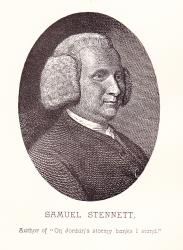
1727 - 1795 Topics: Pilgrimage Author of "On Jordan's Stormy Banks I Stand" in The United Methodist Hymnal Samuel Stennett was born at Exeter, in 1727. His father was pastor of a Baptist congregation in that city; afterwards of the Baptist Chapel, Little Wild Street, London. In this latter pastorate the son succeeded the father in 1758. He died in 1795. Dr. Stennett was the author of several doctrinal works, and a few hymns.
--Annotations of the Hymnal, Charles Hutchins, M.A. 1872.
======================
Stennett, Samuel, D.D., grandson of Joseph Stennett, named above, and son of the Rev. Joseph Stennett, D.D., was born most pro;bably in 1727, at Exeter, where his father was at that time a Baptist minister. When quite young he removed to London, his father having become pastor of the Baptist Church in Little Wild Street, Lincoln's Inn Fields. In 1748, Samuel Stennett became assistant to his father in the ministry, and in 1758 succeeded him in the pastoral office at Little Wild Street. From that time until his death, on Aug. 24, 1795, he held a very prominent position among the Dissenting ministers of London. He was much respected by some of the statesmen of the time, and used his influence with them in support of the principles of religious freedom. The celebrated John Howard was a member of his congregation and an attached friend. In 1763, the University of Aberdeen conferred on him the degree of D.D. Dr. S. Stennett's prose publications consist of volumes of sermons, and pamphlets on Baptism and on Nonconformist Disabilities. He wrote one or two short poems, and contributed 38 hymns to the collection of his friend, Dr. Rippon (1787). His poetical genius was not of the highest order, and his best hymns have neither the originality nor the vigour of some of his grandfather's. The following, however, are pleasing in sentiment and expression, and are in common use more especially in Baptist congregations:—
1. And have I, Christ, no love for Thee? Love for Christ desired.
2. And will the offended God again? The Body the Temple of the Holy Ghost.
3. As on the Cross the Saviour hung. The Thief on the Cross.
4. Behold the leprous Jew. The healing of the Leper.
5. Come, every pious heart. Praise to Christ.
6. Father, at Thy call, I come. Lent.
7. Great God, amid the darksome night. God, a Sun.
8. Great God, what hosts of angels stand. Ministry of Angels.
9. Here at Thy Table, Lord, we meet. Holy Communion.
10. How charming is the place. Public Worship.
11. How shall the sons of men appear? Acceptance through Christ alone.
12. How soft the words my [the] Saviour speaks. Early Piety.
13. How various and how new. Divine Providence.
14. Not all the nobles of the earth. Christians as Sons of God.
15. On Jordan's stormy banks I stand. Heaven anticipated.
16. Prostrate, dear Jesus, at thy feet. Lent. Sometimes, "Dear Saviour, prostrate at Thy feet."
17. Should bounteous nature kindly pour. The greatest of these is Love. From this, "Had I the gift of tongues," st. iii., is taken.
18. Thy counsels of redeeming grace. Holy Scripture. From "Let avarice, from shore to shore."
19. Thy life 1 read, my dearest Lord. Death in Infancy. From this "'Tis Jesus speaks, I fold, says He."
20. 'Tis finished! so the Saviour cried. Good Friday.
21. To Christ, the Lord, let every tongue. Praise of Christ. From this,"Majestic sweetness sits enthroned," st. iii., is taken.
22. To God, my Saviour, and my King. Renewing Grace.
23. To God, the universal King. Praise to God.
24. What wisdom, majesty, and grace. The Gospel. Sometimes, “What majesty and grace."
25. Where two or three with sweet accord. Before the Sermon.
26. Why should a living man complain? Affliction. From this, "Lord, see what floods of sorrow rise," st. iii., is taken.
27. With tears of anguish I lament. Lent.
28. Yonder amazing sight I see. Good Friday.
All these hymns, with others by Stennett, were given in Rippon's Baptist Selection, 1787, a few having previously appeared in A Collection of Hymns for the use of Christians of all Denominations, London. Printed for the Booksellers, 1782; and No. 16, in the 1778 Supplement to the 3rd edition of the Bristol Baptist Selection of Ash and Evans. The whole of Stennett's poetical pieces and hymns were included in vol. ii. of his Works, together with a Memoir, by W. J. Jones. 4 vols., 1824. [Rev. W. R. Stevenson, M.A.]
--John Julian, Dictionary of Hymnology (1907)
Samuel Stennett
Frederick William Faber
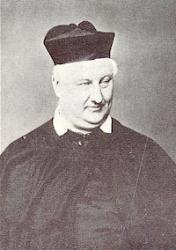
1814 - 1863 Person Name: Frederick William Faber, 1814-1863 Topics: Christian Vocation and Pilgrimage Author of "Faith of our fathers, holy faith" in The Hymnal 1982 Raised in the Church of England, Frederick W. Faber (b. Calverly, Yorkshire, England, 1814; d. Kensington, London, England, 1863) came from a Huguenot and strict Calvinistic family background. He was educated at Balliol College, Oxford, and ordained in the Church of England in 1839. Influenced by the teaching of John Henry Newman, Faber followed Newman into the Roman Catholic Church in 1845 and served under Newman's supervision in the Oratory of St. Philip Neri. Because he believed that Roman Catholics should sing hymns like those written by John Newton, Charles Wesley, and William Cowpe, Faber wrote 150 hymns himself. One of his best known, "Faith of Our Fathers," originally had these words in its third stanza: "Faith of Our Fathers! Mary's prayers/Shall win our country back to thee." He published his hymns in various volumes and finally collected all of them in Hymns (1862).
Bert Polman
=================
Faber, Frederick William, D.D., son of Mr. T. H. Faber, was born at Calverley Vicarage, Yorkshire, June 28, 1814, and educated at Balliol College, Oxford, graduating B.A. in 1836. He was for some time a Fellow of University College, in the same University. Taking Holy Orders in 1837, he became Rector of Elton, Huntingdonshire, in 1843, but in 1846 he seceded to the Church of Rome. After residing for some time at St. Wilfrid's, Staffordshire, he went to London in 1849, and established the London "Oratorians," or, "Priests of the Congregation of St. Philip Neri," in King William Street, Strand. In 1854 the Oratory was removed to Brompton. Dr. Faber died Sept. 26, 1863. Before his secession he published several prose works, some of which were in defence of the Church of England; and afterwards several followed as Spiritual Conferences, All for Jesus, &c. Although he published his Cherwell Waterlily and Other Poems, 1840; The Styrian Lake, and Other Poems, 1842; Sir Lancelot, 1844; and The Rosary and Other Poems, 1845; and his Lives of the Saints, in verse, before he joined the Church of Rome, all his hymns were published after he joined that communion. They were included in his:—
(1) A small book of eleven Hymns1849, for the School at St. Wilfrid's, Staffordshire. (2) Jesus and Mary: or, Catholic Hymns for Singing and Reading, London 1849. In 1852 the 2nd edition was published with an addition of 20 new hymns. (3) Oratory Hymns, 1854; and (4) Hymns, 1862, being a collected edition of what he had written and published from time to time.
Dr. Faber's account of the origin of his hymn-writing is given in his Preface to Jesus & Mary. After dwelling on the influence, respectively, of St. Theresa, of St. Ignatius, and of St. Philip Neri, on Catholicism; and of the last that "sanctity in the world, perfection at home, high attainments in common earthly callings…was the principal end of his apostolate," he says:—
“It was natural then that an English son of St. Philip should feel the want of a collection of English Catholic hymns fitted for singing. The few in the Garden of the Soul were all that were at hand, and of course they were not numerous enough to furnish the requisite variety. As to translations they do not express Saxon thought and feelings, and consequently the poor do not seem to take to them. The domestic wants of the Oratory, too, keep alive the feeling that something of the sort was needed: though at the same time the author's ignorance of music appeared in some measure to disqualify him for the work of supplying the defect. Eleven, however, of the hymns were written, most of them, for particular tunes and on particular occasions, and became very popular with a country congregation. They were afterwards printed for the Schools at St. Wilfrid's, and the very numerous applications to the printer for them seemed to show that, in spite of very glaring literary defects, such as careless grammar and slipshod metre, people were anxious to have Catholic hymns of any sort. The manuscript of the present volume was submitted to a musical friend, who replied that certain verses of all or nearly all of the hymns would do for singing; and this encouragement has led to the publication of the volume."
In the same Preface he clearly points to the Olney Hymns and those of the Wesleys as being the models which for simplicity and intense fervour he would endeavour to emulate. From the small book of eleven hymns printed for the schools at St. Wilfrid's, his hymn-writing resulted in a total of 150 pieces, all of which are in his Hymns, 1862, and many of them in various Roman Catholic collections for missions and schools. Few hymns are more popular than his "My God, how wonderful Thou art," "O come and mourn with me awhile," and "Sweet Saviour, bless us ere we go." They excel in directness, simplicity, and pathos. "Hark, hark, my soul, angelic songs are swelling," and "O Paradise, O Paradise," are also widely known. These possess, however, an element of unreality which is against their permanent popularity. Many of Faber's hymns are annotated under their respective first lines; the rest in common use include:—
i. From his Jesus and Mary, 1849 and 1852.
1. Fountain of love, Thyself true God. The Holy Ghost.
2. How shalt thou bear the Cross, that now. The Eternal Years.
3. I come to Thee, once more, O God. Returning to God.
4. Joy, joy, the Mother comes. The Purification.
5. My soul, what hast thou done for God? Self-Examination
6. O how the thought of God attract. Holiness Desired.
7. O soul of Jesus, sick to death. Passiontide. Sometimes this is divided into two parts, Pt. ii. beginning, “My God, my God, and can it be."
ii. From his Oratory Hymns, 1854.
8. Christians, to the war! Gather from afar. The Christian Warfare.
9. O come to the merciful Saviour that calls you. Divine Invitation. In many collections.
10. O God, Thy power is wonderful. Power and Eternity of God.
11. O it is sweet to think, Of those that are departed. Memory of the Dead.
12. O what are the wages of sin? The Wages of Sin.
13. O what is this splendour that beams on me now? Heaven.
14. Saint of the Sacred Heart. St. John the Evangelist.
iii. From his Hymns, 1862.
15. Father, the sweetest, dearest Name. The Eternal Father.
16. Full of glory, full of wonders, Majesty Divine. Holy Trinity.
17. Hark ! the sound of the fight. Processions.
18. How pleasant are thy paths, 0 death. Death Contemplated.
19. O God, Whose thoughts are brightest light. Thinking no Evil.
20. O why art thou sorrowful, servant of God? Trust in God.
21. Souls of men, why will ye scatter? The Divine Call.
22. The land beyond the sea. Heaven Contemplated.
23. The thought of God, the thought of thee. Thoughts of God.
24. We come to Thee, sweet Saviour. Jesus, our Rest.
In addition to these there are also several hymns in common use in Roman Catholic hymn-books which are confined to those collections. In the Hymns for the Year, by Dr. Rawes, Nos. 77, 110, 112, 117, 120, 121, 122, 125, 127, 128, 131, 140, 152, 154,169, 170, 174, 179, 180, 192, 222, 226, 230, 271, 272, are also by Faber, and relate principally to the Blessed Virgin Mary. Several of these are repeated in other Roman Catholic collections.
--John Julian, Dictionary of Hymnology (1907
==================
Faber, Frederick William, p. 361, i. To this article the following additions have to be made:—
1. Blood is the price of heaven. Good Friday. (1862.)
2. Exceeding sorrowful to death. Gethsemane. This in the Scottish Ibrox Hymnal, 1871, is a cento from "O soul of Jesus, sick to death," p. 362, i., 7.
3. From pain to pain, from woe to woe. Good Friday. (1854.)
4. I wish to have no wishes left. Wishes about death. (1862.)
5. Why is thy face so lit with smiles? Ascension. (1849.)
The dates here given are those of Faber's works in which the hymns appeared. In addition to these hymns there are also the following in common use:—
6. Dear God of orphans, hear our prayer. On behalf of Orphans. This appeared in a miscellaneous collection entitled A May Garland, John Philip, n.d. [1863], No. 1, in 7 stanzas of 4 lines. In the Roman Catholic Parochial Hymn Book, 1880, it begins, "O God of orphans, hear our prayer."
7. Sleep, sleep my beautiful babe. Christmas Carol. This carol we have failed to trace.
8. By the Archangel's word of love. Pt. i. Life of our Lord. This, and Pt. ii., “By the blood that flowed from Thee"; Pt. iii., "By the first bright Easter day"; also, "By the word to Mary given"; "By the name which Thou didst take"; in The Crown Hymn Book and other Roman Catholic collections, we have seen ascribed to Dr. Faber, but in the Rev. H. Formby's Catholic Hymns, 1853, they are all signed "C. M. C," i.e. Cecilia M. Caddell (p. 200, i.).
--John Julian, Dictionary of Hymnology, Appendix, Part II (1907)
======================
Faber, F. W., pp. 361, i.; 1562, ii. We are informed by members of Dr. Faber's family that his father was Mr. Thomas Henry Faber, sometime Lay Secretary of the Bishop of Durham. In addition to his hymns already noted in this Dictionary, the following are found in various Roman Catholic collections, viz.:—
i. From St. Wilfrid's Hymns, 1849:—
1. Dear Father Philip, holy Sire. S. Philip Neri.
2. Hail, holy Joseph, hail. S. Joseph.
3. Mother of Mercy, day by day. Blessed Virgin Mary.
ii. Jesus and Mary, 1849:—
4. Ah ! dearest Lord! I cannot pray. Prayer.
5. Dear Husband of Mary. S. Joseph.
6. Dear Little One, how sweet Thou art. Christmas.
7. Father and God! my endless doom. Predestination.
8. Hail, holy Wilfrid, hail. S. Wilfrid.
9. O Jesus, if in days gone by. Love of the World.
10. O turn to Jesus, Mother, turn. B. V. M.
11. Sing, sing, ye angel bands. Assum. B. V. M.
iii. Jesus and Mary, 1852:—
12. All ye who love the ways of sin. S. Philip Neri.
13. Day set on Rome! its golden morn. S. Philip Neri.
14. Hail, bright Archangel! Prince of heaven. S. Michael.
15. Hail, Gabriel, hail. S. Gabriel.
16. O Flower of Grace, divinest Flower. B. V. M.
17. Saint Philip! 1 have never known. S. Philip Neri.
18. Sweet Saint Philip, thou hast won us. S. Philip Neri. Previously in the Rambler, May, 1850, p. 425.
iv. Oratory Hymns, 1854:—
19. Day breaks on temple roofs and towers. Expect. of B. V. M.
20. How gently flow the silent years. S. Martin and S. Philip.
21. How the light of Heaven is stealing. Grace.
22. Like the dawning of the morning. Expect. of B. V. M.
23. Mother Mary ! at thine altar. For Orphans.
24. My God! Who art nothing but mercy and kindness. Repentance.
25. O blessed Father! sent by God. S. Vincent of Paul.
26. O do you hear that voice from heaven? Forgiveness.
27. The chains that have bound me. Absolution.
28. The day, the happy day, is dawning. B. V. M.
29. The moon is in the heavens above. B. V. M.
30. Why art thou sorrowful, servant of God? Mercy.
v. Hymns, 1862:—
31. At last Thou art come, little Saviour. Christmas.
32. By the spring of God's compassions. S. Raphael.
33. Fair are the portals of the day. B. V. M.
34. Father of many children. S. Benedict.
35. From the highest heights of glory. S. Mary Magdalene.
36. Like the voiceless starlight falling. B. V. M.
37. Mary! dearest mother. B. V. M.
38. Mother of God, we hail thy heart. B. V. M.
39. O Anne! thou hadst lived through those long dreary years. S. Anne. Previously in Holy Family Hymns, 1860.
40. O balmy and bright as moonlit night. B. V. M.
41. O Blessed Trinity! Thy children. Holy Trinity.
42. O dear Saint Martha, busy saint. S. Martha
43. O Mother, will it always be. B. V. M.
44. O vision bright. B. V. M.
45. Summer suns for ever shining. B. V. M.
46. There are many saints above. S. Joseph. Previously in Holy Family Hymns, 1860.
vi. Centos and altered forms:—
47. Confraternity men to the fight. From "Hark the sound of the fight," p. 362, i.
48. Hail, sainted Mungo, hail. From No. 8.
49. I bow to Thee, sweet will of God. From "I worship Thee," p. 559, ii.
50. They whom we loved on earth. From "0 it is sweet to think," p. 362, i.
51. Vincent! like Mother Mary, thou. From No. 25.
When Dr. Faber's hymns which are in common use are enumerated, the total falls little short of one hundred. In this respect he outnumbers most of his contemporaries. [Rev. James Mearns]
--John Julian, Dictionary of Hymnology, New Supplement (1907)
--------------
See also in:
Hymn Writers of the Church
Frederick William Faber





