

 My Starred Hymns
 My Hymnals
 My Purchased Files
Planning worship?
Check out our sister site, ZeteoSearch.org,
for 20+ additional resources related to your search.
- |
User Links
Search Results


Rejoice, the Lord is King!
Author: Charles Wesley Meter: 6.6.6.6.8.8 Appears in 769 hymnals Topics: Processional Hymns Lyrics: 1 Rejoice, the Lord is King!
The risen Christ adore!
Rejoice, give thanks, and sing,
and triumph evermore:
lift up your heart,
lift up your voice!
Rejoice, again I say, rejoice!
2 God's reign can never fail,
Christ rules o’er earth and heaven;
the keys of death and hell
are to our Jesus given:
lift up your heart,
lift up your voice!
Rejoice, again I say, rejoice!
3 Rejoice in glorious hope!
For Christ, our Judge, shall come
to glorify the saints
for their eternal home:
lift up your heart,
lift up your voice!
Rejoice, again I say, rejoice! Used With Tune: DARWALL'S 148TH
Rejoice, the Lord is King!
Love Divine, All Loves Excelling
Author: Charles Wesley Meter: 8.7.8.7 D Appears in 1,932 hymnals Topics: Processional Hymns First Line: Love, divine, all loves excelling Scripture: 2 Corinthians 3:18 Used With Tune: BEECHER
Love Divine, All Loves Excelling


Joyful, Joyful, We Adore Thee
Author: Henry Van Dyke Meter: 8.7.8.7 D Appears in 288 hymnals Topics: Processional Hymns; Processional Hymns Lyrics: 1 Joyful, joyful, we adore thee, God of glory, Lord of love;
hearts unfold like flowers before thee, opening to the sun above.
Melt the clouds of sin and sadness, drive the dark of doubt away;
giver of immortal gladness, fill us with the light of day!
2 All thy works with joy surround thee, earth and heaven reflect thy rays,
stars and angels sing around thee, center of unbroken praise.
Field and forest, vale and mountain, flowery meadow, flashing sea,
chanting bird and flowing fountain call us to rejoice in thee.
3 Thou art giving and forgiving, ever blessing, ever blest,
well-spring of the joy of living, ocean depth of happy rest!
Thou our Father, Christ our Brother--all who live in love are thine;
teach us how to love each other, lift us to the joy divine.
Scripture: Psalm 19:1 Used With Tune: ODE TO JOY
Joyful, Joyful, We Adore Thee

LASST UNS ERFREUEN
Meter: 8.8.4.4.8.8 with refrain Appears in 548 hymnals Composer and/or Arranger: Ralph Vaughan Williams Topics: The Glory of the Triune God Praise and Thanksgiving; The Glory of the Triune God Creation; Adoration and Praise; Christian Year Trinity Sunday; Christian Year Thanksgiving Day; Eternal Life; Music and Singing; Nature; Opening Hymns; Processionals; Responses, Antiphonal; Service Music Doxology Tune Sources: Geistliche Kirchengesänge, 1623 Tune Key: E Flat Major Incipit: 11231 34511 23134 Used With Text: All Creatures of Our God and King
LASST UNS ERFREUEN
LYONS
Meter: 10.10.11.11 Appears in 888 hymnals Composer and/or Arranger: Johann Michael Haydn; William Gardiner Topics: The Glory of the Triune God Praise and Thanksgiving; Adoration and Praise; Opening Hymns; Processionals; Providence; Testimony and Witness; Trust Tune Key: G Major Incipit: 51123 14432 51123 Used With Text: O Worship the King
LYONS


Joyful, Joyful, We Adore Thee
Author: Henry Van Dyke Hymnal: The Worshiping Church #20 (1990) Meter: 8.7.8.7 D Topics: Processional Hymns; Processional Hymns Lyrics: 1 Joyful, joyful, we adore thee, God of glory, Lord of love;
hearts unfold like flowers before thee, opening to the sun above.
Melt the clouds of sin and sadness, drive the dark of doubt away;
giver of immortal gladness, fill us with the light of day!
2 All thy works with joy surround thee, earth and heaven reflect thy rays,
stars and angels sing around thee, center of unbroken praise.
Field and forest, vale and mountain, flowery meadow, flashing sea,
chanting bird and flowing fountain call us to rejoice in thee.
3 Thou art giving and forgiving, ever blessing, ever blest,
well-spring of the joy of living, ocean depth of happy rest!
Thou our Father, Christ our Brother--all who live in love are thine;
teach us how to love each other, lift us to the joy divine.
Scripture: Psalm 19:1 Languages: English Tune Title: ODE TO JOY
Joyful, Joyful, We Adore Thee
Lift High the Cross
Author: George W. Kitchin; Michael R. Newbolt Hymnal: The Worshiping Church #229 (1990) Meter: 10.10.10.10 Topics: Processional Hymns; Processional Hymns First Line: Come, Christians, follow where our Savior trod Refrain First Line: Lift high the cross, the love of Christ proclaim Lyrics: Refrain:
Lift high the cross, the love of Christ proclaim
till all the world adore his sacred name.
1 Come, Christians, follow where our Savior trod,
our King victorious, Christ, the Son of God. [Refrain]
2 All newborn servants of the Crucified
bear on their brows the seal of him who died. [Refrain]
3 O Lord, once lifted on the tree of pain,
draw all the world to seek you once again. [Refrain]
4 Let every race and every language tell
of him who saves our souls from death and hell. [Refrain]
5 So shall our song of triumph ever be:
praise to the Crucified for victory! [Refrain]
Scripture: John 12:32 Languages: English Tune Title: CRUCIFER
Lift High the Cross
Holy, Holy, Holy! Lord God Almighty
Author: Reginald Heber Hymnal: The Worshiping Church #2 (1990) Meter: 11.12.12.10 Topics: Processional Hymns; Processional Hymns Lyrics: 1 Holy, holy, holy! Lord God Almighty!
Early in the morning our song shall rise to thee.
Holy, holy, holy! Merciful and mighty!
God in three persons, blessed Trinity!
2 Holy, holy, holy! All the saints adore thee,
casting down their golden crowns around the glassy sea;
cherubim and seraphim falling down before thee,
which wert, and art, and evermore shalt be.
3 Holy, holy, holy! Though the darkness hide thee,
though the eye of sinful flesh thy glory may not see,
only thou art holy; there is none beside thee,
perfect in power, in love, and purity.
4 Holy, holy, holy! Lord God Almighty!
All thy works shall praise thy Name, in earth, and sky, and sea;
Holy, holy, holy! Merciful and mighty,
God in three persons, blessed Trinity! Scripture: 1 Samuel 2:2 Languages: English Tune Title: NICAEA
Holy, Holy, Holy! Lord God Almighty


Isaac Watts
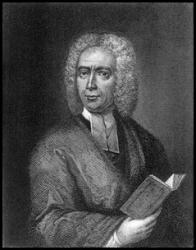
1674 - 1748 Topics: Processional Hymns; Processional Hymns Paraphraser of "Give to Our God Immortal Praise" in The Worshiping Church Isaac Watts was the son of a schoolmaster, and was born in Southampton, July 17, 1674. He is said to have shown remarkable precocity in childhood, beginning the study of Latin, in his fourth year, and writing respectable verses at the age of seven. At the age of sixteen, he went to London to study in the Academy of the Rev. Thomas Rowe, an Independent minister. In 1698, he became assistant minister of the Independent Church, Berry St., London. In 1702, he became pastor. In 1712, he accepted an invitation to visit Sir Thomas Abney, at his residence of Abney Park, and at Sir Thomas' pressing request, made it his home for the remainder of his life. It was a residence most favourable for his health, and for the prosecution of his literary labours. He did not retire from ministerial duties, but preached as often as his delicate health would permit.
The number of Watts' publications is very large. His collected works, first published in 1720, embrace sermons, treatises, poems and hymns. His "Horae Lyricae" was published in December, 1705. His "Hymns" appeared in July, 1707. The first hymn he is said to have composed for religious worship, is "Behold the glories of the Lamb," written at the age of twenty. It is as a writer of psalms and hymns that he is everywhere known. Some of his hymns were written to be sung after his sermons, giving expression to the meaning of the text upon which he had preached. Montgomery calls Watts "the greatest name among hymn-writers," and the honour can hardly be disputed. His published hymns number more than eight hundred.
Watts died November 25, 1748, and was buried at Bunhill Fields. A monumental statue was erected in Southampton, his native place, and there is also a monument to his memory in the South Choir of Westminster Abbey. "Happy," says the great contemporary champion of Anglican orthodoxy, "will be that reader whose mind is disposed, by his verses or his prose, to imitate him in all but his non-conformity, to copy his benevolence to men, and his reverence to God." ("Memorials of Westminster Abbey," p. 325.)
--Annotations of the Hymnal, Charles Hutchins, M.A., 1872.
=================================
Watts, Isaac, D.D. The father of Dr. Watts was a respected Nonconformist, and at the birth of the child, and during its infancy, twice suffered imprisonment for his religious convictions. In his later years he kept a flourishing boarding school at Southampton. Isaac, the eldest of his nine children, was born in that town July 17, 1674. His taste for verse showed itself in early childhood. He was taught Greek, Latin, and Hebrew by Mr. Pinhorn, rector of All Saints, and headmaster of the Grammar School, in Southampton. The splendid promise of the boy induced a physician of the town and other friends to offer him an education at one of the Universities for eventual ordination in the Church of England: but this he refused; and entered a Nonconformist Academy at Stoke Newington in 1690, under the care of Mr. Thomas Rowe, the pastor of the Independent congregation at Girdlers' Hall. Of this congregation he became a member in 1693.
Leaving the Academy at the age of twenty, he spent two years at home; and it was then that the bulk of the Hymns and Spiritual Songs (published 1707-9) were written, and sung from manuscripts in the Southampton Chapel. The hymn "Behold the glories of the Lamb" is said to have been the first he composed, and written as an attempt to raise the standard of praise. In answer to requests, others succeeded. The hymn "There is a land of pure delight" is said to have been suggested by the view across Southampton Water. The next six years of Watts's life were again spent at Stoke Newington, in the post of tutor to the son of an eminent Puritan, Sir John Hartopp; and to the intense study of these years must be traced the accumulation of the theological and philosophical materials which he published subsequently, and also the life-long enfeeblement of his constitution.
Watts preached his first sermon when he was twenty-four years old. In the next three years he preached frequently; and in 1702 was ordained pastor of the eminent Independent congregation in Mark Lane, over which Caryl and Dr. John Owen had presided, and which numbered Mrs. Bendish, Cromwell's granddaughter, Charles Fleetwood, Charles Desborough, Sir John Hartopp, Lady Haversham, and other distinguished Independents among its members. In this year he removed to the house of Mr. Hollis in the Minories. His health began to fail in the following year, and Mr. Samuel Price was appointed as his assistant in the ministry. In 1712 a fever shattered his constitution, and Mr. Price was then appointed co-pastor of the congregation which had in the meantime removed to a new chapel in Bury Street. It was at this period that he became the guest of Sir Thomas Abney, under whose roof, and after his death (1722) that of his widow, he remained for the rest of his suffering life; residing for the longer portion of these thirty-six years principally at the beautiful country seat of Theobalds in Herts, and for the last thirteen years at Stoke Newington. His degree of D.D. was bestowed on him in 1728, unsolicited, by the University of Edinburgh. His infirmities increased on him up to the peaceful close of his sufferings, Nov. 25, 1748. He was buried in the Puritan restingplace at Bunhill Fields, but a monument was erected to him in Westminster Abbey.
His learning and piety, gentleness and largeness of heart have earned him the title of the Melanchthon of his day. Among his friends, churchmen like Bishop Gibson are ranked with Nonconformists such as Doddridge. His theological as well as philosophical fame was considerable. His Speculations on the Human Nature of the Logos, as a contribution to the great controversy on the Holy Trinity, brought on him a charge of Arian opinions. His work on The Improvement of the Mind, published in 1741, is eulogised by Johnson. His Logic was still a valued textbook at Oxford within living memory. The World to Come, published in 1745, was once a favourite devotional work, parts of it being translated into several languages. His Catechisms, Scripture History (1732), as well as The Divine and Moral Songs (1715), were the most popular text-books for religious education fifty years ago. The Hymns and Spiritual Songs were published in 1707-9, though written earlier. The Horae Lyricae, which contains hymns interspersed among the poems, appeared in 1706-9. Some hymns were also appended at the close of the several Sermons preached in London, published in 1721-24. The Psalms were published in 1719. The earliest life of Watts is that by his friend Dr. Gibbons. Johnson has included him in his Lives of the Poets; and Southey has echoed Johnson's warm eulogy. The most interesting modern life is Isaac Watts: his Life and Writings, by E. Paxton Hood. [Rev. H. Leigh Bennett, M.A.]
A large mass of Dr. Watts's hymns and paraphrases of the Psalms have no personal history beyond the date of their publication. These we have grouped together here and shall preface the list with the books from which they are taken.
(l) Horae Lyricae. Poems chiefly of the Lyric kind. In Three Books Sacred: i.To Devotion and Piety; ii. To Virtue, Honour, and Friendship; iii. To the Memory of the Dead. By I. Watts, 1706. Second edition, 1709. (2) Hymns and Spiritual Songs. In Three Books: i. Collected from the Scriptures; ii. Composed on Divine Subjects; iii. Prepared for the Lord's Supper. By I. Watts, 1707. This contained in Bk i. 78 hymns; Bk. ii. 110; Bk. iii. 22, and 12 doxologies. In the 2nd edition published in 1709, Bk. i. was increased to 150; Bk. ii. to 170; Bk. iii. to 25 and 15 doxologies. (3) Divine and Moral Songs for the Use of Children. By I. Watts, London, 1715. (4) The Psalms of David Imitated in the Language of the New Testament, And apply'd to the Christian State and Worship. By I. Watts. London: Printed by J. Clark, at the Bible and Crown in the Poultry, &c, 1719. (5) Sermons with hymns appended thereto, vol. i., 1721; ii., 1723; iii. 1727. In the 5th ed. of the Sermons the three volumes, in duodecimo, were reduced to two, in octavo. (6) Reliquiae Juveniles: Miscellaneous Thoughts in Prose and Verse, on Natural, Moral, and Divine Subjects; Written chiefly in Younger Years. By I. Watts, D.D., London, 1734. (7) Remnants of Time. London, 1736.
454 Hymns and Versions of the Psalms, in addition to the centos are all in common use at the present time.
--Excerpts from John Julian, Dictionary of Hymnology (1907)
==================================
Watts, I. , p. 1241, ii. Nearly 100 hymns, additional to those already annotated, are given in some minor hymn-books.
--John Julian, Dictionary of Hymnology, Appendix, Part II (1907)
=================
Watts, I. , p. 1236, i. At the time of the publication of this Dictionary in 1892, every copy of the 1707 edition of Watts's Hymns and Spiritual Songs was supposed to have perished, and all notes thereon were based upon references which were found in magazines and old collections of hymns and versions of the Psalms. Recently three copies have been recovered, and by a careful examination of one of these we have been able to give some of the results in the revision of pp. 1-1597, and the rest we now subjoin.
i. Hymns in the 1709 ed. of Hymns and Spiritual Songs which previously appeared in the 1707 edition of the same book, but are not so noted in the 1st ed. of this Dictionary:—
On pp. 1237, L-1239, ii., Nos. 18, 33, 42, 43, 47, 48, 60, 56, 58, 59, 63, 75, 82, 83, 84, 85, 93, 96, 99, 102, 104, 105, 113, 115, 116, 123, 124, 134, 137, 139, 146, 147, 148, 149, 162, 166, 174, 180, 181, 182, 188, 190, 192, 193, 194, 195, 197, 200, 202.
ii. Versions of the Psalms in his Psalms of David, 1719, which previously appeared in his Hymns and Spiritual Songs, 1707:—
On pp. 1239, U.-1241, i., Nos. 241, 288, 304, 313, 314, 317, 410, 441.
iii. Additional not noted in the revision:—
1. My soul, how lovely is the place; p. 1240, ii. 332. This version of Ps. lxiv. first appeared in the 1707 edition of Hymns & Spiritual Songs, as "Ye saints, how lovely is the place."
2. Shine, mighty God, on Britain shine; p. 1055, ii. In the 1707 edition of Hymns & Spiritual Songs, Bk. i., No. 35, and again in his Psalms of David, 1719.
3. Sing to the Lord with [cheerful] joyful voice, p. 1059, ii. This version of Ps. c. is No. 43 in the Hymns & Spiritual Songs, 1707, Bk. i., from which it passed into the Ps. of David, 1719.
A careful collation of the earliest editions of Watts's Horae Lyricae shows that Nos. 1, 7, 9, 10, 11, 12, 14, 16, p. 1237, i., are in the 1706 ed., and that the rest were added in 1709. Of the remaining hymns, Nos. 91 appeared in his Sermons, vol. ii., 1723, and No. 196 in Sermons, vol. i., 1721. No. 199 was added after Watts's death. It must be noted also that the original title of what is usually known as Divine and Moral Songs was Divine Songs only.
--John Julian, Dictionary of Hymnology, New Supplement (1907)
===========
See also in:
Hymn Writers of the Church
Isaac Watts
Samuel Sebastian Wesley
1810 - 1876 Person Name: Samuel S. Wesley Topics: Processional Hymns Composer of "AURELIA" in Chalice Hymnal Samuel Sebastian Wesley (b. London, England, 1810; d. Gloucester, England, 1876) was an English organist and composer. The grandson of Charles Wesley, he was born in London, and sang in the choir of the Chapel Royal as a boy. He learned composition and organ from his father, Samuel, completed a doctorate in music at Oxford, and composed for piano, organ, and choir. He was organist at Hereford Cathedral (1832-1835), Exeter Cathedral (1835-1842), Leeds Parish Church (1842-1849), Winchester Cathedral (1849-1865), and Gloucester Cathedral (1865-1876). Wesley strove to improve the standards of church music and the status of church musicians; his observations and plans for reform were published as A Few Words on Cathedral Music and the Music System of the Church (1849). He was the musical editor of Charles Kemble's A Selection of Psalms and Hymns (1864) and of the Wellburn Appendix of Original Hymns and Tunes (1875) but is best known as the compiler of The European Psalmist (1872), in which some 130 of the 733 hymn tunes were written by him.
Bert Polman
Samuel Sebastian Wesley
Frances Elizabeth Cox
1812 - 1897 Person Name: Frances E. Cox Topics: Processional Hymns Translator of "Sing Praise to God Who Reigns Above" in Rejoice in the Lord Cox, Frances Elizabeth, daughter of Mr. George V. Cox, born at Oxford, is well known as a successful translator of hymns from the German. Her translations were published as Sacred Hymns from the German, London, Pickering. The 1st edition, pub. 1841, contained 49 translations printed with the original text, together with biographical notes on the German authors. In the 2nd edition, 1864, Hymns from the German, London, Rivingtons, the translations were increased to 56, those of 1841 being revised, and with additional notes. The 56 translations were composed of 27 from the 1st ed. (22 being omitted) and 29 which were new. The best known of her translations are "Jesus lives! no longer [thy terrors] now" ; and ”Who are these like stars appearing ?" A few other translations and original hymns have been contributed by Miss Cox to the magazines; but they have not been gathered together into a volume.
-- John Julian, Dictionary of Hymnology (1907)
Frances Elizabeth Cox





