

 My Starred Hymns
 My FlexScores
 My Hymnals
 My Purchased Files
Planning worship?
Check out our sister site, ZeteoSearch.org,
for 20+ additional resources related to your search.
- |
User Links
Person Results
Charles William Everest
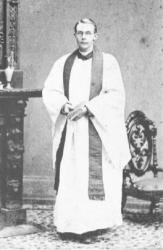
1814 - 1877 Topics: Proper 8 Year A Author of "Take up your cross, the Saviour said" in Voices United Everest, Charles William, M.A., born at East Windsor, Connecticut, May 27, 1814, graduated at Trinity College, Hartford, 1838, and took Holy Orders in 1842. He was rector at Hamden, Connecticut, from 1842 to 1873, and also agent for the Society for the Increase of the Ministry. He died at Waterbury, Connecticut, Jan. 11, 1877 (See Poets of Connecticut, 1843). In 1833 he published Visions of Death, and Other Poems; from this work his popular hymn is taken:—
Take up thy cross, the Saviour said. Following Jesus. The original text of this hymn differs very materially from that which is usually found in the hymn-books. The most widely known form of the text is that in Hymns Ancient & Modern, where it appeared in 1861. It was copied by the Compilers from another collection, but by whom the alterations were made is unknown. The nearest approach to the original is in Horder's Congregational Hymn Book, 1884. Original text in Biggs's English Hymnology, 1873, p. 24. [Rev. F. M. Bird, M.A.]
-- John Julian, Dictionary of Hymnology (1907)
Charles William Everest
Henry Francis Lyte
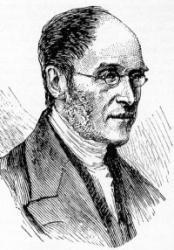
1793 - 1847 Topics: Proper 8 Year C Author of "Abide with Me" in Voices United Lyte, Henry Francis, M.A., son of Captain Thomas Lyte, was born at Ednam, near Kelso, June 1, 1793, and educated at Portora (the Royal School of Enniskillen), and at Trinity College, Dublin, of which he was a Scholar, and where he graduated in 1814. During his University course he distinguished himself by gaining the English prize poem on three occasions. At one time he had intended studying Medicine; but this he abandoned for Theology, and took Holy Orders in 1815, his first curacy being in the neighbourhood of Wexford. In 1817, he removed to Marazion, in Cornwall. There, in 1818, he underwent a great spiritual change, which shaped and influenced the whole of his after life, the immediate cause being the illness and death of a brother clergyman. Lyte says of him:—
"He died happy under the belief that though he had deeply erred, there was One whose death and sufferings would atone for his delinquencies, and be accepted for all that he had incurred;"
and concerning himself he adds:—
"I was greatly affected by the whole matter, and brought to look at life and its issue with a different eye than before; and I began to study my Bible, and preach in another manner than I had previously done."
From Marazion he removed, in 1819, to Lymington, where he composed his Tales on the Lord's Prayer in verse (pub. in 1826); and in 1823 he was appointed Perpetual Curate of Lower Brixham, Devon. That appointment he held until his death, on Nov. 20, 1847. His Poems of Henry Vaughan, with a Memoir, were published in 1846.
His own Poetical works were:—
(1) Poems chiefly Religious 1833; 2nd ed. enlarged, 1845. (2) The Spirit of the Psalms, 1834, written in the first instance for use in his own Church at Lower Brixham, and enlarged in 1836; (3) Miscellaneous Poems (posthumously) in 1868. This last is a reprint of the 1845 ed. of his Poems, with "Abide with me" added. (4) Remains, 1850.
Lyte's Poems have been somewhat freely drawn upon by hymnal compilers; but by far the larger portion of his hymns found in modern collections are from his Spirit of the Psalms. In America his hymns are very popular. In many instances, however, through mistaking Miss Auber's (q. v.) Spirit of the Psalms, 1829, for his, he is credited with more than is his due. The Andover Sabbath Hymn Book, 1858, is specially at fault in this respect. The best known and most widely used of his compositions are "Abide with me, fast falls the eventide;” “Far from my heavenly home;" "God of mercy, God of grace;" "Pleasant are Thy courts above;" "Praise, my soul, the King of heaven;" and "There is a safe and secret place." These and several others are annotated under their respective first lines: the rest in common use are:—
i. From his Poems chiefly Religious, 1833 and 1845.
1. Above me hangs the silent sky. For Use at Sea.
2. Again, 0 Lord, I ope mine eyes. Morning.
3. Hail to another Year. New Year.
4. How good, how faithful, Lord, art Thou. Divine care of Men.
5. In tears and trials we must sow (1845). Sorrow followed by Joy.
6. My [our] rest is in heaven, my [our] rest is not here. Heaven our Home.
7. 0 Lord, how infinite Thy love. The Love of God in Christ.
8. Omniscient God, Thine eye divine. The Holy Ghost Omniscient.
9. The leaves around me falling. Autumn.
10. The Lord hath builded for Himself. The Universe the Temple of God.
11. Vain were all our toil and labour. Success is of God.
12. When at Thy footstool, Lord, I bend. Lent.
13. When earthly joys glide swift away. Ps. cii.
14. Wilt Thou return to me, O Lord. Lent.
15. With joy we hail the sacred day. Sunday.
ii. From his Spirit of the Psalms, 1834.
16. Be merciful to us, O God. Ps. lvii.
17. Blest is the man who knows the Lord. Ps. cxii.
18. Blest is the man whose spirit shares. Ps. xli.
19. From depths of woe to God I cry. Ps. cxxxx.
20. Gently, gently lay Thy rod. Ps. vi.
21. Glorious Shepherd of the sheep. Ps. xxiii.
22. Glory and praise to Jehovah on high. Ps. xxix.
23. God in His Church is known. Ps. lxxvi.
24. God is our Refuge, tried and proved. Ps. xlvi.
25. Great Source of my being. Ps. lxxiii.
26. Hear, O Lord, our supplication. Ps. lxiv.
27. How blest the man who fears the Lord. Ps.cxxviii.
28. Humble, Lord, my haughty spirit. Ps. cxxxi.
29. In this wide, weary world of care. Ps. cxxxii.
30. In vain the powers of darkness try. Ps.lii.
31. Jehovah speaks, let man be awed. Ps. xlix.
32. Judge me, O Lord, and try my heart. Ps. xxvi.
33. Judge me, O Lord, to Thee I fly. Ps. xliii.
34. Lord, I have sinned, but O forgive. Ps. xli.
35. Lord, my God, in Thee I trust. Ps. vii.
36. Lord of the realms above, Our Prophet, &c. Ps.xlv.
37. Lone amidst the dead and dying. Ps. lxii.
38. Lord God of my salvation. Ps. lxxxviii.
39. Lord, I look to Thee for all. Ps. xxxi.
40. Lord, I would stand with thoughtful eye. Ps. lxix.
41. Lord, my God, in Thee I trust. Ps. vii.
42. My God, my King, Thy praise I sing. Ps. cviii.
43. My God, what monuments I see. Ps. xxxvi.
44. My spirit on [to] Thy care. Ps. xxxi.
45. My trust is in the Lord. Ps. xi.
46. Not unto us, Almighty Lord [God]. Ps. cxv.
47. O God of glory, God of grace. Ps. xc.
48. O God of love, how blest are they. Ps. xxxvii.
49. O God of love, my God Thou art. Ps. lxiii.
50. O God of truth and grace. Ps. xviii.
51. O had I, my Saviour, the wings of a dove. Ps. lv.
52. O how blest the congregation. Ps. lxxxix.
53. O how safe and [how] happy he. Ps. xci.
54. O plead my cause, my Saviour plead. Ps. xxxv.
55. O praise the Lord, 'tis sweet to raise. Ps. cxlvii.
56. O praise the Lord; ye nations, pour. Ps. cxvii.
57. O praise ye the Lord With heart, &c. Ps. cxlix.
58. O that the Lord's salvation. Ps. xiv.
59. O Thou Whom thoughtless men condemn. Ps. xxxvi.
60. Of every earthly stay bereft. Ps. lxxiv.
61. Our hearts shall praise Thee, God of love. Ps. cxxxviii.
62. Pilgrims here on earth and strangers. Ps. xvi.
63. Praise for Thee, Lord, in Zion waits. Ps. lxv.
64. Praise to God on high be given. Ps. cxxxiv.
65. Praise ye the Lord, His servants, raise. Ps. cxiii.
66. Redeem'd from guilt, redeem'd from fears. Ps. cxvi.
67. Save me by Thy glorious name. Ps. liv.
68. Shout, ye people, clap your hands. Ps. xlvii.
69. Sing to the Lord our might. Ps. lxxxi.
70. Strangers and pilgrims here below. Ps. cix.
71. Sweet is the solemn voice that calls. Ps. cxxii.
72. The Church of God below. Ps. lxxxvii.
73. The Lord is King, let earth be glad. Ps. xcvii.
74. The Lord is on His throne. Ps. xciii.
75. The Lord is our Refuge, the Lord is our Guide. Ps. xlvii.
76. The mercies of my God and King. Ps. lxxxix.
77. The Lord Who died on earth for men. Ps. xxi.
78. Tis a pleasant thing to fee. Ps. cxxxiii.
79. Thy promise, Lord, is perfect peace. Ps. iii.
80. Unto Thee I lift mine [my] eyes. Ps. cxxiii.
81. Whom shall [should] we love like Thee? Ps. xviii.
Lyte's versions of the Psalms are criticised where their sadness, tenderness and beauty are set forth. His hymns in the Poems are characterized by the same features, and rarely swell out into joy and gladness.
--John Julian, Dictionary of Hymnology (1907)
==================
Lyte, Henry Francis, p. 706, i. Additional versions of Psalms are in common use:--
1. Lord, a thousand foes surround us. Psalms lix.
2. Praise, Lord, for Thee in Zion waits. Psalms lxv.
3. The Christian like his Lord of old. Psalms cxl.
4. The Lord of all my Shepherd is. Psalms xxiii.
5. The Lord of heaven to earth is come. Psalms xcviii.
6. Thy mercy, Lord, the sinner's hope. Psalms xxxvi.
7. To Thee, O Lord, in deep distress. Psalms cxlii. Sometimes given as "To God I turned in wild distress."
8. Uphold me, Lord, too prone to stray. Psalms i.
9. When Jesus to our [my] rescue came. Psalms cxxvi. These versions appeared in the 1st edition of Lyte's Spirit of the Psalms, 1834. It must be noted that the texts of the 1834, the 1836, and the 3rd ed., 1858, vary considerably, but Lyte was not responsible for the alterations and omissions in the last, which was edited by another hand for use at St. Mark's, Torquay.
Lyte's version of Psalms xxix., "Glory and praise to Jehovah on high" (p. 706, ii., 22), first appeared in his Poems, 1st ed., 1833, p. 25. Read also No. 39 as "Lord, I look for all to Thee."
--John Julian, Dictionary of Hymnology, Appendix, Part II (1907)
Henry Francis Lyte
Caroline M. Noel
1817 - 1877 Person Name: Caroline Maria Noel Topics: Proper 8 Year A Author of "At the Name of Jesus" in Voices United Caroline Marie Noel (b. Teston, Kent, England, 1817; d. St. Marylebone, London, England, 1877) The daughter of an Anglican clergyman and hymn writer, she began to write poetry in her late teens but then abandoned it until she was in her forties. During those years she suffered frequent bouts of illness and eventually became an invalid. To encourage both herself and others who were ill or incapacitated, Noel began to write devotional verse again. Her poems were collected in The Name of Jesus and Other Verses for the Sick and Lonely (1861, enlarged in 1870).
Bert Polman
================
Noel, Caroline Maria, daughter of the Hon. Gerard T. Noel (p. 809, ii.), and niece of the Hon. Baptist W. Noel, was born in London, April 10, 1817, and died at 39 Great Cumberland Place, Hyde Park, Dec. 7, 1877. Her first hymn, "Draw nigh unto my soul" (Indwelling), was written when she was 17. During the next three years she wrote about a dozen pieces: from 20 years of age to 40 she wrote nothing; and during the next 20 years the rest of her pieces were written. The first edition of her compositions was published as The Name of Jesus and Other Verses for the Sick and Lonely, in 1861. This was enlarged from time to time, and its title subsequently changed by the publishers to The Name of Jesus and Other Poems. The 1878 ed. contains 78 pieces.
Miss Noel, in common with Miss Charlotte Elliott, was a great sufferer, and many of these verses were the outcome of her days of pain. They are specially adapted "for the Sick and Lonely" and were written rather for private meditation than for public use, although several are suited to the latter purpose. Her best known hymn is the Processional for Ascension Day, "At the Name of Jesus." It is in the enlarged edition of The Name of Jesus, &c, 1870, p. 59, and is dated 1870 by her family.
--John Julian, Dictionary of Hymnology, Appendix, Part II (1907)
Caroline M. Noel
William M. Runyan
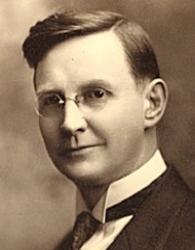
1870 - 1957 Topics: Proper 8 Year B Composer of "FAITHFULNESS" in Voices United Showing early musical promise, William Marion Runyan (b. Marion, NY, 1870; d. Pittsburg, KS, 1957) was a substitute church organist by the age of twelve. He became a Methodist minister in 1891 and served several churches in Kansas but turned to evangelism in 1903; he worked for the Central Methodist Conference for the next twenty years. Following that service, Runyan became pastor at the Federated Church at John Brown University, Sulphur Springs, Arkansas. Editor of Christian Workers Magazine, he also served the Moody Bible Institute and was an editor for Hope Publishing Company until his retirement in 1948. Runyan wrote a number of hymn texts, gospel songs, and hymn tunes.
Bert Polman
William M. Runyan
Martin Rinkart
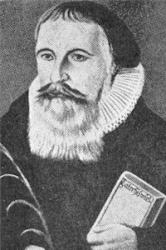
1586 - 1649 Person Name: Martin Rinckart Topics: Proper 8 Year C Author of "Now Thank We All Our God" in Voices United Rinkart, Martin, son of Georg Rinkart or Rinckart, cooper at Eilenburg on the Mulde, Saxony, was born at Eilenburg, April 23, 1586.* After passing through the Latin school at Eilenburg, he became, in Nov., 1601, a foundation scholar and chorister of the St. Thomas's School at Leipzig. This scholarship also allowed him to proceed to the University of Leipzig, where he matriculated for the summer session of 1602, as a student of Theology; and after the completion of his course he remained for some time in Leipzig (he did not take his M.A. till 1616). In March 1610 he offered himself as a candidate for the post of diaconus at Eilenburg, and was presented by the Town Council, but the Superintendent refused to sanction this arrangement, nominally on the ground that Rinkart was a better musician than theologian, but really because he was unwilling to have a colleague who was a native of Eilenburg, and who appeared to have a will of his own. Rinkart, not wishing to contest the matter, applied for a vacant mastership in the gymnasium at Eisleben, and entered on his duties there in the beginning of June, 1610, as sixth master, and also cantor of the St. Nicholas Church. After holding this appointment for a few months, he became diaconus of St. Anne's Church, in the Neustadt of Eisleben, and began his work there May 28, 1611; and then became pastor at Erdeborn and Lyttichendorf (Lütjendorf), near Eisleben, entering on his duties there on Dec. 5, 1613. Finally he was invited by the Town Council of Eilenburg to become archidiaconus there, and in Nov. 1617 came into residence at Eilenburg. He died at Eilenburg, Dec. 8, 1649. A memorial tablet to his memory, affixed to the house where he lived, was unveiled at Eilenburg on Easter Monday, April 26, 1886. (Martin Rinkart’s Geistliche Lieder, ed., with a biographical introduction, and an extensive bibliography, by Heinrich Rembe and Johannes Linke, D.D., Gotha, F. A. Perthes, 1886; K. Goedeke's Grundris, vol. iii., 1887, pp. 169, 211, &c.)
The greater part of Rinkart's professional life was passed amid the horrors of the Thirty Years War. Eilenburg being a walled town became a refuge for fugitives from all around, and being so overcrowded, not unnaturally suffered from pestilence and famine. During the great pestilence of 1637 the Superintendent went away for change of air, and could not be persuaded to return; and on Aug. 7 Rinkart had to officiate at the funerals of two of the town clergy and two who had had to leave their livings in the country. Rinkart thus for some time was the only clergyman in the place, and often read the service over some 40 to 50 persons a day, and in all over about 4,480. At last the refugees had to be buried in trenches without service, and during the whole epidemic some 8,000 persons died, including Rinkart's first wife, who died May 8, 1637. The next year he had an epidemic of marriages to encounter, and himself fell a victim on June 24. Immediately thereafter came a most severe famine, during which Rinkart's resources were strained to the uttermost to help his people. Twice also he saved Eilenburg from the Swedes, once in the beginning of 1637, and again in 1639 (see p. 319, i.). Unfortunately the services he rendered to the place seemed to have made those in authority the more ungrateful, and in his latter years he was much harassed by them in financial and other matters, and by the time that the long-looked-for peace came (Oct. 24, 1648) he was a worn-out and prematurely aged man.
Rinkart was a voluminous writer and a good musician, but a considerable number of his books seem to have perished, and others survive only in single copies. He early began to write poetry, and was crowned as a poet apparently in 1614. Among other things he wrote a cycle of seven so-called "Comedies," or rather dramas, on the Reformation Period, suggested by the centenary of the Reformation in 1617. Three of these were printed respectively in 1613, 1618, and 1625, and two of them were acted in public. Rinkart's hymns appeared principally in the following works:—
(1) Jesu Hertz-Büchlein. This was completed in 1630, and first published at Leipzig in 1636. No copy is now known. The second edition, published at Leipzig, 1663, is in the Royal Library at Hannover. (2) Der Meissnische Thränen Saat, Leipzig, 1637. In the Royal Library at Berlin. (3) xlv. Epithalami Salomoneo—Sulamitici cantica canticorum . . . Leibliche Geistliche und Uimmlische Braut Messe, Leipzig, 1642. In Wolfenbüttel Library. (4) Catechismus-wolthaten, und Catechismus-Lieder, Leipzig, 1645. In the Berlin Library.
Dr. Linke, 1886, as above, gives a list of the first lines of all the hymns in the works of Rinkart which have come under his notice, and prints a selection from them, including 66 in all. The best of them are characterised by a true patriotism, a childlike devotion to God, and a firm confidence in God's mercy, and His promised help and grace. A few passed into the German hymn-books. Those which have been translated into English are:—
1. Alleluja, Lob, Preis und Ehr. This hymn… seems to be based on two hymns, beginning with the same first line, and both found in Rinkart's Braut Messe, 1642. Dr. Linke does not print the full text. (See Blätter für Hymnologie, 1886, p. 91.)
ii. Nun danket alle Gott. Thanksgiving. The oldest text now accessible is in J. Crüger's Praxis, 1648, No. 183, in 3 stanzas of 8 lines; also in the Crüger-Runge Gesang-Buch, 1653, No. 187. It is also in Rinkart's Jesu Hertz-Büchlein, 1663, where the text slightly varies, and is entitled "Grace" ("Tisch-Gebetlein," i.e. a short prayer at table). There does not seem any good reason for supposing that it did not appear in the first ed., 1636, of the Hertz-Büchlein, and in any case it has no connection with the Peace of Westphalia. (A good specimen of the way in which stories of hymns are manufactured is in the Sunday at Home, Aug., 1888, p. 539, where a full and particular account is given of its legendary origin in Nov. 1648.) It is founded on Ecclesiasticus 1. 22-24; and st. i., ii. are indeed little more than a paraphrase of these verses, st. iii. being a version of the Gloria Patri. The fact that the regimental chaplains, when holding the special service of thanksgiving for the conclusion of the peace, were commanded to preach from this passage, may have suggested the theory that Rinkart's hymn was written for the same occasion. It gradually came into general use, successfully survived the period of Rationalism, and is now to be found in every German hymnbook, e.g. in the Berlin Geistliche Lieder, ed. 1863, No. 1022. It may be called the German Te Deum, and as such is used at all national festivals or special occasions of thanksgiving. It was recently used at the festal celebration of the completion of Cologne Cathedral, on Aug. 14, 1880, at the laying of the foundation stone of the new Reichstags building in Berlin, by the Emperor William, June 9, 1884, &c.
The fine melody (set to the hymn in Hymns Ancient & Modern and most recent English collections) appears in the Praxis, 1648 (Crüger's Kirchenmelodien, 1649, No. 94), and in the Crüger-Runge Gesang-Buch, 1653, is marked with Crüger's initials. It has been described as adapted from a melody by Lucas Marenzo (choirmaster at Rome, who died 1598), or as adapted from a motet by Rinkart; but to prove either statement, very little evidence is forthcoming.
The translations of the hymn into English are:—
1. Let all men praise the Lord. This is a tr. of st. i., iii., by Alfred Novello, as part of his version of the word-book to Mendelssohn's Lobgesang, or Hymn of Praise, 1843, p. 89. This form has passed into a number of hymnals, including the New Congregational Hymn Book, 1859; Dale's English Hymn Book 1874, and others. In the Baptist Hymnal, 1879, a tr. of st. ii. is added, of which 11. 1—4 are from Miss Winkworth's translation.
2. Now praise the Lord on high. In full as No. 53 in the Dalston Hospital Hymn Book, 1848. This appears to be the version which Kübler, in his Historical Notes to the Lyra Germanica, 1865, p. 247, says was made by Baron C. K. J. von Bunsen, for the opening of the German Hospital at Dalston, on Oct. 15, 1845.
3. Now let us all to God. In full, by A. T. Russell, as No. 201, in his Psalms & Hymns, 1851.
4. 0 let us praise the Lord, From hearts by true love guided. This is No. 240 in the Winchester Church Hymn Book, 1857, and seems to be intended as a paraphrase of the German.
5. Now thank we all our God. A full and very good translation by Miss Winkworth, in her Lyra Germanica, 2nd Serv. 1858, p. 145, repeated in her Chorale Book for England, 1863, No. 11, and her Christian Singers, 1869, p. 181. It has been included in many recent English and American hymnals, e. g. Hymns Ancient & Modern, 1861; People's Hymnal, 1867; Congregational Hymnal, 1887, &c, and in America in the Episcopal Hymnal, 1871; Presbyterian Hymnal, 1874, and many others, generally in full and unaltered.
6. Now all give thanks to God. In full as No. 264 in the Anglican Hymn Book, 1868 (1871, No. 307), marked as a versification by R. C. Singleton. Repeated in J. L. Porter's Collection, 1876.
7. Now all men thank ye God. In full by T. E. Brown, as No. 37 in the Clifton College Hymn Book, 1872.
Other translations are:—
(l) "Now let us praise the Lord." In full by J. C. Jacobi, 1722, p. 85 (1732, p. 144), repeated, altered, in the Moravian Hymn Book, 1754 to 1886. (2) "Now all, to God give thanks." By Dr. H. Mills, in the Evangelical Review, Gettysburg, 1851, p. 293, and his Horae Germanica, 1856, p. 14. (3) "Lift heart, and hands, and voice." By Miss Cox, 1864, p. 239. (4) “Now all give thanks to God." By J. D. Burns, 1869, p. 252. (5) “All hearts and tongues and hands." By N. L. Frothingham, 1870, p. 212.
iii. So fahr ich hin mit Freuden. For the Dying. In his Meissnische Thränen-Saat, 1637, No. 24, p. 19, in 5 st.anzas of 8 lines, entitled "Even the same, and her soul-rejoicing Farewell Hymn. On May 8." St. i. is,
"So fahr ich hin mit Frewden
Aus diesem Jammerthal,
Aus Angst, Gefahr und Leiden
In Himmels-Frewden Saal,
Da wir und alle Frommen
Durch Gottes Wundermacht
Zusaminen wiederkominen:
In des zu guter Nacht."
The title refers to the preceding hymn, which is in 19 stanzas, the initials of the stanzas forming the acrostic Christina Rinckardi. Dr. Linke abridges it and misprints the title, which is:—
"Die Teutsche Jobs-Schwester (Christina M. Rinckart's Hertzgetrewe Ehe- und Creutz-genossin) und ihr Tagliches und behägliches Trost Lied. Aus ihrem längst erwählten und am 10. [not 30] Tage des Trosthühlen Meyen dieses 1637. Jahres zum letzten Ehrengedächtniss abgehandelten Leich-Text: des 77. Psalms."
From this it is clear that both hymns are in memory of his wife, that she died on May 8, 1637, and that her funeral sermon was preached by her husband on May 10, 1637. The form translation into English is the greatly altered, or rather practically new text. [Rev. James Mearns, M.A.]
* His own statement was that he “was born Anno 1586, Jubilate Sunday, on St. George's day, which was the 23rd of April, between 6 and 7 a.m." In 1586 however Jubilate S. (3rd Sunday after Easter) fell on April 24, while St. George's day is April 23. The entry in the Registers at Eilenburg says that he was baptised "Monday after Jubilate, the 25th of April," which is quite correct.
--John Julian, Dictionary of Hymnology (1907)
Martin Rinkart
John Ernest Bode

1816 - 1874 Topics: Proper 8 Year A Author of "O Jesus, I Have Promised" in Voices United John E. Bode (b. St. Pancras, England, 1816; d. Castle Camps, Cambridgeshire, England, 1874) A fine student at Christ Church, Oxford, England, and a prominent scholar who gave the famous Bampton Lectures ("for the exposition and defense of the Christian faith") at Oxford in 1855, was a rector in Westwell, Oxfordshire, and in Castle Camps. This gifted poet and hymn writer published Hymns for the Gospel of the Day, for Each Sunday and Festivals of Our Lord in 1860.
Bert Polman
==============
Bode, John Ernest, M.A., son of Mr. William Bode, late of the General Post Office, b. 1816, and educated at Eton, the Charter House, and at Christ Church, Oxford, graduating B.A. 1837, and M.A. in due course. Taking Holy Orders in 1841, he became Rector of Westwell, Oxfordshire, 1847; and then of Castle Camps, Cambridgeshire, 1860. He was also for a time Tutor of his College, and Classical Examiner. His Bampton Lectures were delivered in 1855. He d. at Castle Camps, Oct. 6, 1874. In addition to his Bampton Lectures, and Ballads from Herodotus, he published Hymns from the Gospel of the Day for each Sunday and Festivals of our Lord, 1860; and Short Occasional Poems, Lond., Longmans, 1858. In addition to his well-known hymn, “O Jesu, I have promised " (q. v.), the following from his Hys. from the Gospel are also in common use:—
1. God of heaven, enthroned in might. H. Trinity.
2. Spirit of Truth, indwelling Light. Whitsuntide.
-John Julian, Dictionary of Hymnology (1907)
=================
Bode, John E. , p. 151, ii. Additional pieces from his Hys.from the Gospel of the Day, &c, 1800, are in common use :— (1) "Sweetly the Sabbath bell" (Sunday); (2) "Thou Who hast called us by Thy word" (20th S. after Trinity).
--John Julian, Dictionary of Hymnology, Appendix, Part II (1907)
John Ernest Bode
Henry J. Gauntlett
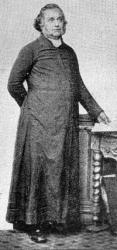
1805 - 1876 Person Name: H. J. Gauntlett, 1805-1876 Topics: Proper 8 Year A Composer of "LAUDATE DOMINUM (GAUNTLETT)" in Common Praise Henry J. Gauntlett (b. Wellington, Shropshire, July 9, 1805; d. London, England, February 21, 1876) When he was nine years old, Henry John Gauntlett (b. Wellington, Shropshire, England, 1805; d. Kensington, London, England, 1876) became organist at his father's church in Olney, Buckinghamshire. At his father's insistence he studied law, practicing it until 1844, after which he chose to devote the rest of his life to music. He was an organist in various churches in the London area and became an important figure in the history of British pipe organs. A designer of organs for William Hill's company, Gauntlett extended the organ pedal range and in 1851 took out a patent on electric action for organs. Felix Mendelssohn chose him to play the organ part at the first performance of Elijah in Birmingham, England, in 1846. Gauntlett is said to have composed some ten thousand hymn tunes, most of which have been forgotten. Also a supporter of the use of plainchant in the church, Gauntlett published the Gregorian Hymnal of Matins and Evensong (1844).
Bert Polman
Henry J. Gauntlett
C. G. Gläser
1784 - 1829 Person Name: Carl Gotthelf Gläser Topics: Proper 8 Year B Composer of "AZMON" in Voices United Carl Gotthelf Gläser Germany 1781-1829. Born at Weissenfels, Burgenlandkreis, Sachsen-Anhalt, Germany, he received musical training from his father, after which he attended St. Thomas school in Leipzig. He became an author and composer. At Barmen he taught voice, piano, and violin. He also wrote and conducted chorale music. He died at Barmen.
John Perry
C. G. Gläser
Johann Crüger
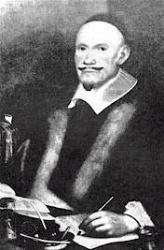
1598 - 1662 Topics: Proper 8 Year C Composer of "NUN DANKET" in Voices United Johann Crüger (b. Grossbriesen, near Guben, Prussia, Germany, 1598; d. Berlin, Germany, 1662) Crüger attended the Jesuit College at Olmutz and the Poets' School in Regensburg, and later studied theology at the University of Wittenberg. He moved to Berlin in 1615, where he published music for the rest of his life. In 1622 he became the Lutheran cantor at the St. Nicholas Church and a teacher for the Gray Cloister. He wrote music instruction manuals, the best known of which is Synopsis musica (1630), and tirelessly promoted congregational singing. With his tunes he often included elaborate accompaniment for various instruments. Crüger's hymn collection, Neues vollkomliches Gesangbuch (1640), was one of the first hymnals to include figured bass accompaniment (musical shorthand) with the chorale melody rather than full harmonization written out. It included eighteen of Crüger's tunes. His next publication, Praxis Pietatis Melica (1644), is considered one of the most important collections of German hymnody in the seventeenth century. It was reprinted forty-four times in the following hundred years. Another of his publications, Geistliche Kirchen Melodien (1649), is a collection arranged for four voices, two descanting instruments, and keyboard and bass accompaniment. Crüger also published a complete psalter, Psalmodia sacra (1657), which included the Lobwasser translation set to all the Genevan tunes.
Bert Polman
===============================
Crüger, Johann, was born April 9, 1598, at Gross-Breese, near Guben, Brandenburg. After passing through the schools at Guben, Sorau and Breslau, the Jesuit College at Olmütz, and the Poets' school at Regensburg, he made a tour in Austria, and, in 1615, settled at Berlin. There, save for a short residence at the University of Wittenberg, in 1620, he employed himself as a private tutor till 1622. In 1622 he was appointed Cantor of St. Nicholas's Church at Berlin, and also one of the masters of the Greyfriars Gymnasium. He died at Berlin Feb. 23, 1662. Crüger wrote no hymns, although in some American hymnals he appears as "Johann Krüger, 1610,” as the author of the supposed original of C. Wesley's "Hearts of stone relent, relent" (q.v.). He was one of the most distinguished musicians of his time. Of his hymn tunes, which are generally noble and simple in style, some 20 are still in use, the best known probably being that to "Nun danket alle Gott" (q.v.), which is set to No. 379 in Hymns Ancient & Modern, ed. 1875. His claim to notice in this work is as editor and contributor to several of the most important German hymnological works of the 16th century, and these are most conveniently treated of under his name. (The principal authorities on his works are Dr. J. F. Bachmann's Zur Geschichte der Berliner Gesangbücher 1857; his Vortrag on P. Gerhard, 1863; and his edition of Gerhardt's Geistliche Lieder, 1866. Besides these there are the notices in Bode, and in R. Eitner's Monatshefte für Musik-Geschichte, 1873 and 1880). These works are:—
1. Newes vollkömmliches Gesangbuch, Augspur-gischer Confession, &c, Berlin, 1640 [Library of St. Nicholas's Church, Berlin], with 248 hymns, very few being published for the first time.
2. Praxis pietatis melica. Das ist: Ubung der Gottseligkeit in Christlichen und trostreichen Gesängen. The history of this, the most important work of the century, is still obscure. The 1st edition has been variously dated 1640 and 1644, while Crüger, in the preface to No. 3, says that the 3rd edition appeared in 1648. A considerable correspondence with German collectors and librarians has failed to bring to light any of the editions which Koch, iv. 102, 103, quotes as 1644, 1647, 1649, 1650, 1651, 1652, 1653. The imperfect edition noted below as probably that of 1648 is the earliest Berlin edition we have been able to find. The imperfect edition, probably ix. of 1659, formerly in the hands of Dr. Schneider of Schleswig [see Mützell, 1858, No. 264] was inaccessible. The earliest perfect Berlin edition we have found is 1653.
The edition printed at Frankfurt in 1656 by Caspar Röteln was probably a reprint of a Berlin edition, c. 1656. The editions printed at Frankfurt-am-Main by B. C. Wust (of which the 1666 is in the preface described as the 3rd) are in considerable measure independent works.
In the forty-five Berlin and over a dozen Frankfurt editions of this work many of the hymns of P. Gerhardt, J. Franck, P. J. Spener, and others, appear for the first time, and therein also appear many of the best melodies of the period.
3. Geistliche Kirchen-Melodien, &c, Leipzig, 1649 [Library of St. Katherine's Church, Brandenburg]. This contains the first stanzas only of 161 hymns, with music in four vocal and two instrumental parts. It is the earliest source of the first stanzas of various hymns by Gerhardt, Franck, &c.
4. D. M. Luther's und anderer vornehmen geisU reichen und gelehrten Manner Geistliche Lieder und Psalmen, &c, Berlin, 1653 [Hamburg Town Library], with 375 hymns. This was edited by C. Runge, the publisher, and to it Crüger contributed some 37 melodies. It was prepared at the request of Luise Henriette (q.v.), as a book for the joint use of the Lutherans and the Re¬formed, and is the earliest source of the hymns ascribed to her, and of the complete versions of many hymns by Gerhardt and Franck.
5. Psalmodia Sacra, &c, Berlin, 1658 [Royal Library, Berlin]. The first section of this work is in an ed. of A. Lobwasser's German Psalter; the second, with a similar title to No. 4, and the date 1657, is practically a recast of No. 4,146 of those in 1653 being omitted, and the rest of the 319 hymns principally taken from the Praxis of 1656 and the hymn-books of the Bohemian Brethren. New eds. appeared in 1676, 1700, 1704, 1711, and 1736.
[Rev. James Mearns, M.A.]
-- Excerpt from John Julian, Dictionary of Hymnology (1907)
=======================
Crüger, Johann, p. 271, ii. Dr. J. Zahn, now of Neuendettelsau, in Bavaria, has recently acquired a copy of the 5th ed., Berlin, 1653, of the Praxis.
--John Julian, Dictionary of Hymnology, Appendix, Part II (1907)
Johann Crüger
Ralph Vaughan Williams
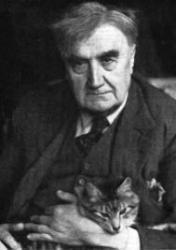
1872 - 1958 Topics: Proper 8 Year A Composer of "KING'S WESTON" in Voices United Through his composing, conducting, collecting, editing, and teaching, Ralph Vaughan Williams (b. Down Ampney, Gloucestershire, England, October 12, 1872; d. Westminster, London, England, August 26, 1958) became the chief figure in the realm of English music and church music in the first half of the twentieth century. His education included instruction at the Royal College of Music in London and Trinity College, Cambridge, as well as additional studies in Berlin and Paris. During World War I he served in the army medical corps in France. Vaughan Williams taught music at the Royal College of Music (1920-1940), conducted the Bach Choir in London (1920-1927), and directed the Leith Hill Music Festival in Dorking (1905-1953). A major influence in his life was the English folk song. A knowledgeable collector of folk songs, he was also a member of the Folksong Society and a supporter of the English Folk Dance Society. Vaughan Williams wrote various articles and books, including National Music (1935), and composed numerous arrangements of folk songs; many of his compositions show the impact of folk rhythms and melodic modes. His original compositions cover nearly all musical genres, from orchestral symphonies and concertos to choral works, from songs to operas, and from chamber music to music for films. Vaughan Williams's church music includes anthems; choral-orchestral works, such as Magnificat (1932), Dona Nobis Pacem (1936), and Hodie (1953); and hymn tune settings for organ. But most important to the history of hymnody, he was music editor of the most influential British hymnal at the beginning of the twentieth century, The English Hymnal (1906), and coeditor (with Martin Shaw) of Songs of Praise (1925, 1931) and the Oxford Book of Carols (1928).
Bert Polman
Ralph Vaughan Williams
Pages




