

 My Starred Hymns
 My FlexScores
 My Hymnals
 My Purchased Files
Planning worship?
Check out our sister site, ZeteoSearch.org,
for 20+ additional resources related to your search.
- |
User Links
Search Results


Heilig ist Gott der Vater
Appears in 1 hymnal Topics: Songs for the Feast of the Holy Trinity Lyrics: Heilig ist Gott der Vater,
Heilig ist Gott der Sohn,
Heilig ist Gott der Heilig' Geist,
unser Gott und Herr Zebaoth.
Himmel und Erde sind
mit seiner Herrlichkeit
und Ehren erfüllet.
Hosianna sie Gott dem Herrn in der Höhe.
Gelobet sei unser Heiland, der Sohn Gottes,
der da kömmt im Namen des Herrn.
Hosianna dem Sohn David in der Höhe.
Heilig ist Gott der Vater
Jesaia, dem Propheten, das geschah
Author: Dr. M. Luther Appears in 21 hymnals Topics: Songs for the Feast of the Holy Trinity Lyrics: Jesaia dem Propheten das geschah,
daß er im Geist den Herren sitzen sah
auf einem hohen Thron im hellem Glanz
seines Kleides Saum den Chor füllet ganz.
Es standen zween Seraph bei Ihm daran,
sechs Flügel sah einen jeden han;
mit zween bedekten sie ihr Antlitz klar,
mit zween bedeckten sie die Füße gar,
und mit den andern zween sie flogen frei,
gegen ander ruften sie mit großem G'schrei:
Heilig ist Gott, der Herre Zebaoth!
Heilig ist Gott, der Herre Zebaoth!
Heilig ist Gott, der Herre Zebaoth!
Sein' Ehr' die ganze Welt erfüllet hat.
Von dem Geschrei erzittert Schwell und Balken gar,
das Haus auch ganz voll Rauchs und Nebels war. Scripture: Isaiah 6
Jesaia, dem Propheten, das geschah
Lob, Ehr' und Preis sei unserm Gott
Appears in 10 hymnals Topics: Songs for the Feast of the Holy Trinity Lyrics: 1 Lob, Ehr' und Preis sei unserm Gott,
der uns so hoch geliebet hat
daß Er uns seinen ein'gen Sohn
gesandt zum Heil und Gnadenthron.
2 Lob sei Dir, o Herr Jesu Christ,
daß Du uns'r Bruder worden bist,
hast uns errettet durch Dein Blut
von's Teufels Strick und Höllengluth.
3 Lob sei Dir, o Gott Heil'ger Geist,
der Du der Herzen Tröster heißt'st
und zierest sie mit Glauben fein,
damit wir Gott gefällig sein.
4 Kein's Menschen Zung' aussprechen kann,
was Du, o Gott an uns gethan,
drum seufzen wir, o treuer Hort,
gieb uns, was wir Dich bitten, fort.
5 Vater, gedenk der Kinder Dein,
wir trauen ja auf Dich allein;
gieb Leibs G'sundheit, gut Regiment:
Krieg, Sterben, Theurung von uns wend'.
6 Herr Jesu Christ, Du starker Held,
wehr' doch dem Fürsten dieser Welt,
zerstör' sein Reich und schaff' uns Ruh,
auf daß Dein' Kirche nehme zu.
7 O Tröster schon, Heiliger Geist,
der Du all' unsre Schwachheit weiß'st,
sei uns mit Deiner Hülf' bereit,
daß wir Gott dienen allezeit.
8 O heilige Dreifaltigkeit,
einiger Gott von Ewigkeit,
leucht' uns mit Deinem Angesicht,
hilf, daß wir von Dir wanken nicht.
Lob, Ehr' und Preis sei unserm Gott

O lux beata Trinitas
Author: Ambrosius Hymnal: Evangelisch-Lutherisches Gesang-Buch #189 (1848) Topics: Songs for the Feast of the Holy Trinity Lyrics: 1 O lux beata Trinitas,
et principalis unitas,
jam sol recedit igneus,
infundo lumen cordibus.
2 Te mane laudum carmine,
Te deprecemur vespere,
Te nostra suplex gloria
per cuncta laudet cesula.
3 Deo patri sit gloria,
ejusque soli filio
cum spiritu paracleto
nunc et per omne seculum. Languages: German; Latin
O lux beata Trinitas
Der Du bist Drei in Einigkeit
Author: Dr. M. Luther Hymnal: Evangelisch-Lutherisches Gesang-Buch #190 (1848) Topics: Songs for the Feast of the Holy Trinity Lyrics: 1 Der du bist Drei in Einigkeit,
ein wahrer Gott von Ewigkeit,
die Sonn' mit dem Tag von uns weicht,
laß uns leuchten Dein göttlich Licht.
2 Des Morgens, Gott, Dich loben wir,
des Abends auch beten vor Dir,
unser armes Lied rühmet Dich
jetzund, immer und ewiglich.
3 Gott Vater, dem sei ewig Ehr',
Gott Sohn, der ist der einig Herr,
und dem Tröster heiligen Geist,
von nun an bis in Ewigkeit.
Languages: German
Der Du bist Drei in Einigkeit
Das Kyrie Summum
Hymnal: Evangelisch-Lutherisches Gesang-Buch #191 (1848) Topics: Songs for the Feast of the Holy Trinity First Line: Kyrie fons bonitatis Lyrics: 1 Kyrie Fons bonitatis,
Pater ingenite,
a quo bona cuncta procedunt.
Eleison.
2 Christe! unice Dei patris genite!
quem de virgine nasciturum mundo
mirifice sancti praedixerunt Prophetae.
Eleison.
3 Kyrie, ignis divene,
pectore nostra accende,
ut digni pariter te laudare possimus semper.
Eleison Languages: German; Greek; Latin
Das Kyrie Summum


Johann Franck
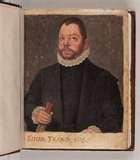
1618 - 1677 Person Name: Johann Frank Topics: Songs for the Feast of the Holy Trinity Author of "Dreieinigkeit! der Gottheit wahrer Spiegel" in Evangelisch-Lutherisches Gesang-Buch Johann Franck (b. Guben, Brandenburg, Germany, 1618; d. Guben, 1677) was a law student at the University of Köningsberg and practiced law during the Thirty Years' War. He held several positions in civil service, including councillor and mayor of Guben. A significant poet, second only to Paul Gerhardt in his day, Franck wrote some 110 hymns, many of which were published by his friend Johann Crüger in various editions of the Praxis Pietatis melica. All were included in the first part of Franck’s Teutsche Gedichte bestehend im geistliche Sion (1672).
Bert Polman
=============
Franck, Johann, son of Johann Franck, advocate and councillor at Guben, Brandenburg, was born at Guben, June 1, 1618. After his father's death, in 1620, his uncle by marriage, the Town Judge, Adam Tielckau, adopted him and sent him for his education to the schools at Guben, Cottbus, Stettin and Thorn. On June 28, 1638, he matriculated as a student of law at the University of Königsberg, the only German university left undisturbed by the Thirty Years' War. Here his religious spirit, his love of nature, and his friendship with such men as Simon Dach and Heinrich Held, preserved him from sharing in the excesses of his fellow students. He returned to Guben at Easter, 1640, at the urgent request of his mother, who wished to have him near her in those times of war during which Guben frequently suffered from the presence of both Swedish and Saxon troops. After his return from Prague, May, 1645, he commenced practice as a lawyer. In 1648 he became a burgess and councillor, in 1661 burgomaster, and in 1671 was appointed the deputy from Guben to the Landtag (Diet) of Lower Lusatia. He died at Guben, June 18, 1677; and on the bicentenary of his death, June 18, 1877, a monumental tablet to his memory was affixed to the outer wall of the Stadtkirche at Guben (Koch, iii. 378-385; Allgemeine Deutsche Biographie, vii. 211-212; the two works by Dr. Hugo Jentsch of Guben, Johann Franck, 1877, and Die Abfassungszeit der geistlichen Lieder Johann Franck's, 1876).
Of Franck's secular poems those before 1649 are much the best; his later productions becoming more and more affected and artificial, long-winded and full of classical allusions, and much inferior to those of Dach or Opitz. As a hymn writer he holds a high rank and is distinguished for unfeigned and firm faith, deep earnestness, finished form, and noble, pithy, simplicity of expression. In his hymns we miss the objectivity and congregational character of the older German hymns, and notice a more personal, individual tone; especially the longing for the inward and mystical union of Christ with the soul as in his "Jesus, meine Freude." He stands in close relationship with Gerhardt, sometimes more soaring and occasionally more profound, but neither on the whole so natural nor so suited for popular comprehension or Church use.
His hymns appeared mostly in the works of his friends Weichmann, Crüger and Peter. They were collected in his Geistliches Sion, Guben, 1674, to the number of 110; and of these the 57 hymns (the other 53 being psalm versions of no great merit) were reprinted with a biographical preface by Dr. J. L. Pasig as Johann Franck's Geistliche Lieder, Grimma, 1846. Two of those translated into English are from the Latin of J. Campanus (q. v.). Four other hymns are annotated under their own first lines:—"Brunquell aller Güter"; "Dreieinigkeit der Gottheit wahrer Spiegel"; "Jesu, meine Freude"; "Schmücke dich, o liebe Secle." The rest are:—
i. Hymns in English common use: --
i. Erweitert eure Pforten . [Advent]. Founded on Psalm xxiv. 7-10. First published in C. Peter's Andachts-Zymbeln, Freiberg, 1655, p. 25, in 7 stanzas of 8 lines; repeated 1674, p. 3, and 1846, p. 3, as above. Included in the 1688 and later editions of Crüger's Praxis pietatis, in Bollhagen's Gesang-Buch, 1736, &c.
The only translation in common use is:—-
Unfold your gates and open, a translation of st. 1, 3, 6, by A. T. Russell, as No. 30 in his Hymns & Psalms, 1851; repeated altered as No. 30 in Kennedy, 1863, and thus as No. 102 in Holy Song, 1869.
ii. Herr Gott dich loben wir, Regier. Thanksgiving for Peace. Evidently written as a thanksgiving for the conclusion of the Thirty Years' War, by the Peace of Westphalia, Oct. 24, 1648. First published in the Crüger-Runge Gesang-Buch, Berlin, 1653, No. 306, in 9 st. of 8 l., as the first of the "Hymns of Thanksgiving for Peace attained"; and repeated 1674, p. 182, and 1846, p. 77, as above. Included in Crüger's Praxis, 1653, and many later collections, and, as No. 591, in the Unverfälschter Liedersegen, 1851. The only translation in common use is:—
Lord God, we worship Thee, a very good version of st. 2, 3, 6, 8, by Miss Winkworth in her Chorale Book for England, 1863, No. 183. Repeated in full in the Society for Promoting Christian Knowledge Church Hymns, 1871; the Hymnary, 1872; the Psalmist, 1878; and in America in the Pennsylvania Lutheran Church Book, 1868. In the American Protestant Episcopal Collection, 1871; the Hymns & Songs of Praise, N. Y. 1874; and the Ohio Lutheran Hymnal, 1880, the translation of stanza 8 is omitted.
iii. Herr ich habe missgehandelt. Lent. Of this fine hymn of penitence stanza i. appeared as No. 19 in Cruger's Geistliche Kirchenmelodien , Leipzig, 1649. The full form in 8 stanzas of 6 lines is No. 41 in the Crüger-Runge Gesang-Buch, Berlin, 1653, entitled "For the forgiveness of sins," repeated 1674, p. 39, and 1846, p. 37, as above. Included in Crüger's Praxis, 1653, and others, and in the Unverfälschter Liedersegen, 1851. The only translation in common use is:—
Lord, to Thee I make confession, a very good translation, omitting st. 4, 5, 6, by Miss Winkworth in her Chorale Book for England, 1863, No. 44, repeated in the Appendix to the Hymnal for St. John's, Aberdeen, 1865-1870; and in the Pennsylvania Lutheran Ch. Book, 1868; Evangelical Hymnal, N. Y., 1880; Ohio Lutheran Hymnal, 1880. Another translation is: "Lord, how oft I have offended," by N. L. Frothingham, 1870, p. 177.
iv. Herr Jesu, Licht der Heiden. Presentation in the Temple. Founded on the account in St. Luke ii., and probably the finest hymn on the subject. Dr. Jentsch, 1876, p. 9, thinks it was written before Dec. 8, 1669, as C. Peter, who died then, left a melody for it. We have not found the full text earlier than 1674, as above, p. 10, in 6 stanzas of 8 lines, entitled "On the Festival of the Purification of Mary" (1846, p. 10). Included in the 1688 and later editions of Crüger's Praxis, and in the Unverfälschter Liedersegen, 1851, No. 197. The translations in common use are:—
1. Light of the Gentile world , a translation, omitting st. 6, by Miss Winkworth in the first service of her Lyra Germanica, 1855, p. 193 (ed. 1876, p. 195), and thence as No. 147 in the Pennsylvania Lutheran Hymn Book, 1865. This version is in S.M. Double.
2. Light of the Gentile Nations, a good translation, omitting st. 6, by Miss Winkworth in her Chorale Book for England, 1863, No. 80. Repeated in Dr. Thomas's Augustine Hymn Book, 1866, and in America in the Pennsylvania Lutheran Church Book, 1868, and the Ohio Lutheran Hymnal, 1880.
ii. Hymns not in English common use:
v. Du geballtes Weltgebäude. Christ above all earthly things. Stanza i. in Cruger's Kirchenmelodien, 1649, No. 116. The full text (beginning "Du o schönes) is No. 239 in the Crüger-Runge Gesang-Buch, 1653, in 8 stanzas, entitled "Longing after Eternal Life." Repeated, 1674, p. 194, and 1846, p. 60, as above. The translations are: (1) "Let who will in thee rejoice," by Miss Winkworth, 1855, p. 180 (1876, p. 182). (2) "O beautiful abode of earth," by Miss Warner, 1858 (1861, p. 233). (3) "Thou, O fair Creation-building," by N. L. Frothingham, 1870, p. 232.
vi. Unsre müden Augenlieder. Evening. Probably written while a student at Königsberg. First published in J. Weichmann's Sorgen-lägerin, Königsberg, 1648, Pt. iii., No. 4, in 7 st.; repeated 1674, p. 213, and 1846, p. 91, as above. The only translation is by H. J. Buckoll, 1842, p. 79, beginning with st. vi., "Ever, Lord, on Thee relying." [Rev. James Mearns, M.A.]
--John Julian, Dictionary of Hymnology (1907)
Johann Franck
Johann Olearius
1611 - 1684 Person Name: Dr. Joh. Olearius Topics: Songs for the Feast of the Holy Trinity Author of "Gelobet sei der Herr" in Evangelisch-Lutherisches Gesang-Buch Johannes Olearius (b. Halle, Germany, 1611; d. Weissenfels, Germany, 1684) Born into a family of Lutheran theologians, Olearius received his education at the University of Wittenberg and later taught theology there. He was ordained a Lutheran pastor and appointed court preacher to Duke August of Sachsen-Weissenfels in Halle and later to Duke Johann Adolph in Weissenfels. Olearius wrote a commentary on the entire Bible, published various devotional books, and produced a translation of the Imitatio Christi by Thomas a Kempis. In the history of church music Olearius is mainly remembered for his hymn collection, which was widely used in Lutheran churches.
Bert Polman
=======================
Olearius, Johannes, son of Johann Olearius, pastor of St. Mary's Church and superintendent at Halle, was born at Halle, Sept. 17, (N.S.) 1611. He entered the University of Wittenberg in 1629 (M.A. 1632, D.D. 1643], where he became lecturer, and, in 1635, adjunct of the philosophical faculty. In 1637 he became Superintendent at Querfurt; and, in 1643, was appointed by Duke August of Sachsen-Weissenfels as his chief court preacher, and private chaplain at Halle, where he became in 1657 Kirchenrath, and in 1664 General Superintendent. When, on the death of Duke August in 1680, the administration of Magdeburg fell to the Elector of Brandenburg, Duke Johann Adolf gave Olearius similar appointments at Weissenfels, which he held till his death on April 24, 1684 (Koch, iii. 346; Allgemeine Deutsche Biographie xxiv. 279, &c).
Olearius was the author of a Commentary on the whole Bible, and of various devotional works. He was also the compiler of one of the largest and most important German hymn-books of the 17th century, viz. the Geistliche Singe-Kunst, of which the first edition appeared at Leipzig in 1671, with 1207 (1218) hymns, and the second at Leipzig in 1672, with 1340. The first edition contained 302 hymns by Olearius himself, and marked "D. J. O." They may best be described as useful, being for times and seasons hitherto unprovided for, and filling up many gaps in the various sections of the German hymn-books. They are mostly short, many of only two verses, simple and easy of comprehension, often happy in expression and catching, and embodying in a concise form the leading ideas of the season or subject. Many were speedily adopted into German hymn-books, and a considerable number are still in use.
Of Olearius's hymns the following have passed into English:—
i. Gelobet sei der Herr. Trinity Sunday. One of his best hymns. Founded on the Gospel for Trinity Sunday. Included in 1(571 as above, No. 709, in 5 stanzas of 8 lines, and entitled "Encouragement from the Gospel to thankful meditation on this great mystery." In the Berlin Geistliche Lieder ed. 1863, No. 17. Translated as:—
1. Blest be my Lord and God. A good translation, omitting st. v. by A. T. Russell, as No. 134, in his Psalms & Hymns 1851.
2. 0 praise the Lord! His name extol. A version of st. i.-iii., as No. 115 in the Ohio Lutheran Hymnal, 1880.
ii. Herr Jesu Christ, dein theures Blut. Passiontide. His finest hymn. Founded on I St. John i. 7. In 1671 as above, No. 576, in 4 stanzas of 4 lines and entitled "Meditation on the Precious Blood of Jesus Christ." St. ii. is based on the hymn “In Christi Wunden schlaf ich ein" (p. 319, ii.). In the Berlin Geistliche Lieder, edition 1863, No. 233. Translated as:—
1. Lord Jesu Christ! Thy precious blood Brings to my soul. A good and full translation by A. T. Russell, as No. 161 in his Psalms & Hymns, 1851.
2. Lord Jesus Christ! Thy precious blood Is to my soul. In full by C. H. L. Schnette, as No. 77 in the Ohio Lutheran Hymnal, 1880.
Another translation is "Lord Jesus Christ, Thy blessed blood." By Miss Manington, 1863, p. 43.
iii. Herr, öffhe mir die Herzensthür. Holy Scripture. After Sermon. In 1671 as above, No. 975, in 2 stanzas and a doxology. In the Berlin Geistliche Lieder, ed. 1863, No. 422. The translation in common use is:—
Lord, open Thou my heart to hear, And by Thy Word to me draw near. In full by Dr. M. Loy in the Ohio Lutheran Hymnal, 1880.
iv. Nun kommt das neue Kirchenjahr. Advent. In 1671 as above, No. 384, in 3 stanzas and a doxology. In the Berlin Geistliche Lieder, ed. 1863, No. 145. The translation is:—
The new Church year again is come. By E. Cronenwett, as No. 15 in the Ohio Lutheran Hymnal, l880.
v. Tröstet, tröstet meine Lieben. St. John Baptist's Day. In 1671 as above, No. 733, in 4 stanzas of 8 lines, and entitled "Meditation on the Lesson of the Festival. Isaiah xl." In the Berlin Geistliche Lieder, ed. 1863, No. 124. Translated as:—
Comfort, comfort ye my people. A full and good translation by Miss Winkworth, as No. 83 in her Chorale Book for England, 1863. Repeated in full in the Parish Hymn Book, 1865, and the Ohio Lutheran Hymnal, 1880, and, omitting st. ii. in the Pennsylvania Lutheran Church Book, 1868.
Other hymns by Olearius have been translated into English, viz.:—
vi. Gott Lob, mein Jesus macht mich rein. Presentation in the Temple. In 1671 as above, No. 507, as a hymn on the Purification in 6 stanzas, and entitled "Encouragement from the Gospel," viz. St. Luke ii. 22-32. In the Berlin Geistliche Lieder, ed. 1863, No. 1270. The form tr. is "Durch Jesum kann ich auch mit Freud," which is No. 428 in Knapp's Evangelischer Liederschatz, 1837, and is st. iv.-vi. altered. Translated as "I too, through Jesus, may in peace." By Dr. H. Mills, 1845 (1856, p. 277).
vii. Sollt ich meinem Gott nicht trauen. Trust in God. In 1671 as above, No. 878, in 6 stanzas, and entitled “Encouragement from the Gospel," viz. St. Matt. vi. 24 ff, the Gospel for the 15th Sunday after Trinity. In the Berlin Geistliche Lieder, ed. 1863, No. 857. Tr. as, "Shall I not trust my God." By Miss Warner, 1858, p. 206.
viii. Wenn dich Unglüick hat betreten. Cross and Consolation. In 1671 as above, No. 827, in 6 st., and entitled "Encouragement from the Gospel," viz. St. Matt. xv. 21-28, the Gospel for Reminiscere Sunday (2nd Sunday in Lent). In Porst's Gesang-Buch, ed. 1855, No. 997. The translations are (1) "When afflictions sore oppress you." By Miss Cox, 1841, p. 129. (2) "When affliction rends the heart." By Lady E. Fortescue, 1843, p. 55. [Rev. James Mearns, M.A.]
--John Julian, Dictionary of Hymnology (1907)
Johann Olearius
Michael Weisse
1480 - 1534 Person Name: Michael Weiß Topics: Songs for the Feast of the Holy Trinity Author of "Mein Mund soll fröhlich preisen" in Evangelisch-Lutherisches Gesang-Buch Michael Weiss was born at Neisse, in Silesia. He was a pastor among the Bohemian Brethren, and a contemporary with Luther. His hymns have received commendation. He died in 1540.
--Annotations of the Hymnal, Charles Hutchins, M.A. 1872.
============
Weisse, Michael (Weiss, Wiss, Wegs, Weys, Weyss), was born circa 1480, in Neisse, Silesia, took priest's orders, and was for some time a monk at Breslau. When the early writings of Luther came into his hands, Weisse, with two other monks, abandoned the convent, and sought refuge in the Bohemian Brethren's House at Leutomischl in Bohemia. He became German preacher (and apparently founder of the German communities) to the Bohemian Brethren at Landskron in Bohemia, and Fulnck in Moravia, and died at Landskron in 1534 (Koch, ii. 115-120; Wackernagel's D. Kirchenlied, i. p. 727; Fontes rerum Austricarum, Scriptores, vol. ii. pt. ii. p. 227, Vienna, 18G3, &c).
Weisse was admitted as a priest among the Brethren at the Synod of Brandeis, in 1531, and in 1532 was appointed a member of their Select Council, but he had previously performed important missions for the Brethren. He was, e.g., sent by Bishop Lucas, in 1522, along with J. Roh or Horn, to explain the views of the Bohemian Brethren to Luther; and again, in 1524, when they were appointed more especially to report on the practices and holiness of life of the followers of the German Reformers. He was also entrusted with the editing of the first German hymn-book of the Bohemian Brethren, which appeared as Ein New Gesengbuchlen at Jungen Bunzel (Jung Bunzlau) in Bohemia in 1531. This contained 155 hymns, all apparently either translations or else originals by himself. The proportion of translations is not very clear. In the preface to the 1531, Weisse addressing the German Communities at Fulnek and Landskron says, "I have also, according to my power, put forth all my ability, your old hymn-book as well as the Bohemian hymn-book (Cantional) being before me, and have brought the same sense, in accordance with Holy Scripture, into German rhyme."
Luther called Weisse "a good poet, with somewhat erroneous views on the Sacrament" (i.e. Holy Communion); and, after the Sacramental hymns had been revised by Roh (1544), included 12 of his hymns in V. Babst's Gesang-Buch, 1545. Many of his hymns possess considerable merit. The style is flowing and musical, the religious tone is earnest and manly, but yet tender and truly devout, and the best of them are distinguished by a certain charming simplicity of thought and expression. At least 119 passed into the German Lutheran hymnbooks of the 16th and 17th centuries, and many are still in use.
The following hymns by Weisse have also passed into English:—
i. Christus ist erstanden. Von des Todes Banden. Easter. First published 1531 as above, and thence in Wackernagel, iii. p. 273, in 7 stanzas of 4 lines. It is suggested by the older hymn, "Christ ist erstanden". In the Unverfälschter Liedersegen, 1851, No. 129. The translation in common use is:—
Christ the Lord is risen again! This is a full and very good translation by Miss Winkworth, in her Lyra Germanica, 2nd Ser., 1858, p. 37, and her Chorale Book for England, 1863, No. 58. It has been included in many recent English and American hymnals. Other translations are:—
(1) "Christ (and 'tis no wonder"). This is No. 260 in pt. i. of the Moravian Hymn Book, 1754. (2) "Christ our Lord is risen," by Dr. H. Mills, 1856, p. 322.
ii. Es geht daher des Tages Schein. Morning. 1531 as above, and thence in Wackernagel, iii. p. 318, in 7 stanzas of 4 lines. In the Unverfälschter Liedersegen, 1851, No. 455. The translations in common use are:—
1. The Light of Day again we see. In full, by H. J. Buckoll in his Hymns from German, 1842, p. 14. His translations of stanzas iii., iv., vi., vii., beginning “Great God, eternal Lord of Heaven," were included in the Rugby School Hymn Book, 1843.
2. Once more the daylight shines abroad. This is a full and very good translation by Miss Winkworth, in her Lyra Germanica, 2nd Ser., 1858, p. 69, and her Chorale Book for England, 1863, No. 18. Repeated in Thring's Collection, 1880-82.
iii. Gelobt sei Gott im höchsten Thron. Easter. 1531 as above, and thence in Wackernagel, iii. p. 265, in 20 stanzas of 3 lines, with Alleluia. The translations in common use are: —
1. Praise God upon His heavenly throne. This is a free translation of stanzas 1, 4, 10, 19, 20, by A. T. Russell, as No. 112, in his Psalms & Hymns, 1851.
2. Glory to God upon His throne. By Mrs. H. R. Spaeth, in the Southern Lutheran Service and Hymns for Sunday Schools , Philadelphia, 1883.
iv. Gott sah zu seiner Zeit. Christmas. 1531 as above, and thence in Wackernagel, iii. p. 244, in 10 stanzas of 9 lines. The translation in common use is:—
When the due Time had taken place. By C. Kinchen, omitting stanza v., as No. 169 in the Moravian Hymn Book, 1742 (1849, No. 20). In the ed. of 1886, No. 954 consists of stanza x., beginning “Ah come, Lord Jesus, hear our prayer."
v. Lob sei dem allmächtigen Gott. Advent. 1531 as above, and thence in Wackernagel, iii. p. 230, in 14 stanzas of 4 lines. Included in V. Babst's Gesang-Buch, 1545, and recently as No. 12 in the Unverfälschter Liedersegen , 1851. In the larger edition of the Moravian Hymn Book, 1886, it is marked as a translation from a Bohemian hymn, beginning "Cirkev Kristova Boha chval." The translations are:—
1. Praise be to that Almighty God. By J. Gambold, omitting stanza xi.-xiii., as No, 246, in pt. i. of the Moravian Hymn Book, 1754. In the 1789 and later eds. (1886, No. 31), it begins “To God we render thanks and praise."
2. O come, th' Almighty's praise declare. By A. T. Russell, of stanzas i.-iii., v., as No. 26 in his Psalms & Hymns, 1851.
vi. O Herre Jesu Christ, der du erschienen bistanza. For Children. On Christ's Example in His early years on earth . 1531 as above, and in Wackernagel, iii. p. 326, in 7 stanzas of 7 lines. The first three stanzas are translated as “Christ Jesus, Lord most dear," in the Moravian Hymn Book, 1754, pt. i., No. 278. The form in common use is that in Knapp's Evangelischer Lieder-Schatz , 1837, No. 2951, which begins "Nun hilf uns, o Herr Jesu Christ," and is in 3 stanzas of 4 lines, entirely recast. This is translated as:—
Lord Jesus Christ, we come to Thee . In full from Knapp, by Miss Winkworth, in her Chorale Book for England , 1863, No. 179.
Hymns not in English common use:—
vii. Den Vater dort oben. Grace after Meat. 1531, and thence in Wackernagel, iii., p. 321, in 5 stanzas of 7 lines. In the Berlin Geistliche Lieder, ed. 1863, No. 1136. Translated as, "Father, Lord of mercy," by J. V. Jacobi, 1122, p. 117. In his edition, 1732, p. 183, slightly altered, and thence in the Moravian Hymn Book, 1754, pt. i., No. 290.
viii. Die Sonne wird mit ihrem Schein. Evening. 1531, and thence in Wackernagel, iii., p. 323, in 6 stanzas of 4 lines. In the Unverfälschter Liedersegen, 1851, No. 517. Translated as, "Soon from our wishful eyes awhile," by H. J. Buckoll, 1842.
ix. Komm, heiliger Geist, wahrer Gott. Whitsuntide . 1531, and in Wackernagel , iii., p. 282, in 9 stanzas of 5 lines From the Bohemian as noted at p. 157, and partly suggested by the "Veni Sancte Spiritus reple " (q.v.). The translations are: (1) “Come, Holy Ghost, Lord God indeed." This is No. 285 in pt. i. of the Moravian Hymn Book, 1754. (2) "Thou great Teacher, Who instructest." This is a translation of stanza vii., as No. 234 in the Moravian Hymn Book, 1801 (1849, No. 267).
x. Lob und Ehr mit stettem Dankopfer. The Creation: Septuagesima . 1531, and in Wackernagel, iii., p. 287, in 5 stanzas of 16 lines. Translated as, “Praise, glory, thanks, be ever paid," by Miss Winkworth, 1869, p. 137.
xi. 0 Jesu Christ, der Heiden Licht. Epiphany. 1531, and in Wackernagel , iii. p. 248, in 2 stanzas of 14 lines. Translated as, "0 Jesus Christ, the Gentiles' Light." This is No. 253 in pt. i. of the Moravian Hymn Book, 1754. In the Brüder Gesang-Buch, 1778, No. 1467, stanza ii. was rewritten. This form begins, "Erscheine alien Auserwahlten," and is in 4 stanzas of 4 lines. Translated as, "Lord, to Thy chosen ones appear," by Miss Winkworth, 1869, p. 139.
xii. Singet lieben Leut. Redemption by Christ. 1531, and in Wackernagel, iii. p. 243, in 16 stanzas of 4 lines. Translated as, "Sing, be glad, ye happy sheep." This is a translation of stanza xiv., by C. G. Clemens, as No. 299 in the Moravian Hymn Book, 1789. In the 1801 and later editions (1849, No. 403) it begins, "O rejoice, Christ's happy sheep." [Rev. James Mearns, M.A.]
-- Excerpts from John Julian, Dictionary of Hymnology (1907)
Michael Weisse





