

 My Starred Hymns
 My Hymnals
 My Purchased Files
Planning worship?
Check out our sister site, ZeteoSearch.org,
for 20+ additional resources related to your search.
- |
User Links
Search Results


Forsaken once, and thrice denied
Author: Cecil Frances Alexander Meter: 8.8.8.6 Appears in 16 hymnals Topics: Holy Days St. Peter Lyrics:
Forsaken once, and thrice denied,
The risen Lord gave pardon free,
Stood once again at Peter's side,
And asked him, "Lov'st thou me?"
260
How many times with faithless word
Have we denied his holy Name,
How oft forsaken our dear Lord,
land shrunk when trial came!
Saint Peter, when the cock crew clear,
Went out and wept his broken faith;
Strong as a rock through strife and fear,
He served his Lord till death.
How oft his cowardice of heart
We have without his love sincere,
The sin without the sorrow's smart,
The shame without the tear!
O oft forsaken, oft denied,
Forgive our shame, wash out our sin;
Look on us from thy Father's side,
And let that sweet look win.
Hear when we call thee from the deep,
Still walk beside us on the shore,
Give hands to work, and eyes to weep,
And hearts to love thee more.
Amen.
Used With Tune: ELMHURST
Forsaken once, and thrice denied
The Son of God goes forth to war
Author: Reginald Heber Meter: 8.6.8.6 D Appears in 855 hymnals Topics: St. Peter Epistle Used With Tune: ALL SAINTS NEW
The Son of God goes forth to war

I love thy kingdom, Lord, The house of thine abode
Author: Timothy Dwight Meter: 6.6.8.6 Appears in 1,398 hymnals Topics: St. Peter Collect Used With Tune: ST. THOMAS (Williams)
I love thy kingdom, Lord, The house of thine abode

[A toda la tierra alcanza su pregón]
Appears in 1 hymnal Composer and/or Arranger: RK Topics: June 29: Sts. Peter and Paul, Apostles: Vigil Mass Tune Key: D Major Incipit: 15345 12346 5 Used With Text: A toda la tierra al canza su pregón (Their message goes out through all the earth)
[A toda la tierra alcanza su pregón]

ALL SAINTS NEW
Meter: 8.6.8.6 D Appears in 606 hymnals Composer and/or Arranger: Henry S. Cutler Topics: St. Peter Epistle Tune Key: B Flat Major Incipit: 53451 17712 34322 Used With Text: The Son of God goes forth to war
ALL SAINTS NEW
ST. THOMAS (Williams)
Meter: 6.6.8.6 Appears in 1,149 hymnals Composer and/or Arranger: Aaron Williams Topics: St. Peter Collect Tune Key: F Major or modal Incipit: 51132 12345 43432 Used With Text: I love thy kingdom, Lord, The house of thine abode
ST. THOMAS (Williams)


Feed my lambs, my son, feed my sheep
Author: Charles A. Buffham, 1940- Hymnal: CPWI Hymnal #782 (2010) Meter: Irregular Topics: Saints' and Other Holy Days St. Peter Scripture: John 21:15 Languages: English Tune Title: FEED MY LAMBS
Feed my lambs, my son, feed my sheep
Forsaken once, and thrice denied
Author: C. F. Alexander Hymnal: The Church Hymnal #159 (1920) Topics: Holy Days St. Peter Lyrics: 1 Forsaken once, and thrice denied,
The risen Lord gave pardon free,
Stood once again at Peter's side,
And asked him, "Lov'st thou Me?"
2 How many times with faithless word
Have we denied His holy Name,
How oft forsaken our dear Lord,
And shrunk when trial came!
3 Saint Peter, when the cock crew clear,
Went out and wept his broken faith;
Strong as a rock through strife and fear,
He served his Lord till death.
4 How oft his cowardice of heart
We have without his love sincere,
The sin without the sorrow's smart,
The shame without the tear!
5 O oft forsaken, oft denied,
Forgive our shame, wash out our sin;
Look on us from Thy Father's side,
And let that sweet look win. Languages: English Tune Title: ELMHURST
Forsaken once, and thrice denied
With golden splendour and with roseate hues of morn
Author: T. A. Lacey, 1853-1931 Hymnal: The New English Hymnal #171 (1986) Meter: 12.12.12.12 Topics: St Peter and St Paul June 29th Lyrics: 1 With golden splendour and with roseate hues of morn,
O gracious Saviour, Light of light, this day adorn,
Which brings to ransomed sinners hopes of that far home
Where saints and angels sing the praise of martyrdom.
2 Peter Keybearer, Paul the Teacher of mankind,
Lights of the world and judges sent to loose and bind,
Alike triumphant or by cross and sword-stroke found,
In life's high senate stand with victor's laurel crowned.
3 Good Shepherd, Peter, unto whom the charge was given
To close or open ways of pilgrimage to heaven,
In sin's hard bondage held may we have grace to know
The full remission thou wast granted to bestow.
4 O noble Teacher, Paul, we trust to learn of thee
Both earthly converse and the flight of ecstasy;
Till from the fading truths that now we know in part
We pass to fullness of delight for mind and heart.
5 *Twin olive branches, pouring oil of gladness forth,
Your prayers shall aid us, that for all our little worth,
Believing, hoping, loving, we for whom ye plead,
This body dying, may attain to life indeed.
6 Now to the glorious Trinity be duly paid
Worship and honour, praise and service unafraid,
Who in unchanging Unity, one Lord sublime,
Hath ever lived as now and to unending time. Amen.
Languages: English Tune Title: ANNUE CHRISTE
With golden splendour and with roseate hues of morn


Timothy Dwight
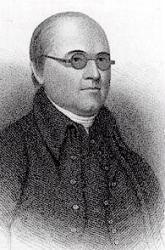
1752 - 1817 Topics: St. Peter Collect Author of "I love thy kingdom, Lord, The house of thine abode" in Magnify the Lord Timothy Dwight (b. Northampton, MA, 1752; d. Philadelphia, PA, 1817) was a grandson of Jonathan Edwards who became a Congregationalist pastor, a Revolutionary War army chaplain, a tutor and professor at Yale College, and president of Yale from 1795 to 1817. As president he continued to teach and serve as chaplain and was instrumental in improving both the academic and the spiritual life of the college.
Bert Polman
===============
Dwight, Timothy, D.D. This is the most important name in early American hymnology, as it is also one of the most illustrious in American literature and education. He was born at Northampton, Massachusetts, May 14, 1752, and graduated at Yale College, 1769; was a tutor there from 1771 to 1777. He then became for a short time a chaplain in the United States Army, but passed on in 1783 to Fairfield, Connecticut, where he held a pastorate, and taught in an Academy, till his appointment, in 1795, as President of Yale College. His works are well known, and need no enumeration. He died at New Haven, Jan. 11, 1817. In 1797 the General Association of Connecticut, being dissatisfied with Joel Barlow's 1785 revision of Watts, requested Dwight to do the work de novo. This he did liberally, furnishing in some instances several paraphrases of the same psalm, and adding a selection of hymns, mainly from Watts. The book appeared as—
"The Psalms of David, &c.... By I. Watts, D.D. A New Edition in which the Psalms omitted by Dr. Watts are versified, local passages are altered, and a number of Psalms are versified anew in proper metres. By Timothy Dwight, D.D., &c….To the Psalms is added a Selection of Hymns," 1800.
Dwight's lyrics are all professedly psalms, but they are by no means literal versions. His original compositions number 33. Of these many are still in common use, the most important being:—
1. Blest be the Lord, Who heard my prayer. Psalm xxviii. This is the second part of Psalm xxviii., in 5 stanzas of 4 lines. It is in the English New Congregational Hymn Book, 1859.
2. I Love Thy kingdom, Lord. Psalm cxxxvii. This is version three of Ps. 137, in 8 stanzas of 4 lines, and is in extensive use at the present time throughout the States. It is also included in many English, Irish, and Scottish collections, sometimes in the original form, as in Alford's Year of Praise, 1867; again as, "I love Thy Church, 0 God," which opens with the second stanza, as in the Scottish Evangelical Union Hymnal, 1878, in 3 stanzas, and "We love Thy kingdom, Lord," in the Irish Church Hymnal, 1873. In Cleveland's Lyra Sacra Americana six stanzas only are given from the original.
Next to this in popularity are his 2nd and 3rd renderings of Psalm lxxxviii.:—
3. Shall man, 0 God of life and light. (3rd stanza)
4. While life prolongs its precious light. (2nd stanza) Both of which are in extensive use. From his 4th version of the same Psalm (88), the following hymns have been compiled, each opening with the stanza indicated:—
5. Just o'er the grave I hung. Stanza ii.
6. I saw beyond the tomb. Stanza iv.
7. Ye sinners, fear the Lord. Stanza xii. This last is found in Spurgeon's 0ur Own Hymnbook. The original version consists of 13 stanzas.
8. 0 Thou Whose sceptre earth and seas obey. Psalm lxxii. This is his second version of this Psalm, and was given in the Comprehensive Rippon, 1844.
The following, most of which are of a more jubilant character, are well known:—
9. How pleasing is Thy voice. Psalm lxv.
10. In Zion's sacred gates. Psalm cl.
11. Lord of all worlds, incline Thy gracious [bounteous] ear. Psalm llii.
12. Now to Thy sacred house. Psalm xliii., st. 3.
13. Sing to the Lord most high. Psalm c.
14. In barren wilds shall living waters spring. Psalm liii.
15. Lord, in these dark and dismal days. Psalm cxxxvii.
No. 9 is found in Lyra Sacra Americana, pp. 101-2, the seven stanzas of the original being abbreviated to five.
In addition to the Psalms, Dr. Dwight published three poems, "The Conquest of Canaan," 1785; "Greenfield Hill," 1794; "Triumph of Infidelity," 1788. [Rev. F. M. Bird, M.A.]
- John Julian, Dictionary of Hymnology (1907)
Timothy Dwight
Martin Luther
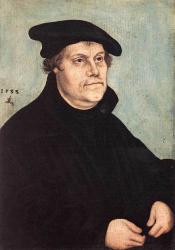
1483 - 1546 Topics: St. Peter Collect Author of "Lord, keep us steadfast in thy Word" in Magnify the Lord Luther, Martin, born at Eisleben, Nov. 10, 1483; entered the University of Erfurt, 1501 (B.A. 1502, M.A.. 1503); became an Augustinian monk, 1505; ordained priest, 1507; appointed Professor at the University of Wittenberg, 1508, and in 1512 D.D.; published his 95 Theses, 1517; and burnt the Papal Bull which had condemned them, 1520; attended the Diet of Worms, 1521; translated the Bible into German, 1521-34; and died at Eisleben, Feb. 18, 1546. The details of his life and of his work as a reformer are accessible to English readers in a great variety of forms. Luther had a huge influence on German hymnody.
i. Hymn Books.
1. Ellich cristlich lider Lobgesang un Psalm. Wittenberg, 1524. [Hamburg Library.] This contains 8 German hymns, of which 4 are by Luther.
2. Eyn Enchiridion oder Handbuchlein. Erfurt, 1524 [Goslar Library], with 25 German hymns, of which 18 are by Luther.
3. Geystliche Gesangk Buchleyn. Wittenberg, 1524 [Munich Library], with 32 German hymns, of which 24 are by Luther.
4. Geistliche Lieder auffs new gebessert. Wittenberg. J. Klug, 1529. No copy of this book is now known, but there was one in 1788 in the possession of G. E. Waldau, pastor at Nürnberg, and from his description it is evident that the first part of the Rostock Gesang-Buch, 1531, is a reprint of it. The Rostock Gesang-Buch, 1531, was reprinted by C. M. Wiechmann-Kadow at Schwerin in 1858. The 1529 evidently contained 50 German hymns, of which 29 (including the Litany) were by Luther.
5. Geistliche Lieder auffs new gebessert. Erfurt. A. Rauscher, 1531 [Helmstädt, now Wolfenbüttel Library], a reprint of No. 4.
6. Geistliche Lieder. Wittenberg. J. Klug, 1535 [Munich Library. Titlepage lost], with 52 German hymns, of which 29 are by Luther.
7. Geistliche Lieder auffs new gebessert. Leipzig. V. Schumann, 1539 [Wernigerode Library], with 68 German hymns, of which 29 are by Luther.
8. Geistliche Lieder. Wittenberg. J. Klug, 1543 [Hamburg Library], with 61 German hymns, of which 35 are by Luther.
9. Geystliche Lieder. Leipzig. V. Babst, 1545 [Gottingen Library]. This contains Luther's finally revised text, but adds no new hymns by himself. In pt. i. are 61 German hymns, in pt. ii. 40, of which 35 in all are by Luther.
For these books Luther wrote three prefaces, first published respectively in Nos. 3, 4, 9. A fourth is found in his Christliche Geseng, Lateinisch und Deudsch, zum Begrebnis, Wittenberg, J. Klug, 1542. These four prefaces are reprinted in Wackernagel’s Bibliographie, 1855, pp. 543-583, and in the various editions of Luther's Hymns. Among modern editions of Luther's Geistliche Lieder may be mentioned the following:—
Carl von Winterfeld, 1840; Dr. C. E. P. Wackernagel, 1848; Q. C. H. Stip, 1854; Wilhelm Schircks, 1854; Dr. Danneil, 1883; Dr. Karl Gerok, 1883; Dr. A. F. W. Fischer, 1883; A. Frommel, 1883; Karl Goedeke, 1883, &c. In The Hymns of Martin Luther. Set to their original melodies. With an English version. New York, 1883, ed. by Dr. Leonard Woolsey Bacon and Nathan H. Allen, there are the four prefaces, and English versions of all Luther's hymns, principally taken more or less altered, from the versions by A. T. Russell, R. Massie and Miss Winkworth [repub. in London, 1884]. Complete translations of Luther's hymns have been published by Dr. John Anderson, 1846 (2nd ed. 1847), Dr. John Hunt, 1853, Richard Massie, 1854, and Dr. G. Macdonald in the Sunday Magazine, 1867, and his Exotics, 1876. The other versions are given in detail in the notes on the individual hymns.
ii. Classified List of Luther's Hymns. Of Luther's hymns no classification can be quite perfect, e.g. No. 3 (see below) takes hardly anything from the Latin, and No. 18 hardly anything from the Psalm. No. 29 is partly based on earlier hymns (see p. 225, i.). No. 30 is partly based on St. Mark i. 9-11, and xvi., 15, 16 (see p. 226, ii.). No. 35 is partly based on St. Luke ii. 10-16. The following arrangement, however, will answer all practical purposes.
A. Translations from the Latin.
i. From Latin Hymns:
1. Christum wir sollen loben schon. A solis ortus cardine
2. Der du bist drei in Einigkeit. O Lux beata Trinitas.
3. Jesus Christus unser Heiland, Der von. Jesus Christus nostra salus
4. Komm Gott Schopfer, heiliger Geist. Veni Creator Spiritus, Mentes.
5. Nun komm der Beidenheiland. Veni Redemptor gentium
6. Was flirchst du Feind Herodes sehr. A solis ortus cardine
ii. From Latin Antiphons, &c.:
7. Herr Gott dich loben wir. Te Deum laudamus.
8. Verleih uns Frieden gnädiglich. Dapacem, Domine
9. Wir glauben all an einen Gott.
iii. Partly from the Latin, the translated stanzas being adopted from Pre-Reformation Versions:
10. Komm, heiliger Geist, Herre Gott.
11. Mitten wir im Leben sind. Media vita in morte sumus.
B. Hymns revised and enlarged from Pre-Reformation popular hymns.
12. Gelobet seist du Jesus Christ.
13. Gott der Vater wohn uns bei.
14. Gott sei gelobet und gebenedeiet.
15. Nun bitten wir den heiligen Geist.
C. Psalm versions.
16. Ach Gott vom Himmel, sieh darein.
17. Aus tiefer Noth schrei ich zu dir.
18. Ein' feste Burg ist unser Gott.
19. Es spricht der Unweisen Mund wohl.
20. Es wollt uns Gott genädig sein.
21. War Gott nicht mit uns diese Zeit.
22. Wohl dem, der in Gotten Furcht steht.
D. Paraphrases of other portions of Holy Scripture.
23. Diess sind die heilgen zehn Gebot.
24. Jesaia dem Propheten das geschah.
25. Mensch willt du leben seliglich.
26. Mit Fried und Freud ich fahr dahin.
27. Sie ist mir lieb die werthe Magd.
28. Vater unser im Himmelreich.
E. Hymns mainly Original.
29. Christ lag in Todesbanden.
30. Christ unser Herr zum Jordan kam.
31. Ein neues Lied wir heben an.
32. Erhalt uns Herr bei deinem Wort.
33. Jesus Christus unser Heiland, Der den,
34. Nun freut euch lieben Christengemein.
35. Vom Himmel hoch da komm ich her.
36. Vom Himmel kam der Engel Schaar.
In addition to these —
37. Fur alien Freuden auf Erden.
38. Kyrie eleison.
In the Blätter fur Hymnologie, 1883, Dr. Daniel arranges Luther's hymns according to what he thinks their adaptation to modern German common use as follows:—
i. Hymns which ought to be included in every good Evangelical hymn-book: Nos. 7-18, 20, 22, 28, 29, 30, 32, 34, 35, 36, 38.
ii. Hymns the reception of which into a hymn-book might be contested: Nos. 2, 3, 4, 19, 21, 22, 23, 24, 25, 33.
iii. Hymns not suited for a hymn-book: Nos. 1, 5, 6, 27, 31, 37.
[Rev. James Mearns, M.A.]
--John Julian, Dictionary of Hymnology (1907)
Martin Luther
Joseph Haydn
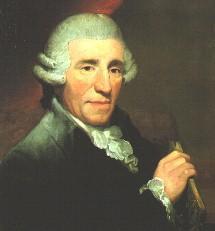
1732 - 1809 Person Name: Franz Joseph Haydn Topics: St. Peter Gospel Composer of "AUSTRIA" in Magnify the Lord Franz Joseph Haydn (b. Rohrau, Austria, 1732; d. Vienna, Austria, 1809) Haydn's life was relatively uneventful, but his artistic legacy was truly astounding. He began his musical career as a choirboy in St. Stephen's Cathedral, Vienna, spent some years in that city making a precarious living as a music teacher and composer, and then served as music director for the Esterhazy family from 1761 to 1790. Haydn became a most productive and widely respected composer of symphonies, chamber music, and piano sonatas. In his retirement years he took two extended tours to England, which resulted in his "London" symphonies and (because of G. F. Handel's influence) in oratorios. Haydn's church music includes six great Masses and a few original hymn tunes. Hymnal editors have also arranged hymn tunes from various themes in Haydn's music.
Bert Polman
Joseph Haydn





