You help make Hymnary.org possible. More than 10 million people from 200+ countries found hymns, liturgical resources and encouragement on Hymnary.org in 2025, including you. Every visit affirms the global impact of this ministry.

If Hymnary has been meaningful to you this year, would you take a moment today to help sustain it? A gift of any size—paired with a note of encouragement if you wish—directly supports the server costs, research work and curation that keep this resource freely available to the world.

Give securely online today, or mail a check to:
Hymnary.org
Calvin University
3201 Burton Street SE
Grand Rapids, MI 49546

Thank you for your partnership, and may the hope of Advent fill your heart.

Person Results

Topics:trinity+24
In:people

Planning worship? Check out our sister site, ZeteoSearch.org, for 20+ additional resources related to your search.
Showing 1 - 10 of 132Results Per Page: 102050

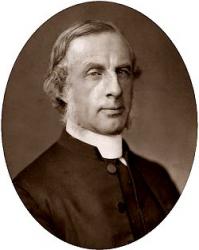
E. H. Plumptre

1821 - 1891 Person Name: Edward Hayes Plumptre Topics: Trinity 24 Gospel Author of "Thine arm, O Lord, in days of old" in Magnify the Lord Edward H. Plumptre (b. London, England, August 6, 1821; d. Wells, England, February 1, 1891) was an eminent classical and biblical scholar who gained prominence in both church and university. Educated at King's College, London, and University College, Oxford, he was ordained in the Church of England in 1846. Plumptre served as a preacher at Oxford and a professor of pastoral theology at King's College, and held a number of other prestigious positions. His writings include A Life of Bishop Ken (1888), translations from Greek and Latin classics, and poetry and hymns. Plumptre was also a member of the committee that produced the Revised Version of the Bible. Bert Polman ==================== Plumptre, Edward Hayes, D.D., son of Mr. E. H. Plumptre, was born in London, Aug. 6, 1821, and educated at King's College, London, and University College, Oxford, graduating as a double first in 1844. He was for some time Fellow of Brasenose. On taking Holy Orders in 1846 he rapidly attained to a foremost position as a Theologian and Preacher. His appointments have been important and influential, and include that of Assistant Preacher at Lincoln's Inn; Select Preacher at Oxford; Professor of Pastoral Theology at King's College, London; Dean of Queen's, Oxford; Prebendary in St. Paul's Cathedral, London; Professor of Exegesis of the New Testament in King's College, London; Boyle Lecturer; Grinfield Lecturer on the Septuagint, Oxford; Examiner in the Theological schools at Oxford; Member of the Old Testament Company for the Revision of the A.V. of the Holy Scriptures; Rector of Pluckley, 1869; Vicar of Bickley, Kent, 1873; and Dean of Wells, 1881. Dean Plumptre's literary productions have been very numerous and important, and embrace the classics, history, divinity, biblical criticism, biography, and poetry. The list as set forth in Crockford's Clerical Directory is very extensive. His poetical works include Lazarus, and Other Poems, 1864; Master and Scholar, 1866; Things New and Old, 1884; and translations of Sophocles, Æschylus, and Dante. As a writer of sacred poetry he ranks very high. His hymns are elegant in style, fervent in spirit, and broad in treatment. The subjects chosen are mainly those associated with the revived Church life of the present day, from the Processional at a Choral Festival to hospital work and the spiritual life in schools and colleges. The rhythm of his verse has a special attraction for musicians, its poetry for the cultured, and its stately simplicity for the devout and earnest-minded. The two which have attained to the most extensive use in Great Britain and America are: Rejoice, ye pure in heart," and "Thine arm, O Lord, in days of old." His translations from the Latin, many of which were made for the Hymnary, 1871 and 1872, are very good and musical, but they have not been used in any way in proportion to their merits. His original hymns in common use include:— 1. Behold they gain the lonely height. The Transfiguration. Written for and first published in the Society for Promoting Christian Knowledge Church Hymns, 1871. 2. For all Thy countless bounties. National Hymns. Written for the Jubilee of Queen Victoria, 1887, and set to music by C. W. Lavington. It was printed, together with the National Anthem adapted for the Jubilee, in Good Words, 1887. 3. Lo, summer comes again! Harvest. Written in 1871 for use at the Harvest Festival in Pluckley Church, Kent, of which the author was then rector, and published in the same year in the Hymnary, No. 466. 4. March, march, onward soldiers true. Processional at Choral Festivals. Written in 1867 for the tune of Costa's March of the Israelites in the Oratorio of Eli, at the request of the Rev. Henry White, Chaplain of the Savoy, and first used in that Chapel. It was subsequently published in the Savoy Hymnary, N.D. [1870], in 4 stanzas of 4 lines; in a Choral Festival book at Peterborough, and in the S. P. C. K. Church Hymns, 1871. 5. 0 Light, Whose beams illumine all. The Way, the Truth, and the Life. Written in May 1864, and published in his Lazarus, and Other Poems, 1864, as one of five Hymns for School and College. It passed into the 1868 Appendix to Hymns Ancient & Modern, and again into other collections. 6. 0 Lord of hosts, all heaven possessing. For School or College. Written in May, 1864, and published in his Lazarus and other Poems, 1864, in 5 stanzas of 6 lines. 7. 0 praise the Lord our God. Processional Thanksgiving Hymn. Written May 1864, and published in his Lazarus, and other Poems, 1864, in 4 stanzas of 8 lines. It is a most suitable hymn for Sunday school gatherings. 8. Rejoice, ye pure in heart. Processional at Choral Festival. Written in May 1865, for the Peterborough Choral Festival of that year, and first used in Peterborough Cathedral. In the same year it was published with special music by Novello & Co; and again (without music) in the 2nd edition of Lazarus, and Other Poems, 1865. It was included in the 1868 Appendix to Hymns Ancient & Modern with the change in stanza i., line 3, of "Your orient banner wave on high," to "Your festal banner wave on high." It is more widely used than any other of the author's hymns. Authorized text in Hymns Ancient & Modern. 9. Thine arm, 0 Lord, in days of old. Hospitals. Written in 1864 for use in King's College Hospital, London, and first printed on a fly-sheet as "A Hymn used in the Chapel of King's College Hospital." It was included in the 2nd edition of Lazarus, and Other Poems, 1865; in the 1868 Appendix to Hymns Ancient & Modern; the S. P. C. K. Church Hymns, 1871; Thring's Collection, 1882; and many others. 10. Thy hand, 0 God, has guided. Church Defence. Included in the 1889 Supplemental Hymns to Hymns Ancient & Modern The closing line of each stanza, "One Church, one Faith, one Lord," comes in with fine effect. Dean Plumptre's Life of Bishop Ken, 1888, is an exhaustive and excellent work. -- John Julian, Dictionary of Hymnology (1907) =============== Plumptre, E. H., p. 897, i. Died at the Deanery, Wells, Feb. 1, 1891. --John Julian, Dictionary of Hymnology, Appendix, Part II (1907)

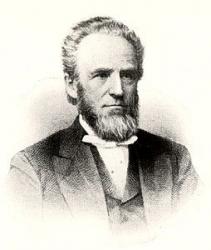
Ray Palmer

1808 - 1887 Topics: Trinity 24 Collect Author of "My faith looks up to thee, Thou Lamb of Calvary" in Magnify the Lord Ray Palmer (b. Little Compton, RI, 1808; d. Newark, NJ, 1887) is often considered to be one of America's best nineteenth-century hymn writers. After completing grammar school he worked in a Boston dry goods store, but a religious awakening prodded him to study for the ministry. He attended Yale College (supporting himself by teaching) and was ordained in 1835. A pastor in Congregational churches in Bath, Maine (1835-1850), and Albany, New York (1850-1865), he also served as secretary of the American Congregational Union (1865-1878). Palmer was a popular preacher and author, writing original poetry as well as translating hymns. He published several volumes of poetry and hymns, including Sabbath Hymn Book (1858), Hymns and Sacred Pieces (1865), and Hymns of My Holy Hours (1868). His complete poetical works were published in 1876. Bert Polman =================== Palmer, Ray, D.D., son of the Hon. Thomas Palmer, a Judge in Rhode Island, was born at Little Compton, Rhode Island, Nov. 12, 1808. His early life was spent at Boston, where he was for some time clerk in a dry-goods store. At Boston he joined the Park Street Congregational Church, then under the pastoral care of Dr. S. E. Dwight. After spending three years at Phillips Academy, Andover, he entered Yale College, New Haven, where he graduated in 1830. In 1835 he became pastor of the Central Congregational Church, Bath, Maine. During his pastorate there he visited Europe in 1847. In 1850 he was appointed to the First Congregational Church, at Albany, New York, and in 1865 Corresponding Secretary to the American Congregational Union, New York. He resigned in 1878, and retired to Newark, New Jersey. He died at Newark, Mar. 29, 1887. Dr. Palmer's published works in prose and verse include:-- (1) Memoirs and Select Remains of Charles Pond, 1829; (2) The Spirit's Life, a Poem, 1837; (3) How to Live, or Memoirs of Mrs. C. L. Watson, 1839; (4) Doctrinal Text Book, 1839; (5) Spiritual Improvement, 1839, republished as Closet Hours in 185; (6) What is Truth? or Hints on the Formation of Religious Opinions, 1860; (7) Remember Me, or The Holy Communion, 1865; (8) Hymns and Sacred Pieces, with Miscellaneous Poems, 1865; (9) Hymns of my Holy Hours, and Other Pieces, 1868; (10) Home, or the Unlost Paradise, 1873; and (11) Voices of Hope and Gladness, 1881. Most of Dr. Palmer's hymns have passed into congregational use, and have won great acceptance. The best of them by their combination of thought, poetry, and devotion, are superior to almost all others of American origin. The first which he wrote has become the most widely known of all. It is:— 1. My faith looks up to Thee. Faith in Christ. This hymn was written by the author when fresh from College, and during an engagement in teaching in New York. This was in 1830. The author says concerning its composition, "I gave form to what I felt, by writing, with little effort, the stanzas. I recollect I wrote them with very tender emotion, and ended the last line with tears." A short time afterwards the hymn was given to Dr. Lowell Mason for use, if thought good, in a work then being compiled by him and Dr. T. Hastings. In 1831 that work was published as Spiritual Songs for Social Worship: adapted to the use of Families, &c. Words and Music arranged by Thomas Hastings, of New York, and Lowell Mason of Boston. It is No. 141 in 4 stanzas of 8 lines, entitled "Self Consecration," and accompanied with the tune by Dr. L. Mason, there given as "My faith looks up to Thee, "but subsequently known as Olivet. (Orig. text of hymn in Thring's Collection, 1882.) It has passed into most modern collections in all English-speaking countries, and has been rendered into numerous languages. That in Latin, by H. M. Macgill (p. 708, ii.), begins "Fides Te mea spectat." 2. Fount of everlasting love. Praise for renewed Spiritual Life. This also appeared in the Spiritual Songs, &c, 1831, No. 191, in 4 stanzas of 4 lines, and headed "Praise for a Revival." The hymns which are given below are all in Dr. Palmer's Poetical Works, N. Y., 1876, and the dates appended in brackets are those given by him in that work. 3. Thou who roll'st the year around. (1832.) Close of the Year. In several American collections. 4. Away from earth my spirit turns. (1833.) Holy Communion. Appeared in Lowell Mason's Union Hymns, in 4 stanzas of 4 lines. In the Church Praise Book, N. Y.. 1882, it begins with st. ii., "Thou, Saviour, art the Living Bread." 5. Before Thy throne with tearful eyes. (1834.) Liberty of Faith. 6. Stealing from the world away. (1834.) Evening. Written at New Haven in 1834, and is very popular in America. 7. Thine [Thy] holy day's returning. (1834.) Sunday Morning. 8. Wake thee, 0 Zion. (1862.) Zion Exultant. 9. We stand in deep repentance. (1834.) Lent. This last, No. 9, in common with Nos. 10, 11, 12, is marked "original," in the Presbyterian Parish Hymns, 1843. Probably they were given to the editors of that book in manuscript, and had not previously appeared. 10. And is there, Lord, a rest? (1843.) Rest in Heaven. Written at Bath, Maine, in 1843. 11. 0 sweetly breathe the lyres above. Consecration to Christ. This was accidentally omitted from Dr. Palmer's Poetical Works, 18?6. S. W. Duffield says:— "It was written in the winter of 1842-43, at a time of revival. At the previous Communion several had been received under circumstances that made Doddridge's hymn, ‘0 happy day that fixed my choice 'a most appropriate selection. Not caring to repeat it, and needing something similar, Dr. Palmer composed the present hymn." English Hymns, N. Y., 1886, p. 432. 12. When downward to the darksome tomb. (1842.) Death Contemplated. Written at Bath, Maine, 1842. From 1843 there comes a long break, and Dr. Palmer seems to have done no more hymn-writing until called upon by Professors Park and Phelps, of Andover, for contributions to their Sabbath Hymn-Book, 1858. His hymns written for that important collection rank amongst the best that America has produced. This is specially true of the first four (Nos. 13-16) from the Latin. 13. Jesus, Thou joy of loving hearts. (l858.) Translation of a cento from "Jesu dulcis memoria" (p. 588, ii.). 14. 0 Bread to Pilgrims given. (1858.) Translation of “O esca viatorum" (q.v.). 15. 0 Christ our King, Creator Lord. (1858.) Translation of “Rex Christe, factor omnium " 16. Come Holy Ghost, in love. (1858.) Translation of “Veni Sancte Spiritus" (q.v.) 17. Jesus, these eyes have never seen. (1858.) Christ loved, though unseen. This hymn is accounted by many as next in merit and beauty to "My faith looks up to Thee." 18. Lord, my weak thought in vain would climb. (1858.) God Unsearchable. This hymn deals with the mysteries of Predestination in a reverent and devout manner. 19. Thy Father's house! thine own bright home. (1858.) Heaven. The next group, Nos. 20-27, appeared in Dr. Robinson's Songs for the Sanctuary, 1865. 20. Lord, Thou wilt bring the joyful day. (1864.) Contemplation of Heaven. Written in New York City. 21. Eternal Father, Thou hast said. (i860.) Missions. 22. Jesus, Lamb of God, for me. (1863.) Jesus, the Way of Salvation. Written in Albany, New York. 23. Take me, 0 my Father, take me. (1864.) Lent. 24. Wouldst thou eternal life obtain. (1864.) Good Friday. 25. Come Jesus, Redeemer, abide Thou with me. (1864.) Holy Communion. 26. Lord, Thou on earth didst love Thine own. (1864.) Fellowship with Christ. 27. Thou, Saviour, from Thy throne on high. (1864.) Prayer. The next four (Nos. 28-31) present another group. They appeared in D. E. Jones's Songs for the New Life, 1869, and the Reformed Dutch Hymns of the Church, N. Y., 1869. The dates of composition are from Dr. Palmer's Poems, 1876. 28. Lord, Thou hast taught our hearts to glow. (1865.) Ordination, or Meeting of Ministers. 29. When inward turns my searching gaze. (1868.) Evening. 30. 0 Jesus, sweet the tears I shed. (1867.) Good Friday. 31. Jesus, this [my] heart within me burns. (1868.) Love. The hymns which follow are from various sources. 32. 0 Christ, the Lord of heaven, to Thee. (1867.) Universal Praise to Christ. Appeared in the author's Hymns of my Holy Hours, 1867. It is a hymn of great merit, and is widely used. 33. Behold the shade of night is now receding. (1869.) A translation of "Ecce jam noctis." (p. 320, i., and Various). 34. Hid evening shadows let us all be waking. (1869.) A translation of "Nocte surgentes" (p. 809, i.). 35. I give my heart to Thee. (Aug. 20, 1868.) A translation of "Cor meum Tibi dedo," p. 262, ii. 36. Holy Ghost, that promised came. (1873.) Whitsuntide. From the author's Poems, 1876. 37. 0 Holy Comforter, I hear. The Comforter. Appeared in the Boston Congregationalist, September 7th, 1867. 38. Lord, when my soul her secrets doth reveal. (1865.) Holy Communion. Most of the foregoing hymns are in common in Great Britain, and all are found in one or more American hymnbooks of importance. [Rev. F. M. Bird, M.A.] -- John Julian, Dictionary of Hymnology (1907) =================== Palmer, Ray, D.D., p. 877, i. The following original hymns by Dr. Palmer are also in common use:— 1. O Rock of Ages, since on Thee. Faith. From his Poetical Works, 1876, p. 27, where it is dated 1869. Bp. Bickersteth says "This hymn"... is "worthy of Luther." (Note Hymnal Companion, ed. 1876.) 2. Thy holy will, my God, be mine. Resignation. From his Hymns of my Holy Hours, &c, 1868, p. 47. Also in his P. Works, 1876, dated 1867. 3. We praise Thee, Saviour, for Thy grace. Holy Communion. From his Hymns and Sacred Pieces, &c, 1865. Also in P. Works, 1876, dated 1864. --John Julian, Dictionary of Hymnology, Appendix, Part II (1907) ========== Ray Palmer was born at Little Compton, Rhode Island, in 1808. He studied at Phillip's Academy, Andover, Mass., and graduated at Yale College in 1830. In 1835, he was ordained pastor of a Congregational Society in Bath, Maine, from which he removed, in 1850, to the pastorate of a Congregational Society in Albany, N.Y. He has published many hymns, some of his own authorship, and some translations. He has published some sermons and reviews. --Annotations of the Hymnal, Charles Hutchins, M.A. 1872.

Lowell Mason

1792 - 1872 Topics: Trinity 24 Collect Composer of "OLIVET" in Magnify the Lord Dr. Lowell Mason (the degree was conferred by the University of New York) is justly called the father of American church music; and by his labors were founded the germinating principles of national musical intelligence and knowledge, which afforded a soil upon which all higher musical culture has been founded. To him we owe some of our best ideas in religious church music, elementary musical education, music in the schools, the popularization of classical chorus singing, and the art of teaching music upon the Inductive or Pestalozzian plan. More than that, we owe him no small share of the respect which the profession of music enjoys at the present time as contrasted with the contempt in which it was held a century or more ago. In fact, the entire art of music, as now understood and practiced in America, has derived advantage from the work of this great man. Lowell Mason was born in Medfield, Mass., January 8, 1792. From childhood he had manifested an intense love for music, and had devoted all his spare time and effort to improving himself according to such opportunities as were available to him. At the age of twenty he found himself filling a clerkship in a banking house in Savannah, Ga. Here he lost no opportunity of gratifying his passion for musical advancement, and was fortunate to meet for the first time a thoroughly qualified instructor, in the person of F. L. Abel. Applying his spare hours assiduously to the cultivation of the pursuit to which his passion inclined him, he soon acquired a proficiency that enabled him to enter the field of original composition, and his first work of this kind was embodied in the compilation of a collection of church music, which contained many of his own compositions. The manuscript was offered unavailingly to publishers in Philadelphia and in Boston. Fortunately for our musical advancement it finally secured the attention of the Boston Handel and Haydn Society, and by its committee was submitted to Dr. G. K. Jackson, the severest critic in Boston. Dr. Jackson approved most heartily of the work, and added a few of his own compositions to it. Thus enlarged, it was finally published in 1822 as The Handel and Haydn Society Collection of Church Music. Mason's name was omitted from the publication at his own request, which he thus explains, "I was then a bank officer in Savannah, and did not wish to be known as a musical man, as I had not the least thought of ever making music a profession." President Winchester, of the Handel and Haydn Society, sold the copyright for the young man. Mr. Mason went back to Savannah with probably $500 in his pocket as the preliminary result of his Boston visit. The book soon sprang into universal popularity, being at once adopted by the singing schools of New England, and through this means entering into the church choirs, to whom it opened up a higher field of harmonic beauty. Its career of success ran through some seventeen editions. On realizing this success, Mason determined to accept an invitation to come to Boston and enter upon a musical career. This was in 1826. He was made an honorary member of the Handel and Haydn Society, but declined to accept this, and entered the ranks as an active member. He had been invited to come to Boston by President Winchester and other musical friends and was guaranteed an income of $2,000 a year. He was also appointed, by the influence of these friends, director of music at the Hanover, Green, and Park Street churches, to alternate six months with each congregation. Finally he made a permanent arrangement with the Bowdoin Street Church, and gave up the guarantee, but again friendly influence stepped in and procured for him the position of teller at the American Bank. In 1827 Lowell Mason became president and conductor of the Handel and Haydn Society. It was the beginning of a career that was to win for him as has been already stated the title of "The Father of American Church Music." Although this may seem rather a bold claim it is not too much under the circumstances. Mr. Mason might have been in the average ranks of musicianship had he lived in Europe; in America he was well in advance of his surroundings. It was not too high praise (in spite of Mason's very simple style) when Dr. Jackson wrote of his song collection: "It is much the best book I have seen published in this country, and I do not hesitate to give it my most decided approbation," or that the great contrapuntist, Hauptmann, should say the harmonies of the tunes were dignified and churchlike and that the counterpoint was good, plain, singable and melodious. Charles C. Perkins gives a few of the reasons why Lowell Mason was the very man to lead American music as it then existed. He says, "First and foremost, he was not so very much superior to the members as to be unreasonably impatient at their shortcomings. Second, he was a born teacher, who, by hard work, had fitted himself to give instruction in singing. Third, he was one of themselves, a plain, self-made man, who could understand them and be understood of them." The personality of Dr. Mason was of great use to the art and appreciation of music in this country. He was of strong mind, dignified manners, sensitive, yet sweet and engaging. Prof. Horace Mann, one of the great educators of that day, said he would walk fifty miles to see and hear Mr. Mason teach if he could not otherwise have that advantage. Dr. Mason visited a number of the music schools in Europe, studied their methods, and incorporated the best things in his own work. He founded the Boston Academy of Music. The aim of this institution was to reach the masses and introduce music into the public schools. Dr. Mason resided in Boston from 1826 to 1851, when he removed to New York. Not only Boston benefited directly by this enthusiastic teacher's instruction, but he was constantly traveling to other societies in distant cities and helping their work. He had a notable class at North Reading, Mass., and he went in his later years as far as Rochester, where he trained a chorus of five hundred voices, many of them teachers, and some of them coming long distances to study under him. Before 1810 he had developed his idea of "Teachers' Conventions," and, as in these he had representatives from different states, he made musical missionaries for almost the entire country. He left behind him no less than fifty volumes of musical collections, instruction books, and manuals. As a composer of solid, enduring church music. Dr. Mason was one of the most successful this country has introduced. He was a deeply pious man, and was a communicant of the Presbyterian Church. Dr. Mason in 1817 married Miss Abigail Gregory, of Leesborough, Mass. The family consisted of four sons, Daniel Gregory, Lowell, William and Henry. The two former founded the publishing house of Mason Bros., dissolved by the death of the former in 1869. Lowell and Henry were the founders of the great organ manufacturer of Mason & Hamlin. Dr. William Mason was one of the most eminent musicians that America has yet produced. Dr. Lowell Mason died at "Silverspring," a beautiful residence on the side of Orange Mountain, New Jersey, August 11, 1872, bequeathing his great musical library, much of which had been collected abroad, to Yale College. --Hall, J. H. (c1914). Biography of Gospel Song and Hymn Writers. New York: Fleming H. Revell Company.

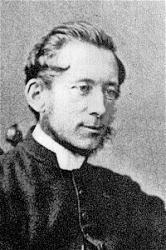
Frances Ridley Havergal

1836 - 1879 Topics: Trinity 24 Epistle Author of "Take my life, and let it be" in Magnify the Lord Havergal, Frances Ridley, daughter of the Rev. W. H. Havergal, was born at Astley, Worcestershire, Dec. 14, 1836. Five years later her father removed to the Rectory of St. Nicholas, Worcester. In August, 1850, she entered Mrs. Teed's school, whose influence over her was most beneficial. In the following year she says, "I committed my soul to the Saviour, and earth and heaven seemed brighter from that moment." A short sojourn in Germany followed, and on her return she was confirmed in Worcester Cathedral, July 17, 1853. In 1860 she left Worcester on her father resigning the Rectory of St. Nicholas, and resided at different periods in Leamington, and at Caswall Bay, Swansea, broken by visits to Switzerland, Scotland, and North Wales. She died at Caswell Bay, Swansea, June 3, 1879. Miss Havergal's scholastic acquirements were extensive, embracing several modern languages, together with Greek and Hebrew. She does not occupy, and did not claim for herself, a prominent place as a poet, but by her distinct individuality she carved out a niche which she alone could fill. Simply and sweetly she sang the love of God, and His way of salvation. To this end, and for this object, her whole life and all her powers were consecrated. She lives and speaks in every line of her poetry. Her poems are permeated with the fragrance of her passionate love of Jesus. Her religious views and theological bias are distinctly set forth in her poems, and may be described as mildly Calvinistic, without the severe dogmatic tenet of reprobation. The burden of her writings is a free and full salvation, through the Redeemer's merits, for every sinner who will receive it, and her life was devoted to the proclamation of this truth by personal labours, literary efforts, and earnest interest in Foreign Missions. [Rev. James Davidson, B.A.] Miss Havergal's hymns were frequently printed by J. & R. Parlane as leaflets, and by Caswell & Co. as ornamental cards. They were gathered together from time to time and published in her works as follows:— (1) Ministry of Song, 1869; (2) Twelve Sacred Songs for Little Singers, 1870; (3) Under the Surface, 1874; (4) Loyal Responses, 1878; (5) Life Mosaic, 1879; (6) Life Chords, 1880; (7) Life Echoes, 1883. About 15 of the more important of Miss Havergal's hymns, including "Golden harps are sounding," "I gave my life for thee," "Jesus, Master, Whose I am," "Lord, speak to me," "O Master, at Thy feet," "Take my life and let it be," "Tell it out among the heathen," &c, are annotated under their respective first lines. The rest, which are in common use, number nearly 50. These we give, together with dates and places of composition, from the Havergal mss. [manuscript], and the works in which they were published. Those, and they are many, which were printed in Parlane's Series of Leaflets are distinguished as (P., 1872, &c), and those in Caswell’s series (C., 1873, &c). 1. A happy New Year! Even such may it be. New Year. From Under the Surface, 1874. 2. Certainly I will be with thee. Birthday. Sept. 1871, at Perry Barr. (P. 1871.) Published in Under the Surface, 1874, and Life Mosaic, 1879. 3. Church of God, beloved and chosen. Sanctified in Christ Jesus, 1873. (P. 1873.) Published in Under the Surface, 1874, and Life Mosaic, 1879. 4. God Almighty, King of nations. Sovereignty of God. 1872. Published in Under the Surface, 1874, and Life Mosaic, 1879. 5. God doth not bid thee wait. God faithful to His promises. Oct. 22, 1868, at Oakhampton. (P. 1869.) Published in Ministry of Song, 1869, and Life Mosaic, 1879. 6. God of heaven, hear our singing. A Child's hymn for Missions. Oct. 22, 1869, at Leamington. Published in her Twelve Sacred Songs for Little Singers, 1870, and her Life Chords, 1880. 7. God will take care of you, All through the day. The Good Shepherd. In Mrs. Brock's Children's Hymn Book, 1881. 8. God's reiterated all. New Year. 1873, at Winterdyne. (C. 1873.) Published in Loyal Responses, 1878, and Life Mosaic, 1879. 9. Have you not a word for Jesus? Boldness for the Truth. Nov. 1871, at Perry Barr. (P. 1872.) Published in Under the Surface, 1874, and Life Mosaic, 1879. 10. He hath spoken in the darkness. Voice of God in sorrow. June 10,1869, at Neuhausen. (P. 1870.) Published in Under the Surface, 1874, and in Life Mosaic, 1879. 11. Hear the Father's ancient promise. Promise of the Holy Spirit. Aug. 1870. Published in Under the Surface, 1874, and Life Mosaic, 1879. 12. Holy and Infinite! Viewless, Eternal. Infinity of God. 1872. Published in Under the Surf ace, 1874, and L. Mosaic, 1879. 13. Holy brethren, called and chosen. Election a motive for Earnestness. 1872. Published in Snepp's Songs of Grace & Glory, 1876. 14. I am trusting Thee, Lord Jesus. Faith. Sept. 1874, at Ormont Dessona. (P. 1874.) Published in Loyal Responses, 1878, and Life Chords, 1880. Miss Havergal’s tune, Urbane (Snepp's Songs of Grace & Glory, 1048), was composed for this hymn. The hymn was the author's "own favourite," and was found in her pocket Bible after her death. 15. I bring my sins to Thee. Besting all on Jesus. June, 1870. (P. 1870.) Printed in the Sunday Magazine, 1870, and Home Words, 1872. Published in Under the Surface, 1874, and Life Chords, 1880. 16. I could not do without Thee. Jesus All in All. May 7, 1873. (P. 1873.) Printed in Home Words, 1873, and published in Under the Surface, 1874, and Life Mosaic, 1879. 17. In full and glad surrender. Confirmation. Miss Havergal's sister says this hymn was “The epitome of her [Miss F. R. H.'s] life and the focus of its sunshine." It is a beautiful hymn of personal consecration to God at all times. 18. In the evening there is weeping. Sorrow followed by Joy. June 19, 1869, at the Hotel Jungfraublick, Interlaken. "It rained all day, except a very bright interval before dinner. Curious long soft white clouds went slowly creeping along the Scheinige Platte; I wrote “Evening Tears and Morning Songs” (Marg. reading of Ps. xxx. 5.)" (P. 1870.) Published in Under the Surface, 1874. 19. Increase our faith, beloved Lord. Increase of Faith desired. In Loyal Responses, 1878, in 11 stanzas of 4 lines, on St. Luke xvii. 5. It is usually given in an abridged form. 20. Is it for me, dear Saviour? Heaven anticipated. Nov. 1871, at Perry Barr. (P. 1872.) Published in Under the Surface, 1874, and Life Mosaic, 1879. 21. Israel of God, awaken. Christ our Righteousness. May, 1871, at Perry Barr. (P. 1872.) Published in Under the Surface, 1874, and Life Mosaic, 1879. 22. Jehovah's covenant shall endure. The Divine Covenant, 1872. Published in Snepp's Songs of Grace & Glory, 1876. 23 Jesus, blessed Saviour. New Year, Nov. 25, 1872, at Leamington. (P. 1873.) Printed in the Dayspring Magazine, Jan. 1873, and published in Life Chords, 1880. 24. Jesus only! In the shadow. Jesus All in All. Dec. 4, 1870, at Pyrmont Villa. (P. & C. 1871.) Published in Under the Surface, 1874, and in Life Mosaic, 1879. 25. Joined to Christ by [in] mystic union. The Church the Body of Christ. May, 1871, at Perry Barr. (P. 1872.) Published in Under the Surface, 1874, Life Mosaic, 1879. 26. Just when Thou wilt, 0 Master, call. Resignation. In Loyal Responses, 1878, in 5 stanzas of 4 lines, and Whiting's Hymns for the Church Catholic, 1882. 27. King Eternal and Immortal. God Eternal. Written at Perry Villa, Perry Barr, Feb. 11, 1871, and Published in Snepp's Songs of Grace & Glory, 1876; Under the Surface, 1874 ; and Life Mosaic, 1879. 28. Light after darkness, Gain after loss. Peace in Jesus, and the Divine Reward. In Sankey's Sacred Songs and Solos, from her Life Mosaic, 1879. 29. Like a river glorious, Is God's perfect Peace. Peace. In her Loyal Responses, 1878, in 3 st. of 8 1., with the chorus, "Stayed upon Jehovah." In several collections. 30. Master, speak! Thy servant heareth. Fellowship with and Assistance from Christ desired. Sunday evening, May 19, 1867, at Weston-super-Mare. Published in Ministry of Song, 1869, and L. Mosaic, 1879. It is very popular. 31. New mercies, new blessings, new light on thy way. New Life in Christ. 1874, at Winterdyne. (C. 1874.) Published in Under His Shadow, 1879, Life Chords, 1880. 32. Not your own, but His ye are. Missions. Jan. 21, 1867. (C. 1867.) Published in Ministry of Song, 1869; Life Mosaic, 1879; and the Hymnal for Church Missions, 1884. 33. Now let us sing the angels' song. Christmas. In her Life Mosaic, 1879; and W. B. Stevenson's School Hymnal, 1880. 34. Now the daylight goes away. Evening. Oct. 17, 1869, at Leamington. Published in Songs for Little Singers, 1870, and Life Chords, 1880. It originally read, " Now the light has gone away." 35. Now the sowing and the weeping. Sorrow followed by Joy. Jan. 4, 1870, at Leamington. Printed in Sunday at Home, 1870 ; and published in Under the Surface, 1874, and L. Mosaic, 1879. 36. 0 Glorious God and King. Praise to the Father, Feb. 1872. Published in Under the Surface, 1874, and Life Mosaic, 1879. 37. 0 Saviour, precious [holy] Saviour. Christ worshipped by the Church. Nov. 1870, at Leamington. (P. 1870.) Published in Under the Surface, 1874, and Life Mosaic, 1879. 38. O thou chosen Church of Jesus. Election. April 6, 1871. Published in Under the Surface, 1874, and L. Mosaic, 1879. 39. O what everlasting blessings God outpoureth on His own. Salvation everlasting. Aug. 12, 1871, at Perry Barr. (P. 1871.) Published in Under the Surface, 1874, and L. Mosaic, 1879. 40. Our Father, our Father, Who dwellest in light. The blessing of the Father desired. May 14, 1872. Published in Under the Surface, 1874, and Life Mosaic, 1879. Miss Havergal's tune, Tertius, was composed for this hymn. 41. Our Saviour and our King. Presentation of the Church to the Father. (Heb. ii. 13.) May, 1871, at Perry Barr. (P. 1871.) Published in Under the Surface, 1874, and L. Mosaic, 1879. 42. Precious, precious blood of Jesus. The precious Blood. Sept. 1874, at Ormont Dessons. (C.) Published in Loyal Responses, 1878, and Life Chords, 1880. 43. Sing, O heavens, the Lord hath done it. Redemption. In her Life Mosaic, 1879, and the Universal Hymn Book, 1885. 44. Sit down beneath His shadow. Holy Communion. Nov. 27, 1870, at Leamington. (P. 1870.) Published in Under the Surface, 1874, and Life Mosaic, 1879. 45. Sovereign Lord and gracious Master. Grace consummated in Glory. Oct. 22, 1871. (P. 1872.) Published in Under the Surface, 1874, and Life Mosaic, 1879. 46. Standing at the portal of the opening year. New Year. Jan. 4, 1873. Published in Under the Surface, 1874, and Life Chords, 1880. 47. To Thee, 0 Comforter divine. Praise to the Holy Spirit. Aug. 11, 1872, at Perry Barr. Published in Under the Surface 1874, and Life Mosaic, 1879. Miss Havergal's tune, Tryphosa, was written for this hymn. 48. True-hearted, whole-hearted, faithful and loyal. Faithfulness to the Saviour. In her Loyal Responses, 1878, and the Universal Hymn Book, 1885. 49. What know we, Holy God, of Thee? God's Spirituality, 1872. Published in Under the Surface, 1874, and Life Mosaic, 1879. 50. Who is on the Lord's side? Home Missions. Oct. 13, 1877. Published in Loyal Responses, 1878, andLife Chords, 1880. 51. With quivering heart and trembling will. Resignation. July, 10, 1866, at Luccombe Rectory. (P. 1866.) Published in Ministry of Song, 1869, and Life Mosaic, 1879. 52. Will ye not come to Him for life? The Gospel Invitation. 1873. Published in Snepp's Songs of Grace and Glory, 1876. 53. Worthy of all adoration. Praise to Jesus as the Lamb upon the throne. Feb. 26 1867, at Oakhampton. Published in Ministry of Song, 1869, and Life Mosaic, 1874. It is pt. iii. of the "Threefold Praise," and was suggested by the "Worthy is the Lamb," the "Hallelujah" and "Amen" choruses in Handel's Messiah. 54. Ye who hear the blessed call. The Invitation of the Spirit and the Bride. March, 1869, at Leamington. (P. 1869.) Published in Ministry of Song, 1869, and Life Mosaic, 1879. Suggested by, and written for, the Young Men's Christian Association. 55. Yes, He knows the way is dreary. Encouragement. 1867. Published in Ministry of Song, 1869. Most of these hymns are given in Snepp's Songs of Grace and Glory, 1872]and 1876, his Appendix, 1874, and the Musical edition, 1880, and many of them are also in several other hymnbooks, including Hymns Ancient & Modern, Thring, Church Hymns, Hymnal Companion, &c, and some of the leading American collections. --John Julian, Dictionary of Hymnology (1907) ============================== Havergal, Frances Ridley, p. 496, i. Miss Havergal's Poetical Works were published in 2 vols. in 1884 (Lond., J. Nisbet); and the hymns therein are accompanied by notes. From these volumes, and the Havergal manuscript, we gather the following facts concerning additional hymns in common use: 1. In God's great field of labour. Work for Christ. Written Feb. 27, 1867, and published in her Ministry of Song, I860, and later works. In Snepp's Songs of Grace and Glory, 1872, it begins with stanza ii., "Sing to the little children." “The poem expresses her own life-ministry of song, and relates true incidents" in that life. [Hav. mss.] 2. Only a mortal's power. Consecration of Self to Christ. Published in her Loyal Responses, 1878, in 7 stanzas of 4 lines, and headed "Only.” In Common Praise, 1879, stanzas ii.-vi., are given for Confirmation as, "Only one heart to give." 3. Through the yesterday of ages. Jesus always the same. Written at Leamington, Nov. 1876, and published in her Loyal Responses, 1878. 4. What hast Thou done for me, 0 Thou my mighty Friend. Good Friday. Written at Leamington, Jan. 1877, and pub. in Loyal Responses, 1878. 5. Yes, He knows the way is dreary, p. 498, i. 55. This hymn was written at Shareshill Parsonage, Nov. 17, 1865, and first printed as one of Parlane's leaflets; then in Lyra Britannica, 1867; and later, in several of her books. It was "suggested by a letter from her niece, A. M. S., at school, and written to console her when weary, lonely, and the only absentee at the rejoicings for her brother J. H. S.'s coming of age." [Hav. mss.] --John Julian, Dictionary of Hymnology, Appendix, Part II (1907) =================== Havergal, Frances R., pp. 426, ii., 1569, ii. During the past fifteen years Miss Havergal's hymns have been in great request by compilers of hymnals for Missions and Conventions. In addition to the large number already annotated in this Dictionary, the following are also in common use:— 1. Begin at once! in the pleasant days. [Temperance.] From her Poetical Works, vol. i., p. 303, into The Sunday School Hymnary, 1905. In her Poetical Works. It is given as a "Band of Hope Song," and dated "May, 1876." 2. God in heaven, hear our singing. An altered form of her "God of heaven, hear our singing," p. 497, i. 6. 3. Holy Father, Thou hast spoken. [Holy Spirit desired.] Written May 5, 1876. P. Works, 1874, ii., p. 261. 4. I love. I love my Master. [Jesus the object of love.] Written at Fins, Hants., July 16, 1876. In her Loyal Responses, 1878, and her Poetical Works, 18S4, ii., p. 274. 5. I love to feel that I am taught. [Love of Divine Teaching.] Written at Morecambe Bay, Aug., 1867, for her Ministry of Song, 1869. Included in her Poetical Works, 1884, i., p. 36. 6. Jesus, Thy life is mine. [Union with Christ.] Written June 2, 1876. Poetical Works, 1884, ii., p. 268. 7. Looking unto Jesus, Never need we yield. [Jesus, All in All.] Dated 1876. P. Works, 1884, ii., p. 253. 8. Master, how shall I bless Thy Name! [Holy Service.] Written at Whitby, Sept. 27, 1875. A long hymn of 17 stanzas of 6 lines. P. Works, 1884, ii., p. 280. 9. Resting on the faithfulness. [Union with Christ.] A metrical epitome of a dozen or more of the attributes of Our Lord and His manifestation of loving kindness towards men, in which the word "Resting" is used eighteen times. Written June 11, 1876. Poetical Works, 1884, ii., p. 260. 10. Singing for Jesus, our Saviour and King. [Praise of Jesus.] Written at Winterdyne, June 12. 1872; published in her Under the Surface, 1874, p. 94, and her P. Works, 1884, ii., p. 70. 11. Unfurl the Christian Standard with firm and fearless hand. [Courage for the Christian Warfare. This begins with st. iv. of her hymn, "Unfurl the Christian Standard, lift it manfully on high," written at Perry Barr, Sep. 23, 1872 ; published in her Under the Surface, 1874; and her Poetical Works, 1884, ii. 12. Unto him that hath Thou givest. [Growth in Grace.] Written at Leasowes, April 12, 1876. P. Works, 1884, ii. 259. Of these hymns Nos. 3, 4, 6, 7, 8, 9, and 12 were published in the first instance in J. Mountain's Hymns of Consecration and Faith, 1876. At the present time (1907) the number of Miss Havergal's hymns in common use reaches nearly one hundred. --John Julian, Dictionary of Hymnology, New Supplement (1907)

John Bacchus Dykes

1823 - 1876 Person Name: John B. Dykes Topics: Trinity 24 Epistle Composer of "HOLLINGSIDE" in Magnify the Lord As a young child John Bacchus Dykes (b. Kingston-upon-Hull' England, 1823; d. Ticehurst, Sussex, England, 1876) took violin and piano lessons. At the age of ten he became the organist of St. John's in Hull, where his grandfather was vicar. After receiving a classics degree from St. Catherine College, Cambridge, England, he was ordained in the Church of England in 1847. In 1849 he became the precentor and choir director at Durham Cathedral, where he introduced reforms in the choir by insisting on consistent attendance, increasing rehearsals, and initiating music festivals. He served the parish of St. Oswald in Durham from 1862 until the year of his death. To the chagrin of his bishop, Dykes favored the high church practices associated with the Oxford Movement (choir robes, incense, and the like). A number of his three hundred hymn tunes are still respected as durable examples of Victorian hymnody. Most of his tunes were first published in Chope's Congregational Hymn and Tune Book (1857) and in early editions of the famous British hymnal, Hymns Ancient and Modern. Bert Polman

Thomas Ken

1637 - 1711 Topics: Trinity 24 Epistle Author of "Awake, my soul, and with the sun" in Magnify the Lord Thomas Ken (b. Berkampstead, Hertfordshire, England, 1637; d. Longleat, Wiltshire, England, 1711) studied at Winchester College, Hart Hall, and New College, Oxford, England. Ordained in the Church of England in 1662, he served variously as pastor, chaplain at Winchester College (1669-1679), chaplain to Princess (later Queen) Mary in The Hague, and bishop of Bath and Wells (1685-1691). He was a man of conscience and independent mind who did not shirk from confrontations with royalty. When King Charles II came to visit Winchester, he took along his mistress, the famous actress Nell Gwynne. Ken was asked to provide lodging for her. The story is told that Ken quickly declared his house under repair and had a builder take off the roof! He later was dismissed from the court at The Hague when he protested a case of immorality. Then, later in 1688, Bishop Ken refused to read King James II's Declaration of Indulgence in the churches, which granted greater religious freedom in England, and he was briefly imprisoned in the Tower of London. A few years later he refused to swear allegiance to King William, and he lost his bishopric. Ken wrote many hymns, which were published posthumously in 1721 and repub­lished in 1868 as Bishop Ken's Christian Year, or Hymns and Poems for the Holy Days and Festivals of the Church. But he is best known for his morning, evening, and midnight hymns, each of which have as their final stanza the famous doxology “Praise God, from Whom All Blessings Flow.” Bert Polman =============== Ken, Thomas, D.D. The bare details of Bishop Ken's life, when summarised, produce these results:—-Born at Berkhampstead, July, 1637; Scholar of Winchester, 1651; Fellow of New College, Oxford, 1657; B.A., 1661; Rector of Little Easton, 1663; Fellow of Winchester, 1666; Rector of Brighstone, 1667; Rector of Woodhay and Prebendary of Winchester, 1669; Chaplain to the Princess Mary at the Hague, 1679; returns to Winchester, 1680; Bishop of Bath and Wells, 1685; imprisoned in the Tower, 1688; deprived, 1691; died at Longleat, March 19, 1711. The parents of Ken both died during his childhood, and he grew up under the guardianship of Izaak Walton, who had married Ken's elder sister, Ann. The dominant Presbyterianism of Winchester and Oxford did not shake the firm attachment to the English Church, which such a home had instilled. His life until the renewal of his connection with Winchester, through his fellowship, his chaplaincy to Morley (Walton's staunch friend, then bishop of Winchester), and his prebend in the Cathedral, calls for no special remark here. But this second association with Winchester, there seems little doubt, originated his three well-known hymns. In 1674 he published A Manual of Prayers for the Use of the Scholars of Winchester College, and reference is made in this book to three hymns, for "Morning," "Midnight," and "Evening," the scholars being recommended to use them. It can scarcely be questioned that the Morning, Evening, and Midnight hymns, published in the 1695 edition of The Manual, are the ones referred to. He used to sing these hymns to the viol or spinet, but the tunes he used are unknown. He left Winchester for a short time to be chaplain to the Princess Mary at the Hague, but was dismissed for his faithful remonstrance against a case of immorality at the Court, and returned to Winchester. A similar act of faithfulness at Winchester singularly enough won him his bishopric. He stoutly refused Nell Gwynne the use of his house, when Charles II. came to Winchester, and the easy king, either from humour or respect for his honesty, gave him not long afterwards the bishopric of Bath and Wells. Among the many acts of piety and munificence that characterised his tenure of the see, his ministration to the prisoners and sufferers after the battle of Sedgmoor and the Bloody Assize are conspicuous. He interceded for them with the king, and retrenched his own state to assist them. He attended Monmouth on the scaffold. James II. pronounced him the most eloquent preacher among the Protestants of his time; the judgment of Charles II. appears from his pithy saying that he would go and hear Ken "tell him of his faults." Among the faithful words of the bishops at Charles's death-bed, none were so noble in their faithfulness as his. He was one of the Seven Bishops who refused to read the Declaration of Indulgence, and were imprisoned in the Tower by James for their refusal, but triumphantly acquitted on their trial. At the accession of William III, he refused, after some doubt on the subject, to take the oaths, and was at length (1691) deprived of his see. His charities had left him at this time only seven hundred pounds, and his library, as a means of subsistence; but he received hospitality for his remaining years with his friend Lord Weymouth, at Longleat. The see of Bath and Wells was again offered him, but in vain, at the death of his successor, Bishop Kidder. He survived all the deprived prelates. His attitude as a nonjuror was remarkable for its conciliatory spirit. The saintliness of Ken's character, its combination of boldness, gentleness, modesty and love, has been universally recognised. The verdict of Macaulay is that it approached "as near as human infirmity permits to the ideal perfection of Christian virtue." The principal work of Ken's that remains is that on the Catechism, entitled The Practice of Divine Love. His poetical works were published after his death, in four volumes. Among the contents are, the Hymns for the Festivals, which are said to have suggested to Keble the idea of The Christian Year; the Anodynes against the acute physical sufferings of his closing years; and the Preparatives for Death. Although many passages in them are full of tender devotion, they cannot rank either in style or strength with the three great hymns written at Winchester. The best biographies of Ken are he Life of Ken by a Layman, and, specially, his Life, by the Very Rev. E. H. Plumptre, Dean of Wells, 1888. [Rev. H. Leigh Bennett, M.A.] Bishop Ken is known to hymnody as the author of the Morning, Evening, and Midnight Hymns, the first and second of which at least have found a place in almost every English collection for the last 150 years. The general history of these hymns, as we now know it, is as follows:— 1. In 1674 Ken published his Manual of Prayers for Winchester Scholars as A Manual of Prayers For the Use of the Scholars of Winchester College [here arms of William of Wykeham within a border]. London, Printed for John Martyn, 1674, 12 mo, pp. 69. From a passage in this work it may fairly be inferred that the author had already composed hymns for the use of the scholars. He says:— “Be sure to sing the Morning and Evening Hymn in your chamber devoutly, remembering that the Psalmist, upon happy experience, assures you that it is a good thing to tell of the loving kindness of the Lord early in the morning and of his truth in the night season." Two hymns only seem to be here referred to, but the expression "night season" may include both the Evening and Midnight hymns, and the latter would be only used occasionally. The hymns are not given in the Manual of 1674, or succeeding editions, until that of 1695, when the three hymns are added as an Appendix. The title of this edition is:— A Manual of Prayers For the Use of the Scholars of Winchester College. And all other Devout Christians. To which is added three Hymns for Morning, Evening, and Midnight; not in former Editions: By the Same Author. Newly Revised. London, Printed for Ctarles Brome at the Ovn, at the West end of St. Paul's Church, 1695. 2. In 1704 Richard Smith, a London publisher, issued a book similar in appearance to the Manual, and entitled Conference between the Soul and Body concerning the Present and Future State. This edition contained a strong recommendation by Dodwell, an intimate friend of Ken, but no hymns. To the 2nd edition, however (1705), were added two (Morning and Evening) hymns, with Ken's name appended, but containing two additional verses to the Evening hymn, and differing in several other respects from the text of the Manual. Thereupon Charles Brome, to whom the copyright of the latter belonged, issued a new edition with an Advertisement stating that Ken "absolutely disowned" the hymns appended to the Conference, "as being very false and uncorrect," and that the genuine text was that given in the Manual only. Brome's Advertisementreads:— "Advertisement—-Whereas at the end of a Book lately Publish'd call'd, 'A Conference between the Soul and Body,' there are some Hymns said to be writ by Bishop Ken, who absolutely disowns them, as being very false and uncorrect; but the Genuine ones are to be had only of Charles Brome, Bookseller, whose just Propriety the Original copy is." 3. In 1709, however, the spurious hymns were again published as Ken's in a book entitled A New Year's Gift: in Two Parts: to which is added A Morning and Evening Hymn. By Thomas, late L. B. of Bath and Wells. The Third Edition with additions. London Printed by W. Olney. 1709. Brome met this, as before, with a new edition of the Manual, in which the Advertisement of 1705 as above was repeated, but the text of the hymns considerably revised. This revised text was followed in all subsequent editions of the Manual, but as, until lately, it was thought to have appeared first in the edition of 1712, published soon after Ken's death, its genuineness was suspected by many. The question as it then stood was fully discussed in an able letter by Sir Roundell Palmer (Lord Selborne), prefixed to the reprint of Ken's Hymns, published by D. Sedgwick in 1864. Since that time the discovery in the Bodleian Library of a copy of the Manual of 1709 shows that the revision was made in that year, and confirms the conclusion at which Lord Selborne had previously arrived, that it was Ken's genuine revised text. The title of this edition is:— A Manual of Prayers For the Use of the Scholars of Winchester College, And all other Devout Christians, To which is added three Hymns for Morning, Evening, and Midnight; By the same Author. Newly Revised. London: Printed for Charles Brome at the Gun, the West end of St. Paul's Church, 1709. The Advertisement before referred to is at p. 130. The alterations of 1709 may therefore be accepted as being made by Ken himself, and it seems not improbable that the revision was suggested by the recent republication of the spurious text in spite of Brome's disclaimer in 1705, and possibly by adverse criticism of the original text. Lord Selborne pointed out in his Letter that Ken altered a passage in his Practice of Divine Love (1st ed., 1685) because "some Roman Catholic writer professed to discover the doctrine of Transubstantiation" therein. This alteration was made in the 2nd ed., 1686, and explained in the Preface to have been made "to prevent all misunderstanding for the future." A passage also in the Manual—-"Help me, then, ye blessed Hosts of Heaven, to celebrate that unknown sorrow, &c." — was claimed in a Roman Catholic pamphlet as a passage which taught the scholars of Winchester to invocate the whole Court of Heaven." This passage Ken altered "to prevent all future misinterpretations," and prefixed an Advertisement to the 1687 edition of the Manual explaining why he had done so. In looking through the texts of the three hymns for 1695, and 1709, and especially at the doxologies, and at st. x. and xi. in the Evening Hymn, "You my Blest Guardian, whilst I sleep," &c. (1695); and "O may my Guardian while I sleep," &c. (1709), do we not see a good and sufficient reason to account for the revision of the hymns? 4. With regard to the text given in the Conference, Lord Selborne observes that it is not improbable that alterations and various readings, originating with Ken himself, might have obtained private circulation among his friends, long before he had made up his own mind to give them to the public; a suggestion which may possibly help to explain the fact, that a writer, patronised by Dodwell, was misled into believing (for such a writer ought not lightly to be accused of a wilful fraud) that the text, published in the Conference in Ken's name was really from his hand. That Ken occasionally altered passages in his writings when for any reason he considered it necessary, is certain ; and there can be little doubt that the text of the three Winchester hymns was more or less unsettled before 1695. At any rate, before their first appearance in that year in the Manual the Evening hymn had found its way into print. It was published in ”Harmonia Sacra; or Divine Hymns and Dialogues .. . Composed by the Best Masters . . . The Words by several Learned and Pious Persons. The Second Book," London, Henry Playford, 1693. The first volume, of this work appeared in 1688, and was dedicated to Ken. It is not improbable therefore that Playford, when collecting materials for his second volume, obtained the words of the Evening Hymn directly from the author. The hymn was set by Clarke as a Cantata for a solo voice, with the Doxology as a chorus in four parts. 5. The various Morning Hymns by Ken which have appeared in the Appendix to Tate and Brady's Version of the Psalms, and in most hymnals published during the past 150 years are compilations from this hymn, with, in many instances, slight alterations of the text either of 1695 or of that of 1709. In some modern hymnals the difficulty of the length of the hymn is overcome by dividing it into two or more parts. A reference to the text given in Harmonia Sacra shows that the change from "Glory" to "All praise" in line 1. is only a restoration of the original reading; and without being aware of this fact, Lord Selborne points out that the expression "All praise" is remarkably consistent with Ken's frequent use of it in other writings. The same alteration was made in 1709 in the Morning Hymn, stanza 9, and in the Midnight Hymn, st. 7; while at the same time "Glory" in the Morning Hymn, st. v. 1. 4, is changed to "High Praise." As in the case of "Awake my soul," this hymn has been divided, subdivided, and rearranged in a great many ways during the last 150 years. In one form or another it will be found in most hymnals published during that period. Like the Morning and Evening Hymns, this hymn has been divided and rearranged in various ways, and is found in one form or another in most hymnals published during the last 150 years. 6. The various centos from these hymns which are in common use in English-speaking countries are:— i. From the Morning Hymn. 1. All praise to Thee Who safe hast kept. 2. Awake, my soul, and with the sun. 3. Glory to Thee Who safe hast kept. 4. I wake, I wake, ye heavenly choirs. 5. I would not wake nor rise again. 6. Wake, and lift up thyself, my heart. ii. From the Evening Hymn. 1. All praise to Thee, my God, this night. 2. Glory to Thee, my God, this night. iii. From the Midnight Hymn. 1. All praise to Thee in light array'd. 2. Glory to Thee in light array'd. 3. Lord, now my sleep doth me forsake. 4. My God, now [when] I from sleep awake. 7. Bishop Ken has not escaped the not unusual charge of plagiarism, in connection with his celebrated hymns. Charges of this kind have been made from time to time, the nature and value of which we will endeavour to summarize. These are: (1) he borrowed from Sir Thomas Browne; (2) he did the same from Thomas Flatman; (3) he did neither, but Paraphrased from the Latin. 8. The title of Bishop Ken's hymns on the Festivals of the Church, published posthumously in 1721, is: Hymns for all the Festivals of the Year. They were republished by Pickering as: Bishop Ken's Christian Year or Hymns and Poems for the Holy Days and Festivals of the Church, Lond., 1868. From this work the following centos have come into common use:— 1. All human succours now are flown. Visitation of the Sick. 2. I had one only thing to do. A New Creature. 3. O purify my soul from stain. 10th Sunday after Trinity, or A Prayer for Purity. 4. 0 Lord, when near the appointed hour. Holy Communion. 5. Unction the Christian name implies. Confirmation. [George Arthur Crawford, M.A.] -- John Julian, Dictionary of Hymnology (1907) ======================== Ken, T. , p. 422, i. Since this article was electrotyped the following details concerning Bishop Ken's three hymns have come to light:—In a Catalogue of the Society for Promoting Christian Knowledge, published in 1707, there appears an entry of a tract entitled, Three Hymns for Morning, Evening; and Midnight, by the Author of the Manual of Prayers for Winchester Scholars. A copy of this hitherto unknown tract has lately come into the hands of Mr. W. T. Brooke, and by him has been passed on to the British Museum Library. It is bound up in a volume with two other pamphlets, of which the respective titles are: (1) An Exposition on the Church Catechism, or the Practice of Divine Love. Revised. Composed for the Diocese of Bath and Wells. Printed for Charles Brome, at the Gun of the West end of St. Paul's Churchyard, 1703; (2) Directions for Prayer for the Dioceses of Bath and Wells. Price 2d. pp. 16; (3) A Morning, Evening, and Midnight Hymn by the Author of the Manual of Prayers for Winchester Scholars. Nos. 2 and 3 have no title, but on the last page of No. 3 is "London, Printed at the Gun, at the West End of St. Paul's Church." The text of this tract of the "Three Hymns" agrees absolutely with that of 1709, except that in the 10th stanza of the Morning Hymns it reads "not rise again," as in 1705. We may therefore conclude that Ken's revisions, with this exception, were made between 1705 and 1707, the date of the Society for Promoting Christian Knowledge Catalogue. We may add that another cento from Ken's Midnight Hymn is "Blest Jesu! Thou, on heaven intent." in Rice's Hymns, 1870. The Life of Bishop Ken by the late Dean Plumptre was published in 1888, in 2 volumes. It is by far the best and most exhaustive life of the Bishop, and is worthy of the author's great reputation. [George Arthur Crawford, M.A.] --John Julian, Dictionary of Hymnology, Appendix I (1907)

William Cowper

1731 - 1800 Topics: Trinity 24 Gospel Author of "Heal us, Emmanuel, hear our pray'r" in Magnify the Lord William Cowper (pronounced "Cooper"; b. Berkampstead, Hertfordshire, England, 1731; d. East Dereham, Norfolk, England, 1800) is regarded as one of the best early Romantic poets. To biographers he is also known as "mad Cowper." His literary talents produced some of the finest English hymn texts, but his chronic depression accounts for the somber tone of many of those texts. Educated to become an attorney, Cowper was called to the bar in 1754 but never practiced law. In 1763 he had the opportunity to become a clerk for the House of Lords, but the dread of the required public examination triggered his tendency to depression, and he attempted suicide. His subsequent hospitalization and friendship with Morley and Mary Unwin provided emotional stability, but the periods of severe depression returned. His depression was deepened by a religious bent, which often stressed the wrath of God, and at times Cowper felt that God had predestined him to damnation. For the last two decades of his life Cowper lived in Olney, where John Newton became his pastor. There he assisted Newton in his pastoral duties, and the two collaborated on the important hymn collection Olney Hymns (1779), to which Cowper contributed sixty-eight hymn texts. Bert Polman ============ Cowper, William, the poet. The leading events in the life of Cowper are: born in his father's rectory, Berkhampstead, Nov. 26, 1731; educated at Westminster; called to the Bar, 1754; madness, 1763; residence at Huntingdon, 1765; removal to Olney, 1768; to Weston, 1786; to East Dereham, 1795; death there, April 25, 1800. The simple life of Cowper, marked chiefly by its innocent recreations and tender friendships, was in reality a tragedy. His mother, whom he commemorated in the exquisite "Lines on her picture," a vivid delineation of his childhood, written in his 60th year, died when he was six years old. At his first school he was profoundly wretched, but happier at Westminster; excelling at cricket and football, and numbering Warren Hastings, Colman, and the future model of his versification. Churchill, among his contemporaries or friends. Destined for the Bar, he was articled to a solicitor, along with Thurlow. During this period he fell in love with his cousin, Theodora Cowper, sister to Lady Hesketh, and wrote love poems to her. The marriage was forbidden by her father, but she never forgot him, and in after years secretly aided his necessities. Fits of melancholy, from which he had suffered in school days, began to increase, as he entered on life, much straitened in means after his father's death. But on the whole, it is the playful, humorous side of him that is most prominent in the nine years after his call to the Bar; spent in the society of Colman, Bonnell Thornton, and Lloyd, and in writing satires for The Connoisseur and St. James's Chronicle and halfpenny ballads. Then came the awful calamity, which destroyed all hopes of distinction, and made him a sedentary invalid, dependent on his friends. He had been nominated to the Clerkship of the Journals of the House of Lords, but the dread of appearing before them to show his fitness for the appointment overthrew his reason. He attempted his life with "laudanum, knife and cord,"—-in the third attempt nearly succeeding. The dark delusion of his life now first showed itself—a belief in his reprobation by God. But for the present, under the wise and Christian treatment of Dr. Cotton (q. v.) at St. Albans, it passed away; and the eight years that followed, of which the two first were spent at Huntingdon (where he formed his lifelong friendship with Mrs. Unwin), and the remainder at Olney in active piety among the poor, and enthusiastic devotions under the guidance of John Newton (q. v.), were full of the realisation of God's favour, and the happiest, most lucid period of his life. But the tension of long religious exercises, the nervous excitement of leading at prayer meetings, and the extreme despondence (far more than the Calvinism) of Newton, could scarcely have been a healthy atmosphere for a shy, sensitive spirit, that needed most of all the joyous sunlight of Christianity. A year after his brother's death, madness returned. Under the conviction that it was the command of God, he attempted suicide; and he then settled down into a belief in stark contradiction to his Calvinistic creed, "that the Lord, after having renewed him in holiness, had doomed him to everlasting perdition" (Southey). In its darkest form his affliction lasted sixteen months, during which he chiefly resided in J. Newton's house, patiently tended by him and by his devoted nurse, Mrs. Unwin. Gradually he became interested in carpentering, gardening, glazing, and the tendance of some tame hares and other playmates. At the close of 1780, Mrs. Unwin suggested to him some serious poetical work; and the occupation proved so congenial, that his first volume was published in 1782. To a gay episode in 1783 (his fascination by the wit of Lady Austen) his greatest poem, The Task, and also John Gilpin were owing. His other principal work was his Homer, published in 1791. The dark cloud had greatly lifted from his life when Lady Hesketh's care accomplished his removal to Weston (1786): but the loss of his dear friend William Unwin lowered it again for some months. The five years' illness of Mrs. Unwin, during which his nurse of old became his tenderly-watched patient, deepened the darkness more and more. And her death (1796) brought “fixed despair," of which his last poem, The Castaway, is the terrible memorial. Perhaps no more beautiful sentence has been written of him, than the testimony of one, who saw him after death, that with the "composure and calmness" of the face there “mingled, as it were, a holy surprise." Cowper's poetry marks the dawn of the return from the conventionality of Pope to natural expression, and the study of quiet nature. His ambition was higher than this, to be the Bard of Christianity. His great poems show no trace of his monomania, and are full of healthy piety. His fame as a poet is less than as a letter-writer: the charm of his letters is unsurpassed. Though the most considerable poet, who has written hymns, he has contributed little to the development of their structure, adopting the traditional modes of his time and Newton's severe canons. The spiritual ideas of the hymns are identical with Newton's: their highest note is peace and thankful contemplation, rather than joy: more than half of them are full of trustful or reassuring faith: ten of them are either submissive (44), self-reproachful (17, 42, 43), full of sad yearning (1, 34), questioning (9), or dark spiritual conflict (38-40). The specialty of Cowper's handling is a greater plaintiveness, tenderness, and refinement. A study of these hymns as they stood originally under the classified heads of the Olney Hymns, 1779, which in some cases probably indicate the aim of Cowper as well as the ultimate arrangement of the book by Newton, shows that one or two hymns were more the history of his conversion, than transcripts of present feelings; and the study of Newton's hymns in the same volume, full of heavy indictment against the sins of his own regenerate life, brings out the peculiar danger of his friendship to the poet: it tends also to modify considerably the conclusions of Southey as to the signs of incipient madness in Cowper's maddest hymns. Cowper's best hymns are given in The Book of Praise by Lord Selborne. Two may be selected from them; the exquisitely tender "Hark! my soul, it is the Lord" (q. v.), and "Oh, for a closer walk with God" (q. v.). Anyone who knows Mrs. Browning's noble lines on Cowper's grave will find even a deeper beauty in the latter, which is a purely English hymn of perfect structure and streamlike cadence, by connecting its sadness and its aspiration not only with the “discord on the music" and the "darkness on the glory," but the rapture of his heavenly waking beneath the "pathetic eyes” of Christ. Authorities. Lives, by Hayley; Grimshaw; Southey; Professor Goldwin Smith; Mr. Benham (attached to Globe Edition); Life of Newton, by Rev. Josiah Bull; and the Olney Hymns. The numbers of the hymns quoted refer to the Olney Hymns. [Rev. H. Leigh Bennett, M.A.] --John Julian, Dictionary of Hymnology (1907) ================ Cowper, W. , p. 265, i. Other hymns are:— 1. Holy Lord God, I love Thy truth. Hatred of Sin. 2. I was a grovelling creature once. Hope and Confidence. 3. No strength of nature can suffice. Obedience through love. 4. The Lord receives His highest praise. Faith. 5. The saints should never be dismayed. Providence. All these hymns appeared in the Olney Hymns, 1779. --John Julian, Dictionary of Hymnology, Appendix, Part II (1907) ===================== Cowper, W., p. 265, i. Prof. John E. B. Mayor, of Cambridge, contributed some letters by Cowper, hitherto unpublished, together with notes thereon, to Notes and Queries, July 2 to Sept. 24, 1904. These letters are dated from Huntingdon, where he spent two years after leaving St. Alban's (see p. 265, i.), and Olney. The first is dated "Huntingdon, June 24, 1765," and the last "From Olney, July 14, 1772." They together with extracts from other letters by J. Newton (dated respectively Aug. 8, 1772, Nov. 4, 1772), two quotations without date, followed by the last in the N. & Q. series, Aug. 1773, are of intense interest to all students of Cowper, and especially to those who have given attention to the religious side of the poet's life, with its faint lights and deep and awful shadows. From the hymnological standpoint the additional information which we gather is not important, except concerning the hymns "0 for a closer walk with God," "God moves in a mysterious way," "Tis my happiness below," and "Hear what God, the Lord, hath spoken." Concerning the last three, their position in the manuscripts, and the date of the last from J. Newton in the above order, "Aug. 1773," is conclusive proof against the common belief that "God moves in a mysterious way" was written as the outpouring of Cowper's soul in gratitude for the frustration of his attempted suicide in October 1773. --John Julian, Dictionary of Hymnology, New Supplement (1907)

John Fawcett

1740 - 1817 Topics: Trinity 24 Epistle Author (attributed to) of "Lord, dismiss us with thy blessing" in Magnify the Lord An orphan at the age of twelve, John Fawcett (b. Lidget Green, Yorkshire, England, 1740; d. Hebden Bridge, Yorkshire, 1817) became apprenticed to a tailor and was largely self-educated. He was converted by the preaching of George Whitefield at the age of sixteen and began preaching soon thereafter. In 1765 Fawcett was called to a small, poor, Baptist country church in Wainsgate, Yorkshire. Seven years later he received a call from the large and influential Carter's Lane Church in London, England. Fawcett accepted the call and preached his farewell sermon. The day of departure came, and his family's belongings were loaded on carts, but the distraught congregation begged him to stay. In Singers and Songs of the Church (1869), Josiah Miller tells the story associated with this text: This favorite hymn is said to have been written in 1772, to commemorate the determination of its author to remain with his attached people at Wainsgate. The farewell sermon was preached, the wagons were loaded, when love and tears prevailed, and Dr. Fawcett sacrificed the attraction of a London pulpit to the affection of his poor but devoted flock. Fawcett continued to serve in Wainsgate and in the nearby village of Hebden Bridge for the remainder of his active ministry. Bert Polman =============== Fawcett, John, D.D., was born Jan. 6, 1739 or 1740, at Lidget Green, near Bradford, Yorks. Converted at the age of sixteen under the ministry of G. Whitefield, he at first joined the Methodists, but three years later united with the Baptist Church at Bradford. Having begun to preach he was, in 1765, ordained Baptist minister at Wainsgate, near Hebden Bridge, Yorks. In 1772 he was invited to London, to succeed the celebrated Dr. J. Gill, as pastor of Carter's Lane; the invitation had been formally accepted, the farewell sermon at Wainsgate had been preached and the wagons loaded with his goods for removal, when the love and tears of his attached people prevailed and he decided to remain. In 1777 a new chapel was built for him at Hebden Bridge, and about the same time he opened a school at Brearley Hall, his place of residence. In 1793 he was invited to become President of the Baptist Academy at Bristol, but declined. In 1811 he received from America the degree of D.D., and died in 1817, at the age of 78. Dr. Fawcett was the author of a number of prose works on Practical Religion, several of which attained a large circulation. His poetical publications are:— (1) Poetic Essays, 1767; (2) The Christian's Humble Plea, a Poem, in answer to Dr. Priestley against the Divinity of our Lord Jesus Christ, 1772; (3) Three hymns, in the Gospel Magazine, 1777; (4) The Death of Eumenio, a Divine Poem, 1779; (5) Another poem, suggested by the decease of a friend, The Reign of Death, 1780; and (6) Hymns adapted to the circumstances of Public Worship and Private Devotion, Leeds, G. Wright & Son. 1782. They are 166 in number, and were mostly composed to be sung after sermons by the author. Whilst not attaining a high degree of excellence as poetry, they are "eminently spiritual and practical," and a number of them are found in all the Baptist and Congregational hymn-books that have appeared during the last 100 years. The best known of these are, “Infinite excellence is Thine;" "How precious is the Book divine;" "Thus far my God hath led me on;" "Religion is the chief concern;" "Blest be the tie that binds;" “I my Ebenezer raise;" and "Praise to Thee, Thou great Creator." These hymns, together with others by Fawcett, are annotated under their respective first lines. [Rev. W. R. Stevenson, M.A.] In addition the following hymns, also by Fawcett, but of less importance, are in common use: 1. Behold the sin-atoning Lamb. Passiontide. No. 60 of his Hymns, 1782, in 7 stanzas of 4 lines. In several hymnals in Great Britain and America. 2. I my Ebenezer raise. Birthday. No. 102 of his Hymns, in 10 stanzas of 4 lines. Usually given in an abbreviated form. 3. Infinite excellence is Thine. Jesus the Desire of Nations. No. 42 of his Hymns, in 12 stanzas of 4 lines. In several hymn-books in Great Britain and America in an abridged form. 4. Jesus, the heavenly Lover, gave. Redemption in Christ. No. 10 of his Hymns, &c., 1782, in 7 stanzas of 4 lines, and headed, "The marriage between Christ and the Soul." In Snepp's Songs of Grace & Glory, 1872, it reads, “Jesus, the heavenly Bridegroom, gave," and stanza v. is omitted. 5. Lord, hast Thou made me know Thy ways? Perseverance. No. 122 of his Hymns, &c., 1782, in 8 stanza of 4 lines. In the Baptist Hymnal, 1879, No. 451, stanzas iv.-vii. are omitted. 6. 0 God, my Helper, ever near. New Year. No. 108 of his Hymns, &c., 1782, in 6 stanzas of 4 lines. The New Congregational Hymn Book, 1859-69 omits st. vi. 7. 0, my soul, what means this sadness? Sorrow turned to Joy. No. 111 of his Hymns, &c., 1782, in 5 stanzas of 6 lines, and based upon the words, "Why art Thou cast down, O my soul?" &c. It is in common use in America, and usually with the omission of stanza ii. as in Dr. Hatfield's Church Hymn Book, 1872. 8. Sinners, the voice of God regard. Invitation to Repentance. No. 63 of his Hymns, &c., 1782, in 7 stanzas of 4 lines on Isaiah lv. 7, "Let the wicked forsake his way," &c. It is in common use in America, but usually in an abbreviated form. 9. Thy presence, gracious God, afford. Before Sermon. No 165 in his Hymns, &c., in 4 stanzas of 4 lines, and a chorus of two lines. In Dr. Hatfield's Church Hymnbook, 1872, No. 126, the chorus is omitted. Fawcett has another hymn on the same subject (No. 79) and beginning, "Thy blessing, gracious God, afford," but this is not in common use. 10. Thy way, 0 God, is in the sea. Imperfect Knowledge of God. No. 66 in his Hymns, &c., 1782, in 7 stanzas of 4 lines on 1 Corinthians xiii. 9, "We know in part," &c. It is in several American collections, usually abbreviated, and sometimes as, "Thy way, O Lord, is in the sea." In this form it is in The Sabbath Hymn Book, 1858, &c. 11. With humble heart and tongue. Prayer for Guidance in Youth. No. 86 in his Hymns, &c., 1782, in 7 stanzas of 4 lines on Psalms cxix. 9. "Wherewith shall a young man cleanse his way." It is No. 954 in the Baptist Psalms and Hymns, 1858-80. About 20 of Fawcett's hymns are thus still in common use. Two hymns which have been ascribed to him from time to time, but concerning which there are some doubts, are fully annotated under their respective first lines. These are," Humble souls that seek salvation," and "Lord, dismiss us with Thy blessing." -- John Julian, Dictionary of Hymnology (1907)

Thomas Tallis

1505 - 1585 Topics: Trinity 24 Epistle Composer of "TALLIS' CANON" in Magnify the Lord Thomas Tallis (b. Leicestershire [?], England, c. 1505; d. Greenwich, Kent, England 1585) was one of the few Tudor musicians who served during the reigns of Henry VIII: Edward VI, Mary, and Elizabeth I and managed to remain in the good favor of both Catholic and Protestant monarchs. He was court organist and composer from 1543 until his death, composing music for Roman Catholic masses and Anglican liturgies (depending on the monarch). With William Byrd, Tallis also enjoyed a long-term monopoly on music printing. Prior to his court connections Tallis had served at Waltham Abbey and Canterbury Cathedral. He composed mostly church music, including Latin motets, English anthems, settings of the liturgy, magnificats, and two sets of lamentations. His most extensive contrapuntal work was the choral composition, "Spem in alium," a work in forty parts for eight five-voice choirs. He also provided nine modal psalm tunes for Matthew Parker's Psalter (c. 1561). Bert Polman

Henry Alford

1810 - 1871 Topics: Trinity 24 Old Testament Author of "Come, ye thankful people, come" in Magnify the Lord Alford, Henry, D.D., son of  the Rev. Henry Alford, Rector of Aston Sandford, b. at 25 Alfred Place, Bedford Row, London, Oct. 7, 1810, and educated at Trinity College, Cambridge, graduating in honours, in 1832. In 1833 he was ordained to the Curacy of Ampton. Subsequently he held the Vicarage of Wymeswold, 1835-1853,--the Incumbency of Quebec Chapel, London, 1853-1857; and the Deanery of Canterbury, 1857 to his death, which took. place  at  Canterbury, Jan. 12, 1871.  In addition he held several important appointments, including that of a Fellow of Trinity, and the Hulsean Lectureship, 1841-2. His literary labours extended to every department of literature, but his noblest undertaking was his edition of the Greek Testament, the result of 20 years' labour.    His hymnological and poetical works, given below, were numerous, and included the compiling of collections, the composition of original hymns, and translations from other languages.    As a hymn-writer he added little to his literary reputation. The rhythm of his hymns is musical, but the poetry is neither striking, nor the thought original.   They are evangelical in their teaching,   but somewhat cold  and  conventional. They vary greatly in merit, the most popular being "Come, ye thankful  people, come," "In token that thou  shalt  not fear," and "Forward be our watchword." His collections, the Psalms and Hymns of 1844, and the Year of Praise, 1867, have not achieved a marked success.  His poetical and hymnological works include— (1) Hymns in the Christian Observer and the Christian Guardian, 1830. (2) Poems and Poetical Fragments (no name), Cambridge, J.   J.  Deighton, 1833.  (3) The School of the Heart, and other Poems, Cambridge, Pitt Press, 1835. (4) Hymns for the Sundays and Festivals throughout the Year, &c.,Lond., Longman ft Co., 1836. (5) Psalms and Hymns, adapted for the Sundays and Holidays throughout the year, &c, Lond., Rivington, 1844. (6) Poetical Works, 2 vols., Lond., Rivington, 1845. (7) Select Poetical Works, London, Rivington, 1851. (8) An American ed. of his Poems, Boston, Ticknor, Reed & Field, 1853(9) Passing away, and Life's Answer, poems in Macmillan's Magazine, 1863. (10) Evening Hexameters, in Good Words, 1864. (11) On Church Hymn Books, in the Contemporary Review, 1866. (12) Year of Praise, London, A. Strahan, 1867. (13) Poetical Works, 1868. (14) The Lord's Prayer, 1869. (15) Prose Hymns, 1844. (16) Abbot of Muchelnaye, 1841. (17) Hymns in British Magazine, 1832.   (18) A translation of Cantemus cuncti, q.v. -- John Julian, Dictionary of Hymnology (1907) ================== Alford, Henry, p. 39, ii. The following additional hymns by Dean Alford are in common use:— 1. Herald in the wilderness. St. John Baptist. (1867.) 2. Let the Church of God rejoice. SS. Simon and Jude. (1844, but not in his Psalms & Hymns of that year.) 3. Not in anything we do. Sexagesima. (1867.) 4. O Thou at Whose divine command. Sexagesima. (1844.) 5. 0 why on death so bent? Lent. (1867.) 6. Of all the honours man may wear. St. Andrew's Day. (1867.) 7. Our year of grace is wearing to a close. Close of the Year. (1867.) 8. Saviour, Thy Father's promise send. Whit-sunday. (1844.) 9. Since we kept the Saviour's birth. 1st Sunday after Trinity. (1867.) 10. Thou that art the Father's Word. Epiphany. (1844.) 11. Thou who on that wondrous journey. Quinquagesima. (1867.) 12. Through Israel's coasts in times of old. 2nd Sunday after Epiphany. (1867.) 13. Thy blood, O Christ, hath made our peace. Circumcision . (1814.) 14. When in the Lord Jehovah's name. For Sunday Schools. (1844.) All these hymns are in Dean Alford's Year of Praise, 1867, and the dates are those of their earliest publication, so far as we have been able to trace the same. --Excerpts from John Julian, Dictionary of Hymnology, Appendix, Part II (1907)

Pages


Export as CSV
It looks like you are using an ad-blocker. Ad revenue helps keep us running. Please consider white-listing Hymnary.org or getting Hymnary Pro to eliminate ads entirely and help support Hymnary.org.