You help make Hymnary.org possible. More than 10 million people from 200+ countries found hymns, liturgical resources and encouragement on Hymnary.org in 2025, including you. Every visit affirms the global impact of this ministry.

If Hymnary has been meaningful to you this year, would you take a moment today to help sustain it? A gift of any size—paired with a note of encouragement if you wish—directly supports the server costs, research work and curation that keep this resource freely available to the world.

Give securely online today, or mail a check to:
Hymnary.org
Calvin University
3201 Burton Street SE
Grand Rapids, MI 49546

Thank you for your partnership, and may the hope of Advent fill your heart.

Search Results

Topics:twenty+second+sunday+after+trinity

Planning worship? Check out our sister site, ZeteoSearch.org, for 20+ additional resources related to your search.

Texts

text icon
Text authorities
TextPage scansFlexScoreFlexPresent

Love divine, all love excelling

Author: C. Wesley Appears in 1,933 hymnals Topics: Twenty Second Sunday after Trinity Lyrics: 1 Love divine, all love excelling, Joy of heaven, to earth come down! Fix in us Thy humble dwelling, All thy faithful mercies crown. Jesus, Thou art all compassion, Pure, unbounded love Thou art; Visit us with Thy salvation, Enter every trembling heart! 2 Breathe, O breathe Thy loving spirit Into every troubled breast! Let us all in Thee inherit, Let us find Thy promised rest. Take away the love of sinning, Alpha and Omega be; End of faith, as its beginning, Set our hearts at liberty. 3 Come, Almighty, to deliver, Let us all Thy life receive; Graciously return, and never, Never more Thy temples leave! Thee we would be always blessing, Serve Thee as Thy hosts above, Pray and praise Thee without ceasing, Glory in Thy precious love. 4 Finish then Thy new creation, Pure and spotless let us be; Let us see Thy great salvation Perfectly restored in Thee! Changed from glory into glory, Till in heaven we take our place, Till we cast our crowns before Thee, Lost in wonder, love, and praise. Used With Tune: RIPLEY
TextPage scans

Gracious Spirit, Holy Ghost

Author: C. Wordsworth Meter: 7.7.7.5 Appears in 210 hymnals Topics: The Church Year Twenty-second Sunday after Trinity; The Church Year Twenty-second Sunday after Trinity Lyrics: 1 Gracious Spirit, Holy Ghost, Taught by Thee, we covet most, Of Thy gifts of Pentecost Holy, heavenly love. 2 Faith that mountains could remove, Tongues of earth or heaven above, Knowledge, all things, empty prove, Without heavenly Love. 3 Though I as a martyr bleed, Give my goods the poor to feed, All is vain if love I need; Therefore give us Love. 4 Love is kind, and suffers long, Love is meek and thinks no wrong, Love than death itself more strong; Therefore, give me love. 5 Prophecy will fade away, Melting in the light of day; Love will ever with us stay: Therefore give me love. 6 Faith and hope and love we see, Joining hand in hand, agree; But the greatest of the three, And the best, is Love. Used With Tune: [Gracious Spirit, Holy Ghost]
TextPage scansFlexScoreFlexPresent

O for a heart to praise my God

Author: C. Wesley Meter: 8.6.8.6 Appears in 1,191 hymnals Topics: Twenty Second Sunday after Trinity Lyrics: 1 O for a heart to praise my God, A heart from sin set free! A heart that always feels Thy Blood, So freely shed for me! 2 A heart resigned, submissive, meek, My great Redeemer's throne; Where only Christ is heard to speak, Where Jesus reigns alone. 3 An humble, lowly, contrite heart, Believing, true, and clean; Which neither life nor death can part From Him that dwells within. 4 A heart in every thought renewed, And full of love divine; Perfect, and right, and pure, and good, A copy, Lord, of Thine! 5 Thy nature, gracious Lord, impart, Come quickly from above; Write Thy new Name upon my heart, Thy new, best Name of Love. Used With Tune: WILTSHIRE

Tunes

tune icon
Tune authorities
Page scansFlexScoreAudio

RIPLEY

Appears in 87 hymnals Topics: Twenty Second Sunday after Trinity Tune Key: E Flat Major Incipit: 13534 65351 43221 Used With Text: Love divine, all love excelling
Page scansAudio

ST. THOMAS

Appears in 1,150 hymnals Composer and/or Arranger: Aaron Williams Topics: Twenty Second Sunday after Trinity Tune Key: G Major Incipit: 51132 12345 43432 Used With Text: And shall we still be slaves
Page scansAudio

MEAR

Appears in 313 hymnals Topics: Twenty Second Sunday after Trinity Tune Sources: Aaron Williams' Collection, ca 1760 Tune Key: F Major Incipit: 15533 13223 15455 Used With Text: The saints on earth and those above

Instances

instance icon
Published text-tune combinations (hymns) from specific hymnals
TextPage scan

I Kristne, I, som træde

Author: Kingo Hymnal: Salmebog for Lutherske Kristne i Amerika #234 (1919) Topics: Twenty second Sunday after Trinity Sunday; Twenty second Sunday after Trinity Sunday Lyrics: 1 I Kristne, I som træde Hver Dag med Hjertens Glæde Til Jesus Kjærlighed, Ifører dog de Dyder, Som sande Kristne pryder, Og Gud kan tækkes ved. 2 I drage dog til Minde, At ingen er at finde, I Verden uden Brøst, Dog vilde Gud os kalde Som Hellige, Udvalgte Til al sin Glædes Høst. 3 Barmhjertighed I øve Og gjøre Venskabs Prøve I Ydmyghed og Tro, Med stille Taal I søge Al Kjærlighed at øge Til Sjælens Fred og Ro. 4 Kan En med Rette klage, Saa skal han dog fordrage Og se til Jesus hen; For eders Skyld han døde, Forlod al eders Brøde, Saa gjører I igjen! 5 Med Kjærligheden klæder Ord, Gjerninger og Sæder, Saa skal Guds gode Aand Fast eder sammenbinde Med Kjærlighedens Tvinde, Fuldkommenhedens Baand. 6 Guds Fred og Fryd regjere Og daglig sig formere I eders Hjertested, At som I kaldte ere, Eet Legeme at være, I prise Gud dermed! 7 Guds Ord sin Bolig have Hos eder og begave Med Visdom og Forstand, At I med Aand og Tunge Ham Takkesalmer sjunge, Som Himlen røre kan! 8 Alt det, som I vil gjøre Og agter at udføre Til eders Sjælegavn, Det skal I tage fore Med Hjertens Bøn saa saare I Jesu Kristi Navn. Languages: Norwegian
TextPage scan

O kjære Sjæl, luk op din Mund

Author: Kingo Hymnal: Salmebog for Lutherske Kristne i Amerika #578 (1919) Topics: Twenty second Sunday after Trinity Sunday Lyrics: 1 O kjære Sjæl, luk up din Mund, Den Tunge bør sig røre Med Tak udaf dit Hjertes Grund, At Himlens Gud kan høre, Hvor du ved Guds Aand takke vil For Ordet, han dig sendte til: O se, hvad du kan gjøre! 2 Hvor kan jeg noksom skjønne paa, Og værdelig begrunde, At Verden, som i Synden laa, Gud vilde dog forunde Sit saliggjørend' Livsens Ord, Ja Daaben og sin Nadvers Bord, Hvorved den hjælpes kunde! 3 Og, at vi kan hans Naade se, Han Lærere os sender, Hans Ord og Sakramenterne De har i Mund og Hænder, Og med Formaning til enhver, Forstandere i Herren er; Gid vi den Naade kjender! 4 Det Embede saa værdigt er, Gid vi det aldrig savne, Men dem, som deri tjene her, Med Kjærlighed omfavne, Og leve samtlig' udi Fred Med god og frelst Samvittighed! Det vil os meget gavne. 5 Gid Jesu Glæde i os bo, Og Bønnens Aand os røre, At vi vor Gud med Fryd og Ro Taksigelse kan gjøre, Og aldrig staa Guds Aand imod, Men tro hans Ord af Hjerterod, Det elske, ære, høre! 6 Giv os, o Gud, din Helligaand, Hvorved vi ret kan prøve Hver Lærdom, og med sund Forstand Os i den sande øve, Og fly al Ondskabs Skam og Skin, At ei i usund Lærdoms Trin Guds Aand vi skal bedrøve! 7 Men Fredens Gud i Kjærlighed Os saa tilsammen binde, At i hans Kraft vi blive ved Et helligt Navn at vinde, Saa Sjæl og Aand og Legem maa Paa Kristi Dag fuldkomne staa, Guds Salighed at finde! Languages: Norwegian
TextPage scan

Kom, Brødre, lad os haste

Author: Gerh. Terstegen; Schwarzkopf Hymnal: Salmebog for Lutherske Kristne i Amerika #252 (1919) Topics: Twenty second Sunday after Trinity Sunday Lyrics: 1 Kom Brødre! lad os haste, Vor Aften kommer nær, Vi Verden fra os kaste, Og alt, som hefter her; Kom, lad os fatte Mod I Aandens Kraft at vandre Til Himlen med hverandre, Saa blir vor Ende god! 2 Det skal os ei fortryde, Den trange Vei at gaa, Gud vil sig selv tilbyde, Og trofast med os staa; Hann giver Liv og Lyst, Han lokker, vederkvæger, Han styrker, føder, læger Vor Sjal med Ordets Trøst. 3 Kom, lad os kjærlig vandre Og lægge Haand i Haand, Og holde af hverandre I dette Trængsels Land! Som Børn vi være maa, Paa Veien ikke stride, Guds Engle ved vor Side Som vore Brødre gaa. 4 De Stærkere de Svage Skal hjælpe frem, vi saa Hverandre bære, drage I kjærligt Samlag maa. Fremad da fort, enhver Sig selv for intet agte, Men kun derefter tragte, At Gud ham alting er! 5 Nu frisk dertil, I Fromme! Vor Vei den knapper af, Den Dag saa snart kan komme, Man bær os til vor Grav; Endnu lidt mere tro, Endnu lidt mere vakker, Det ud ad Aften lakker, Saa faar, saa faar vi Ro! 6 Det kan ei længe vare, Hold kun et Lidet ud, Saa skal vi hjemad fare Til Himlen, til vor Gud. Vær glad og vel bered! Naar vi med alle Fromme Hjem til vor Fader komme, Tænk, hvilken Salighed! 7 O Ven, o du Udkaarne, Vor Sjæles Himmerig, Du evige Enbaarne! Vi længes efter dig, Vi rose os i dig, Vor Lyst, vor sol, vor Ære, Vi ønske kun at være Hos dig evindelig! Languages: Norwegian

People

person icon
Authors, composers, editors, etc.

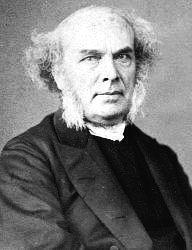
Horatius Bonar

1808 - 1889 Topics: Twenty Second Sunday after Trinity Author of "I lay my sins on Jesus" in Church Book Horatius Bonar was born at Edinburgh, in 1808. His education was obtained at the High School, and the University of his native city. He was ordained to the ministry, in 1837, and since then has been pastor at Kelso. In 1843, he joined the Free Church of Scotland. His reputation as a religious writer was first gained on the publication of the "Kelso Tracts," of which he was the author. He has also written many other prose works, some of which have had a very large circulation. Nor is he less favorably known as a religious poet and hymn-writer. The three series of "Hymns of Faith and Hope," have passed through several editions. --Annotations of the Hymnal, Charles Hutchins, M.A. 1872 ================================ Bonar, Horatius, D.D. Dr. Bonar's family has had representatives among the clergy of the Church of Scotland during two centuries and more. His father, James Bonar, second Solicitor of Excise in Edinburgh, was a man of intellectual power, varied learning, and deop piety. Horatius Bonar was born in Edinburgh, Dec. 19th, 1808; and educated at the High School and the University of Edinburgh. After completing his studies, he was "licensed" to preach, and became assistant to the Rev. John Lewis, minister of St. James's, Leith. He was ordained minister of the North Parish, Kelso, on the 30th November, 1837, but left the Established Church at the "Disruption," in May, 1848, remaining in Kelso as a minister of the Free Church of Scotland. The University of Aberdeen conferred on him the doctorate of divinity in 1853. In 1866 he was translated to the Chalmers Memorial Church, the Grange, Edinburgh; and in 1883 he was chosen Moderator of the General Assembly of of the Free Church of Scotland. Dr. Bonar's hymns and poems were, he tells us, composed amid a great variety of circumstances; in many cases he cannot himself recall these circumstances; they also appeared in several publications, but nearly all have boen published or republished in the following:— (i) Songs for the Wilderness, 1843-4. (2) The Bible Hymn Book, 1845. (3) Hymns, Original and Selected, 1846. (4) Hymns of Faith and Hope, First Series, 1857; Second Series, 1861; Third Series, 1866. (5) The Song of the New Creation, 1872. (6) My Old Letters, a long poem, 1877. (7) Hymns of the Nativity, 1879. (8) Communion Hymns, 1881. In addition to numerous prose works, he has also edited The New Jerusalem; a Hymn of the Olden Time, 1852, &c. Dr. Bonar's poems—-including many beautiful lyrics, several psalm versions, and translations from the Greek and Latin, a large number of hymns, and a long meditative poem—-are very numerous, too numerous, perhaps, for their permanent fame as a whole. Dr. Bonar's scholarship is thorough and extensive; and his poems display the grace of style and wealth of allusion which are the fruit of ripe culture. Affected very slightly by current literary moods, still less by the influence of other religious poetry, they reveal extreme susceptibility to the emotional power which the phases of natural and of spiritual life exercise; the phases of natural life being recognised chiefly as conveying and fashioning spiritual life, used chiefly for depicting spiritual life, and handled for this purpose with greater delicacy of touch than in the Olney Hymns, and with less conscious purpose than in the Christian Year. As a result of this susceptibility, and from habitual contemplation of the Second Advent as the era of this world's true bliss, his hymns and poems are distinguished by a tone of pensive reflection, which some might call pessimism. But they are more than the record of emotion; another element is supplied by his intellectual and personal grasp of Divine truth, these truths particularly:—The gift of a Substitute, our Blessed Saviour; Divine grace, righteous, yet free and universal in offer; the duty of immediate reliance upon the privilege of immediate assurance through that grace; communion with God, especially in the Lord's Supper, respecting which he insists on the privilege of cherishing the highest conceptions which Scripture warrants; and finally, the Second Advent of our Lord: by his vigorous celebration of these and other truths as the source and strength of spiritual life, his hymns are protected from the blight of unhealthy, sentimental introspection. To sum up: Dr. Bonar's hymns satisfy the fastidious by their instinctive good taste; they mirror the life of Christ in the soul, partially, perhaps, but with vivid accuracy; they win the heart by their tone of tender sympathy; they sing the truth of God in ringing notes; and although, when taken as a whole, they are not perfect ; although, in reading them, we meet with feeble stanzas, halting rhythm, defective rhyme, meaningless Iteration; yet a singularly large number have been stamped with approval, both in literary circles and by the Church. In Great Britain and America nearly 100 of Dr. Bonar's hymns are in common use. They are found in almost all modern hymnals from four in Hymns Ancient & Modern to more than twenty in the American Songs for the Sanctuary, N. Y., 1865-72. The most widely known are, "A few more years shall roll;" "Come, Lord, and tarry not;" "Here, O my Lord, I see Thee face to face;" "I heard the Voice of Jesus say;" "The Church has waited long;" and "Thy way, not mine, O Lord." In addition to these and others which are annotated under their respective first lines, the following are also in common use:— From Songs for the Wilderness, No. 1, 1843. 1. For Thee we long and pray. Sunday Morning. 2. Holy Father, hear my cry. A Child's Prayer. 3. I thought upon my sins and I was sad. Christ our Peace. 4. Peace to the world, our Lord is come. A Millennial Song. 5. Spirit of everlasting grace. The Vision of Dry Bones. ii. From Songs for the Wilderness, No. 2,1844. 6. Ho, ye thirsty, parched and fainting. Invitation. 7. 0 'tis not what we fancied it. The world renounced. 8. Sing them, my children, sing them still. Children exhorted to Praise. 9. Time's sun is fast setting. Advent. 10. Weep, pilgrim, weep, yet 'tis not for the sorrow. Faith. 11. Yes, for me, for me He careth. Christ the Elder Brother . iii. From The Bible Hymn Book, 1845. 12. Jesus, my sorrow lies too deep. Jesus, the Great High Priest. 13. There is a Morning Star, my soul. The Morning Star. 14. This is not my place of resting. Pressing towards heaven. iv. From Hymns, Original and Selected, 1845. 15. Let there be light, Jehovah said. Creation. v. From Hymns of Faith and Hope, 1st series, 1857. 16. Be brave, my brother. The Fight of Faith. 17. Blessed be God, our God. Good Friday. 18. Everlasting praises. Doxology. 19. Go up, go up, my heart. Heavenly aspirations desired. 20. I close my heavy eye. Evening. Sometimes given as "We close our heavy eyes." 21. I see the crowd in Pilate's hall. Good Friday. 22. Jesus, while this rongh desert soil. Strength by the Way. 23. Jesus, Whom angel-hosts adore. The Word made Flesh. From "The Son of God, in mighty love." 24. Make haste, 0 man, to live. Exhortation to lay hold of Life. 25. No seas again shall sever. Heaven. 26. Oppressed with noonday's scorching heat. Shadow of the Cross. 27. Rest for the toiling hand. Burial. From "Lie down, frail body, here." 28. Shall this life of mine be wasted? Exhortation to Duty. 29. These are the crowns that we shall wear. Heaven. 30. Thy works, not mine, O Christ [Lord]. The Sin-bearer. 31. Where the faded flower shall freshen. Heaven. vi. From Hymns of Faith and Hope. 2nd series, 1861. 32. Be still, my soul, Jehovah loveth Thee. Rest in the Love of God. 33. Christ has done the mighty work. Good Friday. 34. Come, mighty Spirit, penetrate. Whitsuntide. 35. Deep down beneath the unresting surge. Burial at Sea. 36. Fear not the foe, thou flock of God [thou little flock]. Battle-Song of the Church. 37. For lack of love I languish. Lent. 38. From this bleak hill of storms. Eternal Rest desired. 39. He liveth long who liveth well. The True Life. 40. Here shall death's triumph end: the rock-barred door. Easter. From "The tomb is empty: wouldst thou have it full." 41. Jesus, Sun and Shield art Thou. Jesus the First and Last. 42. Jesus, the Christ of God. Praise to Christ. 43. Light of the world, for ever, ever shining. Christ the Light of the World. From "Why walk in darkness? Has the dear light vanished?" 44. Make use of me, my God. Duty desired. 45. Not what I am, 0 Lord, but what Thou art. The Love of God. 46. 0 Light of Light, shine in. Cry of the Weary. 47. 0 love of God, how strong and true. Love of God. 48. 0 love that casts out fear. Love of God. 49. 0 strong to save and bless. Lent. 50. 0 this soul, how dark and blind. Lent. 51. Safe across the waters. Thanksgiving at end of a journey. 52. Silent, like men in solemn haste. Pressing onwards. 53. Speak, lips of mine. Exhortation to Praise. 54. The Bridegroom comes. Advent. vii. From Hymns of Faith and Hope. 3rd series, 1866. 55. Bear Thou my burden, Thou Who bar'st my sin. Lent or Passiontide. 56. Done is the work that saves. Easter. 57. Father, our children keep. Prayer on behalf of Children. 58. Fill Thou my life, 0 Lord my God. Life's Praise. 59. Finish Thy work, the time is short. Earnest labour to the end. 60. From the Cross the blood is falling. Good Friday. 61. He called them, and they left. Obedience. 62. Help me, my [0] God to speak. Truth desired. 63. Holy Father, Mighty God. Holy Trinity. 64. How are my troubles multiplied. Ps. iii. 65. How sweetly doth He show His face Flower Service. 66. Light hath arisen, we walk in its brightness. Sustaining power of Faith. 67. Lo, God, our God has come. Christmas. 68. Lord, give me light to do Thy work. Divine guidance desired. 69. No, not despairingly. Lent. 70. Not to ourselves again. Life in Christ, or, Living unto God. 71. Now in parting, Father, bless us. Post Communion. 72. Sounds the trumpet from afar. Battle-Song of the Church. 73. Thee in the loving bloom of morn. God in all. 74. Through good report and evil, Lord. Faithfulness. 75. To Jehovah, God of might. Praise to the Father. 76. To the name of God on high. Doxology. 77. Upward, where the stars are burning. Heavenward Aspirations. 78. We take the peace which He hath won. The Gift of Peace. 79. When the weary, seeking rest. Intercession for all Conditions of Men. viii. From The Song of the New Creation,1872. 80. For the Bread and for the Wine. Holy Communion. 81. Light of life so softly shining. Light of Life. 82. Yet there is room. The Lamb's bright hall of song. Home Missions. ix. From Hymns of the Nativity, 1879. 83. Great Ruler of the land and sea. Sailors' Liturgy. From Communion Hymns, 1881. 84. Beloved, let us love. Brotherly Love. In several instances these hymns are given in an abbreviated form, and sometimes alterations are also introduced. In this latter respect however Dr. Bonar has suffered less than most modern hymn-writers. [Rev. James Mearns, M.A.] -- John Julian, Dictionary of Hymnology (1907) ==================== Bonar, Horatius, p. 161, i. He died at Edinburgh, July 31, 1889. In 1890 his son published a posthumous volume of his poetical pieces as Until the Day Break and other Hymns and Poems left behind. The following additional hymns are in common use:— 1. Almighty Comforter and Friend. (1866.) Whitsuntide. 2. Father, make use of me. An altered form of No. 44, p. 162, ii. 3. I ask a perfect creed. (1861.) Creed not Opinions. From this is also taken "O True One, give me truth." 4. Long, long deferred, now come at last. Marriage of the Lamb. Part of "Ascend, Beloved, to the joy." (1861.) 5. Nay 'tis not what we fancied it. (1857.) Vanity of the World. 6. No blood, no altar now. (1861.) The Finished Sacrifice. 7. No shadows yonder. (1857.) Heaven Anticipated. 8. Not with the light and vain. (1857.) Godly Companionship. 9. O Love invisible, yet infinite. (1866.) Divine Love. 10. On the great love of God I lean. (1866.) Love of God our Resting-place. 11. On Thee, O Jesus, strongly leaning. (1866.) Fellowship with Christ. 12. Peace upon peace, like wave on wave. (1866.) Divine Peace. 13. Sower divine, sow the good seed in me. (1857.) Heavenly Sowing. 14. Speaketh the sinner's sin within my heart. (1866.) Ps. xxxvi. 15. Still one in life and one in death. (1857.) Communion of Saints. Part of "'Tis thus they press the hand and part." 16. Surely, yon heaven, where angels see God's face. (1857.) Heaven Anticipated. 17. That city with the jewelled crest. (1857.) Heaven. Part of "These are the crowns that we shall wear." Another cento from the same is "Yon city, with the jewelled crest." 18. That clime is not like this dull clime of ours. (1843.) Heaven. 19. The Free One makes you free: He breaks the rod. (1857.) Freedom in Christ. From "Of old they sang the song of liberty." 20. There is a Morning-star, my soul. (1357.) Christ the Morning Star. 21. This is the day of toil. (1866.) Pressing Onwards. 22. Thy thoughts are here, my God. (1866.) Holy Scripture. 23. Till the day dawn. (1857.) Life's Journey. 24. To Him Who spread the skies. (1866.) Creation's Song. 25. Trustingly, trustingly. (1866.) Trust. 26. Unto th' eternal hills. (1866.) Ps. cxxi. The above dates are: 1843, Songs in the Wilderness; 1857, Hymns of Faith and Hope, 1st Series; 1861, same, 2nd Ser. (not 1864); 1866, same, 3rd Ser. (not 1867), The dates 1857, 1864,1867, were given by Dr. Bonar, but the British Museum copies are 1857, 1861, 1866 respectively. --John Julian, Dictionary of Hymnology, Appendix, Part II (1907) ============== Bonar, H., pp. 161, i.; 1554, i. The Rev. H. N. Bonar, Dr. Bonar's son, published in 1904, Hymns by Horatius Bonar, Selected and Arranged by his Son H. N. Bonar, With a brief History of some of the Hymns, &c. (London: H. Frowde). From this work we must correct the date of his Song of the New Creation to 1872. We have also enriched our pages by additional and expanded notes on several of Dr. Bonar's most widely used hymns. In his biographical notes, Mr. Bonar refers to Dr. Bonar's work as editor of the Quarterly Journal of Prophecy, begun in 1848, to which he contributed a hymn for each number. We find that the number of hymns contributed thereto is 101. With Dr. Bonar's poetical productions great difficulty has been encountered by the historian and annotator because of his absolute indifference to dates and details. It was enough for him that he had written, and that the Church of Christ approved and gladly used what, out of the fulness of his heart, he had given her. --Excerpt from John Julian, Dictionary of Hymnology, New Supplement (1907)

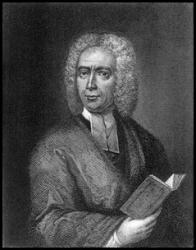
Isaac Watts

1674 - 1748 Topics: Twenty Second Sunday after Trinity Author of "And shall we still be slaves" in Evangelical Lutheran hymnal Isaac Watts was the son of a schoolmaster, and was born in Southampton, July 17, 1674. He is said to have shown remarkable precocity in childhood, beginning the study of Latin, in his fourth year, and writing respectable verses at the age of seven. At the age of sixteen, he went to London to study in the Academy of the Rev. Thomas Rowe, an Independent minister. In 1698, he became assistant minister of the Independent Church, Berry St., London. In 1702, he became pastor. In 1712, he accepted an invitation to visit Sir Thomas Abney, at his residence of Abney Park, and at Sir Thomas' pressing request, made it his home for the remainder of his life. It was a residence most favourable for his health, and for the prosecution of his literary labours. He did not retire from ministerial duties, but preached as often as his delicate health would permit. The number of Watts' publications is very large. His collected works, first published in 1720, embrace sermons, treatises, poems and hymns. His "Horae Lyricae" was published in December, 1705. His "Hymns" appeared in July, 1707. The first hymn he is said to have composed for religious worship, is "Behold the glories of the Lamb," written at the age of twenty. It is as a writer of psalms and hymns that he is everywhere known. Some of his hymns were written to be sung after his sermons, giving expression to the meaning of the text upon which he had preached. Montgomery calls Watts "the greatest name among hymn-writers," and the honour can hardly be disputed. His published hymns number more than eight hundred. Watts died November 25, 1748, and was buried at Bunhill Fields. A monumental statue was erected in Southampton, his native place, and there is also a monument to his memory in the South Choir of Westminster Abbey. "Happy," says the great contemporary champion of Anglican orthodoxy, "will be that reader whose mind is disposed, by his verses or his prose, to imitate him in all but his non-conformity, to copy his benevolence to men, and his reverence to God." ("Memorials of Westminster Abbey," p. 325.) --Annotations of the Hymnal, Charles Hutchins, M.A., 1872. ================================= Watts, Isaac, D.D. The father of Dr. Watts was a respected Nonconformist, and at the birth of the child, and during its infancy, twice suffered imprisonment for his religious convictions. In his later years he kept a flourishing boarding school at Southampton. Isaac, the eldest of his nine children, was born in that town July 17, 1674. His taste for verse showed itself in early childhood. He was taught Greek, Latin, and Hebrew by Mr. Pinhorn, rector of All Saints, and headmaster of the Grammar School, in Southampton. The splendid promise of the boy induced a physician of the town and other friends to offer him an education at one of the Universities for eventual ordination in the Church of England: but this he refused; and entered a Nonconformist Academy at Stoke Newington in 1690, under the care of Mr. Thomas Rowe, the pastor of the Independent congregation at Girdlers' Hall. Of this congregation he became a member in 1693. Leaving the Academy at the age of twenty, he spent two years at home; and it was then that the bulk of the Hymns and Spiritual Songs (published 1707-9) were written, and sung from manuscripts in the Southampton Chapel. The hymn "Behold the glories of the Lamb" is said to have been the first he composed, and written as an attempt to raise the standard of praise. In answer to requests, others succeeded. The hymn "There is a land of pure delight" is said to have been suggested by the view across Southampton Water. The next six years of Watts's life were again spent at Stoke Newington, in the post of tutor to the son of an eminent Puritan, Sir John Hartopp; and to the intense study of these years must be traced the accumulation of the theological and philosophical materials which he published subsequently, and also the life-long enfeeblement of his constitution. Watts preached his first sermon when he was twenty-four years old. In the next three years he preached frequently; and in 1702 was ordained pastor of the eminent Independent congregation in Mark Lane, over which Caryl and Dr. John Owen had presided, and which numbered Mrs. Bendish, Cromwell's granddaughter, Charles Fleetwood, Charles Desborough, Sir John Hartopp, Lady Haversham, and other distinguished Independents among its members. In this year he removed to the house of Mr. Hollis in the Minories. His health began to fail in the following year, and Mr. Samuel Price was appointed as his assistant in the ministry. In 1712 a fever shattered his constitution, and Mr. Price was then appointed co-pastor of the congregation which had in the meantime removed to a new chapel in Bury Street. It was at this period that he became the guest of Sir Thomas Abney, under whose roof, and after his death (1722) that of his widow, he remained for the rest of his suffering life; residing for the longer portion of these thirty-six years principally at the beautiful country seat of Theobalds in Herts, and for the last thirteen years at Stoke Newington. His degree of D.D. was bestowed on him in 1728, unsolicited, by the University of Edinburgh. His infirmities increased on him up to the peaceful close of his sufferings, Nov. 25, 1748. He was buried in the Puritan restingplace at Bunhill Fields, but a monument was erected to him in Westminster Abbey. His learning and piety, gentleness and largeness of heart have earned him the title of the Melanchthon of his day. Among his friends, churchmen like Bishop Gibson are ranked with Nonconformists such as Doddridge. His theological as well as philosophical fame was considerable. His Speculations on the Human Nature of the Logos, as a contribution to the great controversy on the Holy Trinity, brought on him a charge of Arian opinions. His work on The Improvement of the Mind, published in 1741, is eulogised by Johnson. His Logic was still a valued textbook at Oxford within living memory. The World to Come, published in 1745, was once a favourite devotional work, parts of it being translated into several languages. His Catechisms, Scripture History (1732), as well as The Divine and Moral Songs (1715), were the most popular text-books for religious education fifty years ago. The Hymns and Spiritual Songs were published in 1707-9, though written earlier. The Horae Lyricae, which contains hymns interspersed among the poems, appeared in 1706-9. Some hymns were also appended at the close of the several Sermons preached in London, published in 1721-24. The Psalms were published in 1719. The earliest life of Watts is that by his friend Dr. Gibbons. Johnson has included him in his Lives of the Poets; and Southey has echoed Johnson's warm eulogy. The most interesting modern life is Isaac Watts: his Life and Writings, by E. Paxton Hood. [Rev. H. Leigh Bennett, M.A.] A large mass of Dr. Watts's hymns and paraphrases of the Psalms have no personal history beyond the date of their publication. These we have grouped together here and shall preface the list with the books from which they are taken. (l) Horae Lyricae. Poems chiefly of the Lyric kind. In Three Books Sacred: i.To Devotion and Piety; ii. To Virtue, Honour, and Friendship; iii. To the Memory of the Dead. By I. Watts, 1706. Second edition, 1709. (2) Hymns and Spiritual Songs. In Three Books: i. Collected from the Scriptures; ii. Composed on Divine Subjects; iii. Prepared for the Lord's Supper. By I. Watts, 1707. This contained in Bk i. 78 hymns; Bk. ii. 110; Bk. iii. 22, and 12 doxologies. In the 2nd edition published in 1709, Bk. i. was increased to 150; Bk. ii. to 170; Bk. iii. to 25 and 15 doxologies. (3) Divine and Moral Songs for the Use of Children. By I. Watts, London, 1715. (4) The Psalms of David Imitated in the Language of the New Testament, And apply'd to the Christian State and Worship. By I. Watts. London: Printed by J. Clark, at the Bible and Crown in the Poultry, &c, 1719. (5) Sermons with hymns appended thereto, vol. i., 1721; ii., 1723; iii. 1727. In the 5th ed. of the Sermons the three volumes, in duodecimo, were reduced to two, in octavo. (6) Reliquiae Juveniles: Miscellaneous Thoughts in Prose and Verse, on Natural, Moral, and Divine Subjects; Written chiefly in Younger Years. By I. Watts, D.D., London, 1734. (7) Remnants of Time. London, 1736. 454 Hymns and Versions of the Psalms, in addition to the centos are all in common use at the present time. --Excerpts from John Julian, Dictionary of Hymnology (1907) ================================== Watts, I. , p. 1241, ii. Nearly 100 hymns, additional to those already annotated, are given in some minor hymn-books. --John Julian, Dictionary of Hymnology, Appendix, Part II (1907) ================= Watts, I. , p. 1236, i. At the time of the publication of this Dictionary in 1892, every copy of the 1707 edition of Watts's Hymns and Spiritual Songs was supposed to have perished, and all notes thereon were based upon references which were found in magazines and old collections of hymns and versions of the Psalms. Recently three copies have been recovered, and by a careful examination of one of these we have been able to give some of the results in the revision of pp. 1-1597, and the rest we now subjoin. i. Hymns in the 1709 ed. of Hymns and Spiritual Songs which previously appeared in the 1707 edition of the same book, but are not so noted in the 1st ed. of this Dictionary:— On pp. 1237, L-1239, ii., Nos. 18, 33, 42, 43, 47, 48, 60, 56, 58, 59, 63, 75, 82, 83, 84, 85, 93, 96, 99, 102, 104, 105, 113, 115, 116, 123, 124, 134, 137, 139, 146, 147, 148, 149, 162, 166, 174, 180, 181, 182, 188, 190, 192, 193, 194, 195, 197, 200, 202. ii. Versions of the Psalms in his Psalms of David, 1719, which previously appeared in his Hymns and Spiritual Songs, 1707:— On pp. 1239, U.-1241, i., Nos. 241, 288, 304, 313, 314, 317, 410, 441. iii. Additional not noted in the revision:— 1. My soul, how lovely is the place; p. 1240, ii. 332. This version of Ps. lxiv. first appeared in the 1707 edition of Hymns & Spiritual Songs, as "Ye saints, how lovely is the place." 2. Shine, mighty God, on Britain shine; p. 1055, ii. In the 1707 edition of Hymns & Spiritual Songs, Bk. i., No. 35, and again in his Psalms of David, 1719. 3. Sing to the Lord with [cheerful] joyful voice, p. 1059, ii. This version of Ps. c. is No. 43 in the Hymns & Spiritual Songs, 1707, Bk. i., from which it passed into the Ps. of David, 1719. A careful collation of the earliest editions of Watts's Horae Lyricae shows that Nos. 1, 7, 9, 10, 11, 12, 14, 16, p. 1237, i., are in the 1706 ed., and that the rest were added in 1709. Of the remaining hymns, Nos. 91 appeared in his Sermons, vol. ii., 1723, and No. 196 in Sermons, vol. i., 1721. No. 199 was added after Watts's death. It must be noted also that the original title of what is usually known as Divine and Moral Songs was Divine Songs only. --John Julian, Dictionary of Hymnology, New Supplement (1907) =========== See also in: Hymn Writers of the Church

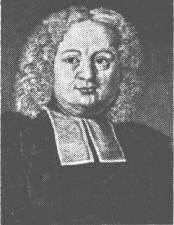
Benjamin Schmolck

1672 - 1737 Person Name: Benjamin Schmolke Topics: Twenty Second Sunday after Trinity Author of "Precious Word from God in heaven" in Evangelical Lutheran hymnal Schmolck, Benjamin, son of Martin Schmolck, or Schmolcke, Lutheran pastor at Brauchitschdorf (now Chrόstnik) near Liegnitz in Silesia (now Poland) was born at Brauchitschdorf, Dec. 21, 1672. He entered the Gymnasium at Lauban in 1688, and spent five years there. After his return home he preached for his father a sermon which so struck the patron of the living that he made Benjamin an allowance for three years to enable him to study theology. He matriculated, at Michaelmas, 1693, at the University of Leipzig, where he came under the influence of J. Olearius, J. B. Carpzov, and others, and throughout his life retained the character of their teaching, viz. a warm and living practical Christianity, but Churchly in tone and not Pietistic. In the autumn of 1697, after completing his studies at Leipzig (during his last year there he supported himself mainly by the proceeds of occasional poems written for wealthy citizens, for which he was also, crowned as a poet), he returned to Brauchitzchdorf to help his father, and, in 1701, was ordained as his assistant. On Feb. 12, 1702, he married Anna Rosina, daughter of Christoph Rehwald, merchant in Lauban and in the end of the same year was appointed diaconus of the Friedenskirche at Schweidnitz in Silesia. As the result of the Counter-Reformation in Silesia, the churches in the principality of Schweidnitz had been taken from the Lutherans, and for the whole district the Peace of Westphalia (1648) allowed only one church (and that only of timber and clay, without tower or bells), which the Lutherans had to build at Schweidnitz, outside the walls of the town; and the three clergy attached to this church had to minister to a population scattered over some thirty-six villages, and were moreover hampered by many restrictions, e.g. being unable to communicate a sick person without a permit from the local Roman Catholic priest. Here Schmolck remained till the close of his life, becoming in 1708 archidiaconus, in 1712 senior, and in 1714 pastor primarius and inspector. Probably as the result of his exhausting labours he had a stroke of paralysis on Laetare (Mid-Lent) Sunday, 1730, which for a time laid him aside altogether, and after which he never recovered the use of his right hand. For five years more he was still able to officiate, preaching for the last time on a Fastday in 1735. But two more strokes of paralysis followed, and then cataract came on, relieved for a time by a successful operation, but returning again incurably. For the last months of his life he was confined to bed, till the message of release came to him, on the anniversary of his wedding, Feb. 12, 1737. (Koch, v. 463; Bode, p. 144; Goedeke's Grundriss, vol. iii., 1887, p. 306; sketch prefixed to Ledderhose's edition of Schmolck's Geistliche Lieder, Halle, 1857, &c.) Schmolck was well known in his own district as a popular and useful preacher, a diligent pastor, and a man of wonderful tact and discretion. It was however his devotional books, and the original hymns therein contained, that brought him into wider popularity, and carried his name and fame all over Germany. Long lists of his works and of the various editions through which many of them passed are given by Koch, Bode and Goedehe. It is rather difficult to trace the hymns, as they are copied from one book of his into another, &c. Schmolck was the most popular hymnwriter of his time, and was hailed as the "Silesian Rist," as the "second Gerhardt," &c. Nor was he altogether unworthy of such praise. It is true that he did not possess the soaring genius of Gerhardt. Nor had he even Gerhardt's concise, simple style, but instead was too fond of high-sounding expressions, of plays upon words, of far-fetched but often recurring contrasts, and in general of straining after effect, especially in the pieces written in his later years. In fact he wrote a great deal too much, and latterly without proper attention to concentration or to proportion. Besides Cantatas, occasional pieces for weddings, funerals, &c, he is the author of some 900 hymns, properly so called. These were written for all sorts of occasions, and range over the whole field of churchly, family, and individual life. Naturally they are not all alike good; and those in his first three collections are decidedly the best. A deep and genuine personal religion, and a fervent love to the Saviour, inspire his best hymns; and as they are not simply thought out but felt, they come from the heart to the heart. The best of them are also written in a clear, flowing, forcible, natural, popular style, and abound in sententious sayings, easily to be remembered. Even of these many are, however, more suited for family use than for public worship. Nevertheless they very soon came into extensive use, not only in Silesia, but all over Germany. A number of Schmolck's hymns [that] have passed into English are:— i. Der beste Freund ist in dem Himmel. Love of Jesus. First published in his Heilige Flammen (ed. 1709, p. 100), in 6 stanzas of 6 lines, entitled "The best Friend." The translation in common use is:— A faithful friend is waiting yonder. This is a good translation, omitting stanza v., as No. 293, in Kennedy, 1863. ii. Die Woche geht zum Ende. Saturday Evening. In his Andächtige Hertze, 1714, p. 116, in 10 stanzas of 8 lines, entitled "Evening Hymn," and appointed for Evening Prayer on Saturday. In the Berlin Geistliche Lieder, ed. 1863, No. 1158. Translated as:— The week draws near its ending. This is a good translation of stanzas i., vi., vii., x., marked as by "A. G.," as No. 81 in the Dalston Hospital Hymn Book 1848. Other trs. are: (1) “Though now the week is ending," by H. J. Buckoll, 1842, p. 107. (2) “The week at length is over," by Miss Manington, 1863, p. 137. iii. Gott du hist selbst die Liehe. Holy Matrimony. Translated as:— O God, "Who all providest. This is a good translation, omitting stanza iii., by J. M. Sloan, as No. 312 in J. H. Wilson's Service of Praise, 1865. iv. Halleluja! Jesus lebt. Easter. In his Bochim und Elim, 1731, p. 67, in 5 stanzas of 6 lines, entitled "Hallelujah! at the grave of Jesus." In the Berlin Geistliche Lieder, ed. 1863, No. 296. Tr. as:— Hallelujah! Lo, He wakes. By E. Cronenwett, omitting st. iv., as No. 79 in the Ohio Lutheran Hymnal 1880. Another translation is: "Hallelujah! Jesus lives! Life, immortal life, He gives." This is a full and good translation, by Miss Warner, 1858, p. 486, repeated in the Treasury of Sacred Song, Kirkwall, n.d. v. Heute mir und Morgen dir. Funeral Hymn. In his Schmuck und Asche, 1717, p. 252, in 6 stanzas of 6 lines, entitled "Daily Dying". The tr. in common use is:— Today mine, tomorrow thine. This is a good and full translation, by Miss Warner, in her Hymns of the Church Militant, 1858, p. 260. vi. Je grösser Kreuz, je näher Himmel. Cross and Consolation. In his Andächtige Hertz, 1714, p. 273, in 9 stanzas of 6 lines, entitled "Hymn of Cross and Consolation." By its sententiousness and its manifold illustrations of the power of the Cross it has been a favourite with many. Translated as:— 1. Greater the Cross, the nearer heaven. 2. The more the cross, the nearer heaven. Another translation is: "The heavier the cross, the nearer heaven," by J. D. Burns, in the Family Treasury, 1859, p. 160. vii. Jesus soil die Losung sein. New Year. The translation in common use is:— Jesus shall the watchword he. Another translation is: "Jesu's name shall be our watchword," by J. Kelly, in the Family Treasury, 1868, p. 689. viii. Licht vom Licht, erleuchte mich. Sunday Morning. Translated as:— Light of Light, enlighten me. This is a very good tr. omitting stanza vii., by Miss Winkworth, in her Lyra Germanica, 2nd Ser., 1858, p. 66, and thence in her Chorale Book for England, 1863, No. 17. Other translations are: (1) "Light of Light! illumine me," by H. J. Buckoll, 1842, p. 6. (2) "O thou blessed Light of Light," by Miss Dunn, 1857, p. 74. ix. Meinen Jesum lass ich nicht, Ach was wollt ich hessres haben. Love to Christ. Translated as:— I'll with Jesus never part. This is a translation of st. i., ii., iv., as stanzas iii.-v. of No. 378 in the Moravian Hymn Book, 1789. In the ed. of 1886, No. 452 (see p. 614, i.), the part from Schmolck begins, "He is mine and I am His" (the translation of stanza ii.). Another tr. is: "I'll not leave Jesus—-never, never," by Miss Warner, 1858, p. 509. x. Mein Gott, ich weiss wohl dass ich sterbe. For the Dying. Translated as:— My God! I know that I must die, My mortal. Other trs. are: (1) "That I shall die full well 1 know," by Dr. H. Mills, 1845 (1856, p. 232). (2) "My God! I know full well that I must die," by Miss Warner, 1858, p. 344. (3) "My God, I know that I must die; I know," by G. Moultrie, in his Espousals of S. Dorothea, 1870. xi. Mein Jesus lebt! was soil ich sterben. Easter. Translated as:— My Saviour lives; I shall not perish. xii. 0 wie fröhlich, o wie selig. Eternal Life. Translated as:— Oh how joyous, oh how blessed. Another tr. is: "Oh, how blest beyond our telling." xiii. Schmückt das Fest mit Maien. Whitsuntide. Translated as:— Come, deck our feast today. xiv. Thut mir auf die schöne Pforte. Sunday. Translated as:— 1. Open now thy gates of beauty. This is a good tr., omitting stanza iii., vii., by Miss Winkworth, in her Chorale Book for England, 1863, No. 15. 2. Open wide the gates of beauty. This is a translation of stanzas i., ii., iv., vi.-vii., by H. L. Hastings, dated 1885, as No. 1076, in his Songs of Pilgrimage, 1886. Another tr. is: "Throw the glorious gates wide open," by Miss Manington, 1863, p. 146. xv. Weine nicht, Gott lebet noch. Cross and Consolation. Tr. as:— "Weep not,-—Jesus lives on high. Another tr. is: "Weep not, for God, our God, doth live," by Dr. R. Maguire, 1883, p. 59. xvi. Willkommen, Held im Streite. Easter. The translation in common use is:— Welcome Thou victor in the strife. This is a good translation omitting st. ii.—iv., by Miss Winkworth, in her Lyra Germanica, 1st Ser., 1855, p. 91. Hymns not in English common use:-- xvii. Ach wenn ich dich, mein Gott, nur habe. Love to God. Founded on Ps. lxxiii. 25, 26. Translated as "My God, if I possess but Thee," by G. Moultrie, in his Espousals of S. Dorothea, 1870. xviii. An Gott will ich gedenken. Remembering God's Love and Care. In his Heilige Flammen (ed. 1707, p. 59; ed. 1709, p. 131), in 6 stanzas of 8 lines, and Burg's Gesang-Buch, Breslau, 1746, No. 112. Translated as "My God will I remember," by J. Kelly, in the Family Treasury, 1868. xix. Der Sabbath ist vergangen. Sunday Evening. Tr. as "The Sabbath now is over," by Dr. H. Mills, 1856, p. 226. xx. Du angenehmer Tag. Sunday. In his Lustige Sabbath, 1712, p. 1, in 8 stanzas of 6 lines. Tr. as “Thou ever welcome day," by J. Kelly, in the Family Treasury, 1868, p. 688. xxi. Endlich, endlich, muss es doch. Cross and Consolation. Translated as "Yes, at last, our God shall make," in the Christian Examiner, Boston, U.S., Sept., 1860, p. 251. xxii. Gedenke mein, mein Gott, gedenke mein. For the Dying. Translated as "Remember me, my God! remember me," by Miss Borthwick, in Hymns from the Land of Luther 1854, p. 9. xxiii. Geh, müder Leib, zu deiner Euh. Evening. Translated as "Go, wearied body, to thy rest," by J. Kelly, in the Family Treasury, 1868. In his Lustige Sabbath, 1712, p. 35, in 10 stanzas of 6 lines, and Burg’s Gesang-Buch, Breslau, 1746, No. 403. Translated as "King, to Jews and Gentiles given," by Dr. H. Mills, 1845. xxiv. Gott der Juden,Gott der Heiden. Epiphany. Translated as “King, to Jews and Gentiles given,” by Dr. H. Mills, 1845. xxv. Gott lebt, wie kann ich traurig sein. Trust in God. Translated as "God lives! Can I despair," by Miss Warner, 1869, p. 44. xxvi. Gott mit uns, Immanuel. New Year. Translated as "God with us! Immanuel, Open with the year before us," by Dr. R. P. Dunn, in Sacred Lyrics from the German, Philadelphia, U.S., 1859, p. 166. xxvii. Hier ist Immanuel! New Year. Translated as "Here is Immanuel!" by Miss Manington, 1864, p. 24. xxviii. Hilf, Heifer, hilf! ich muss verzagen. Cross and Consolation. Translated as "Help, Saviour, help, I sink, I die,” in the Monthly Packet, vol. xviii., 1859, p. 664. xix. Ich habe Lust zu scheiden. For the Dying. Tr. as "Weary, waiting to depart," by Mrs. Findlater, in Hymns from the Land of Luther, 1855, p 130. xxx. Ich sterbe täglich, und mein Leben. For the Dying. Translated as "Both life and death are kept by Thee" (st. iv.), by J. Kelly, in the Family Treasury, 1868, p. 689. xxxi. Mein Gott, du hast mich eingeladen. Sunday. Translated as "My God, Thou hast the invite given," by Miss Manington, 1863, p. 150. xxxii. Mein Gott! du wohnst in einem Lichte. Holy Scripture. Translated as "In glory bright, O God, Thou dwellest," by Dr. H. Mills, 1845. xxxiii. Mein Gott, ich klopf an deine Pforte. Supplication. Tr.Translated as "given as "Mein Gott, mein Erstes und mein Alles." Translated as "My God! the Source of all my blessing," in the British Herald, August, 1866, p. 312; repeated in Reid's Praise Book, 1872. xxxv. Mein Gott, weil ich in meinem Leben. The ChristiaWho, Lord, has any good whatever," by Dr. H. Mills, 1845, p. 91. xxxiv. Mein Gott, mein Alles Uber Alles. Trust in God. Sometimes n Life. Translated as "Most High! with reverence to fear Thee," by Dr. H. Mills, 1845, p. 114.). xxxvi. Nun hab ich überwunden; Zu guter Nacht, o Welt. For the Dying. Translated as "Now soon I shall have conquer'd," by Miss Manington, 1863, p. 87. xxxvii. Seht welch ein Mensch ist das. Passiontide. The translations are (1) "See, what a man is this! How tearful is His glance," by J. Kelly, in the British Messenger, Feb., 1S68; repeated in the Family Treasury, 1868, p. 691. (2) "See what a man is this, O glances," by Miss Warner, 1869, p. 32. xxxviii. Sei getreu bis in den Tod. Christian Faithfulness. Translated as "Be thou faithful unto death! Let not troubles nor distresses," by R. Massie, in the Day of Rest, 1878, vol. ix. p. 219. xxxix. Theures Wort aus Gottes Munde. Holy Scripture. Translated as "Word by God the Father spoken," by Miss Manington, 1863. xl. Was Gott thut das ist wohlgethan! Er giebt und nimmt auch wieder. On the Death of a Child. The trs. are (1) "What God does is well done, "Who takes what He gave," by W. Graham, in his The Jordan and the Rhine, London, 1854, p. 251. (2) "Whatever God doth is well done, He gives, &c," by J. Kelly, in the Family Treasury, 1868, p. 688. xli. Wer will mich von der Liebe scheiden. Faith. Translated as "Who can my soul from Jesus sever," by Miss Manington, 1863, p. 39. [Rev. James Mearns, M.A.] --Excerpts from John Julian, Dictionary of Hymnology (1907)
It looks like you are using an ad-blocker. Ad revenue helps keep us running. Please consider white-listing Hymnary.org or getting Hymnary Pro to eliminate ads entirely and help support Hymnary.org.