You help make Hymnary.org possible. More than 10 million people from 200+ countries found hymns, liturgical resources and encouragement on Hymnary.org in 2025, including you. Every visit affirms the global impact of this ministry.

If Hymnary has been meaningful to you this year, would you take a moment today to help sustain it? A gift of any size—paired with a note of encouragement if you wish—directly supports the server costs, research work and curation that keep this resource freely available to the world.

Give securely online today, or mail a check to:
Hymnary.org
Calvin University
3201 Burton Street SE
Grand Rapids, MI 49546

Thank you for your partnership, and may the hope of Advent fill your heart.

Person Results

Tune Identifier:"^domine_clamavi_knecht$"
In:person

Planning worship? Check out our sister site, ZeteoSearch.org, for 20+ additional resources related to your search.
Showing 1 - 6 of 6Results Per Page: 102050

Anne Steele

1717 - 1778 Author of "O Thou whose tender mercy hears" in Church Book Anne Steele was the daughter of Particular Baptist preacher and timber merchant William Steele. She spent her entire life in Broughton, Hampshire, near the southern coast of England, and devoted much of her time to writing. Some accounts of her life portray her as a lonely, melancholy invalid, but a revival of research in the last decade indicates that she had been more active and social than what was previously thought. She was theologically conversant with Dissenting ministers and "found herself at the centre of a literary circle that included family members from various generations, as well as local literati." She chose a life of singleness to focus on her craft. Before Christmas in 1742, she declined a marriage proposal from contemporary minister-hymnist Benjamin Beddome. All the same, some of Steele's sufferings were very real. She lost her mother at age 3, a potential suitor at age 20, her step mom at 43, and her sister-in-law at 45. She spent many years caring for her father until his death in 1769. For most of her life, she exhibited symptoms of malaria, including persistent pain, fever, headaches, and stomach aches. Caleb Evans, in his preface to Steele's posthumous Miscellaneous Pieces in Verse and Prose (1780), noted that she had been bed ridden for "some years" before her death: When the interesting hour came, she welcomed its arrival, and though her feeble body was excruciated with pain, her mind was perfectly serene. . . . She took the most affectionate leave of her weeping friends around her, and at length, the happy moment of her dismission arising, she closed her eyes, and with these animating words on her dying lips, "I know that my Redeemer liveth," gently fell asleep in Jesus. Historically, her most popular hymn has been "When I survey life's varied scene" (and its shortened form, "Father, whate'er of earthly bliss"), a hymn that turns earthly loss or denial into a spirit of thankfulness, published in over 800 North American hymnals since 1792. Not all of her work deals with personal agony. Her hymns span a wide doctrinal and ecclesiastical range, some crafted and used for her father's congregation. Her metrical psalms are among the finest of the genre. Steele's hymns and psalms were published in two volumes in 1760, Poems on Subjects Chiefly Devotional, under the pseudonym Theodosia, with an additional volume of material published after her death, in Miscellaneous Pieces in Verse and Prose, 1780. Another small collection, Verses for Children, was issued in 1788, with two other editions given in 1803 and 1806. Sixty-two of her hymns, including new material and some revisions by Steele, were published in a hymnal for Baptists in 1769, A Collection of Hymns Adapted to Public Worship, edited by Caleb Evans and John Ash. Forty seven were included in John Rippon's A Selection of Hymns from the Best Authors in 1787; the only author with larger representation was Philip Doddridge, with 101. These collections represent the earliest attempts to anthologize Baptist hymns and were vital for bringing Steele's hymns into wider public worship, where they have been a mainstay for over two hundred years. Chris Fenner adapted from The Towers (Southern Baptist Theological Seminary, August 2015) Recommended Bibliography: Cynthia Y. Aalders, To Express the Ineffable: The Hymns and Spirituality of Anne Steele (Milton Keynes, U.K.: Paternoster, 2008). Cynthia Y. Aalders, "In melting grief and ardent love: Anne Steele's contribution to eighteenth-century hymnody," The Hymn (summer 2009), 16-25. J.R. Broome, A Bruised Reed: The Life and Times of Anne Steele (Harpenden, U.K.: Gospel Standard Trust Publications, 2007). Joseph Carmichael, The Hymns of Anne Steele in John Rippon's Selection of Hymns: A Theological Analysis in the Context of the English Particular Baptist Revival (2012), dissertation, http://digital.library.sbts.edu/handle/10392/4112 Priscilla Wong, Anne Steele and Her Spiritual Vision (Grand Rapids: Reformation Heritage Books, 2012). Timothy Whelan & Julia B. Griffin, eds., Nonconformist Women Writers, 1720–1840, vols. 1 & 2 (London: Pickering & Chatto, 2011). ======================== Steele, Anne, born in 1716, was the daughter of Mr. Wm. Steele, a timber merchant, and pastor, without salary, of the Baptist Church at Broughton, in Hampshire. At an early age she showed a taste for literature, and would often entertain her friends by her poetical compositions. But it was not until 1760 that she could be prevailed upon to publish. In that year two volumes appeared under the title of Poems on Subjects chiefly Devotional, by Theodosia. After her death, which occurred in November, 1778, a new edition was published with an additional volume and a Preface by the Rev. Dr. Caleb Evans, of Bristol (Bristol, 1780). In the three volumes are 144 hymns, 34 Psalms in verse, and about 30 short poems. They have been reprinted in one vol. by D. Sedgwick, 1863…. Among Baptist hymnwriters Miss Steele stands at the head, if we regard either the number of her hymns which have found a place in the hymnals of the last 120 years, or the frequency with which they have been sung. Although few of them can be placed in the first rank of lyrical compositions, they are almost uniformly simple in language, natural and pleasing in imagery, and full of genuine Christian feeling. Miss Steele may not inappropriately be compared with Miss F. R. Havergal, our "Theodosia" of the 19th century. In both there is the same evangelic fervour, in both the same intense personal devotion to the Lord Jesus. But whilst Miss Steele seems to think of Him more frequently as her "bleeding, dying Lord "—dwelling on His sufferings in their physical aspect—Miss Havergal oftener refers to His living help and sympathy, recognizes with gladness His present claims as "Master" and "King," and anticipates almost with ecstasy His second coming. Looking at the whole of Miss Steele's hymns, we find in them a wider range of thought than in Miss Havergal's compositions. She treats of a greater variety of subjects. On the other hand, Miss Havergal, living in this age of missions and general philanthropy, has much more to say concerning Christian work and personal service for Christ and for humanity. Miss Steele suffered from delicacy of health and from a great sorrow, which befell her in the death of her betrothed under peculiarly painful circumstances. In other respects her life was uneventful, and occupied chiefly in the discharge of such domestic and social duties as usually fall to the lot of the eldest daughter of a village pastor. She was buried in Broughton churchyard. [Rev W. R. Stevenson, M.A.] A large number of Miss Steele's hymns are in common use, the larger proportion being in American hymnbooks. In addition to "Almighty Maker of my frame," “Far from these narrow scenes of night," "Father of mercies in Thy word," and others annotated under their respective first lines, there are also:— i. From her Poems on Subjects Chiefly Devotional, 1760, vols. i., ii. 1. Come, let our souls adore the Lord. Pleading for Mercy. One of two hymns "On the Fast, Feb. 11, 1757," the first being "While justice waves her vengeful hand." 2. Come, tune ye saints, your noblest strains. Christ Dying and Rising. 3. Deep are the wounds which sin has made. Christ, the Physician. 4. Enslaved by sin, and bound in chains. Redemption. 5. Eternal power, almighty God. Divine Condescension. 6. Eternal Source of joys divine. Divine Assurance desired. 7. Great God, to Thee my evening song. Evening. 8. Great Source of boundless power and grace. Desiring to Trust in God. 9. Hear, gracious [God] Lord, my humble moan [prayer] . The presence of God desired. 10. Hear, O my God, with pity hear. Ps. cxliii. 11. How long shall earth's alluring toys ? On Longing after unseen pleasures. 12. How lovely, how divinely sweet. Ps. lxxziv. 13. How oft, alas, this wretched heart. Pardoning Love. 14. In vain my roving thoughts would find. Lasting Happiness. 15. Jesus, the spring of joys divine. Christ the Way. 16. Lord, how mysterious are Thy ways. Providence. 17. Lord, Thou hast been Thy Children's God. Ps. xc. 18. Lord, we adore Thy boundless grace. Divine Bounty. 19. Lord, when my [our] raptured thought surveys. Creation and Providence. 20. Lord, when my thoughts delighted rove. Passiontide. 21. My God, 'tis to Thy mercy seat. Divine Mercy. 22. My God, to Thee I call. Lent. 23. O for a sweet, inspiring ray. The Ascended Saviour. 24. O Thou Whose tender mercy hears. Lent. 25. Permit me, Lord, to seek Thy face. Strength and Safety in God alone. 26. Should famine o'er the mourning field. During Scarcity. 27. So fades the lovely, blooming flower. Death of a Child. 28. Stretched on the Cross the Saviour dies. Good Friday. 29. The Lord, my Shepherd and my Guide. Ps.xxiii. 30. The Lord, the God of glory reigns. Ps. xciii. 31. The Saviour calls; let every ear. The Invitation. 32. There is a glorious world on high. True Honour. 33. Thou lovely [only] Source of true delight. Desiring to know Jesus. 34. Thou only Sovereign of my heart. Life in Christ alone. 35. To Jesus, our exalted Lord. Holy Communion. 36. To our Redeemer's glorious Name. Praise to the Redeemer. 37. To your Creator, God. A Rural Hymn. 38. When I survey life's varied scene. Resignation. 39. When sins and fears prevailing rise. Christ the Life of the Soul. 40. Where is my God? does He retire. Rreathing after God. 41. While my Redeemer's near. The Good Shepherd. 42. Why sinks my weak desponding mind? Hope in God. 43. Ye earthly vanities, depart. Love for Christ desired. 44. Ye glittering toys of earih adieu. The Pearl of great Price. 45. Ye humble souls, approach your God. Divine Goodness. ii. From the Bristol Baptist Collection of Ash & Evans, 1769. 46. Come ye that love the Saviour's Name. Jesus, the King of Saints. 47. How helpless guilty nature lies. Need of Receiving Grace. 48. Praise ye the Lord let praise employ. Praise. iii. Centos and Altered Texts, 49. How blest are those, how truly wise. True honour. From "There is a glorious world on high." 50. How far beyond our mortal view. Christ the Supreme Beauty. From "Should nature's charms to please the eye," 1760, st. iii. 51. In vain I trace creation o'er. True happiness. From "When fancy spreads her boldest wings," 1760, st. ii. 52. Jesus, and didst thou leave the sky? Praise to Jesus. From “Jesus, in Thy transporting name," 1760, st. iv. 53. Look up, my soul, with cheerful eye. Breathing after God. From No. 40, st. v. 54. Lord, in the temple of Thy grace. Christ His people's Joy. From "The wondering nations have beheld," 1760, st. iii. 55. My God, O could I make the claim. Part of No. 9 above. 56. My soul, to God, its source, aspires. God, the Soul's only Portion. From "In vain the world's alluring smile," st. iii. 57. O could our thoughts and wishes fly. Part of No. 11 above, st. iv. 58. O for the eye of faith divine. Death anticipated. From "When death appears before my sight," 1760, st. iii., vii., viii. altered, with opening stanzas from another source. 59. O Jesus, our exalted Head. Holy Communion. From "To Jesus, our exalted Lord." See No. 35. 60. O world of bliss, could mortal eyes. Heaven. From "Far from these narrow scenes of night." 61. See, Lord, Thy willing subjects bow. Praise to Christ. From "O dearer to my thankful heart," 1780, st. 5. 62. Stern winter throws his icy chains. Winter. From "Now faintly smile day's hasty hours," 1760, st. ii. 63. Sure, the blest Comforter is nigh. Whitsuntide. From "Dear Lord, and shall Thy Spirit rest," 1760, st. iii. 64. The God of my salvation lives. In Affliction. From, "Should famine, &c," No. 26, st. iv. 65. The Gospel, O what endless charms. The Gospel of Redeeming Love. From "Come, Heavenly Love, inspire my song." 66. The mind was formed lo mount sublime. The Fettered Mind. From "Ah! why should this immortal mind?" 1760, st. ii. 67. The once loved form now cold and dead. Death of a Child. From "Life is a span, a fleeting hour," 1760, st. iii. 68. Thy gracious presence, O my God. Consolation in Affliction. From "In vain, while dark affliction spreads," 1780, st. iv. 69. Thy kingdom, Lord, for ever stands. Ps. cxlv. From "My God, my King, to Thee I'll raise," 1760, st. xii. 70. Triumphant, Christ ascends on high. Ascension. From "Come, Heavenly Love, inspire my song," 1760, st. xxxii. 71. When blest with that transporting view. Christ the Redeemer. From "Almighty Father, gracious Lord," 1760, st. xi. 72. When death before my sight. Death Anticipated. From "When death appears before my sight," 1760. 73. When gloomy thoughts and boding fears. Com¬forts of Religion. From "O blest religion, heavenly fair," 1760, st. ii. 74. When weary souls with sin distrest. Invitation to Rest. From "Come, weary souls, with sin distressed," 1760. 75. Whene'er the angry passions rise. Example of Christ. From “And is the gospel peace and love?" 1760, st. ii. All the foregoing hymns are in D. Sedgwick's reprint of Miss Steele's Hymns, 1863. --Excerpts from John Julian, Dictionary of Hymnology (1907) ==================== Steele, Anne, p. 1089, i., Additional hymns in common use: 1. Amazing love that stoop'd so low. Thankfulness. From "O dearer to my thankful heart," 1780, iii. 2. Bright scenes of bliss, unclouded skies. Saved by Hope. Poems, 1760, i. p. 228. 3. Jesus demands this heart of mine. Pardon De¬sired. Poems, 1760, i. p. 120. 4. Jesus, Thou Source divine. Christ the Way. Poems, 1760, i. p. 53, altered. 5. Lord, how mysterious are Thy ways. Mysteries of Providence. Poems, 1760, i. p. 131. 6. Lord^in Thy great, Thy glorious Name. Ps. xxxi. Poems, 1760, ii. p. 158. --John Julian, Dictionary of Hymnology, Appendix, Part II (1907)

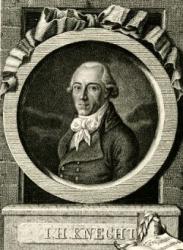
Justin Heinrich Knecht

1752 - 1817 Person Name: J. H. Knecht Composer of "DOMINE CLAMAVI" in Christian Hymns Justin Heinrich Knecht Germany 1752-1817. Born at Biberach Baden-Wurttemberg, Germany, he attended a Lutheran college in Esslingen am Neckar from 1768-1771. Having learned the organ, keyboard, violin and oratory, he became a Lutheran preceptor (professor of literature) and music director in Biberach. It was a free imperial city until 1803 and had a rich cultural life. He became organist of St. Martin’s Church in 1792, used by both Lutherans and Catholics, and was there for many years. He led an energetic, busy musical life, composing for both the theatre and church, organizing subscription concerts, teaching music theory, acoustics, aesthetics, composition, and instruments at the Gymnasium, affiliated to the Musikschule in 1806. He went to Stuttgart in 1806 in hopes of a post there as Kapellmeister, serving two years as Konzertmeister, but he was appointed Direktor Beim Orchester by the King of Wurttemberg in 1807. However, he returned to his former life in 1808 and remained there the rest of his life. He died at Biberach. He wrote 10 vocals, 11 opera and stage works, one symphony, 3 chamber music instrumentals, 7 organ works, 4 piano works, and 6 music theories. He was an author composer, editor, contributor, musician, compiler, and lyricist. John Perry

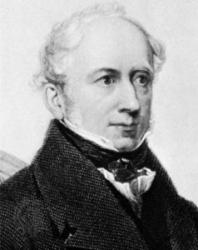
Isaac Williams

1802 - 1865 Author of "Jesus, Thy soul, for ever blest" in Church Book Isaac Williams was born in London, in 1802. His father was a barrister. The son studied at Trinity College, Oxford, where he gained the prize for Latin verse. He graduated B.A. 1826, M.A. 1831, and B.D. 1839. He was ordained Deacon in 1829, and Priest in 1831. His clerical appointments were Windrush (1829), S. Mary the Virgin's, Oxford (1832), and Bisley (1842-1845). He was Fellow of Trinity College, Oxford, from 1832 to 1842. During the last twenty years of his life his health was so poor as to permit but occasional ministerial services. He died in 1865. He was the author of some prose writings, amongst which are Nos. 80, 86 and 87 of the "Oxford Tracts." His commentaries are favourably known. He also published quite a large number of poems and hymns and translations. --Annotations of the Hymnal, Charles Hutchins, M.A., 1872 ========================== Williams, Isaac, B.D., was born at Cwmcynfelin in Cardiganshire, Dec. 12, 1802, where his mother happened to be staying at her father's house at the time of his birth. But his parents' house was in Bloomsbury, London, his father beiug a Chancery barrister at Lincoln's Inn. He received his early education from a clergyman named Polehampton, with whom he was at first a day pupil in London, but whom he afterwards accompanied to a curacy at Worplesdon, near Guildford. All Mr. Polehampton's pupils (15), with the exception of Isaac Williams and his two elder brothers, were being prepared for Eton, where great stress was laid upon Latin versification; and it was in these early years that Isaac Williams acquired his fondness for, and proficiency in, this species of composition. In 1814 he was removed to Harrow, where Mr. Drury was his private tutor. He gained several school prizes, and became so used, not only to write, but to think, in Latin, that when he had to write an English theme he was obliged to translate his ideas, which were in Latin, into English. In 1821 he proceeded to Trinity College, Oxford, that college being chosen on the advice of Mr. Drury; and in his second term he was elected scholar of Trinity. In 1823 he won the University Prize for Latin Verse, the subject being Ars Geologica. The gaining of this prize was indirectly the turning point of his life, for it brought him into close relationship with John Keble, who may be termed his spiritual father. He had been previously introduced to Mr. Keble by the Vicar of Aberystwith, Mr. Richards, whom he had met at his grandfather's house. But there was no intimacy between them until he had won the Latin Verse Prize, when Mr. Keble came to his rooms and offered to look over the poem with him before it was recited and printed. This led to an intimate acquaintance which ripened into a warm friendship of infinite benefit to Isaac Williams's spiritual life. Mr. Keble offered to take him with him into the country and read with him during the Long Vacation, without any payment. Robert Wilberforce, then an undergraduate of Oriel, was also to be of the party. They settled at Southrop, near Fahford, a name familiar to the readers of Keble Life. Here Isaac Williams made the acquaintance of Hurrell Froude, who was also reading with Mr. Keble, and this acquaintance also ripened into a friendship which was terminated only by death. Keble was like a boy with his pupils, entering with zest into all their amusements, but he also exercised a deep influence over their religious characters, especially that of Isaac Williams. Williams spent this and all his subsequent Long Vacations at Southrop, and became more and more influenced for good by Mr. Keble. He also became a great friend of Sir George Prevost, then an undergraduate of Oriel, who afterwards married his only sister. During one of these sojourns at Southrop, Keble showed Williams and Froude a manuscript copy of the Christian Year, but, strange to say, the young men did not appreciate its beauties. Williams's intimacy with Keble caused alarm to Mr. Hughes, the successor of the Vicar of Aberystwith who had first brought the two together; Mr. Hughes was greatly shocked to hear that he was a friend of Mr. Keble of Oriel, and said he would introduce him to a most excellent and promising person there, a Mr. Newman, whom the evangelical vicar knew in connexion with the Church Missionary Society, and who would, he doubtless thought, supply an antidote to Keble's High Church opinions. While Williams was an undergraduate at Oxford, though he was a member of Trinity College, he spent much of his time at Oriel, attracted thither, not only because it was Keble's college, but also because he had many friends there, the chief of whom were the Wilberforces, Ryder, Anderson (now Sir C. Anderson), Hurrell Froude, and Sir G. Prevost. As an accomplished scholar who had the benefit of Keble's tuition, it was naturally expected that he would take a high degree; and so, no doubt, he would have done, had he not attempted too much. In spite of the warnings of friends, he resolved to aim at a "double first," and, as mathematical studies were not to his taste, the labour over this uncongenial work in addition to the necessary preparation for the classical school was too severe for him; his health broke down, and he was obliged to be content with a pass degree. In 1829 he was ordained to the curacy of Windrush, about twelve miles from Fairford where Keble then lived, and about twenty from Bisley, where his brother-in-law, Sir George Prevost, who was now married, was curate. But he did not stay long at Windrush. Passman though he was, he competed successfully for a Trinity Fellowship, and had to return to Oxford the same year as college tutor. He lived on terms of great intimacy with Hurrell Froude, then Fellow of Oriel, and was introduced by him to J. H. Newman, to whom he was much attracted, like almost all who were brought into contact with that remarkable man. The attraction appears to have been mutual, and Williams became Newman's curate at S. Mary's, Oxford, which then included the village or rather hamlet of Littlemore. In 1842 he married Caroline, the third daughter of Arthur Champernown, of Dartington Hall, Devon, left Oxford, and went to Bisley as curate to Mr. T. Keble. So far as his outer life went, little more need be said. Nothing seems to have occurred to ruffle its placid course, except one episode which occurred in 1841-2. When John Keble resigned the Poetry Professorship at Oxford, he was naturally anxious that his friend Williams should be his successor. Not only was there a warm personal friendship and an entire sympathy of opinion on the most important of all matters between the two men, but on the score of poetical merit, Williams seemed to him obviously the proper person. He had already published several of his poetical works, and his reputation as a sacred poet was second only to that of Keble himself. But he was also identified in a peculiar way with the Tract writers. He had actually written that Tract which, next to the memorable Tract 90, had given the greatest offence of all, viz.: Tract 80, on Reserve in the Communication of Religious Knowledge, and he was also known as the especial friend and late coadjutor of Newman. It is not, therefore, surprising that vehement opposition was raised against his election. A rival candidate was found in the person of Mr. Edward Garbett, of Brasenose, a First Classman, but quite unknown in the domain of poetry. There was really no comparison whatever between the fitness of the two candidates, but that counted for little when men's minds were heated by the "odium theologicum." It became simply a party question; but a public contest was happily averted by a private comparison of votes, when it was found that there was a large majority of votes in favour of Mr. Garbett. Mr. Williams was much hurt—not by the opposition of the Low Churchmen, for he expected that,—but by the desertion of several whom he counted upon as friends. He withdrew from Oxford and from public life (which had never possessed much attraction to a man of his retiring and studious habits) altogether. He remained at Bisley until 1848, when he removed to Stinchcombe; and there he lived until his death. From time to time some cultured and thoughtful work from his pen was given to the world, but that was all; and when the announcement that he had quietly passed away on SS. Philip and James Day, May 1, 1865, appeared, the outer world had almost forgotten that he was still living, though it had not forgotten, and will not, it is hoped, while the English language lasts, ever forget his writings. He died of a decline, the seeds of which had long been sown. As a devotional writer both in prose and verse the name of Isaac Williams stands deservedly high, but as a writer of hymns for congregational use, he does not, either for quantity or quality, at all reach the first rank. Indeed, it would have been very distressing to him if he had done so, for he shared the distaste which most of the early leaders of the Oxford movement felt for the congregational use of any metrical hymns apart from the Psalter, and it is said that he purposely made his translations of the Hymns from the Parisian Breviary rough, in order to prevent them from being so used. His poetical works are:— (1.) The Cathedral, his first publication in verse, issued in the early part of 1838. It was written about the same time as the famous Tract on Reserve, and "in pursuance of the same great object we had undertaken " (in the Tracts for the Times). What that object was is intimated in the alternative title, The Cathedral, or the Catholic and Apostolic Church in England. It followed very much the same lines as George Herbert's Temple, only it worked out the ideas far more in detail, connecting each part of the edifice with some portion of church doctrine or discipline. The whole volume is written in the true spirit of poetry, and some of the sonnets in it are good specimens of that difficult form of composition; but it contains scarcely any verses out of which even centos of hymns can be formed. (2.) Later on in the same year (1838) he published a volume, entitled Thoughts in Past Years, though, as the title implies, many of its contents were written at an earlier date. In fact the composition ranged over a period of at least twelve years. In the writer's own opinion there was more true, poetry in this volume than in The Cathedral, but the latter had the advantage of being written on one systematic plan, while the Thoughts was a collection of detached poems. The connexion between the four divisions of the volume was, that they were all suggested by the writer's surroundings. Thus the “Golden Valley" was the beautiful district in the neighbourhood of Stroud known by that name; "The Mountain Home" was the writer's own birthplace, Cwmcynfelin in Cardiganshire; "The River's Bank" was the River Windrush, on the banks of which was the writer's first curacy; "The Sacred City" is Oxford. In a later edition (1852) there is an additional division entitled "The side of the Hill," that is, Stinchcombe Hill, Gloucestershire. Like The Cathedral, this is rather a volume of sonnets and sacred poems for private use, than of hymns in the popular sense of the term. The same volume contains his Beliquiae Latinae; or Harrow School Exercises, and his Oxford Prize Poem, Ars Geologica. The Latinity of these poems fully bears out the writer's own remark, that in his early years he was more at home in Latin than he was in his own language. It also contained a translation of the "Dies Irse, Dies Ilia," to which, in the revised and enlarged edition of 1848, were added, under the title of Lyra Ecclesiastica, a number of translations from other Latin and Greek Hymns. These translations are for the most part very free, and are not adapted, as they were certainly not intended, for congregational use. (3.) His next publication was Hymns translated from the Parisian Breviary, 1839. He thought that "the ancient Latin hymns were the best source from which our acknowledged deficiency in metrical psalmody should be supplied, as being much more congenial to the spirit of our own Liturgy than those hymns which are too often made to take part in our ancient services;" and he had already published many of the translations which appear in this volume, at intervals from 1833 to 1837, in the British Magazine, the church organ which was edited by Hugh James Rose. A few hymns from this volume, e.g. "0 Heavenly Jerusalem," "Disposer Supreme," "0 Word of God above," have been adopted for congregational use, but most of these are, perhaps purposely, done into such irregular metres, that they are not available for the purpose. Indirectly, however, they have been highly serviceable to the cause of congregational psalmody, for Mr. Chandler tells us in the Preface to his Hymns of the Primitive Church that Mr. Williams's translations in the British Magazine led him to produce that work. (4.) The next little volume, Hymns on the Catechism, was written at Bisley and published in 1842. Its object was strictly practical; it was intended as "an aid towards following out that catechetical instruction which is so essential a part of the church system." It cannot be said that these hymns are likely to be so attractive to children, as, for example, those of Mrs. Alexander, but they are suitable for congregational, or at any rate, for Sunday school use, and one of them, "Be Thou my Guardian and my Guide," has found its way deservedly into most collections. (5.) In the same year (1842) a much more ambitious work, The Baptistery, also saw the light. One seems to recognize in this work the pupil of John Keble, for its leading idea is very much the same as that of Tract , viz.: that earthly things are a shadow of heavenly. It is divided into thirty-two "Images," as the author terms them; it is not easy reading, but it well repays the careful attention which it requires, for both in form and matter it is the product of a true poet. One of the "Images," the 20th, "The Day of Days, or the Great Manifestation," has supplied our well-known hymn, "Lord, in this, Thy mercy's day," but the general tenour of the work is quite apart from hymnody. (6.) The same may be said of The Altar, published in 1847, which takes the second great Sacrament of the Gospel, as The Baptistery took the first, for the basis of a series of devout meditations, 34 in number. The first edition was illustrated by 34 pictures, one to each meditation, after the fashion of a foreign book which the writer had seen; but the illustrations were thought unworthy of the subject, and the later editions appeared without them. The object of the work was to connect the various events which occurred at the time of our Blessed Lord's Passion with the Eucharistic Service. It consists exclusively of a series of sonnets, and supplies no hymns for congregational use. (7.) In the same year (1849) appeared another work of a very different type. It is entitled The Christian Scholar, and its object is "to render the study of the classics subservient to a higher wisdom." It incidentally gives us an interesting insight into the author's own training under Mr. Keble, for he tells us in the Preface that he himself "derived, not merely moral benefit, but actual religious training from this indirect mode of instruction in another to whom he owes everything that renders life valuable." The plan of the book is, in a word, to take passages from all the chief classical authors, and to give Christian comments on each. (8.) His only other poetical work was Ancient Hymns for Children, 1842, which consisted of a reprint, with slight alterations, of 30 of his translations from the Latin, previously published in 1838 and 1839 as above. Although Isaac Williams's prose writings are as valuable, and perhaps more popular than his verse, yet from the point of view of this article it will suffice to enumerate the principal of them. They include— Several reviews for The British Critic at various dates; Thoughts on the Study of the Gospels, 1842; Sermons on the Characters of the Old Testament, 1856; The Beginning of the Book of Genesis, with Notes and Reflections, 1861; The Psalms interpreted of Christ, vol. i., 1864 (no other volumes were published); A Memoir of the Rev. R. A. Suckling, late Perpetual Curate of Bussage, 1852; A Harmony of the Four Gospels, 1850; Sermons on the Epistles and Gospels, 3 vols., 1853; Sermons on the Female Characters of Holy Scripture, 1859; The Apocalypse, 1851, and many other minor works. Besides these, he edited a large number of Plain Sermons at different dates by various writers, and he also wrote some of the Tracts for the Times, notably Tract 80 (1838), and 87 (1840), on Reserve in Communicating Religious Knowledge. It is difficult to see why these should have given so much offence. The principles on which the conclusion is based are obviously correct. Perhaps the title Reserve was alarming when men's minds were excited by the fear that they were being led by the new Oxford school they knew not whither. These two Tracts, with Tract 86, also by Isaac Williams, would fill an octavo volume of more than 200 pages. Both the character and the writings of Isaac Williams are singularly attractive. They both present a striking combination of qualities which are not often found in union. He was as firm as a rock in the maintenance and expression of his principles, but so quiet and retiring that his personality came far less before the public than that of any of the other leaders of the Oxford movement. His writings are so Christian and unaggressive in their tone that we are won over to his side almost without knowing it. He was a most valuable ally on this very account to his party, and the hymnologist may well regret that he did not devote his exquisite poetical taste, his refined culture, and his ardent piety more to hymnwriting than he did. [Rev. J. H. Overton, D.D.] Isaac Williams's position in hymnody does not lie so much in the actual work which he did, as in the influence he had over others. His translation from the Latin, mainly through the metres which he deliberately adopted, have not had a wide acceptance in the hymnody of the Church. J. Chandler, however, has left it on record that Williams's translations in the British Magazine led him to undertake kindred work, and Chandlers translations are amongst the most popular in the English language. Williams's Hymns on the Catechism, 1842, were with, Dr. Neale's Hymns for Children of the same year the forerunners of the more popular productions on the same lines by later writers. Of his original hymns the following are also in common use:- 1. How solemn, silent, and how still. Obedience (1842.) 2. Jesus, most loving Lord. Hymn to Christ (1844.) 3. Lord, Thou dost abhor the proud. Humility. 4. Members of Christ are we. Members of Christ. 5. The child leans on its parent's breast. Trust in God. (1842.) 6. The High Priest once a year. Ascension. (1842.) The dates here given indicate the works in which these hymns appeared. -- John Julian, Dictionary of Hymnology (1907)

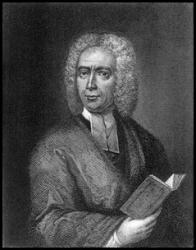
Isaac Watts

1674 - 1748 Author of "Why Do We Mourn Departing Friends" in The Lutheran Hymnal Isaac Watts was the son of a schoolmaster, and was born in Southampton, July 17, 1674. He is said to have shown remarkable precocity in childhood, beginning the study of Latin, in his fourth year, and writing respectable verses at the age of seven. At the age of sixteen, he went to London to study in the Academy of the Rev. Thomas Rowe, an Independent minister. In 1698, he became assistant minister of the Independent Church, Berry St., London. In 1702, he became pastor. In 1712, he accepted an invitation to visit Sir Thomas Abney, at his residence of Abney Park, and at Sir Thomas' pressing request, made it his home for the remainder of his life. It was a residence most favourable for his health, and for the prosecution of his literary labours. He did not retire from ministerial duties, but preached as often as his delicate health would permit. The number of Watts' publications is very large. His collected works, first published in 1720, embrace sermons, treatises, poems and hymns. His "Horae Lyricae" was published in December, 1705. His "Hymns" appeared in July, 1707. The first hymn he is said to have composed for religious worship, is "Behold the glories of the Lamb," written at the age of twenty. It is as a writer of psalms and hymns that he is everywhere known. Some of his hymns were written to be sung after his sermons, giving expression to the meaning of the text upon which he had preached. Montgomery calls Watts "the greatest name among hymn-writers," and the honour can hardly be disputed. His published hymns number more than eight hundred. Watts died November 25, 1748, and was buried at Bunhill Fields. A monumental statue was erected in Southampton, his native place, and there is also a monument to his memory in the South Choir of Westminster Abbey. "Happy," says the great contemporary champion of Anglican orthodoxy, "will be that reader whose mind is disposed, by his verses or his prose, to imitate him in all but his non-conformity, to copy his benevolence to men, and his reverence to God." ("Memorials of Westminster Abbey," p. 325.) --Annotations of the Hymnal, Charles Hutchins, M.A., 1872. ================================= Watts, Isaac, D.D. The father of Dr. Watts was a respected Nonconformist, and at the birth of the child, and during its infancy, twice suffered imprisonment for his religious convictions. In his later years he kept a flourishing boarding school at Southampton. Isaac, the eldest of his nine children, was born in that town July 17, 1674. His taste for verse showed itself in early childhood. He was taught Greek, Latin, and Hebrew by Mr. Pinhorn, rector of All Saints, and headmaster of the Grammar School, in Southampton. The splendid promise of the boy induced a physician of the town and other friends to offer him an education at one of the Universities for eventual ordination in the Church of England: but this he refused; and entered a Nonconformist Academy at Stoke Newington in 1690, under the care of Mr. Thomas Rowe, the pastor of the Independent congregation at Girdlers' Hall. Of this congregation he became a member in 1693. Leaving the Academy at the age of twenty, he spent two years at home; and it was then that the bulk of the Hymns and Spiritual Songs (published 1707-9) were written, and sung from manuscripts in the Southampton Chapel. The hymn "Behold the glories of the Lamb" is said to have been the first he composed, and written as an attempt to raise the standard of praise. In answer to requests, others succeeded. The hymn "There is a land of pure delight" is said to have been suggested by the view across Southampton Water. The next six years of Watts's life were again spent at Stoke Newington, in the post of tutor to the son of an eminent Puritan, Sir John Hartopp; and to the intense study of these years must be traced the accumulation of the theological and philosophical materials which he published subsequently, and also the life-long enfeeblement of his constitution. Watts preached his first sermon when he was twenty-four years old. In the next three years he preached frequently; and in 1702 was ordained pastor of the eminent Independent congregation in Mark Lane, over which Caryl and Dr. John Owen had presided, and which numbered Mrs. Bendish, Cromwell's granddaughter, Charles Fleetwood, Charles Desborough, Sir John Hartopp, Lady Haversham, and other distinguished Independents among its members. In this year he removed to the house of Mr. Hollis in the Minories. His health began to fail in the following year, and Mr. Samuel Price was appointed as his assistant in the ministry. In 1712 a fever shattered his constitution, and Mr. Price was then appointed co-pastor of the congregation which had in the meantime removed to a new chapel in Bury Street. It was at this period that he became the guest of Sir Thomas Abney, under whose roof, and after his death (1722) that of his widow, he remained for the rest of his suffering life; residing for the longer portion of these thirty-six years principally at the beautiful country seat of Theobalds in Herts, and for the last thirteen years at Stoke Newington. His degree of D.D. was bestowed on him in 1728, unsolicited, by the University of Edinburgh. His infirmities increased on him up to the peaceful close of his sufferings, Nov. 25, 1748. He was buried in the Puritan restingplace at Bunhill Fields, but a monument was erected to him in Westminster Abbey. His learning and piety, gentleness and largeness of heart have earned him the title of the Melanchthon of his day. Among his friends, churchmen like Bishop Gibson are ranked with Nonconformists such as Doddridge. His theological as well as philosophical fame was considerable. His Speculations on the Human Nature of the Logos, as a contribution to the great controversy on the Holy Trinity, brought on him a charge of Arian opinions. His work on The Improvement of the Mind, published in 1741, is eulogised by Johnson. His Logic was still a valued textbook at Oxford within living memory. The World to Come, published in 1745, was once a favourite devotional work, parts of it being translated into several languages. His Catechisms, Scripture History (1732), as well as The Divine and Moral Songs (1715), were the most popular text-books for religious education fifty years ago. The Hymns and Spiritual Songs were published in 1707-9, though written earlier. The Horae Lyricae, which contains hymns interspersed among the poems, appeared in 1706-9. Some hymns were also appended at the close of the several Sermons preached in London, published in 1721-24. The Psalms were published in 1719. The earliest life of Watts is that by his friend Dr. Gibbons. Johnson has included him in his Lives of the Poets; and Southey has echoed Johnson's warm eulogy. The most interesting modern life is Isaac Watts: his Life and Writings, by E. Paxton Hood. [Rev. H. Leigh Bennett, M.A.] A large mass of Dr. Watts's hymns and paraphrases of the Psalms have no personal history beyond the date of their publication. These we have grouped together here and shall preface the list with the books from which they are taken. (l) Horae Lyricae. Poems chiefly of the Lyric kind. In Three Books Sacred: i.To Devotion and Piety; ii. To Virtue, Honour, and Friendship; iii. To the Memory of the Dead. By I. Watts, 1706. Second edition, 1709. (2) Hymns and Spiritual Songs. In Three Books: i. Collected from the Scriptures; ii. Composed on Divine Subjects; iii. Prepared for the Lord's Supper. By I. Watts, 1707. This contained in Bk i. 78 hymns; Bk. ii. 110; Bk. iii. 22, and 12 doxologies. In the 2nd edition published in 1709, Bk. i. was increased to 150; Bk. ii. to 170; Bk. iii. to 25 and 15 doxologies. (3) Divine and Moral Songs for the Use of Children. By I. Watts, London, 1715. (4) The Psalms of David Imitated in the Language of the New Testament, And apply'd to the Christian State and Worship. By I. Watts. London: Printed by J. Clark, at the Bible and Crown in the Poultry, &c, 1719. (5) Sermons with hymns appended thereto, vol. i., 1721; ii., 1723; iii. 1727. In the 5th ed. of the Sermons the three volumes, in duodecimo, were reduced to two, in octavo. (6) Reliquiae Juveniles: Miscellaneous Thoughts in Prose and Verse, on Natural, Moral, and Divine Subjects; Written chiefly in Younger Years. By I. Watts, D.D., London, 1734. (7) Remnants of Time. London, 1736. 454 Hymns and Versions of the Psalms, in addition to the centos are all in common use at the present time. --Excerpts from John Julian, Dictionary of Hymnology (1907) ================================== Watts, I. , p. 1241, ii. Nearly 100 hymns, additional to those already annotated, are given in some minor hymn-books. --John Julian, Dictionary of Hymnology, Appendix, Part II (1907) ================= Watts, I. , p. 1236, i. At the time of the publication of this Dictionary in 1892, every copy of the 1707 edition of Watts's Hymns and Spiritual Songs was supposed to have perished, and all notes thereon were based upon references which were found in magazines and old collections of hymns and versions of the Psalms. Recently three copies have been recovered, and by a careful examination of one of these we have been able to give some of the results in the revision of pp. 1-1597, and the rest we now subjoin. i. Hymns in the 1709 ed. of Hymns and Spiritual Songs which previously appeared in the 1707 edition of the same book, but are not so noted in the 1st ed. of this Dictionary:— On pp. 1237, L-1239, ii., Nos. 18, 33, 42, 43, 47, 48, 60, 56, 58, 59, 63, 75, 82, 83, 84, 85, 93, 96, 99, 102, 104, 105, 113, 115, 116, 123, 124, 134, 137, 139, 146, 147, 148, 149, 162, 166, 174, 180, 181, 182, 188, 190, 192, 193, 194, 195, 197, 200, 202. ii. Versions of the Psalms in his Psalms of David, 1719, which previously appeared in his Hymns and Spiritual Songs, 1707:— On pp. 1239, U.-1241, i., Nos. 241, 288, 304, 313, 314, 317, 410, 441. iii. Additional not noted in the revision:— 1. My soul, how lovely is the place; p. 1240, ii. 332. This version of Ps. lxiv. first appeared in the 1707 edition of Hymns & Spiritual Songs, as "Ye saints, how lovely is the place." 2. Shine, mighty God, on Britain shine; p. 1055, ii. In the 1707 edition of Hymns & Spiritual Songs, Bk. i., No. 35, and again in his Psalms of David, 1719. 3. Sing to the Lord with [cheerful] joyful voice, p. 1059, ii. This version of Ps. c. is No. 43 in the Hymns & Spiritual Songs, 1707, Bk. i., from which it passed into the Ps. of David, 1719. A careful collation of the earliest editions of Watts's Horae Lyricae shows that Nos. 1, 7, 9, 10, 11, 12, 14, 16, p. 1237, i., are in the 1706 ed., and that the rest were added in 1709. Of the remaining hymns, Nos. 91 appeared in his Sermons, vol. ii., 1723, and No. 196 in Sermons, vol. i., 1721. No. 199 was added after Watts's death. It must be noted also that the original title of what is usually known as Divine and Moral Songs was Divine Songs only. --John Julian, Dictionary of Hymnology, New Supplement (1907) =========== See also in: Hymn Writers of the Church

James Montgomery

1771 - 1854 Person Name: J. Montgomery, 1771-1854 Author of "Lord, Teach Us How to Pray Aright" in Evangelical Lutheran Hymnary James Montgomery (b. Irvine, Ayrshire, Scotland, 1771; d. Sheffield, Yorkshire, England, 1854), the son of Moravian parents who died on a West Indies mission field while he was in boarding school, Montgomery inherited a strong religious bent, a passion for missions, and an independent mind. He was editor of the Sheffield Iris (1796-1827), a newspaper that sometimes espoused radical causes. Montgomery was imprisoned briefly when he printed a song that celebrated the fall of the Bastille and again when he described a riot in Sheffield that reflected unfavorably on a military commander. He also protested against slavery, the lot of boy chimney sweeps, and lotteries. Associated with Christians of various persuasions, Montgomery supported missions and the British Bible Society. He published eleven volumes of poetry, mainly his own, and at least four hundred hymns. Some critics judge his hymn texts to be equal in quality to those of Isaac Watts and Charles Wesley . Many were published in Thomas Cotterill's Selection of Psalms and Hymns (1819 edition) and in Montgomery's own Songs of Zion (1822), Christian Psalmist (1825), and Original Hymns (1853). Bert Polman ======================== Montgomery, James, son of John Montgomery, a Moravian minister, was born at Irvine, Ayrshire, Nov. 4, 1771. In 1776 he removed with his parents to the Moravian Settlement at Gracehill, near Ballymena, county of Antrim. Two years after he was sent to the Fulneck Seminary, Yorkshire. He left Fulneck in 1787, and entered a retail shop at Mirfield, near Wakefield. Soon tiring of that he entered upon a similar situation at Wath, near Rotherham, only to find it quite as unsuitable to his taste as the former. A journey to London, with the hope of finding a publisher for his youthful poems ended in failure; and in 1792 he was glad to leave Wath for Shefield to join Mr. Gales, an auctioneer, bookseller, and printer of the Sheffield Register newspaper, as his assistant. In 1794 Mr. Gales left England to avoid a political prosecution. Montgomery took the Sheffield Register in hand, changed its name to The Sheffield Iris, and continued to edit it for thirty-one years. During the next two years he was imprisoned twice, first for reprinting therein a song in commemoration of "The Fall of the Bastille," and the second for giving an account of a riot in Sheffield. The editing of his paper, the composition and publication of his poems and hynms, the delivery of lectures on poetry in Sheffield and at the Royal Institution, London, and the earnest advocacy of Foreign Missions and the Bible Society in many parts of the country, gave great variety but very little of stirring incident to his life. In 1833 he received a Royal pension of £200 a year. He died in his sleep, at the Mount, Sheffield, April 30, 1854, and was honoured with a public funeral. A statue was erected to his memory in the Sheffield General Cemetery, and a stained glass window in the Parish Church. A Wesleyan chapel and a public hall are also named in his honour. Montgomery's principal poetical works, including those which he edited, were:— (1) Prison Amusements, 1797; (2) The Wanderer of Switzerland, 1806; (3) The West Indies, 1807; (4) The World before the Flood, 1813; (5) Greenland and Other Poems, 1819; (6) Songs of Zion, 1822; (7) The Christian Psalmist, 1825; (8) The Christian Poet, 1825; (9) The Pelican Island, 1828; (10) The Poet’s Portfolio, 1835; (11) Original Hymns for Public, Private, and Social Devotion, 1853. He also published minor pieces at various times, and four editions of his Poetical Works, the first in 1828, the second in 1836, the third in 1841, and the fourth in 1854. Most of these works contained original hymns. He also contributed largely to Collyer's Collection, 1812, and other hymnbooks published during the next 40 years, amongst which the most noticeable was Cotterill's Selections of 1819, in which more than 50 of his compositions appeared. In his Christian Psalmist, 1825, there are 100 of his hymns, and in his Original Hymns, 1853, 355 and 5 doxologies. His Songs of Zion, 1822, number 56. Deducting those which are repeated in the Original Hymns, there remain about 400 original compositions. Of Montgomery's 400 hymns (including his versions of the Psalms) more than 100 are still in common use. With the aid of Montgomery's MSS. we have given a detailed account of a large number. The rest are as follows:— i. Appeared in Collyer's Collection, 1812. 1. Jesus, our best beloved Friend. Personal Dedication to Christ. 2. When on Sinai's top I see. Sinai, Tabor, and Calvary. ii. Appeared in Cotterill's Selection, 1819. 3. Come to Calvary's holy mountain. The Open Fountain. 4. God in the high and holy place. God in Nature. The cento in Com. Praise, 1879, and others, "If God hath made this world so fair," is from this hymn. 5. Hear me, O Lord, in my distress. Ps. cxliii. 6. Heaven is a place of rest from sin. Preparation for Heaven. 7. I cried unto the Lord most just. Ps. cxlii. 8. Lord, let my prayer like incense rise. Ps. cxxxix. 9. O bless the Lord, my soul! His grace to thee proclaim. Ps. ciii. 10. Out of the depths of woe. Ps. cxxx. Sometimes "When from the depths of woe." 11. The world in condemnation lay. Redemption. 12. Where are the dead? In heaven or hell? The Living and the Dead. iii. Appeared in his Songs of Zion, 1822. 13. Give glory to God in the highest. Ps. xxix. 14. Glad was my heart to hear. Ps. cxxii. 15. God be merciful to me. Ps. lxix. 16. God is my strong salvation. Ps. xxvii. 17. Hasten, Lord, to my release. Ps. lxx. 18. Have mercy on me, O my God. Ps. li. 19. Hearken, Lord, to my complaints. Ps. xlii. 20. Heralds of creation cry. Ps. cxlviii. 21. How beautiful the sight. Ps. cxxxiii. 22. How precious are Thy thoughts of peace. Ps. cxxxix. 23. I love the Lord, He lent an ear. Ps. cxvi. 24. In time of tribulation. Ps. lxxvii. 25. Jehovah is great, and great be His praise. Ps. xlviii. Sometimes, "0 great is Jehovah, and great is His Name." 26. Judge me, O Lord, in righteousness. Ps. xliii. 27. Lift up your heads, ye gates, and wide. Ps.xxiv. 28. Lord, let me know mine [my] end. Ps. xxxi. 29. Of old, 0 God, Thine own right hand. Ps. lxxx. 30. O God, Thou art [my] the God alone. Ps. lxiii. 31. 0 Lord, our King, how excellent. Ps. viii. Sometimes, "0 Lord, how excellent is Thy name." 32. O my soul, with all thy powers. Ps. ciii. 33. One thing with all my soul's desire. Ps. xxvii. From this, "Grant me within Thy courts a place." 34. Searcher of hearts, to Thee are known. Ps. cxxxix. 35. Thank and praise Jehovah's name. Ps. cvii. 36. Thee will I praise, O Lord in light. Ps. cxxxviii. 37. The Lord is King; upon His throne. Ps. xciii. 38. The Lord is my Shepherd, no want shall I know. Ps. xxiii. 39. The tempter to my soul hath said. Ps. iii. 40. Thrice happy he who shuns the way. Ps. i. 41. Thy glory, Lord, the heavens declare. Ps. xix. 42. Thy law is perfect, Lord of light. Ps. xix. 43. Who make the Lord of hosts their tower. Ps. cxxv. 44. Yea, I will extol Thee. Ps. xxx. iv. Appeared in his Christian Psalmist. 1825. 45. Fall down, ye nations, and adore. Universal adoration of God desired. 46. Food, raiment, dwelling, health, and friends. The Family Altar. 47. Go where a foot hath never trod. Moses in the desert. Previously in the Leeds Congregational Collection, 1822. 48. Green pastures and clear streams. The Good Shepherd and His Flock. 49. Less than the least of all. Mercies acknowledged. 50. Not to the mount that burned with fire [flame]. Communion of Saints. 51. On the first Christian Sabbath eve. Easter Sunday Evening. 52. One prayer I have: all prayers in one. Resignation. 53. Our heavenly Father hear. The Lord's Prayer. 54. Return, my soul, unto thy rest. Rest in God. 55. Spirit of power and might, behold. The Spirit's renewing desired. 56. The Christian warrior, see him stand. The Christian Soldier. Sometimes, "Behold the Christian warrior stand." 57. The days and years of time are fled. Day of Judgment. 58. The glorious universe around. Unity. 59. The pure and peaceful mind. A Children's Prayer. 60. This is the day the Lord hath made (q. v.). Sunday. 61. Thy word, Almighty Lord. Close of Service. 62. What secret hand at morning light ? Morning. 63. While through this changing world we roam. Heaven. 64. Within these walls be peace. For Sunday Schools. v. Appeared in his Original Hymns, 1853. 65. Behold yon bright array. Opening a Place of Worship. 66. Behold the book whose leaves display. Holy Scriptures. 67. Come ye that fear the Lord. Confirmation. 68. Home, kindred, friends, and country, these. Farewell to a Missionary. 69. Let me go, the day is breaking. Jacob wrestling. 70. Not in Jerusalem alone. Consecration of a Church. 71. Praise the high and holy One. God the Creator. In common with most poets and hymnwriters, Montgomery strongly objected to any correction or rearrangement of his compositions. At the same time he did not hesitate to alter, rearrange, and amend the productions of others. The altered texts which appeared in Cotterill's Selections, 1819, and which in numerous instances are still retained in some of the best hymnbooks, as the "Rock of Ages," in its well-known form of three stanzas, and others of equal importance, were made principally by him for Cotterill's use. We have this confession under his own hand. As a poet, Montgomery stands well to the front; and as a writer of hymns he ranks in popularity with Wesley, Watts, Doddridge, Newton, and Cowper. His best hymns were written in his earlier years. In his old age he wrote much that was unworthy of his reputation. His finest lyrics are "Angels from the realms of glory," "Go to dark Gethsemane," "Hail to the Lord's Anointed," and "Songs of praise the angels sang." His "Prayer is the soul's sincere desire," is an expanded definition of prayer of great beauty; and his "Forever with the Lord" is full of lyric fire and deep feeling. The secrets of his power as a writer of hymns were manifold. His poetic genius was of a high order, higher than most who stand with him in the front rank of Christian poets. His ear for rhythm was exceedingly accurate and refined. His knowledge of Holy Scripture was most extensive. His religious views were broad and charitable. His devotional spirit was of the holiest type. With the faith of a strong man he united the beauty and simplicity of a child. Richly poetic without exuberance, dogmatic without uncharitableness, tender without sentimentality, elaborate without diffusiveness, richly musical without apparent effort, he has bequeathed to the Church of Christ wealth which could onlv have come from a true genius and a sanctified! heart. --John Julian, Dictionary of Hymnology (1907)

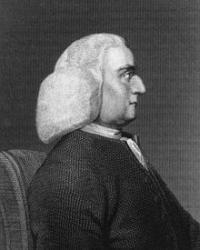
Nathaniel Cotton

1707 - 1788 Author of "Affliction is a stormy deep" in Church Book Cotton, Nathaniel, M.D., born in 1707, and educated for the medical profession at Leyden. Giving his attention more especially to brain diseases, he first assisted a physician, who devoted his attention to the insane, at Dunstable; and they erected a large Asylum at St. Albans. In 1763 the poet Cowper became one of his patients, and, on his recovery, conceived a warm attachment for his medical friend. Dr. Cotton died at St Albans, Aug. 2, 1788. Several of his hymns appeared from 1760 onwards in Dr. Dodd's Christian's Magazine, some signed "Dr. Cotton, St. Albans," some “N.," and some without signature. His poetical works were published posthumously:— Various Pieces in Verse and Prose, 2 vols., Lond., Dodsley, 1791; and Visions in Verse, &c, with Memoir, 1808. His hymns came into use through Collyer's Collection, 1812. They are:— 1. Amid the various scenes of ill. Affliction Sanctified. From Various Pieces, &c, 1791. 2. Tell me, my soul, O tell me why. Sin the cause of fear. From Various Pieces, &c, 1791. 3. This is the day the Lord of Life. Sunday. From Various Pieces, &c, 1791. 4. While sorrow wrings my bleeding heart. Suffering. From his version of Ps. xiii., "Offended Majesty, how long ?" in the Christian's Magazine, Feb. 1761. 5. With fierce desire the hunted hart. Ps. 42. Dr. Cotton's most widely known hymn is, “Affliction is a stormy deep," q. v. It is a port of No. 5. --John Julian, Dictionary of Hymnology (1907)

Export as CSV
It looks like you are using an ad-blocker. Ad revenue helps keep us running. Please consider white-listing Hymnary.org or getting Hymnary Pro to eliminate ads entirely and help support Hymnary.org.