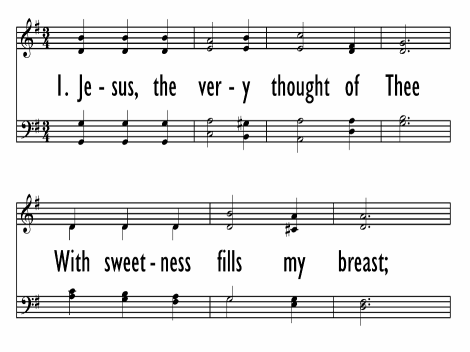
1 Jesus, the very thought of thee
with sweetness fills the breast;
but sweeter far thy face to see,
and in thy presence rest.
2 O hope of every contrite heart,
O joy of all the meek,
to those who fall, how kind thou art!
How good to those who seek!
3 But what to those who find? Ah, this
nor tongue nor pen can show;
the love of Jesus, what it is,
none but his loved ones know.
4 Jesus, our only joy be thou,
as thou our prize wilt be;
Jesus, be thou our glory now,
and through eternity.
United Methodist Hymnal, 1989
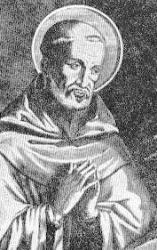
Bernard of Clairvaux, saint, abbot, and doctor, fills one of the most conspicuous positions in the history of the middle ages. His father, Tecelin, or Tesselin, a knight of great bravery, was the friend and vassal of the Duke of Burgundy. Bernard was born at his father's castle on the eminence of Les Fontaines, near Dijon, in Burgundy, in 1091. He was educated at Chatillon, where he was distinguished for his studious and meditative habits. The world, it would be thought, would have had overpowering attractions for a youth who, like Bernard, had all the advantages that high birth, great personal beauty, graceful manners, and irresistible influence could give, but, strengthened in the resolve by night visions of his mother (who had died in 1… Go to person page >
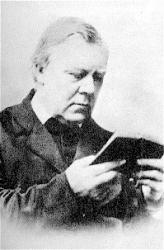
Edward Caswall was born in 1814, at Yately, in Hampshire, where his father was a clergyman. In 1832, he went to Brasenose College, Oxford, and in 1836, took a second-class in classics. His humorous work, "The Art of Pluck," was published in 1835; it is still selling at Oxford, having passed through many editions. In 1838, he was ordained Deacon, and in 1839, Priest. He became perpetural Curate of Stratford-sub-Castle in 1840. In 1841, he resigned his incumbency and visited Ireland. In 1847, he joined the Church of Rome. In 1850, he was admitted into the Congregation of the Oratory at Birmingham, where he has since remained. He has published several works in prose and poetry.
--Annotations of the Hymnal, Charles Hutchins, M.A. 1872… Go to person page >| First Line: | Jesus! the very thought of Thee |
| Title: | Jesus, the Very Thought of Thee |
| Latin Title: | Jesu dulcis memoria |
| Author (attributed to): | St. Bernard of Clairvaux |
| Translator: | Edward Caswall (1849) |
| Meter: | 8.6.8.6 |
| Source: | Latin, 12th century |
| Language: | English |
| Notes: | Spanish translation: See "En Ti, Jesús, dulce es pensar" by George Paul Simmonds |
| Copyright: | Public Domain |
| Liturgical Use: | Communion Songs |
Scripture References:
all st. = Eph. 3:19
The extended (forty-two stanzas) Latin poem 'Jesu, dulcis memo¬ria" is the source of this text (see discussion at PHH 307, which includes its traditional attribution to Bernard of Clairveaux). Although some scholars believe the poem was written by Bernard, others suggest that it originated in Britain at the end of the twelfth century. Most agree, however, that the poem's fervor was influenced by the famous Bernard. The English text is taken from a fifty-stanza translation by Edward Caswall (PHH 438) published in his Lyra Catholica (1849), where the opening line read “Jesu, the very thought of Thee.”
Displaying a passionate devotion to Christ, the text provides a clear hint of its original use as a text for personal devotion. Its focus is entirely on Christ and his saving love, a love that gives hope, joy, and rest to believers (st. 1,3), a love that excels any human love (st. 2, 4).
Liturgical Use:
Worship that focuses on Christ's redemptive work; Lord's Supper; Lent.
--Psalter Hymnal Handbook, 1987
The text of this hymn was penned by Bernard of Clairvaux, a saint, abbot, and doctor born in 1091. The lyrics were originally Latin (original title: “Jesu dulcis memoria), but were later translated by Edward Caswall in the mid 1800s. Although we usually see five four-line stanzas in hymnals today, the original Latin hymn had fifty. Caswall selected five stanzas (1-4 and 40) to be used as a vesper hymn for the Feast of the Most Holy Name of Jesus during the second Sunday after epiphany. The hymn has lasted for centuries and been published in over eight hundred hymnals, enjoying a timelessness not shared by many other hymns.
The tune most widely used with this hymn is ST. AGNES, written by John B. Dykes in 1866. It was originally written for Edward Caswall’s translation of “Jesus, the very thought of thee,” but has been used with many other hymns since then. The tune is named after a young Christian woman who was martyred in A.D. 304 for refusing to marry a nobleman. She said, "I am already engaged to Christ, to Him alone I keep my troth." The tune is simple and sweet, being a perfect match for the text.
This hymn would work in many normal services, but would perhaps works best in redemption, communion, or Lent themed services. It is best sung in two long lines and in harmony.
Suggested music for this hymn:
Luke Getz Hymnary.org
My Starred Hymns