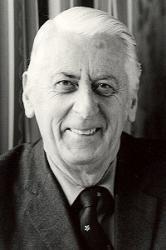
The name of the Rev. F. Pratt Green is one of the best-known of the contemporary school of hymnwriters in the British Isles. His name and writings appear in practically every new hymnal and "hymn supplement" wherever English is spoken and sung. And now they are appearing in American hymnals, poetry magazines, and anthologies.
Mr. Green was born in Liverpool, England, in 1903. Ordained in the British Methodist ministry, he has been pastor and district superintendent in Brighton and York, and now served in Norwich. There he continued to write new hymns "that fill the gap between the hymns of the first part of this century and the 'far-out' compositions that have crowded into some churches in the last decade or more."
--Seven New Hymns o… Go to person page >| First Line: | God is here! As we your people |
| Title: | God Is Here |
| Author: | Fred Pratt Green (1977) |
| Meter: | 8.7.8.7 D |
| Place of Origin: | England |
| Language: | English |
| Copyright: | © 1979, Hope Publishing Co. |
| Liturgical Uses: | Communion Songs, Opening Hymns |
Scripture References:
st. 1 = 1 Cor. 12:27-31
st. 2 = 2 Cor. 4:5
st. 3 = 2 Thess. 2:15
st. 4 = Titus 2:14
Fred Pratt Green (PHH 455) wrote this text early in 1978 in Norwich, England. Russell Schulz-Widmar had requested that Pratt Green write a hymn text to be sung at the closing service of an eight-month festival on worship, music, and the arts, held at the University United Methodist Church in Austin, Texas. In that service on April 30, 1978, the church dedicated its new chancel furniture (thus st. 2), and the people rededicated themselves to God. The text was first published in the British/Methodist supplementary volume Partners in Praise (1979).
"God Is Here" helps us celebrate what it means to be a church: to offer praise and prayer to God with "all our varied skills and arts" (st. 1), to preach the Word and participate in the sacraments (st. 2), to foster faith and service (st. 3), and to live lives ill "church and kingdom" that bring glory to our Lord (st. 4). This text presents a catalog of the central tasks of the church (see also 515) and emphasizes the relationship between Sunday worship and daily living.
Liturgical Use:
Regular Sunday worship; festivals, dedications, anniversaries of the church; worship conferences and missions.
--Psalter Hymnal Handbook, 1987
My Starred Hymns