1 O sacred head, sore wounded,
Defiled and put to scorn:
O kingly head, surrounded
With mocking crown of thorn;
What sorrow mars thy grandeur?
Can death thy bloom deflow'r?
O countenance whose splendor
The hosts of heav'n adore!
2 Thy beauty, long desired,
Hath vanished from our sight:
Thy pow'r is all expired,
And quenched the light of light.
Ah me! for whom thou diest,
Hide not so far thy grace:
Show me, O Love most highest,
The brightness of thy face.
3 In thy most bitter passion
My heart to share doth cry.
With thee for my salvation
Upon the cross to die.
Ah, keep my heart thus moved
To stand thy cross beneath,
To mourn thee, well-beloved,
Yet thank thee for thy death.
4 What language shall I borrow
To thank thee, dearest friend,
For this thy dying sorrow,
Thy pity without end?
Oh, make me thine forever!
And should I fainting be,
Lord, let me never, never
Outlive my love for thee.
5 My days are few, O fail not,
With thine immortal pow'r,
To hold me that I quail not
In death's most fearful hour:
That I may fight befriended,
And see in my last strife
To me thine arms extended
Upon the cross of life.
Source: Lead Me, Guide Me (2nd ed.) #297

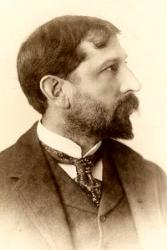
Robert S. Bridges (b. Walmer, Kent, England, 1844; d. Boar's Hill, Abingdon, Berkshire, England, 1930) In a modern listing of important poets Bridges' name is often omitted, but in his generation he was considered a great poet and fine scholar. He studied medicine and practiced as a physician until 1881, when he moved to the village of Yattendon. He had already written some poetry, but after 1881 his literary career became a full-time occupation, and in 1913 he was awarded the position of poet laureate in England. Bridges published The Yattendon Hymnal (1899), a collection of one hundred hymns (forty-four written or translated by him with settings mainly from the Genevan psalter, arranged for unaccompanied singing. In addition to volumes… Go to person page >
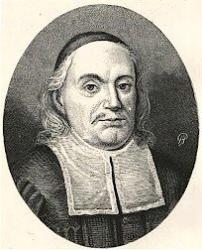
Paul Gerhardt (b. Gräfenheinichen, Saxony, Germany, 1607; d. Lubben, Germany, 1676), famous author of Lutheran evangelical hymns, studied theology and hymnody at the University of Wittenberg and then was a tutor in Berlin, where he became friends with Johann Crüger. He served the Lutheran parish of Mittenwalde near Berlin (1651-1657) and the great St. Nicholas' Church in Berlin (1657-1666). Friederich William, the Calvinist elector, had issued an edict that forbade the various Protestant groups to fight each other. Although Gerhardt did not want strife between the churches, he refused to comply with the edict because he thought it opposed the Lutheran "Formula of Concord," which condemned some Calvinist doctrines. Consequently, he was r… Go to person page >| First Line: | O sacred head sore wounded, Defiled and put to scorn |
| Title: | O Sacred Head, Sore Wounded |
| German Title: | O Haupt voll Blut und Wunden |
| Translator: | Robert Seymour Bridges |
| Author: | Paul Gerhardt |
| Meter: | 7.6.7.6 D |
| Language: | English |
| Notes: | Paul Gerhardt translated "Salve caput cruentaturn," the seventh section of the Latin poem "Salve mundi salutare," into German as "O Haupt voll Blut und Wunden." Robert Bridges translated the German text into "O sacred Head, sore wounded." Some hymnals include a fourth verse which was translated by James W. Alexander from the German text. |
| Copyright: | Public Domain |
My Starred Hymns