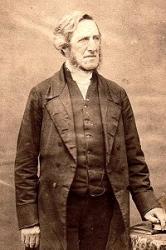
On the mountain's top appearing. T. Kelly [Missions.] This hymn appeared in his Collection of Psalms & Hymns, Dublin, 1802, No. 249, in 4 stanzas of 6 lines, and is based on Psalms lii. 7. It was subsequently repeated in the author's Hymns, &c, 1804, and later editions (edition 1853, p. 555). In Cotterill's 1815 Appendix to his Set of Psalms & Hymns, No. 203, stanzas i., iii., iv. were given in an altered form. This was repeated in the 8th edition of the Selection,1819, No. 162; in Montgomery's Christian Psalmist, 1825, No. 437, and again in later collections. Two texts, both beginning with the same opening stanza, have thus come into common use. They can be easily distinguished by the 3rd stanza of Kelly and the 2nd of Cotterill, which read:—
T. Kelly.
"God, thy God will now restore thee:
He Himself appears thy friend:
All thy foes shall flee before thee,
Here their boasts and triumphs end;
Great deliverance
Zion's King vouchsafes to send."
T. Cotterill.
"Lo! thy sun is risen in glory!
God Himself appears thy friend;
All thy foes shall flee before thee;
Here their boasted triumphs end:
Great deliverance
Zion's King vouchsafes to send.”
When these two forms of the hymn are taken into account, its use is found to be extensive. Cotterill's text has been rendered into Latin by B. Bingham in his Hymnologia Christiana Latina, 1871, as "Stat ecce! in altis montibus jam nuncius."
--John Julian, Dictionary of Hymnology (1907)


 My Starred Hymns
 My FlexScores
 My Hymnals
 My Purchased Files